Slashdot Mirror
Domain: landartgenerator.org
Stories and comments across the archive that link to landartgenerator.org.
Comments · 30
-
Re: 42K meters?
No, you could probably power half of Asia with 42km * 42km of good panels. OK actually that'd only supply about 1% of global energy requirements, but a lot more than Samsung need I'm sure.
-
All crops are grown with solar power
Solar won't do it, because it requires large amounts of land covered by panels, which implies wires, switching stations, repair roads, etc...
"Solar won't do it"? You do realize nearly ALL crops we currently consume are grown exclusively with solar power, right? Claiming that we can't grow our crops using solar power (directly or indirectly) is just an idiotic claim.
You could power the entire globe by covering an area roughly the size of Spain. Close to half of that could be supplied by "simply" (it's not simple) converting existing rooftops to solar. That is more than enough to power all agriculture around the globe. Even if we sacrificed non-arable land for solar panels we could easily generate enough solar energy to power enough indoor farms to supply the world.
The question is whether we can do so economically. There is no question solar can provide adequate energy to power every farm on the planet.
-
Re:Terminology and Bait-and-Switch
and not just the piddling wind farms which look nice but don't run much,
Meanwhile, back on planet earth there's more than enough wind to run the planet.
http://landartgenerator.org/bl...
Note the area required is smaller now because the technology has improved and there's still lots of potential for further improvements.
-
Re: Even if you think nuclear power doesnt kill pe
Uh, you're aware many newer solar panels are made of lead, in order to boost efficiency?
They are not "made out of lead" they contain lead as conductor at the points where the cables are connected. So why do you care? Are you scratching on the panels and licking your fingernails afterwards?they're not that efficient
They are efficient. The point is that you don't grasp what "efficiency" in the context of ordinary solar panels meansand most climates simply can't support them
Why? All energy a solar panel produces does not need to be produced by anything else. The antarctic stations run fine with wind and solar.Here, someone has linked this a few posts up the chain: http://landartgenerator.org/bl...
Does not hurt to link it again. You unfortunately are one of the NJW (just invented that
But thank you
-
Re:From the 'making a virtue of necessity' departm
Solar panels do not need rare earths, they can be made without them, same goes for wind turbines.
"the energy cost of creating solar panels isn't" [falling]: Flat out wrong, see: Whatâ(TM)s the EROI of Solar? | Ramez NaamThe term "rare earth" is an archaic one, dating back to the elementsâ(TM) discovery by a Swedish army lieutenant in 1787. In fact, most (though not all) of the 15 (or 16, or 17, depending on which scientist youâ(TM)re talking to) elements are fairly common; several of them are more abundant in the Earthâ(TM)s crust than lead or nitrogen.
Rare earths are sourced from China because they sell them cheap.
Declining solar panel performance is not an issue, good solar panels decline at less than 0.5% performance per year, that means they will still be going with 50% of their original efficiency 100 years from now.
Energy density is not a problem. See: Land Art Generator Initiative
A huge transition to solar panels will occur for one simple reason: price, solar+battery storage is expected to continue falling to as low as 2c per kWh of solar+battery. -
Re:What's with this headline?
Solar Thermal or PV? Sure, let's take advantage of it on structures and stuff. Using it on an industrial scale isn't quite practical, though, considering the massive areas required. Large scale thermal installations are also hazardous to birds. Doesn't work all the time, either.
Wind? Wind can be unpredictable, and it's supposedly a very big hazard for birds.Wind is not a big hazard to birds, 1000x bigger hazards are windows and cats.
Solar and wind don't need much space and the are needed keeps shrinking as the technologies improve.
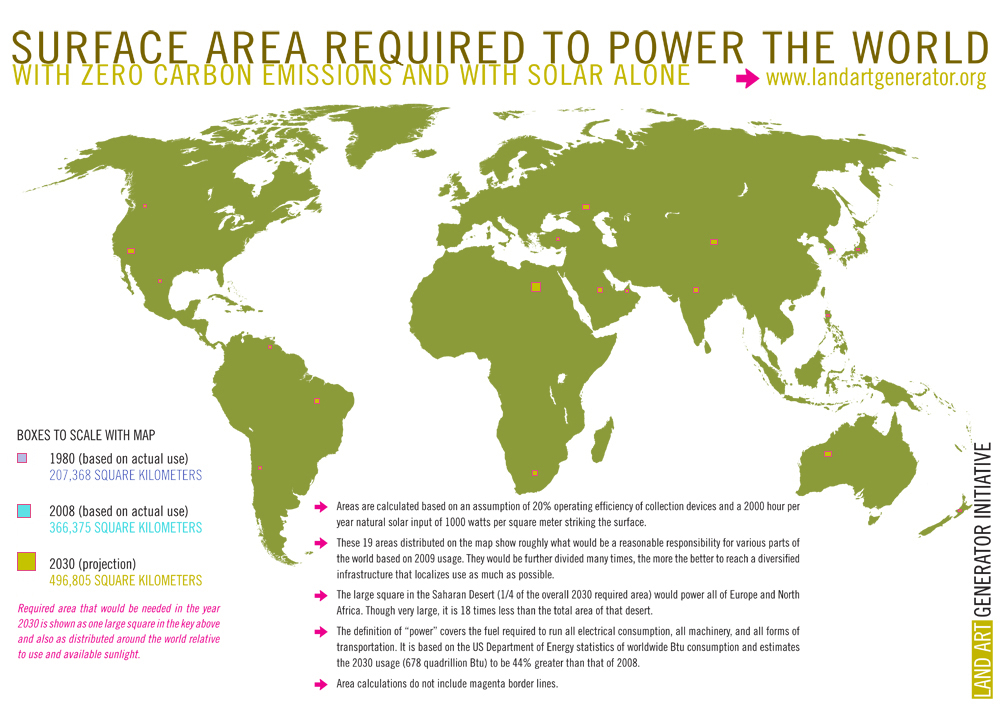
AreaRequired1000.jpg (JPEG Image, 1000ÂÃ--Â706 pixels)
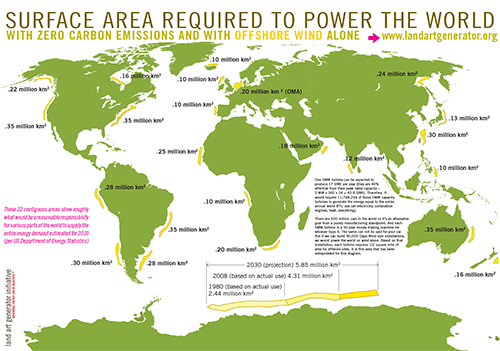
AreaRequiredWindOnly.jpg (JPEG Image, 1000ÂÃ--Â753 pixels) -
Re:What's with this headline?
Solar Thermal or PV? Sure, let's take advantage of it on structures and stuff. Using it on an industrial scale isn't quite practical, though, considering the massive areas required. Large scale thermal installations are also hazardous to birds. Doesn't work all the time, either.
Wind? Wind can be unpredictable, and it's supposedly a very big hazard for birds.Wind is not a big hazard to birds, 1000x bigger hazards are windows and cats.
Solar and wind don't need much space and the are needed keeps shrinking as the technologies improve.
AreaRequired1000.jpg (JPEG Image, 1000ÂÃ--Â706 pixels)
AreaRequiredWindOnly.jpg (JPEG Image, 1000ÂÃ--Â753 pixels) -
Re:With the best will in the world...
We don't have the storage technology available to achieve greater than around 20% grid penetration of wind/solar anywhere except for a small handful of places (namely Denmark, who is next to Norway, who have a HUGE hydro power reserve that they can throttle up/down in response to Denmark's supply/demand.)
Totally wrong.
AreaRequiredWindOnly.jpg (JPEG Image, 1000ÂÃ--Â753 pixels) -
Re:With the best will in the world...
Solar can supply the worlds energy needs several times over, including transport:
Total Surface Area Required to Fuel the World With SolarNote: continuing solar pv efficiency gains since 2009 mean that a far smaller area is actually required.
-
Re:No
"We can't. Without that much free energy it's not possible to sustain our current technology level. Renewables just aren't enough and never will."
Total nonsense, the sun can power our civilisation just by covering a small chunk of the Sahara or roofs worldwide.
http://www.greenpeace.org/inte...
This much area needed for solar to power the world:
http://landartgenerator.org/bl... -
Re:How about thermal solar
It's important also to consider development area required for solar deployments. A key advantage of rooftop solar (which I think means flat panels and water heating) is that the area is already developed.
You see those maps of the world with filled in areas representing the solar deployments necessary to power everything, but not often are those areas compared to that of (already developed) rooftops
-
Re:Baby with bathwater
The number you quote is enough to power all global energy requirements including replacing oil, gas and coal etc.
The images on this page show that solar can power the world perhaps 50+ times over
http://mic.com/articles/91313/...And wind can also power the world exclusively:
http://landartgenerator.org/bl... -
Re:Three square miles of pristine desert? Bad huma
I'm not sure this type of land use could really scale.
Oh, it will scale. (But to see the beauty of solar, one must assume that power storage and long distance power transfer will get more efficient over time.) An area the size of Spain of solar plants will power the entire world in vastly overestimating power needs for the year 2030. That's 496,000 km2. Seems like a lot until you consider the Sahara desert is 9,400,000 km2.
Initially, the cost for solar power seems high compared to nuclear. But over time, say 100 years, considering the cost of operation of solar is vastly cheaper than nuclear, and the cost of indefinite nuclear waste storage and the ridiculous costs of decommissioning plants... solar power, even with today's technology, absolutely crushes nuclear power.
-
Re:Thats a shitload of money
electricity generation is going to use some land
FWIW, to power the entire United States today with solar power, it would take about 92 Sq. miles of solar plants. To power the entire world with solar power by what is estimated the world will need in 2030, it would take a bit less than about 180,000 Sq. miles, i.e. an area smaller than the size of Spain. Seems like a lot, but looking at the graphic linked, looks like we have plenty of space for it... and its better to spread it out anyway.
We really need to get new ideas for more efficiently transferring energy long distances, and battery/energy storage tech advancing faster. And some ideas on how to, on a massive scale, scrub the CO2 currently in the atmosphere back into a safer state somewhere... and maybe humans will still be a living species in a hundred years.
-
Re:It takes 20+ years to build a nuclear plant
-
solar panels needed to power the world
see here - http://www.landartgenerator.org/blagi/wp-content/uploads/2009/08/AreaRequired1000.jpg
the link is to a map that shows how many sq kilometers in solar panels are needed to power the entire world. -
Surface area required for solar powering the world
Solar currently requires a good bit of acreage before you even begin to reap enough energy to power a single, 1 story building.
You might be interested in this infographic.
http://www.landartgenerator.org/blagi/archives/127
As it turns out, the world is remarkably large.
-
Re:pre-RTFA Reactions
If you could collect the entire incident energy of the sun over that area (say by being in orbit) you may be right, one or two thousand square miles doesn't sound unreasonable. But most of that energy is absorbed or reflected by the atmosphere before it hits ground level and of that only a small percentage of the remainder will be collected by any current or near future collector.
Based on that, current energy consumption (of about 20 Terawatts) needs closer to quarter of a million square miles of solar panels as has been calculated here.
The area actually needed is huge, but it is possible for current power and some future growth. You will notice, however, that the prediction on that page doesn't go even one human lifetime into the future, let alone the time periods that "renewables" are supposed to last.
If you want really long term there are two choices; fission and fusion. Fission of U-238 can be done now and known reserves are estimated to last of the order of 4 billion years, which is longer than the Earth will remain habitable without serious air conditioning. Before then they'll have to have solved the fusion problems else everyone gets a really good suntan.
-
Re:Ruling out nuclear entirely may not be wise
Nice try, and an impressive bit of calculation, but a few issues:
* The energy used beyond electricity is mostly process heat or home heating, and so the 50% conversion losses you implicitly assumed in your scale up don't necessarily apply, so by your worst case figures we are back to 3% (I said about 1%).
* Energy efficiency can reduce the demand for power, and in fact US electric power use is predicted to decline in the near future for reasons including energy efficiency. For example, the current state of the art in home design requires no furnace because of good insulation and layout (google on houses without furnaces).
* PV uses less land than solar thermal towers you cited, and can easily be put on roofs and possibly roads, and can store power in electric vehicles and other places, so your worst case choice (all solar thermal and that one particular sprawling plant) is not reasonable.
* You don't have to size the system for the worst month, because there are other complementary systems like wind, hydro, and even synthetic biofuels or hydrogen that could be produced and stored to cover that 10% extra demand in winter months, and also some energy intensive processes could be run seasonally (like grinding rock to make fertilizer or running some smelters). Also, we could have somewhat more energy capture in the south and send the power up north via electric power lines or fuel pipelines or energy embodies in products like steel or liquid nitrogen. So, your overall base calculations are probably off by a factor of two to four based on those sorts of factors about sizing for the worst part of the year since you are assuming no buffering capacity (which goes with your attempt to argue there is no good energy storage for renewables).Put these all together, and we are much closer to the 1% figure I suggested (maybe even lower), which could even potentially be handled to a large extent by solar roadways (and right of ways) and rooftops so that nobody even noticed that much. So, this picture is probably accurate:
http://www.landartgenerator.org/blagi/archives/127But even if it was 3% or so to split the difference, so what? 50% of US land goes to raising animals that are, essentially, killing us early (google on "rave diet movie"). So, we should get upset that 6% of current agricultural land (which looks like a moonscape much of the year anyway) is solar thermal collectors instead of soybeans intended for factory farms?
That said, if we have a responsible system of governance in the USA, stuff like thorium power, which requires a higher level of oversight than renewables, might be appealing. One reason I tend to support renewables over nuclear stuff is issues about dysfunctional politics and dysfunctional corporate oversight, as renewables in general require less centralized control requiring high levels of trust. Of course, if we had abundant cheap energy, then our politicians might have an easier time of things, too, as a chicken and egg problem? No doubt we will get thorium power eventually for whatever reasons as it is a neat concept -- it's what we should have had instead of TMI, Chernobyl, and Fukushima.
-
Re:Nuke power
Wind is not cheap, nor is solar.
Try this and this older one to see how prices progress.
As to the subsidies - nuclear is still subsidized and was even more when it was entering the energy market, so why shouldn't renewables have the same chance?
wind of course only works if there is wind, and there isnt enough of either to meet the power needs of the world
-
Re:The "I Told You So" Thread?
Pave over ALL the desert? Really, if you don't know, don't act like you do. Or just google it, like I did:
http://www.landartgenerator.org/blagi/archives/127
Whoopsie, there goes your argument against solar.
-
Re:So it's a solar cell....
On agriculture using about 50% of the land in the USA (mostly to grow fodder to grow too much factory-farmed animal products that are killing us with health problems especially when combined with too much sugar and refined grains):
http://www.westernwatersheds.org/watmess/watmess_2002/2002html_summer/article6.htm
http://www.ravediet.com/preview.htmlNote also how much land already goes to roads and mining. But agriculture is the biggest user.
Here are pictures of the area needed for off-shore wind and solar:
http://www.landartgenerator.org/blagi/wp-content/uploads/2009/08/AreaRequiredWindOnly.jpg
http://www.landartgenerator.org/blagi/wp-content/uploads/2009/08/AreaRequired1000.jpg -
Re:So it's a solar cell....
On agriculture using about 50% of the land in the USA (mostly to grow fodder to grow too much factory-farmed animal products that are killing us with health problems especially when combined with too much sugar and refined grains):
http://www.westernwatersheds.org/watmess/watmess_2002/2002html_summer/article6.htm
http://www.ravediet.com/preview.htmlNote also how much land already goes to roads and mining. But agriculture is the biggest user.
Here are pictures of the area needed for off-shore wind and solar:
http://www.landartgenerator.org/blagi/wp-content/uploads/2009/08/AreaRequiredWindOnly.jpg
http://www.landartgenerator.org/blagi/wp-content/uploads/2009/08/AreaRequired1000.jpg -
Re:Global Warming, Food Shortages, Energy Crisis,
What makes you say that?
http://i.imgur.com/uKWJd.png
One has to imagine that the amount of energy they're calculating represents the total amount of sunlight hitting the earth's surface. There are myriad of reasons why we'll never be able to collect that much (trees need sunlight too).
A better chart would be this one which demonstrates land area needed for solar power to power current usage.
There are reasons why that isn't practical either (energy grid interoperability for one, resistance and loss at distance, etc), but it's a more honest assessment.
-
Re:Citation needed for skepticism about renewables
Current renewables like well-sited wind and solar PV have energy payback ranging from around three to six months for wind:
http://www.wind-works.org/articles/EnergyBalanceofWindTurbines.html
http://www.treehugger.com/files/2008/01/wind_turbine_lca.phpSolar estimates seem to range around one to four years:
http://www.pvresources.com/en/economics.php
http://www.nrel.gov/docs/fy99osti/24619.pdf
http://en.wikipedia.org/wiki/Energy_payback_time#SustainablesThat last one is citing 2 to 4 years for PV, but it is out of date for thin film solar (if it was accurate back then).
Basically, the power to put in more renewables can come from other renewables in a bootstrapping way. Still, I'd agree that in practice a lot of the energy to make a lot of wind and PV systems quickly is coming from fossil fuels and nuclear. In many way, older nuclear power plants represent embodied fossil fuels used in their construction to pour concrete and mine fuel, too.
These pictures shows how little land or ocean surface is required to power the world entirely from wind or solar:
http://www.landartgenerator.org/blagi/wp-content/uploads/2009/08/AreaRequiredWindOnly.jpg
http://www.landartgenerator.org/blagi/wp-content/uploads/2009/08/AreaRequired1000.jpgSomething like 1% of the USA's surface area is already devoted to things like power line rights of ways, or areas around fossil fuel mining, or roadways, etc..
Something like about 50% of the land in the USA is devoted to animal product production (meat, dairy, etc.) one way or another (mostly growing fodder for animals), and the animal products are actually mostly harming US Americans, so there is plenty of room for renewables from that angle, too:
http://www.westernwatersheds.org/watmess/watmess_2002/2002html_summer/article6.htm
http://www.ravediet.com/preview.htmlAlso, a lot of land can be dual use, like farming under windmills, or PV used on roofs.
So, the amount of land being talked about to be fully renewable is not disproportionate to other activities like the US interstate highway system or especially agriculture.
I'm not saying nuclear does not have interesting applications following the Hyperion approach or similar designs like the Toshiba S4. But to flat out say renewables are not going to work is just not accurate.
-
Re:Citation needed for skepticism about renewables
Current renewables like well-sited wind and solar PV have energy payback ranging from around three to six months for wind:
http://www.wind-works.org/articles/EnergyBalanceofWindTurbines.html
http://www.treehugger.com/files/2008/01/wind_turbine_lca.phpSolar estimates seem to range around one to four years:
http://www.pvresources.com/en/economics.php
http://www.nrel.gov/docs/fy99osti/24619.pdf
http://en.wikipedia.org/wiki/Energy_payback_time#SustainablesThat last one is citing 2 to 4 years for PV, but it is out of date for thin film solar (if it was accurate back then).
Basically, the power to put in more renewables can come from other renewables in a bootstrapping way. Still, I'd agree that in practice a lot of the energy to make a lot of wind and PV systems quickly is coming from fossil fuels and nuclear. In many way, older nuclear power plants represent embodied fossil fuels used in their construction to pour concrete and mine fuel, too.
These pictures shows how little land or ocean surface is required to power the world entirely from wind or solar:
http://www.landartgenerator.org/blagi/wp-content/uploads/2009/08/AreaRequiredWindOnly.jpg
http://www.landartgenerator.org/blagi/wp-content/uploads/2009/08/AreaRequired1000.jpgSomething like 1% of the USA's surface area is already devoted to things like power line rights of ways, or areas around fossil fuel mining, or roadways, etc..
Something like about 50% of the land in the USA is devoted to animal product production (meat, dairy, etc.) one way or another (mostly growing fodder for animals), and the animal products are actually mostly harming US Americans, so there is plenty of room for renewables from that angle, too:
http://www.westernwatersheds.org/watmess/watmess_2002/2002html_summer/article6.htm
http://www.ravediet.com/preview.htmlAlso, a lot of land can be dual use, like farming under windmills, or PV used on roofs.
So, the amount of land being talked about to be fully renewable is not disproportionate to other activities like the US interstate highway system or especially agriculture.
I'm not saying nuclear does not have interesting applications following the Hyperion approach or similar designs like the Toshiba S4. But to flat out say renewables are not going to work is just not accurate.
-
Citation needed for skepticism about renewables
"Again, I'm all for more nuke plants. It's cleaner' than coal, and going heavily into solar + wind is a pipe dream."
Citation needed on solar and wind?
Counterpoints:
http://en.wikipedia.org/wiki/Grid_parity
http://www.earth-policy.org/index.php?/press_room/C68/2010_datarelease9
http://www.scientificamerican.com/article.cfm?id=a-solar-grand-plan
http://en.wikipedia.org/wiki/Brittle_Power
http://www.google.com/#q=no+furnace
http://www.nanosolar.com/company/blog/beck-energy-and-nanosolar-complete-solar-power-plant
http://www.chesapeakeclimate.org/blog/?p=1037
http://www.landartgenerator.org/blagi/archives/127At current levels of exponential growth, renewable energy will supply all our power in twenty years. Why should this exponetial growth stop before then? Short of something way better?
So, citation needed for your point.
However, sure, small modern nukes may be safer, but how risky will the centralized reprocessing plants be in an earthquake?
-
Excellent idea thanks to the Professor
Professor Koinuma is on the right track here. The Sun, being the most abundant source of renewable energy, is obviously the most efficient resource to power the world.
We could power the world using only a fraction of the Earth's surface area.
I really hope that this project succeeds, even if it is done on a smaller scale. -
Re:And nothing could possibly go wrong...
As for the topic at hand, like fusion reactors the main problem will be getting MORE energy than you consume.
Way to go captain obvious.
Perhaps a smarter move would be to figure out how to harness the star we already have
Thanks for the laugh. Even with 100% efficient orbital solar stations we would need a few million km^2 of panels just to match current energy usage. That number seemed large to me so I did a little digging and found this image that details electricity consumption alone. Switching to 100% solar and building a grid capable of redistributing that power from where it is generated to where it is used (nevermind orbital based power stations) would be a megaproject to dwarf every other construction project in history combined.
-
Re:Why ground based solar makes more sense
Do you have any facts to back up your guesses here?
And do you have any idea how much land has already been devoted to things like roads and related right-of-ways (hint, enough in the USA to produce all the power we need).
From here:
http://www.landartgenerator.org/blagi/wp-content/uploads/2009/08/AreaRequired1000.jpg
"Surface area required to power the world with zero carbon emissons and with solar panels alone.It looks about right to me.
I'd be curious to see such a map of land currently devoted to fossil fuel extraction and consumption in power plants. I'd expect it would be roughly the same in overall area, maybe larger. The same for land use devoted to road use. Or land use devoted to cities.
Note that as they say on that picture; "The 19 contiguous areas show what would be a reasonable responsibility for various parts of the world. They would be further divide many times..."
So, that picture is to give you a sense of scale, but people might put panels on rooftops or over parking lots in order to have more local energy security or lower energy transmission costs. So, we might never have big sites like those, but if we did, those look like good places to put them.
I found interesting the note on the front page of that Land Art Generator site: "Art has the ability to create movements and stimulate creative dialogue. The artist community has long taken a critical approach to the problems of energy use and production, which has helped to open the public eye to the severity of the problems facing us. The time is now for artists to go further and take an active role in solving the problem through their own work."
So, all part of "Blessed Unrest" that peer production takes part in:
http://www.blessedunrest.com/Anyway, I don't know why people keep trotting out that "density" issue.
By the way, if you like nuclear power, take a look at this:
http://www.hyperionpowergeneration.com/