Slashdot Mirror
Domain: lemis.com
Stories and comments across the archive that link to lemis.com.
Comments · 66
-
Re:Yup
-
Re:FSF disagrees with ParensI don't quite understand, is it possible you could elaborate on this a little more?
There are two BSD licenses. The original BSD license had a clause that said that if you mentioned features of the software in ads, you had to mention that the code came from UCB. The current BSD license does not have this clause.
The FSF says that the original BSD license is not compatible with the GPL, because of this clause. Here is where FSF says this.
The license that Caldera used when they released some of the code Parens is talking about is very similar to the original BSD license. Here is that license.
If the FSF is correct about the advertising clause making such a license incompatible with the GPL, then it means that Linux does have a problem. When you mix code under the GPL and code that is under an incompatible license, you have to get special permission from the copyright owners of the GPL'ed code. You can't just take GPL'ed code and use it in such a mixed environment.
-
Re:REQ: Someone post the LWN traceWhy SCO won't show the code
At SCO's annual reseller show, the company's executives put up a couple of slides as a way of demonstrating how Unix code had been "stolen" and put into Linux. The two slides were photographed and have since appeared on Heise Online; see them here and here. The escape of these slides has allowed the Linux community to do something it has been craving since the beginning of the SCO case: track down the real origins of the code that SCO claims as its own. The results, in this case, came quick and clear. They do not bode well for SCO.
The code in question is found in arch/ia64/sn/io/ate_utils.c in the 2.4 tree. It carries an SGI copyright. It seems that SGI was not entirely forthcoming in documenting the source of its source; some of the code in question was, indisputably, not written at SGI. So where does it really come from?
This code is from sys/sys/malloc.c in V7 Unix. It has been widely published; among other things, it can be found in Lion's Commentary on Unix (if you can get a copy). It featured in this 1984 Usenet posting. And, crucially, it has been circulated with the V7 Unix source, which was released by Caldera (now the SCO Group) under the BSD license. SCO would like the world to forget about that release now, but the Wayback Machine remembers.
So...SCO's code demonstration, the one that it put up to convince its resellers of its case, comes from a version of Unix which first came out in 1979. The code was publicly circulated in the 1980's, and explicitly released under the BSD license by [the company now known as] SCO at the beginning of 2002. SCO might well have a complaint that SGI did not properly give credit for the code it used. But there is no possible way the company can argue that this code's presence in Linux is an infringement of its copyrights.
And this, of course, is why SCO refuses to show the code that, it claims, is copied. These claims do not stand up to even a few hours' scrutiny on the net. SCO may yet have an interesting contract dispute with IBM, but, from what we have seen so far, its claims of direct copying of code are hollow.
(Many thanks to those who commented on an earlier LWN posting on this subject - those comments are the source for just about everything that appears in this article. Many thanks are due to LWN's readers; you have shown the best of what the community can do. Update: see also: this analysis of SCO's code by Bruce Perens.)
______
While I'm here, I have my own comments, that I really don't think that that chunk is copyrightable... It's far too direct an implementation of a simple algorithm to make it past copyright rules.
-
Re:Location in Sys 7
Nevermind. Looks like Caldera superceded the SCO license with what amounts to a BSD license:
http://www.lemis.com/grog/UNIX/ -
Re:SCO goes after Sequent Code
I talked with a former SCO employee (15 years - high rank) He told me they were well aware of the mixing of code. And that they (this is the previous regime) made the business decision to allow this.
Not only did they know, but they made a pretty big deal about it. "We're opening the traditional Unix Code!", they trumpeted, "We're going to use it to improve Linux!" That was the whole point of Caldera buying up SCO in the forst place.
Link, link, link, and the Slashdot article, which has the same links.
-
Has been done in Germany and Poland
Click
here for info on Polish legal actions
And SCO might even be found in contempt of the german court. Click here for info on the german court actions.
If the court finds against SCO they can be fined a 250000 euros for each infraction.
-
Re:Clean-up
The old System V code is part of Antique Linux, the source to which has been made available under a free license. I think it was a Caldera license.
Sorry, you lose.Actually, caldera placed under a "BSD-style" license some 16 bit UNIX versions (for the PDP-11 CPU), as well as 32V; but system III, system V, and successors, were explicitly excluded.
You can see the announcement here (email from Jan 2002). From there you can get the license letter in PDF, Caldera logo and all.
But anyway, this is probably irrelevant. I already read some people here quoting SCO on that their beef is with "Linux 2.4 and later". Pray tell, what code from ancient UNIX could have been added to the kernel during the 2.3 cycle? It just does not make sense.
-
Re:OpenBSDI don't inherently know anything about *BSD except that it is Unix-like.
That's why it's a google question.
This (somewhat out-of-date) paper may answer some of your questions.
-
Re:UFS2, XFS, JFS, Vinum, FreeBSD, JunOS, everythiRichard Stallman mentioned in a comment that including GPL code with the source of the FreeBSD kernel was no problem, and that the GPL only covered the compiled kernel if it contains the GPL code.
This basically means that you cannot distribute the FreeBSD kernel with both GPL and proprietary code, but there is no problem distributing it if you leave the GPL part out of the compile. See Greg Lehey's Diary, namely the Tuesday, 18 December 2001 entry.
-
Free BSD (not) Dying
For Gods sake, why would someone choose BSD over linux????
First, let me congratulate you for your enthusiastic use of the ? key. Second, if you'd actually used FreeBSD/OpenBSD in any real capacity, you'd realize that the structure and design of BSD makes it attractive for many people who try it.
First, remember that there is no magic bullet. There are always tradeoffs with anything. Linux has definate strong points (new hardware support usually hits linux first; there are more developers for linux). FreeBSD has fewer developers, and doesn't support the newest hardware as quickly - but the (FreeBSD) network stack is extremely solid, and the system design is very clean.
So, you have to evaluate your goals in these kinds of situations. Are you out to get the newest hardware and features, or are you looking for a clean design and good performance.
There is a reason many sites (like Yahoo, imdb, cr.yp.to) use Open/FreeBSD to run their servers.
If that's not one of your priorities, but you're still curious: I'd still take a look at FreeBSD; the overall design is quite pleasant to work with.
Also, many of the exploits produced are usually done on Linux, at least initially. This could buy you a little extra lead-time when something malicious is released. It's not security by obscurity, but it is a fringe benefit.
As always, if you're truly curious as to which OS would suit you best, you should put a little effort into it, and do some research yourself. I'm not saying you shouldn't use Linux, and I'm not saying you should use FreeBSD. FreeBSD is not for everyone. Linux is not for everyone. Do the research, decide for yourself, and next time - when you feel the urge to ask "why use *BSD?" -- you'll be able to at least discuss what you do or don't like about either. Otherwise, you end up contributing nothing to the discussion. -
Re:FreeBSD in Texas
Kinda like Linda Branagan, eh?
-
Depends on the bookOf the books on my shelf in front of me right now, most did not come with CDs, and of the ones that did I actually have used all of them: The Complete FreeBSD, Unix Power Tools and The Perl CD Bookshelf. In two cases, I bought the book specifically for the media, and for the Power Tools book it was just loaded with sorta-but-not-critically useful stuff scattered all over the internet in one useful bundle. Of the books not right on my desk shelf, the portion with CDs is somewhat higher, but of those other books I've barely used the CDs that came with them.
Why? Well, what use is a four year old copy of Python when I can download a current version just as easily? I'd have been happier if that one was a couple bucks cheaper, just as I was happy about the blurbs on the back of Philip & Alex's Guide to Web Publishing and Mac OS9 Missing Manual saying that avoiding the cd keeps costs down while allowing you to get more up to date software. As a paying customer, I appreciate that sort of consideration for my needs and my wallet. So to me, it's kind of a tradeoff among several factors. In no particular order:
- Having the media for a large set of software like FreeBSD is good, because it can avoid a huge download and I can live with a complete but outdated version of things, for a while anyway.
- Having the media for the CD bookshelf is good because it gives you the text -- in this case, of several books -- in searchable digital format.
- Providing the media for smaller, rapidly evolving material like a programming language or major application is less appealing when downloading is a viable alternative.
- Providing a central website is a great way to keep updated while saving some of the publishing costs, but the risk there is that you could lose ready access to the material if the site disappears or moves (like for example the FreeBSD book, though of course that's available elsewhere too; that isn't always the case of course).
- Obviously, the shelf life of a lot of CD-ROMs is limited, and people aren't going to be happy about paying for something out of date. Even if the material happens to be current, if it can be downloaded for free then there's little benefit in having the disc.
- On the other hand, sites obviously aren't eternal but discs come close enough for most purposes (even if their contents don't hold up as well), and download size is a factor to consider.
- Copyright is another angle that your publisher will probably want to have some control over, and no one likes having to go through arcane, tedious hoops to download some tools [I'm looking at you, Apple -- your Developer's site is a royal pain in the ass...], and no one wants to be the victim of an abandoned product
- If you're going to include a CD then you might as well fill up all 600mb or so of available space: if there's room for it and you're not afraid of copyright infrigement, include the text of the book, otherwise throw in a Linux distribution, tools like Perl & Apache [for Unix, Windows, and Mac], pad it out with DeCSS code, etc. In short, make it worth the customer's extra cash. (Slight counterargument: you probably don't want to take on support liability for anything you include, so don't forget whatever legalese would be appropriate there.)
Deciding what way to go is a matter of looking at factors like these & others, and evaluating what you're trying to provide for your customer and what their expectations are likely to be over time. If the digital material is just a supplement to the book, and can be easily downloaded, then most customers will probably appreciate it if you save them a few bucks & don't include the CD. On the other hand, if the book is really a supplement to the discs, and the digital material is difficult or impossible to download (for bandwidth, copyright, or other reasons) then including the CD media is a good idea. Find out where things seem to balance and make your decision from there.
-
Re:The Smart move would be...IBM is already funding a port of FreeBSD to the RS/6000 platform.
Greg Lehey, a FreeBSD core team member, is working for IBM doing the port. See here [http://www.lemis.com/grog/] for details. Look under "What I'm doing" for more info.
-
SMPng Link
My impression is that FreeBSD is going to greatly improve their SMP support with finer grained locking and supporting reentrancy in the kernel. I would very much like to read about it and see if they did any cool stuff like processor affinity scheduling, etc... However the link provided , appears to point to a directory containing files with interesting names, but the files are not downloadable (perhaps a file permissions problem).
-
Re:Matrix and rendering farmsFor everything bad said about Mr. Stallman, at least he has respect for others.
Come on. Let's keep the Linux-BSD competition a friendly sportive one, it should not been carried out at the personal level.
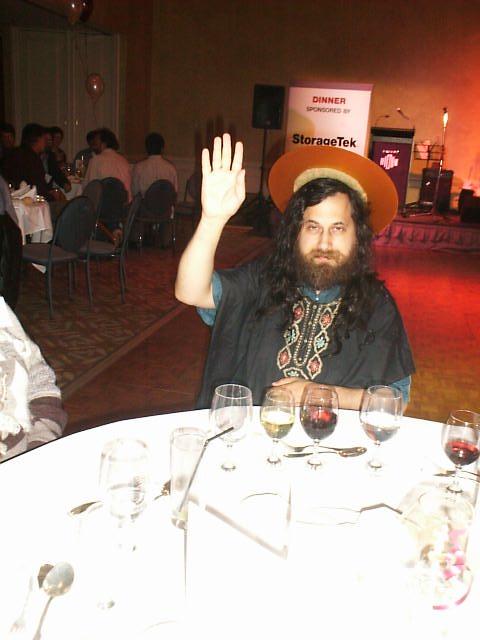
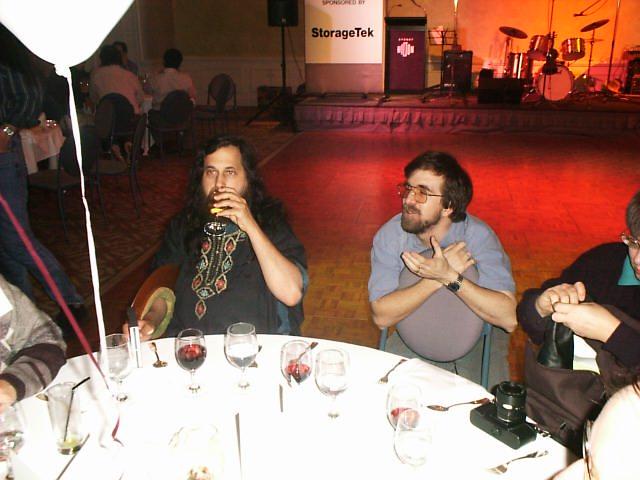
Anyways thanks for that RMS story. By the way, he does not crumble to dust if brought in contact with BSD, as this link from an Australian Unix user group meeting proofs.
Here is the caption:
Peter Wemm trying to convince Stallman to adopt the Berkeley Licensing conditions. You'll notice (but not recognize) that Stallman is holding a FreeBSD CD-ROM set in his right hand. It obviously doesn't taste as good as the Australian wine in his left hand. -
Re:Matrix and rendering farmsFor everything bad said about Mr. Stallman, at least he has respect for others.
Come on. Let's keep the Linux-BSD competition a friendly sportive one, it should not been carried out at the personal level.
Anyways thanks for that RMS story. By the way, he does not crumble to dust if brought in contact with BSD, as this link from an Australian Unix user group meeting proofs.
Here is the caption:
Peter Wemm trying to convince Stallman to adopt the Berkeley Licensing conditions. You'll notice (but not recognize) that Stallman is holding a FreeBSD CD-ROM set in his right hand. It obviously doesn't taste as good as the Australian wine in his left hand.