Slashdot Mirror
Domain: maushammer.com
Stories and comments across the archive that link to maushammer.com.
Comments · 63
-
Some little hacks
The most recent actual "hack" I've been involved with is the single-use (Dakota) camera. So far, the 25-picture disposable camera has been made to also support time-lapse computer-controlled photography, continuous video (i.e. Webcam) modes, and been able to store (in my brief, informal test) 58 pictures.
The rest of these might not be considered hacks per se, just projects.
A project that never got finished would have put a high-power subwoofer amplifier in my car, complete with an authentic '60s fluorescing vacuum tube as a level display. Much classier than the usual LED-bargraph arrangements popular with the kiddies these days. Unfortunately, in the middle of building this I got offered a job and moved 'cross-country, but didn't have room to pack the unfinished bits+pieces and all my electrical test equipment in my little 2-door.
In my college years, I had the position of running an underground student newspaper. An issue was released 'every few weeks' when its dedicated editors were free/bored enough to put one together, but one thing everyone thought would be nice would be to commandeer the University (dorm) cable system after-hours for a student-run movie and wierd footage channel. Starting at about midnight or so, this would replace a lame "information channel" text marquee (which was always several weeks out of date and advertising events whose deadlines had come and gone), that was currently occupying a perfectly good cable channel.
We had obtained keys to the main hub room (also the cable feed room), so inserting the signal was not a problem. The student TV footage was intended to begin late at night, when university officials were guaranteed not to be watching, and would be pre-recorded. This presented a minor problem, however: everyone on the 'staff' had early classes and poor memories, and could not be counted on to get into the hub closet after hours to insert the day's programming and press 'play'. Also, while some students (volunteering for the Computer center) did legitimately have access to these areas, students going in and out of there after hours would arouse unnecessary suspicion from campus security.
It was decided that the best solution was to equip the VCR with a 'remote control' of sorts that would allow it to be controlled over the dorm network via the abundant Ethernet connections available in the room. This would allow for automated starting and stopping as well as manual intervention as necessary; footage could then be loaded during the daytime hours at the convenience of those involved.
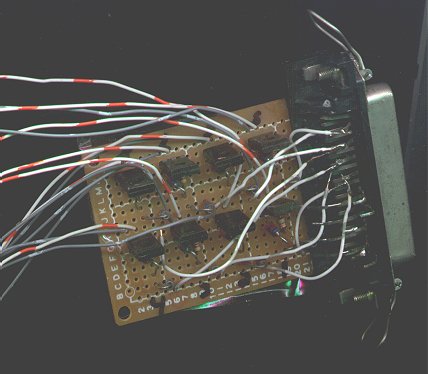
Making a VCR Internet-ready is not has hard as it sounds. I simply built a board with eight simple Darlington transistor circuits (corresponding to 8 data pins on a parallel port) to drive the important VCR function buttons via this port. A simple Web server (disposable '386) running a perl-based CGI interface allowed Web-based control of the parallel port bits, which in turn operated the disposable VCR with wires soldered into the appropriate front-panel switches.
The tricky part then became finding controversial/interesting/non-stupid, but legal, student-produced content worth displaying, but that's another story. -
not nearly that easy
The Dakota Disposable Digital uses the FAT12 file system internally (just like all smart-media products), but this isn't really noticible though its interface to the outside world. The only externally visibile part is the directory entry, of which they don't use all the fields. The FAT table & directories (it does use 2 directories internally) is totally hidden from the interface.
-
not nearly that easy
The Dakota Disposable Digital uses the FAT12 file system internally (just like all smart-media products), but this isn't really noticible though its interface to the outside world. The only externally visibile part is the directory entry, of which they don't use all the fields. The FAT table & directories (it does use 2 directories internally) is totally hidden from the interface.
-
not nearly that easy
The Dakota Disposable Digital uses the FAT12 file system internally (just like all smart-media products), but this isn't really noticible though its interface to the outside world. The only externally visibile part is the directory entry, of which they don't use all the fields. The FAT table & directories (it does use 2 directories internally) is totally hidden from the interface.
-
Re:Even less impressive
The pictures at terrainhost seem to be the worst. Cexx's camera looks much better and my camera is in the middle, quality-wise. Seems like poor quality control rather than poor design.
-
Re:DMCA won't hold up on this
I guess you haven't heard of the Lexmark vs. SCC case -- it' precisely what you said. One of the many sad points in the judge's order upholding the preliminary injunction is that the DMCA only exempted software -- that since the replacement toner cartridge microcontrollers that SCC sold were hardware, they weren't exempt. Argh. The eff has an excellent rebuttal on their page, and brings in a lot of copyright law precedent that the judge didn't bother to research.
-
Re:RTFA - No Encryption, no DMCA
Actually, there is no encryption, but there is an "effective access control measure" in the form of a secret hash. It doesn't matter that it is lame (you don't need to use it to get at your pictures), it's still an attempt. In fact, the workarounds that are just standard usb commands were easier to find than this hash function.
-
Re:RTFA - No Encryption, no DMCA
Actually, there is no encryption, but there is an "effective access control measure" in the form of a secret hash. It doesn't matter that it is lame (you don't need to use it to get at your pictures), it's still an attempt. In fact, the workarounds that are just standard usb commands were easier to find than this hash function.
-
For people who don't read articles
Actually, some of these points are not in the articles, and (not surprisingly) seem to be causing some confusion based on some of the comments I have seen above.
1) The cameras are purchased, just like any ordinary (non-digital) disposable camera. There is no rental agreement, nothing to sign, no deposit, etc. Some previous comments have asked about this. Also, the camera IS cheap; the hardware itself costs probably no more than $25-50 to manufacture, and likely pay for themselves in 1 or 2 processings. The big draw is that you can use them in potentially hazardous environments, and if it gets destroyed or stolen, this only sets you back $11 + a few minutes to solder a new connector into a new camera.
2) The batteries are changeable by the user - they are ordinary AA alkalines. They will last much longer than 1 25-picture cycle (I haven't yet managed to exhaust a set), but when they do run down, just open the battery cover and pop in fresh ones.
3) The sensor is actually 1.3 megapixels, not 2MP as claimed on the package.
4) The picture quality is mediocre - but not nearly as bad as these samples would have you believe (I don't know what happened to that guy's cam). Try the samples here and here (middle of page) for other samples. The biggest problem seems to be motion blurs from not holding the camera steady enough (the "shutter speed" is pretty slow). The other problem is that the lens is adjusted to be in-focus at some specific point probably between 4-12 feet from the camera. In practice, your subject will usually not be exactly at the in-focus distance. While you've got the camera open to solder in a little USB socket (or whatever), you can rotate the lens to adjust it for other distances, up to within an inch of the lens.
5) Concerns that this hack will be singlehandedly responsible for driving the cameras off the market, driving Ritz out of business, etc., seem largely unfounded. They will probably go off the market anyway - last time I was in Wolf Camera, the sales associates were actually warning people away from these cameras, saying that they would get slightly better image quality from the film disposables (for less $$, and 27 vs. 25 pictures - it's a no-brainer, come to think of it...) -
Italy has adopted an equivalent law
On march 28th, italy implemented the EU copyright directive, which is modeled after the DMCA, but with fewer exemptions. All 15 EU members were supposed to adopt this by last december, but only a handful of countries have done it yet. The UK just became the sixth to adopt.
How did I get so interested in the DMCA? I recently interfaced the Ritz disposable digital camera to my computer, and didn't like how the DMCA has been used to stifle competition.
Text of the EUCD (eu copyright directive) -
Italy has adopted an equivalent law
On march 28th, italy implemented the EU copyright directive, which is modeled after the DMCA, but with fewer exemptions. All 15 EU members were supposed to adopt this by last december, but only a handful of countries have done it yet. The UK just became the sixth to adopt.
How did I get so interested in the DMCA? I recently interfaced the Ritz disposable digital camera to my computer, and didn't like how the DMCA has been used to stifle competition.
Text of the EUCD (eu copyright directive) -
Integration
The holster is a bit hokey... would it kill apple/vw to design the ipod so that it can go inside a slot fairly deep such that only the lcd screen is showing? I'm thinking on top of the dash, kinda like a toaster. If necessary, the ipod should be able to rotate the image on its screen accordingly (for upside-down or sideways installations).
I wonder if the car can control the ipod - i.e. fast forward, rewind, etc. The older-style remote protocol is documented here so that you can build an interface to anything you want. It includes nice pictures & working source code! -
Video is done!!
Thanks everyone...
Here's the video (2.8 MB). It should take about 10 more minutes to ftp up. There is no soundtrack, so I'll give the narration here:
The satellite is called GEMstar and was designed to provide SMS-like messaging all over the world. It was built circa 1994-5 and was lost when the rocket blew up. That didn't stop me from producing the video of what it would have looked like!
The video shows a couple of stages that occur when the satellite is released from the rocket. First, it initially tumbles. Then the solar panels deploy (like everything else, they had to be squeezed in to fit in the nosecone of the rocket). The attitude control system (ACS) turns on and stabalizes the spin of the satellite so that it faces towards the earth. This is done with momentum wheels (heavy wheels inside the satellite) and torq coils (coils that act against the earth's magnetic field). Next, the main helicial antenna is deployed, and it's ready for service!
A few notes on the parts of the satellite. The blue panels are solar cells. The gold ring at the bottom is the seperation ring that attaches the whole thing to the rocket. The 4 white squares on top are GPS antennas connected to a special receiver that can measure the phase difference between the antennas and therefore figure out (not only x,y,z and time) its pitch, roll, and yaw. The X-shaped thing on the top of the satellite is a gravity gradient boom. Deployment of this probably should have been in the video, but oh well. It pops out maybe 10 feet and, due to some simple physics I don't understand, will help orient the satellite so that it faces the earth. (In reality, the satellite isn't staying still, it has to constantly re-aim to keep pointing at the earth). On the side panel, the little circle is a window for the earth sensor. There is another one on the other side, and they help orient the satellite.
Antennas- The 4 blade antennas are for command & control. These form a broad pattern and are useful to talk to the satelite when the main antennas aren't pointed correctly (like when there is a problem). Being a broader pattern, they require more power.
The boom antenna has two elements - a larger 150 Mhz antenna to receive transmissions from ground users (who transmit on less licensed taxicab-like frequencies), and a smaller ~400 MHz transmit antenna at the tip. This antenna was the hardest part of the animation because there were no 'spiral' primitives in POVray. I ended up writing a little program in C to generate a bunch of triangle strips, and then used 4 copies of this (at 90, 180, and 270 degrees). The deployment is totally bogus - I just scaled the structure, when in reality the width of the strips don't change.
True story: our competitor at the time was Orbital with their series of ORBcomm satellites. They used a similar antenna structure, but theirs folded up sideways, like a staw that has been rolled up. Our antenna was made of metal, plastic, and fiberglass - theirs was made of copper tape, kapton (a space-rated scotch tape), and bamboo. I never thought that anyone would fly a wooden satellite!