Slashdot Mirror
Domain: metroactive.com
Stories and comments across the archive that link to metroactive.com.
Comments · 65
-
Re:SCIENTOLOGY IS CANCER
-
TrustE: Anarcho-Capitalists in Action
The TrustE program is rooted in the ideology of anarcho-Capitalism, the idea that a free society can come about through the abolition of all government, and the aggressive privatization of everything, including courts and militaries. (Less aggressive Libertarians are generally minarchist, and believe that it's probably best to let government have the courts and the military, in order to best protect property.)
The anarcho-capitalist argument usually goes something like that: Government intervention is not only bad for business (and thus, you and me), but it's also immoral. But people do not need government to be safe; They can rely on the market for protection. It is beneficial to the market to protect you, since there is obviously a demand for protection.
There are many problems with these notions, but anarcho-Capitalists, generally intelligent people have an affinity for axiomatic theories (in this cased, based in the notion of contracts).
How does the theory fail? It's not too difficult to find out, if you aren't an anarcho-capitalist yourself. All you need to do is look at a failing of the market to protect people, and trace it to its source.
For example, Yahoo just recently changed their privacy policy, for the worst. Let's accept as fact that the majority of people don't like this, since its hit Slashdot and most people are bitter about it. How did Yahoo do that? According to the New York Times article, they have played on the exact lettering of their contract. Yahoo pledged that it would not email its users, but did they say they would not telephone? No, they never said they would not do that.
How has anarcho-capitalism failed here? Anarcho-capitalists would have said that we are kept safe by the competition of privacy policies. There would have been, say, 5 yahoo's, all slightly different, and one would have had a better privacy policy. I don't know how the anarcho-capitalist would respond to the complaint that we want to use services, not read contracts and theorize about them all day (for example, "They say they won't contact me by email, but they might call me by telephone! I better inform Yahoo that their contract needs work before I'm willing to sign it..!").
Note Esther Dyson's complaint, supporting this notion:
On that note, Dyson doesn't think the blame lies solely at the feet of Truste or its clients.
"I've also been disappointed in consumers," she said, "in that they've not been proactive in protecting their own data. You do a survey and consumers say they are very concerned about their privacy. Then you offer them a discount on a book and they'll tell you everything." (Wired story, page 2)
In other words, it's our fault, because we don't think about contracts in full. The problem is that contracts do not accurately reflect what we want. We are irrational beings, which chops at the root of anarcho-capitalist thinking. But rather than ammend their philosophy to take into account consumer behavior (which companies are eager to take advantage of; Look at any college textbook on the subject), they insist that consumer behavior is wrong, and that absolute contract-based theory is right.
Going back to Anarcho-capitalists believing in a competition of privacy policies: Unfortunately, there are not 5 yahoo's. (If there are, we don't know about it.) Why is that? That's probably very complicated to answer, but my guess is that it has to do with branding. And when you have advertising/branding strategies in place to get people to use your business, there is almost always room for only 1, 2, maybe 3 companies in people's heads. But very rarely do I ever see the role of advertising and people's ability to recall brands appearing in anarcho-capitalist literature. In anarcho-capitalist literature, we are all perfectly rational beings who have all the time in the world to investigate every contract and extrapolate it's meaning in purely legalistic terms.
Web surfers, [Esther Dyson's] reasoning went, would read the various companies' policies themselves and make their own choices, letting companies use privacy policies as a competitive differentiator. Truste's seal would simply ensure that the policy was being followed, so that "between two sites I've never heard of, I'd rather pick the one that has the Truste logo," she explained.
--Wired (Notice the implicit necessity for competition, and the assumed assumption of TrustE actually working.)
But we're not even at the main story here, which is about TrustE. TrustE is born almost completely out of anarcho-capitalist theory. Indeed, when I worked at a dot-com (now failed), the owner of the company (and big-time Madrona investor) told us how excited he was to participate in TrustE, which was going to show to the world how anarcho-capitalist protections work for everybody. What is the program?
TrustE fills the role in the anarcho-capitalist dream of a market response to the demand for safety. It works like this: Companies pay TrustE in order to have a seal that proves that they are going to play nice. TrustE in turn watches over the company, and makes sure that they are doing right by what they said they would do. The moment the company tries to do anything wrong, TrustE slaps them by removing their brand from the Company.
Systems like these are proposed by anarcho-capitalists in order to remove the entire government. For example: The justice system. There would be a number of competing courts, and the ones with a good reputation and contract would be utilized by people to try their cases. The military and police forces- if one wasn't nice to people, we'll all just hire another to protect us. To be fair, Libertarians don't go quite as far as the anarcho-Capitalists in this respect, the Libertarians just want to have no government/military regulation except of military force. (I find it likely though, that the government would act in the interest of the corporate interests, and not in the public interests; It is said that "Property is 9/10's of the Law". Undoubtably, people crushed by non-violent anarcho-capitalist market rule would want to / need to violate some property laws, and thus have the weight of the establishment upon them, in full military force.)
How do these systems fail? In precisely the ways that critics say that they will fail. Obviously TrustE wants people's money, so it is already biased to certify companies. I suspect that more importantly, it wants to be seen as actually meaning something (lest everyone stop using them), and thus it doesn't want to de-list its most famous clients. Should Yahoo be delisted, Amazon might feel like delisting. Should the big names fall, everyone would fall.
Anarcho-Capitalists need to learn this method. It's not based in axiomatic derivation, which is clean, but rather, in analysis of real world situations. Anarcho-capitalists extrapolate all kinds of things from their initial set of perfectly rational contract-analyzing citizens. Unfortunately, when we look at real world systems, we find that anarcho-capitalist theory has no value.
Anarcho-Capitalists need to think about this very carefully, and act accordingly. Again, in brief, the method is this: Take a limited set of clear ideas. Extrapolate from them. Then check those ideas against reality around you. How do the ideas fail? Is it reasonable to expect that the failing will reoccur, or is this just a fluke? If they will reoccur, revise the ideas to match reality.
In closing, some choice quotes:
L IKE MANY Internet activists, Dyson is an unapologetic libertarian. For her, the true importance of the Internet is its potential to empower individuals against the forces of government. The dispersed nature of the World Wide Web enables individuals (and businesses) to avoid physical jurisdiction, and the ability of users to communicate freely can foster a kind of free-market democracy that leans on the side of citizens, not legislators.
(Esther Dyson, we can at least vote against the government. How will we protect ourselves from companies..? Dollar votes have proven not to work, the companies research our behaviors too well. You have seen yourself that it does not work. Shall we just be screwed; Are we getting our just deserts for being human?)
Another interesting quote is on the TrustE web page:
. The core of this initiative was the TRUSTe Privacy Seal, a visual symbol that could be displayed by Web sites that met the program?s requirements for data gathering and dissemination practices, and agreed to participate in its dispute resolution process. TRUSTe?s goal was to establish a seal that would send a clear signal to consumers that they could expect companies to adhere to certain requirements about the way Web sites handled data, and that an independent, third-party would hear and respond to their complaints and resolve their disputes.
It's interesting to study where the words come from. Unfortunately, I won't take the time to back up this claim, but "...independent, third-party would hear and respond to their complaints and resolve their disputes." comes straight out of the anarcho-capitalist literature on how to run a justice system by third-party companies, without a government..!
Well, young John Gaults of the world, TrustE has failed. This is a great opportunity for you to come forward with your own competing TrustE systems that will have better morals, and certify to the world the successes of your anarcho-capitalist philosophy.
-
Possibly offtopic, but interesting
Check out this story on Sonic Blue. Like TiVo, but with more aggressive anti-commercial features and the ability to send copies of recorded shows to friends. Includes a brief mention of the bill formerly known as SSSCA.
I'd buy one if I had money and/or a job. sigh. -
Haven't you heard?
-
Re:Mac support dropped? Why?Because Sun cares zip for the Mac. When Sun did anything decent for the Mac, such as their Tcl implementation, their horrendous JDK 1.0 implementation, or their abortive efforts at re-porting StarOffice, it was either because it was historical, or because it was a checklist-item soon to ba abandoned.
Considering how they're working to oppose Microsoft in platform (Java) and office suite (StarOffice/OpenOffice) dominance, it's just crazy that they don't support the only other currently viable desktop platform. They can't expect everyone to use Solaris, after having put next to no work into improving its usability (CDE? GNOME? uh, no, certainly not in their current state.).
Sun just fired Lee Ann Rucker, who worked for Sun at Apple on the OS X Java implementation, in particular the Aqua Look & Feel for Swing, and was doing an incredible job. Check out recent messages on Apple's java-dev mailing list for more. I'm still stunned - I hope Apple is able to hire Lee Ann directly.
-
Sushi comments.I've been to Sushi Expo once. I wouldn't consider it the best sushi I've ever had in Silicon Valley. The sushi I had smelled more fishy than it should have, and I had a hard time eating all of it. I'm not a sushi connoseuier, but I'm not afraid of eating any type of sushi available, and have gleefully gobbled down loads of sushi in other places. Sushi Expo is not the worst sushi in existence, but I feel that it is not the best in Silicon Valley.
In my limited experience so far, the best sushi I have had in the South Bay is at Midori on El Camino Real in Sunnyvale. I've been there several times, and each time has been a grand delight. MetroActive thinks they're pretty good, too.
I'm sure there are better places, perhaps in the San Francisco area, but I don't up to the city that often.
-
Of course they don't want it...
-
Re:Doomed to Failure?now that Linus is working for Transmeta
Now? Linus started working for Transmeta in January 1997 . A lot has happened in the Linux world since then, Mr. Rip Van Winkle.
Linux has been under active development spearheaded by Linus (who maintains his day job, too). Linus is integral to the direction of Linux kernel development (he decides what is officially in the kernel) but he is not the only interested party -- many expert developers around the world participate. Why do they let Linus determine the direction of the kernel? Is it a licensing arrangement? No! It is something more binding: Respect.
-
Re:They will never stop teen porn
> What people are talking about here is 10yo or
> something being raped in front of a camera;
> quite a different matter.Sorry, but you're wrong. You're just plain wrong. And the reason you've made the mistake you did is because you are French.
As a Frenchman, you can not grasp the idea that a simple, chaste photo of a nude or semi-nude seventeen-year-old woman could possibly be thought of as an instance of child pornography, nor that any sane government would ever consider imprisoning the possesor of such as photograph as a worse criminal than a violent, sadistic rapist.
Well, do yourself a big favor and stay out the the U.S.A., this sex-sick madhouse. In the U.S.A. any photograph of a seventeen-year-old woman with her breasts visible may be legally held to be not merely pornographic but an instance of child pornography.
You might imagine, as a Frenchman, that if that photograph had been taken by a world-renowned art photographer the law enforcement agencies might be willing to grant an exemption. But that's your sane French logic talking; in the U.S.A. the exemption works entirely in the other direction. Today U.S. citizens spend more on porno than on all other movies and theatre performances put together. But who did the the law come after? Did they try to shut down any of the thousands of vendors of pure obscenity without any redeeming artistic value at all? No, they tried to prosecute bookstores for selling the works of the internationally acclaimed art photographers David Hamilton and Jock Sturges.
Yours WDK - WKiernan@concentric.net
-
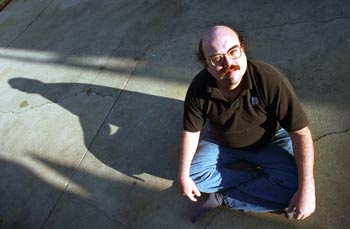
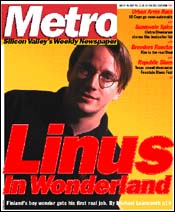
I wore the wrong t-shirtI wore the wrong shirt for my photo in the Metro article.
I wore my BeOS Master's Award polo shirt that I won (honorable mention) for porting Spellswell from MacOS to the BeOS
(It uses a protocol called Word Services that links word processors and email clients to spellers and other text services (including text encryption); the award was as much for bringing Word Services to the BeOS as for Spellswell itself. I plan to do the same for Linux soon, possibly through the CORBA techniques they use in Gnome - http://www.gnome.org seems to be down or I'd link to the relevant page there.)
I'm pretty active in the Be developer community.
I'm also pretty critical of Be because of their complete lack of any sense as far as managing the business and handling developer relations and I have no qualms about making my views known to them and other developers, both in public and in private discussions.
I've always been a shy and quiet person but there's something about living through experiences such as I've had that makes such things as speaking up in public about mere work matters pretty easy in comparison.
Remember my sig: Tilting at Windmills for a Better Tomorrow. Words I live by.
I thought it would provoke quite a lively response to post the link to the Metro article to BeUserTalk and BeDevTalk. I got a couple private responses and one public one. I was very glad to get the responses I did get though.
On the other hand, I submitted this article to Slashdot but figured it wouldn't get posted, considering the dozens of articles I've submitted that I think were more directly relevant to open source programming, privacy, free speech, encryption and so on, but this is the one that gets on.
And my manic depression page, which grew to get 3000 hits last month (it's linked from some bipolar sites and the bipolar category on Yahoo), has gotten 4800 hits in ten hours.
No, I should have worn my Release Your Inner Nerd t-shirt that I bought from the Slashdot booth at the Linuxworld Expo in San Jose a while back.
(Wore it shopping for wedding supplies with my fiance the other day
Michael D. Crawford -
Tilting at Windmills for a Better TomorrowHeh... took me all this time to find the reply button so I could actually post a new topic rather than replying to an existing one...
First, I'd like to thank all the people who have written to me at michael@geometricvisions.com regarding their experiences with manic depression. I'm afraid I'm getting a lot of mail today so I'm going to have to wait until tomorrow to respond to most everyone.
But if you're thinking of writing, please be assured that I take the confidentiality of people who write to me regarding this very seriously. If you like you can encrypt your mail with my PGP key
I want to respond to a number of things that have been posted here and also clarify a few things that were written in Kelly Luker's article about bipolar high-tech workers in the Metro San Jose.
A number of people have posted some very negative things about mental illness or about the mental health profession. While there are instances of bad doctors and certainly a long history of bad science and outright abuse in the history of mental health, there is no doubt that manic depression is a real illness.
This is evidenced by positron emission tomography scans of bipolar patients during various phases. PET scans measure the consumption of radioactive sugar in various parts of the brain.
Manic patients have strong positron emissions from the right hemisphere of the brain, showing that the right hemisphere is very active - suggesting a physical reason for the feeling of creativity and the overabundance of new ideas.
Depressed people have a reduced level of positron emissions relative to a normal patient.
A bipolar patient who is neither manic nor depressed will show a normal level of sugar metabolization.
The illness is thought to be genetic in origin, but the genetic nature of it is not well understood. Several times researchers thought they'd discovered the gene for manic depression but the discovery turned out to be wrong.
It happens that manic depression tends to run in families, but not always. It can appear spontaneously in a family, and after it does it will tend to be passed to successive generations and get worse with each generation.
I don't understand fully why but this is thought to suggest that the disease is caused by a certain morphology of mutation rather than a certain genetic sequence, and that this kind of mutation tends to get worse over generations. Apparently this sort of mutation is understood for other illnesses that do this so they think bipolar depression may work this way too. I'm afraid I don't have a lit reference but I expect I can get some.
Manic depression usually responds to medication. However it is very difficult to treat effectively. The illness varies quite widely in the severity and frequency of its symptoms among individuals, and each individual responds quite differently to the different medications.
It took about twelve years to find the right combinations of medications for me. I didn't work continuously to find the right combo, and in fact I went several years without medication - but it's important for any bipolar reading this to understa nd that you can go years with good health and become profoundly manic or depressed quite suddenly, as I did when I was hospitalized during graduate school during a manic episode.
Another problem is that doctors are often lazy or ill-informed about proper treatment. I was first prescribed lithium and nothing else, even though my most prevalent symptom was depression and I went years with fairly continuous suicidal feelings and no treatment at all for it.
Early on the only direct treatment for manic depression was lithium, so the mental health community seemed to have gotten this idea that lithium was therefore completely effective for everyone. The Only Choice != Effective Treatment
Another problem is that antidepressants tend to provoke manic episodes, especially if they are given without mood stabilizers like lithium, depakote or tegretol. Quite often the new patient's only complaint is depression and the doctor doesn't ask questions that would determine a history of manic behavior, so they prescribe antidepressants without anything to prevent mania, and the patient then has a psychotic episode, as happened to me when I was first given antidepressants and I spent six weeks in a psychiatric hospital.
The doctors then overreact and refuse to prescribe antidepressants at all, and the result is either a miserable life or maybe suicide.
Things are somewhat better now than when I was first diagnosed. Over time it was discovered that a number of epilepsy medications are effective mood stabilizers, and once the first such was found (tegretol) a large number of others followed (I take depakote, or valproic acid). This means that there is a choice for those who either cannot tolerate lithium (as I can't) or for who it is ineffective - lithium only reduces hospitalizations by about 50% overall.
The wide range of medicine and I imagine the overall advances in biology and medical research have combined to yield an understanding of how manic depression actually works in the brain. This understanding has only come about in the last five years or so, so now I understand drugs are under development that effect the processes of bipolar depression directly, by rational drug design.
Most of the existing medications were found to be effective by chance and no one ever understood how they worked.
I understand lithium was discovered because someone noticed that lithium salts made guinea pigs less active so he just fed a bunch of lithium to all the patients in a psychiatric hospital and the bipolar patients happened to get better - most likely the reaction of the guinea pigs resulted from lithium's potent toxicity; regular blood tests are required when one starts taking it because the effective dose is pretty close to the toxic dose.
But basically what got me better isn't just the medication, it was taking responsibility for and control of my treatment. Your doctor only sees you for an hour a week (or 20 minutes a month if you're in a typical state mental health program) while you get to experience your illness every waking moment (plus nightmares during sleep).
So really, if you suffer from this, what you need to do is get informed and get the right treatment. What form that may take I cannot really tell you, but for almost everyone, there is an effective treatment which is not debilitating. If your current medications don't work for you, work with your doctor to find better medications; just give time for the new ones to fully take effect before switching again.
I want to comment on the link between manic depression and creativity. Kelly Luker, the author of the Metro San Jose article, really didn't seem to get it when I explained to her that becoming manic was not a desirable thing. I really did take pains to explain it to her clearly.
Yes, the early stages of mania, or mild mania (called hypomania) do feel pleasurable so she really thought this was something to be desired and all us bipolar programmers were all fired up on our jobs while going through manic episodes.
But that's really not how it is. Mania is a profoundly psychotic state. One goes days on end without sleeping. Thoughts race and crowd the mind so fast that one is able to complete a concept in ones own mind - let alone say a complete sentence to another person. Manic people make extremely poor judgements and often act on them without any regard to the consequences - which all too often come to roost once the manic episode is over and depression sets in.
Hypomania can be a happy and productive time but only in short bursts; it can't be maintained. And for me, severe depression invariably follows any manic phase whether it is mild or severe, so I work very hard to avoid getting manic.
The important thing to understand is that while one feels creative while manic, true creativity only comes during the balanced times (I hesitate to say "normal"), and the work of the manic depressive to heal, as I have over the years in 14 years of psychotherapy, is to learn to live a balanced life without mania or depression.
The link between manic depression and creativity is extensively (and authoritatively) discussed in Kaye Redfield Jamison's Touched with Fire. She gives case studies of many famous poets and writers who were thought to be manic depressive (because of suicides, or manic behaviour) or actually known to be, and also quotes such studies as one about a prestigious writer's workshop, many of the attendees of which went on to commit suicide.
Jamison is a coauthor of the standard medical text on manic depression.
Dr. Jamison kept her own illness largely a secret during her training and career as a psychologist. But she discusses her own (and her father's) manic depression in her biography An Unquiet Mind
The subject of my letter Programming and Madness wasn't about how programming drove me nuts - it was about how it made me sane.
After I cracked up and left college I had no way to support myself, I was broke, hungry, miserable, sick, clinically depressed - not just sad but yearning to kill myself almost continuously, sleeping twenty hours a day.
I needed to find a place for myself in the world where I could live contentedly as the geek I had always been. My first love was, always will be physics (I did research on the 60" and 200" telescopes at Palomar Mountain, and did my senior thesis work for UC Santa Cruz at the particle accellerator at CERN in Geneva, Switzerland). But for some reason I've never been able to survive in the world of physics.
Working with computers, on the other hand, and in the community of computer programmers, I do very well.
It's my experience that there are a lot of other people in the computer industry, and in the scientific and technical world in general, who suffer from mental illness. "Unipolar" depression is most common but manic depression is quite widespread too. I know this both because I see it in others and sometimes we come out of our closet and, at work or on the net, we share our experience with each other. It's been a really long and complicated process for me to get where I am, and a big problem I faced when I first came down with it was a lack of good information. I'm trying to do something about it.
Imagine the day when you could ask a random stranger why the sad face and he'd feel perfectly safe in telling you "I'm clinically depressed". People will tell strangers about a lot of medical conditions, but mental illness still brings up images of Bedlam in a lot of people. And I'm afraid some of the worst stigma is actually self imposed; meaningless comments on the topic of mental illness can often have a devastating effect on someone who suffers from it, causing them to retreat far from the world of light for fear of exposing themselves when often their worst fears are mostly imagined.
I've used this sig for many years, I take it very seriously. Generally only my good friends understand the painful irony in it. I started using it shortly after getting on antidepressants after my first suicide attempt:
Tilting at Windmills for a Better Tomorrow.
Michael D. Crawford -
Re:Future without any privacy a good thingIn David Brin's book "Earth," there was a very interesting idea: no privacy (also known as the transparent society ). When faced with the steady erosion of their privacy, the citizens started becoming snoops themselves. An enabling technology called "Tru-Vu" was invented -- essentially, very small, portable wireless cameras with remote recording. Everyone wore them. Nothing was a secret anymore. And the coporations and governments of the world were *scared* -- they *had* to come clean and stay clean!
Say hello to Tru-Vu:Photobit, a Pasadena, California company that designs and fabricates a wide variety of CMOS sensors, has developed a working prototype of one. Glued directly onto a 1- by 2-inch CMOS-wafer--small enough to fit into a wallet billfold--is a tiny BB-size fixed focus lens. On the same chip is a frame buffer, an analog-to-digital converter, and a variety of standard digital camera features and controls such as auto-focus, auto-exposure control, shutter, and white balance. The chip also has an interface on its edge for connecting to a parallel cable and port. The most significant detail of this camera-on-a-chip is its ample space for additional functions. Look for manufacturers to add lots of extras, such as image memory, image stabilization, motion tracking for surveillance, videoconferencing, a battery, and even a wireless modem for remote control and access. The camera can be miniaturized, and its cost reduced to a few dollars. When this happens, get ready for an explosion of image monitors and capture devices.
The Transparent Society Article mentioned Microelectromechanical Systems:One role promoted for MEMS in a 1995 report by the Pentagon's Advanced Research Projects Agency is as "surveillance dust": several thousand microminiaturized camera/infrared-detector/microphone packages dropped via individual parachutes over a battlefield. This "dust" would float like dandelion fuzz for several hours and track a potential enemy's every move. The civilian applications of this technology need scarcely be mentioned
"The only thing accomplished by privacy laws is to make the bugs smaller." --Heinlein, in Stranger in a Strange Land -
Re:Future without any privacy a good thingIn David Brin's book "Earth," there was a very interesting idea: no privacy (also known as the transparent society ). When faced with the steady erosion of their privacy, the citizens started becoming snoops themselves. An enabling technology called "Tru-Vu" was invented -- essentially, very small, portable wireless cameras with remote recording. Everyone wore them. Nothing was a secret anymore. And the coporations and governments of the world were *scared* -- they *had* to come clean and stay clean!
Say hello to Tru-Vu:Photobit, a Pasadena, California company that designs and fabricates a wide variety of CMOS sensors, has developed a working prototype of one. Glued directly onto a 1- by 2-inch CMOS-wafer--small enough to fit into a wallet billfold--is a tiny BB-size fixed focus lens. On the same chip is a frame buffer, an analog-to-digital converter, and a variety of standard digital camera features and controls such as auto-focus, auto-exposure control, shutter, and white balance. The chip also has an interface on its edge for connecting to a parallel cable and port. The most significant detail of this camera-on-a-chip is its ample space for additional functions. Look for manufacturers to add lots of extras, such as image memory, image stabilization, motion tracking for surveillance, videoconferencing, a battery, and even a wireless modem for remote control and access. The camera can be miniaturized, and its cost reduced to a few dollars. When this happens, get ready for an explosion of image monitors and capture devices.
The Transparent Society Article mentioned Microelectromechanical Systems:One role promoted for MEMS in a 1995 report by the Pentagon's Advanced Research Projects Agency is as "surveillance dust": several thousand microminiaturized camera/infrared-detector/microphone packages dropped via individual parachutes over a battlefield. This "dust" would float like dandelion fuzz for several hours and track a potential enemy's every move. The civilian applications of this technology need scarcely be mentioned
"The only thing accomplished by privacy laws is to make the bugs smaller." --Heinlein, in Stranger in a Strange Land -
Re:My best friend died, but it should be legal.
> Mr. Jon Katz, are you listening?
An excellent article by Michelle Goldberg in this week's San Francisco Metropolitan talks about the availability of drugs on the internet and contains quotes from 'technology journalist Jon Katz, who now writes for the tech news site Slashdot'.
Among other things he's quoted as saying:
"... it's really not for the government to be telling people whether they should be using marijuana or not
It's worth a read -
Wyle: looks more like Linus than Steve.