Slashdot Mirror
Domain: mlahanas.de
Stories and comments across the archive that link to mlahanas.de.
Comments · 21
-
Re:US military doctrine is simple to understand...
I would not be so sure about this very subject. The European slave afflux was as much, if not more, consistent and surely more prolonged in Northern Africa than in Syria/Lebanon/Palestine, yet the usual modern Libyan or Tunisian is not whiter than a modern Syrian.
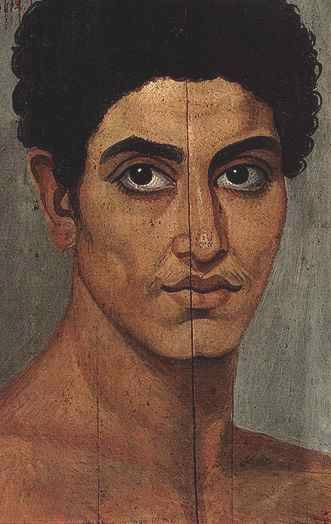
This is probably an Egyptian Jew of the I/II century AD from Fayum, he's not significantly darker than a typical Palestinian Arab, he is not even darker than a typical modern Egyptian Arab for that matter... -
Re:Interesting, but inevitable
Prior art noobs.
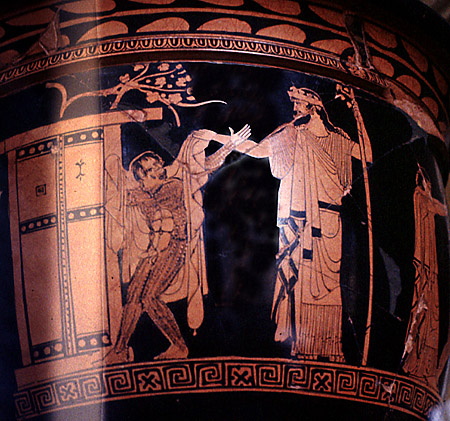
Check out the netbook this dude is using. Shame ergonomics wasn't invented until a couple of millennia later, his posture is hopeless.
-
Re:Eggs came first. I've been saying that forever.
This is an invalid interpretation of the question. The Ancient Greeks had no notion of evolution,
That's your first wrong assumption. The ancient greeks had ideas about evolution: http://www.mlahanas.de/Greeks
The chicken/egg question is a metaphor for resolving a circular dependency.
No, it's not. It's a very straight-forward question. Which came first - and it's obvious that eggs were around before any warm-blooded animals existed, and that includes chickens. There is no circular dependency, just people who lack the ability to step out of the box, or make bad initial assumptions.
Additionally, even if we take your view, then the egg STILL came first - because any egg that gives rise to a chicken is by definition a "chicken egg", even if it was laid by something that was one generation prior to crossing some arbitrary boundary into "chickenhood" - since the chicken is only fully developed at some point after the egg is created, same as a human is not really a human when it's just a clump of cells (or your arm isn't a separate human being if we cut it off).
-
Re:The Republic Party Brand
Look, I was making a humorous comparison between the way we do politics and the way we sell stuff. I was joking when I suggested that there's no difference between the political parties and some brand-obsessed distributor of cleaning products.
But since you insist on drawing a bright line between special interest groups and voters, I have to point out a big flaw in your logic. Who do you think "special interests" are? They're groups of people with a common, special interest. And in this context, "people" is pretty much the same as "voters." AARP is a "special interest" that advocates for older people. Unions are "special interests" that advocate for unionized workers. Corporations are "special interests" that advocate for their owners and even in some ways for their employees. And so on.
Now, I'm not saying this is a good setup. It fosters corruption and guarantees domination by those with the deepest pockets. And too often the leaders of special interests are less than honest about how they do their jobs. But the fact remains that these SIGs are not aliens from another dimension who want to make us all slaves. They're citizens legitimately protecting their own interests.
This has always been a basic problem with democracies, that "the people" have a certain tendency to protect their own interests first, often to detriment of the nation as a whole. (When I say "always", I have in mind the first documented pork barrel project, created 25 centuries ago to keep Athenian trireme rowers occupied between wars.) It's always going to be a problem. You can do your best to curb it, but you're not going to eliminate it. Not unless you want to abandon popular rule and switch to monarchy, dictatorship, feudalism, anarchy, or some other such alternative. Though I might remind you that all these systems tend to be really unpleasant to live under.
And if you do want to get serious about curbing the excesses of special interests, try to remember that everybody in part of at least one of them. Including you.
-
Re:Duh!
Fat drunk people are funny.
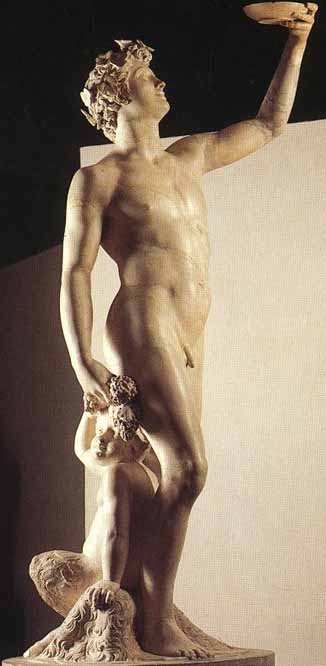
Look at classical depictions of Bacchus...never skinny.*Ahem* I hate to be nit-picky,
I'm guessing you're thinking of Silenos
Oaooow. Now my brain needs washing to get rid of that mental image.
-
Re:hidden cameras ftw
The earliest known written evidence of a camera obscura can be found in Aristotle's documentation of a device in 350 BC in Problemata" (Patti, 1993). Aristotle's apparatus contained a dark chamber that had a single small hole to allow for sunlight to enter. With this device, he made observations of the sun. He noted that no matter what shape the hole was, it would still display the sun correctly as a round object. Another observation that he made was that when the distance between the aperture (the tiny hole) and the surface with the image increased, the image would become amplified. Although no one is perfectly sure, many attribute the invention of the camera obscura to Aristotle. He rejected the vision theory of Plato of light rays emitted from the eyes.
-
Re:That's it!
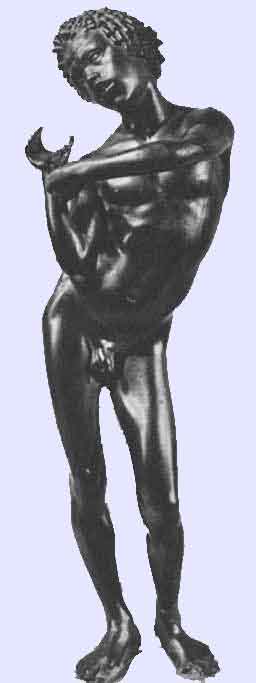
As will this Greek statue from about 300 BC and this young boy with the small penis that Michaelangelo Bonoratti carved about a thousand years ago (it's been thirty years since my art classes and I've slept since then and can't be arsed to look it up).
I haven't seen the 2 girls 1 cup, is that new?
If I rewrite my journals so instead of hookers the girls are teenagers, are the UK police going to come across the pond after me? Or is it only illustrations? Text can tittilate also, you know.
Tami (link NSFW) is only about four foot eight, if I draw her (only flat chested instead of those big fat boobies) would I be breaking the law in England? How about if I draw "Bighead", the hooker with the smallest boobs I've ever seen?
I't nice to know that politicians in other countries are as fucktardedly brain dead as ours. There's hope for my country after all! -
without limits on being electrical
The oldest piece of code was done by Heron of Alexandria. He invented automata in the first century.
Heron used cams, gears, pulleys, even pneumatics in his automata and were a programed sequence.
link -
Re:Excitement
Not necessarily. The use of bitumen/tar was documented in biblical times. The Romans were thought to have used coal for metalwork. A Greek by the name of Heronas, developed a prototype steam engine. They might have advanced faster technologically, if they weren't afraid of making the slaves unemployed
You can also read the history of the combustion engine . The first combustion engines were based on gunpowder, then coal powered steam engines, coal gas, and finally petroleum. At the same time, engineers experimented with one stroke, two stroke and four stroke engines with vertical and V slant pistons. -
Re:Intelligent Design? Or Evolution?
Faith is belief without evidence. Ignorance is "The condition of being uneducated, unaware, or uninformed." I would say it's fair to equate "uninformed" with "no evidence", so beliefs regarding gods is, by definition, ignorant. Of course you may be very informed about the topic of evolution, but then you would also understand that the process works without "God" factored in, just as Laplace told Napoleon that his model of the solar system worked just as well without calculating the work of God into it.
Most modern religions have long accepted the idea that their gods no longer interfere with the natural workings of the universe. Any scientist will also tell you that, if your hypothesis or calculations leave an "x" for "the work of God", they are incomplete. -
Re:MythBuster
Good so they need bronze, highly polished. First you need to get enough of that. They probably used most they could find (there was no deep core mining then) for armour and weapons.
They used bronze for everything. That's why it is known as the bronze age. If they were short of available bronze they could always have melted down some coins.please try it out, with just 120 0.33 m^2 plates. I am sure, 100% sure, you will not succeed. Not even a motionless dry wood.
Who said anything about 120 0.33m^2 plates? To adjust for the lower reflectivity of bronze simply increase the size and number of reflectors. The practicality of the idea has been proven more than once (e.g. see here for reports of successful demostrations in 1747 and 1973). There are claims that the same technique was used by Proclus in 514. Why are you so sure that it never happened? -
The Sakkas ExperimentIn 1973, a Greek scientist, Dr. Ioannis Sakkas performed the same experiment. There is a discussion at this web site, and a link to this one.
It's in Spanish, but it does have a photograph of about 40 of the 70 man-sized mirrors they used. He managed to ignite a tarred wooden boat in about 3 minutes.
I am now seeing "Forbidden" when trying to access the original MIT web page, however Google claims there is mention of the Sakkis experiment on this one (also forbidden).
-
Steam engine of Heron of Alexandria
Heron of Alexandria invented a kind of steam engine. He was mathematician, physicist, and an engineer who lived between 10 and 70 AD.
-
Re:Glad to see a real invention for a change
This is not 'real' inovation, they've been using the technique in Arfrica for years as a cheep way of producing glasses.
I coudln't find any info on google but I'm fairly sure they were invented by the wind up radio guy.
or if your really after pior art, it looks like the Greeks may have beaten them to it by 3000 years.
Here's an encarta link too -
Re:A subtle distinction...
Internet to the rescue -- he calculated the distance to the Sun at 804 million stadia based on data from eclipses. Depending on what the value of a stadium is (apparently, we don't know for sure what units he was using), that's pretty accurate.
-
Re:Solar Death Ray
Actually the ancient Greeks possibly used to do this. But in navel warfare. To set opposing ships on fire.
http://www.mlahanas.de/Greeks/Mirrors.htm -
Re:The myth is dead! Long live the myth!Apparently it worked when it was tried in 1973 (see middle of page).
A Greek scientist, Dr. ioannis Sakkas, curious about whether Archimedes could really have used a "burning glass" to destroy the Roman fleet in 212 BC lined up nearly 60 Greek sailors, each holding an oblong mirror tipped to catch the Sun's rays and direct them at a wooden ship 160 feet away. The ship caught fire at once.....Sakkas said after the experiment there was no doubt in his mind the great inventor could have used bronze mirrors to scuttle the Romans
-
Programmable automata existed long before
Heron of Alexandria created numerous automata, some programmable, some 1400 years earlier. Da Vinci was familiar with translations of Heron's works, and even tried to recreate some of Heron's machines.
-
Re:All we need now are...
Yeah, but who needs sharks? Greeks work just as well.
It's nice to know that modern nerds are following in the footsteps of such as Archimedes... -
Is anyone reminded...
-
Re:warp space?
Saying "mass warps spacetime" doesn't explain how it pulls that stunt anymore than answering who was pushing Kepler's brooms.
Have always been curious about that myself. After all, the usual analogy made is that of a rubber sheet, in order to reduce the dimensions... but the analogy requires gravity in order to work. The sole thing you gain by such an analogy is reducing gravity from something radial (in towards an object) to something linear ("down" through space).
...but why should there be a stream of... somethings... going from 'top' to 'bottom' in the fourth physical dimension... interacting with our cosmos?
I've heard some folks posit that gravity is 'resistance' of matter to whatever medium space is expanding "into" - space has much less resistance to it, and so you get little funnels from the difference. Mind you, that does rely on a 'closed' universe, and I don't think that's the one in favor in the presses at the moment
Personally, I'm most curious about the LeSage-type particle gravity theories - the "push" theories instead of the "pull". I've read a number of variations on the theme and all of them have some testable portion, whether it be gravity fall-off, shielding anomalies, precessions, thermalization of gravitons absorbed (causing planetary heating above any caused by radioactive breakdown), upper bounds of density (there would come a density point where ~100% graviton absorption happens - which would put a limit on compression by gravity)
I find the 'frame dragging' concept a little odd when applied to a framework that looks, for all intentions, as though it's geometric - spacetime bending, sure; spacetime twisting - ? Having spacetime be continuous, or even discrete-but-completely-connected, would imply somewhat that the 'twisting' of frame dragging should be resisted somehow. The only easy way out of the conundrum is to posit spacetime being particulate - water and air have no problem forming vortices when spun. So, is spacetime particulate?
The most annoying thing is that you really can get to the same formulae multiple ways, and often we get stuck with the first analogy that "explains" things until we start figuring out the edge cases. Case in point, it took a long time to turn Plato's optics around (although, to be fair, the theory of emitting rays from your eyes works really well for raytracing
Looking forward to hearing of the results of this. It would be pretty bizarre not to find frame-dragging at this point
...but not as bizarre as finding Kepler's Brooms