Slashdot Mirror
Domain: monash.edu.au
Stories and comments across the archive that link to monash.edu.au.
Comments · 279
-
Re:Three reasons: Money, Money, and Money
It will help you become a bangup conference speaker.
Check out Damian Conway's Perl-in-Latim module Lingua::Romana::Perligata here.
-
Re:stupid strategy
What about the Street Performer Protocol, or variations such as the Rational Street Performer Protocol? Are there any actual companies implementing it?
-
Names By Census
-
Take up a collection
Besides showing MS your middle finger (which I think you should do) or charging everyone money. Why not just ask interested people to donate money until you have enough to pay the fee? You are only interested in not having to pay the fee yourself, I believe this is a fair plan.
If you want to make money of the deal, the Street Performer Protocol may work for you. This will be less risky because you don't have to front the £500 yourself. Another guy has one called The Rational Street Performer Protocol if it suits your tastes better.
-
Academic Treatment
I've recently written an academic paper on ethical issues as they relate to systems designed to support decision makers. Whilst this may be a bit academic, or even specific, for your purposes, it does provide a high level overview of some of the main issues related to ethics and information technology. You can grab a pdf copy here.
-
And can Photoshop do the following?
Just a followup:
Does Photoshop have anything like Resynthesizer?
How about Tileable Blur?
How about the Solid Noise plugin?
Is there native warping functionality in Photoshop, as IWarp provides in the GIMP?
How about the gorgeous Supernova?
IIRC, Xaos makes something (expensive) like GIMPressionist. Of course, Photoshop doesn't come with this functionality.
Lots of other things -- I haven't used Photoshop for a long time, so I'm not going to be much good at pointing out the things that it lacks...just pointing out that the functionality sword cuts two ways.
For output intended for print, Photoshop is better. For output intended to be digital, GIMP is better. Pretty simple. -
Re:As someone who is mentally ill...
Maybe you could do a better job than the color scheme of XP, but I've looked at your site and I'm forced to conclude that you haven't. The text menu on the left side is dark grey on black distressed text with a patchy red glow in the background. I thought they were nifty colored blobs for a while until I saw something that looked suspiciously like an 'e'.
I'm guessing you're developing it on a Mac, where differences in standard gamma make everything seem brighter. On the Mac, it just seems fuzzy, like a poster one of my lecturers had on his window that said Tense? Nervous? Tired? printed in such a way as to cause physical eye discomfort.
-
Other 3D UIs: references and links.This is the kind of stuff that is regularly discussed on Nooface (a Slash site BTW).
Ripped straight off the side bar :
Will 3D user interfaces ever take off? With ever-growing 3D processing capabilities available on standard PC hardware, it seems only natural to pursue UI directions that take advantage of this awesome power. Moreover, the generation of users now emerging has had access to video games for as long as they could remember. As the line between video games and PCs becomes blurrier, the time may have come to think about how to apply 3D visualization techniques for more day-to-day computing tasks.
Here are links to some of the 3DUIs that are available today:
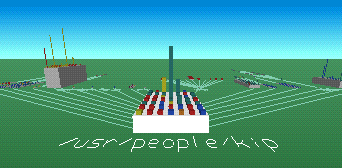
- FSN (pronounced "fusion") produces a cyberspace rendering of a file system. This was the original 3D file system navigator shown in Jurassic Park ("Hey, this is UNIX. I know this!").
[Screenshot] | [Download] (IRIX)
- FSV is modelled after FSN, but runs on Linux. FSV lays out files and directories in 3D, geometrically representing the file system hierarchy to allow visual overview and analysis.
[Screenshot] | [Download] (Linux)
- Xcruise lets you fly through a filesystem in 3D as if it were interplanetary space. Directories are represented as galaxies, files are represented as planets (whose mass is determined by the file size), and symbolic links are represented as wormholes.
[Screenshot] | [Download] (Linux)
- TDFSB is a 3D filesystem browser for Linux. Take a walk through your filesystem!
[Screenshot] | [Download] (Linux)
- Visual File System is a 3D file system visualizer for Windows. The tool scans a drive selected by the user, and then models the contents of the drive in 3D, based on the directories that are selected in a tree browser on the side of the display.
[Screenshot] | [Download] (Windows)
- 3Dtop is an extension for Windows that represents desktop icons in 3D, letting you to fly around your desktop. You can create coloured spotlights, background and floor textures, "paintings" (bitmaps), clocks, and "flags" that represent shortcuts.
[Screenshot] | [Download] (Windows)
- ROOMS turns a Windows desktop into a 3D world. You can see the world either through a first person perspective or with a map view, and you can populate the world with sounds, animated images, and 3D icons.
[Screenshot] | [Download] (Windows)
- CubicEye organizes windows into a navigable cube. Cubes can be arranged by thematic or functional subject matter, and can be explored either individually or collectively as part of a more comprehensive structure of multiple cubes representing various areas of interest.
[Screenshot] | [Download] (Windows)
- Vizible WorldViewer distributes windows across the exterior and interior surfaces of spheres, providing the means to visualize and navigate large numbers of web pages and data sources simultaneously.
[Screenshot] -
Other 3D UIs: references and links.This is the kind of stuff that is regularly discussed on Nooface (a Slash site BTW).
Ripped straight off the side bar :
Will 3D user interfaces ever take off? With ever-growing 3D processing capabilities available on standard PC hardware, it seems only natural to pursue UI directions that take advantage of this awesome power. Moreover, the generation of users now emerging has had access to video games for as long as they could remember. As the line between video games and PCs becomes blurrier, the time may have come to think about how to apply 3D visualization techniques for more day-to-day computing tasks.
Here are links to some of the 3DUIs that are available today:
- FSN (pronounced "fusion") produces a cyberspace rendering of a file system. This was the original 3D file system navigator shown in Jurassic Park ("Hey, this is UNIX. I know this!").
[Screenshot] | [Download] (IRIX)
- FSV is modelled after FSN, but runs on Linux. FSV lays out files and directories in 3D, geometrically representing the file system hierarchy to allow visual overview and analysis.
[Screenshot] | [Download] (Linux)
- Xcruise lets you fly through a filesystem in 3D as if it were interplanetary space. Directories are represented as galaxies, files are represented as planets (whose mass is determined by the file size), and symbolic links are represented as wormholes.
[Screenshot] | [Download] (Linux)
- TDFSB is a 3D filesystem browser for Linux. Take a walk through your filesystem!
[Screenshot] | [Download] (Linux)
- Visual File System is a 3D file system visualizer for Windows. The tool scans a drive selected by the user, and then models the contents of the drive in 3D, based on the directories that are selected in a tree browser on the side of the display.
[Screenshot] | [Download] (Windows)
- 3Dtop is an extension for Windows that represents desktop icons in 3D, letting you to fly around your desktop. You can create coloured spotlights, background and floor textures, "paintings" (bitmaps), clocks, and "flags" that represent shortcuts.
[Screenshot] | [Download] (Windows)
- ROOMS turns a Windows desktop into a 3D world. You can see the world either through a first person perspective or with a map view, and you can populate the world with sounds, animated images, and 3D icons.
[Screenshot] | [Download] (Windows)
- CubicEye organizes windows into a navigable cube. Cubes can be arranged by thematic or functional subject matter, and can be explored either individually or collectively as part of a more comprehensive structure of multiple cubes representing various areas of interest.
[Screenshot] | [Download] (Windows)
- Vizible WorldViewer distributes windows across the exterior and interior surfaces of spheres, providing the means to visualize and navigate large numbers of web pages and data sources simultaneously.
[Screenshot] -
Scanning for MP3sI've already had my (university-owned) laptop scanned for MP3s by Monash University, as has everyone else in my School. The Faculty is presumably conducting these audits to see how much of a liability its staff is. Rumour has it that someone had been suspended for trading MP3s, and the University is getting grief over it from the Australian Record Industry Association. It's interesting to know that this is happening at other universities around Australia too.
There have been a number of memos from the Dean lately about copyrighted material, including music. The University's stance is that any copies of music, whether you own an original or not, are illegal unless you have written permission from the copyright holder. I believe that this is consistent with Australian copyright law, which (correct me if I'm wrong) doesn't seem to have a Fair Use clause. If that's true, it makes me wonder why you can buy solid-state MP3 players in this country at all.
find / -name "*.mp3" -print returned nothing on my laptop, so it's not a big deal to me, and since it's the University's equipment, they're entitled to set their own rules. But searching our hard disks doesn't exactly foster a trusting relationship between staff and university. More to the point, it's also going to have a nasty effect on research on audio compression.
-
A way to create good textures is needed...
I have a few pictures I took with my digital camera which would make very good textures, only problem is I don't have a good way to make the images tileable. GIMP's "Make Seamless" plugin sort of works, but has obvious visual problems. The Resynthesizer may work, but I haven't tried it for a while (when I did, it took lots of CPU time.
There also need to be good texture editors. Some photo editing program where you can view the image in a tiled setting and edit it. I don't know of any. Maybe using the tile function in GIMP, editing it, and recropping the image will work?
BTW, there used to be some public domain textures listed in gimp.org (called something like farm textures--they were taken from real photos), but I can't find them now...
-
Re:You might want to look up the Seldon patents to
The Wright Bros. invented flight.
No they didn't. Not even powered flight. That honour goes to New Zealander Richard William Pearse.
http://www.ctie.monash.edu.au/hargrave/pearse1.htm l
http://www.nzine.co.nz/pearse.html
http://chrisbrady.itgo.com/pearse/pearse.htm -
Re:The evolution of languages
Now, I'm walking a semantic line here, because you can presumably do all that by writing header files, includes, classes, etc. that contain new logic within the structure of the language. But what I mean is a language that by its nature is abstracted and modular, even to the point where the syntax of, say, control structures could be modified in a module?
I am interested in exactly this. It would be nice if regular expressions were simple a syntactical plugin to the language. Extensions could make it easier to specify things that don't quite fit the existing function/expression syntax.
So far, the only example of this I have found is Perl. Though I'm not sure exactly how it is done, I believe that the interpreter just delegates control to a custom parser. The Perl 'Switch' statement is/was implemented this way. You may also have heard of the extension that lets you (kind of) code Perl using Latin (written by the same guy).
-
Jim Breen's Japanese page
I doubt that much of this stuff is multimedia, but one site you should definitely look at is Jim Breen's Japanese page.
Jim Breen is the guy behind the EDICT Japanese/English dictionary file, which powers a lot of open-source Japanese-learning software (including mine).
His website has a bunch of useful links in a variety of categories, including literature, educational resource, and software - both free and commercial.
Two of the free software projects especially worth mentioning are JGloss and Rikai.com
-
Anglo-saxon ethnocentrism?Is it the well-known anglo-saxon ethnocentrism that prevents them from looking elsewhere, say like France, where Clément Ader built working, powered aircraft as early as 1890?
The french word for "airplane", Avion, was coined by Clément Ader in 1894. Many years before the Wright brothers would turn a propeller.
-
More Stuff on Bamboo Dick
Heres some more stuff:
Richard Pearse - Features some really cool pics of his aeroplane
Richard Pearse, Aviator - Features a cool VRML 3d model of his flying machine. Remember VRML? Also has some dimensioned drafts.
Richard Pearse - New Zealand Pioneer Aviator - IT's got soem schematics and descriptions of the engine he used.
Lots more cool stuff available out there if you feel like looking. -
Pointer to Jim's site
If you're really interested in this stuff, do a Google for 'Jim Breen', the professor from Monash who is possibly the leading expert in the field - he's also a hell of a nice guy.
Indeed, he is.
Here's Jim's Japanese page.
-
Re:Whas that?From what I understand, it is a mail filter which determines what to filter out based on a statistics-based machine learning system called "Bayesian Learning".
A couple of URLs quickly found on Google:
http://www.faqs.org/faqs/ai-faq/neural-nets/part3/ section-7.html
http://www.csse.monash.edu.au/courseware/cse5230/a ssets/images/week09.pdfAlso, any decent AI/machine learning textbook ought to cover the topic.
-DVK
-
Re:did any of you actually buy this ?
-
For the real Computer Science in post-modernism
Read the paper on implementing your own post-modernism generator. It's a lot more fun than reading someone else's "postmodern" drivel and you might actually learn something doing it.
-
Re:Postmodernism defined
John Leo, in US News and World Report, wrote in an article about Postmodernism, "A professor once wrote this about Tonya Harding's attack on Nancy Kerrigan: 'This melodrama parsed the transgressive hybridity of unnarrativized representative bodies back into recognizable heterovisual codes.' Possible English translation: Maybe Tonya had Nancy's leg smashed because she was attracted to her. If so the media wouldn't tell.
The professor was writing in 'pomobabble' - the jargon of postmodernism'..."
The Postmodernism Generator Leo cites in the article (create your own Postmodern article!) has been moved. -
Algorithm resources
The definitive online resource for algorithms is NISTS's Dictionary of Algorithms and Data Structures. There is a list of algorithm resources, and you can also find some free e-books using The Assayer.
In print you should be looking for "Introduction to Algorithms, 2nd edition". It is the bible of the field. Other excellent candidates are "Data Structures and Algorithms" ( / in Java / in C).
-
This is Silly...
Taking a look at Hamish's work on the project (available at http://yoyo.its.monash.edu.au/~meddie/patches/scr
e enshots/) shows that the display dialog for resizing windows will also include the dimensions in milimeteres! Who cares? It's another point of confusion that a) no one cares about (when was the last time you took a ruler to determine the dimensions of your horizonal and vertical screen space in mm?) and b) another point for Linux that it's too 'complicated' for a regular user to get aquainted to. It's redundant and is simply another point of confusion.
Seriously, I'm a gamer, programmer and developer and I don't see any situation where I would require this information...so why are we intent on including it in this situation?
Additionally, viewing screenshot #4 displays the fact users can flip the monitor display upside down using a QuickRes-like implementation. This is fantastic for the Vampire population out there, but for the rest of the world it's useless. Sure, include support in XFree86 itself, but to provide this feature in a very prodominent area where users can routinely access is ridiculous. I can see it now - tech support getting thousands of calls from people who think their computer is 'broken' because the image is flipped 270 degrees. Does this really benefit anyone? I don't see any use for this readily-available feature.
Just because we have the *ability* to do it (note: I'm not against XFree86 implementing this feature, just where KDE is going to be placing the options to use it) doesn't mean we *have* to do it. -
screenshots
1) dialog
2) kcontrolmodule
3) notification
4) popup -
screenshots
1) dialog
2) kcontrolmodule
3) notification
4) popup -
screenshots
1) dialog
2) kcontrolmodule
3) notification
4) popup -
screenshots
1) dialog
2) kcontrolmodule
3) notification
4) popup -
programming in latin
Or you can go straigth to programing in Latin, thanks to the efforts of Damian Conway and his module for perl Lingua::Romana::Perligata.
The interesting stuff about programming in latin is that the order of the words doesn't matter any more. In english or most other languages ``The boy gave the dog the food'' has a different meaning than ``The food gave the boy the dog'', but in latin (and in perligata) a similar exchange would have no effect on the meaning of the statement.
Fh
Ps: The dog&food example was stolen from the Perligata web page, just go check it. -
Japanese...
nissan can mean "daily output" or "daily visit" or, and this may be a stretch "2, 3" I searched for it here: http://www.csse.monash.edu.au/cgi-bin/cgiwrap/jwb
/ wwwjdic?1C -
very.
god this got modded up? i swear, all someone has to do is mention freenet on slasdot, sigh..
It's not like freenet. freenet searches work just like gnutella, randomly. it's a completely retarded way to organize a network. A distributed hash table like Circle solves this by organizing the network in a logical, storable and efficient way.
Basically compare a binary search vs. a random search, where the random search is like O(n) except you may just miss something.
-Jon
-
Re:Ailerons, fuselage, nacelle,...
Even though the aeroplane was "invented" right here in the good old U. S. of A, a lot of the technical language describing it is French.
For a good reason, my friend...
Prior art.
If you ever get a chance to go to Paris, be sure to spend some time at the Arts et Metiers Museum. Clement Ader's Avion III is still exposed there, hanging from a ceiling, and it's an extremely impressive sight to behold. It's very humbling to think that this guy spent decades inventing that machine, and tried it, and actually managed to fly in it. Damn, that makes look our daily bickering on -
Re:What is an invention/Who was first
Anyway, everybody knows that Clément Ader was the first to fly a plane, in 1890, way before the Wright brothers.
-
Richard Pearse, ailerons.Well, I would say Richard Pearse bet the Wright brothers to it, but there is insufficient evidence to sway an American from the view point.
What I can tell you though is that the europeans did NOT develop ailerons, that was Richard Pearse in a small farming community of New Zealand, Waitohi.
-
Richard Pearse, ailerons.Well, I would say Richard Pearse bet the Wright brothers to it, but there is insufficient evidence to sway an American from the view point.
What I can tell you though is that the europeans did NOT develop ailerons, that was Richard Pearse in a small farming community of New Zealand, Waitohi.
-
digital frame and firewall too
We did this too, this time using a previous model Ti-book which had been dropped:
http://www.csse.monash.edu.au/~njh/electronics/wal lmount/This ti-book provides a firewall, airport basestation, digital frame and interface to our heating unit, and all for less than 50W continuous power
And yes, typing on the keyboard is hardwork.
-
The Canonical C# for Java Developers ArticleThe article C# From a Java Developer's Perspective which appeared on Slashdot last year.
Mirrors: Translations: -
Re:Linguistics and Perl
-
Re:Show me the money....
I wrote:
printf( ngettext("This location contains %d pallete", "This location contains %d pallettes", numP), numP );And CTalkobt responded with:
Gah, Length Length lenghty... how about:
printf( "This location contains %d pallete%s", numP, numP > 1 ? "s" : "" );
Use the language - don't go the long road by using functions such as ngettext and don't write code to support to implement a feature that the language already represents. If however, use of the language feature would cause confusion or code to be easily misread, then go ahead and implement your own ( eg: use if's instead of nested ?'s).Well, aside from the obvious problem (The "?:" construct was explicitly disallowed in the Original Example), I wouldn't do it that way anyway.
The next most obvious issue is that ngettext() supports interntationalization and "?:" doesn't, but internationalization might not be an issue in the code.
You say "don't write code...to implement a feature that the language already represents", but what does "?:" represent, really? The "?:" construct represents any raw conditional, while ngettext() explicitly identifies a singlular form of a string, a plural form of a string and a number used to select which form to use. The problem is much more explicitly represented using ngettext() than "?:".
There are more advantages to ngettext() in this case. By using "?:" you hardcode program logic into the text string, if the content of the message changes you need to go into the code, change the text, evaluate whether or not the logic for making the text plural needs to change, change that, recompile, and redistribute. With ngettext, you can change the text string without touching code (IIRC, you can change it at run time without even recompiling or redistributing binaries).
Also, the example specified that most of the programmers in question are from a COBOL background, using lots of if statements or "?:" constructs breaks the text string up and pieces it together at runtime. The ngettext() function cleanly supports storing the simple text contstants elsewhere in the program, as a COBOL programmer used to a DATA DIVISION section might be more comfortable with.
-
Donations from multiple people
The main problem mentioned in many of the posts here is that a user might only be willing to pay say $100 for a new feature, but the time required by the developer wouldn't make such a small donation worthwhile. But what if multiple people wanted the same new feature and were each willing to pay $100 (or even many people willing to pay say $5)?
What would be useful would be a site that allowed these people to get together and pledge a certain amount for a new feature. Once enough money has been pledged that the developer thinks it's worthwhile, they can develop the feature and collect the pledged money.
For a discussion on how such a system might work, see The Rational Street Performer Protocol
-
Re:Take that a step further
P2P is hardly "useless for legal reasons." For one, it can be used to reduce bandwidth on overloaded servers. I know of one P2P program that allows you to use Debian's apt system for downloading from peers instead of the main sites. It also has a chatting system and a group messaging system (kind of like usenet, but kind of not). Those are quite useful legal reasons.
You can get those services via other methods, however there are reasons to use P2P over those other methods. Downloading may work better than an overloaded server that is provided by a non-profit organization--you are actually helping them out as it costs them less money that way.
It is a way to use group messaging protocols other than usenet without needing a server--something for those people who are tired of trolls, spam, censorship and etc.
The only reason P2P technolgy seems to be focused on copyright infringement is because the entertainment cartel keeps broadcasting that the only uses for P2P programs are to "steal" music and movies from them. So many people writing P2P programs think that trading music and video files are the "killer app" for this technology, and people running P2P programs mostly came because they heard on the news that they can get free movies and music via P2P services.
-
Another, i think somewhat better approach.
Is a project called Circle. It uses the idea of a distributed hash table.
The Author has a overview here.
My brief synopsis:
The network is orginized in a circle, like a circular link list, each node knows about it's neightbors it's neighbors neighbors and maybe a little more, bassicly every node knows about maybe 6 or so other nodes. Each node keeps a section of the hash table, say 0x0500-0x1000 or so.
Each search item is hashed and then sent left or right depending on if it's less or greater then range you are storing, so 0x3000 would be sent to the rightmost node because it's larger. That node would repeat the process, therefore making the search a lot like a binary search.
-Jon -
Another, i think somewhat better approach.
Is a project called Circle. It uses the idea of a distributed hash table.
The Author has a overview here.
My brief synopsis:
The network is orginized in a circle, like a circular link list, each node knows about it's neightbors it's neighbors neighbors and maybe a little more, bassicly every node knows about maybe 6 or so other nodes. Each node keeps a section of the hash table, say 0x0500-0x1000 or so.
Each search item is hashed and then sent left or right depending on if it's less or greater then range you are storing, so 0x3000 would be sent to the rightmost node because it's larger. That node would repeat the process, therefore making the search a lot like a binary search.
-Jon -
This plane reminds me of...
Compare these two: Boing and the German Horten Go 229 from 1945.
Here's another picture...
-iie1195 -
This plane reminds me of...
Compare these two: Boing and the German Horten Go 229 from 1945.
Here's another picture...
-iie1195 -
Try The CircleThe Circle is a nifty little P2P network which has trust metrics built into it. At the moment, it only uses trust to evaluate "gossip", which is a decentralised news system; but some work is being done to extend this to DOS-resistant file sharing.
At this stage, it seems likely that it will work best with a trust metric only, rather than a mixture of "trust" and "distrust". Mechanisms which simply block nodes based on the "denouncements" of (even trusted) others are a bit risky because they are an obvious tool for DOSers themselves.
That's not to say that a p2p network couldn't have an "immune system" -- but they need to be very carefully constructed.
-
Re:Fake operating systems
This explains it all
-
Re:Linux. My anti-virus.
Funny thing about that, Linux and other Unix OS's actually had the biggest GIF/JPEG vulnerability to date. It was in all Netscape's prior to 4.77, and it allowed javascript to be embedded in comments of GIF89a/JPEG and executed.
GIF/JPEG comment vulnerability in Netscape
Good thing this wasn't widely deployed around the world, or bought by millions during Christmas time. Having a small marketshare does offer a lot of "protection". Most virii writers are going for a large impact. -
Lack of computers?
Can't say I've ever had problems getting on a PC at Monash.
Perhaps your uni just sucks? -
Re:Are these the tools for decompiling DNA?
The starting point for this has to be the classic Boehringer Mannheim "Biochemical Pathways" charts which you can access on the Web here and here. Just click on one of the squares and it will present you with a blow-up of that section of the chart. These are also available as HUGE wallcharts on paper you can order from here. Amazing, ain't it? How the proteins produced by DNA manage to work together as catalysts to create the chemicals needed to form an organism is almost totally unknown, yet by definition it is a cellular automaton problem! To read up on all of this stuff, start with this, then for more details go here and here. After you've skimmed all of the above, pick a site from here or here or here and keep going. It never stops.
-
It's a lightsaber!
No really, the soulwax trax is. Well, if you have the Synaesthesia installed as you listen to it. Most stuff should spread nicely around the screen, but this comes up with a phalic lightsaber in the centre of the screen, with pink around it. Most odd...
Still, the tracks are pretty good if you can get hold of them!