Slashdot Mirror
Domain: n1vg.net
Stories and comments across the archive that link to n1vg.net.
Comments · 11
-
Re:This is hardly anything new
I think the hardware investment for my balloon project was about $300:
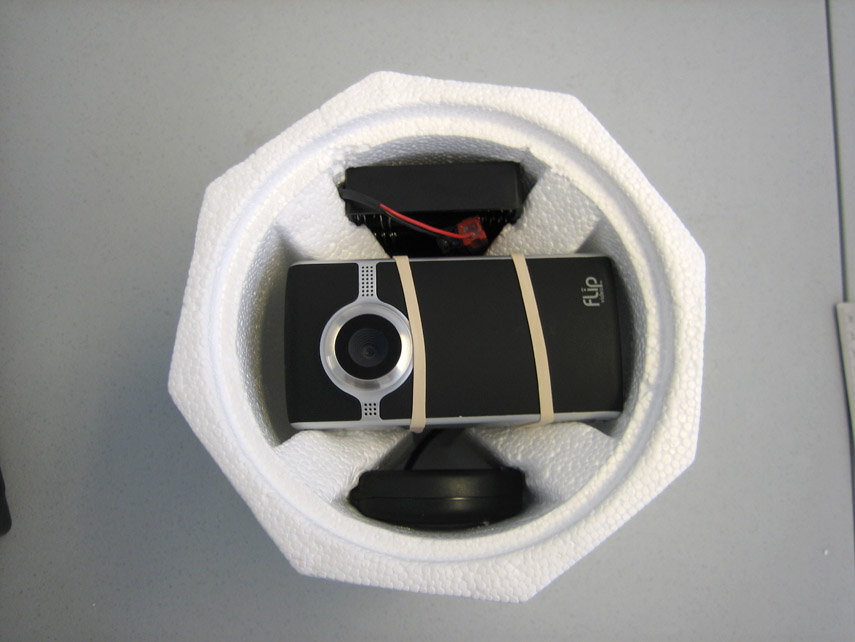
I've got a new payload sitting here ready to go that's a lot cleaner and simpler, and has a 2-hour video capacity. Everything in the payload is off the shelf (granted, the radio/tracker is off my own shelf, it's one of my company's products) except for a DB9 connector and a few wires that took a few minutes to solder together. The housing is the top half of a magnum wine shipper, and all of the components (battery, radio, GPS) just wedge in between the foam pieces intended to hold the neck of the bottle. The camcorder is held in with rubber bands:
http://n1vg.net/images/payload1.jpg
http://n1vg.net/images/payload2.jpg
http://n1vg.net/images/payload3.jpgThe acrylic window that goes over the end took me about 3 minutes to fabricate on a CNC milling machine and could be easily and cheaply replicated.
It'd be cheaper to build a transmit-only version of this system, but having a receiver lets you do useful stuff like control a cutdown device. This particular payload doesn't have one yet, but it can be as simple as a 1-watt resistor that you drive at 3 watts for several seconds to melt through a Nylon or Spectra cord. Maybe an extra buck worth of hardware.
I might launch this thing as soon as next month if I can find the time. Possibly from the Mojave desert again, or maybe from the Cuyama Valley, a little closer to home. Ground crew and chase team volunteers are always welcome.
At some point I'd like to have a ready-to-fly kit to sell at a reasonable price to schools, along with enough instructional materials to get them started. I just don't have the time for it right now.
-
Re:This is hardly anything new
I think the hardware investment for my balloon project was about $300:
I've got a new payload sitting here ready to go that's a lot cleaner and simpler, and has a 2-hour video capacity. Everything in the payload is off the shelf (granted, the radio/tracker is off my own shelf, it's one of my company's products) except for a DB9 connector and a few wires that took a few minutes to solder together. The housing is the top half of a magnum wine shipper, and all of the components (battery, radio, GPS) just wedge in between the foam pieces intended to hold the neck of the bottle. The camcorder is held in with rubber bands:
http://n1vg.net/images/payload1.jpg
http://n1vg.net/images/payload2.jpg
http://n1vg.net/images/payload3.jpgThe acrylic window that goes over the end took me about 3 minutes to fabricate on a CNC milling machine and could be easily and cheaply replicated.
It'd be cheaper to build a transmit-only version of this system, but having a receiver lets you do useful stuff like control a cutdown device. This particular payload doesn't have one yet, but it can be as simple as a 1-watt resistor that you drive at 3 watts for several seconds to melt through a Nylon or Spectra cord. Maybe an extra buck worth of hardware.
I might launch this thing as soon as next month if I can find the time. Possibly from the Mojave desert again, or maybe from the Cuyama Valley, a little closer to home. Ground crew and chase team volunteers are always welcome.
At some point I'd like to have a ready-to-fly kit to sell at a reasonable price to schools, along with enough instructional materials to get them started. I just don't have the time for it right now.
-
Re:This is hardly anything new
I think the hardware investment for my balloon project was about $300:
I've got a new payload sitting here ready to go that's a lot cleaner and simpler, and has a 2-hour video capacity. Everything in the payload is off the shelf (granted, the radio/tracker is off my own shelf, it's one of my company's products) except for a DB9 connector and a few wires that took a few minutes to solder together. The housing is the top half of a magnum wine shipper, and all of the components (battery, radio, GPS) just wedge in between the foam pieces intended to hold the neck of the bottle. The camcorder is held in with rubber bands:
http://n1vg.net/images/payload1.jpg
http://n1vg.net/images/payload2.jpg
http://n1vg.net/images/payload3.jpgThe acrylic window that goes over the end took me about 3 minutes to fabricate on a CNC milling machine and could be easily and cheaply replicated.
It'd be cheaper to build a transmit-only version of this system, but having a receiver lets you do useful stuff like control a cutdown device. This particular payload doesn't have one yet, but it can be as simple as a 1-watt resistor that you drive at 3 watts for several seconds to melt through a Nylon or Spectra cord. Maybe an extra buck worth of hardware.
I might launch this thing as soon as next month if I can find the time. Possibly from the Mojave desert again, or maybe from the Cuyama Valley, a little closer to home. Ground crew and chase team volunteers are always welcome.
At some point I'd like to have a ready-to-fly kit to sell at a reasonable price to schools, along with enough instructional materials to get them started. I just don't have the time for it right now.
-
Re:This is hardly anything new
I think the hardware investment for my balloon project was about $300:
I've got a new payload sitting here ready to go that's a lot cleaner and simpler, and has a 2-hour video capacity. Everything in the payload is off the shelf (granted, the radio/tracker is off my own shelf, it's one of my company's products) except for a DB9 connector and a few wires that took a few minutes to solder together. The housing is the top half of a magnum wine shipper, and all of the components (battery, radio, GPS) just wedge in between the foam pieces intended to hold the neck of the bottle. The camcorder is held in with rubber bands:
http://n1vg.net/images/payload1.jpg
http://n1vg.net/images/payload2.jpg
http://n1vg.net/images/payload3.jpgThe acrylic window that goes over the end took me about 3 minutes to fabricate on a CNC milling machine and could be easily and cheaply replicated.
It'd be cheaper to build a transmit-only version of this system, but having a receiver lets you do useful stuff like control a cutdown device. This particular payload doesn't have one yet, but it can be as simple as a 1-watt resistor that you drive at 3 watts for several seconds to melt through a Nylon or Spectra cord. Maybe an extra buck worth of hardware.
I might launch this thing as soon as next month if I can find the time. Possibly from the Mojave desert again, or maybe from the Cuyama Valley, a little closer to home. Ground crew and chase team volunteers are always welcome.
At some point I'd like to have a ready-to-fly kit to sell at a reasonable price to schools, along with enough instructional materials to get them started. I just don't have the time for it right now.
-
Re:New form of file sharing!Up to 802.11b speeds are in general use - mostly using 802.11b equipment, in fact. Megabit range data links aren't uncommon for microwave frequencies.
Myself, I stick mostly to slow but useful 1200 baud AFSK on VHF. When you're passing things like short text messages, telemetry, and position reports, you don't NEED huge amounts of speed. What you need is a system to get the most critical information to where it will do the most good. And 1200 baud has a big advantage in that you can use it over damn near anything that'll pass a voice signal. You can fit an entire modem and protocol stack in a $2, 8-bit microcontroller, too - no fancy ASICs or DSPs needed (see my link below).
As for the long-distance HF communications people usually associate with ham radio, there's PSK-31 which is a very robust and efficient mode designed for keyboard-to-keyboard use. It's slow, but works when almost nothing else does. It can be encoded with the above-mentioned MCU (I do that for propagation beacons and such) but most people just use a sound card and PC.
Pactor III and other modes give you speeds suitable for email on the HF bands, and they're used for that quite a bit.
Ham radio in emergency situations is less about fancy toys, though, and more about having people with the training and knowledge to be able to use them, and to improvise when things go wrong. That's another reason I stick with relatively low-tech stuff - I'd rather build low-cost devices that can be kludged into doing all sorts of useful things than to focus on finicky, expensive, cutting-edge stuff that's going to fall apart when the fecal matter hits the air circulating device.
Yes, there are a lot of crusty old guys on the radio. But keep in mind that ham radio is what nerds did BEFORE computers and Slashdot, and a lot of them remember that spirit, even if they've fallen behind the curve a bit in technology. There's also a growing number of young hams developing exciting things like GNU Radio, and the open source philosophy is increasingly prevalent in the community. I'm certain that in the next decade open source will be THE major driving force in the hobby.
In the end, it's really just a return to the hobby's roots. There's always been a great deal of information sharing and experimentation, but much of that spirit has dwindled in recent years because of the aging population and the increasing complexity and manufacturing costs associated with modern gear. Open source software, plus DSP, FPGAs, fast computers, and software-defined radios, as well as increased ease of collaboration and access to contract manufacturing are swinging things back the other way.
Think of it this way - a weekend's worth of dedicated cramming can get you a license that grants access to some rather large chunks of spectrum, often with relatively little in the way of restrictions on how you use it. That's the sort of resource that corporations spend millions for - look at the 700 MHz auctions going on now. That license gets you a huge radio frequency playground that's not only wide open for experimentation, it NEEDS active experimentation and exploitation or it will be taken away and auctioned off to the corporations. Don't wait for Google's Android to save wireless communications from the likes of AT&T - go develop an open replacement for a proprietary mode (start with Pactor III or D*Star's AMBE codec), or start a solar-powered 802.11b backbone, or SOMETHING.
Hell, just to make things interesting - I'll send one of my OpenTracker+ kits, free, anywhere in the world, to anyone with a Slashdot account that already exists as of today who gets a license before the end of February 2008. It may not be everyone's thing, but A) it's free and B) it comes with source code. Email scott@argentdata.com.
-
Re:Better link.
Anyone interested in this sort of thing should also check out sites like ARHAB and EOSS. High-altitude ballooning has gained a lot of popularity in recent years, especially among ham radio hobbyists. It's relatively easy to build a payload that can reach an altitude of over 20 miles. I finally built one myself and launched it last month - it reached an altitude of over 106,000 feet and took over a thousand pictures between takeoff and landing. I posted a writeup on my website.
Basic payloads like mine don't really contribute much scientific knowledge, but they're a lot of fun and it's a good way to get kids interested in science. It's the closest thing to launching a satellite you're likely to get on a shoestring budget. For the record, my launch probably cost around $400, and everything but the balloon ($65) and helium (about $40) was recovered in reusable condition. Though I'll probably shell out another $8 for a new payload housing - the last one hit a dry lake bed at around 20-30 mph when the 'chute got tangled.
-
Shameless plugI sell a ham radio APRS tracking kit that's been used in quite a few of these balloons (though not by this particular group, to my knowledge) for GPS tracking and telemetry. My device has built-in temperature and voltage sensors, and can switch configurations (and trigger external devices like a cut-down) based on altitude, temperature, voltage, speed, and so forth.
My standard deal is 20% off for balloons and other educational uses. I also donate freebies from time to time for good causes.
Oh, and of course, it's all Open Source. BSD license. And the firmware's recently been rehosted on SourceForge.
-
Re:Real time?I just spoke with some Google guys the other day, and it sounds like they have some plans in the works to offer an API for integration with Google Maps. They were impressed with the hacking that's been done on it already.
I've got my own open source tracker project that uses the ham radio APRS system and I'd love to be able to point users to a Google Maps enabled site, rather than the fairly inadequate sites that are out there now.
-
Re:Going the way of the dinosaursAnd some of us are still squeezing everything we can out of a 1200-baud AFSK mesh network. Yeah, it's 1970s technology, but it's easily hackable and cheap.
I think European hams have taken the lead in bringing the open source movement to the hobby. It's strange that it's taken so long in the states, since the communities seem to have so much in common. I've got my own open source project going, and I'm happy to see that my efforts have apparently led to at least a couple of other projects being open sourced. Hopefully the trend will continue.
-
Cheaper, but still funRockets are great, but for getting to the 'edge of space' and staying there for longer periods, balloons are a lot easier and cheaper, though they can still be pretty challenging.
Check out Edge of Space Sciences and Arizona Near Space Research for some good examples.
Balloons are a great opportunity to experience the engineering challenges of launching, tracking, and communicating with a payload under harsh conditions without the risk of things blowing up.
I haven't built my own yet, but telemetry encoders (site down at the moment, freaking DSL) I've designed have flown on a couple of flights, and I've got a K-size cylinder of helium in the garage begging to be put to use, so it's probably only a matter of time.
-
Re:What is the scale?Sounds about right. According to my detector here in California at about 200 feet elevation, I'm getting around 33 microroentgens per hour. I measured about 25% more than that up in the Sierras last summer due to the higher altitude.
Of course, *I* wrote the firmware in this thing, so God only knows how accurate it is.