Slashdot Mirror
Domain: nasa.gov
Stories and comments across the archive that link to nasa.gov.
Comments · 16,365
-
Re:and one giant leap...
The replacement for Hubble is well underway. The James Webb Space Telescope is set for launch in 2011.
-
Re:What's wrong with Hubble
It doesn't need repairing today, but it will in a couple of years. The batteries and gyroscopes have limited lifetimes and must be replaced every so often. These cyclic repair missions, which have been performed in the past, were cancelled after the Columbia accident
While they could restart the repair cycle, NASA no longer feels that repair flights are safe, because, unlike when the Shuttle visits ISS, there are no good rescue options given Hubble's orbit. -
Re:Pipe Dream
One thing to remember is that the velocity of a gas molecule is not a constant but depends on the temperature of the atmosphere.
The velocity of a gas molecule can be calculated by the following special case formula:
Vgas(m/s) = 157 * square root ( temperature / molecule's mass)
Hydrogen's mass is 2, while H2O mass is 18, Nitrogen is 28 and carbon dioxide is 44.
Currently Mars atmospheric temperature is about -63 deg C, escape velocity is about 5.03Km/s
(Mars Facts)
For CO2, at the above formula, the velocity of the gas molecule is 187.86 (meters / second) or 0.188 km / second, which is consistant with the current martian atmosphere (Carbon Dioxide (CO2) - 95.32%)
The about only effect that solar radiation has onto a planetary atmosphere when a magnetic field goes down, is slight temperature increase. Mars can never have high oxygen content in its atmosphere, even if the magnetic field is reintroduced into the equation somehow.
-
Re:No !Well, you do not know if there's life unless and until you do research. What if you jump the gun and change Mars before you complete all research?
Did you at least read the article? The slashdot writeup was sensationally misleading, as usual. Actually, here's some more info on the project, more than is in the Guardian link.
Basically, it is NOT a proposal to warm Mars, it's a study exploring various ways that Mars COULD be heated, and how long such methods would take (conducted by an undergrad student at U. Mass). And they even acknowledge in that link that it would be significantly well into the future before any decision would every be implemented to try warming Mars, and at that point the method of using PFC's would probably be archaic compared to future technology.
So keep your pantyhose on, NASA isn't trying to warm Mars, it's just a study. And in all likelihood it was an offshoot of various studies of global warming on Earth, in which case doing more planetary models of effects of PFCs, among others, would be a good thing!
-
Original NASA Article from Feb/2001 with more infoHere's the original NASA article with a lot more details (no surprise!) than the Guardian
BTW, Edgar Rice Burroughs would approve as the author of the John Carter of Mars series of books which talked about life on the Red Planet.
-
Re:Spaceward HoYou are right about a few things. From what I've heard about the mission, I would even rate the Mars Express as more than half of the mission. I also applaud the ESA's recent success with Hguyens. I waited a long time for that one. You were asking for it with the US landers comment though.
From the Mars rovers site
That covers the spectrometers and sample handling tools for you. Also, the 9 CCD's operating in or near the visible spectrum constitute a total of 5 cameras on each of the rovers. They've provided data on everything from forensics on the heat shield to the insides of craters to clouds and dust storms to the insides of martian rocks.
These are the primary science instruments to be carried by the rovers:- Panoramic Camera (Pancam): for determining the mineralogy, texture, and structure of the local terrain.
- Miniature Thermal Emission Spectrometer (Mini-TES): for identifying promising rocks and soils for closer examination and for determining the processes that formed Martian rocks. The instrument will also look skyward to provide temperature profiles of the Martian atmosphere.
- Mössbauer Spectrometer (MB): for close-up investigations of the mineralogy of iron-bearing rocks and soils.
- Alpha Particle X-Ray Spectrometer (APXS): for close-up analysis of the abundances of elements that make up rocks and soils.
- Magnets: for collecting magnetic dust particles. The Mössbauer Spectrometer and the Alpha Particle X-ray Spectrometer will analyze the particles collected and help determine the ratio of magnetic particles to non-magnetic particles. They will also analyze the composition of magnetic minerals in airborne dust and rocks that have been ground by the Rock Abrasion Tool.
- Microscopic Imager (MI): for obtaining close-up, high-resolution images of rocks and soils.
- Rock Abrasion Tool (RAT): for removing dusty and weathered rock surfaces and exposing fresh material for examination by instruments onboard.
I admit, our space agency is milking the awesome photos returned by the rovers for all the publicity they're worth, but Spirit and Opportunity are clearly more than just another lousy Yank tourist taking pictures of the Tower Bridge only to label it as London Bridge in their photo album. -
Re:Hubble
This is a common misconception and completely untrue. It is impossible for ground based telescopes (ANY ground based telescope) to take images that Hubble can.
OK let's assume for a moment that you're correct, can you give us some more detailed information to make your case? As far as I recall the deep-field photos were sustained week-long exposures, something which of course would be impossible on a terristrial scope.
But most scans don't require week long exposures, especially since the terrestrial scopes have over 60X the light-gathering capacity of Hubble's primary mirror. As far as I recall there are at least 2 major projects using optical and infra-red interferometry between 3 or 4 8-meter mirror arrays. 4X10meters plus the resolving power of interferometry(distance of say 200meters between mirrors) results in pound-for-pound a much more versitile viewing instrument than Hubble. Don't get me wrong Hubble was a great scope, but interferometry and adaptive optics are the future of optical astronomy.
If you end up responding, please explain clearly why I'm wrong because I would like to know. -
No way, man
If you're good you could replace it with someone else's living room.
The possibilities are endless! Replace the background with:
- An image of the inside of a real police station,
- A fake police station,
- Some desolate wasteland,
- An image from a fake war,
- An image from a real war, or
- A picture of another planet's landscape!
-
James Webb Telescope
To be honest, I do not entirely understand the great fuss over the fate of the Hubble telescope. It has had a long and immensely successful career probing the reaches of the universe, but it is getting old.
I guess many people think that once the Hubble is gone, there will be nothing to replace it. But the Next Generation James Webb telescope has been in development for years, and is currently scheduled for deployment in 2011. With this in mind, decomissioning the Hubble doesn't seem such a tragedy. -
Re:Things like this are why America is DOOMED.I went back and read the longer article. The cost for launch is actually included. Now if they can actually keep the building costs down to what they are projected as... Remember, the Hubble was originally going to cost $475 million. It ended up being $1,175 million.
-
A few hundred thousand kilometers? Bah
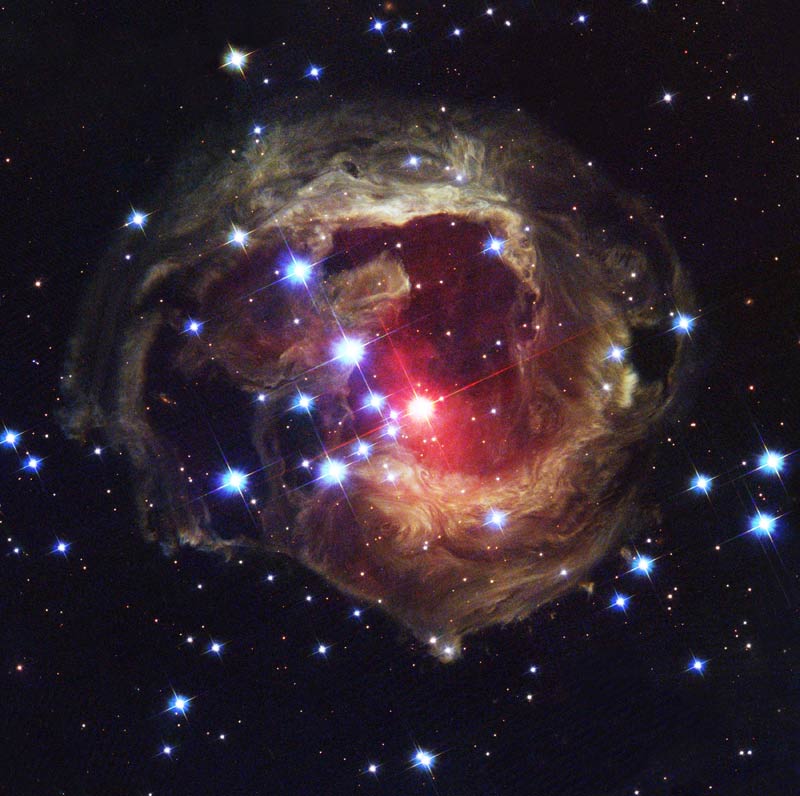
The image is of a region of space about 14 light years across, and the highest res version of the photo I've seen so far is about 800 pixels wide. That makes each pixel ~ 10 billion km wide.
-
A few hundred thousand kilometers? Bah
The image is of a region of space about 14 light years across, and the highest res version of the photo I've seen so far is about 800 pixels wide. That makes each pixel ~ 10 billion km wide.
-
Re:I'll keep waiting
Bah, I already saw the Hale-Bopp. It's all been downhill since 1997.
-
Re:I Always Wonder...
That doesn't mean there's a 5% chance of an earth hit. In 3-D, from a graph like that, I'd estimate 0.02% or so.
The odds are much less than 0.02%.
JPL's 2004 MN4 impact risk page doesn't even list the 2029 flyby, while listing a couple of 0.0000061% chance impacts.
-
Crikey!
That's awefully freakin' close!
-
Uhm...
The pictures of the predicted trajectory on the JPL press release page that CanSpice posted looks strikingly similar to the the arcade game Missile Command in which John Connor played in the movie Terminator 2.
I wonder, is that all it is? Just a game? Who's controlling the asteroid. I demand to know. -
Re:Plan now
Go look at this orbit simulation. If you run it into the future you'll see that the vast majority of the time this thing is pretty far away from the Earth, farther away from the Earth than the moon. And given it's a small body, we can't accurately predict where it's going to be in 50 years. It'd be much better to put something on the Moon than on this asteroid.
-
Re:I Always Wonder...
Go look at this JPL press release. See the white line in the closeup view? That's the error on the position. If that white line intersected Earth, then there would be some probability that this asteroid would strike us.
They can predict these things through hundreds of observations from observers around the world. Through mathematical modelling they can calculate what the orbit is going to be. As more observations come in and as the forecast time comes closer the errors go down. -
Star Tomography
A very interesting thing about this stellar outburst is the possibility to get a 3D image of the cloud surrounding the star. Images of this event taken months apart (like this sequence) show the flash of light as it expands, illuminating regions of space that form spherical shells around the star. This gives a unique insight into the actual threedimensional structure of the cloud, a bit like a CAT scan builds a 3D view from a sequence of planar 2D images. Pity we don't have (for all I know) one picture per day: it would have made a stunning movie! No to mention the scientific value...
-
Apparently faster-than-light
What's interesting, at least when you first think about it, is how the sphere of influence spans 14 light-years less than 3 years after we detected its "flash".
Of course, it's not really going faster-than-light, it's just a matter of perespective. The event happened 20,000 years ago, and the portion of the 14 ly radius sphere that's approximately 11 ly closer to us than the star should now be visible. That is, it took ~20,000 years for the flash to reach us, and ~(20,000+14-11) = ~(20,000+3) years for that portion of the echo to reach us.
-
An explanation
From Astonomy Picture of the Day:
"Explanation: Expanding light echoes continue to illuminate the dusty environs of V838 Monocerotis, mysterious variable star near the edge of our Galaxy. This stunning image, produced from Hubble data recorded in October of 2004, adds to a unique series of space-based, high-resolution views. After detecting a sudden outburst from the star in 2002, astronomers have followed the flash expanding at the speed of light through pre-existing dust clouds surrounding the reddened variable star. While the expanding light echoes are dramatic, astronomers have struggled to understand where V838 Mon itself fits into the stellar life cycle. Studies indicate the V838 Mon is a young binary system with a massive star responsible for the outburst. The Hubble image spans about 14 light-years at the estimated 20,000 light-year distance to V838 Mon." -
Re:High resolution image anyone?
Try NASA's Astronomy picture of the day site and then click on the image to download a high res pic.
Enjoy! -
Astronomy picture of the day
Here is NASA's Astronomy picture of the day site Astronomy picture of the day with the same picture and a brief explanation (with hyperlinks).
Enjoy -
Re:It's simpleProblem is that Microsoft's vastly more likely to eat Sun's lunch than vice-versa. The most probable outcome from all this is that MS gets more headway at the top of the market while Sun collapses into a White Dwarf. Since Microsoft is the monopolist
Sorry, the astronomy metaphors are too easy...
-
Re:Aren't baryons just normal matter?
I think he meant bouncing off of electrons... in the "radiative zone" doncha know...
-
Re:Why?
Now, you're establishing ridiculously narrow criteria for judging the value of the space program: the parent has ruled out all scientific knowledge (so we can't talk about the Genesis Rock brought back by Apollo 15, or the excellent solar observations made on Skylab, or the advances in astronomy due to Hubble, or the contributions of the Mars Rovers), and you've just ruled out spin-offs from technologies developed for the express purpose furthering the space program as well as those technologies themselves (bye bye integrated circuits, farewell satellites).
What you're looking for are things based on the results of pure scientific experiments conducted in space, but neither the science itself, or the technology used to conduct those experiments, is acceptable. Tricky. But not impossible.
There's a smokestack pollution monitor, waste recycling/conversion technology, and a near infrared fire detector, for example. If you want more, there's always Google. -
Re:The Hubble is being replaced...
This should be modded redundant.
This is PortHaven's earlier post, and is neither quoted nor attributed to its source webpage at the JWST homepage -
Now How Much: Who is Hubble Repair Worth?
Any proposal to use the Space Shuttle should require answering the question: Which astronauts are you willing to kill for this mission?
-
Re:$1 billion?
How much would a new telescope cost? I mean, $1 billion is a lot for repair costs -- if a new one costs somewhere around there, why not just replace hubble altogether?
$1.5 billion. But that was just to build it. NASA claims it would cost much less to service and repair the Hubble rather than to launch a new one into service. -
Expanding Glaciers
Lets start with: http://tvnz.co.nz/view/news_national_story_skin/4
6 9987%3Fformat=html
http://www.iol.co.za/index.php?set_id=1&click_id=3 1&art_id=qw1106022963550R131
http://boards.historychannel.com/thread.jspa?threa dID=300034074&messageID=300411450
Showing the southpole has been holding steady temp: http://www.giss.nasa.gov/cgi-bin/update/csci/show_ station.py?id=700890090000&data_set=2 -
Re:Having the wrong goal is worse than no goal1 person walks at about 2 km/d. 1 robot moves at 2 m/d.
Where do you get that robots can only move 2 meters in a day? That's completely absurd. The Mars Rover could do 5 centimeters per second, although, they say it averages 1 cm/sec. At the average speed, it can cover 864 meters in a day, or almost a kilometer. And that's current technology; if we actually did start mass producing these things by the thousands, we could make a lot of improvements.
But this ignores the ease with which a human can obtain the information, the experience gained from living on another planet, and the pride in having a human on another planet in our solar system.
Pride is completely worthless. Pride didn't keep us on the moon, and it won't keep us on Mars. The living experience gained is interesting, but not particularly valuable, especially considering the price.
-
Re:Doing this since the 50s
I'm glad to see somebody beat me to the punch. Perhaps a bit of additional info may shed light on the subject. Disclaimer: I'm a plasma physicist.
The initial 'deal' with detonating nuclear weapons in the ionosphere was to see whether we could create our own artificial radiation belts. Due to Earth's magnetic field, the plasma created by the nuclear detonation will remain trapped (for the most part) in a bananna-shaped orbit, bouncing from north to south pole. Over time, the radiation cloud is ejected into space, again becuase of interactions with the Earth's magnetic field. (Particles can get lost and settle down over the poles, too -- watch out Antarctica!)
Sure enough, lobbing nukes up there created big, bananna shaped radiation belts, just as Nicholas Christofilos had predicted in the 50's. They decayed within a few weeks, and didn't attain the desired military effect of creating a band so intensely radioactive that it would knock out nearby missiles and sattelites. (It vindicated much of the early plasma physics, though!)
In addition to making a radioactive blanket that encircled the Earth, it also made one helluva light show at the poles, where the magnetic mirror bounce was taking place! (Incidentally, such a belt can be more damaging to sattelites than the original EMP itself. Google HANE if you're interested.)
-
Re:Good DesignsThe APUs are powered by the decomposition of hydrazine fuel and drive hydraulic pumps.
See http://science.ksc.nasa.gov/shuttle/technology/st
s -newsref/sts-apu.html. -
Re:Nasa WAS working on heavy lifting in shuttle fo
From the GP's description I would say the X-33 is what it was refering to.
http://www.hq.nasa.gov/office/pao/History/x-33/men u1.htm -
Re:Dump stupid ideas
It's been a while since my grade school science class but I believe that the more important aspect of location is it's distance from the poles (or proximity to the equator). Most space launched items use the earth's rotation to offer additional "thrust" into space.
http://www-spof.gsfc.nasa.gov/stargaze/StarFAQ3.ht m#q62Someone who has more credentials than me agrees. -
Re:Having the wrong goal is worse than no goal
Agreed, and the process whereby you achieve that goal needs as much scrutiny as the goal itself. If you shackle the "permanent colony on the moon" goal to "achieved using existing infrastructure," you're doomed to failure.
If the gub'ment dictates that the Shuttle shall be involved, now all components must a) break down to fit in a Shuttle cargo bay; b) meet Shuttle safety requirements; c) visit LEO and possibly the ISS before moving onward. Yeah, it uses the existing infrastructure, but certainly isn't an optimal solution.
We need a heavy-lift infrastructure element that'll send big payloads to the moon. I would further propose that the heavy-lift launch vehicle be explicitly not-man-rated. Cargo payloads only. Robotic and tele-operated missions as terraforming operations are appropriate for the initial missions. Sending the people up should be one of the last things on the list. When they arrive, there should be cargo containers and shelters waiting for them.
Every time I see the government funding another Crew ($synonym-for-"move") Vehicle, it just makes me cringe. If you want to send a larger crew to the ISS, send another Soyuz. And for chrissakes, install the damned ECLSS Module so the station isn't dependent on the water truck making a delivery. -
Re:Then what?
As I've previously discussed on slashdot, you do not need to be moving outward from your energy source in a solar sail, you can achieve thrust vectors in any direction from full away to orthogonal (perpendicular for the 2D vector peeps) And orbital mechanics isn't of the form of "thrust straight at where you want to go" it's more like "thrust in the direction of orbit to move away from primary, thrust against the direction of orbit to move towards primary"
Good point.
People don't realize orbital mechanics is an arcane science completely unlike the common perception of strapping a rocket booster to yourself and pointing yourself in the right direction. For example, look at the "Interplanetary Superhighway" for normal spacecraft. It's the path of least resistence for spacecraft and it looks nothing like a straight line since it's based on Lagrange points and other strange artifacts of three+ body orbital systems. I'm guessing there is another similar path possible for this solar sail system that invovles it flying in a curve where it's never directly between us an Mars. I.e. it's thrust vector isn't the same as its position vector with respect to Earth. Thus it would be quite possible to steer and stop with this system if you know the right math.
--
Free iPod? Try a free Mac Mini
Wired article as proof -
Re:And how does it slow down when its there?
Well, maybe it's possible that you don't mind a one way trip into space. For example, you could be a martian probe.
-
Re:Spot the problem first
There is a reason why the shuttles have launch windows - to get into certain orbit. If the interval between those windows is too long, then the rocket solution is kind of useless
You can get into any orbit you like, as long as you have the fuel. Also, the interval between the correct low orbit launch window isn't long. According to this page, there is a window each day. Thats not too long to wait.
plus they'd need an arm or something to catch the payload.
A docking collar would be sufficent, the shuttle can manouver precicely enough to dock with the supply capsule. A while ago I read that the MMU (manned manouvering units) that were worn by astronauts to free-fly out to sattelites were mothballed because they were not needed, as it was possible to manouver the shuttle with sufficient accuracy to fly the satellite into the cargo bay, rather than sending guys out to the satellite.
Why not stick a couple of Soyuz escape pods into that payload for the shuttle crew to bail out and abandon the orbiter?
I don't know what Soyuz capsules weigh, but I bet its not light. Plus, you'd lose one of the primary resons for the shuttles existence - its much vaunted but hardly used ability to capture sattelites and bring them back to earth (unless you ditched the Soyuz each time they weren't needed...)
Also, launching the shuttle into orbit w/ ISS creates a possibility of an accidental collision between the two, if one becomes incapacitated.
No. Space is a big place. There is lots of room in LEO. Anyway, things in orbit follow easily predictable paths. If the shuttle, or ISS becomes incapacitated, it will continue to drift along in its current trajectory (for the short-medium term anyway). Their positions are easily predicted months in advance, and can be tracked by ground radar anyway. -
Re:Why not an escape capsule?
Yep, quite sure.
And it's more complicated than the explicitly-stated "oversimplified" description I made earlier. If you just shoot propellant out the spacecraft normal to the velocity vector, the spacecraft heading will change. The net effect is that you've vector-summed the original velocity plus the new input. The result is a new vector direction with a larger magnitude than the original. Congratulations, you just raised your altitude.
It's really tough to change your orbital plane. There's no ocean for your keel to react against. There's no road for your tires to push on. You only have the linear reaction of the thruster. It boils down to vector-sums of linear elements. Really.
If you intend to maintain your orbital altitude, you have to keep the magnitude of your velocity vectory the same. That implies that the steering forces will be constantly moving in a circular motion around the center of the spacecraft. The net effect will be that you cancel out the velocity vector in the "x" direction, and introduce a new one in the "y" direction.
There are plenty of references on the web. If you're willing to substantially alter your orbital parameters, plane changes thorugh a circular-elliptical-circular progression will only require about 1x delta-v expenditure. You make the plane alterations at apogee in the ellipitical phase, then re-circularize. If you intend to make the 90-degree turn while staying in the circular orbit, you're required to expend 2x your original velocity in terms of delta-v. -
Re:Speed
No, they wouldn't require the same amount of fuel to slow or change the direction of the craft from orbit.
I know. That's why I used N=4.5 instead of N=5.4. (You stopped reading my post after the first paragraph, didn't you?)And yes, the shuttle DOES slow down some. It actually comes in completely turned around (IIRC) and starts with a breaking maneuver.
True, it expends a tiny quantity of propellant to nudge its periapsis down into the atmosphere. (See this.) I don't see how that relates to what I said.The Orbiter's entire delta-v capability while in orbit (and for re-entry) is 700m/s. Remember that it's moving somewhere in the neighborhood of 7700m/s at the time. If it used the entire 700m/s to decelerate for re-entry, it would drop only 1% of its kinetic energy. The other 99% is left to the atmosphere.
The point is, you have two choices to do most of your braking: aerobraking or rockets; and the latter uses prohibitive quantities of fuel.
-
Re:Why not an escape capsule?Excape capsules could be created that take up 1/2 the space, could survive re-entry, and easily fit within the cargo area. Wouldn't that be much cheaper than a sister shuttle at the ready?
In principle, perhaps. On the other hand, the Shuttles are only supposed to be used for a few more missions and NASA is looking for a stopgap backup system now. Designing and testing a new escape capsule system would take years and cost billions of dollars, and probably not be ready until after the current generation of Shuttles are retired.
Escape capsules might make sense for the next generation of craft.
Hmmm...for a quick and dirty solution, you could put two Soyuz capsules in the cargo bay. From here, the dimensions suggest that you could still have some space left over in the cargo bay. (Soyuz diameter 2.7 m, length 7 m. Shuttle cargo bay is 18.3 m length and 4.6 m width.) The Soyuz capsules could be stripped down a bit, too.
-
Rescue of Columbia's crew as discussed by CAIB
The Columbia Accident Investigation Report listed one permutation of a rescue mission that could have been launched to save Columbia, if anyone had realized the true severity of the damage to her wing. According to the report, a second shuttle (I believe it was Endeavour, but it's been a while since I read the report) could have been rolled out and launched in a matter of days, skipping the normal three-month pre-launch safety checklist.
The second shuttle could have rendezvoused with Columbia and brought to station-keeping directly below her, such that the two shuttles' cargo bays were facing each other (Columbia would have been orbiting upside-down and backward relative to the ground, as is standard). Columbia's crew could then have transferred to the rescue shuttle via tether.
All of this could have been done inside the week-long window before Columbia's consumables were exhausted; after the rescue, Columbia would have been de-orbited into the ocean.
One of the things that will be mandatory on all remaining shuttle launches will be for all shuttles to be able to rendezvous and dock with the ISS, in the event something like this happens again. This was not an option for Columbia, for a couple of reasons--she was unable to boost to the ISS's altitude, and she lacked the correct docking mechanism to couple with the ISS. -
Re:the shuttle program from the start, in a nutshe
-
Re:IndeedSorry for being a moron, but I think that if you are going for a mission critical solution with high availability I would propose an OpenVMS system.
OK, the EULA is probably not permitting it to be used for mission critical solutions either, but in my opinion it's one of the better commercially available OS:es. (There's even a hobbyist license available). (anybody knowing of an OS that has an EULA that actually claims that the OS is intended for mission critical use?)
I think it's about time to require that software companies are responsible for their code. There are too many simple bugs passed through every day that would have been caught if a thorough software testing was done. One tool for doing it is Purify Plus, and another is Splint.
Splint is available to the public, unfortunately it's only checking C and not C++. (anyone in the mood for implementing a C++ version?)
And not even NASA and ESA software are always bug-free, but their software is as close as you can come to mission critical applications. I wouldn't like to have a computer running Windows on a mission to Mars, it isn't stable enough.
-
Non-ecliptical probe trajectories
The Voyager probes are no longer in the plane of the planetary orbit; I believe both of them are now travelling in a direction more than 30 degrees from this plane.
This is correct. As seen from Earth, the JPL Solar System Simulator shows Voyager 1 in Ophiuchus, Voyager 2 in Telescopium, Pioneer 10 in Taurus, and Pioneer 11 in Scutum. Of these, only Pioneer 10 remains really close to the ecliptic (within 5 degrees), while Pioneer 11 deviates maybe 15 degrees from it. The Voyager probes are each some 30-40 degrees off, on different sides of the ecliptic.
-
Non-ecliptical probe trajectories
The Voyager probes are no longer in the plane of the planetary orbit; I believe both of them are now travelling in a direction more than 30 degrees from this plane.
This is correct. As seen from Earth, the JPL Solar System Simulator shows Voyager 1 in Ophiuchus, Voyager 2 in Telescopium, Pioneer 10 in Taurus, and Pioneer 11 in Scutum. Of these, only Pioneer 10 remains really close to the ecliptic (within 5 degrees), while Pioneer 11 deviates maybe 15 degrees from it. The Voyager probes are each some 30-40 degrees off, on different sides of the ecliptic.
-
Non-ecliptical probe trajectories
The Voyager probes are no longer in the plane of the planetary orbit; I believe both of them are now travelling in a direction more than 30 degrees from this plane.
This is correct. As seen from Earth, the JPL Solar System Simulator shows Voyager 1 in Ophiuchus, Voyager 2 in Telescopium, Pioneer 10 in Taurus, and Pioneer 11 in Scutum. Of these, only Pioneer 10 remains really close to the ecliptic (within 5 degrees), while Pioneer 11 deviates maybe 15 degrees from it. The Voyager probes are each some 30-40 degrees off, on different sides of the ecliptic.
-
Non-ecliptical probe trajectories
The Voyager probes are no longer in the plane of the planetary orbit; I believe both of them are now travelling in a direction more than 30 degrees from this plane.
This is correct. As seen from Earth, the JPL Solar System Simulator shows Voyager 1 in Ophiuchus, Voyager 2 in Telescopium, Pioneer 10 in Taurus, and Pioneer 11 in Scutum. Of these, only Pioneer 10 remains really close to the ecliptic (within 5 degrees), while Pioneer 11 deviates maybe 15 degrees from it. The Voyager probes are each some 30-40 degrees off, on different sides of the ecliptic.
-
Re:Historically speaking...
I don't think you really understand the need for gravitational assists. Without such assists a probe using current launch technology would not be able to make it anywhere close to the edge of the solar system. We can't just fire these things off in a roughly straight line. They're launched in what are essentially variations of a Hohmann transfer orbit. Instead of moving from one circular orbit to another though, you're transfering from a circular orbit to a hyperbolic one. The same concept applies, energy needs to be added to increase the altitude of the orbit which is where the gravity assist comes in.
Shooting a probe off perpendicular to the mean plane of the solar system would be shooting yourself in the foot. You'd be entirely missing out on the enormous gravitation boost Jupiter and/or Saturn offer. You would need überamounts of extraordinarily energetic fuel to make the trip without using the gas giants. Even then the rocket (as mentioned) would need to be about 98% fuel. We can at best build ones that are 90% fuel.
There's also a shitload of vaccuum in the planetary plane just as there is perpendicular to the plane. There would really be little use in avoiding the planetary plane as you suggest. Besides the boost the probe would get from the gas giant(s) it could be put on a course where some secondary science could be conducted on the way to the edge of the solar system. You wouldn't need extra equipment to study doppler shifts as the probe entered say Jupiter's gravity well during an assist or watch it's radio signal as it was occulted by the planet for frequency varations to infer magnetic fields or ionized particles in the atmosphere.