Slashdot Mirror
Domain: nasa.gov
Stories and comments across the archive that link to nasa.gov.
Comments · 16,365
-
Re:Astonishing Scientific Breakthrough!!!!
The transit from SOHOs point of view will merely be a transit across the solar corona. Since Venus is already visible in the Lasco C3 image, the transit of the corona has essentially already started.
-
The U.S.A. will get a much better look in 2012
Here is the map of the transit for 2004.
And here is the map of the transit for 2012.
So while I won't get to see it this year unless I hop in my car and drive east for about 20 hours without rest, I will get to see it in 2012, unless I'm in Chille or Argentina, or something.
The further north you are, the better your chances of seeing it.
If you're in Antarctica you won't see it at all. -
The U.S.A. will get a much better look in 2012
Here is the map of the transit for 2004.
And here is the map of the transit for 2012.
So while I won't get to see it this year unless I hop in my car and drive east for about 20 hours without rest, I will get to see it in 2012, unless I'm in Chille or Argentina, or something.
The further north you are, the better your chances of seeing it.
If you're in Antarctica you won't see it at all. -
Safety, Remember Safety
I'M BLIND!!!!
For one thing, it doesn't start for another day and an hour or so.
(I'll admit that I panicked and rushed outside and took quick looks at the sun, before I came back and read the article and realized we still have about 25 hours until it even starts.
For another thing, slashdot was kind enough to post a link to safety instructions in the headline.
So, what are solar filters? How much do they cost and where can I get one if I want to drive across the country in a mad dash to catch it at sunrise in South Dakota or whatever?
I've been wanting to check out that Wall Drugs that so many people have bumper stickers for for awhile anyway. Maybe they sell solar filters? But if I'm going to drive halfway across the country I want more then just a pinhole thingy.
Who's up for a road trip?
But if you forgot safety and go temporarily blind, at least you can turn your Chinatown apartment into one big computer and discover a way to predict the stock market. -
Crater Naming
Back when the Magellan mission was mapping the surface of Venus, I had a planetary geology friend who was involved in assigning names to features. I managed to persuade him to name a crater after my girlfriend Marianne, as a birthday present to her. At the time I thought this gift was pretty cool; unlike star names, which are meaningless, this was an official designation, and furthermore Venus was the Planet O' Love.
My mistake, however, was to forgetting that Venus is eternal, but love isn't. Every time I see Venus hanging in the evening sky, I realize I named that damn crater after the wrong woman. LOL!
-
Re:Unfortunately...
How Long does it take to drive to Alaska?
They can see it at Sunrise, no wait, that's sunset.
I guess it would make more sense to drive east and see it at sunrise. More time to get there. How far would I have to drive? from this map it looks like I'd have to be east of Colorado. I wish gas wasn't so expensive these days.
Never thought there would be a reason at this point in history to be envious of people in Iraq. They'll get to see the whole thing.
At least we have 8 years to prepair for the next viewing. This sounds pretty kewl. -
Nuclear power
It is already being planned. For whatever reason public squeamishness about nuclear powered planetary probes has abated since it reached a peak with the Galileo and Cassini launches. A good thing for exploration.
-
Earth's magnetic field is starting to flip?
Some scientists think the Earth's magnetic field is preparing to flip again, which it does every so often. Apparently when this occurs, it is preceded by a period of local variations - mini-poles showing up all over the planet. This system could be invaluable in tracking this process.
Also, according to this article and others, the field has decreased 10% over the last 150 years. This has left some satellites vulnerable to damaging radiation.
Other links:
Sun's rays to roast Earth as poles flip"
The Sun Does a Flip
Quick flip of Earth's magnetic field revealed -
Re:were the solar panels made from...
-
Re: Why would they stop working?
Seems like a prime opportunity for a nuclear powered rover!
I believe that's exactly the thing they want to do with the Mars Science Laboratory, to be launched around 2009. Some time ago I saw a presentation on Laser Induced Spectroscopy, which they want to include in that mission. Essentially what they want to do is to put a high power pulsed laser with a small telescope on top of the rover mast. Its light can be focused to a tiny spot some tens of meters away. You pick up the light that is caused by the heated/burnt/evaporated rock and analyse it with an optical spectrum analyser. In this way you can remotely analyse a rock in a few minutes, which costs them a whole day right now with the robotic arm. -
Hmm...It's great to hear that the rovers are operating well beyond first expectations and predictions, it's sad to think that their eventual death will quite possibly due to the physical barriers of the Mars terrain, rather than because of the end of their "natural life".
The question is, why didn't NASA incorporate this into the design of the rovers. They have such high tech equipment encompassed such as hazard avoidance cameras, mechanical senses etc, outlined here that it seems obvious that the rover should be able to get out of craters. After all, Mars is full of them, the terrain is very rocky and unstable.
-
Re:Falling down?
From the pictures in the link it doesn't look that difficult to get a rover into - I think the main problem is traction when trying to get it out.
According to NASA they're aluminium wheels and their main purpose looks like it was to absorb the shock and go over rocks than get the traction required to climb back out of a crater.
I'd imagine they have quite a bit of weight behind them too... -
Please learn how to make links.Please learn how to make links.
<a href="http://www.faqs.org/docs/Linux-HOWTO/Astron
(without the spaces added by Slashdot) yields:o my-HOWTO.html">starting point</a>
<a href="http://www.randomfactory.com/lfa.html">so me software</a>
<a href="http://www.randomfactory.com/lfa/v789info.ht ml">some more software</a>
<a href="http://heasarc.gsfc.nasa.gov/docs/software/l heasoft/">Heasoft</a>starting point
some software
some more software
Heasoft -
Re:International Space StationYou are right, it was the money, not the Air Force (for once) when it came to the boosters:
"The winged S-IC soon would die as well, for it appeared more costly than the pressure-fed reusable booster which, though it might look and fly like an ugly duckling, was a graceful swan in the realm of budgets, and would survive into the next round of designs. This round would resurrect the solid-propellant booster, and would determine the shape of the Shuttle in the form that would actually be built."
From The Space Shuttle Decision
Still, the solid rockets give me the willies until they're jettisoned.
-
It is _NOT_ a database.
It's a search engine, for the most part.
I'm one of the programmers on the Virtual Solar Observatory. The poster I'm presenting today at the American Astronomical Society explains a little bit about what we're trying to accomplish.
The problem is that there are lots of places out there that are making recordings, but not all of the data are being shared with other researchers. Much of the time, it's because people don't know the data is even out there. For instance, if someone finds some odd reading out there, before they go and spend a lot of time on it, if they can compare the data to some other telescope reading at the same time, that's at a different location, they might be able to determine if it was an error on the instrument, as opposed to a legitimate event.
As instruments only point at a fixed region, if you find something on a wide angle picture, you can try to find out if someone else was pointing at the region of interest with a better resolution at that point in time. -
Re:Price of Robot vs new Hubble
Probably not that much since NASA has been working on robotics/telepresence for some time now. Although the NASA's Telerobotics program was shut down in 1997, but the research (at least according to this website) was transferred to other individual programs. I assume one of the flagship programs now is the Robonaut now in development.
-
Re:Price of Robot vs new Hubble
Probably not that much since NASA has been working on robotics/telepresence for some time now. Although the NASA's Telerobotics program was shut down in 1997, but the research (at least according to this website) was transferred to other individual programs. I assume one of the flagship programs now is the Robonaut now in development.
-
Actually, it was Pete Knight, and not Bob White
To protect the craft during the 6.7 Mach flight, there was a coating sprayed on the body of the X-15. As it burnt off, it would cloud the view of the pilot, Air Force Major Robert White in this case.
One small correction - the pilot for the M6.7 flight was Major Pete Knight. The highest mach that Major White got to was M6.04. See:
http://www.edwards.af.mil/history/docs_html/aircr
a ft/x-15_mach6.7.html
http://www.hq.nasa.gov/office/pao/History/x15conf/ log.html -
Re:My first question
The dark energy refered to is unusual because it implies a kind of antigravity. It isn't drawn into play to account for the fact that the universe is expanding, but rather to explain the recent observations that indicate that the rate of expansion is increasing.
It is related to Einstein's cosmological constant which Einstein regretted introducing because it was kind of a kludge to account for a supposed static universe.
Apparently there are cosmologists today who still regard it as a bit of a kludge, making the cosmological model convoluted like Ptolemy's model of the solar system. There was a recent Scientific American article that discussed this, but only a summary is available online.
Maybe you were confusing it with dark matter?
-
Re:Yes, It's Impressive
1) People will not be invigorated by watching three people, two billionaires and a pilot, take a joy ride. They will be invigorated by watching man walk on Mars, or at least having a leader who says we're going to go there.
Part true, part false. The cynical side of me says yes, you are right; Julia Roberts being pregnant with twins is more interesting to the public than the technical feat of affortable space flight. Where you're wrong is that we, at least 'we' in terms of US citizens, do have a leader who says we're going to Mars. An announcement also greeted, I might add, with less enthusiasm than that of Julia Roberts' twins.
2) We've had the technology to go to space for forty years. We've had the technology to do suborbital flight for longer. Hell, we could have landed on Mars before I was born, but we didn't have the economic or political balls to do so.
We have landed on mars, presumably before your birth (1976). Oh, did you mean land humans on mars? I'd argue we don't have the technology now, much less 15 years ago. From where does your statement come? I'd like to see how you're going to keep humans alive for the trip to mars (and back). How you're going to launch this project. How you're going to launch on Mars to get humans back into space from that planet before returning to this planet. Maybe this project needs a cheap way to get to space on this planet, and improved technology developed on this planet before we just toss a couple astronauts toward mars.
3) I don't think tourism is really helping the economic situation in Africa. I'm sure they would rather have people invest in their infrastructure. Same thing with space: We need an infrastructure to make space more than an alternative to the safari. We can't do that launching ~500 kg at a time.
I think tourism is helping the economic situation in Africa. Tourists demand things like food, running water, sanitary waste facilities, roads, airports, internet cafes & other things that will eventually improve locals' lives. In terms of needing an infrastructure to get to space, what do you think Scaled is doing? They're (im)proving the technology necessary to get there. While the gemini, mercury & apollo programs rapidly put the US ahead of the soviets in the space race, they did not leave us with affordable access to space. The people at Scaled Composites seem to be focusing on this goal. So what if they haul tourists with the proof-of concept craft? Its a way to fund future developments.
New advances in space access are not going to come from governments. They are going to come from private sector innovators who develop ways to drive costs down & efficiencies up. You're totally correct that we need an infrastructure to make space more accessable from earth & thus make travel away from earth & earth orbit possible. Developing that technology in one shot is inefficient and expensive. Given the other costs that governments face I don't see them being able to dedicate the necessary resources to such a goal. However, the private sector may be able to create new markets that will provide the funding that will get payloads out of earth orbit sooner & cheaper.
-
Re:It's the commercial version of Mercury
Actually, if you asked NASA to get you into a sub-orbital launch, they would point you to the National Scientific Balloon Facility located at Wallops Island. $500K will get you a two day flight above 120,000 feet - close enough for most science. If you need weightlessness, a sounding rocket can also get you there, but not for as long, of course. Not everything NASA does is an overpriced iron pig.
-
Are not!
The pilot (to be announced at a later date) of the up-coming June sub-orbital space flight will become the first person to earn astronaut wings in a non-government sponsored vehicle, and the first private civilian to fly a spaceship out of the atmosphere. SpaceShipOne then coasts up to its goal height of 100 km (62 miles) before falling back to earth.
Seeing as a) most people in the aerospace industry defines space as 'anything above 100km over SL (sealevel), and b) they havn't gotten any money from the big, evil goverment to build their vessel, this is correct. Off course, he won't be completly out of out atmosphere, but then the edge of that isn't a sharply defined line.The pilot experiences a weightless environment for more than three minutes and, like orbital space travelers, sees the black sky and the thin blue atmospheric line on the horizon.
According to This New Ocean: A History of Project Mercury (freely avilable from NASA's website), this is a very good description of what Alan Shepard experienced on his suborbital flight on the 5th of May 1961 (see chapter 11-4 of the aforementioned bood, or see what Wikipedia has to say on that flight).Interestingly enought, when I first heard of the X-prize, I assumed it would be won by a reusable capsule modeled on the early american designs (Mercury, Gemeni or Apollo) launced by reusable solidfueled rockets. I'm happy a more inovative, less 'brute force' approach seems to be winning.
-
Are not!
The pilot (to be announced at a later date) of the up-coming June sub-orbital space flight will become the first person to earn astronaut wings in a non-government sponsored vehicle, and the first private civilian to fly a spaceship out of the atmosphere. SpaceShipOne then coasts up to its goal height of 100 km (62 miles) before falling back to earth.
Seeing as a) most people in the aerospace industry defines space as 'anything above 100km over SL (sealevel), and b) they havn't gotten any money from the big, evil goverment to build their vessel, this is correct. Off course, he won't be completly out of out atmosphere, but then the edge of that isn't a sharply defined line.The pilot experiences a weightless environment for more than three minutes and, like orbital space travelers, sees the black sky and the thin blue atmospheric line on the horizon.
According to This New Ocean: A History of Project Mercury (freely avilable from NASA's website), this is a very good description of what Alan Shepard experienced on his suborbital flight on the 5th of May 1961 (see chapter 11-4 of the aforementioned bood, or see what Wikipedia has to say on that flight).Interestingly enought, when I first heard of the X-prize, I assumed it would be won by a reusable capsule modeled on the early american designs (Mercury, Gemeni or Apollo) launced by reusable solidfueled rockets. I'm happy a more inovative, less 'brute force' approach seems to be winning.
-
Oh this is gonna be good
Wrong. The average insolation in the US is 6 hours of peak sun per day, no desert required (ie 6000 Wh/sq. meter per day). For a flat panel, the deviation from the best southern nevada site to the worst northern washington state site is only 2-to-1!
Thanks, I did not know that about the deviation. I learned something today. Actually, it was recently mentioned to me that Arizona would not be the best location because excessive heat reduces efficiency.
However, I was under the impression from sources like NASA among others that the Solar Constant was only in fact 1,367W per square meter. Far be it from me to agree with rocket scientists.8-12% is a little low. Current product cell efficiency are around 14-18%, and Concentrators w/ multijunctions get 30%. But who cares?
First of all, the use of concentrators is not useful here. Why? If you concentrate three square meters of sunlight with optics down to a square meter panel, you are still taking up three square meters of solar energy, not one. Optics may reduce the amount of panels that need to be created, but they don't really change the equation. And for the record, I care.
As for efficiency, multijunctions are extremely expensive and not the kind of panel you find on people's homes. The versions that don't break the bank (only cost ~$30K to make a roof of them) are between 8-12% efficient. Don't believe me? Let's quote from your own Solarbuzz.com link:Module efficiency
That's your source, not mine. The question really is, does 8-12% efficiency do the job?
Commercial crystalline photovoltaic modules efficiency typically ranges from 10 to 13 %. However, you must be aware, that the solar cell efficiency doesn't equal the module efficiency. The module efficiency is usually 1 to 3 % lower than the solar cell efficiency due to glass reflection, frame shadowing, higher temperatures etc. Table 1 represent some features of different solar module types. Amorphous modules have the lowest price, yet their lifetime is short and their efficiency is up to 8 % only.
So let's do some actual math shall we? 1.367kW per square meter at 100% efficiency. 2,589,988.11 square meters (1 square mile) * 1.367kW * 6 hours per day * 250 days (I'm being generous with days without rain, fog, snow, etc.) = 5,310,770,619.555kWH. That is hard limit. That's your potential at 100% efficiency (in other words, unattainable) with 100 square miles. That's 0.144% of the total US demand. A better number would be 69,444 square miles needed at 100% efficiency. 50% efficiency lab samples would take 138,888 square miles. Once again, this is larger than the size of Arizona (113,635 square miles)! 690,444 square miles at 10% efficiency (much more likely efficiency). The US (including Alaska) is 3,537,438 square miles. That's 19.5% of all US land area used for solar panels. And you'll please note that I've been more than generous with my calculations.
Once again, repeat after me: It doesn't matter how much you are willing to pay.
Comparisons with the Iraq war are unnecessary and frankly irrelevant. The supply simply isn't there at any cost. Solar and wind alone cannot do the job; Especially solar. A 5kg weight will never be more than 5kg. A 5cm object is a 5cm object. And 1.367kW/m^2 is the total amount of solar energy that hits the Earth. -
been done...
-
Here is a plan for a low-cost reuseable launcher.
Make a modern space-plane like the shuttle, and strap it to the back of a modified large commercial jet-aircraft like a 747, as seen here. Then use the concept used by Scaled Composits for SpaceShipOne, to bring the space plane up to a high altitude and release it there. It then continues into orbit using rocket power.
The trick is that because the shuttle is attached to the TOP of the 747, and not underneath, you have to do a roll and fly upside down for a bit when releasing the shuttle. But that's no problem. Planes can do that; even 747s -
Re:Why not fuel free?This was being done in the early 60's by a Canadian research team. Google for Harp Gun, and read here . Basically they started with 7 inch guns, and were shooting probes up to do high altitude research. In phase 2 of the project they were using a 16 inch gun, and projectiles that included a rocket motor. The 16 inch gun was capable of lifting a 200lb projectile to an altitude of 90 miles.
The projectiles they were firing (the martlett) had a bunch of electronics in them, and they had designed them with a small rocket motor to maneuver at that altitude, not sure if they actually flew any with the motor.
The entire story is quite interesting, after the Harp project ended, Gerald Bull (the engineer behind it) went on to continue the research covertly funded by the cia initially. When he had a major falling out with the cia, he worked with other foriegn governments to continue the upscaling of the concept. He was assasinated when he built one that was capable of launching a 1000kg projectile over a distance of a thousand miles, before they had a chance to fire it. Interestingly, that one was capable of orbiting a much smaller projectile.
-
Re:Boooring.but what is it about those devices is it that makes them a robot?
A positronic brain, of course.
Seriously, robots tend to have at least one of the following characteristics (and examples):
- Humanoid Shape - Everything from battlemechs to service robots.
- A.I. - Data) and HAL 9000
- Manipulators (hands/arms) - Canadarm and Canadarm 2
- Remote (bomb disposal) or Autonomous (Predator UAV) Operation
-
Huygens not released until December
The submission isn't really wrong, 5-6 months could still be considered a 'few' months but the Huygens probe won't be released until December, 2004, and won't reach Titan until January, 2005.
-
Re:Is it just me?
Speaking of that movie. I saw it on the weekend, and I and my friends had a nice long discussion about the difference between improbable and impossible. This movie skirts that line, to say the least.
NASA's web site has a short article called Sudden Climate Change which briefly discusses the plausibility of that movie's scenario. It goes to great lengths to avoid naming the movie but it deals with the possibility of sudden climate change (prossibly to avoid legal trouble?).
An interesting read for anyone wondering about it. Not very long though. The conclusion is essentially to not believe everything you see in the movies. -
comet linear?
It has currently made observations of Comet C/2002 T7, or Comet Linear.
It's not THE Comet Linear, it's just another comet found with the LINEAR research program. -
Re:While we're quoting SF authors (or characters)
As much as everyone's chuckled at it, myself included, it's worth clearing up the Gore thing, especially in light of who made it to the White House instead.
He pitched in, and was one of the proponents of making what was once the rather 'closed' (or at least, nonprofit save for the likes of BBN) ARPANet a full public resource. What we can gather from the sweep of history is that he probably believed that, as such a resource (even one used for commerce), it should be policed to the same extent as the public airwaves (note amateur radio's longstanding restrictions against 'profanity' and the use of cryptography), and, er, the media at large -- gotta protect those kids. That was, of course, his mistake; "the Internet" of today doesn't run on limited public spectrum so much as a theoretically 'unlimited' set of private wires, and while it couldn't have been built in the form we know it without the ARPANet, the First Amendment and property rights rather, erm, 'rightly' intervened, to a greater extent than they were previously able to in the limited broadcast-media bandwidth.
If you look at his other 'initiatives,' it's obvious he's a futurist of sorts, albeit one who might not realize his 'great ideas' have often already been implemented to degrees. Of course, he was proposing more of a national art project than anything else (follow the reference chain from here, if you wish),
but his 'backing' attracted funding for a technically useful climate-monitoring mission that's now complete and awaiting a slot for launch.
[No, don't look at me... I voted Libertarian.] -
#cassini Chat available to all...
We have a room on the irc.freenode.net servers called #cassini which is available to all who are interested in the Cassini project. Here you will find a wide range of interests discussed, from the informal to the most scientific details of the mission. Some of the Cassini staff have shown interest in participating to further support the project's public interest so don't be surprized to meet them there.
We also support the ' Maestro ' program which is the Public-Outreach software created for the Mars Exploration Rover Project from JPL . As a result, we helped maintain the #maestro room (also on freenode.net) which is still in operation today.
With such high interest building as Cassini-Huygens approaches orbital insertion and the Phoebe flyby, we expect a bigger rush in the next weeks. Join in and share the experience!
If you are not sure how to do 'IRC' there are many good primers online to help and you can visit http://freenode.net for details about connecting as well as links to assist you to set things up to chat online.
See all "/.'ers" there...
Pandelirium
http://www.pandelirium.net irc.freenode.net
#cassini
#maestro
#pandelirium -
#cassini Chat available to all...
We have a room on the irc.freenode.net servers called #cassini which is available to all who are interested in the Cassini project. Here you will find a wide range of interests discussed, from the informal to the most scientific details of the mission. Some of the Cassini staff have shown interest in participating to further support the project's public interest so don't be surprized to meet them there.
We also support the ' Maestro ' program which is the Public-Outreach software created for the Mars Exploration Rover Project from JPL . As a result, we helped maintain the #maestro room (also on freenode.net) which is still in operation today.
With such high interest building as Cassini-Huygens approaches orbital insertion and the Phoebe flyby, we expect a bigger rush in the next weeks. Join in and share the experience!
If you are not sure how to do 'IRC' there are many good primers online to help and you can visit http://freenode.net for details about connecting as well as links to assist you to set things up to chat online.
See all "/.'ers" there...
Pandelirium
http://www.pandelirium.net irc.freenode.net
#cassini
#maestro
#pandelirium -
#cassini Chat available to all...
We have a room on the irc.freenode.net servers called #cassini which is available to all who are interested in the Cassini project. Here you will find a wide range of interests discussed, from the informal to the most scientific details of the mission. Some of the Cassini staff have shown interest in participating to further support the project's public interest so don't be surprized to meet them there.
We also support the ' Maestro ' program which is the Public-Outreach software created for the Mars Exploration Rover Project from JPL . As a result, we helped maintain the #maestro room (also on freenode.net) which is still in operation today.
With such high interest building as Cassini-Huygens approaches orbital insertion and the Phoebe flyby, we expect a bigger rush in the next weeks. Join in and share the experience!
If you are not sure how to do 'IRC' there are many good primers online to help and you can visit http://freenode.net for details about connecting as well as links to assist you to set things up to chat online.
See all "/.'ers" there...
Pandelirium
http://www.pandelirium.net irc.freenode.net
#cassini
#maestro
#pandelirium -
#cassini Chat available to all...
We have a room on the irc.freenode.net servers called #cassini which is available to all who are interested in the Cassini project. Here you will find a wide range of interests discussed, from the informal to the most scientific details of the mission. Some of the Cassini staff have shown interest in participating to further support the project's public interest so don't be surprized to meet them there.
We also support the ' Maestro ' program which is the Public-Outreach software created for the Mars Exploration Rover Project from JPL . As a result, we helped maintain the #maestro room (also on freenode.net) which is still in operation today.
With such high interest building as Cassini-Huygens approaches orbital insertion and the Phoebe flyby, we expect a bigger rush in the next weeks. Join in and share the experience!
If you are not sure how to do 'IRC' there are many good primers online to help and you can visit http://freenode.net for details about connecting as well as links to assist you to set things up to chat online.
See all "/.'ers" there...
Pandelirium
http://www.pandelirium.net irc.freenode.net
#cassini
#maestro
#pandelirium -
ESO is *NOT* in Munich
-
Re:Photographic mission
One of the interesting items in a previous Cassini press release is that Hubble's cameras and optics are so good that Cassini had to get a billion-with-a-b miles closer to Saturn before its photographs could compare.
Of course, it will get even closer and do much more that take picture, but I thought that said a lot for the Hubble. -
Re:How does one orbit a ringed planet?
Actually, Cassini will pass through Saturn's rings twice during orbital insertion. Although it will be "driving" through one of the gaps between rings, it will still be going directly through the ring plane.
-
Re:How does one orbit a ringed planet?Although one of the Voyager probes whizzed through Saturn's ring plane (which is only about a km or so thick), no such daring maneuver is planned for Cassini.
There is a preliminary plot of Cassini's possible orbital tour here . According to it, Cassini will make around 69 orbits during its planned mission. Note that one of Cassini's primary targets, Titan, orbits at around 40 Saturn radii, well outside the rings.
Oh, and, look for all the pretty pictures from Cassini to be posted over at CICLOPS (Cassini Imaging Central Laboratory for Operations).
-
Re:How does one orbit a ringed planet?Although one of the Voyager probes whizzed through Saturn's ring plane (which is only about a km or so thick), no such daring maneuver is planned for Cassini.
There is a preliminary plot of Cassini's possible orbital tour here . According to it, Cassini will make around 69 orbits during its planned mission. Note that one of Cassini's primary targets, Titan, orbits at around 40 Saturn radii, well outside the rings.
Oh, and, look for all the pretty pictures from Cassini to be posted over at CICLOPS (Cassini Imaging Central Laboratory for Operations).
-
Re:Beauty is important
Judging from previous releases from the imaging team(CICLOPS, they seem to be a very, very competent bunch. During the Jupiter flyby 4 years ago, they used the spare seconds between scheduled observations to take extra images of Jupiter in true color which they then stitched together later to form the highest detailed full planet image of Jupiter ever taken. With Cassini actually passing through a gap in the inner rings during its orbit insertion it's hard to imaging the spectacular images that await us.
-
Imagessome cool images and data:
Map and Images of Titan from Hubble Space Telescope
Nasa Titan Photojournal
Saturnian Satellite Fact Sheet
Phoebe best image so far, from Voyager2 in 1981! -
Imagessome cool images and data:
Map and Images of Titan from Hubble Space Telescope
Nasa Titan Photojournal
Saturnian Satellite Fact Sheet
Phoebe best image so far, from Voyager2 in 1981! -
Little buddy.
These hocky puck things remind me of another robot devoloped by nasa. They both like floating around in space, but nasa's has more of the little buddy going for it.
-
Space is 3D.....
Let's see how these things do in a swimming pool. It's probably a closer approximation to space than an air-hockey table... Astronauts Take a Dive
-
Re:Not proof - but here's evidence
There have been fossils of aquatic creatures found far inland, at high elevations.
Plate tectonics. The high elevations were once the bottom of the sea.
The Grand Canyon was created by water movement, but it could not have been the Colorado River because there is no buildup of sediment - a "delta".
Sure there is. Here's a picture of it.
The oldest living thing is a bristlecone pine in the White Mountains in California, at about 4700 years old. Since these trees can live seemingly forever in harsh conditions, why aren't there any older?
Semingly forever isn't forever. Also, we have tree ring data going back much further than 4700 years. Hint: You don't have to use just one tree, or even a live tree.
Nearly every ancient culture has a great flood story. Most are strikingly similar to the Biblical account.
Um, citation for that last sentence? Also, these ancient cultures don't agree on *when* the supposed flood happened. And could it be that the reason many ancient cultures have a flood legend is that many ancient cultures were built along rivers, or a lake, or the sea?
The Black Sea is believed to have once been a much smaller freshwater lake.
Yes it was. So? -
Re:Obligatory Jurassic Park Quote
Sorry about dressing up the link in so much Jurassic Park. Really, though, NASA's Near-Earth Object Program website is highly informative, and a great read.
-
Obligatory Jurassic Park QuoteIan Malcolm (Jeff Goldblum):Don't you see the danger, John, in what you're doing here? Genetic force is the most awesome power the planet's ever seen, but you wield it like a kid that found his dad's gun. I'll tell you the problem with the scientific power that you're using here. It didn't acquire any discipline to attain it. You read what others have done and you took the next step. You didn't earn the knowledge for yourself so therefore you don't take any responsibility for it. You stood on the shoulders of geniuses to accomplish something as fast as you could and before you even knew it you had it. You patented it and packaged it and slapped it on a plastic lunch box, and now your selling it! You wanna sell it! Well, your scientists were so preoccupied with whether or not they could they didn't stop if they should. No, hold on John, this is not an animal wiped out by deforestation or the building of a dam. Dinosaurs had their shot and nature selected them for extinction.
Pretty scary if nature selected them in a matter of seconds. Too bad the vastly hyper-intelligent dinosaur civilization's NASA counterpart didn't have a Near-Earth Object Program.
-
Re:MarsUm, no. There have been global dust storms on Mars, and we have seen them from Earth. But there aren't any going on now. Evidence
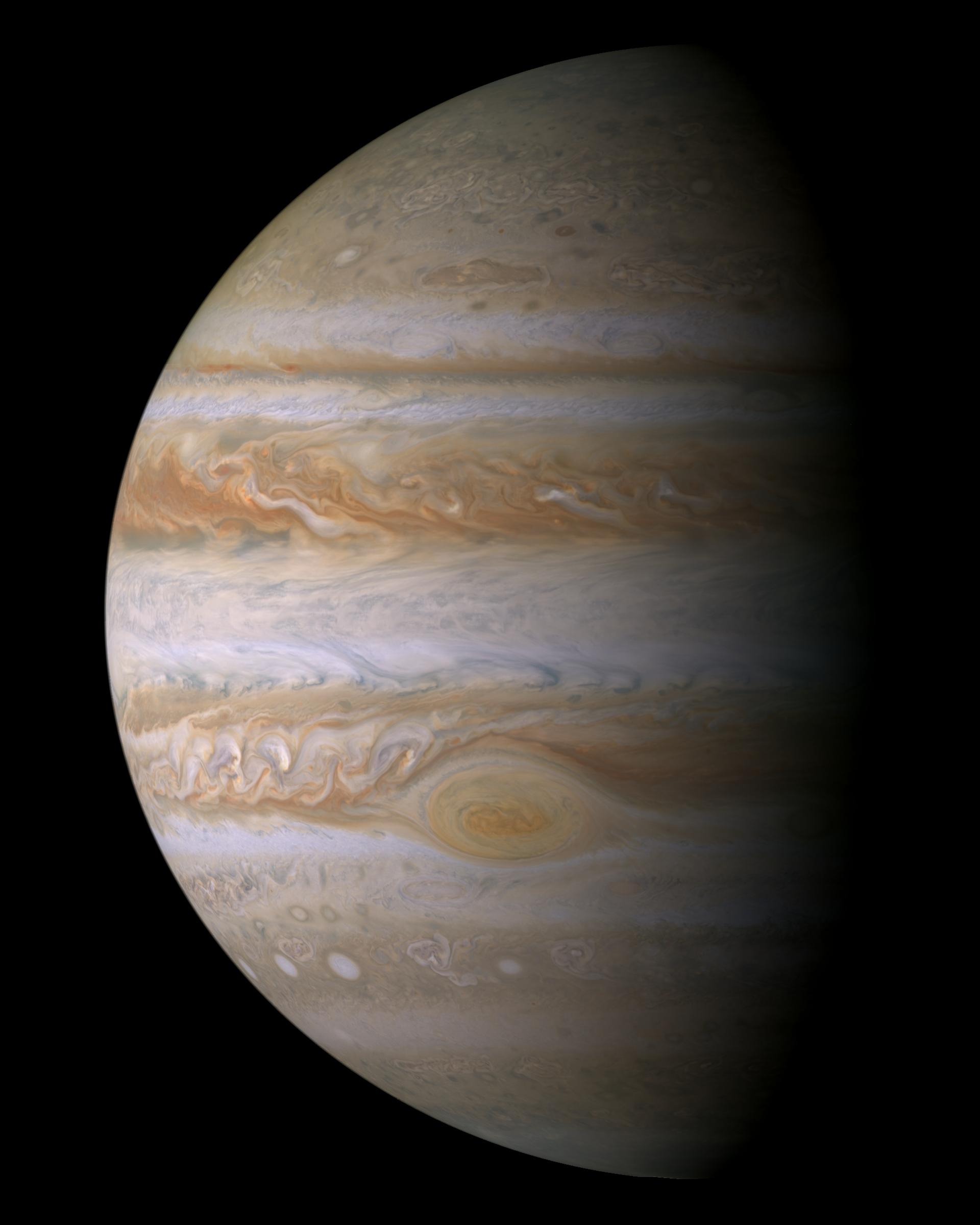
There is a massive storm on Jupiter that's been going for about 400 years.
But Mars and Earth are about as different as astronaut ice cream and Ben & Jerry's. Mars has no water in its meteorological system, whereas Earth's is heavy with water. Mars is also flatter than the Earth, meaning winds can get up to higher speeds, lifting the very, very tiny dust particles into the upper atmosphere.