Slashdot Mirror
Domain: nasa.gov
Stories and comments across the archive that link to nasa.gov.
Comments · 16,365
-
chinese-american running space station
-
chinese-american running space station
-
The Great Worm of '88From the article:
- There are about 60,000 viruses known for Windows, 40 or so for the Macintosh, about 5 for commercial Unix versions, and perhaps 40 for Linux. Most of the Windows viruses are not important, but many hundreds have caused widespread damage. Two or three of the Macintosh viruses were widespread enough to be of importance. None of the Unix or Linux viruses became widespread - most were confined to the laboratory.
Obviously they've already forgotten the Great Worm of '88. This was certainly not confined to the laboratory, unless you consider the whole internet, at the time, as a big lab
But that point aside, the article makes many good points. The only thing it really left out, was the homogeny of server software (it did mention client software, though). This is what made the '88 worm possible. All servers at the time were running sendmail, because it was the only thing available. Now, with the proliferation of different mail services for Unix, it's nigh impossible for this to happen in a widespread way on Unix.
So basically, it seems diversity of software and hardware is the real answer to making the internet more secure. This obviously goes against what Microsoft try to achieve, but fits in very nicely in the open source world. -
Great IdeaThis is a great idea and another really good use of the web. Once it is the later stages of the project this really could lead to a lot of advancements in research in the areas that apply. Here are a few other links I found interesing on this topic:
-
Re:the usual misstatement
If you say that this experiment "confirms" GR, then it also "confirms" many theories that otherwise wildly disagree with GR.
I would concur.
The assumption is often that, since a particular mechanism was proposed along with a particular equation, that if the equation is right, the mechanism has to be.
That simply doesn't have to be the case, any more than deriving an equation describing the falling activity of Slashdot threads would lend 100% credence to my hypothesis that the light from the Slashdot home page casts light evenly on the topics, and thus causes activity, until they pass beyond the Oldnewsii Shell at some distance and get progressively more shielded from the light by other articles.
There are plenty of means to get to the same sorts of relationships as GR presents in terms of light bending. Etheric, tired light, and other particle, flux, or field-based theories can arrive at the same observations.
Sometimes it's a primacy (who got there first) or popularity contest. That's perhaps sad in a way, but the devil is really in the anomalies - sometimes brushed away as 'error', other times requiring some other body acting on it (that can lead to discovering Pluto, or a need for dark matter). The anomalies are where alternate explanations might really prove their mettle.
Here's an example:
There are anomalies in the in-track acceleration of the LAGEOS satellites.
Do you try for the General Relativity solution (section 3.7.3)? Or something "wilder" (near the bottom)?
I guess it's easier to say "X confirms GR" than "X confirms list of equations here", but it does imply that much more in physics has been 'set in stone' than actually has been.
-
Re:Go Space Program!
Bah. What we need isn't another space race -- what we need is a better way to get out of our gravity well. Blowing ourselves into orbit with explosives isn't much safer or more practical for our astronauts than it was for Wiley Coyote. If NASA were to ask my opinion (and rest assured that they won't
-
In Soviet Russia, Soyuz launches YOU
If the shuttle won't fly for another year, how are we going to get people down from the space station? I wondered that for a moment, did a Google search, found NASA's ISS web site, and learned that the ISS missions continue because in former Soviet Russia, Soyuz launches YOU...
-
Re:This does not hold true for this universe
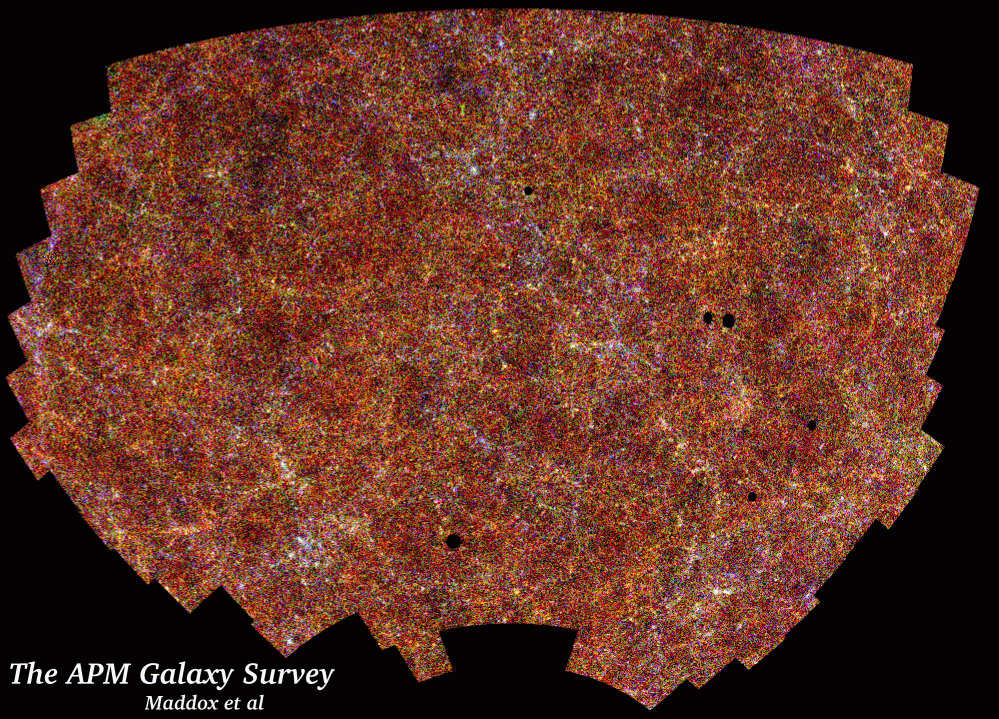
offhand i'd say we've been Trolled. Maps of galaxies, generally thin wedges, show them to be arranged as filaments or sheets around the edges of voids, for example this and a higher res version. The galaxies are not arranged as concentric shells but as the matrix of an open-celled foam. Any appearance of concentricity is due to the fact that galaxies further away are harder to see (see the bottom image).
-
Re:This does not hold true for this universe
offhand i'd say we've been Trolled. Maps of galaxies, generally thin wedges, show them to be arranged as filaments or sheets around the edges of voids, for example this and a higher res version. The galaxies are not arranged as concentric shells but as the matrix of an open-celled foam. Any appearance of concentricity is due to the fact that galaxies further away are harder to see (see the bottom image).
-
Re:Just wait for another 10 years
It is probably a reference to the Pathfinder Mission, which is a demo or proof-of-concept mission.
-
Re:It's a typo: 3 million to 40 millionThe Milky Way is up to 100,000 ly across, but it is only about 2,000 ly thick at the arms, and 10,000 ly thick at the bulge.
The closest galaxy is (quote taken from here):
For a long time, the Large Magellanic Cloud, an irregular type satellite galaxy of our own, was held to be the closest galaxy to the Milky Way. It is 179,000 light-years away. But in 1994 the Sagittarius Dwarf Elliptical Galaxy was discovered at 80,000 light-years. It now holds the honor.
-
Just wait for another 10 yearsWhen the MAXIM flys in about another decade, it will be able to resolve images (in Xray) up to a million times better than anything now available. It will allow imaging of blackholes, that is actual visualization of the Shwarzchild radius as well as observing other stars as well as we can our own sun today. To do this the telescopes must be in orbit since the high frequency radiation scatters too easily in the atmosphere. Even at the infrared wavelengths that the Keck used, adaptive optics were needed to make their observations from the ground.
I would like to see an array of cheap telescopes stationed at the LaGrangian points to do interferometry at any wavelength. Gravity wave detection could also be included in the mix. There would be no need for elaborate vibration damping and not being limited to the simple L shape that current ground based gravity detectors use, we would be able to triangulate gravity wave disturbances in 3 dimensions!
-
Re:Really?20 BILLIONTHS of a G acceleration over 6 months to get that sort of shift needed to give us a milion miles clearance. This is certainly within the capability of current technology.
We're talking a lot of mass, so I'm not so sure we could actually do this. Lets run the numbers again.
Assume we want to push the asteroid about 10,000km, and we have 15 years warning. 0.5*a*t^2 = 1e7 m gives a = 9e-11 m/s2, or 9.2e-12 G. So you don't need a lot of accelleration. However, lets assume it's a 1 km diameter rock -> a mass of about 1.5 billion tons. So to get the required acceleration requires 141 N of thrust, for 15 years.
Now, the NSTAR ion thruster on DS1 had a thrust of about 0.09 N, and a rated power of 2 kW. So we'd need something like 3 MW of power. As for propellant consumption, assuming a specific impulse of about 3000 (pretty standard for ion engines); you'd need a total of 2200 tons of e.g. Xenon. For comparison, the international space station has less than 100 KW of power and masses less than 100 tons.
So deflecting an asteroid is actually a rather big project - it's not trivial (as in we're nowehere even close, and it would required Manhattan-project level investment to get there). Maybe we could do it, maybe we couldn't. But that's assuming 15 years warning, and the smallest possible margin. If something popped up with just a few years warning, and more mass, we'd all be utterly screwed.
-
Re:Within earths orbit ?
They only look for asteroids coming from the outer space ?
Near Earth Objects program covers objects closer to home, including man-made junk. -
Re:Closest, hah!
For those who didn't catch the reference to the skateboarder: http://antwrp.gsfc.nasa.gov/apod/ap031001.html
-
Re:That Explains It.
You saw the one that hit a car in NY, right?
Nasa Interesting pictures. -
Nemesis is not Planet XNemesis was Richard Muller's idea to explain Raup and Sepkoski's thesis that mass extinctions are periodic. It was an off the cuff proposal to counter Alvarez's criticism that there couldn't be any rational explanation that would support periodic asteroid hits. Nemesis would have to have an orbit about 2 light years in diameter and a period of 26 million years to explain Raup and Sepkoski's data.
Planet X is an proposed tenth planet with an orbital period of less than 1000 years. When Pluto was discovered, astronomers thought that was the planet that was responsible for Uranus' orbital perterbation. Then in the 70's and 80's Uranus' orbit didn't quite sync with predictions that accounted for Pluto. The discrepancy suggested that there may be yet another object lurking in the Kuiper belt.
In any event, the the two hypothesis are addressing different issues. A good write up can be found here.
-
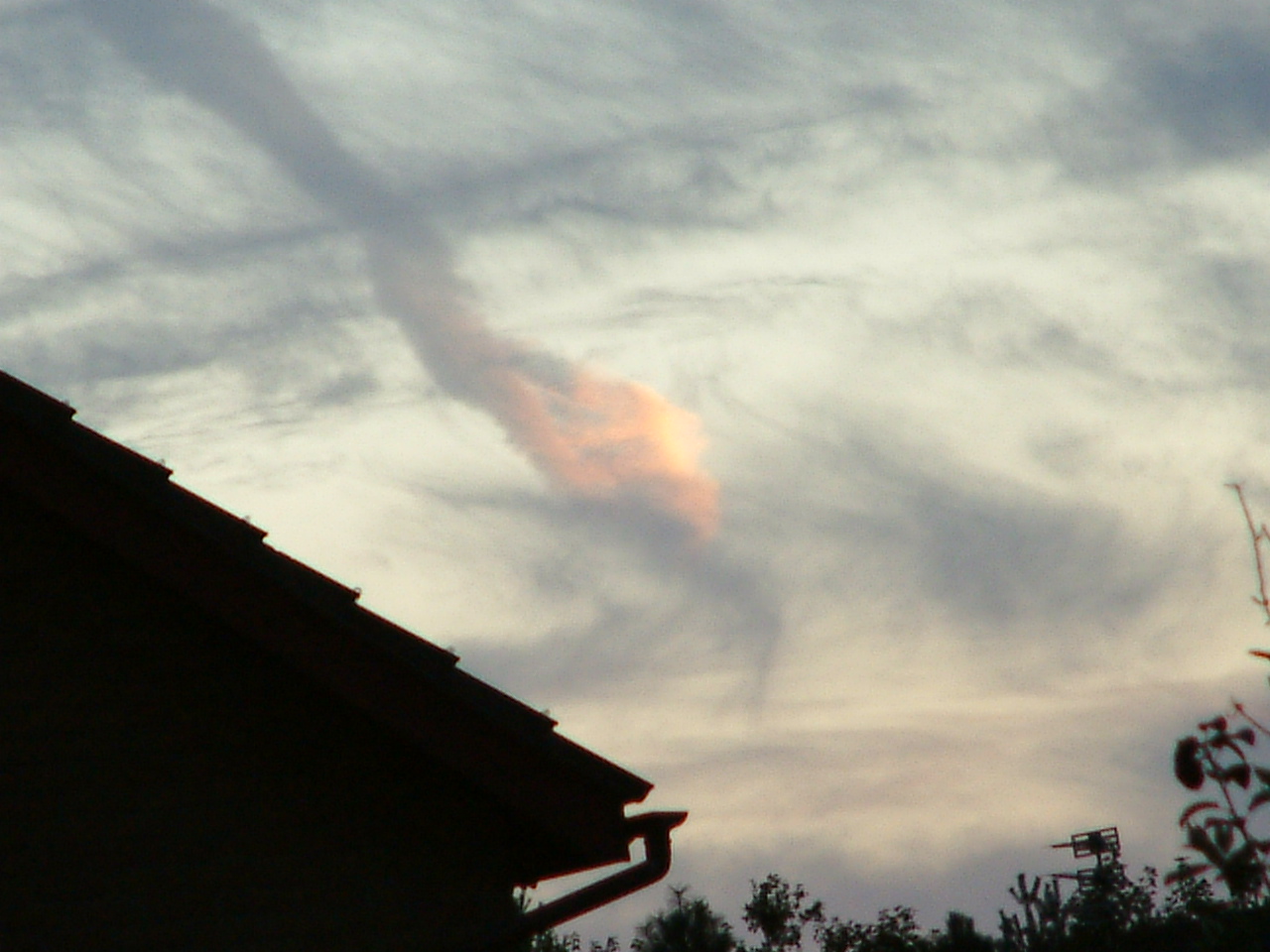
Re:Not a fireball *IT'S A CLOUD!*
OMG, how is this even news?!
Clouds reflect sun light, and sometimes they look funny.
that fireball is much brighter than the light reflected off a cloud could be.
Look at the follow up picture, it's a cloud, reflecting the setting sun. This is the follow up picture, taken a minute after the first:
http://antwrp.gsfc.nasa.gov/apod/image/0310/fireba ll2_burnett_big.jpg
If you think that's a 'fireball in the sky' then your in need of psychiatric attention. -
AHH HAAAAAAA!!!! HAHAHAAHHAAA!
if said 'big object' is a 'ball of hydrogen which never got quite big enough to ignite' it would be called a brown dwarf (that is what brown dwarfs are!) and as big as jupiter (same size larger mass, denser etc)
basic facts
and we would have seen it by now!!!
OK
remember geeks, google is your friend!!
see also
http://www1.msfc.nasa.gov/NEWSROOM/news/releases/2 000/00-206.html
and
http://hubblesite.org/newscenter/archive/1995/48/ -
See the sky falling here
One asteroid the size of a couch DID NOT pass closely by, but entered the the atmosphere -
Event not connected?
The article says this is not connected to the India meteor. How can this not be related? There were way too many interesting meteor events last weekend.
This is very interesting
- September 27 - A meteor hits Eastern India, catching some homes on fire and injuring at least three people. This kind of thing doesn't happen very often.
- September 28 - A post to rec.arts.sf.fandom reported a "rather impressive meteor" with "lots of bits breaking off".
- (the week before) October 1 - Astronomy Picture of the Day showed a spectacular photo of a meteor, reported to be taken "last week" (assumedly relative to the day the picture was posted, which could have been the same Sep 27-28 weekend).
- And now we hear about a fairly large meteor which missed us on the same weekend!
These were probably all fragments of the same meteor. I'd like to hear more information on how they know for sure that these are not related... -
Possibly related
a few days ago APOD had posted this picture. If this picture was taken recently, maybe the asteroid and the fireball are related.
-
During the 2001 Leonids,
I saw one meteor flash so brightly, a friend of mine saw his silhouette on the ground (he was adjusting the blanket he was sitting on at the time). The meteor left a debris trail visible for minutes afterward. A NASA image gallery has several pictures of the trail, including one animated sequence.
-
During the 2001 Leonids,
I saw one meteor flash so brightly, a friend of mine saw his silhouette on the ground (he was adjusting the blanket he was sitting on at the time). The meteor left a debris trail visible for minutes afterward. A NASA image gallery has several pictures of the trail, including one animated sequence.
-
During the 2001 Leonids,
I saw one meteor flash so brightly, a friend of mine saw his silhouette on the ground (he was adjusting the blanket he was sitting on at the time). The meteor left a debris trail visible for minutes afterward. A NASA image gallery has several pictures of the trail, including one animated sequence.
-
During the 2001 Leonids,
I saw one meteor flash so brightly, a friend of mine saw his silhouette on the ground (he was adjusting the blanket he was sitting on at the time). The meteor left a debris trail visible for minutes afterward. A NASA image gallery has several pictures of the trail, including one animated sequence.
-
During the 2001 Leonids,
I saw one meteor flash so brightly, a friend of mine saw his silhouette on the ground (he was adjusting the blanket he was sitting on at the time). The meteor left a debris trail visible for minutes afterward. A NASA image gallery has several pictures of the trail, including one animated sequence.
-
Re:For perks of being unemployed without the guiltPerhaps, I spoke too early in the morning I had to wake up at 7am (to borrow from family guy, "I did not know there was a 7am why didn't anyone tell me?") to hear a badly translated robotics course in spain with wind shear, why nasa did not use their weather control ray is beyond me?
I apologize to all those that are neither liberal arts majors nor use calculators in their graduate study programs. Is calculator use predicative of being an engineering student mostly?
-
Re:Green fireball
Chances are, what you saw was a Bolide they can often glow brighter than the full moon.
-
Incremental Progress after Initial Launch
The really impressive feat to me with being able to reach this altitude (100 km) is that once you can achieve it, real engineers can continue to refine the concept through incremental adjustments to eventually become a true orbital vehicle. After the initial rush of getting to orbit, the next big push will be to see what kind of range they can get.
From the articles, they are currently pushing for about a 35 mile range from launch site to landing site. I can see strong economic viability in trying to push further for an express service going from Los Angeles to London in 1 hour, or how about London to Sydney in 1 - 1/2 hours.
Engineering works better as a discipline when you can achieve goals in smaller steps, rather than pushing for one big goal at once. One of the reasons rocket science is so difficult is that in order to put something in orbit the leap from your Estes class "A" Mosquito rocket to a Delta 4 is quite a bit more than even a soapbox derby car to a Corvette. Even NASA had to go through several hundred rockets well before Alan Shepard got his first ride.
BTW, all that Alan Shepard got to do anyway was ride a sub-orbital flight for 15 minutes on a flight that would have barely qualified for the X-Prize itself. (He got to an altitude of 116 miles, distance of 300 miles)
The point here is that the X-Prize can certainly ignite the spark necessary to develop manned Low-Earth Orbit activities, and as the classic statement goes (I believe coined by Robert A. Heinlin) "Low Earth Orbit is half-way to the rest of the Solar System" Once people are up there, going on to other places in the Solar System is just more incremental steps. -
Interesting or Risky?
I know I've seen NASA projects testing a NASA Ion engine in space. I think it was Deep Space 1, which looks like it was started and finished years ago. They also made a flyby of a comet 2 years ago similar to this European probe's flyby of the moon. Seems to me that the moon is an easier target to fly by than a comet. So, this doesn't look like anything new to NASA.
Here's a FAQ on what they're doing with it and why most NASA projects don't want to use it:
NASA FAQ About Ion Propulsion
It could be simply a question of money -- if you can afford to use tried-and-true technologies, why use slower, riskier technologies when you really REALLY have to produce results? But, like they say in the FAQ, if they can prove the technology for long haul missions, that's where it makes sense. They even say specifically that for short missions like to the moon it doesn't make sense (look at how long it'll take that European probe to get to the moon -- 2005?).
Hmm, I don't remember seeing Deep Space 1 news like this on Slashdot -- I had to see it on PBS. Could it be bias or just ignorance? (correct me if I'm wrong, but even a search for "Deep Space 1" on Slashdot didn't produce anything relevent) -
Interesting or Risky?
I know I've seen NASA projects testing a NASA Ion engine in space. I think it was Deep Space 1, which looks like it was started and finished years ago. They also made a flyby of a comet 2 years ago similar to this European probe's flyby of the moon. Seems to me that the moon is an easier target to fly by than a comet. So, this doesn't look like anything new to NASA.
Here's a FAQ on what they're doing with it and why most NASA projects don't want to use it:
NASA FAQ About Ion Propulsion
It could be simply a question of money -- if you can afford to use tried-and-true technologies, why use slower, riskier technologies when you really REALLY have to produce results? But, like they say in the FAQ, if they can prove the technology for long haul missions, that's where it makes sense. They even say specifically that for short missions like to the moon it doesn't make sense (look at how long it'll take that European probe to get to the moon -- 2005?).
Hmm, I don't remember seeing Deep Space 1 news like this on Slashdot -- I had to see it on PBS. Could it be bias or just ignorance? (correct me if I'm wrong, but even a search for "Deep Space 1" on Slashdot didn't produce anything relevent) -
Interesting or Risky?
I know I've seen NASA projects testing a NASA Ion engine in space. I think it was Deep Space 1, which looks like it was started and finished years ago. They also made a flyby of a comet 2 years ago similar to this European probe's flyby of the moon. Seems to me that the moon is an easier target to fly by than a comet. So, this doesn't look like anything new to NASA.
Here's a FAQ on what they're doing with it and why most NASA projects don't want to use it:
NASA FAQ About Ion Propulsion
It could be simply a question of money -- if you can afford to use tried-and-true technologies, why use slower, riskier technologies when you really REALLY have to produce results? But, like they say in the FAQ, if they can prove the technology for long haul missions, that's where it makes sense. They even say specifically that for short missions like to the moon it doesn't make sense (look at how long it'll take that European probe to get to the moon -- 2005?).
Hmm, I don't remember seeing Deep Space 1 news like this on Slashdot -- I had to see it on PBS. Could it be bias or just ignorance? (correct me if I'm wrong, but even a search for "Deep Space 1" on Slashdot didn't produce anything relevent) -
Re:the new space race
Perhaps you didn't know, but a single 1km asteroid (small as asteroids go) contains over $5,000,000,000,000 worth of platinum, and an equal value of iridium. The real reason noone is going into space is that the cost of getting up there are just too great. Columbus launched a ship, those were relatively cheap and in good supply back then. Where are you going to get a nuclear rocket from? Or the heavy lift booster required to put it into orbit? Initial costs today are significantly higher for space then they were for the new world, despite the profit being exponentially higher.
Check out Mining the Sky by John S. Lewis
Or perhaps a neat little news article from BBC. I'll quote from it:
"If Eros is typical of stony [asteroids, not meteorites], then it contains about 3% metal. With the known abundance's of metals in meteorites, even a very cautious estimate suggests 20,000 million tonnes of aluminium along with similar amounts of gold, platinum and other rarer metals."
Note that eros is a stony asteroid, as opposed to the nice juicy metal asteroids which much high amounts of precious metal for their mass.
Now lets go find out how many asteroids there are in our little solar system, shall we?
According to NASA there are 20,000 numbred and catalogued asteroids and millions in the main belt. There are considerable millions more in the Trojans.
So hows this for a rough calculation:
Lets assume that the average asteroid is a nice sphere 25km in diametre (a nice estimate, considering the largest asteroids are a quarter the size of the moon).
At $2E13 per 25km asteroid (about the size of Eros) and with about a million asteroids in the main belt, theres approximately $20,000,000,000,000,000,000 worth out there. Thats about 5 billion dollars per person on the entire PLANET.
Thats a lowend calculation that assumes all asteroids are stony, no metal asteroids, and that there are no gigantor asteroids like Ceres. So, you were saying about the lack of value..? -
Re:Upper-left isn't NewFor starters, engines don't always burn equally, so you've got to worry about the rocket stack deflecting into the launch tower. That means complicated steering gear. Multiple engines change the nature of the flame stream under the rocket, so you need different materials and cooling strategies to keep the engines from blowing up. Etc Etc.
Over on NASA's site there's an electronic version of Stages to Saturn that details all of the design and fabrication woes of the Saturn boosters. Go read it, and any account of the Soviet N-1 failure and get back to me on how hard it is.
In short, there's a good reason why people describe hard problems that can fail spectacularly as rocket science, mmmKay?
-
Re:Where are these on NASA's site?I didn't see a link to the NASA site that might carry this graphic and their own interpretation of it. Does anyone have a link at nasa.gov?
The OSP will eventually be designed and built by a yet-to-be-named company, under contract to NASA. That contract hasn't yet been awarded. For that matter, NASA hasn't even released a request for proposal. For their part, NASA is trying to leave it up to the various bidding contractors to come up with their take on the optimal design for safety and life-cycle costs. They're trying not to prejudice the selection of a particular vehicle type-- capsule, winged vehicle, etc. There's still a lot of room to screw things up, but NASA appears to be taking the right approach here. Add to that the fact that NASA's internal planning is procurement-sensitive at the moment (recall the recent Lockheed-Martin vs. Boeing lawsuit), and it's not hard to understand why information from the horse's mouth is currently a bit scant.
So, you're not likely to see a lot of concrete information until the OSP program gets further along. In the mean time, you can view press releases at the NASA site. However, you might find it easier to parse them at an independent news site that puts them in context, such as OSPNews.
-
Re: making money from spaceI'm really sick of the space program, especially the US one. While I agree that safety is very important, I really feel that too much money is being spent to make overly complicated transport vehicles that address some safety concerns while opening up a whole new slew of things that can go wrong.
If there was more money to be made from going into space, more people would be willing to take greater risks in order to do so. I can't help wondering if there will eventually be a "wagon train to the stars" (to crib from Gene Roddenberry [usrbingeek.com]) where ordinary men and women put their lives on the line in simple, inexpensive rockets in order to reap the rewards of space. What were the odds of an early settler heading across the US in one of those original wagon trains, bound for new lands and most importantly new money? Personally I'd probably strap into a rocket if the odds were 50%, just to get into space; and I know I'd do it if the odds were up around 70% without a second thought.
The only real hope I see for space is the X-Prize [xprize.org], which of course gets heavy coverage here. However I'd like to include a snippet from their factsheet [xprize.org] which has particular relavence here:Historical Analog: By 1929, governments, individuals, newspapers and major corporations had offered more than 50 major aeronautical prizes. Among them was the Orteig Prize, a $25,000 cash prize sponsored by a wealthy hotel owner, Raymond Orteig, for the first person or persons to fly non-stop between New York and Paris. The Orteig Prize stimulated not one, but nine separate attempts to cross the Atlantic. To initiate the flights, competitors raised and spent some $400,000, or 16 times the amount of the prize. As a result of these early aviation prizes, the world's $250 Billion aviation industry was created. The X PRIZE hopes to spur the creation of a vibrant commercial space industry through the $10M competition.
We can only hope that the space industry sees such a revolution take place. Although the The Dawn of the Space Age [nasa.gov] began October 4, 1957 with the launch of Sputnik I, the sun still hasn't moved that far from the horizon in all those years.
Jonah Hex -
Lifting bodies are much older than Farscape
That lifting body shuttle design concept predates Farscape by decades, dating back to the 1950s (see A history of lifting bodies). I even remember a traveling road show of these things in early 1970s. And for those that remember the 6-Million Dollar Man TV series, the crash footage in the title sequences is of a lifting body accident.
-
Re:Capsules are more efficient
-
Re:Capsules are more efficient
-
Re:Capsules are more efficient
-
Re:Capsules are more efficient
-
Re:Capsules are more efficient
-
Re:Capsules are more efficient
-
Once again here is a possible answer...
From a post I did about 3 weeks ago:
I don't know why NASA or an areospace company (Macdonnell Douglas, are you listening?) is not considering revitalizing the Delta Clipper. It was a capsule shaped Single Stage to Orbit (SSO), re-useable space vehicle that was actually built and was flying throughout the 1990's until an unfortunate accident destroyed it. Apart from the strut breaking that caused it's destruction (an engineering problem that is likely easily fixed), it performed exceptionally.
Consider the costs of revitalizing this "existing" project compared to re-designing and re-creating a new shuttle from scatch. Which do you think is cheaper? The Delta Clipper allowed for totally controlled flight to and from orbit, a lot safer it seems, than an uncontrolled glider.
This idea seems to have the best of apects of what
Can the other four say that?
Hell, strap on a new areospike engine and NASA might actually enjoy a few years of spacefaring success, like they used to in the 60's.
Just a thought...
-
Ion Engines
NASA has fallen behind Europe's ESA/Russian space programs to the point where it is using 1960s rockets compared with ion engines
Really? Damn--that's pretty impressive specific impulse on the ion engine in that Ariane 5.
Oh wait, apples, oranges and NASA did it first. AGAIN.
It's bad enough when Americans think they invented everything without Euros bettering them by, um, becoming them. -
Re:this is not news
Double entendre....
KISS the band.
Early 1970's was the tail end of the Apollo lunar landing program. -
Re:America needs to rethink some priorities
Actually, Nasa first had the ion engines driven with solar energy. It was part of the Deep Space One [NASA.GOV] probe.
-
Re:Timeframe
I'm glad to see someone getting aggressive on the topic of a time frame. AFAIK, the ISS won't last forever, so as long as we have problems getting people and things up and back from it, it is going to waste.
Setting an aggressive timeframe and some healthy competition against other nations (Europe, China, etc) can do wonders to boost the US space program.
The space race is what got America to the moon in such a short timeframe. Frank Culbertson jr.(a NASA mission director) speculated that if the Russians would have named their space station something like "War", or "We're number one" instead of Mir (Peace/Community), we'd have a large space station, moon base, and a manned mission to Mars by now. -
Re:Farscape's influence...
And Farscape just stole the X-38.