Slashdot Mirror
Domain: nasa.gov
Stories and comments across the archive that link to nasa.gov.
Comments · 16,365
-
Re:We should get rid of the torino scale regardlesIt's really not that hard. You plot on a logarithmic scale the probability of collision (x-axis) and the estimated kinetic energy of the object (y-axis). From this figure, read off the Torino scale value.
I don't think it misrepresents anything. Each value is associated with both a specific kinetic energy and a specific probability. The Torino value not just the result of multiplying the two numbers (which would introduce the orthogonal vectors issue you mentioned) but rather a unique area on the plane defined by those two 'vectors'.
-
Re:We should get rid of the torino scale regardlesIt's really not that hard. You plot on a logarithmic scale the probability of collision (x-axis) and the estimated kinetic energy of the object (y-axis). From this figure, read off the Torino scale value.
I don't think it misrepresents anything. Each value is associated with both a specific kinetic energy and a specific probability. The Torino value not just the result of multiplying the two numbers (which would introduce the orthogonal vectors issue you mentioned) but rather a unique area on the plane defined by those two 'vectors'.
-
Simple solution
I've been following the Current Impact Risks page ever since I found out about it over a year ago.
In order to report on this issue responsibly, all that's required is to ignore any object on the list until the NEO survey folks has collected observations over a span of 20 days or more. Before that, the orbits are too unclear to be worth reporting upon. Practically all objects fall of the list before the obeservations span 20 days.
Sadly, some reporters want to get the story out first, so they jump the gun. -
Torino scale's OK; media are the problem
Having a 1 on the Torino scale is kind of like having a Blue on the Terrorism Threat Scale, or a DEFCON 4 instead of 5. It's kind of cute but it's not very meaningful.
Changing the scale won't change the sensationalist, advertising-powered press at all. They'll continue to report asteroids as "harbinger of the approaching eschaton" whether it's on the Torino or Donuto scale (instead of covering, say, the deleterious effects of gasoline consumption by SUV's on the environment, or the tobacco industry's clever solicitation of candidates for DEATH).
-
Re:those who don't dream eventually go crazy...
I just got back from a vacation in Orlando where we took a day to go over to the Kennedy Space Center. There was much more to do and see there than I expected. The best part was seeing the never-used Saturn V rocket from Apollo 18. Other cool stuff is a bus tour (extra $) that takes you up to (not in) the vehicle assembly building, and around launch pads 39a&b.
I even got a cool shirt that says 'I Need My Space'.
The trip invigorated me about space exploration.
Truely we must dream!
It is a must see if you're in Orlando. It's only a 45 minute drive.
-Steve -
Re:those who don't dream eventually go crazy...
I just got back from a vacation in Orlando where we took a day to go over to the Kennedy Space Center. There was much more to do and see there than I expected. The best part was seeing the never-used Saturn V rocket from Apollo 18. Other cool stuff is a bus tour (extra $) that takes you up to (not in) the vehicle assembly building, and around launch pads 39a&b.
I even got a cool shirt that says 'I Need My Space'.
The trip invigorated me about space exploration.
Truely we must dream!
It is a must see if you're in Orlando. It's only a 45 minute drive.
-Steve -
Re:those who don't dream eventually go crazy...
I just got back from a vacation in Orlando where we took a day to go over to the Kennedy Space Center. There was much more to do and see there than I expected. The best part was seeing the never-used Saturn V rocket from Apollo 18. Other cool stuff is a bus tour (extra $) that takes you up to (not in) the vehicle assembly building, and around launch pads 39a&b.
I even got a cool shirt that says 'I Need My Space'.
The trip invigorated me about space exploration.
Truely we must dream!
It is a must see if you're in Orlando. It's only a 45 minute drive.
-Steve -
Re:Not as cool as AerogelFor those that only looked at the pretty pictures: Aerogel is used in the Stardust spacecraft, that is at this very moment collecting spacedust. On january 2nd 2004 it will fly past the comet Wild-2, and collect particles from the comet. And in 2006 the spacecraft will return to earth to bring back the samples.
And this is only one of the spectacular things that NASA is doing next year. There is also the Mars rovers mission, Cassini-Huyghens will arive at Saturn, and (hopefully) the Shuttle will fly again..
-
Disappointed?You may have noticed the extremely low resolution of the images produced by Chandra. In fact, other craft have gotten much better pictures of elemental compositions of the lunar surface, especially common elements like titanium and iron. For instance, Galileo returned this and Clementine (some very high res images here) returned this iron map and this titanium map.
Chandra detected magnesium, silicon, aluminum, and oxygen, but its already known that the lunar highlands are composed mostly of anorthosite, a rock which contains all of those elements but magnesium (I would like to know why magnesium and not calcium was detected). This is more of a proof-of-concept than anything. The most important information to come from these first observations is the discounting of the anomolous farside x-ray emissions.
-
Not as cool as Aerogel
Aerogel is 99.8% holes. Check out the photos of a thin sheet insulating crayons from a blowtorch!
-
Re:This is like nuclear power plants.
That is not correct. The frequency spectrum looks like:
AM/FM/TV (lowest)
Microwave/cell
Infrared
Visible
Ultra violet
X Rays
Gamma rays (highest)
See also this page. -
Re:Population density??
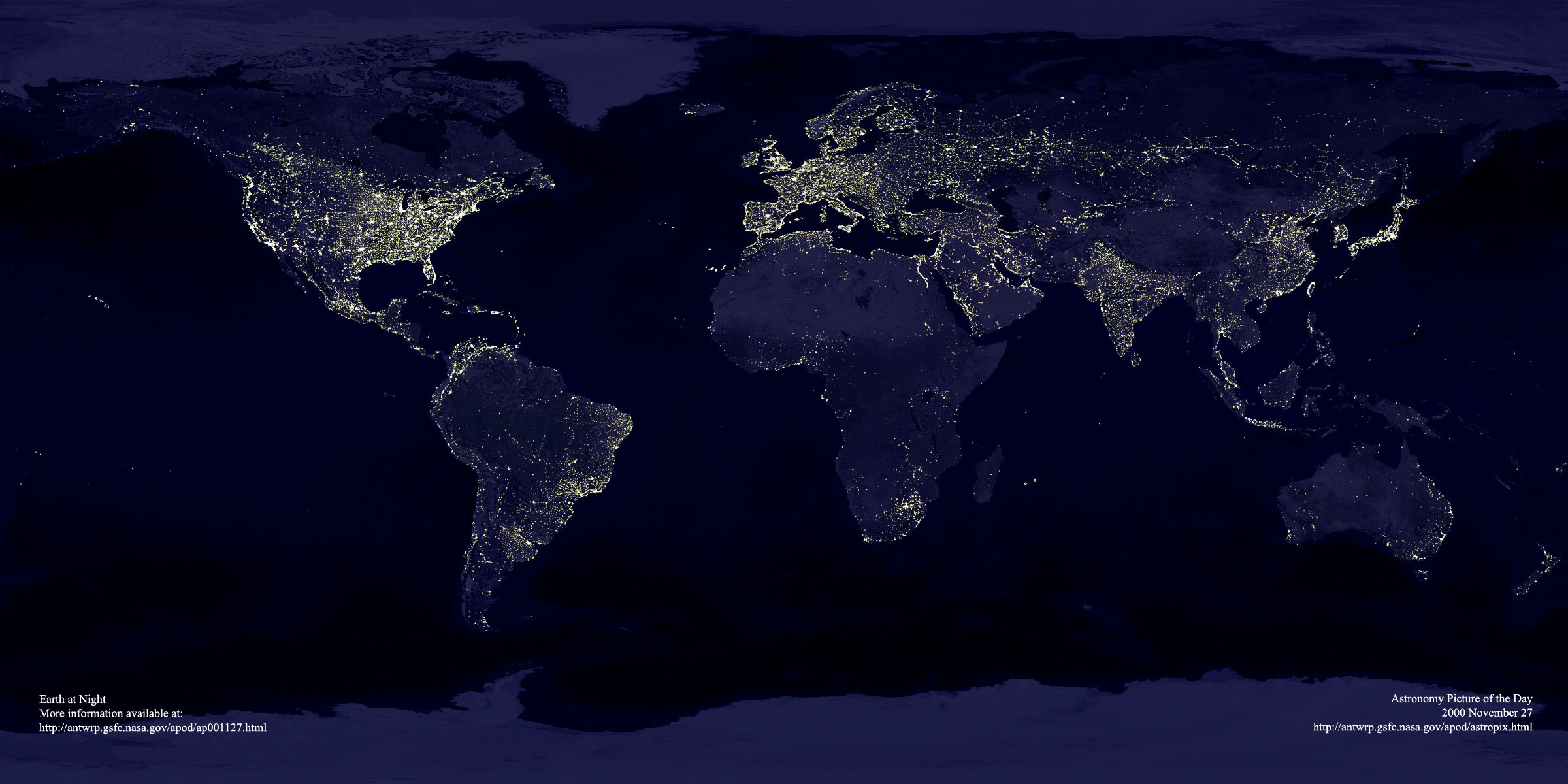
Here's a helpful map.
I can see my house!!! -
Re:Population density??
Here's a helpful map
Note that the U.S. is about as densely populated as India or Western China, both of which have much higher broadband acceptance than the U.S. -
Slightly on-topic
-
Slightly on-topic
-
Slightly on-topic
-
Re:ObjectivesSure, unless you can show me the ROI. And I think we can show an ROI for roads, can't we?
Roads that aren't used have an utterly terrible return on investment. Zero! So why would anyone build roads out in the middle of nowhere, where they'd never be used? That was the point - the Romans built roads across their entire empire, even where virtually no one lived.
Roads are enabling technologies: that is, they allow expansion and development to proceed much quicker than they would without roads. Even if you think that the roads will never be used, the roads turn the middle of nowhere into the middle of somewhere.
And if you want a direct ROI for space technologies, it's out there. Oh, dear God, is it out there. Just do a search for NASA technology spinoffs (or look here). How many examples do you want? Gemcutting tools, electronics, composite materials, infrared thermometers: all former NASA technology. There were conservative estimates that NASA had generated 7 times the money that was invested into it as returns into the GDP via technology improvements and new markets - so a ROI for taxpayers of about 700%. I think that would be considered a "good investment".
It's one thing to waste my hard-earned tax dollars to the tune of, say, ten billion. It's quite another to take several hundred of them, which is what enabling otherwise worthless views of Martian sunsets would run.
Ten billion? You'd be happy with ten billion? Great! With ~ten billion you could
- Build a space elevator
- Return to the Moon
- Go to Mars (Zubrin's Mars Direct plan: probably a little optimistic costwise, but the point is that not everyone thinks it's hundreds of billions of dollars: Zubrin thought between $7 billion for private sector, JPL said $50 billion, for three missions)
As stated before, humans are lazy. So long as everything is easy, we won't learn anything. We'll never really work on radiation treatment technologies until it's necessary, for instance. Or ecological engineering : the real kind, trying to build a stable ecosystem.
C'mon. You're arguing against even $100 billion out of a multi-trillion dollar per YEAR budget. Space it over 5 years, and it's about 1% of the federal government's budget. That's a small price to pay to seriously kickstart several languishing economic sectors - it's not like they didn't pay nearly that amount to try to help the tourism industry, and it's not like the tourism industry has huge room for growth like space technology does. - Build a space elevator
-
Re:"The Truth?" Outrage! Lies!Has anyone masured the RF output of...
-
Re:Anecdotal evidence is always suspect
It's not anecdotal: NASA Langley Research Center
-
Re:A reason not to put people in space...
one little nitpick, you wont explode if exposed to vacuum, you most likely get 'the bends' (decompression sickness) though. YOu wouldn't even instantly freeze to death since there aren't many molecules around that can transfer heat away from your body (even if the few that's around are very cold). More info about what happens to people exposed to vacuum can be found here
-
NASA ASRS Reports
Check out this data collected by NASA's ASRS. It details many specific events regarding PED (Passenger Electronic Devices)
N. -
Real DataSome of the comments here have said basically "Where is the evidence or science?"
Jay J. Ely and team are pretty much the leaders in tearms of research in this area, as the NASA Langley Technical Reports Server shows.
You can get actual reports of incidents related to PEDs and aircraft events at The National Aviation Safety Data Analysis Center .
Also in Oct 2002, at the Digital Avionics Systems Conference in Irvine, CA, Session E addressed this topic:
Session E - The Electromagnetic Environment
Co-Chairs - Paul Cox, Honeywell Defense Avionics Systems Bill Larsen, Federal Aviation Administration- "A Description of the Software Element of the NASA Portable Electronic Device Radiated Emissions Investigation" Sandra V. Koppen
- "Determination of Receiver Susceptibility to Radio Frequency Interference from Portable Electronic Devices" Truong X. Nguyen
- Avionics Interference from Portable Electronic Devices: Review of the Aviation Safety Reporting System Database" Bill Strauss
- "Ultrawideband Electromagnetic Interference To Aircraft Radios" Jay J. Ely
- "Electromagnetic Interference Assessment of CDMA and GSM Wireless Phones to Aircraft Navigation Radios" Jay J. Ely
- Investigation of RF Emissions from Wireless Networks as a Threat to Avionic Systems" Maria Theresa P. Salud
-
Real DataSome of the comments here have said basically "Where is the evidence or science?"
Jay J. Ely and team are pretty much the leaders in tearms of research in this area, as the NASA Langley Technical Reports Server shows.
You can get actual reports of incidents related to PEDs and aircraft events at The National Aviation Safety Data Analysis Center .
Also in Oct 2002, at the Digital Avionics Systems Conference in Irvine, CA, Session E addressed this topic:
Session E - The Electromagnetic Environment
Co-Chairs - Paul Cox, Honeywell Defense Avionics Systems Bill Larsen, Federal Aviation Administration- "A Description of the Software Element of the NASA Portable Electronic Device Radiated Emissions Investigation" Sandra V. Koppen
- "Determination of Receiver Susceptibility to Radio Frequency Interference from Portable Electronic Devices" Truong X. Nguyen
- Avionics Interference from Portable Electronic Devices: Review of the Aviation Safety Reporting System Database" Bill Strauss
- "Ultrawideband Electromagnetic Interference To Aircraft Radios" Jay J. Ely
- "Electromagnetic Interference Assessment of CDMA and GSM Wireless Phones to Aircraft Navigation Radios" Jay J. Ely
- Investigation of RF Emissions from Wireless Networks as a Threat to Avionic Systems" Maria Theresa P. Salud
-
those who don't dream eventually go crazy...capt.Hij said:
None of the reasons given imply that we need a human presence in space. As long as we have to use huge, contained explosions to move things off of the planet there is little reason to put humans in space.
Little reason to put humans into space, huh? Perhaps there is little immediate practical reason to put humans into space, but it is the dream of a good number of humans to go to space. For some of us, it fires our imagination, gives us hope, and helps us find a reason to go through the mundane existance of everyday life. I can only speak for myself, but when I look up at the stars at night, I see hope, unsurpassible(sp?) beauty, wonder, and a dream for the future of (hopefully myself if I ever have the chance and) the human species.What do you see when you look up at the stars at night?
Anyway, how about a more concrete reason for humans to go to space? Here's one: Because there are humans who are willing to go. There are people who are perfectly willing to risk there lives for the future of mankind (not to mention to have the most thrilling ride imaginable). I cannot speak for other humans but in my experiences through life, I know that I am not meant to be caged. I cannot help but feel that we, as a species, are not meant to "be caged" on this planet.
Perhaps these people who are willing to go right now only serve as guinea pigs (giving us important information on how the human body reacts in such an environment), but I'm sure they don't mind (and if any of them do, I am more than willing to take their place...).
Or, how about this for a reason: Robots, remotely operated vehicles, and computers lack the physical and mental ability to deal with equipment problems in space. Here's an example: the Hubble telescope. Without humans, we would have a peice of junk floating around with a bad mirror.
Unmanned vehicles lack two very important things that will allow them to deal with emergencies and keep themselves functioning when things go wrong: imagination and a will to survive. Put those two things together, and you have the kind of stuff that brought Apollo 13 home. Take those things away and you have probes that crash themselves uselessly into Mars.
In my opinion, humans are eventually meant to be in space. Maybe some will be afraid to leave the cage when the door is eventually opened for all to pass through if they choose, but others are anxious to get out and move on to the next stage of human existance. And there is no time like the present to start taking the necessary baby steps to do it.
Sorry for the rant, but views like these are all the reason I personally need.
Those pictures were taken by the astronauts on the final mission of the Space Shuttle Columbia, STS-107. I can do nothing now but salute and honor those heros who have died while chasing their dreams and the dreams of many of us, just as I can do nothing but salute and honor those heros who are still up there realizing the dream and those who have all returned safely.
Anyway, my apologies for any flamebait that may be in this post, but it kind of bothers me whenever anyone suggests that humans should not be in space.
-
those who don't dream eventually go crazy...capt.Hij said:
None of the reasons given imply that we need a human presence in space. As long as we have to use huge, contained explosions to move things off of the planet there is little reason to put humans in space.
Little reason to put humans into space, huh? Perhaps there is little immediate practical reason to put humans into space, but it is the dream of a good number of humans to go to space. For some of us, it fires our imagination, gives us hope, and helps us find a reason to go through the mundane existance of everyday life. I can only speak for myself, but when I look up at the stars at night, I see hope, unsurpassible(sp?) beauty, wonder, and a dream for the future of (hopefully myself if I ever have the chance and) the human species.What do you see when you look up at the stars at night?
Anyway, how about a more concrete reason for humans to go to space? Here's one: Because there are humans who are willing to go. There are people who are perfectly willing to risk there lives for the future of mankind (not to mention to have the most thrilling ride imaginable). I cannot speak for other humans but in my experiences through life, I know that I am not meant to be caged. I cannot help but feel that we, as a species, are not meant to "be caged" on this planet.
Perhaps these people who are willing to go right now only serve as guinea pigs (giving us important information on how the human body reacts in such an environment), but I'm sure they don't mind (and if any of them do, I am more than willing to take their place...).
Or, how about this for a reason: Robots, remotely operated vehicles, and computers lack the physical and mental ability to deal with equipment problems in space. Here's an example: the Hubble telescope. Without humans, we would have a peice of junk floating around with a bad mirror.
Unmanned vehicles lack two very important things that will allow them to deal with emergencies and keep themselves functioning when things go wrong: imagination and a will to survive. Put those two things together, and you have the kind of stuff that brought Apollo 13 home. Take those things away and you have probes that crash themselves uselessly into Mars.
In my opinion, humans are eventually meant to be in space. Maybe some will be afraid to leave the cage when the door is eventually opened for all to pass through if they choose, but others are anxious to get out and move on to the next stage of human existance. And there is no time like the present to start taking the necessary baby steps to do it.
Sorry for the rant, but views like these are all the reason I personally need.
Those pictures were taken by the astronauts on the final mission of the Space Shuttle Columbia, STS-107. I can do nothing now but salute and honor those heros who have died while chasing their dreams and the dreams of many of us, just as I can do nothing but salute and honor those heros who are still up there realizing the dream and those who have all returned safely.
Anyway, my apologies for any flamebait that may be in this post, but it kind of bothers me whenever anyone suggests that humans should not be in space.
-
those who don't dream eventually go crazy...capt.Hij said:
None of the reasons given imply that we need a human presence in space. As long as we have to use huge, contained explosions to move things off of the planet there is little reason to put humans in space.
Little reason to put humans into space, huh? Perhaps there is little immediate practical reason to put humans into space, but it is the dream of a good number of humans to go to space. For some of us, it fires our imagination, gives us hope, and helps us find a reason to go through the mundane existance of everyday life. I can only speak for myself, but when I look up at the stars at night, I see hope, unsurpassible(sp?) beauty, wonder, and a dream for the future of (hopefully myself if I ever have the chance and) the human species.What do you see when you look up at the stars at night?
Anyway, how about a more concrete reason for humans to go to space? Here's one: Because there are humans who are willing to go. There are people who are perfectly willing to risk there lives for the future of mankind (not to mention to have the most thrilling ride imaginable). I cannot speak for other humans but in my experiences through life, I know that I am not meant to be caged. I cannot help but feel that we, as a species, are not meant to "be caged" on this planet.
Perhaps these people who are willing to go right now only serve as guinea pigs (giving us important information on how the human body reacts in such an environment), but I'm sure they don't mind (and if any of them do, I am more than willing to take their place...).
Or, how about this for a reason: Robots, remotely operated vehicles, and computers lack the physical and mental ability to deal with equipment problems in space. Here's an example: the Hubble telescope. Without humans, we would have a peice of junk floating around with a bad mirror.
Unmanned vehicles lack two very important things that will allow them to deal with emergencies and keep themselves functioning when things go wrong: imagination and a will to survive. Put those two things together, and you have the kind of stuff that brought Apollo 13 home. Take those things away and you have probes that crash themselves uselessly into Mars.
In my opinion, humans are eventually meant to be in space. Maybe some will be afraid to leave the cage when the door is eventually opened for all to pass through if they choose, but others are anxious to get out and move on to the next stage of human existance. And there is no time like the present to start taking the necessary baby steps to do it.
Sorry for the rant, but views like these are all the reason I personally need.
Those pictures were taken by the astronauts on the final mission of the Space Shuttle Columbia, STS-107. I can do nothing now but salute and honor those heros who have died while chasing their dreams and the dreams of many of us, just as I can do nothing but salute and honor those heros who are still up there realizing the dream and those who have all returned safely.
Anyway, my apologies for any flamebait that may be in this post, but it kind of bothers me whenever anyone suggests that humans should not be in space.
-
those who don't dream eventually go crazy...capt.Hij said:
None of the reasons given imply that we need a human presence in space. As long as we have to use huge, contained explosions to move things off of the planet there is little reason to put humans in space.
Little reason to put humans into space, huh? Perhaps there is little immediate practical reason to put humans into space, but it is the dream of a good number of humans to go to space. For some of us, it fires our imagination, gives us hope, and helps us find a reason to go through the mundane existance of everyday life. I can only speak for myself, but when I look up at the stars at night, I see hope, unsurpassible(sp?) beauty, wonder, and a dream for the future of (hopefully myself if I ever have the chance and) the human species.What do you see when you look up at the stars at night?
Anyway, how about a more concrete reason for humans to go to space? Here's one: Because there are humans who are willing to go. There are people who are perfectly willing to risk there lives for the future of mankind (not to mention to have the most thrilling ride imaginable). I cannot speak for other humans but in my experiences through life, I know that I am not meant to be caged. I cannot help but feel that we, as a species, are not meant to "be caged" on this planet.
Perhaps these people who are willing to go right now only serve as guinea pigs (giving us important information on how the human body reacts in such an environment), but I'm sure they don't mind (and if any of them do, I am more than willing to take their place...).
Or, how about this for a reason: Robots, remotely operated vehicles, and computers lack the physical and mental ability to deal with equipment problems in space. Here's an example: the Hubble telescope. Without humans, we would have a peice of junk floating around with a bad mirror.
Unmanned vehicles lack two very important things that will allow them to deal with emergencies and keep themselves functioning when things go wrong: imagination and a will to survive. Put those two things together, and you have the kind of stuff that brought Apollo 13 home. Take those things away and you have probes that crash themselves uselessly into Mars.
In my opinion, humans are eventually meant to be in space. Maybe some will be afraid to leave the cage when the door is eventually opened for all to pass through if they choose, but others are anxious to get out and move on to the next stage of human existance. And there is no time like the present to start taking the necessary baby steps to do it.
Sorry for the rant, but views like these are all the reason I personally need.
Those pictures were taken by the astronauts on the final mission of the Space Shuttle Columbia, STS-107. I can do nothing now but salute and honor those heros who have died while chasing their dreams and the dreams of many of us, just as I can do nothing but salute and honor those heros who are still up there realizing the dream and those who have all returned safely.
Anyway, my apologies for any flamebait that may be in this post, but it kind of bothers me whenever anyone suggests that humans should not be in space.
-
those who don't dream eventually go crazy...capt.Hij said:
None of the reasons given imply that we need a human presence in space. As long as we have to use huge, contained explosions to move things off of the planet there is little reason to put humans in space.
Little reason to put humans into space, huh? Perhaps there is little immediate practical reason to put humans into space, but it is the dream of a good number of humans to go to space. For some of us, it fires our imagination, gives us hope, and helps us find a reason to go through the mundane existance of everyday life. I can only speak for myself, but when I look up at the stars at night, I see hope, unsurpassible(sp?) beauty, wonder, and a dream for the future of (hopefully myself if I ever have the chance and) the human species.What do you see when you look up at the stars at night?
Anyway, how about a more concrete reason for humans to go to space? Here's one: Because there are humans who are willing to go. There are people who are perfectly willing to risk there lives for the future of mankind (not to mention to have the most thrilling ride imaginable). I cannot speak for other humans but in my experiences through life, I know that I am not meant to be caged. I cannot help but feel that we, as a species, are not meant to "be caged" on this planet.
Perhaps these people who are willing to go right now only serve as guinea pigs (giving us important information on how the human body reacts in such an environment), but I'm sure they don't mind (and if any of them do, I am more than willing to take their place...).
Or, how about this for a reason: Robots, remotely operated vehicles, and computers lack the physical and mental ability to deal with equipment problems in space. Here's an example: the Hubble telescope. Without humans, we would have a peice of junk floating around with a bad mirror.
Unmanned vehicles lack two very important things that will allow them to deal with emergencies and keep themselves functioning when things go wrong: imagination and a will to survive. Put those two things together, and you have the kind of stuff that brought Apollo 13 home. Take those things away and you have probes that crash themselves uselessly into Mars.
In my opinion, humans are eventually meant to be in space. Maybe some will be afraid to leave the cage when the door is eventually opened for all to pass through if they choose, but others are anxious to get out and move on to the next stage of human existance. And there is no time like the present to start taking the necessary baby steps to do it.
Sorry for the rant, but views like these are all the reason I personally need.
Those pictures were taken by the astronauts on the final mission of the Space Shuttle Columbia, STS-107. I can do nothing now but salute and honor those heros who have died while chasing their dreams and the dreams of many of us, just as I can do nothing but salute and honor those heros who are still up there realizing the dream and those who have all returned safely.
Anyway, my apologies for any flamebait that may be in this post, but it kind of bothers me whenever anyone suggests that humans should not be in space.
-
those who don't dream eventually go crazy...capt.Hij said:
None of the reasons given imply that we need a human presence in space. As long as we have to use huge, contained explosions to move things off of the planet there is little reason to put humans in space.
Little reason to put humans into space, huh? Perhaps there is little immediate practical reason to put humans into space, but it is the dream of a good number of humans to go to space. For some of us, it fires our imagination, gives us hope, and helps us find a reason to go through the mundane existance of everyday life. I can only speak for myself, but when I look up at the stars at night, I see hope, unsurpassible(sp?) beauty, wonder, and a dream for the future of (hopefully myself if I ever have the chance and) the human species.What do you see when you look up at the stars at night?
Anyway, how about a more concrete reason for humans to go to space? Here's one: Because there are humans who are willing to go. There are people who are perfectly willing to risk there lives for the future of mankind (not to mention to have the most thrilling ride imaginable). I cannot speak for other humans but in my experiences through life, I know that I am not meant to be caged. I cannot help but feel that we, as a species, are not meant to "be caged" on this planet.
Perhaps these people who are willing to go right now only serve as guinea pigs (giving us important information on how the human body reacts in such an environment), but I'm sure they don't mind (and if any of them do, I am more than willing to take their place...).
Or, how about this for a reason: Robots, remotely operated vehicles, and computers lack the physical and mental ability to deal with equipment problems in space. Here's an example: the Hubble telescope. Without humans, we would have a peice of junk floating around with a bad mirror.
Unmanned vehicles lack two very important things that will allow them to deal with emergencies and keep themselves functioning when things go wrong: imagination and a will to survive. Put those two things together, and you have the kind of stuff that brought Apollo 13 home. Take those things away and you have probes that crash themselves uselessly into Mars.
In my opinion, humans are eventually meant to be in space. Maybe some will be afraid to leave the cage when the door is eventually opened for all to pass through if they choose, but others are anxious to get out and move on to the next stage of human existance. And there is no time like the present to start taking the necessary baby steps to do it.
Sorry for the rant, but views like these are all the reason I personally need.
Those pictures were taken by the astronauts on the final mission of the Space Shuttle Columbia, STS-107. I can do nothing now but salute and honor those heros who have died while chasing their dreams and the dreams of many of us, just as I can do nothing but salute and honor those heros who are still up there realizing the dream and those who have all returned safely.
Anyway, my apologies for any flamebait that may be in this post, but it kind of bothers me whenever anyone suggests that humans should not be in space.
-
those who don't dream eventually go crazy...capt.Hij said:
None of the reasons given imply that we need a human presence in space. As long as we have to use huge, contained explosions to move things off of the planet there is little reason to put humans in space.
Little reason to put humans into space, huh? Perhaps there is little immediate practical reason to put humans into space, but it is the dream of a good number of humans to go to space. For some of us, it fires our imagination, gives us hope, and helps us find a reason to go through the mundane existance of everyday life. I can only speak for myself, but when I look up at the stars at night, I see hope, unsurpassible(sp?) beauty, wonder, and a dream for the future of (hopefully myself if I ever have the chance and) the human species.What do you see when you look up at the stars at night?
Anyway, how about a more concrete reason for humans to go to space? Here's one: Because there are humans who are willing to go. There are people who are perfectly willing to risk there lives for the future of mankind (not to mention to have the most thrilling ride imaginable). I cannot speak for other humans but in my experiences through life, I know that I am not meant to be caged. I cannot help but feel that we, as a species, are not meant to "be caged" on this planet.
Perhaps these people who are willing to go right now only serve as guinea pigs (giving us important information on how the human body reacts in such an environment), but I'm sure they don't mind (and if any of them do, I am more than willing to take their place...).
Or, how about this for a reason: Robots, remotely operated vehicles, and computers lack the physical and mental ability to deal with equipment problems in space. Here's an example: the Hubble telescope. Without humans, we would have a peice of junk floating around with a bad mirror.
Unmanned vehicles lack two very important things that will allow them to deal with emergencies and keep themselves functioning when things go wrong: imagination and a will to survive. Put those two things together, and you have the kind of stuff that brought Apollo 13 home. Take those things away and you have probes that crash themselves uselessly into Mars.
In my opinion, humans are eventually meant to be in space. Maybe some will be afraid to leave the cage when the door is eventually opened for all to pass through if they choose, but others are anxious to get out and move on to the next stage of human existance. And there is no time like the present to start taking the necessary baby steps to do it.
Sorry for the rant, but views like these are all the reason I personally need.
Those pictures were taken by the astronauts on the final mission of the Space Shuttle Columbia, STS-107. I can do nothing now but salute and honor those heros who have died while chasing their dreams and the dreams of many of us, just as I can do nothing but salute and honor those heros who are still up there realizing the dream and those who have all returned safely.
Anyway, my apologies for any flamebait that may be in this post, but it kind of bothers me whenever anyone suggests that humans should not be in space.
-
Re:Just goes to show you.You've got that right.
If you're impressed by how these "magnetars" can affect us, check out gamma-ray bursters.
From http://www-2.cs.cmu.edu/afs/cs.cmu.edu/user/mnr/st The integrated flux of the strongest burst, GB790305, was 10^-4 ergs/cm^2 (the time structure of this pulse was consistent with a
We might get beat up real good by one of those bad boys - the Earth could get cooked if one happened right outside our neighborhood.
rotating or precessing neutron star; the period is about 8 seconds).
A lethal dose to unshielded astronauts would be about 4 x 10^6 ergs/cm^2, so anyone 200,000 closer to the burster than we were had
better have good shielding.
...
If the burster was at 5 billion light years (say), the lethal radius for unshielded astronauts would be around 25,000 light years. I hope one doesn't go off in our galaxy soon.
Ah well, what's life without a little excitement? -
Re:Just goes to show you.You've got that right.
If you're impressed by how these "magnetars" can affect us, check out gamma-ray bursters.
From http://www-2.cs.cmu.edu/afs/cs.cmu.edu/user/mnr/st The integrated flux of the strongest burst, GB790305, was 10^-4 ergs/cm^2 (the time structure of this pulse was consistent with a
We might get beat up real good by one of those bad boys - the Earth could get cooked if one happened right outside our neighborhood.
rotating or precessing neutron star; the period is about 8 seconds).
A lethal dose to unshielded astronauts would be about 4 x 10^6 ergs/cm^2, so anyone 200,000 closer to the burster than we were had
better have good shielding.
...
If the burster was at 5 billion light years (say), the lethal radius for unshielded astronauts would be around 25,000 light years. I hope one doesn't go off in our galaxy soon.
Ah well, what's life without a little excitement? -
Re:No, YOU are Worthless.
Our current economic woes can be directly attributed to Clinton-administration trade policies.
That makes no sense at all. During the Clinton years, the economy was roaring along on a wave of prosperity. Since Bush has been in office we've been in a terrible recession. How is this Clinton's fault again?
Osama bin Laden died December 5, 2001. Where've you been, man?
Prove it. I guess I must have missed that announcement.
I always get a chuckle when somebody gets on the Internet and publicly maligns the government for "raping" his civil rights. The irony of that statement is just thick, you know?
Ahem.
Which resources would those be? Vacuum? Moon oil? Moon trees?
Ahem again.
The only long-term national priority that matters is winning World War IV. Everything else is just pissing in the wind.
Riiiiiight. You just keep on believing that. -
NASA study
Note that NASA has already done extensive studies on the subject.
-
Re:Kind of scary.Imagine a 100,000 km cable falling to earth.. I wouldn't want to be under it.
I don't mean to sound too condescending, but really, the centrifugal force of earth's rotation makes that impossible. I would have been humoured if you would have stated imagine a 100,000 km cable being hurtled at the moon when I move there. For it to fall to earth would mean the earth would stop spinning...highly unlikely given what we know.
You might be able to argue that inertia from the atmosphere would allow it to operate like a whip, but even that is farfetched. I doubt they would implement such a system without properly addressing such an issue.
Be more afraid of Near Earth Objects. Of course those things fall from roughly 4.7E17 km. Why the hell don't people imagine that?
-
Re:Low temperatures scare me
logarithmic mapping
Good idea. Here is a logarithmic (base 10) scale:
Core of a supernova: 9.2
Highest man made (1996): 8.7
Core of the Sun: 7.2
Surface of the Sun: 3.75
Water boils: 2.57
Human body temperature: 2.49
Room temperature: 2.47
Water freezes: 2.44
Liquid oxygen: 1.95
Dark side of the moon: 1.95
Pluto: 1.68
Deepest depths of space: 0.44 (Cosmic microwave background)
Boomerang Nebula, coldest natural place in the universe: roughly zero
Coldest man made (1995): -6.77
Coldest man made (today): -9.3
Man made (-9.3) is as much colder than coldest place in the natural universe (zero) as the core of a supernova (9.2) is hotter than the coldest place in the natural universe.
- -
No more starsI think you've discovered an important factor in the downfall of "hard" SF. But I don't think you've described it accurately. Remember, fiction about space travel is not a new thing. One of the very first movies made was George Melies's A Trip to the Moon. In printed literature, people started speculating about travelling to other worlds as soon as they realized that there were other worlds. The earliest example I know about is de Bergerac's "Voyage to the Moon" -- written in 1657!
Things reached a peak in the first two-thirds of the twentieth century. With the growth of science and technology, people began to assume that space travel would happen some day, but not all of them assumed that it would happen soon. In the 30s and 40s, there were writers like Heinlen who had some grasp of rocket technology, and were sure things would get going in their own lifetimes. (I never caught Heinlen's color commentary of Apollo 11, but I'm sure he delivered it with a certain feeling of vindication.) But the mainstream imagination didn't grasp space travel as something that could happen any time soon. The Buck Rogers serials were set 5 centuries in the future. Olaf Stapledon's post-humans don't get around to it for millions of years!
Then the Soviets launched the first artificial satellite and all of a sudden space travel became a means of Soviet-American mutual oneupmanship. With actually rocket ships blasting off, everybody suddenly believed in space travel, aliens, and all the other stuff that used to be marginalized "fantasy".
Then reality set in. Probes of other planets found no ancient Martians or Venusian swamp dwellers. Only nasty environments seemingly devoid of life, or even the ability to support it. Even the old assumption that such an unimaginably huge universe had to have intelligent life somewhere came to be doubted.
Worst of all, the space race turned out to work against space becoming "the final frontier". It had the wrong goals. Instead of working on practical technologies for exploring space, we invented fearsomely expensive vehicles whose only virtue was that they "put a man on the moon" before JFK's deadline. People saw that big expensive Saturn rocket, with its teeny tiny payload, and decided that it was all a big stunt. And despite various half-assed efforts (Skylab, that "Strategic Defense" snake oil, our current limited and unsafe shuttle fleet), and short-lived enthusiasm every time there's some interesting accomplishment, that's still the underlying attitude. And space travel is now back to being "fantasy."
-
Re:I work at JPL...You should be fired. In fact, you and all your buddies at JPL should be fired.
What a troll... I've worked with several people at JPL and many of them are among the most dedicated, intelligent, hardworking and clever people I've known. And I was a grad student at Caltech, which has it's share of intelligent people. Sure, like any large organization, there are duds. In my experience the duds at JPL were mostly sysadmins (i.e. the slashdot-reading types), for some odd reason. So in my opinion, Mr. McGibbys post reveals that he suffers from a serious case of rectoencephaly
You've had decades since Apollo to actually make some serious accomplishments and you haven't accomplished much of anything. JPL hasn't produced anything really innovative in years.
Oh really? How about Voyager (Far cooler than even Apollo in my mind), Galileo(Really cool, despite problems), Cassini,Mars Odyssey, the Mars Missions in general, and a huge number of various Earth-orbiting missions? Go to the JPL Missions page for a list. As a scientist (Astronomy and Planetary Science) I would say that the JPL missions comprise the largest, most significant set of scientific missions done by anyone on this planet. And they are still working on a good list of new missions and proposed missions; certainly a far better set than anyone else.
-
Re:I work at JPL...You should be fired. In fact, you and all your buddies at JPL should be fired.
What a troll... I've worked with several people at JPL and many of them are among the most dedicated, intelligent, hardworking and clever people I've known. And I was a grad student at Caltech, which has it's share of intelligent people. Sure, like any large organization, there are duds. In my experience the duds at JPL were mostly sysadmins (i.e. the slashdot-reading types), for some odd reason. So in my opinion, Mr. McGibbys post reveals that he suffers from a serious case of rectoencephaly
You've had decades since Apollo to actually make some serious accomplishments and you haven't accomplished much of anything. JPL hasn't produced anything really innovative in years.
Oh really? How about Voyager (Far cooler than even Apollo in my mind), Galileo(Really cool, despite problems), Cassini,Mars Odyssey, the Mars Missions in general, and a huge number of various Earth-orbiting missions? Go to the JPL Missions page for a list. As a scientist (Astronomy and Planetary Science) I would say that the JPL missions comprise the largest, most significant set of scientific missions done by anyone on this planet. And they are still working on a good list of new missions and proposed missions; certainly a far better set than anyone else.
-
Re:I work at JPL...You should be fired. In fact, you and all your buddies at JPL should be fired.
What a troll... I've worked with several people at JPL and many of them are among the most dedicated, intelligent, hardworking and clever people I've known. And I was a grad student at Caltech, which has it's share of intelligent people. Sure, like any large organization, there are duds. In my experience the duds at JPL were mostly sysadmins (i.e. the slashdot-reading types), for some odd reason. So in my opinion, Mr. McGibbys post reveals that he suffers from a serious case of rectoencephaly
You've had decades since Apollo to actually make some serious accomplishments and you haven't accomplished much of anything. JPL hasn't produced anything really innovative in years.
Oh really? How about Voyager (Far cooler than even Apollo in my mind), Galileo(Really cool, despite problems), Cassini,Mars Odyssey, the Mars Missions in general, and a huge number of various Earth-orbiting missions? Go to the JPL Missions page for a list. As a scientist (Astronomy and Planetary Science) I would say that the JPL missions comprise the largest, most significant set of scientific missions done by anyone on this planet. And they are still working on a good list of new missions and proposed missions; certainly a far better set than anyone else.
-
Re:I work at JPL...You should be fired. In fact, you and all your buddies at JPL should be fired.
What a troll... I've worked with several people at JPL and many of them are among the most dedicated, intelligent, hardworking and clever people I've known. And I was a grad student at Caltech, which has it's share of intelligent people. Sure, like any large organization, there are duds. In my experience the duds at JPL were mostly sysadmins (i.e. the slashdot-reading types), for some odd reason. So in my opinion, Mr. McGibbys post reveals that he suffers from a serious case of rectoencephaly
You've had decades since Apollo to actually make some serious accomplishments and you haven't accomplished much of anything. JPL hasn't produced anything really innovative in years.
Oh really? How about Voyager (Far cooler than even Apollo in my mind), Galileo(Really cool, despite problems), Cassini,Mars Odyssey, the Mars Missions in general, and a huge number of various Earth-orbiting missions? Go to the JPL Missions page for a list. As a scientist (Astronomy and Planetary Science) I would say that the JPL missions comprise the largest, most significant set of scientific missions done by anyone on this planet. And they are still working on a good list of new missions and proposed missions; certainly a far better set than anyone else.
-
Re:I work at JPL...You should be fired. In fact, you and all your buddies at JPL should be fired.
What a troll... I've worked with several people at JPL and many of them are among the most dedicated, intelligent, hardworking and clever people I've known. And I was a grad student at Caltech, which has it's share of intelligent people. Sure, like any large organization, there are duds. In my experience the duds at JPL were mostly sysadmins (i.e. the slashdot-reading types), for some odd reason. So in my opinion, Mr. McGibbys post reveals that he suffers from a serious case of rectoencephaly
You've had decades since Apollo to actually make some serious accomplishments and you haven't accomplished much of anything. JPL hasn't produced anything really innovative in years.
Oh really? How about Voyager (Far cooler than even Apollo in my mind), Galileo(Really cool, despite problems), Cassini,Mars Odyssey, the Mars Missions in general, and a huge number of various Earth-orbiting missions? Go to the JPL Missions page for a list. As a scientist (Astronomy and Planetary Science) I would say that the JPL missions comprise the largest, most significant set of scientific missions done by anyone on this planet. And they are still working on a good list of new missions and proposed missions; certainly a far better set than anyone else.
-
Re:I work at JPL...You should be fired. In fact, you and all your buddies at JPL should be fired.
What a troll... I've worked with several people at JPL and many of them are among the most dedicated, intelligent, hardworking and clever people I've known. And I was a grad student at Caltech, which has it's share of intelligent people. Sure, like any large organization, there are duds. In my experience the duds at JPL were mostly sysadmins (i.e. the slashdot-reading types), for some odd reason. So in my opinion, Mr. McGibbys post reveals that he suffers from a serious case of rectoencephaly
You've had decades since Apollo to actually make some serious accomplishments and you haven't accomplished much of anything. JPL hasn't produced anything really innovative in years.
Oh really? How about Voyager (Far cooler than even Apollo in my mind), Galileo(Really cool, despite problems), Cassini,Mars Odyssey, the Mars Missions in general, and a huge number of various Earth-orbiting missions? Go to the JPL Missions page for a list. As a scientist (Astronomy and Planetary Science) I would say that the JPL missions comprise the largest, most significant set of scientific missions done by anyone on this planet. And they are still working on a good list of new missions and proposed missions; certainly a far better set than anyone else.
-
Re:I work at JPL...You should be fired. In fact, you and all your buddies at JPL should be fired.
What a troll... I've worked with several people at JPL and many of them are among the most dedicated, intelligent, hardworking and clever people I've known. And I was a grad student at Caltech, which has it's share of intelligent people. Sure, like any large organization, there are duds. In my experience the duds at JPL were mostly sysadmins (i.e. the slashdot-reading types), for some odd reason. So in my opinion, Mr. McGibbys post reveals that he suffers from a serious case of rectoencephaly
You've had decades since Apollo to actually make some serious accomplishments and you haven't accomplished much of anything. JPL hasn't produced anything really innovative in years.
Oh really? How about Voyager (Far cooler than even Apollo in my mind), Galileo(Really cool, despite problems), Cassini,Mars Odyssey, the Mars Missions in general, and a huge number of various Earth-orbiting missions? Go to the JPL Missions page for a list. As a scientist (Astronomy and Planetary Science) I would say that the JPL missions comprise the largest, most significant set of scientific missions done by anyone on this planet. And they are still working on a good list of new missions and proposed missions; certainly a far better set than anyone else.
-
When might we go back to the moon?
"The main reason why Apollo ended as quickly as it did was simply that it was very expensive. The Space Age began during a period of intense rivalry between the United States and the Soviet Union and, during the four years that led up to the Apollo decision, America was subject to one humiliation after the another. Russian leader Nikita Khrushchev had bid the political value of dramatic space "firsts" so high that, in response to the Gagarin flight, President Kennedy had to find a way of achieving a clear, unambiguous, final victory in what had become the "Space Race". What was required was an undertaking "so expensive and so difficult to accomplish" that the Russians would have little chance of keeping pace. So Kennedy committed the United States to a giant step forward. However, Apollo was so expensive and so difficult that it could not continue for very long. America's political will to win the Space Race could not be translated into political and financial support for sustained lunar operations, not to mention voyages to Mars. At its peak in 1965, the annual cost of Apollo was about 0.8 percent of the U.S. Gross Domestic Product and, as more recent history suggests, there is political support for a program only a quarter that size."
http://www.hq.nasa.gov/office/pao/History/alsj/apo llo.epilog.html
The current GDP is 11 Trillion?
Current political support (.0025) would be $27 Billion.
The rate JFK set for the moon missions (.008) would be about $87 Billion
Which sales pitch sounds better?
- "We choose to go to the moon. We choose to go to the moon in this decade and do the other things, not because they are easy, but because they are hard, because that goal will serve to organize and measure the best of our energies and skills, because that challenge is one that we are willing to accept, one we are unwilling to postpone, and one which we intend to win, and the others, too."
- "Our strategy in Iraq will require new resources. We have conducted a thorough assessment of our military and reconstruction needs in Iraq, and also in Afghanistan. I will soon submit to Congress a request for 87 billion dollars. " -
Re:AstoundingThere already is a reusable vehicle for getting people and material to Low Earth Orbit. It's called the space shuttle.
For certain values of "reusable":The NASA Space Transportation System (STS), or "Space Shuttle," was the pioneering effort at producing a partially reusable launch system. Conceived in the late 60's, the Shuttle has proven to be an incredible machine that has opened up new dimensions of space missions in the two decades since first flight. No launch system ever developed comes close in terms of overall mission capabilities of the STS. However, the launch costs currently associated with Shuttle flight are not dramatically different (per pound deliverable to orbit) than expendable systems.
Not to mention that the STS fleet was originally supposed to be flying around 60 missions per year, which is about 12 times the rate they've actually flown.
Clearly the shuttle isn't what they're looking for when considering real reusability, low cost, and frequent use. -
Re:on manned space missions
"And oh, I think that russians were ready to send a man to the moon. I think they tried and I think something happened and that they kept the secret."
Yeah, the rocket they were building to send a ship to orbit the moon exploded on the pad, killing a bunch of the scientists responsible for figuring out how to get there. The russian program was a nightmare. If you look at just the unclassified parts, you'll realize that it was crazy. They were losing cosmonauts and rockets right and left. There great rockets would explode possibly as much as 3 out of 4 launches at the begiing with sputnik. I might be mistaken, but Yuri Gegarin was actually not orginally going to be the first man in space but the guy ahead of him was killed when his rocket blew. We lost 3 guys in the space program up to 1970. Only a handful of our rockets exploded and not a single one with people on board. The russians were lossing rockets right and left (more the military pushing them than the scientists fault) and cosmonauts were as replacable. As for your list, it is easy to create such a list of first for the american space program as well check out this. -
Re:Now the important question...
Well, $50 million and $200 million are not a big slice of even NASA's current budget so they will be easy to slap on today. They won't accomplish much with that money, however, aside from some initial planning and research. To really do what is proposed will add much more, at least an average of $2 billion per year more according to most estimates of what it will take to get to Mars.
Hopefully some new technologies like nuclear electric propulsion will turn out to be fit for this sort of purpose to cut the travel time to Mars down to a reasonable level so we can survive the largest problem with such a mission, radiation. Since Bush likes nuclear technology, this one might even fly.
-
Re:Now the important question...
Well, $50 million and $200 million are not a big slice of even NASA's current budget so they will be easy to slap on today. They won't accomplish much with that money, however, aside from some initial planning and research. To really do what is proposed will add much more, at least an average of $2 billion per year more according to most estimates of what it will take to get to Mars.
Hopefully some new technologies like nuclear electric propulsion will turn out to be fit for this sort of purpose to cut the travel time to Mars down to a reasonable level so we can survive the largest problem with such a mission, radiation. Since Bush likes nuclear technology, this one might even fly.
-
Disclosure
Rep. Lampson's congressional district includes Johnson Space Center, which would benefit greatly from an expansion of manned spaceflight.