Slashdot Mirror
Domain: nasa.gov
Stories and comments across the archive that link to nasa.gov.
Comments · 16,365
-
Link to ARES
Go here for the ARES website itself
-
Want to SEE the Hyperwall?
There's a picture of the hyperwall in this article on the NASA Advanced Supercomputing webserver. NAS Feature Story
-
Re:Isn't government owned software public domain?This is a *big* deal, and it's not because we get to do the happy dance around the OSS tree.
Information created by the federal government is not subject to copyright protection. WPIDalamar is wrong, and needs to go read Title 17, Chapter 1, Section 105:Copyright protection under this title is not available for any work of the United States Government,
Section 3.4.3.2 of NPG 2210.1A, referenced in the article, mentions this lack of copyright protection:
but the United States Government is not precluded from receiving and holding copyrights transferred
to it by assignment, bequest, or otherwise."3.4.3.2. Copyrights - Software created solely by an officer or employee of the U. S. Government as part
The sticky part of this is the overlap between national security/IP precautions and Title 17. The policies regarding the release of NASA's software are defined in NPG 2210.1A. Section 2.2 of this document outlines several possible release levels. The least restrictive level is "Approved for Public Domain Release"; All other levels are more restrictive than that due to security, patent, or export control issues.
of that person's official duties is a work of the U. S. Government. Copyright protection is not currently
available in the United States for a work of the U. S. Government. However, the Government can claim
foreign copyrights for software created by its employees and can receive and hold copyrights transferred
to it by assignment.
What these jokers are trying to do is get the most open form of release - "Approved for Public Domain Release" - switched to "Approved for Release Under [Some] License". This is less freedom than before. They practically state this explicitly when they say "...Open Source and Public Domain are not the same thing. We want the protections that an Open Source license can give us."
This is not a Good Thing.
Fortunately, it's pretty obvious that it's a violation of Title 17, and it'll probably never fly. -
It's more about publishing software than using itMost of the discussion here has focused on NASA using OSS but it IMHO misses the point. The author is talking about publishing or releasing NASA-developed code, and what types of licenses are compatible with NASA's federally-mandated mission. NASA develops quite a bit of code, including generally-useful tools as part of larger projects. It would be great if this was easily accessible to the public.
It's disappointing seeing how much bureaucracy I'd have to go through to release our secure HTTP and CIFS proxy/portal. We don't have time to work on it any longer and superior commercial products exist now. So why not give our code away, let interested hackers turn it into something really cool. But it would be a nightmare of approvals, especially his citation from the NASA Procedures and Guideline ( http://nodis3.gsfc.nasa.gov/library/displayDir.cf
m ?Internal_ID=N_PG_2210_001A_&page_name=main&search _term=2210 )This release category indicates there are no export restrictions on the software and should be approved with great care and requires concurrence by Agency Export Control officials.
I don't expect officials are really gonna want to read our code to ensure there's nothing of value to cryptoporn terrorists.So the code with just languish in our CVS repo, and die due to lack of interest.
-
Re:Nice to hear about this, but I doubt...
Well, if Dan Goldin was still NASA Administrator you might have a point, but Sean O'Keefe has been in charge for about, oh, 18 months now...
Also, Goldin didn't rise through the ranks at NASA. He came over from 25 year career at TRW to head up the agency, although he had worked at NASA in the early 1960s. -
Re:My open source contribution to NASA
I heard somewhere that NASA is using Python for some stuff. Good choice.
You mean this:
"NASA is using Python to implement a CAD/CAE/PDM repository and model management, integration, and transformation system which will be the core infrastructure for its next generation collaborative engineering environment. We chose Python because it provides maximum productivity, code that's clear and easy to maintain, strong and extensive (and growing!) libraries, and excellent capabilities for integration with other applications on any platform. All of these characteristics are essential for building efficient, flexible, scalable, and well-integrated systems, which is exactly what we need. Python has met or exceeded every requirement we've had," said Steve Waterbury, Software Group Leader, NASA STEP Testbed.
-
Getting tools open sourced from NASAI work at NASA/Ames as a senior software engineer in the Automated Software Engineering group and I reviewed Patrick's report a month ago. Patrick's report is the result of his efforts to convince management that it would be a good thing to release the scientific computing software that he had written to the public.
I am in a research lab working on software engineering tools and most of us would love to release the tools that we develop as Open Source. Unfortunately, we need to get the administration's support. (We've been trying for over a year on a software model checker named Java Path Finder and haven't had any luck yet.) We have other stuff like an C++ AST language model (in XML/Java) that we are currently developing that would also be nice to release.
I can understand the administration's desire to keep the software ownership for itself, but the greater good would be for us to release the tools under GPL. Especially, since the opportunities for commericialization are much more limited than they were a few years ago. Releasing the tools as Open Source would make them available to many more people and dramatically increase the impact of the work. A further complication was mentioned in the report is that we have a lot of contractors (~40%?) and the IP ownership is determined by the particular contract. *sigh*
We also use a lot Open Source code, including linux, x11, xemacs, ssh, gcc, cvs, etc. and it would be nice to give something back to the community.
-
Getting tools open sourced from NASAI work at NASA/Ames as a senior software engineer in the Automated Software Engineering group and I reviewed Patrick's report a month ago. Patrick's report is the result of his efforts to convince management that it would be a good thing to release the scientific computing software that he had written to the public.
I am in a research lab working on software engineering tools and most of us would love to release the tools that we develop as Open Source. Unfortunately, we need to get the administration's support. (We've been trying for over a year on a software model checker named Java Path Finder and haven't had any luck yet.) We have other stuff like an C++ AST language model (in XML/Java) that we are currently developing that would also be nice to release.
I can understand the administration's desire to keep the software ownership for itself, but the greater good would be for us to release the tools under GPL. Especially, since the opportunities for commericialization are much more limited than they were a few years ago. Releasing the tools as Open Source would make them available to many more people and dramatically increase the impact of the work. A further complication was mentioned in the report is that we have a lot of contractors (~40%?) and the IP ownership is determined by the particular contract. *sigh*
We also use a lot Open Source code, including linux, x11, xemacs, ssh, gcc, cvs, etc. and it would be nice to give something back to the community.
-
Getting tools open sourced from NASAI work at NASA/Ames as a senior software engineer in the Automated Software Engineering group and I reviewed Patrick's report a month ago. Patrick's report is the result of his efforts to convince management that it would be a good thing to release the scientific computing software that he had written to the public.
I am in a research lab working on software engineering tools and most of us would love to release the tools that we develop as Open Source. Unfortunately, we need to get the administration's support. (We've been trying for over a year on a software model checker named Java Path Finder and haven't had any luck yet.) We have other stuff like an C++ AST language model (in XML/Java) that we are currently developing that would also be nice to release.
I can understand the administration's desire to keep the software ownership for itself, but the greater good would be for us to release the tools under GPL. Especially, since the opportunities for commericialization are much more limited than they were a few years ago. Releasing the tools as Open Source would make them available to many more people and dramatically increase the impact of the work. A further complication was mentioned in the report is that we have a lot of contractors (~40%?) and the IP ownership is determined by the particular contract. *sigh*
We also use a lot Open Source code, including linux, x11, xemacs, ssh, gcc, cvs, etc. and it would be nice to give something back to the community.
-
They already use open source softwareI used to work at NASA Ames, starting back in 1996. On a daily basis, I used Perl, Apache, and all the GNU tools I could get my hands on. And this wasn't just a lone coder using this software either. Everyone on the project used open source software either directly or indirectly.
So it's really great that some people within NASA are making a more formal push for open source software, and are even discussing releasing some of their own, but open source within NASA is hardly new!
-
It was all good, until the MPL part.From the FSF's license page (about halfway down the page):
The Mozilla Public License (MPL). This is a free software license which is not a strong copyleft; unlike the X11 license, it has some complex restrictions that make it incompatible with the GNU GPL. That is, a module covered by the GPL and a module covered by the MPL cannot legally be linked together. We urge you not to use the MPL for this reason.
This means that any MPL program may be distributed with GPL software, but cannot be reused with it. That is, Mozilla and Linux may be distributed together, but you can't take any substantial code from Mozilla and use it to make Gimp better.I just can't see how this particular choice of license makes things better for the Linux community. NASA seems to be deliberately slapping us in the face with this.
It seems, from the PDF document (page 8) that their intent is to enable commercial exploitation of their code:
The Mozilla Public License (MPL) attempts to strike a middle ground between promoting free source development by commercial enterprises and protecting free source developers. Like the GPL, it requires that any and all changes to code (derivative works) covered by the license must be made publicly available. [snip]
I think that since I've paid once for this proposed code, through my taxes, that there's something fundamentally wrong with allowing NASA to give the code to a business which will ask me to pay for it a second time.I'm sure that NASA hopes to collect a fat bribe
-
Re:Time travel too!!!
> it managed to reenter the atmosphere 4 years before it launched
Launched May 14, 1973 (30 years ago?) 2003-1973=30
>Perhaps it should say it reentered in 1989.
Perhaps it shouldn't, since
On July 11, 1979, Skylab impacted the Earth surface. The debris dispersion area stretched from the Southeastern Indian Ocean across a sparsely populated section of Western Australia.
I know NASA doesn't have the best track-record, but they do at least know which decade their spacecraft flew.
Among other feats you should try RTFA -
Re:Six whole dimensions...
According to NASA Ames research scientists, the Hyperwall is extremely adept at displaying a 2D array of 3D images; thereby providing a five dimensional view.
Somehow, I don't think dimensions quite add up that way. Especially because the 2d array reuses 2 of the dimensions used in the 3d view.
What they are doing is drawing slices - the same way you can represent a car in 3D by displaying lots of 2D slices. Since the pictures are disjoint, it's a lot harder to interpret (that's why people are working on fly-throughs for MRI 2D slice data). Here's another article with a picture of the beast. All that power, and they use only 2 colors - argh!!
Not content, these scientists are "currently attempting to provide a tool for interactively exploring the six dimensional electronic pair density function calculated for small molecules."
So, the last dimension is interactivity, which can be considered time. -
Re:Six whole dimensions...
According to NASA Ames research scientists, the Hyperwall is extremely adept at displaying a 2D array of 3D images; thereby providing a five dimensional view.
Somehow, I don't think dimensions quite add up that way. Especially because the 2d array reuses 2 of the dimensions used in the 3d view.
What they are doing is drawing slices - the same way you can represent a car in 3D by displaying lots of 2D slices. Since the pictures are disjoint, it's a lot harder to interpret (that's why people are working on fly-throughs for MRI 2D slice data). Here's another article with a picture of the beast. All that power, and they use only 2 colors - argh!!
Not content, these scientists are "currently attempting to provide a tool for interactively exploring the six dimensional electronic pair density function calculated for small molecules."
So, the last dimension is interactivity, which can be considered time. -
Re:20 Years?
yeah, so much for mailing daddypants (the "on-duty editor" and pointing this error out... the launch was 30 years ago today. NASA has a page about this by the way.
-
Put it in space
Park it at L1 or L2. Space is roomy, so building big things is easier. Aiming is easier - you do have to be more accurate and have a better collimated beam, but you only have to track it across a degree or two to cover the whole earth, and you could aim by tracking the whole ring, so you'd need less powerful deflector magnets. You can power it with solar energy. And, the vacuum is free!
There is the little problem of getting there, setting up shop, and building a 1000 km structure, of course... -
Why so much "faster, better, cheaper" bashing ?
I don't understand why so many people are constantly bashing Goldin's faster, better, cheaper (FBC) approch. And it's not only our own
I mean, the first part of the article somewhat describes that FBC sucks, then it explains that this new mission is going to use trusted technology like, [guess what ?], bouncing airbag landing, aeroshell insertion (probably aeorbreaking too). Guess when all this "trusted" technology whas first tested ?
I'm sure Goldin must have done some things badly, but I personally don't think that FBC is one of it. Given the budget cuts that NASA has gone thru and the pressure for more "exciting" science from the general public, I really think that FBC was the logical answer. Sure it fumbled on a couple of occasions, but I won't even count the loss of the Mars Polar lander (the Metric vs US, snafu) as a cause of FBC, more like the exact reason why having common standard is a Good Thing(tm).
I still think that some wonderfull experiments have come out of FBC, Pathinder is certanly one, DS-1 too (first autonomous navigation, first Ion Drive), and not to mention the Mars Global Surveyor.
I liked the idea of trying and squeezing every last bit of science out of a project. Like the NEAR Shoemaker's landing on Eros
Murphy(c) -
fuel cell-powered aircraft
Power cells will be always more difficult to operate and heavier than jet engines. No matter what the fuel (not hydrogen, to be sure)
On the contrary, the sustained altitude record is already held by a craft which has recently been fitted with a fuel-cell based energy storage system in preparation for this Summer's overhight 50,000 ft. flight.
If I were a betting man, my money would be on wind power and fuel cell storage systems.
-
fuel cell-powered aircraft
Power cells will be always more difficult to operate and heavier than jet engines. No matter what the fuel (not hydrogen, to be sure)
On the contrary, the sustained altitude record is already held by a craft which has recently been fitted with a fuel-cell based energy storage system in preparation for this Summer's overhight 50,000 ft. flight.
If I were a betting man, my money would be on wind power and fuel cell storage systems.
-
fuel cell-powered aircraft
Power cells will be always more difficult to operate and heavier than jet engines. No matter what the fuel (not hydrogen, to be sure)
On the contrary, the sustained altitude record is already held by a craft which has recently been fitted with a fuel-cell based energy storage system in preparation for this Summer's overhight 50,000 ft. flight.
If I were a betting man, my money would be on wind power and fuel cell storage systems.
-
Re:Golf cart?
Your link has an extraneous space in it. Here's the functioning version: http://mars.jpl.nasa.gov/mer/gallery/spacecraft/h
i res/roverteam.jpg -
Re:The price of explorationIf it were physically possible to hover in zero-g at a stationary point 200 miles above the earth, they would do that instead. It would require 80% less energy to get there than to go into orbit.
Sorry, no... To maintain orbit at 200 miles above the earth, you need to be going quite fast, and expending constant amounts of energy. That's why geostationary orbits have to be so high up - otherwise, they'd need to be constantly firing thrusters to maintain their artifically close 200 mile level.
Additionally, once you're up there, it takes no energy to continue orbiting. They aren't going 18kmph just because they want to go fast, they're going that fast because that's the only way to be in orbit.
Check out this orbital calculator.
-T
-
Re:Fiber
Especially in North Florida
With an average of around 30 strikes km^-2 year^-1, it isn't going to be long before you get a hit on one of them.
-
Re:Will they double charge?
On this page, at the very bottom, it says each additional gig of transfer is $1.50. Where do you get the $0.25 figure?
-
Re:All in all...
Not Several Millions, we're talking Billions...
According to http://hubble.nasa.gov/faq.html it cost $1.5 billion Plus another $230-250 million each year for maintenence. Estimated costs to fix the lens problem on the telescope were $20 million. Since the Hubble was launched in 1990 and is planned to operate until 2010, that's $230M per year for 20 years = $4.6 Billion + the $1.5 Billion initial cost. That's a total cost of operation equal to $6.1 Billion (low estimate that doesn't include the cost of engineering and scientific knowledge needed for this to happen).
In my opinion, the information it sends back is priceless to humanity, and well worth whatever cost it takes. -
Re:Very impressed...
Actually, the really unique thing about this image is the stellar populations. The stars you see in the image are almost all in the Andromeda galaxy (aka M 31), seen here.
M 31 is 2.2 million light-years away. This is the galaxy that Hubble originally resolved into stars, thereby settling the Shapley-Curtis debate on the true scale of the Universe. However, the stars Hubble saw were the very brightest supergiants in M 31. In this HST image, we see stars 2 magnitudes fainter than the ancient main-sequence turn-off; i.e., stars which are intrinsically fainter than our Sun! This lets us learn a lot about the ages and chemical composition of M 31's halo stars, which turn out to be quite different from the stars in our halo (our halo is entirely composed of ancient, metal-poor stars; M 31's halo contains stars that are only 6 Gyr old, and much more metal-rich than our halo).
I heard Tom Brown give a talk on this work last week; very cool stuff. -
Re:Why rush?
we could EASILY afford to reconfigure the shuttles, design and build new ones, and solve most of our domestic (US) problems (education, etc) if we'd Stop giving so damn much money away in foreign aid!!!
An intersting perspective. Let's see if it's backed up by fact. Here are the numbers I get from the U.S. state department. You can find the report here. These numbers seem to be in pretty good agreement with what I've seen from other sites on the web (you can do your own googling to verify).
U.S. Spending on Foreign Operations 2002: $17.9 Billion
Requested spending in 2003: $16.4 Billion
Requested spending in 2004: $18.8 Billion
Just so you know - those aid figures include a little over $4 billion a year in foreign military financing and a couple hundred million each for anti-drug efforts and peacekeeping efforts. But, to give you the benefit of the doubt, we'll lump it all in as "foreign aid."
In FY 2004, NASA's proposed budget is $15.4 Billion ( link).
Cost of the ISS (estimated, from Young Report): ~$30 billion (link)
Estimated costs of "other" domestic problems:
Medicare prescription drug benefit for elderly: $11-15 Billion (link).
Domestic port security needs: $2 billion (link).
Upgrade school technology: $100 billion (link).
I could go on, but I don't see much point in doing so. Foreign aid is a teeny tiny part of the federal budget, and cutting it won't do much of anything. A vast proportion of federal discretionary spending comes from Defense - if you want to cut, that's where you've got to cut. -
Re:Why rush?
we could EASILY afford to reconfigure the shuttles, design and build new ones, and solve most of our domestic (US) problems (education, etc) if we'd Stop giving so damn much money away in foreign aid!!!
An intersting perspective. Let's see if it's backed up by fact. Here are the numbers I get from the U.S. state department. You can find the report here. These numbers seem to be in pretty good agreement with what I've seen from other sites on the web (you can do your own googling to verify).
U.S. Spending on Foreign Operations 2002: $17.9 Billion
Requested spending in 2003: $16.4 Billion
Requested spending in 2004: $18.8 Billion
Just so you know - those aid figures include a little over $4 billion a year in foreign military financing and a couple hundred million each for anti-drug efforts and peacekeeping efforts. But, to give you the benefit of the doubt, we'll lump it all in as "foreign aid."
In FY 2004, NASA's proposed budget is $15.4 Billion ( link).
Cost of the ISS (estimated, from Young Report): ~$30 billion (link)
Estimated costs of "other" domestic problems:
Medicare prescription drug benefit for elderly: $11-15 Billion (link).
Domestic port security needs: $2 billion (link).
Upgrade school technology: $100 billion (link).
I could go on, but I don't see much point in doing so. Foreign aid is a teeny tiny part of the federal budget, and cutting it won't do much of anything. A vast proportion of federal discretionary spending comes from Defense - if you want to cut, that's where you've got to cut. -
Re:Ugh, this is 6 1/2 years oldIndeed, I was in college when this launched:
JPL's Official Siteand
FYI: Cassini launched on Oct. 15 1997.
-
Re:Ugh, this is 6 1/2 years oldIndeed, I was in college when this launched:
JPL's Official Siteand
FYI: Cassini launched on Oct. 15 1997.
-
Re:200 scientists
Most of the pretty pictures look nothing like the raw data. Many pictures are taken in various wavelengths and the final image is a composite of several exposures with false colors used for invisible wavelengths. Many of those releases are from observations months beforehand.
SOHO is one satellite that does give everyone near realtime access to the data. Some amateur astronomers use this data to find new comets. -
Re:1 in 65 or 2 in 65 ??
you aren't familiar with a math principle called reduction? 1-in-62.5 is equal to 2-in-125
The shuttle has flown closer to 125 times than it has to 62.5. I think that the Columbia disaster occurred on missios STS-107, which according to NASA, was the 113th mission of the shuttle.
FWIW, the STS-# designation of the mission is it's originally scheduled launch sequence - that is, STS-107 was slated originally to be the 107th launch. In the end, though, the launch order changes for a variety of reasons. The various recent problems with cracks, crewing issues, shuttle readiness, payload readiness, etc, cause NASA to shift the actual launch order around quite a bit. -
Re:only half agreeTurn them into the first step of having a shuttle fleet between LOE and the moon and mars.
A good idea, but unfortunately impractical from an engineering standpoint. See the NASA STS overview for why.
Here are a few more practical reasons why we can't use shuttles for trips to Mars:
- Radiation. Shuttles fly in LEO, inside the Earth's protective radiation shield. When we leave it for Mars, we'll need heavy lead shielding somewhere on the ship to protect astronauts against sudden sun flares. Where does it go? (On the Apollo missions, the astronauts reported seeing flashes, which were caused by cosmic radiation. Even jaunts to the Moon are dangerous.)
- Food. There isn't nearly enough food capacity on the shuttle for a trip to Mars. We're talking launch windows only every 18 months, and best technology puts us at 3-6 months to get there. Where are you gonna grow (or store??) 2 years worth of food on the shuttle?
- Water. The average person should consume daily a number of ounces of water equal to half their weight in pounds (sorry for the Imperial units). A 176 pound (80 kg) astronaut needs to consume 88 ounces (2.5 kg / 2.5 L) of water per day (from whatever source). Multiply that by an 800-day mission and by the number of crewmembers and you see very quickly that you need a water reclamation system on board. Where does that go?
- Psychology. NASA is undergoing extensive research into a problem which has been known in space for decades and on the ground for centuries: cabin fever. The shuttle is too small for extended missions.
- Energy. The amount of fuel required to get to Mars (or the moon) is considerable. Yes, it's a lot easier to go from orbit to another celestial body, assuming you've got the fuel up there. That's a HUGE assumption. Tell me how you propose to get the fuel up there, and where it goes on the shuttle. Remember that the shuttle is going to be literally tons heavier than it is now, due to all the extra systems I've listed above (and many I've omitted) being included.
-
Re:only half agreeTurn them into the first step of having a shuttle fleet between LOE and the moon and mars.
A good idea, but unfortunately impractical from an engineering standpoint. See the NASA STS overview for why.
Here are a few more practical reasons why we can't use shuttles for trips to Mars:
- Radiation. Shuttles fly in LEO, inside the Earth's protective radiation shield. When we leave it for Mars, we'll need heavy lead shielding somewhere on the ship to protect astronauts against sudden sun flares. Where does it go? (On the Apollo missions, the astronauts reported seeing flashes, which were caused by cosmic radiation. Even jaunts to the Moon are dangerous.)
- Food. There isn't nearly enough food capacity on the shuttle for a trip to Mars. We're talking launch windows only every 18 months, and best technology puts us at 3-6 months to get there. Where are you gonna grow (or store??) 2 years worth of food on the shuttle?
- Water. The average person should consume daily a number of ounces of water equal to half their weight in pounds (sorry for the Imperial units). A 176 pound (80 kg) astronaut needs to consume 88 ounces (2.5 kg / 2.5 L) of water per day (from whatever source). Multiply that by an 800-day mission and by the number of crewmembers and you see very quickly that you need a water reclamation system on board. Where does that go?
- Psychology. NASA is undergoing extensive research into a problem which has been known in space for decades and on the ground for centuries: cabin fever. The shuttle is too small for extended missions.
- Energy. The amount of fuel required to get to Mars (or the moon) is considerable. Yes, it's a lot easier to go from orbit to another celestial body, assuming you've got the fuel up there. That's a HUGE assumption. Tell me how you propose to get the fuel up there, and where it goes on the shuttle. Remember that the shuttle is going to be literally tons heavier than it is now, due to all the extra systems I've listed above (and many I've omitted) being included.
-
Re:The price of exploration
Per dollar, per mile it bloody well should be.
You think so? NASA operates on a shoestring budget that is so microscopic compared the Department of Defense or virtually any other government agency it's pathetic. As a former employee, I can tell you firsthand that the public, and pardon my expression, ignorant opinions of most of the US population (read: voters) are -way- off-base. Compare the annual budget of NASA to, say one Naval warship, or one fleet of Army communication vans, or virtually anything DoD. Seriously. If you or others want to bitch about the way NASA is funded, back it up with some facts, and look around. I'll even help you!
NASA Budget
This reality check brought to by the Office of Management and Budget! -
How about Soyuz, then?
The Russian Soyuz spacecraft has made 1500 successful launches in a life of over 30 years. Several hundred of those have been manned, with only one catastrophe.
Unlike the Shuttle, the Soyuz is not a reusable craft. The Shuttle was designed to be reusable to cut down on the cost of manned spaceflight - the irony being that the cost of the two lost Shuttles is greater than all the money spent on Soyuz craft so far.
More information here. -
And this is 'recent' news?
Well it seems that CowboyNeal has just awoken from a five year coma. The Cassini-Huygens satellite is currently nearing the end of its seven-year voyage to Saturn! It was launched on way back in October 1997 and will arrive in July 2004. In December 2004 the Huygens probe will be ejected from the orbiter and will descend into Titan's cloudy atmosphere. For those that care, there is a huge archive of Cassini Jupiter data availible. Sadly, there are few (if any) Jupiter publications as it seems a few NASA engineers & scientists are still mucking around with the calibration.
-
Former CS major at NASA
I've posted this info before and I'll do it again. Furthermore, I do realize that this story is mainly about a European scientific experiment.
The Chief Scientist for Mars Exploration at NASA Headquarters is James Garvin. For those of you who bemoan the lack of jobs/future for CS majors, check out Jim's educational background. A degree is just a piece of paper. Knowledge, curiousity, and intelligence is something entirely different.
BTW, do anyone of you remember the panorama pictures of the Martian surface taken by Viking I? Jim manually classified every rock (yes every sticking rock!) in some of those pictures. -
Re:Already finished
I suppose it depends on what you want.
If you only want people with a deep love of astronomy to know about upcoming events, then you're dead on.
If you want to try to introduce newcomers to the delights of celestrial events, then you want to have sites like Slashdot put up the articles ahead of time.
I consider myself fairly interested in astronomical events. I've gone out in freezing cold weather for meteor showers. I've sat on a rooftop to get a good view of a lunar eclipse. (And I'll be out photographing the upcoming one.) And I tend to go to the Astronomy Picture of the Day at least once a week, if not more. But I would never have heard of this except for Slashdot.
-
Don't even bother with welder's goggles...From the NASA news story on this event:
The transit can't be seen with the naked eye because Mercury is so small - only about 1/160 of the Sun's diameter. But anyone with an Internet connection can watch it live from the SOHO spacecraft.
-
Don't even bother with welder's goggles...From the NASA news story on this event:
The transit can't be seen with the naked eye because Mercury is so small - only about 1/160 of the Sun's diameter. But anyone with an Internet connection can watch it live from the SOHO spacecraft.
-
Total Lunar Eclipse: May 15-16, 2003
for the record, this is posted on
Summary: Atlantic Ocean, eastern half of the US, eastern third of Canada see the whole thing. People in Europe and Africa see it at moonset, while those in the rest of US and Canada see it at moonrise. -
Don't forget the total lunar eclipse in a week!
Don't forget about the total lunar eclipse coming in less than a week. [May 16]. Very romantic! Have fun.
-
Re:Capsules should be the defalt recovery method
IIRC the capsule is also used on launch, and rockets have escape mechanism with additional boosters
(check the page for description of how it worked too) on top of the rocket that carry top part away from exploding rocket or ejection seats. -
Re:Funny you should mention Canada
"one would expect Canada, which is even larger than the US, less densly populated even in its populated areas, and much so in its rural areas,"
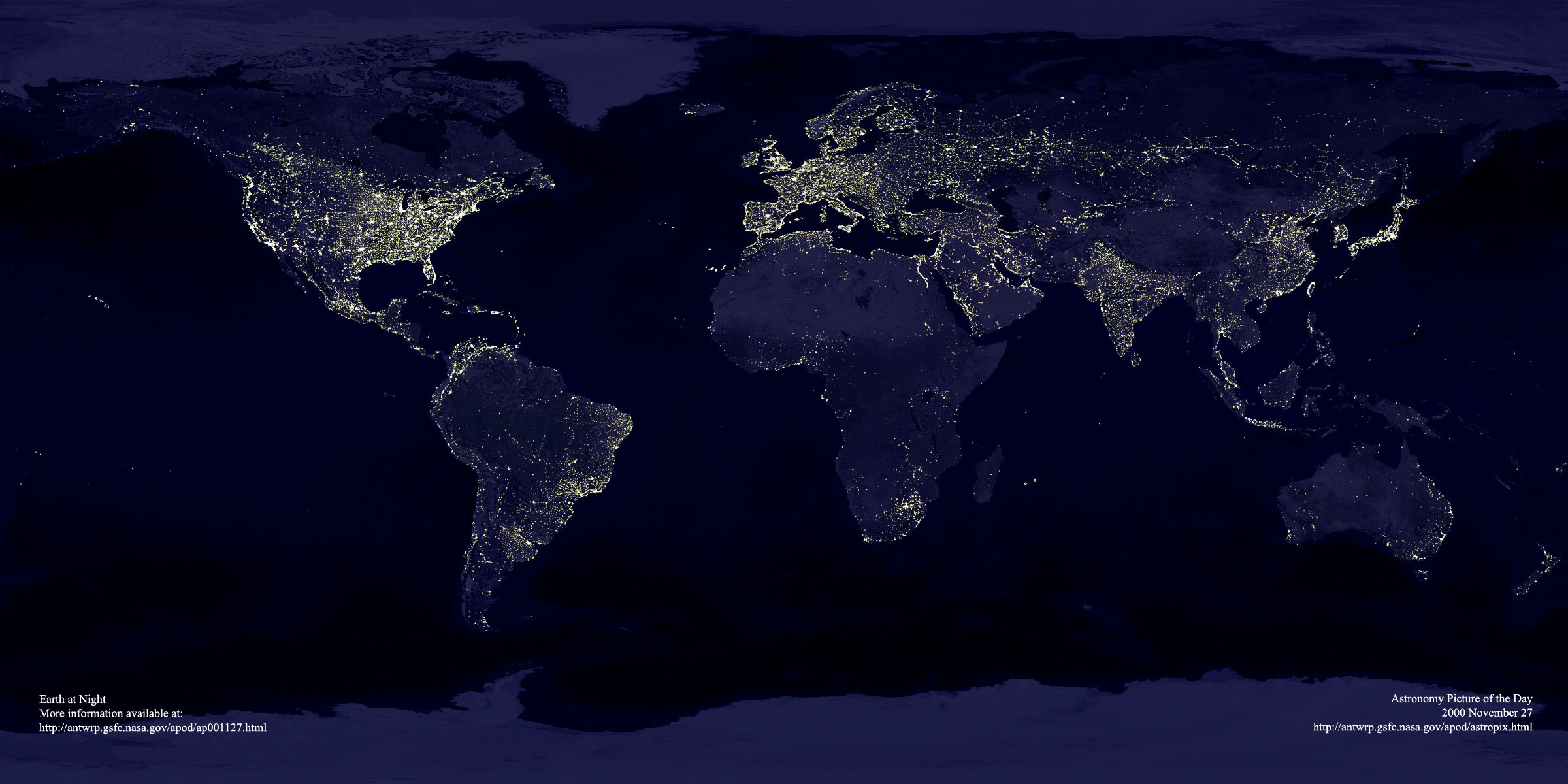
It looks to me like Canada doesn't exactly have a homogeneous population distribution. Once you get 50 or 100 miles away from the border, Ontario and Quebec look about as empty as Alaska, and even out west you can easily see all the lights clumping around places like Calgary. Heck, looking at the US east of the Mississippi, I'd say a good chunk of the US is more homogeneously distributed than even western Europe. Even South Korea is a bit more "clumpy."
It's much easier to wire together a heterogeneous population because you just have to deal with sporadic, concentrated clumps here and there. You just need a whole bunch of short-range connections (such as DSL) with a few longer leads here and there to connect the clumps (A T-3 pipe here and there). An even distribution, on the other hand, is much trickier, requiring a whole mess of medium-to-long connections between users, where DSL doesn't reach far enough an a leased line is just way too expensive.
I'm sorry, but at first glance it doesn't look like comparisons between Canada and the US hold water. -
Re:South Korea.
Check out this pic to contrast electicity usage in North and South Korea.
-
Re:How about Canada?
How about Canada?
Canada is much more "spread out" than the US
Ummm... About 99% of Canadians live on 1% of the landmass. As you can see in This Photo the northern 75% of the country is virtually deserted.
-
Re:GREAT
That's all we need, is some fifteen-year-old DDoS-ing the Hubble.
Why stop there? Insert a phoney image of the Vigina Nebula. Oh wait, they already did that. -
More info on the JPL site
This is actually a long-term project which, in 2015 (probably 2030 in reality
Check out the info here.
-
Someone wanted evidence.
Here are 107 pages of reports by pilots and crew about electronic interference.
Some of my favorites include airplanes turning 3 miles early.
And complete loss of heading infomration.
Now most of this evidence is circumstantial, but isn't it best not test this sort of stuff on live passengers?