Slashdot Mirror
Domain: nasa.gov
Stories and comments across the archive that link to nasa.gov.
Comments · 16,365
-
For comparison...
A google only has 100 zeros, thus 100 places.
10^trillion is 1 followed by 1 trillions 0's... Assuming we are following the american system that would be equivalent to.
10^(10^12)
Okay... now.. let's get some interesting facts with this.
The absolutely smallest length measurable by quantum theory is the planck length which is approx 10^-34 m. Needless to say, if we have a diameter of an incredibly small perfect circle, we'll know it's circumference beyond what is possible by quantum theory (but since there are no perfect circles, and quantum theory adds probability, this doesn't mean anything really useful.
Now, since we know the smallest measurable... lets look at what the estimates for the size of the universe are. Recent estimates put it as 10 billion light years in radius source
Which works out to about... (assuming american notation on billion)
10^9 * 300,000,000 m/s* 365*24*3600 ~= 10^25 m
Okay... now if we were to measure the circumference to as accurate as allowed by quantum theory we'd have.
pi*2.10^25 ~= 6.28*10^26 10^27 with an accuracy of about 34 decimals...
So... to get perfect accuracy as allowed by quantum theory we would have at most 35 decimal places afterwards... therefore, we'd need pi with an accuracy of
~10^63...
We have pi with an accuracy of 10^(10^12) which is
63 : 10^12 ~= 1: 1.59x10^11
Way more accuracy then we really need.
That's absolutely insane, but it is fun math.
Just some food for thought. -
Re:Asteroids sizes unlikey
The actual nasa article does say that there are photos of about 30 impacts that are older than 3.5 billion years, so I will give you that.
She also does say that she is making the assumption that the craters and river valleys are the same age. I would like to know if any of those river valleys are interupted by crater impacts, showing that some of them are newer, leading to this idea that it has happened many times. I doubt some of these incredibly deep valleys could be carved with even a millenia of 6 foot annual rainfalls. The Grand Canyon is small compared to some on Mars and it has been forming with a rather steady flow (remember the used to erode much quicker, when it was prone to sudden burts of water) for for five or six million years, a geologically young feature.
I still think Ms. Segura is missing some very important details when it comes to this theory. -
An ocean on Mars?
There is convincing evidence that Mars once had an ENTIRE OCEAN covering most of the northern part of the planet, early-on during the period of extensive meteor bombardment. This theory was further substantiated using a sensitive altimeter onboard the Mars Global Surveyor. Just take a look at this map: (It speaks for itself!)
http://ltpwww.gsfc.nasa.gov/tharsis/shademap.html Pretty amazing, eh?
I am aware that there is considerable debate on the matter, but I haven't seen convincing evidence that could explain the lack of cratering and extremely flat terrain of this northern region. Perhaps someone here who knows more about planetary science than I could provide possible explanations?
-
Re:Asteroids sizes unlikey
Why do people who can't read keep getting modded as "insightful" here at
>Doesnt anyone think we'd notice the pothole
>left by a 150 mile wide asteroid?
Please READ the article:
"Segura and colleagues used photographs of the Red Planet's surface and computer models to show that large asteroids or comets hit the planet 3.5 billion years ago."
That's 3.5 *billion* years. Almost any impact crater from 3.5 billion years ago on the surface of the Earth would have long ago been eroded away, uplifted by faults into mountains, or subducted down into the mantle. In any case, they'd be difficult or impossible to identify now. Very little of the Earth's surface from 3.5 billion years ago remains intact. On Mars, it's a completely different story.
There are a handful of large craters on Earth that are still identifiable after around 2 billion years, as this article makes clear. But the giants formed by large impactors from early in our solar system's history have long ago been erased (or at least thoroughly obscured) from the surface of this world.
Our moon on the other hand has plenty of gigantic impact scars left over from before 3.5 billion years ago. For example, the gigantic Imbrium crater on the lunar surface is around 700 miles in diameter, and was formed about 3.85 billion years ago. There are several lunar craters in excess of 500 miles in diameter. Our moon is also home to the largest known impact crater in the solar system, the colossal 1,300 mile wide South Pole-Aitken Basin. -
Re:A bit contrived, perhaps?
Nope! One theory goes that this is the same way that Earth got its water. (Orginal water was boiled away in early hot days when there was no atmosphere). The only problem with such theories is the isotope ratios of the water found in comets versus Earth. Search around a bit, you'll find more. One Two Three
-
Nice
-
Nice
-
.Mac ("dot-mac") screen saver for Mac OS X
Ironically, this was submitted (and rejected) earlier today; faulting myself for not having checked for this thread before submitting (or acting before.)
The "Earth As Art" images are also available for Mac OS X v10.2 users as a
The images were mangled with
The imagery is a pick of about ten random images from the about fourty images available, randomized daily by a Perl script and pushed to the site with HTTP::DAV.
Prior art disclaimer:
[hypsis:~] uucee% HEAD http://homepage.mac.com/EarthAsArt/.Pictures/Slid
e %20Shows/Public/aleutian-1.jpg
Date: Thu, 05 Dec 2002 22:23:36 GMT
Last-Modified: Fri, 15 Nov 2002 02:25:50 GMTThe "EarthAsArt"
Enjoy.
-
Re:Playing the Odds
Nice scientific arguement. Read this page on NASAs site.
-
Re:Download a printable poster TIFF file...
-
Re:Download a printable poster TIFF file...
-
Re:Download a printable poster TIFF file...
-
More and better pictures at a NASA site...
This contains load of images taken by the space shuttle. Well worth a look... Earth From Space
-
If you are interested in Earth Pictures
Check out the Blue Marble pictures. A resolution of 1 pixel/per kilometers for the whole of the planet, which makes the full pictures 40000*20000 pixels big =) They are available in different views (cloudless, with or without the sea floor relief, at night...) and are truly amazing.
I'm probably going to get a -1 for promoting my own soft, but if your computer cannot handle a 2 gb file in RAM, check my website. I made a soft (approved by the guy who made the picts) for viewing them without much RAM. Only works on macs and PCs, though I'm thinking of a linux version. -
The other obvious joke
That's your Norwegian Blue, see, he's pining for the fjords.
Fifty posts old, and nobody else misquoted the obvious Python reference. And you call yourselves nerds... -
Re:Other planets are art as well... but...Earth's stark contrast of water, ice, cloud and land cannot be beat. The other planets are very beautiful, but nothing comes close to Earth.
For variety and detail, I'd take Earth; the unique effects of life all over its surface have made an incredible difference. But then we're biased; our eyes have evolved to use the colour palette used on Earth, so of course it looks good to us. Take a look at Jupiter in radio or magnetic spectra some time...
From a non-homeworld-chauvinistic view, the jewel of the Solar System can only be this one. Pick a spectrum, any spectrum, it's still magnificent. Even buy a cheap telescope and just look at the thing. That's going to be the mother of all tourist attractions five hundred years from now.
-
Re:More information hereDoes anyone have a pointer to the article that UPI has so badly dumbed-down?
Check out NASA's Space Interferometry Mission site, especially their page on Planet Detection
There's much more information on that site that should sate your curiousity. HTH!
-
Re:More information hereDoes anyone have a pointer to the article that UPI has so badly dumbed-down?
Check out NASA's Space Interferometry Mission site, especially their page on Planet Detection
There's much more information on that site that should sate your curiousity. HTH!
-
printed versions
you can get something like this in print for free
-
Re:Math != reality
Check out
Spherical Cows.
-
Re:That's not important
-
Re:That's not important
-
Re:That's not important
-
Re:That's not important
-
Re:That's not important
-
Re:That's not important
-
Re:That's not important
-
Re:That's not important
-
Re:That's not important
-
Re:That's not important
-
Re:That's not important
-
Re:That's not important
-
Re:That's not important
-
Re:Oh really?
And not one second to soon. See this machine (points to the floor and right)? It's got 2 GB of memory (2^63), and it's my friggin' home computer. The fact that Intel is not pushing for 64-bit desktops is very strange indeed, considering that the will be nessecary even for high-end consumers like myself within the year.
And don't give me that crap about 36 bit virtual adressing... The reason I use 2 GB in my machine is that I USE >1GB, in one process, and in a very random fashion (in fact, the hobby program I'm developing would really like ~7 GB of RAM (yes, just for this one process), but I can't afford that just yet).
For those who are wondering what kind of "hobby program" I'm writing that needs such a shit-load of memory: It's an application that displays the globe, using the Blue Marble world texture maps at 1x1 km resolution from NASA (40,000x20,000 pixels, night and day side). And sometime soon-ish they'll release 100m maps, and I will need 700 GB of ram, then 10m/70TB, 1m/7PB...
-
Specialty application
The's a whole bunch of ways to cool things. It's just a matter of what works for a particular application.
Thermo-acoustic cooling has been considered for use in space to reduce the weight and mechanical complexity of traditional refrigeration systems. iirc, there was also the advantage of using less dangerous/toxic gasses with acoustic cooling. -
Re:Not too much money, really
Actually,
"Since 1976, about 1,300 documented NASA technologies have benefited U.S. industry, improved the quality of life and created jobs for Americans." (http://www.sti.nasa.gov/tto/apollo.htm)
Just do a search on google for NASA spinoffs and I'm sure you'll come up with a huge list of important (and arguable some less-important) inventions that have been the result of NASA.
However, I think that too often people miss the point of investing in space. Many important technologies have already come out of NASA's efforts, including CAT scans, self-righting life-rafts, kidney dialysis machines, etc. Even despite these advances, how do we know that something better isn't out there waiting to be discovered? That is what we are investing in.
Doing research in space is just the same as doing any type of research. It's the persuit of something better, even though we don't always know what, if anything, it will produce. Why do research in anything for that matter? By investing millions of dollars in gene research do we know for sure we're going to find a cure for cancer, or alsheimers, or any other diseases? No, but we look into it anyway because we might find something. Why bother mapping the human genome otherwise? We have nothing better than guesses as to what eventual result can come out of that.
Lastly, we just have to look at history. Why did Spain fund Christopher Columbus to sail to the edge of the world when they _knew_ the world was flat? Why did we continue to try and split the atom when we _knew_ it was the smallest piece of matter? Sure some advances have been made as a result of funding in NASA. Whether or not those results are worth the initial investment is arguable, but how do we _know_ that NASA isn't going to make a landmark discovery that makes the investment required for that discovery seem laughable?
-Mark
-
Some engineering feats to consider
"Is there anyone besides me who likes to travel and look at engineering projects?
I've always thought the London Underground was a great engineering achievement... Fast transit, the fares are relatively cheap, and you get black nose hairs free of charge.
Other engineering achievements I'd recommend would be the Petronas Towers in Malaysia (these are the tallest buildings in the world right now, and they have an interesting "bridge" between them); the Hoover Dam outside of Las Vegas, NV; and the Channel Tunnel. If you have a few million to spare, you could always contact Russia to visit the International Space Station. I'm sure other Slashdotters will think up many other sights to see... -
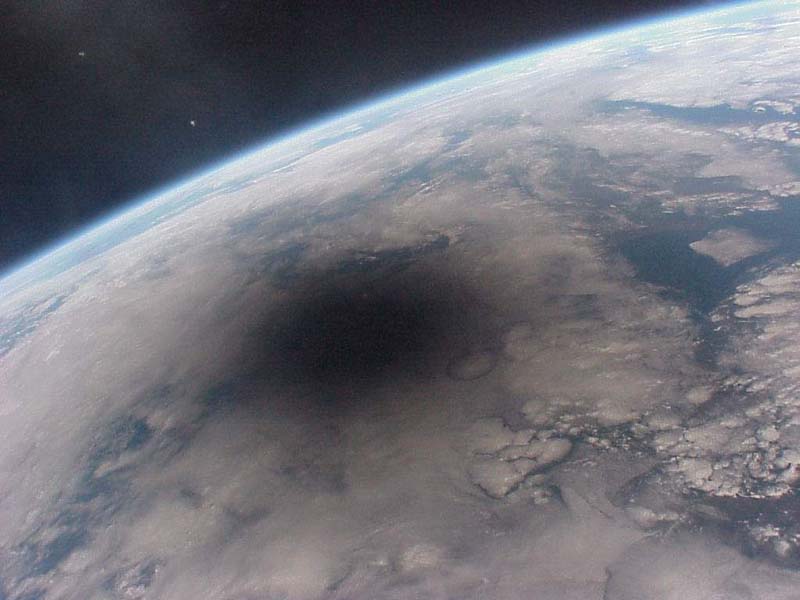
Total Solar Eclipse
-
Total Solar Eclipse
-
Go watch some rockets in Florida
-
Wated money? Not all of it...According to NASA propoganda (which I will take for face value), there is quite a bit of side benefits to the money that is "wasted" on the space program in general. Things like cordless tools, smoke detectors, quartz clocks, satellite communications, sports pads, etc have all been direct offshoots of this money "wasted" by the space program. Lets face it, even if NASA doesn't accomplish all the lofty goals set out 100%, they still are applying high quality research to real problems, which directly leads to useful technological solutions which apply to other aspects of life. I'd be interested to see what has sprung off of the space station program in particular, because that link sounds like stuff developed during the shuttle era.
The main problem is we're lacking the stiff competition that the Russians used to provide to us, so we're just moping along at our own pace. We're not worried about some damn communists beating us into space anymore. NASA should create a rogue nation for the explicit purpose of competiting with us to get to Mars. We'd get there lickity split! (Hell, GM did it to themselves by creating Saturn, why can't NASA?)
-
Re:NASA Accounting> We've seen too much throwing good money after bad.
I agree. ISS is an example where good money was thrown after bad. BUT there have been many many times when the reverse has been the case at NASA. So often they have brought a project to 80% completion, only to cancel it at the last minute. The ones I can think of off the top of my head:
- Triana -- all hardware finished, never launched.
- Apollo 18, 19 & 20 -- All hardware finished, crews trained, never launched.
- Skylab B -- Entire space station was built, a Saturn V was available, never launched.
[Posting as a coward because I don't want to undo the mods I made earlier on this story.]
-
Re:NASA Accounting> We've seen too much throwing good money after bad.
I agree. ISS is an example where good money was thrown after bad. BUT there have been many many times when the reverse has been the case at NASA. So often they have brought a project to 80% completion, only to cancel it at the last minute. The ones I can think of off the top of my head:
- Triana -- all hardware finished, never launched.
- Apollo 18, 19 & 20 -- All hardware finished, crews trained, never launched.
- Skylab B -- Entire space station was built, a Saturn V was available, never launched.
[Posting as a coward because I don't want to undo the mods I made earlier on this story.]
-
Re:NASA should benchmark other organizations,
If NASA has the attitude that having a space station that was 99% safe, instead of 99.99% safe, and relied on the skill of the residents astronauts to fix any problems, we'd have the dual torus in 2001, instead of a little tin can. Good luck getting that in today's wiffle world.
With all due respect, tell that to the three crew members who burned in the Apollo I pad fire or the seven who died in the Challenger disaster. While NASA has designed with 99.99% (or higher) reliability in mind the whole time, things still go wrong with the remaining 0.01%, and that ends up hurting the whole program. Congress cuts back funding when things blow up unexpectedly and people die.
Whenever NASA or anyone is doing something grandiose that has never been done before, there is an undefined amount of risk that you have to plan for. Having 99.99% reliability (or higher) is necessary in situations such as this to prevent catastrophe. However, once the system has been tested over and over, future systems can be designed more optimally by taking out redundancy where it is not needed. This is evident in many products, from cars to TVs -- they used to be made like tanks, but now they're made to be practically disposable.
Another important point to mention is that overall system reliability tends to be multiplicative. For instance, if 450 components that work in series together have component reliabilities of only 99%, the overall system reliability is 0.99^450 or 1%. With a 99.99% reliability, you would have a 95.6% reliable system (0.9999^450). Now imagine the Space Shuttle or ISS with millions and millions of parts. I will take 99.99% component reliability any day for something as complex as the these systems! -
Re:NASA should benchmark other organizations,
If NASA has the attitude that having a space station that was 99% safe, instead of 99.99% safe, and relied on the skill of the residents astronauts to fix any problems, we'd have the dual torus in 2001, instead of a little tin can. Good luck getting that in today's wiffle world.
With all due respect, tell that to the three crew members who burned in the Apollo I pad fire or the seven who died in the Challenger disaster. While NASA has designed with 99.99% (or higher) reliability in mind the whole time, things still go wrong with the remaining 0.01%, and that ends up hurting the whole program. Congress cuts back funding when things blow up unexpectedly and people die.
Whenever NASA or anyone is doing something grandiose that has never been done before, there is an undefined amount of risk that you have to plan for. Having 99.99% reliability (or higher) is necessary in situations such as this to prevent catastrophe. However, once the system has been tested over and over, future systems can be designed more optimally by taking out redundancy where it is not needed. This is evident in many products, from cars to TVs -- they used to be made like tanks, but now they're made to be practically disposable.
Another important point to mention is that overall system reliability tends to be multiplicative. For instance, if 450 components that work in series together have component reliabilities of only 99%, the overall system reliability is 0.99^450 or 1%. With a 99.99% reliability, you would have a 95.6% reliable system (0.9999^450). Now imagine the Space Shuttle or ISS with millions and millions of parts. I will take 99.99% component reliability any day for something as complex as the these systems! -
What is that ring?
What is the ring that appears to the lower right of the Moon's shadow in that photo taken from Mir?
-
Researchers tread it all the time, but since they
understand the difference between a closed system and an open system, they have no fear..
More==>
The numerical calculation of entropy changes accompanying physical and chemical changes are very well understood and are the basis of the mathematical determination of free energy, emf characteristics of voltaic cells, equilibrium constants, refrigeration cycles, steam turbine operating parameters, and a host of other parameters. The creationist position would necessarily discard the entire mathematical framework of thermodynamics and would provide no basis for the engineering design of turbines, refrigeration units, industrial pumps, etc. It would do away with the well-developed mathematical relationships of physical chemistry, including the effect of temperature and pressure on equilibrium constants and phase changes.
So what you are really asking when talking about thermodynamics is where does the energy needed to reverse entropy come from? The aswer is big, hot, and round, and has often been called a god in the past, but unlike the Xian god can be seen quite easily with the human eye.
Meanwhile, the origin of the first cell is interesting (and certainly there are plenty of researchers who aren't afraid of looking into that), but has nothing to do with evolution, since Evolution is the theory of what happened AFTER the first cell formed (which is why Darwin's book is called the Origin of the Species, not the Origin of Life. -
Re:Why not lease it out instead?
that's all the higher the shuttle can go
Before you state that Nasa is just blowing air out their asses, make sure you're not blowing air out your own.
-
Re:Why not lease it out instead?
that's all the higher the shuttle can go
Before you state that Nasa is just blowing air out their asses, make sure you're not blowing air out your own.
-
Diesel engines for airplanes tooDiesels (GAP Diesel Engine) are cool for aviation: they will burn standard jet fuel (kerosene-like) which is cheaper than Aviation gasoline and unleaded (yes AVgas is still leaded!), and jet fuel is generally more available. And diesel engines will probabaly last longer than gas betw. overhauls.
-- "Eat Bowl Futty"