Slashdot Mirror
Domain: nasa.gov
Stories and comments across the archive that link to nasa.gov.
Comments · 16,365
-
Re:Verify?
There's a laser corner reflector on the moon, left there by Apollo 11. It's the only instrument still in use today; fire a laser pulse at the moon, wait for the reflected pulse, and you get a really accurate measure of how far away it is.
Given that it's usable by anyone in the world (who has a really big telescope and laser setup) I suspect it would be rather hard to fake...
-
Final Proof of the Moon landings
for final proof of the moon landings, visit http://sunearth.gsfc.nasa.gov/eclipse/SEhelp/Apol
l oLaser.html. Apollo 11 left a mirror up there so that we could use a laser rangefinder to calculate the distance to the moon. It's still there - and it still is working. You can remove your tin foil hat now... -
Interferometer
What you are describing is called an interferometer. This is the Keck Observatory in California which is basically two telescopes whose centerlines are 85 meters apart.
-
Why I'm not a civil servant...I worked at NASA/GSFC from 1995-1999, doing solar physics and operating an instrument on board SOHO. When I started looking for a more permanent, 100% science position, I got offered a ``hard money'' civil service position at Goddard.
``Hard money'' is the career goal of most young scientists, regardless of field. Those two words mean that your salary is paid regardless of what you do. A traditional way to get hard money is to work through the university system and become a tenured professor somewhere. The other main way is to become a civil servant at a government research lab. Once you're in, you're in. As a scientist, you're essentially bulletproof: it's very hard to fire a civil servant, especially one with as nebulous a set of responsibilities as a scientist carries.
But there are drawbacks too. With the security of a government job come responsibilities ranging from the trivial (such as not being allowed to eat the free doughnuts at a meeting) to the ludicrous (I went to a meeting held at the 1998 eclipse site on the island of Guadaloupe. My civil service friends were required to book hotels 25 miles away to save a few bucks a night -- but then they discovered that their hotel was on another island!) to the onerous (e.g. it's difficult to travel, get equipment, or hire help).
I ended up taking a ``soft money'' position at a nonprofit research institute. The downside is that I have to find sources of income (grants) to support myself. The upside is that when I want a book, I buy it; when there's a meeting I should attend, I go to it; and if I have an idea for a new instrument or analysis technique, I can just implement it. Management is very supportive.
Civil service is great -- but on the other hand, the people who are most attracted to it are the people who value security above opportunity. That fosters a CYA culture and makes it difficult to get things done (such as science). Although tenure and absolute job security in principal make it possible to explore unpopular-but-important ideas (and many civil servants are very productive!), they also make it possible to relax into a not-very-productive rut.
The entrepreneurial spirit of soft-money research labs, ironically, makes it easier to have (some kinds of) bold ideas, simply because you have to do something to keep yourself going. That small-but-significant frisson of worry about the future keeps people on their toes and thinking creatively. Ordinary entrepreneurs must get it in spades.
-
Why I'm not a civil servant...I worked at NASA/GSFC from 1995-1999, doing solar physics and operating an instrument on board SOHO. When I started looking for a more permanent, 100% science position, I got offered a ``hard money'' civil service position at Goddard.
``Hard money'' is the career goal of most young scientists, regardless of field. Those two words mean that your salary is paid regardless of what you do. A traditional way to get hard money is to work through the university system and become a tenured professor somewhere. The other main way is to become a civil servant at a government research lab. Once you're in, you're in. As a scientist, you're essentially bulletproof: it's very hard to fire a civil servant, especially one with as nebulous a set of responsibilities as a scientist carries.
But there are drawbacks too. With the security of a government job come responsibilities ranging from the trivial (such as not being allowed to eat the free doughnuts at a meeting) to the ludicrous (I went to a meeting held at the 1998 eclipse site on the island of Guadaloupe. My civil service friends were required to book hotels 25 miles away to save a few bucks a night -- but then they discovered that their hotel was on another island!) to the onerous (e.g. it's difficult to travel, get equipment, or hire help).
I ended up taking a ``soft money'' position at a nonprofit research institute. The downside is that I have to find sources of income (grants) to support myself. The upside is that when I want a book, I buy it; when there's a meeting I should attend, I go to it; and if I have an idea for a new instrument or analysis technique, I can just implement it. Management is very supportive.
Civil service is great -- but on the other hand, the people who are most attracted to it are the people who value security above opportunity. That fosters a CYA culture and makes it difficult to get things done (such as science). Although tenure and absolute job security in principal make it possible to explore unpopular-but-important ideas (and many civil servants are very productive!), they also make it possible to relax into a not-very-productive rut.
The entrepreneurial spirit of soft-money research labs, ironically, makes it easier to have (some kinds of) bold ideas, simply because you have to do something to keep yourself going. That small-but-significant frisson of worry about the future keeps people on their toes and thinking creatively. Ordinary entrepreneurs must get it in spades.
-
Re:Why does this company have to get US permission
I think other posters have already explained that very well, so I won't repeat that here.
But talking about the satellite and orbits issue, it may be interesting but bear in mind that orbital elements or ephemeredes are only valid for a certain amount of time after they are issued (up to a few weeks); this is due to the effects of things like atmospheric drag, orbital corrections and the alike. This is particularly true for low-orbit satellites like ISS and the Space Shuttle (when in orbit, off course)
Specially interesting, see here a chart of the orbital height of the International Space Station over time. Quite interesting chart. -
Re:Why does this company have to get US permission
I think other posters have already explained that very well, so I won't repeat that here.
But talking about the satellite and orbits issue, it may be interesting but bear in mind that orbital elements or ephemeredes are only valid for a certain amount of time after they are issued (up to a few weeks); this is due to the effects of things like atmospheric drag, orbital corrections and the alike. This is particularly true for low-orbit satellites like ISS and the Space Shuttle (when in orbit, off course)
Specially interesting, see here a chart of the orbital height of the International Space Station over time. Quite interesting chart. -
Re:Get a fucking telescopeActually, we don't. Hubble would have to be about 10 times larger to be able to make out any of the lunar modules on the landing sites, at the distance the moon is from Hubble's orbit. Currently, it can discern objects or features about 80m in diameter. Obviously, the lunar modules are a good bit smaller.
Here's a link:
-
Re:Verify?
Apparently not. Even for the Hubble telescope it's not that easy, and I've got the pictures to prove it.
-
Re:Verify?
I think that the sites are below the resolution limit of Earth based telescopes. However, Apollos 11 and 15 left retroreflectors which anyone can use to measure the range to the moon with quite high accuracy. There is a website here where anyone can read about it. Of course, I suppose you can fake all the range data and the ranging experiment as well.
-
I saw it recently using NASA's J-Pass software
I saw it two nights in a row a couple weeks ago. If you follow the link below, you will find the NASA J-Pass Java applet. Enter your location and it will display a star chart that shows you precisely where and when to look. Here's a hint, it's only visible right before sunrise or right after sunset. Why? Well, it's orbiting pretty low and quickly passes into the Earth's shadow. It's actually pretty cool to watch it "wink out" after going 2/3 across the sky.
It's so easy to use, my parents were able to figure it out!
J-Pass -
Re:Second Prize.
-
Re:Second Prize.
-
Re:With those odds
Not to belabor this discussion but you are wrong about how weather and meteorology works. Historical records are pretty much useless for day to day weather prediction and provide ambiguous data at best about the future. Look at the American meterological society web page (under "What tools do meteorologists use?") and you'll see that models play a big part in short-term weather forecasting. As to long term climate prediction, they play an even bigger part. Why do you think there is controversy over global warming? It all comes down to models. Look at the NASA page for example.
Your assertion that if we had a model we would have a certainty rather than a probability is inaccurate too. That is why future global warming is a probability rather than a certainty - even though we have some fairly detailed models. Why is that? Because once you have enough particles interacting, the system becomes too complex to have a perfect simulation. So you make a bunch of simplifying assumptions and try to calculate the error of those assumptions.
So what you're advocating with your one in a thousand probability is basically a reliance on ignorance. In other words, since we don't know any better, let's just use history as our guide. You can certainly do that but if you want to have any credibility you have to calculate some margin of error. And even in the best case, this margin of error is going to be much greater than 100% if we only use recorded history.
Also, insurance companies do use models. They aren't very open about what they are though. But anyway these kinds of predictions are a little different. They are all based on assumptions like people are pretty reasonable on average so the world economy won't entirely implode and throw us into total chaos. These insurance probabilities don't take that into account but it doesn't matter cause, in that case, we're all broke. In contrast, you can't make this "reasonableness" assumption for asteroids or particles in the atmosphere.
I'm sure NASA has calculated the probability of dangers from certain meteors. I'm just saying that if they told me their assumptions and margins of error, I probably wouldn't put much stock in them. -
I think I'm in love...
Now if we could just get Peggy Whitson to flash us! Does anyone know whether the U.S. Naval Observatory Telescope is open on the morning of the 6th?
-
Re:1 chance in 10,000Here is another quote suggesting that the effect of airbursts are not trivial. The dust generated is more disruptive than the impact itself, if there was an impact. So, breaking the rock into pieces small enough they don't penetrate all the way to the surface may be worse than doing nothing...
What is the range of impactor sizes that might lead to
-
1 chance in 10,000
Life on earth can cope with two
A number of respondents have said more or less the same thing -- that Earth is struck by small space rubble every day, with no apparent adverse effects. I have trouble with this idea.
But first, to be pedantic. If you split a
Here is a link I found in an earlier slashdot discussion to an article classifying the destruction from different sizes of impacting rocks. This passage discusses the difference in destructive effect of a rock large enough to pierce through the atmosphere, and strike the surface, and those smaller or less solid bergs that fragment in an airburst.
The total area of destruction is not, however, necessarily greater than in the case of atmospheric disruption of somewhat smaller objects, because much of the energy of the impactor is absorbed by the ground during crater formation. Thus the effects of small crater-forming events are still chiefly local.
This suggests to me that 8 x 100 megaton airbursts would be worse than one 8,000 megaton groundburst.
The article says a 10 meter rock releases a blast equivalent of 100 kiloton of TNT -- about 6 or 7 x Hiroshima. The 1908 Tunguska event, the airburst of a berg about 50 meters in diameter, released the blast effect of a 16 million tons of TNT. The fireball to seen to streak across Pennsylvania this summer was less than a meter in diameter.
A 500 meter rock, massing something like 4*10^7 tons, would not wipe the Earth of life. Nor would being struck by by 40*10^7 tons of rubble. I contend it would be a mistake to shrug off either one as trivial however.
Here is a final quote:
-
Re:Walnut-sized Nuclear Reactor
Uh... The americium only acts as a radiation source. The smoke alarm still needs a battery (or mains connection) to actually do anything useful with the detected radiation levels. The deep space probes have used radioactive fuel cells driving thermopiles - it's the grey cylinder sticking out of the side in this picture. On a smaller scale, there's this little wonder, which just about fills your gap.
-
Re:Dumb Question
It is maintenance related. A nice explanation can be found here.
-
Not the 'uninformed Mars advocate' virus again!Your level of "proof" to debunk things is a bit lower than mine. The first link you had talks about sheltering on Mars, which doesn't address the real dangers of the radiation exposure on the long trip to Mars. The second link you presented was so devoid of information that it sounds like those trekkies who like to lecture scientists and engineers as to why they haven't figured out how to build transporters yet.
You might want to check out some studies that have some science behind them instead of hand waiving and talking about moving astronauts into the food locker or wrapping a copper wire around the spaceship (which reminds me, it is an excellent exercise for the student to calculate the gyroradius of a charged particle as well as the magnetic field from a ring of current; do that for some solar energetic particle events and see what kind of currents you need to carry to make a dent in their trajectories).
A quick search of papers written by people who have some grounding in science turned up this one and this one (the second one has worst case shielding thicknesses of 20 cm Al which would be more than a few water bottles). You can also track down the several times the National Academy of Sciences covered the issue (hey, find your own links 'cause I ain't gonna spoon feed the whole thing to you!).
You can belittle the problem, but please refrain from ridiculing people who can calculate particle rigidities, who know what kind of momenta these particles in space have, and who know what the stopping potential of a material is.
-
Not the 'uninformed Mars advocate' virus again!Your level of "proof" to debunk things is a bit lower than mine. The first link you had talks about sheltering on Mars, which doesn't address the real dangers of the radiation exposure on the long trip to Mars. The second link you presented was so devoid of information that it sounds like those trekkies who like to lecture scientists and engineers as to why they haven't figured out how to build transporters yet.
You might want to check out some studies that have some science behind them instead of hand waiving and talking about moving astronauts into the food locker or wrapping a copper wire around the spaceship (which reminds me, it is an excellent exercise for the student to calculate the gyroradius of a charged particle as well as the magnetic field from a ring of current; do that for some solar energetic particle events and see what kind of currents you need to carry to make a dent in their trajectories).
A quick search of papers written by people who have some grounding in science turned up this one and this one (the second one has worst case shielding thicknesses of 20 cm Al which would be more than a few water bottles). You can also track down the several times the National Academy of Sciences covered the issue (hey, find your own links 'cause I ain't gonna spoon feed the whole thing to you!).
You can belittle the problem, but please refrain from ridiculing people who can calculate particle rigidities, who know what kind of momenta these particles in space have, and who know what the stopping potential of a material is.
-
Realtime movies of last 48 hoursThe best pics for my money are at:
http://sohowww.nascom.nasa.gov/data/realtime/mpe g/
In particular this:
http://sohowww.nascom.nasa.gov/data/LATEST/curre nt _c2.mpg
is a reasonably small (3Mb) mpeg of the last 48 hours... the flare is right at the end of the sequence. Notice that although it appears on the right limb of the sun first, it's also pretty symetrical - indictating that the thing's coming straight for us.
Incidentally, if you've ever fancies getting your name on a comet, there are people who sit in front of those pages pressing ^r constantly in order to be the first to identify a new sungrazer. No, there's no software sitting processing the images in realtime for comet-like objects, and they (or rather, their ion tails) show up nicely.
Enjoy!
-
Realtime movies of last 48 hoursThe best pics for my money are at:
http://sohowww.nascom.nasa.gov/data/realtime/mpe g/
In particular this:
http://sohowww.nascom.nasa.gov/data/LATEST/curre nt _c2.mpg
is a reasonably small (3Mb) mpeg of the last 48 hours... the flare is right at the end of the sequence. Notice that although it appears on the right limb of the sun first, it's also pretty symetrical - indictating that the thing's coming straight for us.
Incidentally, if you've ever fancies getting your name on a comet, there are people who sit in front of those pages pressing ^r constantly in order to be the first to identify a new sungrazer. No, there's no software sitting processing the images in realtime for comet-like objects, and they (or rather, their ion tails) show up nicely.
Enjoy!
-
Old photo
According to the directory listing, that photo is from March 15,1999. I know it takes a while until submitted articles are posted, but this seems a little excessive.
-
Nature is Pretty, DIY
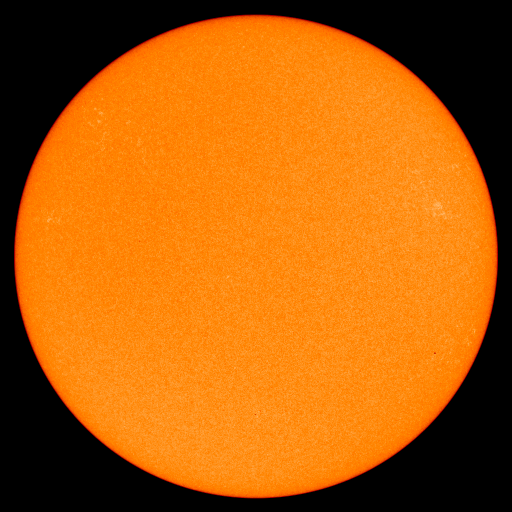
You can actually see sunspots (it'll look kinda like this, but in grayscale) any time you want by projecting the sun onto paper. Binoculars work well, a telescope works even better.
Aim your binoculars at the sun, without looking into them. If you look into them, you'll only see the steam rise from your eyes as they cook. Put a piece of white paper about 2m away from your binoculars. Cover a lense so only 1 circle shows on the paper. Finally, focus your binoculars to make the remaining circle as crisp as possible. This is easiest when you mount your binoculars on a tripod, but still works by hand.
If you look closely, you'll see the sunspots.
-
The whole submission seems trollish to me
What have we got:
- a link to a "spaceweather" page that will be obsolete in a day
- a link to a "Sun_and_earth.jpg" picture from 15-Mar-1999
- a link to a "sunnow" website that will be obsolete in a day
- a link to a "Space Weather on Mars" story from June 02, 2002
Where is the _article_? -
Re:Odd
(* Frankly, that flare looks slightly demonic to me... but seeing as it's not headed our way, I suppose it's just a nifty looking explosion. *)
Well, it is not alone in that department. My favorite is still the "middle finger nebula" near Eta Coroni (sp?). I want to buy a poster of that, but my wife won't let me put it up. -
Not the 'Mars Radiation' virus again!This one sure gets about! Don't worry though, from the very article actually linked in the story above, the "problem" is immediately debunked:
Fortunately, astronauts can find the protection they need indoors (from solar storms) ; shelter walls made of lightweight materials provide adequate shielding.
For those needing more on this, go find what you need here or, for something a little more cautious and "NASA" here.
Now only if we can get people to stop running about waving their arms and shouting "The Radiation! The Radiation!" we might get something productive done... Heh! No chance of that I guess, might as well join them...
*waves hands over head, runs about, starts screaming "The Radiation!" and giggling*
-
Re:Alabamer
With such insightful commentary from Auburn's engineering students, it's no wonder that Alabama is such a hotbed of intellectualism.
Exactly which intellectual hotbed do you live in?
Auburn University's engineering program is ranked 63rd. It's business school is ranked 49th. And ranked 54th in their doctoral program. Those may not be the highest numbers around, but they are certainly doing okay.
Additionally, the University of Alabama's Law school is ranked 66th (no link), and their doctoral program is also in the second tier.
On the non-academic side of things, Alabama is home of NASA's Marshall Space Flight Center, and is the location of many industry leading businesses, particularly in steel and construction materials. Mercedes also apparently has enough confidence in the competency of Alabamians (there is a rather large Mercedes plant in Tuscaloosa county).
Now I realize you were just taking a cheap shot to get some quick karma, but I'm rather tired of the stereotype that south = slave-owning rednecks. -
sounding rockets?
Don't people do this all the time with Sounding rockets? Although maybe the point is that NASA runs that program too, and this is really independent? Still, it doesn't seem that big a deal...
-
Speed of Shuttle Launch
Taken from NASA's Site "It takes only about eight minutes for the Space Shuttle to accelerate to a speed of more than 17,000 miles (27,358 kilometers) per hour." I'm not sure of the exact speed of sound, but it's something like 650 MPH, so that would mean the Shuttle goes from 0-Mach 26.15 (Using 650 MPH, it can vary depending on air temp, but not by much) in 8 minutes.
-
Re:Byebye organized religion
>Prove the earth revolves around the sun.
Take a look at the solar system Family Picture that voyager sent back.
>Prove NASA *didn't* fake the moon landings.
Go have a look at the moon rocks in a museum.
>Prove computers work by electricity, and not magic.
Put your index and thumb between the little socket that plugs into your computer.
>Prove these things to someone that starts off thinking you're a flake anyway, and just *knows* you're making this stuff up from some fantasy books you read somewhere. (That's all high-energy physics is, right? Fantasy and magic.)
You have very little understanding of what constitute science and its methodology. If you want to play around the semantics of the word "proof", then go ahead. You can't prove anything. But you can build up a solid confidence in knowing how things really works.
Many religions require the use of the Special Pleading argument to "prove" their point (i.e. praying will cure cancer etc.) That is the point of the OP : if your religion (i.e. Jedi) claim you can do mindtricks, then show that it exist by doing just that.
Unfortunately, most people don't care about believing in believable things. Things that are nice and fuzzy inside is so much more comforting.
-
Ion engines are better
Orion is interesting history, but not particularly compelling technology as is. These days ion engines perform as well as the Orion specs. They are also much cleaner and have been successfully tested in space:
Most significantly, the DS1 engine achieved a specific impulse of 3100 seconds, which is comparable to Orion specifications and much better than chemical rockets. (The specific impulse indicates how efficient an engine is at converting propellant mass into forward momentum.)
The one thing that ion engines aren't good for is producing a lot of thrust, so in particular you could never launch yourself off the ground with one. Presumably the Orion technology also wouldn't be used for this purpose.
-
Ion engines are better
Orion is interesting history, but not particularly compelling technology as is. These days ion engines perform as well as the Orion specs. They are also much cleaner and have been successfully tested in space:
Most significantly, the DS1 engine achieved a specific impulse of 3100 seconds, which is comparable to Orion specifications and much better than chemical rockets. (The specific impulse indicates how efficient an engine is at converting propellant mass into forward momentum.)
The one thing that ion engines aren't good for is producing a lot of thrust, so in particular you could never launch yourself off the ground with one. Presumably the Orion technology also wouldn't be used for this purpose.
-
Warp drive when?
You can find more info about advanced propulsion techniques (like the Orion-project) and other interesting space-science stuff at Warp Drive When?.
-
Permanent linkSince the APoD rolls over each day, the link in the story now points to the next day's Astronomy Picture of the Day.
This is a permanent link to the APoD highlighting the Voynich Manuscript, for those reading the story after the rollover.
-
Re:What Hogwash! Nothing Can Move in Time!
By the way, the world is flat because there is no z-axis. The proof is dz/dz = 1 which mean that if you built a rocket it won't blasted off because moving in z-direction is self-referential or impossible.
Of course, the story about men going to the moon is also a hoax. -
Re:ET Phone home!
Hum, keep in mind that this is a RADIO telescope array. So you can't "see" further with it, you can "listen" better...
What are you talking about? There are lots of radio images around.
Whether it's "audio" or "video" depends only on whether you're using a point detector (like a radio receiver or a photodiode for visual light) or a spread out detector (like a lens or an array of point detectors). -
More more linksA few more Voyager links:
- 3D trajectory [java]
- current(?) mission status
- more images from NASA's Spacelink
-
More more linksA few more Voyager links:
- 3D trajectory [java]
- current(?) mission status
- more images from NASA's Spacelink
-
Who cares about photos, check the video...Okay well anyone who's not familiar with what the voyager project is, or you just want a quick nostalgic recap.
Here is a RM stream that has a nice little highschool science class feel to it, but is still very informative.
But I don't get why we keep in contact with the Voyager satellites, everyone knows we'll just lose contact anyways
-
More linksVoyager is coming up lately because it just had its 25th anniversary launch date on August 20. Here are some more links: And a few newspaper stories:
-
META: Linking PDFs
I wish that when Slashdotters linked file-formats beyond the basic HTML or txt, they'd at least add a little warning of some kind, eg link [pdf] so people can choose whether to mess with it. (In my case, it just starts downloading and I have to specifically cancel it.)
-
Photoshop?
Is it just me or does this image look photoshop'd? Is that a real image taken by voyager??
-
Lovely
Here's a picture of Uranus.
-
Re:Heathens
Besides, how can you can believe in evolution when it violates basic laws of the universe? There are so many arguments against evolution that it's ridiculous. Even those that ignore the written record of humanity cannot ignore the scientific facts making it impossible.
I very highly suspect this as a troll, but I'll give it a go
Evolutionists claim that universe the earth is billions of years old, but how is that possible when the rotation of the earth slows by 30 seconds every century? If the earth were billions of years old the speed at which it would have been rotating four years ago would have been so fast that it could not have held together.
Er, 30 seconds every century indeed! More like 2.2 seconds every 100,000 years. Here are some references.
There's also the second law of thermodynamics to look at. It states that the universe is constantly heading toward disorder. Evolution violates that law, so which one is right?
Well the second law of thermodynamics only makes sense when you understand what it's actually saying
Another problem with evolution is that certain nucleic acids cannot form without the help of certain proteins, but those proteins cannot form without certain nucleic acids. That makes it impossible to occur naturally.
Admittedly, I know nothing about nucleic acids and proteins, so I cannot comment on this.
Oh well, so I got 2 out of 3. Perhaps somebody with a biology tilt can comment in on the proteins and acids.
-
Re:Heathens
Open your eyes people! I could go on and on.
Please do! I tried to take your lead, and find out more information on Google, but all I came up with was Giant Robots, Giant Squids, and The Jolly Green Giant, who, incidentally, lives in Blue Earth MN, the birthplace of the ice cream sandwich. So if you would be so kind, and provide some links to these giants of which you speak, I would be much obliged. -
Re:Question !
you should see this link
http://antwrp.gsfc.nasa.gov/apod/ap010528.html -
Re:Mars Face
-
NASA's Pitiful efforts?Last June there was a closer near miss, of a smaller asteroid, that was only detected after its closest approach to Earth. This article commented on the press hysteria over the failure of
however, some of the press coverage has been sensationalistic. Some either decry that the object was found after closest approach (rather than before) or express concern about the "blind spot" otherwise commonly known to astronomers as the daytime sky.
The NASA page he cites says the plan is to map all the major near Earth asteroids by 2008. How is this pitiful? If extinction class rocks hit us every 10^7 or 10^8 years, how much time can we budget to defend ourselves against the next one? What if it took 10^2 years? Would that be an unreasonable amount of time to be confident we had detected most of them?
The rock last week was about 100 meters in diameter. Tunguska is estimated to have been 60 meters in diameter. Since the mass goes up as the cube of the diameter this one would have been about five times as powerful as Tunguska. The planetary.org article I linked to says one that size strikes us every couple of millenia. Is this program a failure if we can't detect and divert the next Tunguska sized rock? The article says the Tunguska strike was as powerful as the blast from a 16 megaton H-bomb. It said it devastated 2000 square kilometres. That would be a square about 42 kilometers on a side. Ie. Bigger than Monaco, smaller than NYC.
16 megatons? Rick Green's glossary of cold-war terms defined a "small-theatre nuclear exchange" as "Curtains for the actors after just one act, hence the prefix 'small theatre'". Sure, this could be devastating for lots of people, if it too didn't land somewhere relatively deserted, like northern Siberia. But civilization would survive, even if it landed on Hollywood.
The planetary.org article said 25% or more of the rocks that have hit Earth may have been long period comets. Figuring out how to detect and deflect long period comets that might hit the Earth would be much more difficult. Maybe so much more difficult we shouldn't waste any resources trying?