Slashdot Mirror
Domain: nasa.gov
Stories and comments across the archive that link to nasa.gov.
Comments · 16,365
-
Re:Story poster didnt read the entire article
The probability of impact for CU11 object is actually 0.0021% which is twice as scary. The 0.0021% figure comes from adding the probablities of all of the guessed trajectories.
Oh come on. The 0.001% impact probability is for the year range 2002-2049, your 0.0021% probability is for the range 2002-2096 (twice as long). Since typically, searches are conducted 100 years into the future. there's no data beyond 2102, but you'd expect a proportionally higher cumulative probability for the next 200 years, 500 years, etc. There's nothing to nitpick about.
Gee, do you always try so hard to attack other's people statements? You really found nothing this time. Try to find something positive to say about the submitter write-up next time. -
Been there, done that
NASA is already sending out hydrogen ion stream rockets, using the magnetic ionizer you're describing. It is a complete success, and many times more efficient than traditional rockets.
As for a scramjet launcher... that is silly. You don't save a lot of money. The major expense in a launch is not the fuel, it's the craft. A reusable craft does not always result in a cheaper launch, because that requires a fancier craft. For example, Shuttle launches are more expensive than disposible rocket launches.
Saturn in a year claim is dubious. Ion propulsion gives slow, steady, efficient thrust, perfect for long cheap trips, but terrible at fast acceleration. Though a combo with chemical early stages, and ion later stages, might work well for a fast distance trip. The actual thrust in the Deep Space craft using ion propultion is about the weight of a sheet of paper... but that really adds up over a few months!
See also: ion faq at NASA
-
Re:Warning: Another Green Hoax
All I can say is, check again. Diatomic oxygen (02 - a standard oxygen molecule) absorbs UV, but only up to 240nm wavelength. When it does this, it breaks down into free oxygen atoms, and frequently re-combines with another oxygen molecule to form ozone (O3).
Ozone absorbs UV radiation between 240 and 320 nm. Without the ozone in the upper atmosphere, this UV radiation would make it through to the surface of the earth.
For details on the chemistry of ozone, check here. More information can be found here, here, here, and many other places on the web.
Please, before popping off on a scientific issue, check the facts and not the politics. -
Re:Tourism In Space Will Never Work
The Space Elevator would solve the unhealthy launch problems and should lower the cost.
There is currently no market for a 'space pill' or equivalent to fight the bone loss, etc., but you know what they say about necessity.. -
500000 light years?
From the article:
The next member of the gang expected to go supernova is Antares, which at almost 500,000 light-years away is too distant to rattle our planet, they say.
What kind of dope are these astronomers smoking? Antares is 500 light years away.
Still quite distant, but 500000 light years will place you well outside the Milky way. It's about as far as the Magellanic clouds. -
Re:Retiring Hubble
Next generation space telescope is what you're looking for.
With the way cutbacks are being made, perhaps Hubble's life will be extended a bit longer while the NGST is put on hold for a couple years. I seem to remember reading something about Hubble being run at the same time as the NGST for a little while. Too lazy to look though.
I guess after a while the computers and other equipment eventualy break down over time because of all the radiation and junk. I realize that they built this thing with radiation shields and whatnot, but I don't think they stop everything 100% forever. -
Re:NASA's troubles
Just a reminder: One of the goals of the Mars Odyssey Mission is to analyze the radiation environment. Why? To know what risks future human explorers will face, and allow scientists, engineers, and planners to make certain our human explorers are as safe as possible.
Another example, in the NASA Human Spaceflight Gallery are a series of Mars Exploration artists' concepts. Why? Let me quote: "the art work represented here serves as a comprehensive study of various concepts and ideas developed as possibilities over a period of years." People are being paid to dream of a manned mission to Mars--and are sharing that dream with us to inspire us to share that goal (and open our wallets when the time comes).
Now, I don't know about you, but what I see in these examples is a ramp-up to send actual human beings to Mars, they just haven't set it in stone yet.
For now, until the commercial potential of space exploration is realized, we need NASA to continue its efforts. We're already seeing a "boom" in space tourism, but that would not have happened without the Space Station (and the Russians willing to explore the capitalistic potential of space travel). I think for the private sector to truly get involved, we need NASA to develop the base technologies and create an infrastructure for the private sector to build upon. NASA one day may become a regulatory body along the lines of today's Department of Transportation, but that time has yet to arrive.
-
Re:NASA's troubles
Just a reminder: One of the goals of the Mars Odyssey Mission is to analyze the radiation environment. Why? To know what risks future human explorers will face, and allow scientists, engineers, and planners to make certain our human explorers are as safe as possible.
Another example, in the NASA Human Spaceflight Gallery are a series of Mars Exploration artists' concepts. Why? Let me quote: "the art work represented here serves as a comprehensive study of various concepts and ideas developed as possibilities over a period of years." People are being paid to dream of a manned mission to Mars--and are sharing that dream with us to inspire us to share that goal (and open our wallets when the time comes).
Now, I don't know about you, but what I see in these examples is a ramp-up to send actual human beings to Mars, they just haven't set it in stone yet.
For now, until the commercial potential of space exploration is realized, we need NASA to continue its efforts. We're already seeing a "boom" in space tourism, but that would not have happened without the Space Station (and the Russians willing to explore the capitalistic potential of space travel). I think for the private sector to truly get involved, we need NASA to develop the base technologies and create an infrastructure for the private sector to build upon. NASA one day may become a regulatory body along the lines of today's Department of Transportation, but that time has yet to arrive.
-
Re:NASA's troubles
Just a reminder: One of the goals of the Mars Odyssey Mission is to analyze the radiation environment. Why? To know what risks future human explorers will face, and allow scientists, engineers, and planners to make certain our human explorers are as safe as possible.
Another example, in the NASA Human Spaceflight Gallery are a series of Mars Exploration artists' concepts. Why? Let me quote: "the art work represented here serves as a comprehensive study of various concepts and ideas developed as possibilities over a period of years." People are being paid to dream of a manned mission to Mars--and are sharing that dream with us to inspire us to share that goal (and open our wallets when the time comes).
Now, I don't know about you, but what I see in these examples is a ramp-up to send actual human beings to Mars, they just haven't set it in stone yet.
For now, until the commercial potential of space exploration is realized, we need NASA to continue its efforts. We're already seeing a "boom" in space tourism, but that would not have happened without the Space Station (and the Russians willing to explore the capitalistic potential of space travel). I think for the private sector to truly get involved, we need NASA to develop the base technologies and create an infrastructure for the private sector to build upon. NASA one day may become a regulatory body along the lines of today's Department of Transportation, but that time has yet to arrive.
-
Finally
-
Finally
-
Finally
-
Re:Eat this, MacBigots
-
Re:NASA's troublesIt's posts like these that remind me of why the scientists on the FUSE team (like any competent Geek or Scientist) is able to pull off great stunts and saves like this: they are diverse in their skillset. NASA tends to encourage this by being involved in many of the most 'interesting' projects that wouldn't (at first) seem relevant to the agencies goals of manned space exploration. Disolving or reducing NASA would probably have to start with the expensive and not very popular nitche projects such as / AIDS / environmental / fusion / fuel cell / quantum computing / immortality research.
See
for a few examples. A lot of the stranger and more 'profitable' science that gets done through the NSA starts under the umbrella of a NASA project. There is something to be said for name recognition like NASA's when it comes Congressional belt-tightening-so-we-can-make-a-few-more-bombs time in the all to political world of publicly funded research. -
Re:NASA's troublesIt's posts like these that remind me of why the scientists on the FUSE team (like any competent Geek or Scientist) is able to pull off great stunts and saves like this: they are diverse in their skillset. NASA tends to encourage this by being involved in many of the most 'interesting' projects that wouldn't (at first) seem relevant to the agencies goals of manned space exploration. Disolving or reducing NASA would probably have to start with the expensive and not very popular nitche projects such as / AIDS / environmental / fusion / fuel cell / quantum computing / immortality research.
See
for a few examples. A lot of the stranger and more 'profitable' science that gets done through the NSA starts under the umbrella of a NASA project. There is something to be said for name recognition like NASA's when it comes Congressional belt-tightening-so-we-can-make-a-few-more-bombs time in the all to political world of publicly funded research. -
Re:NASA these days
Everyone seems to think that since many of the outward looking missions are having trouble that NASA isn't really doing much, check out all the reasearch thats being done on our actual planet. NASA has been collecting huge amounts information about Earth's atmosphere, oceans and land, and they've been doing important analyses. I'd suggest you check out places like:
earth.nasa.gov
earthobservatory.nasa.gov
terra.nasa.gov
data assimilation office
and for image products:
visibleearth.nasa.gov
NASA does alot of interesting earth science too! -
Re:NASA these days
Everyone seems to think that since many of the outward looking missions are having trouble that NASA isn't really doing much, check out all the reasearch thats being done on our actual planet. NASA has been collecting huge amounts information about Earth's atmosphere, oceans and land, and they've been doing important analyses. I'd suggest you check out places like:
earth.nasa.gov
earthobservatory.nasa.gov
terra.nasa.gov
data assimilation office
and for image products:
visibleearth.nasa.gov
NASA does alot of interesting earth science too! -
Re:NASA these days
Everyone seems to think that since many of the outward looking missions are having trouble that NASA isn't really doing much, check out all the reasearch thats being done on our actual planet. NASA has been collecting huge amounts information about Earth's atmosphere, oceans and land, and they've been doing important analyses. I'd suggest you check out places like:
earth.nasa.gov
earthobservatory.nasa.gov
terra.nasa.gov
data assimilation office
and for image products:
visibleearth.nasa.gov
NASA does alot of interesting earth science too! -
Re:NASA these days
Everyone seems to think that since many of the outward looking missions are having trouble that NASA isn't really doing much, check out all the reasearch thats being done on our actual planet. NASA has been collecting huge amounts information about Earth's atmosphere, oceans and land, and they've been doing important analyses. I'd suggest you check out places like:
earth.nasa.gov
earthobservatory.nasa.gov
terra.nasa.gov
data assimilation office
and for image products:
visibleearth.nasa.gov
NASA does alot of interesting earth science too! -
Re:NASA these days
Everyone seems to think that since many of the outward looking missions are having trouble that NASA isn't really doing much, check out all the reasearch thats being done on our actual planet. NASA has been collecting huge amounts information about Earth's atmosphere, oceans and land, and they've been doing important analyses. I'd suggest you check out places like:
earth.nasa.gov
earthobservatory.nasa.gov
terra.nasa.gov
data assimilation office
and for image products:
visibleearth.nasa.gov
NASA does alot of interesting earth science too! -
Oohhh...Look at the Pretty Pictures
Alright, this isn't geeky science stuff (and I freely admit that I'm a geeky-science type!)and a little off track but it's good to see someone else uses cool space photos for their Windows background.
I've downloaded over a 100 images from AstroPix. I wrote a nice little batch file (sorry, not C++ or whatever. Just good old Apple BASIC from elementary school) that ensures I have a new screen background everytime I log onto my computer. If anyone is interested, just email me. -
Better than liquid nitrogen
First install your mobo and proc inside this custom case. Then use the patented location cooling system to lower the temperature to 4Deg about absolute zero. Now you only need to find 7.5 billion miles of CAT 5 ( and some batteries that last longer than 2 hours). Sure you can play Qake at 900fpss, but the latency is a bitch.
SD -
Better than liquid nitrogen
First install your mobo and proc inside this custom case. Then use the patented location cooling system to lower the temperature to 4Deg about absolute zero. Now you only need to find 7.5 billion miles of CAT 5 ( and some batteries that last longer than 2 hours). Sure you can play Qake at 900fpss, but the latency is a bitch.
SD -
Better than liquid nitrogen
First install your mobo and proc inside this custom case. Then use the patented location cooling system to lower the temperature to 4Deg about absolute zero. Now you only need to find 7.5 billion miles of CAT 5 ( and some batteries that last longer than 2 hours). Sure you can play Qake at 900fpss, but the latency is a bitch.
SD -
There is no "face" on Mars
Please see this great NASA site with pictures showing that it's not a face.
Of course, I fully expect a reply that this is all just a government sponsored cover-up/conspiracy. -
Re:will voyager 10 still be usefull
Well, as far as PIONEER 10 goes, the answer is probably no. It's moving too slowly to hit any interesting features (that we know about) before its batteries fail.
Voyagers 1 and 2, on the other hand, are headed for the heliopause. The heliopause is where the solar wind meets the interstellar medium. The ISM is probably quite different than the energetic particles the sun spews out. They should be out into interstellar space in the near future (less than 10 years). The good news is, they're still operating well! Voyager 2 is unfortuantely running low on propellant, though.
Find updates at the Voyager Project Homepage.
And -
Re:Money - $$$$
Although we can't "prove" it persay, this is our best guess.
-
More pics / better pics
The website for Odyssey's pictures is here. New desktop images for my 1600x1200...
-
Re:Well.. what I DO know is this..
Why doesn't anyone use LISP or Scheme when they are clearly the better than Java and C++?
-
Re:drake equation = retarded.Because primitive "life" seems to have begun on Earth very early in its history and that life induces atmospheric changes that can be detected remotely, it does seem reasonable for scientists to develop methods to look for planets capable of supporting such life. The work by the OGLE team and telescopes being planned such as the Kepler Mission will identify planetary systems that more advanced telescopes, such as the Darwin Mission will be able to study for smaller planets that might show signs of primitive life. Simulations suggest that it is feasible for the gas giant planets to migrate into the near-stellar orbits being detected by the OGLE team without disrupting the orbits of planets in the habitable zone at least some of the time. It isn't unreasonable to look for life similar to that found on Earth because the elements on which it is based CHON are the most abundant in the galaxy. There is a much lower probability for life based on alternative chemistries. Given this perspective I think it is perfectly reasonable for scientists to attempt to put hard numbers on the f_p, n_e and f_l parameters of the Drake Equation.
If assume that we understand most of the basic laws of physics and there isn't any possibility for "magic physics" such as subatomic engineering or faster-than-light travel, then one can predict what "advanced" intelligent technological civilizations may look like. At least some of them seem likely to be Matrioshka Brains. These would be very difficult to detect using our current technology because they radiate heat at close to the cosmic microwave background temperature. To look for signs of advanced technological civilizations we will need to do infrared surveys, something that was suggested by Freeman Dyson more than 40 years ago.
Another form they might take would be bacteria sized hive minds constructed using advanced molecular nanotechnology. In which case they could be all around us on Earth and we would never notice them. To look for those we need to start a program to develop highly parallel air, water and soil samplers that can detect micron and submicron sized bits of "technology".
Free your mind -- the rest will follow.
-
Scene from a future alien press conference...
In what has proven to be one of the most sensational discoveries in recent times, scientists have announced that they have discovered a probe originating from a far away alien race. This probe contains a plaque containing a mysterious cryptic message. We go live to an update from the scientific team studying the probe...
"After much careful studying of the plaque and it's contents we believe we have determined the approximate nature of the message it contains..."
"It says: Get your free porn here!" -
Re:The Discovery channel..Sorry - you are wrong about that - it is not a Hollywood exaggeration. There are plenty of rocks in the Asteroid belt between Mars and Jupiter which are large enough to cause a Permian level extinction on the Earth. These rocks are from time to time deflected by the massive gravitational field of Jupiter in such a way as to become potentially hazardous to Earth .
The object Toutatis . Is an example of a large asteroid which has been deflected in this way. Fortunately the orbit of Toutatis won't allow it to hit us any time soon - but it is plenty big enough - about 2.8 Km across - to kill billions of people if it did. On average the Earth is struck by a rock that big about every 8 million years - not a Dinosaur killer - but enough to effectively destroy civilization.
-
Re:Terriforming Mars
From an earlier
And I still like my roving iron plant idea from an earlier post regarding this article. Cheap iron, and more greenhouse gasses to create an atmosphere with. The only concern would be fuel, but I'll bet a Coke that if it goes to the boards, the design team will figure that issue out. -
No photosynthesis required
I wonder what life on Europa might have in common with the creatures that live near thermal vents in the ocean floor. The root of the ecosystem there is a type of bacteria that gets energy by breaking down hydrogen sulfide coming out of the vents.
-
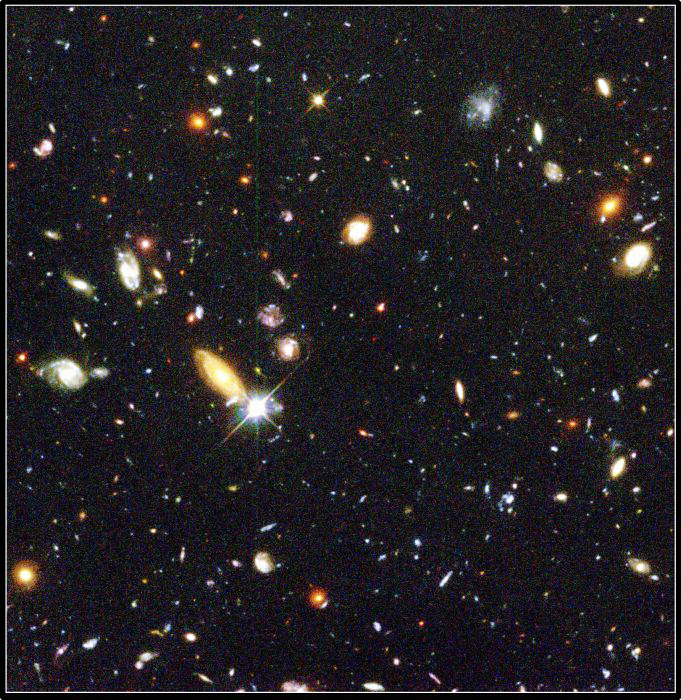
Re:How times change public perception...Wow. I remember when I first saw the picture with the all the galaxies in National Geographic. Just glancing at it, it looked like another 'bunch a stars' picture; then I looked closer and saw galaxies. Infinite galaxies receding into the distance. Nothing has ever blown my mind like that, before or since. Here's a link to some photos and here's the photo I'm talking about
-
Re:How times change public perception...Wow. I remember when I first saw the picture with the all the galaxies in National Geographic. Just glancing at it, it looked like another 'bunch a stars' picture; then I looked closer and saw galaxies. Infinite galaxies receding into the distance. Nothing has ever blown my mind like that, before or since. Here's a link to some photos and here's the photo I'm talking about
-
HST"A filter that blocks out bright light"? Sometimes it's difficult finding the connection between CNN science news and reality.
Serious space junkies will want to check out the SM3B web site. In particular has lots of tech info about the stuff getting installed, and for your idle moments has webcams viewing the clean room and launch pad.
-
C-H == carbohydrate == life like us?
If you look at Mars' atmosphere, you see a 50x higher concentration of carbondioxide compared to earth.
Well... not exactly. The CO2 is about 50x more common in proportion, but remember that there is also 100x less pressure (7-10 millbars versus roughly 1000 millibars) so the total amount of CO2 around on Mars is about 1/2. Low atmospheric pressure complicates things even more by boiling off most of the volatiles which would generally be considered useful for quite a big stretch along the putative road to life.
After an initial flurry of excitement, the original Miller-Urey experiments which produced some amino acids also highlighted a number of problems on the way along said road.
- The experiment was highly artifical, not at all a good representation of putative early Earth conditions
- despite this, we would expect some amino acids to form anyway, due to the chemical potentials involved (there is a dip in the road to life, into which some chemical processes will roll with very little pursuasion)
- the dip in potential has another side, and that looks kind of like the roads you see in some cartoons, which lead up to the base of a cliff, then trundle straight on up the face of it; what this means in real terms is that not only do some simple atoms/molecules find it relatively easy to become amino acids, but also more complicated molecules find it much easier to relapse to aminoness and it's very unlikely that aminos will self-assemble into anything much more complicated
- the acids formed were racemised, that is, about half of them were twisted the wrong way; with one exception, amino acids in living beings are twisted left-handed (are said to have left-handed chirality)
- the putative primitive conditions also destroy even the simple amino acids formed by the experiment very quickly
- the early conditions involve a heck of a lot of chemicals unlikely to exist in useful amounts on Mars
- for that matter, there is much evidence that Earth did not have a reducing atmosphere like the one used in the experiment, or at least did not have one for very long.
I think it's more important that the presence of water enables us to create colonies on Mars in the near future
Agree. And let's do it properly, by building a Beanstalk now that it is technically feasible. Or is that the mistake the Babelians made? (-: - The experiment was highly artifical, not at all a good representation of putative early Earth conditions
-
The biggest canal on Mars
That's what all of the canals were for...
Really? But the biggest canal was neither formed by water nor carried significant water.
Since these scientist chappies are getting so good at finding water on a completely dry planet (and explaining away global floods on another planet which is covered in water to an average depth of 2.7km), perhaps they can figure out where that much lightning came from? It certainly explains all of those rocks you see strewn around in Mars lander images.
-
Re: Errr, thats easy...
Not really, the threat is only as serious as you perceive it to be. I don't know if global warming is real or not, the data is as skewed as the interpretor's bias. If you believe, or want to believe, you'll see what you want to see. The sad fact is most people's views, including those of reputable scientists, are biased. The whole grant proposal system doesn't encourage diversity since those who sit on the grant committees are themselves biased and are looking to award grants to people who will confirm their ideas. I know it is true, I've co-authored several NSF and NASA proposals and have made a nice chunk of change in my spare time. Last year our team even won a share of NASA's Space Act Award. But that doesn't mean what we did was particularly interesting (to me at least), it just means we did something that impressed some folks who wanted their preconceived ideas confirmed.
With the exception of the Jupiter thing, the examples I cited earlier were proposed and accepted by a large segment of the scientific community at the time (not unlike global warming), not because they were true, but because people seem to want to see scary things on the horizon. Poor Carl, I think he even scared himself with those oil well fires... -
Re:Why we look for water and life on Mars
I don't understand this at all..
for I perplex others, not because I am clear, but because I am utterly perplexed myself.
But the polyphosphazene polymers you provide a link to could easily be chiral...
I'm following Prof. Robert D. Minard (Penn State Astrobiology Research Center) who says they aren't chiral.
But why do we need a mathematical definition of life, or indeed any definition of life at all?
I was playing here with the previous post's idea that life might be more fundamental than its chemistry. There's a hint of this idea in Stephen Wolfram's theories. Coming up with a precise definition of life would only be pointless if it's impossible. The point would be that a mathematical description of life might give it the same standing as a natural law like gravity or entropy: The Law of Life.
-
Re:Better safe than sorry...
Mmm...weak arguments.
First of all, there's a lot more than a one in a billion chance of earth being hit by an asteroid (see this also)...some kind of defence mechanism will have to be implemented at some time, when it is technically feasible to do so. In any case, part of the NASA budget (as well as other space agencies around the world) is being used for NEO monitoring. The risk is taken seriously, even though we're pretty sure that it is not an immediate risk.
As far as the SDI - or, as it is now know, the NMD - the analogy is even less accurate. First, I'll point out that we were talking about probabilities of a catastrophy occuring, while you talk about the probability of a defense system being effective. Already, this is a completely different argument, so you're way off-mark. But let's assumed you talked about the probability of a missile attack on the United States, against which National Missile Defence would be used. Again, note that the NMD is not designed to prevent against an environmental catastrophy (whether natural or man-made), but against a military threat, so you're talking about apples and oranges. The question is: how effective would the NMD be, and how real is the threat it addresses. Nobody in their right mind believes that North Korea or another so-called "rogue" state would try to attack the U.S. with nuclear arms (they'd be vaporized within the next half-hour, and good ol' Kim isn't that delirious!). At the same time, NMD wouldn't protect against fanatics hijacking commercial airplanes, or from terrorist bombs being planted on U.S. soil. Finally, most military threats are dealt with through diplomacy and foreign policy, things which - unlike asteroids - can be influenced. So your arguments don't hold...sorry.
In other words, I think a asteroid defence mechanism is something we should look in the future, global warming is a risk we shouldn't take now and in the future, despite initial costs (which would appear small if global warming turned out to be as catastrophic as predicted) while NMD is just a colossal waste of money (or rather, a disguised subsidy of several key industries which are close to the current administration). -
Re:Beating plowshares into swords
For a nice overview of anti-matter propulsion check out http://science.nasa.gov/newhome/headlines/prop12a
p r99_1.htm -
Re:Beating plowshares into swords
Of course, anti-matter engines are waaaaaaaay off
Actually, we already have anti-matter engines, they're just not very sophisticated. Pennsylvania State University and NASA are investigating these drives. The drive could power a mission to Mars in 120 days. That's: go to Mars (30 days), stay for 30 days, and come back (30 days). Sum: 120 days. That's awesome.
Ah, here we go:
Antimatter Catalyzed Micro Fission/Fusion
NASA Press release
Antimatter drives
ANTIPROTON-CATALYZED MICROFISSION/FUSION PROPULSION SYSTEMS FOR EXPLORATION OF THE OUTER SOLAR SYSTEM AND BEYOND -
Re:Glowing Blue Coastlines?
The ocean water is not actually a true color image - Moderate Resolution Imaing Spectroradiometer (MODIS) surface reflectance data are only processed over land and shallow water regions. [MODIS's data flow is over a Terabyte a day, so the data system (which was designed years ago) has to take some shortcuts.] Over the ocean I used Ocean Color data [a measurement of the amount of chlorphyll in water, used to get an estimate of phytoplankton (which are the base of the marine food chain)] with a color palette that resembled what the ocean should look like.
for more info, go here:
What are Phytoplankton?
and to see chlorophyll data dating to 1978, go here (click on the two chlorophyll datasets):
http://earthobservatory.nasa.gov/Observatory/datas ets.html
I did cheat a little in the Bahamas, which are surrounded by shallows whcih appear bright aquamarine in satellite imagery. Rivers with a high sediment load (the Mississippi, Amazon, Yellow, etc.) make the nearby ocean very brown, and this is (regretably) not shown at all in most of the imagery. Incidentally, the sediment also wreaks havoc on the ocean color measurements. -
Re:Glowing Blue Coastlines?
The ocean water is not actually a true color image - Moderate Resolution Imaing Spectroradiometer (MODIS) surface reflectance data are only processed over land and shallow water regions. [MODIS's data flow is over a Terabyte a day, so the data system (which was designed years ago) has to take some shortcuts.] Over the ocean I used Ocean Color data [a measurement of the amount of chlorphyll in water, used to get an estimate of phytoplankton (which are the base of the marine food chain)] with a color palette that resembled what the ocean should look like.
for more info, go here:
What are Phytoplankton?
and to see chlorophyll data dating to 1978, go here (click on the two chlorophyll datasets):
http://earthobservatory.nasa.gov/Observatory/datas ets.html
I did cheat a little in the Bahamas, which are surrounded by shallows whcih appear bright aquamarine in satellite imagery. Rivers with a high sediment load (the Mississippi, Amazon, Yellow, etc.) make the nearby ocean very brown, and this is (regretably) not shown at all in most of the imagery. Incidentally, the sediment also wreaks havoc on the ocean color measurements. -
Re:path radience
Yup, the MODIS data used to make the Blue Marble are atmospherically corrected. The data are actually a measurement of surface reflectance, which also includes corrections for slope, cloud shadows, aerosols, etc.
If you want the specifics, look here:
http://modis-land.gsfc.nasa.gov/products/products. asp?ProdFamID=2 -
Re:Publicity stunt with altered photos
If you want to see more detailed images, we post a NASA Earth science image every day:
http://earthobservatory.nasa.gov/
There's lots of smog and cities.
By the way, the data for the Blue Marble are corrected for the effects of the atmosphere - including aerosols (some of which are pollution) This is an essential step in the process of using the data to measure properties of the Earth's surface.
We were forced to touch up the clouds - it's impossible for a single polar-orbiting satellite to image all the Earth's clouds at once. (Actually, it's impossible to see all the Earth's clouds at once in visible wavelengths since half is dark at any one time) The cloud map we made has fewer clouds than are visible in real life.
Yes, it is part of our public relations, but I don't think we're being dishonest. -
Re:What problem is this supposed to solve?I thought that Mini-Magnetospheric Plasma Propulsion (M2P2) was supposed to solve this problem.
For human travelers the greatest advantage of M2P2 might not be steady acceleration or fuel efficiency, but rather its impressive safety features. Just as the Earth's magnetosphere protects us from solar radiation, an M2P2 bubble could shield spacefarers from cosmic rays and solar flares.
Emphasis mine. -
Here (I think)
This might be an older version of it, but it's good enough for me.