Slashdot Mirror
Domain: nasa.gov
Stories and comments across the archive that link to nasa.gov.
Comments · 16,365
-
Re:Look at the audience....
Fortran and OOP are NOT mutually exclusive, in fact the Fortran 90 dialect has OOP features. While not an "engineering" application, there was substantial work done by Norton along with Decyk and Szymanski and others on simulation of plasma physics and containment, in their numerical Tokamak simulation, The CACM paper gives a nice overview but it is not available on line due to copyright restrictions.
Unfortunately, since this post is actually factual and informative and I'm an AC it will not get modded up to a readable level without help, Thus, I'll need to throw in the following keywords/phrases to get
modded up
Alan Cox
Linus Thorvalds
KDE
GNOME
Richard Stallman
Beowulf Cluster
Micro$oft sux
L33T HaxorsRIAA Bastards!How about a Beowlf cluster of those? -
NASA is doing it
It's called NPSS and it stands for Numerical Propulsion System Simulation. The basic idea behind it is to be able to build a simulation of a jet engine by linking together different objects (fan, compressor, burner, turbine, nozzle, etc) whose properties you can change (fan area, burner temp, fuel flow), in order to theoretically model any engine you want.
I played with it some, and it's very cool. My BS is in Mechanical Engineering, and they didn't start letting engineering students take C/C++ until the year after I started, so I know the FORTRAN woes you suffer.
The thing is that for years engineers have had to use FORTRAN to do stuff it shouldn't really be doing, so they've gotten into habits of trying to think of problems as more complex than they really are, just because the programming language they have to use is unsuited to the problems.
Anyway, NASA has been at it for a few years, and they've done a great job (IMHO) at implementing OO for what they're doing. Using the software to build and simulate an engine is incredibly easy, and you can simulate all kinds of manuevers and engine configurations really fast.
-ristoril -
Numerical Recipes and stuffWell, I wouldn't recommend Numerical Recipes. It lacks rigor.
I haven't looked at NAG, but you're not getting all the source code? Actually, I find it weird that one does rely on closed source in science, when science depends on the full disclosure of all relevant material. Well, the computations done is arguably the most important aspect of most analysis done today, so all source code should be available for public scrutiny.
I would recommend R for many applications. It has some lightweight OO that is very efficient, it's a really beautiful language. It is also very rigorous, you will find the best things in Numerical Recipes there, but there is also a lot of code that has been through formal peer review.
-
We do it!
Imagine for a minute that you don't know what problem you want to solve yet. You know that that you want to apply a Galerkin Finite Element Method (for instance, though this particular method isn't required) to a whole class of problems on unstructured grids on a whole class of distributed and shared memory parallel computers. Imagine that you want your user base to be able to specify their equations like they would in LaTeX or some other markup language. Now try imagining that you have only FORTRAN77. Not a pretty picture. We're in the process of completing a rewrite of major sections of our parallel code to do exactly this. Our code started out (7 years ago) as an extremely efficient parallel (3D) C/F77 code for Navier-Stokes + Heat Transfer and is quickly growing into a multi-purpose, multi-physics code written largely in C++.* We extract considerable advantage form C++'s ability to hide implemenations so that as long as interfaces don't change the guts can. We also make good use of the ability to run code before main() in order to register the exisitence of routines (hash tables are your friend). If the routine isn't there you can't call it, but the code still compiles and runs otherwise. We also make use of base class/derived class relationships and polymorphism to allow, for instance, one base mesh class for the rest of the code to interact with, but with two separate derived classes: one to generate meshes internally, and one to read meshes from other programs. Etc., etc. I'm not sure our website can take the
-
a turbine engine modeling application
When I worked at AEDC I spent some time involved in NASA Lewis (now Glenn)'s numerical propulsion system simulation project. The idea of this project was to apply OO principles to turbine engine modeling.
Each component of a modern engine was viewed as an object (compressor, turbine, burner, etc). The solver could use helper aplications of any complexity to model components, then tie them together (very useful for integrating proprietary codes with a common architecture).
I could talk a lot more about it but it has been years and it would be better for you just to follow the link...
neh -
Re:It's about time...teridon's danger seems even worse that the Brit problem, because he's dealing with science satellites, which release more info to the public than do military ones. His user info suggessts he's discussing the SOHO (Solar & Heliospheric Observatory) satellite, which has already demonstrated a hacker-desirable feature: a buffer overflow in code that caused control problems in the satellite.
Uplink/Downlink details on SOHO are readily available, e.g.:- Uplink Frequency(s) 2067.271 MHz
- Downlink Frequency(s) 2245.000 MHz
- Commands: 16Khz subchannel @ 2kbps
- Uplink transmitters used: Gladstone, Canberra, Madrid
-
Re:It's about time...teridon's danger seems even worse that the Brit problem, because he's dealing with science satellites, which release more info to the public than do military ones. His user info suggessts he's discussing the SOHO (Solar & Heliospheric Observatory) satellite, which has already demonstrated a hacker-desirable feature: a buffer overflow in code that caused control problems in the satellite.
Uplink/Downlink details on SOHO are readily available, e.g.:- Uplink Frequency(s) 2067.271 MHz
- Downlink Frequency(s) 2245.000 MHz
- Commands: 16Khz subchannel @ 2kbps
- Uplink transmitters used: Gladstone, Canberra, Madrid
-
use IPYou probably want to talk to the OMNI group (Operating Missions as Nodes on the Internet) (IP in Space). They have done significant work dealing with using IP to communicate with the spacecraft, including issues of security.
I have passed this article onto them.
http://ipinspace.gsfc.nasa.gov/
--
Chris Hendrickson
FlightLinux
http://flightlinux.gsfc.nasa.gov/ -
use IPYou probably want to talk to the OMNI group (Operating Missions as Nodes on the Internet) (IP in Space). They have done significant work dealing with using IP to communicate with the spacecraft, including issues of security.
I have passed this article onto them.
http://ipinspace.gsfc.nasa.gov/
--
Chris Hendrickson
FlightLinux
http://flightlinux.gsfc.nasa.gov/ -
Re:Interesting idea but...No, the article is wrong. It states that Pioneer 10 is the furthest man-made object and this is simply not true. Voyager 1 is currently the most distant man-made object and has been for a few years now. See the press release from NASA. The article doesn't mention Voyager 1 at all and if you'd read the article you'd have noticed this. But I won't hold it against you.
I think it's important to keep in mind that neither Voyager 1 nor Pioneer 10 were ever intended to last as long as they have. Its a tribute to the engineers and technicians that designed and built these spacecraft that they continue to do useful science long after their primary missions ended. What the solar foci mission proposes to do though is really quite different from any previous mission and comparing the Voyager or Pioneer missions to it is, in some respects, like comparing apples to oranges. Sending a spacecraft out to 550 AU before it actually starts its primary mission is an entirely different proposition and a very much harder technical feat to achieve. Consider that the round trip light-time to 550 AU is on the order of 6 days and you start to realize how far out we're talking about here. Not that I think it's impossible to accomplish this type of mission but I don't expect to see it happen in my lifetime. I'll leave out the discussion of costs for another time but suffice it to say that considering all the hassles that the NASA and the Pluto Express folks have run into I wouldn't hold my breath.
I'll give you the point as to the 'orders of magnitude' question. I tend to use the astronomical definition, i.e. approx. 2.5 times, and not the 10 times definition. So sue me.
-
Re:Interesting idea but...
When you consider that Pioneer 10 at 75AU out, has been traveling for thirty years (since 1972) so far, then you can imagine that 550AU almost eight times further is actually very far.
Not that necessarily this detracts from the possibility, new propulsion techniques such as the ion drive discused in the article will bring that time down considerably, but I didnt notice any estimates there in the article. A quick guess would indicate that even at 10x the speed, you would still be looking at a few decades of travel time!
So I would imagine this being quite a while off yet, neverless it's still a very good idea! -
Interferometry
If you can get an array with a long enough baseline, and high precision in positioning, you can do interferometry with space telescopes. In principle that could give you enough resolution to spot small planets around nearby stars. JPL is currently studying a space interferometry mission, to fly by 2009, which will fly a small interferometer to demonstrate the potential of this technique.
-
Interferometry
If you can get an array with a long enough baseline, and high precision in positioning, you can do interferometry with space telescopes. In principle that could give you enough resolution to spot small planets around nearby stars. JPL is currently studying a space interferometry mission, to fly by 2009, which will fly a small interferometer to demonstrate the potential of this technique.
-
NASA's still in the game though ...
-
Re:In response to others...
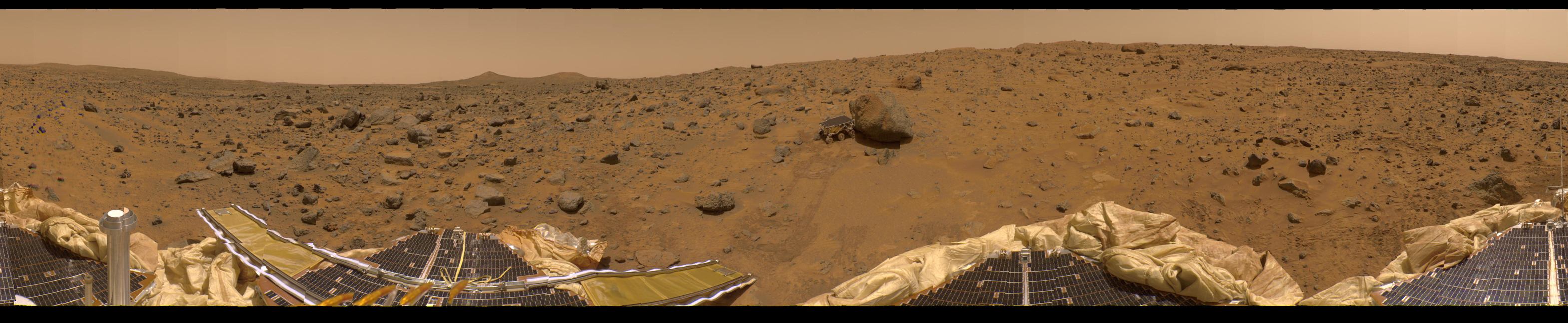
I was able to find a few images of mars, this one here is particularly good. In terms of color it seems fairly ok to me, though the other color references are a bit limited. Also, a basic overview of Raleigh Scatter for those who are interested can be found at www.people.cornell.edu/pages/eac26/RaleighScatter
i ng.html. A quick quote from it, Have you ever seen a brilliant red sunset? After all of the colors have scattered out of the white light, we see the oranges and reds. Where on the horizon are the red colors found? The reds are found close to the horizon because the sunlight must pass through many particles before we reach the point that red is scattered out. So if the atmosphere of Mars is particularly dusty for instance then you'd get a more red hue (at least if I'm reading this right), making the Mars sky closer in hue to a reddish color. -
Nice experiment to prepare the way for LISA...
It will be interesting to see whether this experiment gets the results everyone seems to be anticipating, or mirrors the 'success' of the Michelson-Morley experiment.
The Laser Interferometer Space Antenna (LISA) (launching in 2009) should return significantly better data, but it'll be nice to get a sneak preview from Cassini.
"The most exciting phrase to hear in science, the one that heralds new discoveries, is not 'Eureka!' (I found it!) but 'That's funny -
links
There was already a story on this earlier this summer.
and a great page on
space clocks and frequency control technology -
Catch a clue:space.com sucks.
Pop-ups and pop-unders and thousands of cookies...
Go to the source: antwrp.gsfc.nasa.gov/apod/archivepix.html
t_t_b
-
Re:pathetic
Perhaps I should also mention that you'll find nearly all of the images from that little 'top ten' presentation in equal or higher resolution on the Astronomy Picture of the Day Archive.
-
pathetic
oh, what a cute little setup space.com has. all glorified and brushed up. bah! we're geeks, right? here's something far less propgandized; The Astronomy Picture of the Day Archive has hundreds of great pictures.
One of my favorite ways to get good pictures is to search it for the word "nebula" ( click here )- it gives you a nice thumbnail index that I much prefre over that space.com "Image Viewer" -
pathetic
oh, what a cute little setup space.com has. all glorified and brushed up. bah! we're geeks, right? here's something far less propgandized; The Astronomy Picture of the Day Archive has hundreds of great pictures.
One of my favorite ways to get good pictures is to search it for the word "nebula" ( click here )- it gives you a nice thumbnail index that I much prefre over that space.com "Image Viewer" -
How about...
-
desktop source material?!?
All the images I've seen so far are really small (course, if they were large, the site would probably be smoking by now)...
For the good stuff, try NASA. -
Re:UK Metric
Well I live in the UK.
I was taught in metric,
grew up in metric,
did my undergradute Physics degree in metric,
did my postgradute Physics degree in metric.
I don't understand the illogical mess that is imperial (somewhat like NASA Mars Missions). And thank god I did science in metric - thermodynamics is hard enough without having to work in something arcane like the British Thermal Unit.
So thats nearly 30 years where everything in my life has been metric, unless I want to buy groceries or a beer! (yes I know the roads are marked in miles, but I also know how much it would cost to replace the signs so let that slide)
So if most people under 30 in the UK are happy with metric, and don't understand imperial, can it really be said that metric is being forced on us?
In my experience of talking to Joe Public the biggest current confusion is between RAM and HDD - as they use the same measurement! Surely the solution to the original problem is to sell stuff marked in bits - as much transport based kit like SCSI and Ethernet already is? This is then independant of whatever the byte size is, and can be base 10 or 2 as appropriate - this would limit confusion as it would be a new standard measurement, rather than trying to fit a new word to an abused measurement.
And yes I am aware that people are exploiting the confusion between MB - Mb to flog things like digital cameras in megabits so that Joe Public thinks they are getting 8 times the memory they are, its just that I have the niave belief that not even the HDD manufactors would have the gall to try that scam.
In my experience the biggest confusion for Joe Public is between RAM and HDD - as they use the same units - so I have no hope the situation will improve -
What about SI units ?(was Re:I heard this...)
Let me predict the outcome based upon past events: with the exception of the USA, the entire world will make the switch to the official standard. Half of the US scientific community will switch and half won't. The 2014 first manned mission to Mars will fail because the the navigation computer design team specified 100gibs of RAM, but the implementation team only installed 100gigs of RAM and it is unable to perform course corrections---the crew and ship are lost in space.
-
sensors easy - reconfigurable logic tricky
I'd like to know how he could have programmed responses like "fear of light" with a handful of discrete transistors.
Use two light sensors (such as light dependant resistors) to measure how much light the bug is in and to help guide the bug away from the light. When one sensor reaches a certain threshold, I imagine "move away from light" circuitry takes over and guides the bug towards darker areas with the light intensity information from the two light sensors - if the right sensor is darker, move right, if the left sensor is darker, move left.
What I'd like to know is, how they are implementing the downloadable transistor patterns. I know that reconfigurable digital logic can come in the form of Field Programmable Gate Arrays (FPGA) so I wondered if there was such a thing as Field Programmable Transistor Arrays (FPTA). Punched it into Google and hey presto NASA has a paper on an FPTA that JPL has developed!
-
Compare to Taningia danae
It looks much more like the Taningia danae than the giant squid that most of us are more familiar with. While Taningia danae has lighted tentacles, the key things to notice would be the prominance of the fins, and the consistency of length of the "arms".
You can see more comparisons at NASA of all places. -
Re:Question?
In all seriousness, probably not very good. A lot of large deep-sea squid taste like ammonia.
-
Apparently there are silicon-rich rocks...
...on Mars. Silicon is an important ingredient in the manufacturing of computers and according to some experts it is possible to construct artificial life using computers. The inescapable conclusion is that this is evidence that life once inhabited the Martian surface.
-
Re:Contrary to popular beliefnobody's figured out a way to quantify software quality...
See this paper on software metrics and reliability, and John Musa's work on software reliability engineering.
Software reliability can be measured and reliability goals can be set and met with current technology. Management has to make a specified level of reliability a requirement and support a software development and testing process that can meet that requirement.
-
Re:Seriously....
then what about radiation? Cosmic rays and the 3k background are bound to disrupt celluar actions (assuming they are cells). Also, space is quite harsh to adapt to.
Bacteria are tough; they can spore up and be very hard to kill. (That's why anthrax is such a bitch to deal with.) Earth bacteria survived for several years unprotected on the moon.
-
Re:Info on Ion Drives
You can start here. The exit velocity of the Xe ions is 1/3 lightspeed limited by the maximum accelerating voltage of 1280 V.
-
The root
"Maybe, but they certainly don't cite convincing sources... that means about 90% of the research space, and presumably the budget, came from the US." - Cato the Elder
"Total Program Estimate $37.1$39.4 B (range)" - ISS factbook 2000-10
"Draws significant financial support from the partner nations, which will collectively add more than $10 billion to the U.S. contribution." - ISS factbook 1999-07
-
it came, i saw, it was neck breaking. + some links
i caught it with 20x120 binocs
It was really some experience
i have put my observation log and a plot of moving wt24 and stars here. the log shows some of excitement i went through. not anything of scientific value though.
here are downloadable finder charts prepared using Guide 7.0 to make life a little easier.
here is a MUST SEE mpeg video made by compiling the frames from a 2 hour CCD run on WT24 by Nick James
here is great image showing 1 complete rotation of 1998 WT24
-
Re:Too bad they didn't do this for the SR71.. (OT)
The story might be bogus, but your facts are, too.
If you know anything about old Soviet aircraft, you'll know that an Su-9 could never reach the operational altitude of a U-2.
Err whut? The Su-9 is, as you say, quite similar to the MiG-21. The Ye-66A, an experimental version of the MiG-21, held the altitude record for a brief period in the early 1960s - 113,829 feet. The F-104s were hitting 90,000 feet even before they started strapping booster rockets onto them. Obviously this is not a sustainable altitude (ask Chuck Yeager - whoops) but the idea of an Su-9 blowing by a U2 at 75,000 feet is certainly not impossible. Don't confuse operational ceiling with maximum altitude.
Err whut? Mach 2.1 for the MiG-21, Mach 1.8 for the Su-9.
While I don't neccesarily buy the Su-9 story, realize that a properly piloted Su-9 will zoom climb much higher than a U2's cruise altitude. So the story's plausible.
The flameout theory's been pretty thoroughly debunked as far as I know, both by recently declassified documents and by NASA's records: "Powers...insists that he was shot down ata operational altitude" -
Re:Hmm...
Looks like about 30.
-
Re:Question about XIPS enginesI imagine it would be pretty easy to add them on after the fact, but the people running the project likely have plenty of other problems to worry about besides replacing a system that already does an acceptable job (the current stationkeeping method).
As you say, the ISS has plenty of issues to worry about. Many of them are system integration issues (getting all sorts of parts from different contractors to work well together). Adding an unplanned-for component to the mix is a recipe for schedule and cost disaster. There're likely to be structural issues with mounting the XIPS engines, and all sorts of exciting issues with routing command lines and power supplies. Not something you want to do to a project that's already $4B in the hole.
At the station's current mass (~120 Mg), about 3 continuously-firing 165 mN XIPS thrusters, at a combined power requirement of 13.5 kW, would be required to keep ISS in its orbit. At its completed mass (~450 Mg) about 10 would be required, using a total of 45 kW.
In other words, you wouldn't need many of the motors, but they'd suck all of your power, so they're not a viable solution for ISS as designed.
Not only that, but a quick back-of-the-envelope calculation gives me ~2 tons/year of propellant to supply 10 XIPS thrusters. That's a lot of Xenon to ship to orbit. Not that chemical propellants would be any less massive if you were using them to keep the ISS fixed in place. They're projecting ~6 tons/year for the present system.
Perhaps a better choice would be something that doesn't use any propellant - like an electrodynamic tether (see e.g. this)
My guess is that because the xenon exhaust is being launched into a lower-energy orbit than the station it would combine with the rest of the atmosphere, and wouldn't cause a problem. The electric field from the motors might cause problems with experiments, but I don't know enough about either to say for sure.
A chemical rocket you just point away from anything you don't want to hit, and you're fine since the rocket makes a relatively well directed jet of hot gas. An ion engine produces more of a cloud than a jet, so surfaces well off the thrust line are in danger of contamination. Xenon is more than likely going to impinge on many of the ISS surfaces and experiments, simply because the plume goes everywhere.
-
Re:Question about XIPS engines
Exactly the way I understood this as well. The propulsion provided on the DS1 probe was suited to continuous operation over a long period of time, resulting in gradual, continuous acceleration of a very small craft using a very small amount of thrust.
http://nmp.jpl.nasa.gov/ds1/tech/ionpropfaq.html
Under the circumstances for which ion propulsion is appropriate, it can push a spacecraft up to about ten times as fast as chemical propulsion. Because the ion propulsion system, although highly efficient, is very gentle in its thrust, it cannot be used for any application in which a rapid acceleration is required. With patience, the ion propulsion system on DS1 imparts about 3.6 km/s to the spacecraft. To undertake the same mission with a chemical propulsion system would require a more expensive launch vehicle and a larger spacecraft to accommodate a large tank for the chemical propellants.
You need the opposite to boost the ISS - a large amount of thrust in a short period of time to move a very large object. -
Reflections on a successful missionWhen DS 1 launched in 1998, I was in my junior year of high school, and taking physics, which is now one of my three undergraduate majors. There was a girl in my class whose mother is a JPL scientist, and she and I would always spend our lab times talking about the mission. I remember reading that the ion engine created only as much force as a sheet of paper exerts on the hand of the person holding it, and wondered how in the world they expected anything to come of this. But F = ma, and in space there is practically no friction, so with the hours-long burns that the team discovered they could do, the acceleration added up. (For those of you who have asked, the ion engine is just another Newton's-third-law technology, with the big nuance being that rather than relying on the expansion of hot gases from the burning of fuel to provide the counter-force, the spacecraft uses an electified grid to propel tiny charged ions out the back).
When the star tracker failed in 1999, I wept, for I was sure that the mission was doomed. When the ground crew, in a long stroke of genius, kept it going, I wept for joy.
In the past year and a half or so, DS 1 hasn't been doing so much. WIth most of its objectives achieved, the mission became largely a test of how long it would last. Nevertheless, it was always fun to read Dr. Marc Rayman's mission logs, "widely thought of and commonly spoken of in the spiral arms of the Milky Way galaxy as the most reliable source of information on this bold mission of exploration."
This fall, the probe paid a visit to comet Borrelley. Nobody knew where in the tail the rock itself was, but DS 1's job was to get as close to it as possible, and send back pictures. Nobody expected it to work. If anything, this was supposed to be a dignified death for the bird, which the September 9 log referred to as being "kept flying with duct tape and good wishes." The chances that the probe would do anything but smash into the comet and die, or be pommeled to death by the microdust in the coma, were astronomically slim. But somehow, miraculously, it survived, and with the pictures to prove it.
DS 1 was the stuff of science fiction, and that so many things went right is simply amazing. While I , like Dr. Rayman, am happy that it lived so long, I think we are all somewhat sad to see it go. But we can be consoled by the fact that the funding, the DSN time, the space, and the positively brilliant staff that have kept DS 1 running will now move on to projects that have even more excitement and adventure to offer us, and science will march on, at a steadily accelerating tempo.
-
Reflections on a successful missionWhen DS 1 launched in 1998, I was in my junior year of high school, and taking physics, which is now one of my three undergraduate majors. There was a girl in my class whose mother is a JPL scientist, and she and I would always spend our lab times talking about the mission. I remember reading that the ion engine created only as much force as a sheet of paper exerts on the hand of the person holding it, and wondered how in the world they expected anything to come of this. But F = ma, and in space there is practically no friction, so with the hours-long burns that the team discovered they could do, the acceleration added up. (For those of you who have asked, the ion engine is just another Newton's-third-law technology, with the big nuance being that rather than relying on the expansion of hot gases from the burning of fuel to provide the counter-force, the spacecraft uses an electified grid to propel tiny charged ions out the back).
When the star tracker failed in 1999, I wept, for I was sure that the mission was doomed. When the ground crew, in a long stroke of genius, kept it going, I wept for joy.
In the past year and a half or so, DS 1 hasn't been doing so much. WIth most of its objectives achieved, the mission became largely a test of how long it would last. Nevertheless, it was always fun to read Dr. Marc Rayman's mission logs, "widely thought of and commonly spoken of in the spiral arms of the Milky Way galaxy as the most reliable source of information on this bold mission of exploration."
This fall, the probe paid a visit to comet Borrelley. Nobody knew where in the tail the rock itself was, but DS 1's job was to get as close to it as possible, and send back pictures. Nobody expected it to work. If anything, this was supposed to be a dignified death for the bird, which the September 9 log referred to as being "kept flying with duct tape and good wishes." The chances that the probe would do anything but smash into the comet and die, or be pommeled to death by the microdust in the coma, were astronomically slim. But somehow, miraculously, it survived, and with the pictures to prove it.
DS 1 was the stuff of science fiction, and that so many things went right is simply amazing. While I , like Dr. Rayman, am happy that it lived so long, I think we are all somewhat sad to see it go. But we can be consoled by the fact that the funding, the DSN time, the space, and the positively brilliant staff that have kept DS 1 running will now move on to projects that have even more excitement and adventure to offer us, and science will march on, at a steadily accelerating tempo.
-
Useful Links:
- NASA's Orbital Debris Research Center.
- The Hypervelocity Impact Technology Facility. (Much information on the design and testing of micromeorite shields.)
-
Useful Links:
- NASA's Orbital Debris Research Center.
- The Hypervelocity Impact Technology Facility. (Much information on the design and testing of micromeorite shields.)
-
Re:NASA's B-52NASA uses a B-52 for high altitude drops of prototype flight models.
It's been a busy aircraft used for a variety of tasks, some more information:- A press release from 008's 40th birthday in 1995.
- A picture gallery from the Dryden Flight Research Center. (Scroll down to B-52 for several galleries showing 008 in her various guises.)
- A fact sheet on the history of 008.
-
Re:NASA's B-52NASA uses a B-52 for high altitude drops of prototype flight models.
It's been a busy aircraft used for a variety of tasks, some more information:- A press release from 008's 40th birthday in 1995.
- A picture gallery from the Dryden Flight Research Center. (Scroll down to B-52 for several galleries showing 008 in her various guises.)
- A fact sheet on the history of 008.
-
Re:NASA's B-52NASA uses a B-52 for high altitude drops of prototype flight models.
It's been a busy aircraft used for a variety of tasks, some more information:- A press release from 008's 40th birthday in 1995.
- A picture gallery from the Dryden Flight Research Center. (Scroll down to B-52 for several galleries showing 008 in her various guises.)
- A fact sheet on the history of 008.
-
Re:Whoops!
The "no danger of collision" quote comes from NASA as does the 0.05AU critereon on the same page.
Slashdot is blameless this time. -
Whoops!
This NEO will be passing within 5 lunar distances to Earth, so there's no danger of collision.
Sloppy English is all part of the Slashdot experience, but in this case it just won't do. "Five lunar distances" is only 0.015 AUs. The NEO people at JPL consider a collision possible if the rock is predicted to pass within 0.05 AUs. Of course that possibility is still very very small, but it ain't zero. -
Re:Deflectors
It's a wonder one of the middle eastern countries have not tried to build orbital rockets whose only purpose is to blow up when they get there. They have lots of money and their engineers are not incompetent. One properly armed missle could create a whole cascade effect. It's would totally devistate our economy and take out spy and targeting satelites all at once.
There's several problems with this. One is just how vast space is. Even in a low earth orbit you are talking about distances that are much larger than on the Earth. Suppose you did turn a whole rocket into debris. Most of the debris from the explosion would immediately deorbit to the Earth. The fraction of the original mass which stayed up would have to spread out enough to cover a good-sized area, or else it would present such a small target that the chance of it hitting anything would be extremely small. Even when the debris is out there, it would be very likely to miss any spacecraft, unless you sent up a few dozen of these things.
The second, major issue is cost. I did a little searching and found here that launches cost around $20,000 per pound for a 400 pound launch. That means that the entire 400 pound payload would cost around $8 million.
Now, with the World Trade Center disaster as an example you can see that far more damage could be done far more inexpensively. For an investment which was probably in the several hundred thousand dollar range (including food, housing, training, travel, of all the terrorists), they were able to kill 5,000 people, cause damage which is in the billions, and disturb an entire world. If they sent up 400 pounds worth of shrapnel they might eventually take out a satellite or spacecraft and cause damage in the few hundred million, along with 4 or 5 lives - all for the cost of $8 million a shot (assuming that one is enough). Which choice would you make?
-
Clickable links
Learn basic HTML, then submit in 'HTML Formatted' mode.
<A HREF="http://www.nasa.gov/";>More info on NASA</A;> as an example of a link More info on NASA
Also <BR> for line breaks and <P> for paragraph breaks. -
Cassini report 10/25 discusses the problem
From the 10/25/01 - 10/31/01 weekly status report:
The Imaging Science Subsystem (ISS) post-warm-up images were downlinked for analysis. The 15 images were planned in support of the UVIS Spica observation, and were examined for potential changes relative to the pre-warm-up images. Preliminary results show a change in the character of the anomaly with the halo gone but more spreading of the star image than before. ISS also performed a scattered light observation, in an effort to resolve an anomaly observed in C25 when an ISS observation received far more light than expected. This current observation included a series of scans across the sky to see how much scattered light ISS gets at different distances from the sun for a selection of different orientations, to see if reflection off another part of the spacecraft is causing the extra light seen by ISS.