Slashdot Mirror
Domain: nasa.gov
Stories and comments across the archive that link to nasa.gov.
Comments · 16,365
-
Re:Wrong Anniversary
Also its the wrong web site: Its http://www.nasa.gov/mission_pages/msl/curiosity-nearing-first-anniversary-on-Mars/index.html or http://nasa.gov/ .
Why this constant pumping of space.com and all their ads, instead of the official sources?
-
Re:Wrong Anniversary
Also its the wrong web site: Its http://www.nasa.gov/mission_pages/msl/curiosity-nearing-first-anniversary-on-Mars/index.html or http://nasa.gov/ .
Why this constant pumping of space.com and all their ads, instead of the official sources?
-
Re:In which direction?
Bullshit.
If all you care about is firing people on ballistic trajectories around other solar system bodies, then yes, NASA has failed. If what you want is great science, something like having a network of sophisticated planetary science missions operating on all of the major solar system bodies right now, then they're kicking ass, and Stofan is the right person for the job of continuing that mission.
-
Re:Mars and Venus are warnings
Venus already has a really effective 'shade' - the bond albedo (percentage of light from the sun it reflects) is 0.9 (90%). Compared to ~0.3 for Earth
http://nssdc.gsfc.nasa.gov/planetary/factsheet/venusfact.html
Venus is so hot at the surface mostly because the atmosphere is incredibly dense at the surface (93 times earth). In geneneral, as pressure increases in a planets troposphere, so does temperature. If you go deep enough into the gas giants (even Neptune), you will find very hot temperatures, at high pressures.
On Venus at 1 bar pressure, the temperature is actually not that far off of Earth http://www.datasync.com/~rsf1/vel/1918vpt.htm - (about 50 C = 122 F), hot, but not unmanageable if we could somehow put a floating colony there. You would have to seal the habitation anyway because the atmosphere is about 95% CO2.
-
No surprise
Venus has always been suspicious.
I personally find Pluto suspect.
You can understand why the Indian Army might be jumpy.
-
Re:More to the point...
http://www.nasa.gov/topics/earth/features/rapid-change-feature.html
If temperatures were to rise 2 degrees Celsius over pre-industrial times, global mean temperature would far exceed that of the Eemian, when sea level was four to six meters higher than today, Hansen said.
"The paleoclimate record reveals a more sensitive climate than thought, even as of a few years ago. Limiting human-caused warming to 2 degrees is not sufficient," Hansen said. "It would be a prescription for disaster."
-snip-
The human-caused release of increased carbon dioxide into the atmosphere also presents climate scientists with something they've never seen in the 65 million year record of carbon dioxide levels – a drastic rate of increase that makes it difficult to predict how rapidly the Earth will respond. In periods when carbon dioxide has increased due to natural causes, the rate of increase averaged about
"Humans have overwhelmed the natural, slow changes that occur on geologic timescales," Hansen said.
I think its both the rate and direction of temperature change that is so worrisome. Life on Earth today is adapted to multi-millennial oscillations between familiar "glacial cool" and "ice age" conditions, not the hothouse Earth. Even if most species could migrate much faster, its unlikely to be of much help.
-
Re:Causation or Correlation?
Please explain why you are sure that the cessation of the ice age, with an accompanying moderation in temperature, is not what permitted human agriculture -- and not the reverse. Please describe an experiment to falsify your premise.
The experiments have already been run many times by nature.
Take a look. The release of carbon dioxide brings the end of great ice ages happens at intervals of about 75,000 during the last 800,000 (it has happened 11 times). The development of agriculture clearly post-dates this most recent natural CO2 and temperature surge.
Now agriculture has almost certainly helped maintaining this inter-glacial period by gradually clearing land that stored carbon as forest.
In fact we had a recent episode when pandemic disasters reversed this process of land clearing, causing a dip in atmospheric CO2, and precipitating the event know as the "Little Ice Age". First the Black Death and Central Asian population by a third starting in 1346, then the greatest pandemic even in world history (a series of them actually) depopulated the New World starting in 1492. This second collapse of agricultural civilization was much larger than the Black Death, but followed before recovery from same.
Humans have been manipulating global climate for 10,000 years.
-
Re:What you call rapid occurs over thousands of ye
What makes you think that sending the Earth's temperature to a whole different geologic era in the space of 200 years will be tolerable for most life?
There is no other warming trend seen to be anywhere near this rapid. Its like the difference between stopping a car at 60mph with brakes or with a brick wall.
You were called out on this in the other thread, but you keep spewing this misinterpretation of science because you think the economy needs to be saved from environmental regulations (even within the sphere of economics, a wholly unsupported claim except in the eyes of market fundamentalists such as yourself). Your opinion sounds "scientific" much the way a creationists does; the terminology is there but the conclusion is dead wrong.
Here is a far more considered assessment: Paleoclimate Record Points Toward Potential Rapid Climate Changes
If temperatures were to rise 2 degrees Celsius over pre-industrial times, global mean temperature would far exceed that of the Eemian, when sea level was four to six meters higher than today, Hansen said.
"The paleoclimate record reveals a more sensitive climate than thought, even as of a few years ago. Limiting human-caused warming to 2 degrees is not sufficient," Hansen said. "It would be a prescription for disaster."
(edit)
The human-caused release of increased carbon dioxide into the atmosphere also presents climate scientists with something they've never seen in the 65 million year record of carbon dioxide levels – a drastic rate of increase that makes it difficult to predict how rapidly the Earth will respond. In periods when carbon dioxide has increased due to natural causes, the rate of increase averaged about
"Humans have overwhelmed the natural, slow changes that occur on geologic timescales," Hansen said.
This also provides a clue as to why "climate change" is often preferred over "global warming": That change could be so rapid as to induce a great deal of chaos where some regions experience, for example, heavier and more frequent snow storms (at least transitionally).
-
Re:let me unpack this for you
The models failed in their predictions for recent warming, which has remained flat.
Which models?
The warming trends are simply continuing.And to drive the point further home, we have some of the warmest years in over 100 years now: At least clearly a lot more than a random distribution of hot years is likely to produce.
-
NASA?
TFA says NASA has its own SWAT. "Along with the formidable force of standard security at Kennedy, a highly trained and specialized group of guardians protect the Center from would-be troublemakers. They are the members of the Kennedy Space Center Special Weapons and Tactics (SWAT) team and they mean business. " http://www.nasa.gov/returntoflight/main/swat_feature.html
-
What you call rapid occurs over thousands of years
What makes you think that sending the Earth's temperature to a whole different geologic era in the space of 200 years will be tolerable for most life?
There is no other warming trend seen to be anywhere near this rapid. Its like the difference between stopping a car at 60mph with brakes or with a brick wall.
You were called out on this in the other thread, but you keep spewing this misinterpretation of science because you think the economy needs to be saved from environmental regulations (even within the sphere of economics, a wholly unsupported claim except in the eyes of market fundamentalists such as yourself). Your opinion sounds "scientific" much the way a creationists does; the terminology is there but the conclusion is dead wrong.
Here is a far more considered assessment: Paleoclimate Record Points Toward Potential Rapid Climate Changes
If temperatures were to rise 2 degrees Celsius over pre-industrial times, global mean temperature would far exceed that of the Eemian, when sea level was four to six meters higher than today, Hansen said.
"The paleoclimate record reveals a more sensitive climate than thought, even as of a few years ago. Limiting human-caused warming to 2 degrees is not sufficient," Hansen said. "It would be a prescription for disaster."
(edit)
The human-caused release of increased carbon dioxide into the atmosphere also presents climate scientists with something they've never seen in the 65 million year record of carbon dioxide levels – a drastic rate of increase that makes it difficult to predict how rapidly the Earth will respond. In periods when carbon dioxide has increased due to natural causes, the rate of increase averaged about
"Humans have overwhelmed the natural, slow changes that occur on geologic timescales," Hansen said.
This also provides a clue as to why "climate change" is often preferred over "global warming": That change could be so rapid as to induce a great deal of chaos where some regions experience, for example, heavier and more frequent snow storms (at least transitionally).
-
Try tracing the calcium in your bones
Try tracing the calcium in your bones to their origin. It's a very interesting flight of fancy:
"Calcium comes from stars. In fact, all of the elements that make up your body and the planet Earth itself, other than hydrogen and helium, were made in stars or during during explosions of massive stars." -- http://imagine.gsfc.nasa.gov/docs/teachers/calcium/got_calcium_litho.html
-
Re:"we now know" or "we hypothesize"
-
Re:weather change
Does that take into account that the weather has changed due to climate change (global warming) and these rare events will become more probable in this new climate?
Depends on how you calculate probable.
Storms are actually predicted to be fewer in number, but more intense. http://www.giss.nasa.gov/research/features/201303_storms/
-
Re:So what happens ...
even events like hurricanes, where there is no scientific consensus on the matter - are as big a problem as the "I don't believe in global warming" crowd.
Well, the problem with that statement is that except for the "I do not believe in global warming" crowd, there's an awful lot of scientific consensus on the topic.
-
Re:So what happens ...
Maybe you should visit the source, NASA's Goddard Institute for Space Studies http://www.giss.nasa.gov/ and see if you think this particular branch of NASA is soft pedaling global warming.
It's been James E. Hansen personal pulpit for the last 30 years.
-
Re:So happy
I also realize that the fucking Sun has much more effect on the climate than we ever will.
True, if there were no Sun, the temperature would be roughly 2.7 Kelvin. Right now it's 86 degrees Fahrenheit where I live, or 303.15 Kelvins, so about a 11,228% increase for where I live, at the moment. So yeah, humans have come up with no feasible method of heating up our own entire planet by that amount without using nearby star undergoing nuclear fusion. If that's how you want to look at it.
Most people are fucking retarded when it comes to climate.
Again, totally true. For example, if someone were to think a valid point to make in a climate debate was that the Sun is affecting our climate more than humans. Problem is, the Sun has reached a relatively static heat output for the functional purpose of generating and sustaining life. That is, temperature hasn't changed rapidly enough within the lifespan of any species to fundamentally alter their environment in a way that the species could not adapt through the natural course of evolution. The last Ice Age was over a period of 100,000 years, plenty of time for most species to adapt. But now we're talking about global warming, on a scale that can be felt within someone's lifetime. Earth's ecosystems have been fine tuned to a temperature equilibrium that is changing faster than they can adapt. And the Sun, of all things, is cooling, so we know (for a plethora of other reasons, too) it's man-made.
and you know the suns temp as far back as when? maybe the ice age? how about distance to the sun?
-
Re:Why is it called...
From NASA:
The strongest geomagnetic storm on record is the Carrington Event of August-September 1859, named after British astronomer Richard Carrington who witnessed the instigating solar flare with his unaided eye while he was projecting an image of the sun on a white screen.
-
Re:So happy
I also realize that the fucking Sun has much more effect on the climate than we ever will.
True, if there were no Sun, the temperature would be roughly 2.7 Kelvin. Right now it's 86 degrees Fahrenheit where I live, or 303.15 Kelvins, so about a 11,228% increase for where I live, at the moment. So yeah, humans have come up with no feasible method of heating up our own entire planet by that amount without using nearby star undergoing nuclear fusion. If that's how you want to look at it.
Most people are fucking retarded when it comes to climate.
Again, totally true. For example, if someone were to think a valid point to make in a climate debate was that the Sun is affecting our climate more than humans. Problem is, the Sun has reached a relatively static heat output for the functional purpose of generating and sustaining life. That is, temperature hasn't changed rapidly enough within the lifespan of any species to fundamentally alter their environment in a way that the species could not adapt through the natural course of evolution. The last Ice Age was over a period of 100,000 years, plenty of time for most species to adapt. But now we're talking about global warming, on a scale that can be felt within someone's lifetime. Earth's ecosystems have been fine tuned to a temperature equilibrium that is changing faster than they can adapt. And the Sun, of all things, is cooling, so we know (for a plethora of other reasons, too) it's man-made.
-
Global Warming / Climate Change I'M DONE
I'm done being invested in anything climate change / global warming related. We had the global cooling in the 70's / global warming / now in the last few months there have been several reports of global cooling now: http://www.nature.com/nclimate/journal/v2/n12/full/nclimate1589.html http://www.forbes.com/sites/peterferrara/2013/05/26/to-the-horror-of-global-warming-alarmists-global-cooling-is-here/ http://www.alaskadispatch.com/article/20130503/alaskans-alarmed-russian-specter-global-cooling Backed up by the NASA chart: http://earthobservatory.nasa.gov/Features/GISSTemperature/giss_temperature2.php So now we are at Climate Change/Global Warming/Global Cooling. Anyway you look at it man is far too myopic to be objective on this. We have what 50 years of really good temperature data? 150 years of historical data (of varying quality)? For a planet that is 4.5 billion years old? Besides shouldn't we be in global warming anyway if we are still in an ice age? Flame away...
-
Re:It is NOT powering through interplanetary space
Meanwhile the Dawn probe is powering through space using its ion drive. It's scheduled to get to Ceres a few months before New Horizons flies past Pluto. Here's the current position, and there's also an interesting journal.
As well as space probes seeing Pluto and Ceres, 2015 should be when the LHC is turned up to higher power, so it could be a good year for science news.
-
Re:It is NOT powering through interplanetary space
Meanwhile the Dawn probe is powering through space using its ion drive. It's scheduled to get to Ceres a few months before New Horizons flies past Pluto. Here's the current position, and there's also an interesting journal.
As well as space probes seeing Pluto and Ceres, 2015 should be when the LHC is turned up to higher power, so it could be a good year for science news.
-
Re: No kidding
Except those embedded controllers are not shielded from possible radiation.
http://lws-set.gsfc.nasa.gov/space_radiation.html#satellites
http://en.wikipedia.org/wiki/Radiation_hardening -
Re:MRO's images are totally awesome
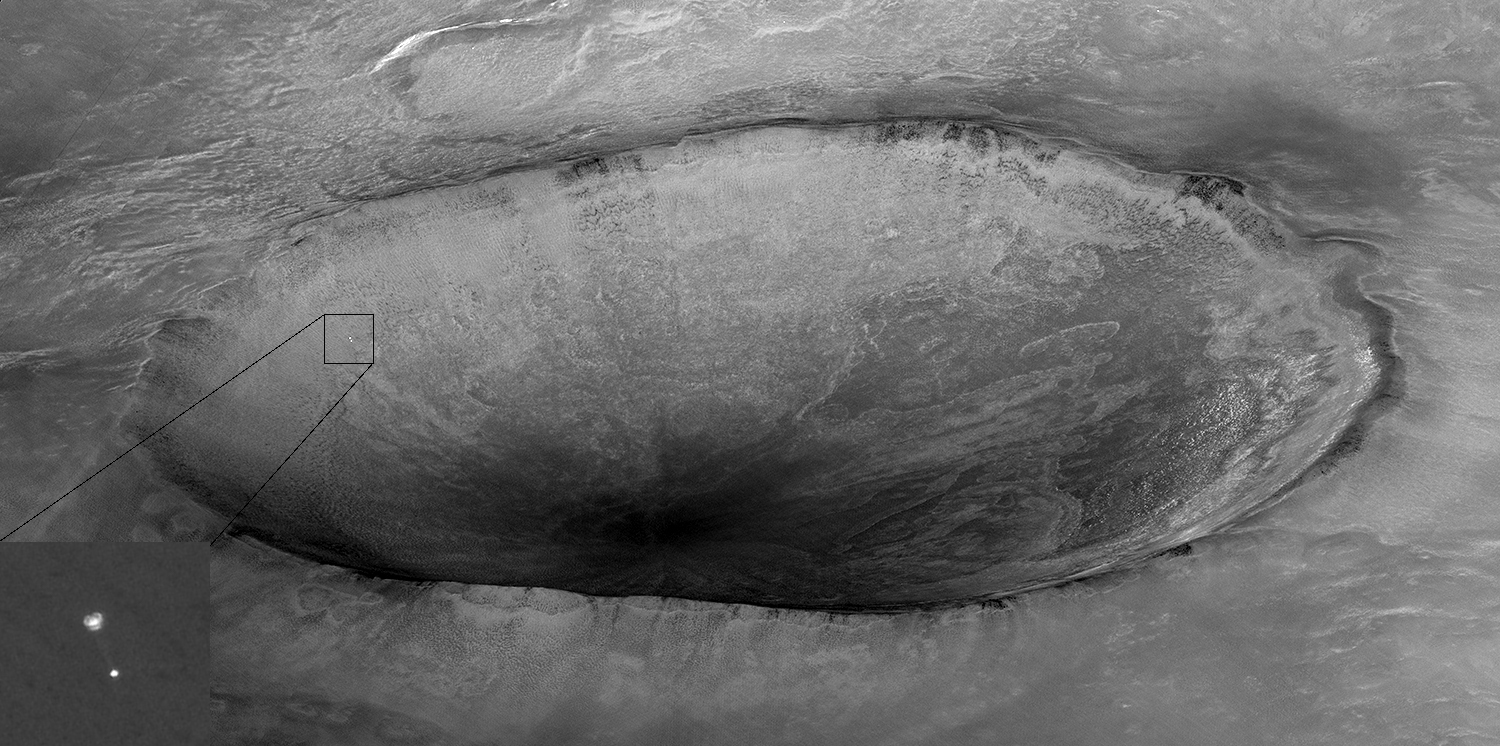
For more immediate visual gratification appreciated by a wider audience, the Mars Reconnaissance Orbiter provides wonderfully detailed images of Phobos.
That was the instrument that caught this mind-numbing image of the Phoenix lander as it was descending on its parachute. Words are really quite superfluous.
That's a great image, I wouldn't consider it mind-numbing at all.
-
MRO's images are totally awesome
For more immediate visual gratification appreciated by a wider audience, the Mars Reconnaissance Orbiter provides wonderfully detailed images of Phobos.
That was the instrument that caught this mind-numbing image of the Phoenix lander as it was descending on its parachute. Words are really quite superfluous.
-
Re:Sounds like this was noticed earlier ...
If it were my guess, there are so many priorities of glitches, and with a limited budget, if it isn't something that actively shuts down operations, resources are spent on other things.
Devil here: This isn't a budget problem, this is a management problem. Going all the way back to the Challenger disaster, NASA has shown a pattern of disregard for proper engineering practice. Richard Feynman chewed their ass out in Appendix F of the Challenger report to congress, and it was so scathing that both Congress and NASA tried to kick him off the board and discard his results... prompting the entire senior engineering staff of all branches of the Shuttle project to sign a petition saying: Either publish this, or face our wrath.
This isn't a technical problem -- this is management having shitty project management skills. If the budget is insufficient, then the project scope has to be reduced. It's just that simple. This is not the engineers' fault, or is it the fault of the technology... this is management trying to do too much with too little.
-
Do you know what you are talking about even
I'm pretty sure NASA have heard of this JPL since the Jet Propulsion Laboratory at Caltech is a NASA laboratory.
From TFA:
“A commercial lunar lander jointly developed with NASA would capitalize on NASA's previous investments and expertise in lander technologies. It also would stimulate a commercial capability to deliver payloads to the lunar surface reliably and cost-effectively."
So how is reaching out to commercial entities to improve their existing know-how instead of relying ONLY on their own labs "being clueless and pathetic"?
-
Need a lander for the Lunar Resoure Prospecto
They need a lander for this mission to explore the permanently shadowed region of the lunar poles.
-
Re:Last known position Units????
Too many years in sciences, I read Nina's last known position as decimal. I think the alert was in DD-MM so -33 Degrees, 50 minutes and 169 degrees 41 minutes which is -33.8333 169.68333. It also isn't as far south as in that photobucket image I posted earlier, but is very near the center of this MODIS image for June 4th. If you go to this website you can zoom in and out and change the date and be amazed at how rapidly this low forms a circular storm and moves east leaving a whispy trail of high-wind clouds. The best resolution MODIS imagery is around 250mm so little chance of seeing a boat but NASA/NOAA night imagery might be able to pick up ship lights if they are particularly bright.
-
Re: It aint done left this galaxy yet ?
Or if it were pointed towards Andromeda (it's not), it would take 44.7 Billion years to get there.
If you're willing to wait O(billions) of years, you don't have to go to Andromeda. Andromeda is coming to you!
-
Re:Too bad it's at NASA
Which all but guarantees that this engine will never do anything more.
Sort of like the ion thruster on the Dawn probe, which left Vesta about a year ago with an ETA on Ceres sometime in 2015?
-
Re:$80 per 15 gallons of gas
Prices in my area went up 15 cents overnight for no damn reason whatsoever other than the sun happened to rise in the same place as it did the day before.
The sun rose in the same place? Oh shit! That's not supposed to happen!
http://apod.nasa.gov/apod/ap120920.html
The only way the Sun can rise in the same place on two consecutive days is if the Earth has stopped orbiting the Sun, which means we're all going to die a fiery death as the Earth plunges into the sun (assuming it doesn't collide with Mercury or Venus along the way).
-
Re:If ever there was a role for drones...
-
Sign with Space-X
Space-X is planning a manned flight in 2015. Space-X will have their own private astronauts. They'll probably be ex-NASA astronauts initially, test-pilot types. Once Space-X has flight crew, that will probably be the place to go.
NASA still has 49 active astronauts, most of whom (but not all) have been in space. They don't have much to do. There are lot of recent astronaut layoffs and quits. NASA had over 80 astronauts at peak. That's not where you go if you want to go into space. It's surprising that they're training new ones, but they probably want to keep the training operation going.
Being a former astronaut sucks today. It's not like being John Glenn. Ex-astronauts used to have a pass to NASA facilities, but one found out last year that his pass to HSC was no longer valid. Even worse, they're now portrayed as unemployed losers on TV. There was an episode of Blue Bloods on this, where a has-been alcoholic ex-astronaut is begging his old friend the police commissioner to find him a job.
-
Here's the list
Because the summary couldn't be bothered.
Five are military (four are Navy test pilots, surprising no one, the fifth is a doctor), and the other three are useful Ph.D.s. Cassada really is the only standout among them, because he's a physicist, not a CTO, by training (which will make the scientific community at least a little happier about manned space missions). Meir is an enigma for sure, but makes sense from a strategic standpoint: she's done some time for NASA at JSC and Lockheed Martin doing human experiments and working with astronauts on the ISS, is interested in astrobiology, and worked at Aquarius Underwater Laboratory, which was later used to simulate an asteroid mission last year.
All of them are mostly in their mid to late 30s, which means the next class of astronauts are likely to be Millenials: all you shiny new Ph.D.s should start polishing your resumes for space!
-
Re:what should NASA do?
I'd love to see an interstellar probe launched, but that is far beyond our current technology. We just can't do it.
Technically, we already have. But yeah, unless we count on it coming back as V'Ger in a couple centuries, we're not going to get a lot of interstellar data back from it.
-
Re:NASA's mission
Not sure how any serious engineer or scientist works at NASA these days. NASA's mission changes quarterly (or more frequently), subject to political whim.
Because private companies are totally not flip-flopping based on quarterly performance and managers playing musical chairs. Most of this is simply political theater because none of these missions are funded, so nobody really cares how often they change except to make other politicians look bad. NASA's got plenty more mundane missions which will continue.
-
Re:Doh...
NASA doesn't launch any satellites except for TDRS. https://www.spacecomm.nasa.gov/spacecomm/programs/tdrss/default.cfm
-
Re:While you're on ebay...
Quickly, to add on to your discussion: I was stationed at NAS Moffett during the early '90's and recall a great deal of research at that time on the topic of augmented lift in STOL/VSTOL fixed wing aircraft. NASA had a number of unusual experimental planes that were able to fly at very slow relative wind speeds by bathing the wing in jet thrust or prop wash. It was very striking to watch these aircraft virtually float to a landing at about 40KTS.
-
Re:Debbie Downers
Sure, but at the end of the day, the effect of gravity diminishes with distance, something that might work on the plane may not then have "enough" of a gravitational pull to make it work on the ISS.
You do understand that BOTH the astronauts in the space station and people on the plane are in free fall, right?? They may be accelerating at slightly different rates, but they cannot be aware of the difference in acceleration, since there is no force pushing back in either case... as there would be on the earth's surface for example. Objects can't be aware of the different acceleration either.
YOu can see this with fire, when a match is struck on the plane it'll look the same as on the surface, but when done on the ISS, it behaves differently.
Given that NASA itself does experiments with flames with the assumption that they behave similarly on these planes as in space, it's pretty clear that you're talking nonsense.
-
Re:But Why?
The locale where it would hit is probably not feasible to evacuate. Pick a spot on earth that would be affected, middle of Africa, major city, farmland, doesn't matter. Now, propose a plan on how to evacuate that area that will work in the real world. Start by looking at examples of 'mandatory' evacuations in recent history for hurricanes, volcanoes, wild fires and the like. Point being that evacuations only work in the movies and even then they rarely work as they should. Evacuation also doesn't do anything for atmospheric affects, and those are what are said to kill most of the dinosaurs.
You have to either destroy it or deflect it, those are the only realistic choices. If you destroy it you have many small pieces that impact in a series of impacts instead of all at once. Most of the smaller pieces will simply burn up in the atmosphere. The larger pieces may or may not hit the earth (some will maintain trajectory, many will be deflected out of the way). Those pieces that do hit will still cause damage, however they have far less mass.
To put in perspective the earth gets hit by small amounts of material every day and most people never notice. To quote NASA "Every day, the Earth is bombarded with more than 100 tons of dust and sand-size particles." If those same 100 tons of debris hit as a single asteroid the damage would be quite devastating. By spreading out the impact into a series of smaller impacts you reduce the damage that would occur.
-
Re:Need to Be Careful
Here is a statement from Dennis Bushnell, Chief Scientist, NASA Langley Research Center:
The current situation is that we now have over two decades of hundreds of experiments worldwide indicating heat and transmutations with minimal radiation and low energy input. By any rational measure, this evidence indicates something real is occurring. So, is LENR "Real?" Evidently, from the now long standing and diverse experimental evidence. And, yes - with effects occurring from using diverse materials, methods of energy addition etc. This is far from a "Narrow Band" set of physical phenomena.
There is a physical theory NASA is evaluating, no violation of thermodynamics required.
You might also be interested in this presentation by another NASA scientist. From the summary page:
- A cheap, abundant, clean, scalable, portable source of energy will impact EVERYONE.
- Singular solution to peak oil, climate change, fresh water, and associated geopolitical instabilities.
- Drop-in replacement for traditional utility heat sources. Minimal impact to existing infrastructure
- Enables widely distributed generation. Homes and businesses generate what they need - on site.
- Enables whole new approaches to all of NASA’s missions - we can affordably get off this rock!
If true, guilt-free high intensity energy all around!
-
Re: So....
Wheels take far less power to move than legs. However, check out ATHLETE, the best of both worlds.
-
A hoax just like Global Warming, eh slashdot?
Nice "quote" there, very appropriate.
You might want to tell NASA's chief research scientist about your insights.
Since the physical evidence at this point overwhelmingly favors LENR being real, and the Widom-Larsen theory presents a plausible explanation for it, it's amusing that the basement dwelling hordes consider it a hoax...
-
Need to Be Careful
Don't conflate a charlatan with the science. NASA is still looking at this.
-
Re:Fun fact
The sections where added to be used to to visually measure the precise distance between drives.
source:
http://www.nasa.gov/mission_pages/msl/news/msl20120829f.html -
Re:I look forward to hearing about why this will f
-
Re:That's what you get
Earth's atmospheric pressure at sea level is roughly equivalent to having ~10m of water (1g/cm^3 density) above our heads. At a density of ~1.5g/cm^3, and a thickness between 5 and 10m, lunar regolith is in many areas equivalent to *less* mass than the atmosphere protecting our heads. That "solid rock" might be a bit less tough than you think compared to the crazy big chunk of air covering us on Earth.
-
Re:didn't temperatures peak in 1998?
I recall that the global temperature peaked in 1998 and has not broken that record since... recall that the temperature reached in 1998 was lower than that of 1934
http://data.giss.nasa.gov/gistemp/graphs_v3/
I also recall that CO2 levels have reached a new peak
http://www.esrl.noaa.gov/gmd/ccgg/trends/global.html#global_growth (see Annual Mean Global Carbon Dioxide Growth Rates) - it's been increasing every year. You seem to have recalled several things incorrectly.
Just one example, federal buildings in DC are heated by one of the dirtiest coal fired power plants in the federation. If they were serious about global warming then I would expect them to do something about this first before telling me what kind of heat I can use in my own home.
Problem is, energy is a private authority. I assume, based on your "2nd ammendment" signature, that you are a conservative. The government doesn't have the ability in modern times (it's more conservative now than when the TVA was around) to regulate energy. Would you rather have them force a company to build a solar/wind/etc farm around DC, or build one themselves? That's a whole different debate.
-
Re:What Global Warming?
Get with the program. We call it climate change now, since the global temperature hasn't risen in over 16 yrs and is lower than the 2sigma range of the models.
We call it climate change now due to fucking idiots going "Global Warm'n?! It's COLD OUT, HAR HAR HAR."
Personally I'm expecting after 3-4 more Superstorms like Sandy that MAYBE the morons in my country will finally get a clue, but by then Keystone XL will be forced through and we'll be quite well and truly fucked. But hey, at least a few people will get rich in the process, right?