Slashdot Mirror
Domain: nasa.gov
Stories and comments across the archive that link to nasa.gov.
Comments · 16,365
-
Re:This leads me to an interesting question...
Not entirely accurate, but close.
- it was a complete failure with regard to its original purpose, making orbital travel routine and inexpensive
I think they definitely succeeded in the first part--making orbital travel routine. The inexpensive part, they didn't succeed but the method they were using to make it inexpensive was more of an accounting trick than some sort of new technology. The idea was to block people from using anything except the Shuttle to put things into orbit. The idea was that the Shuttle is going to go up anyway, so you load it up with a bunch of paying customers' satellites and they end up paying for the launch.
- it was a spectacularly inefficient tool for what it was actually used for
Well, that depends. Through the 80s and 90s, it was mostly used as a launchable space station, keeping a crew of 7 alive in a shirt-sleeve environment doing research. The problem is that the Shuttle could only stay up for a few weeks--experiments that needed longer were out-of-luck. Of course, the solution was a space station but NASA didn't have the money to build one. That said, once the ISS was online, the Shuttle did become a very inefficient tool for delivering people to the ISS.
- what it was actually used for wasn't very interesting either: the ISS has not been a good investment compared to the unmanned programs
That depends. Lots of interesting research happens on ISS. The problem is that it's all boring sciency stuff--it isn't exploring the great unknown out there. As an aside, I'm seeing the "No Bucks, No Buck Rogers" POV here--it's just that Buck has been replaced by a robot. Go take pictures of rocks on Titan? Hell yeah! Actually try to figure out the differences between the rocks on Titan and Earth and why those differences exist? Snoooooooze. I'd rather see pictures of the rocks on Triton!
- it was incapable of going anywhere more interesting than low orbit, let alone the moon or Mars
Now you're conflicting with your first point: "it was a complete failure with regard to its original purpose, making orbital travel routine and inexpensive." It wasn't supposed to go anywhere interesting.
- it was sucking the life out of the manned space program anyway, and often crippling the unmanned programs because they were designed around the shuttle
This one, I agree with wholeheartedly and that was the best reason to end the Shuttle program.
As I mentioned above, the ISS was basically the nail in the Shuttle's coffin. The whole raison d'etre for the Shuttle was to do experiments in space. Now we have ISS for that. So the Shuttle is just a really expensive way to get some people up to the ISS--the equivalent of driving your huge gas guzzling SUV to the corner grocery store to pick up a coke. I wholeheartedly agree with NASA shutting it down. Personally, I don't even think they should waste time building a rocket to get them back there--give that task to some contractor and promise that, if successful, they'll pay for x flights. There are various companies already working in that direction--let them ferry scientists up to the ISS. Personally, I'd consider moving ISS management over to the National Science Foundation or some other group and get it completely out of NASA, but that might be going a bit far.
-
Yeah, but
This is still cooler: http://apod.nasa.gov/apod/ap120312.html
-
Re:Why not post link to NASA website?The LRO page has both videos http://www.nasa.gov/mission_pages/LRO/news/vid-tour.html/
Fuck you ITWorld author for not linking back to the source
-
Why not post link to NASA website?
-
Re:Most analogies break down at some point...
I disagree - you keep strawmanning me. I recommend that you use sources, pay a bit more attention to not continuing arguments where the other person already agrees with you,
Then what was the point of arguing that the ban on incadescent light bulbs could reduce deaths from air pollution more than it cost in terms of loss of freedom, when you agree that there was a much better solution to the problem which didn't lead to this loss of freedom and which actually works?
1. Lying about their equivalency. They were claiming to be equivalent to a 60 watt bulb while only producing the lumens of a 40 watt.
As an aside, the human eye is more sensitive to certain colors (I recall green then blue then red). So it is possible for a lower lumen bulb with bluer spectrum to appear as bright as an incandescent bulb with a redder spectrum. This was no doubt part of the gimmick.
As to using sources, I'd rather make logical, correct arguments than use sources. For example, remember the pretty picture of Earth at night? You used that to support an argument that lights were used at night only to admit later that those lights aren't covered by the ban. So that use of source was irrelevant. Or link to articles that speak of deaths from particulate pollution while estimating pollution contribution from linked charts of non-particulate pollution?
The point here is a that good argument may benefit from the use of sources, but the use of sources doesn't in itself lead to good argument. I find it's more used on Slashdot for argument from authority (which hasn't been a problem with your posts).
A second problem is that these links frequently don't say what you intend. I don't have endless hours to spend on a single post (though obviously I do spend too much time in total on Slashdot posting) and it's not infrequent for me to go through a link and see that the source doesn't actually support what the linker intended.
Fundamentally, the original question was does the incandescent light bulb ban create more benefit for us than the constraint on our freedom? We find out that the ban doesn't and that better and less intrusive approaches for reducing air pollution are being ignored.
Even the connection between light bulb and coal burning plant is tenuous with most bulbs which are subject to the ban operating at peak load times and hence covered more by peaking power than coal burning power. And that's assuming that one lives in an area that uses coal. It wouldn't be the case for much of the Northwest, for example.It depends on how the system is designed; our local one you can feed more coal to the boilers and simply generate steam faster, then they open a valve to another turbine in a planned, routine operation. It can be quite quick.
Ok, that is a point I haven't considered. Though there are two problems. Why aren't they running the plant full tilt most of the time? Coal is pretty cheap. And they could sell the night's excess to someone with pumped storage or other electricity storage systems.
Second, how old is that plant? It strikes me that this sort of variability is a relatively new innovation (within the past 30-40 years). The plants least likely to be able to do this sort of thing are also probably the most polluting. That goes with my original assertion that base load generation tends to be more polluting than peaking load. -
There's no triangle...
but North America can be seen in this SDO image!
sdo image -
Re:Not a Triangle.
No fucking clue why the first article is linked, myself... it has nothing to do with what the summary is talking about.
However, the second link actually shows what I think they're trying to talk about in the summary (you can kinda make it into a strange triangle sort of thing...).
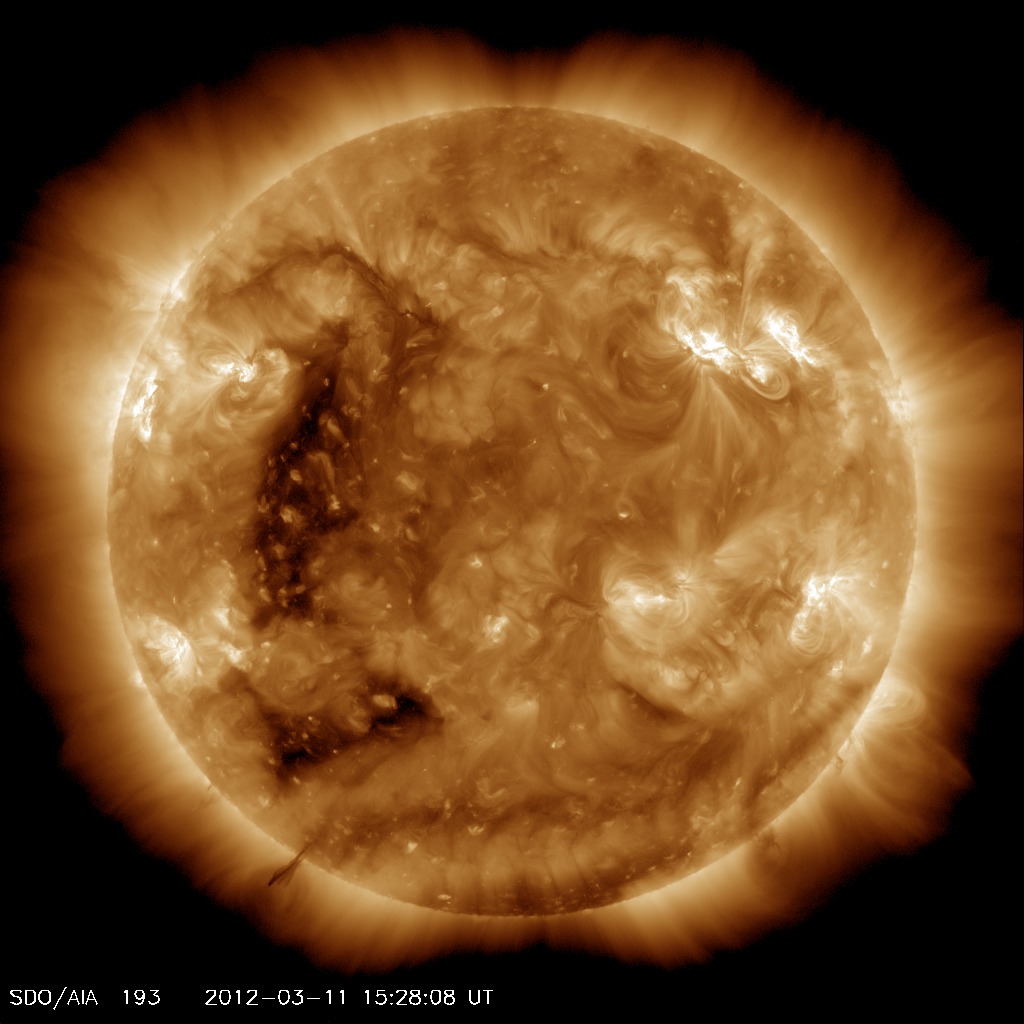
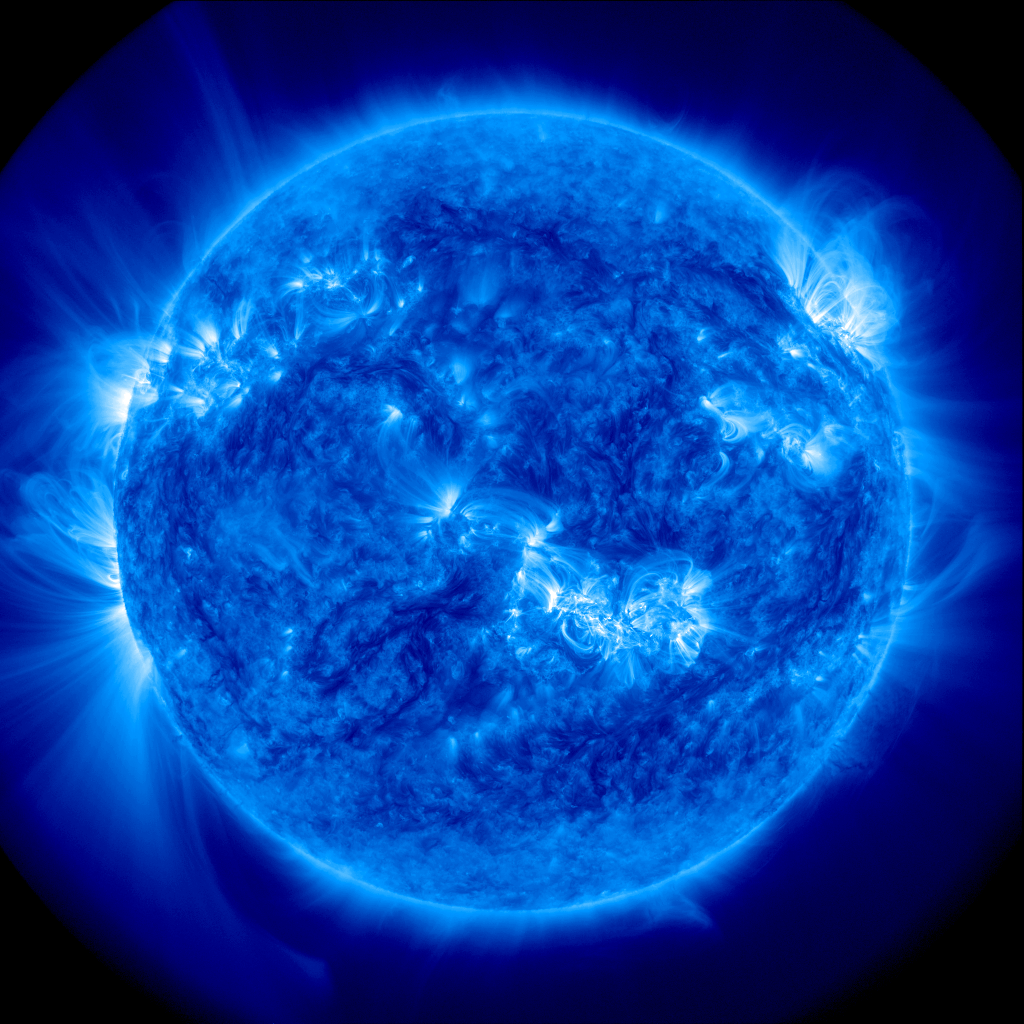
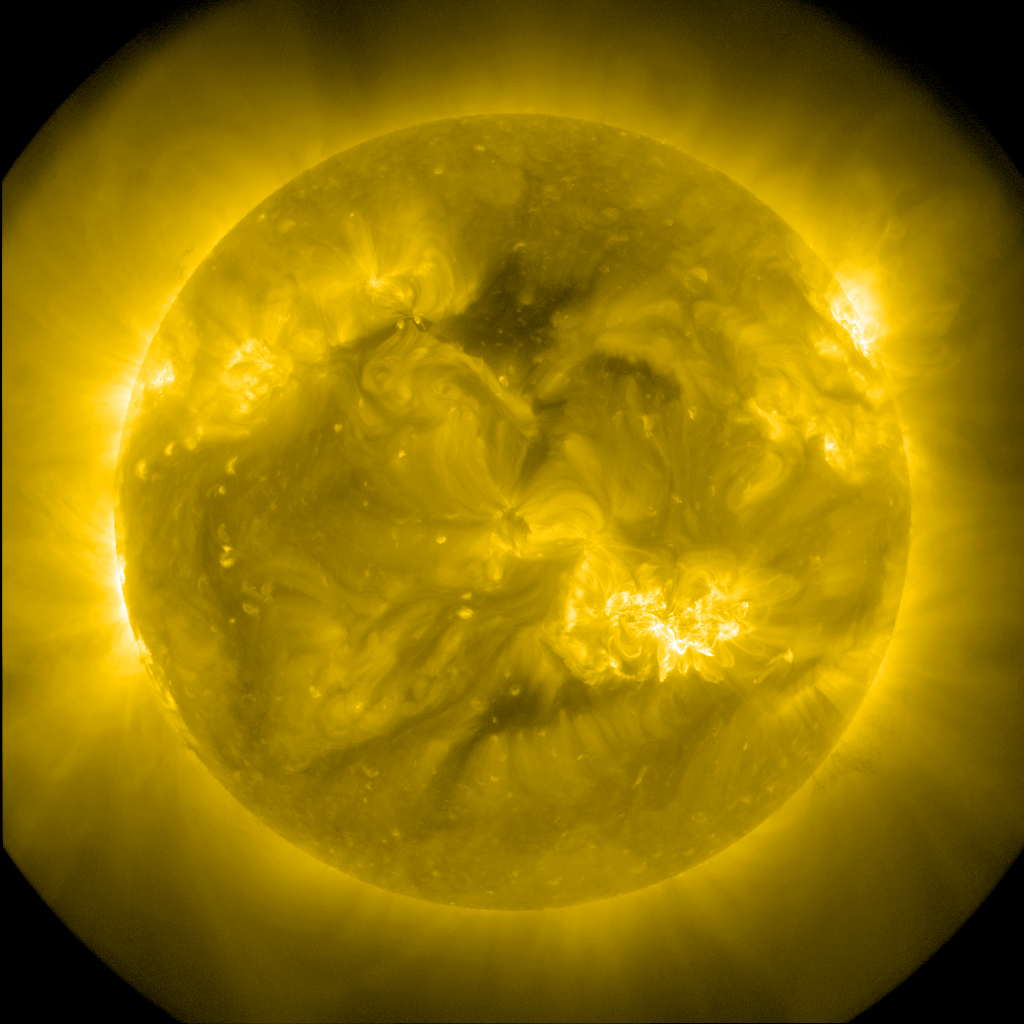
Or you can go to http://sdo.gsfc.nasa.gov/ and select AIA 193 (or AIA 211, AIA 335, or AIA Composite [all three of those, but one that it particularly stands out is 211, 193, 171]) on the drop down below the picture of the sun, and you'll see another view of it.
-
Re:Not a Triangle.
No fucking clue why the first article is linked, myself... it has nothing to do with what the summary is talking about.
However, the second link actually shows what I think they're trying to talk about in the summary (you can kinda make it into a strange triangle sort of thing...).
Or you can go to http://sdo.gsfc.nasa.gov/ and select AIA 193 (or AIA 211, AIA 335, or AIA Composite [all three of those, but one that it particularly stands out is 211, 193, 171]) on the drop down below the picture of the sun, and you'll see another view of it.
-
There's a face visible in this image
Two eyes and a mouth (which appears to be eating a butterfly...).
The sun is smiling at us!
-
To see it, try this
Using the links in the parent post, I didn't see it either. But I think the image they're talking about can be found here:
1. Go to http://sdo.gsfc.nasa.gov/
2. You'll see an image of the sun in a box on the left.
3. There's a drop-down menu in the box. Select AIA-193.
4. View the apocalypse.OR... just go here: http://umbra.nascom.nasa.gov/images/latest_aia_211.gif
-
To see it, try this
Using the links in the parent post, I didn't see it either. But I think the image they're talking about can be found here:
1. Go to http://sdo.gsfc.nasa.gov/
2. You'll see an image of the sun in a box on the left.
3. There's a drop-down menu in the box. Select AIA-193.
4. View the apocalypse.OR... just go here: http://umbra.nascom.nasa.gov/images/latest_aia_211.gif
-
didn't see the triangle but did see a number
a giant upside down '5' or a backwards '2'
Go look at AIA211 at http://sdo.gsfc.nasa.gov/
It's hard to miss. That number is 2/3 the siz of the sun...
I think my observation is a little more realistic/interesting than some weird triangle/sphere thing. I couldn't find it.
LAME.
-
Re:Better video of the "triangle".
Your video looks nothing like NASAs image
-
Re:Most analogies break down at some point...
Dang, first post got eaten. Anyways - on enforcing the law. I did some research. It bans the importation and manufacture of non-compliant bulbs. It doesn't make selling them domestically illegal, nor possession, etc... So unless you're running a factory or importing business, I don't think you have to worry. Just like the toilets. They aren't going to break down people's doors looking for them.
Even you can see the right answer. So why go with a wrong one?
Remember I only stepped in to explain the analogy. Didn't say I agreed with it. I think we can both agree that pollution, especially too much of it, can be bad.
But not from light bulbs.
Let's see: ~70k deaths from air pollution in the USA per year. The UK is 50k. Worldwide is 1.3M per year.
Lighting is 9% of electricity usage.
Eyeballing this and averaging the four sources, I get 24% of air pollution from energy production and distribution. EPA says 67% sulfur dioxide, 23% nitrogen oxide. I dropped CO2. That would be 45%. I'll stick with 24%.Using a straight blame - 70k deaths from air pollution. 17k would be from electricity generation. 1.5k for pollution from powering lights, on average. 28k worldwide.
So yeah, I can trace thousands of deaths to the pollution from light bulbs. Making matters worse - there's plenty of survivors affected - per 75 deaths there are '505 hospital admissions for asthma and other respiratory diseases, 3,500 respiratory emergency doctor visits, 180,000 asthma attacks, 930,000 restricted activity days, and 2,000,000 acute respiratory symptom days.' Per 75 deaths seems an odd measure to use, but it's what the article listed. That's a lot of lost labor due to the pollution.As for the baseload vs peak - 'not many lights are left on overnight'? I refer you to this image. And coal power isn't entirely baseload - fire up another boiler, spin another turbine. It might have to be scheduled a bit more compared to hydro or NG, but it's there.
Look, it's not that we don't agree on some things, it's just that, well, if you're going to argue this stuff, you need to do it right, and denying facts isn't going to help. I lean majorly libertarian, but given the pollution levels in my town on occasion,
-
Re:What if...
You mean something like this?
Searching for Good Science: The Cancellation of Nasa's Seti Program
-
Re:What if...
You mean something like this?
Searching for Good Science: The Cancellation of Nasa's Seti Program
-
Carrington Event ?
Why does it seem I am the only one that is concerned about what's going to happen when one of these flares whacks the power grid in the Northeast U.S.? http://en.wikipedia.org/wiki/Solar_storm_of_1859 Oh, that's right - the US Gov't is real concerned too. - http://science.nasa.gov/science-news/science-at-nasa/2009/21jan_severespaceweather/ So here's what really concerns me - say, the entire Northeast grid goes down. There are a number of nuclear plants that have cooling pools for spent fuel rods, just like Fukushima. So what happens when - just like Fukushima - the power goes down and the pool pumps can't run for lack of electricity - Won't that be like Fukushima x (no. of nuclear plants in the Northeast)? Don't mean to be alarmist, but someone tell me where I am wrong on this?
-
Re:50 years ago...
PS... NASA still has operating SR-71's, so we technically still have a plane capable of traveling at Mach 3.35. And, God only knows what the slow, Government-teat-sucking, mouth-breathing engineers have been able to cook up in the past 50 years. Maybe they have us up to Mach 4 now.
No they don't. They haven't since 1999...
http://www.nasa.gov/centers/dryden/news/FactSheets/FS-030-DFRC.html
-
1992 - NASA wrote Hyperman
1992 - NASA wrote a program like this called Hyperman as part of EDP. In 1996, the project won runner up in the NASA software of the year contest. Most of the project pages are gone from the internet now. http://ntrs.nasa.gov/archive/nasa/casi.ntrs.nasa.gov/19960022643_1996044857.pdf
Annotations were shared between multiple users and were very cross platform. Document authors were able to force annotations onto all readers of their documents.
OTOH, I could be misreading the new aspects to Amazon's patent.
I recall when Adobe came to visit our lab
-
Re:Research? Sure.
I'm sorry, but 700 km = 434 miles, is well within the height necessary for Low Earth Orbit (LEO), 400km = 234 mi. The normal delineation for LEO is anywhere from 100 - 620 miles (200-2000KM) to 200-500 mi (340-800 km). Well at least according to NASA , NASA again, Wikipedia and ESA . So it seems this little rocket "barrage" is one way to test a new "inexpensive" launch vehicle. Perhaps with military implications. Minutemen are rather expensive , and three stages. A two stage rocket is bound to be cheaper.
-
Re:Research? Sure.
These are sounding rockets.
The Orion is a single stage sounding rocket which will achieve an altitude of 60 km with a 250 lb payload or 90 km with a 75 lb payload.
The Terrier-Malemute is a two-stage, solid fuel rocket consisting of a Terrier 1st stage and a Malemute 2nd stage. It is capable of lifting a 200 lb payload to an apogee of approximately 700 km or a 500 lb payload to approximately 400 km.
The The Terrier-Improved Orion consists of a Terrier 1st stage and an "improved" Orion second stage. This vehicle is capable of achieving an altitude of 75 km with an 800 lb payload and 225 km with a 200 lb payload.
(source: http://sites.wff.nasa.gov/mpl/srockets.html)To be compared to the LGM-30G Minuteman-III which is a three-stage, solid fuel rocket capable of lifting an approximately 600 lbs warhead to over 1100 km. We have 450 of these more or less ready to launch.
(source: http://en.wikipedia.org/wiki/LGM-30G_Minuteman-III and http://en.wikipedia.org/wiki/W87)In short, the Chinese already know we have "the capability of rapidly launching a barrage of orbit-capable warheads", and either way, these rockets aren't demonstrating anything of the sort.
-
Re:Why wait?
Is there any reason why NASA can't start working out a 'asteroid impact playbook' right now instead of scrambling to make one when the big one does come, even if it's not this one? I fail to see how that would be a worse use of taxpayer dollars than, say, the shuttle program was.
Oh, you mean like this one?
-
JPL's list of future Earth impact risks
Sentry Risk Table
The following table lists potential future Earth impact events that the JPL Sentry System has detected based on currently available observations. Click on the object designation to go to a page with full details on that object.
Sentry is a highly automated collision monitoring system that continually scans the most current asteroid catalog for possibilities of future impact with Earth over the next 100 years. Whenever a potential impact is detected it will be analyzed and the results immediately published here, except in unusual cases where an IAU Technical Review is underway.
-
Re:Is SETI wasting its time?
>Planets are very poor reflectors. Not comparable.
Not comparable!??? From wikipedia:
"The average overall albedo of Earth, its planetary albedo, is 30 to 35%, because of the covering by clouds, but varies widely locally across the surface, depending on the geological and environmental features."Just because one square inch of mirror reflects better than one square inch of planet surface does not mean the mirror will be more visible. Your positionable mirrors will still need to cover a surface area that's a pretty large fraction of a planet.
BUT unfortunately that's not how Kepler detects planets. Assuming the detectors can detect an increase in brightness as well as a decrease...you're going to need an array that's close to 100% reflective and exactly the size of a planet.
>What you do is point at a target, let fly, then point at the next target, let fly, etc
From wikipedia:
"While only about a dozen planets have been confirmed in the habitable zone, the Kepler spacecraft has identified a further 54 candidates and current estimates indicate that there are "at least 500 million" such planets in the Milky Way."Either the transmitter or receiver will need to have a wide lobe...otherwise the probability of intercept is stupid low. If you could position your absolutely massive mirrors array at a rate of 1500 planets/second, you would, on your receiving planet, see a signal once every three days for 1/1500 of a second. Kepler can see something like 15 degrees, and requires DAYS of averaging to get something statistically useful. Seeing a 1/1500 second signal even with, literally, planet sized light blockers or reflectors isn't anywhere close to our grasp yet.
Not saying that some aliens aren't doing this....but I don't think we're ready to see it yet.
And, if you're talking about planet sized mirror arrays being feasible, why not planet sized light blockers arrays that can be modulated? Way easier to construct. Is there a benefit in making the average brightness of a sun look brighter rather than darker?
-
Re:Is SETI wasting its time?
>Planets are very poor reflectors. Not comparable.
Not comparable!??? From wikipedia:
"The average overall albedo of Earth, its planetary albedo, is 30 to 35%, because of the covering by clouds, but varies widely locally across the surface, depending on the geological and environmental features."Just because one square inch of mirror reflects better than one square inch of planet surface does not mean the mirror will be more visible. Your positionable mirrors will still need to cover a surface area that's a pretty large fraction of a planet.
BUT unfortunately that's not how Kepler detects planets. Assuming the detectors can detect an increase in brightness as well as a decrease...you're going to need an array that's close to 100% reflective and exactly the size of a planet.
>What you do is point at a target, let fly, then point at the next target, let fly, etc
From wikipedia:
"While only about a dozen planets have been confirmed in the habitable zone, the Kepler spacecraft has identified a further 54 candidates and current estimates indicate that there are "at least 500 million" such planets in the Milky Way."Either the transmitter or receiver will need to have a wide lobe...otherwise the probability of intercept is stupid low. If you could position your absolutely massive mirrors array at a rate of 1500 planets/second, you would, on your receiving planet, see a signal once every three days for 1/1500 of a second. Kepler can see something like 15 degrees, and requires DAYS of averaging to get something statistically useful. Seeing a 1/1500 second signal even with, literally, planet sized light blockers or reflectors isn't anywhere close to our grasp yet.
Not saying that some aliens aren't doing this....but I don't think we're ready to see it yet.
And, if you're talking about planet sized mirror arrays being feasible, why not planet sized light blockers arrays that can be modulated? Way easier to construct. Is there a benefit in making the average brightness of a sun look brighter rather than darker?
-
Re:History too
When you change the Angle of Attack (AOA), then you change where on the front of the wing that the air starts. So, with a symmetric airfoil you adjust the lift positively and negatively by adjusting the AOA with the elevator. The description is still right.
-
JPL impact risk table
TFA contains a link to an predicted impact table of DA14 with earth, going some 50 years into the future. The likelihood of each impact is rather small, and the cumulative probability of any impact is computed as 2.2e-04 (about 1 in 5000 - not alarming, but not exactly negligible IMO).
Here's what I don't understand: the first entry in the chart, corresponding to the next risk event, is in the year 2020. What happened to Feb 2013?
-
Re:Next stop, tower to space!
Yes! Exoatmospheric tower next! Let's do it!
What do you think about the Launch loop concept? While it is a huge undertaking, it seems to be way up from a space elevator on the feasibility scale. It would offer huge savings for putting things in orbit even compared to your tower, basically obviating the need for using (and lifting) chemical propellant for most of the delta-V needed. Any thoughts on that?
-
Re:An agenda
If you dig a bit, you will find plenty of papers showing that climate change in the past century correlates more closely to astronomical phenomena (sunspots, cosmic radiance, tidal forces) than it does to CO2 levels? If temperature increases correlate so strongly to CO2 levels then why was the increase so much slower from 1940 to 1970, than it was from 1970 to 2000, and why has it been so much slower in the last decade than predicted by every single model promulgated by the IPCC AR4?
http://icecap.us/images/uploads/US_Temperatures_and_Climate_Factors_since_1895.pdf
http://www.duke.edu/~renato/RamosdaSilvaandAvissarGRL2005.pdf
Or this, from NASA itself, which shows the decrease in sunspot activity which correlates to the current decrease in temperatures in the past decade or so.
http://solarscience.msfc.nasa.gov/SunspotCycle.shtml
Yes, CO2 can and does affect the climate, but so do many other things, especially some things that aren't well understood yet. And that's not even considering whether we humans are significantly contributing to the problem or more importantly, whether we can do anything about it.
Now, correlation does not imply causation, but the current models always seem to fail to predict what's actually happening, or "retro-predict" was has already occurred.
-
Next stop, tower to space!
Yes! Exoatmospheric tower next! Let's do it!
-
Warming or not? What does the data say?
Correct me if I am wrong but in simple terms the planet warmed a little over 10 years ago and at which time the warming leveled off.
Not much point in replying to posts by anonymous coward, since even if, as you say, "I am willing to listen to evidence that refutes it," how would I know? I don't even know what data you're willing to look at, and what data you have decided to ignore because you claim it is (quoting from the previous post) "...lying with statistics... fabricating temperature readings... committing scientific and financial frauds."
However, taking you at your word for just a moment, here is the data for the Berkeley Earth Surface Temperature project:
http://berkeleyearth.org/images/berkeley-earth-land-surface-average-temperature-60yr.jpgWould you say, based on this data, that "the Earth warmed a little ten years ago and the warming stopped"?
What about if you draw a line from the 1998 data point to the 2008 data point? Would you say that this line is, or is not, representative of the data?
This despite the fact that present day CO2 levels are now even higher than worst case scenario predictions 10 years ago.
Actually, no; check your data source. It turns out that the global recession had a negative impact on the CO2 emission growth rate. It's not "higher than worse case predictions," it ended up being "slightly less than predicted." (Not enough to make much of a difference in the predictions, though).
That graph came from the BEST FAQ, which can be found here: http://berkeleyearth.org/faq/#stopped
You can also try the NASA data, NOAA data, CRU data etc. The Goddard Institute for Space Studies (GISS) graphs, for example, compare data taken by several different methods; they are here: http://data.giss.nasa.gov/gistemp/graphs_v3/ -
Re:Let the climate models speak for themselves
"GISS is well known for fabricating their data using 1,200 km radius circles with just one temperature station in them. That is not permitted in science when you are representing that the data is actual temperature measurements..."
Stations are usually much closer together than 1,200 km. Picking a random spot on the globe gets me in northern China, and the closest station is in Linhe. The next closest station to Linhe is 114 km away, and the 34th closest and last station listed on the page by GISS is Wutai Shan at 558 km away. Clicking again on GISS' world map, this time deliberately where there isn't much land (the middle of the south Atlantic) gets me 550 km from the station at Tristan Da Cuhna. Next closest stations to that one are a triplet 424 km away on Gough Island, and then they get distant in a hurry. Imagine that, not many stations where there are not many patches of land to put them on. But even in the south Atlantic, where there's land, there's a station. St. Helena, Ascension Island, Gough Island, South Georgia Island, Laurie Island, and the Falklands all have stations, despite being in some of the most remote and/or inhospitable places on the planet. So it isn't 1,200 km between stations, except in exceptionally remote and/or inhospitable places where there isn't land to put them on. The GISS does smoothing of data between stations, at either 250 km or 1,200 km radius, and except for where land is lacking like the open ocean, there are always multiple stations--dozens even--that are included in that smoothing. -
Re:Let the climate models speak for themselves
"GISS is well known for fabricating their data using 1,200 km radius circles with just one temperature station in them. That is not permitted in science when you are representing that the data is actual temperature measurements..."
Stations are usually much closer together than 1,200 km. Picking a random spot on the globe gets me in northern China, and the closest station is in Linhe. The next closest station to Linhe is 114 km away, and the 34th closest and last station listed on the page by GISS is Wutai Shan at 558 km away. Clicking again on GISS' world map, this time deliberately where there isn't much land (the middle of the south Atlantic) gets me 550 km from the station at Tristan Da Cuhna. Next closest stations to that one are a triplet 424 km away on Gough Island, and then they get distant in a hurry. Imagine that, not many stations where there are not many patches of land to put them on. But even in the south Atlantic, where there's land, there's a station. St. Helena, Ascension Island, Gough Island, South Georgia Island, Laurie Island, and the Falklands all have stations, despite being in some of the most remote and/or inhospitable places on the planet. So it isn't 1,200 km between stations, except in exceptionally remote and/or inhospitable places where there isn't land to put them on. The GISS does smoothing of data between stations, at either 250 km or 1,200 km radius, and except for where land is lacking like the open ocean, there are always multiple stations--dozens even--that are included in that smoothing. -
Re:Let the climate models speak for themselves
-
Re:Let the climate models speak for themselves
Bullshit.
Global temperatures are still rising. Anybody saying otherwise has come unmoored from the data.
http://data.giss.nasa.gov/gistemp/graphs_v3/Fig.E.gif -
VASIMR prototype
For now, since the warp drive has a serious side effect ( 0.0 ). I rather put my money on the VASIMR prototype for now until "further research is done". Nasa has over 100 guys working on this project with AAR right now. So this one is very promising
-
Re:With a bit of luck...
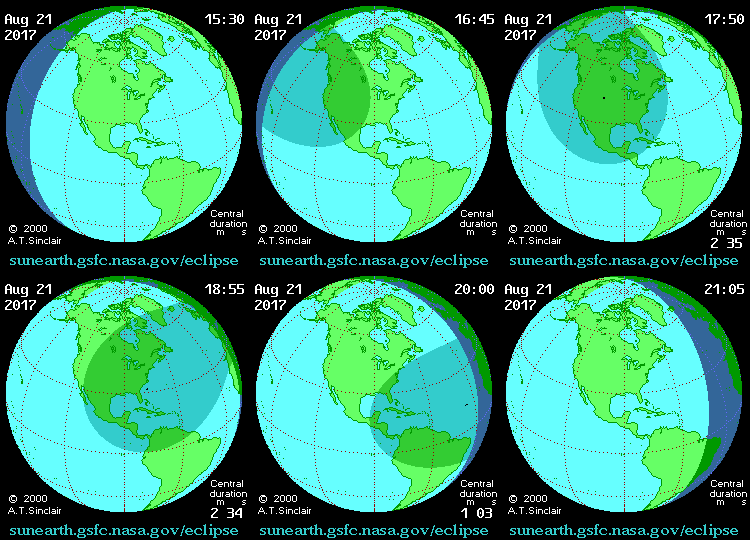
Well, if one knew exactly where the solar eclipse was going to be at the exact moment the storm struck, then THAT area - if they could disconnect from the rest of the world - would be safe. The rest of the world would still be hosed.
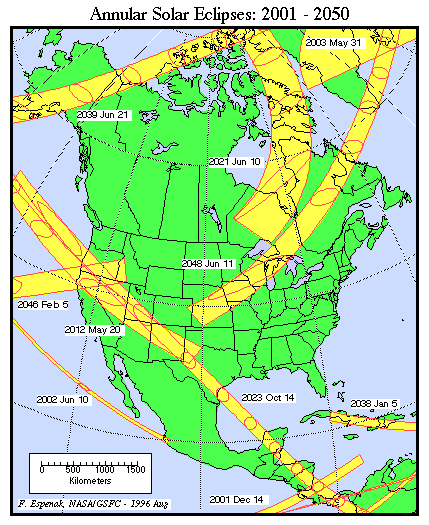
A good time would be August 21, 2017, in the late morning - at least if you're in the continental United States... (or maybe May 20th of this year or Oct 14th, 2023, but those annulars wouldn't be as fun to watch)..
-
Re:With a bit of luck...
Well, if one knew exactly where the solar eclipse was going to be at the exact moment the storm struck, then THAT area - if they could disconnect from the rest of the world - would be safe. The rest of the world would still be hosed.
A good time would be August 21, 2017, in the late morning - at least if you're in the continental United States... (or maybe May 20th of this year or Oct 14th, 2023, but those annulars wouldn't be as fun to watch)..
-
Re:Denialism of natural climate change
CO2 may not be as well mixed as I assumed. Here is some more information about that. But climate scientists are no doubt aware of this and take it into account as best they can. You'll have to provide a lot more solid evidence to convince me it significantly affects what they are saying.
Well, actually, they do ignore it:
Have you done a comprehensive review of the literature and confirmed that or is that just your supposition? (And no I haven't either but if Jaworski had something other scientists would pay more attention to him.)
The estimates I've seen lately mostly say that human contributions are responsible for more than 100% of the warming in the past several decades.
That's not remotely possible, but furthermore, like Obama's "jobs saved or created", it's not falsifiable
Why isn't it possible? If natural forcings would lead to cooling but it's still warming then you can say human contributions are responsible for more than 100% of the warming. Here is an article on a paper that indicates natural forcings may actually be negative. The actual paper is here.
-
Mars mission will have an impact on eyesight tech
A recent discovery of long term space exploration is that being in low gravity for too long literally folds parts of your eye. Causing astronauts who spend too much time up in space to have permanent vision changes that leave them very far-sighted and required to wear reading glasses. Just six months in low gravity was enough for major changes in vision.
Imagine a missions to Mars that takes six months just one way? These astronauts would be blind under our current understanding of how space travel affects sight by the time that they came back.
http://articles.latimes.com/2011/sep/20/nation/la-na-blind-nasa-astronaut-20110921
"What we are seeing is flattening of the globe, swelling of the optic nerve, a far-sighted shift, and choroidal folds," said Dr. C. Robert Gibson, one of authors of the study published in the October 2011 issue of Ophthalmology, the journal of the American Academy of Ophthalmology. "We think it is intracranial pressure related, but we're not sure; it could also be due to an increase in pressure along the optic nerve itself or some kind of localized change to the back of the eyeball."
The study identified new risks for those who live in space for at least six months. Blurred vision was the primary issue reported by the seven astronaut test subjects.
"After a few weeks aboard the [station]," said Astronaut Bob Thirsk, a Canadian Space Agency physician who spent six months as a member of the Expedition 20 and 21 crews in 2007, "I noticed that my visual acuity had changed. My distant vision was not too bad, but I found that it was more difficult to read procedures. I also had trouble manually focusing cameras, so I would ask a crewmate to verify my focus setting on critical experiments."
http://www.nasa.gov/mission_pages/station/research/news/Astronaut_Vision.html
The way I see it is that there are two options. The first one is we only send replicants to Mars or more unmanned flights. The other is that NASA gets some awesome new understanding of vision loss or develops technology to overcome vision loss. Either way this would be quite the benefit for society if NASA can develop some new things to combat vision loss.
-
Re:Exceptions
A particular scientific theory can be both well-proven and NP-Hard to determine.
Yea, but I was referring to the AGW theory, not theories that can make consistent predictions. Before you can even derive a reliable equation, you need to understand and include factors in all the underlying equations and their ultimate effects.
Oops! Missed another one.
-
Re:They're seeing what?
I seriously wonder how they're being detected. The only thing telescopes can do is detect emission in the light spectrum.
This detection is by the Spitzer Space Telescope, which looks at the infrared spectrum - not visible light. As for how they found particles so small, the answer is that they found a lot of them. The NASA press release states:
They found the particles around a pair of stars called "XX Ophiuchi," 6,500 light-years from Earth, and detected enough to fill the equivalent in volume to 10,000 Mount Everests.
-
This is not a new idea
It's been around since the year Tet. NASA have been playing with the idea for years; they have even deployed it. In 1968 a certain TV show used it as a plot device. Said show reused the plot device in several subsequent episodes and at least one movie.
The problem with EIP is that it produces such a small amount of thrust (although large compared with the amount of propellant it uses, it's still less thrust than you get from a can of hairspray), a human in a capsule wouldn't even feel the pressure in the small of his back. Current deployments are designed to produce a small amount of thrust continuously for extended periods of time - such that over
-
This is not a new idea
It's been around since the year Tet. NASA have been playing with the idea for years; they have even deployed it. In 1968 a certain TV show used it as a plot device. Said show reused the plot device in several subsequent episodes and at least one movie.
The problem with EIP is that it produces such a small amount of thrust (although large compared with the amount of propellant it uses, it's still less thrust than you get from a can of hairspray), a human in a capsule wouldn't even feel the pressure in the small of his back. Current deployments are designed to produce a small amount of thrust continuously for extended periods of time - such that over
-
Sodium cloud atmosphere
Along with the body being active, moon has a active exosphere and surrounded by a sodium cloud bright enough to be seen by the unaided eye if not for the brightness of the moon's surface. This active "atmosphere" will be further investigated by LADEE, Lunar Atmosphere and Dust Environment Explorer, spacecraft being built now at NASA Ames and Space Systems Loral (on San Antonio off hwy 101 few miles north of Ames), to be launched next year. LADEE is Small Spacecraft/Big Science. http://www.nasa.gov/mission_pages/LADEE/main/ And discussion on exosphere at http://lunarscience.nasa.gov/articles/solar-storms-sandblast-moon
-
Sodium cloud atmosphere
Along with the body being active, moon has a active exosphere and surrounded by a sodium cloud bright enough to be seen by the unaided eye if not for the brightness of the moon's surface. This active "atmosphere" will be further investigated by LADEE, Lunar Atmosphere and Dust Environment Explorer, spacecraft being built now at NASA Ames and Space Systems Loral (on San Antonio off hwy 101 few miles north of Ames), to be launched next year. LADEE is Small Spacecraft/Big Science. http://www.nasa.gov/mission_pages/LADEE/main/ And discussion on exosphere at http://lunarscience.nasa.gov/articles/solar-storms-sandblast-moon
-
Pix of the where the monolith should be
Here is the top of the central peak in Tycho: http://lunarscience.arc.nasa.gov/articles/tycho-central-peak-spectacular Maybe it is a round monolith
-
Re:No volcanos
...the moon has none, as long as we've been observing it.
Don't be so sure.
The Moon has shallow (non-tidal) Moonquakes. No one knows much about their causes.
No other solar system body (except, of course, for the Earth) has had any seismological data at all. (One of the Viking landers had a working seismometer; it was totally swamped by wind vibrations; at most it may have detected the grand total of one Marsquake, but that's not clear.)
-
Re:Why Moon?Two words 'moon quakes', as little as we really know about the moon, one thing is for certain there is seismic activity there. Would you really trust your moon base to be underground when there is so very little knowledge about frequency or scale of them? The first based need to be above ground, perhaps under piles of excavation material, but certainly not under the surface of the moon. From NASA Science News
The first three were generally mild and harmless. Shallow moonquakes on the other hand were doozies. Between 1972 and 1977, the Apollo seismic network saw twenty-eight of them; a few "registered up to 5.5 on the Richter scale," says Neal. A magnitude 5 quake on Earth is energetic enough to move heavy furniture and crack plaster.
Furthermore, shallow moonquakes lasted a remarkably long time. Once they got going, all continued more than 10 minutes. "The moon was ringing like a bell," Neal says.
-
Re:Google Earth
From TFA:
The researchers augmented the ICESat data with other types of data to compensate for the sparse lidar data, the effects of topography and cloud cover. These included estimates of the percentage of global tree cover from NASA's Moderate Resolution Imaging Spectroradiometer on NASA's Terra satellite, elevation data from NASA's Shuttle Radar Topography Mission, and temperature and precipitation maps from NASA's Tropical Rainfall Measuring Mission and the WorldClim database.
From a video with a Google Earth overlay you can find on NASA's ICESat mission website, the points from a single pass look more like 100 m apart.