Slashdot Mirror
Domain: nasa.gov
Stories and comments across the archive that link to nasa.gov.
Comments · 16,365
-
Re:Downloading all of the data?
Hmm. Try again with that link. Here.
-
Re:Downloading all of the data?
If you don't mind processed data, . There may also be a torrent somewhere - I know I've downloaded some NASA data with bittorrent, but I can't remember whether it was SRTM or Blue Marble.
Warning: if you're thinking of using this data commercially, take note that if you dig around enough (why there isn't a README in that directory I don't know) you will find that at least one university claims copyright on some of the bathymetric data included in SRTM30+.
-
Re:Downloading all of the data?
Here is all the data from the radar mapping mission . . .
http://www2.jpl.nasa.gov/srtm/dataprod.htm -
NASA imaging
Hopefully this will spur more interest in some of the many tools that NASA provides for free on its website. There are many free Java applications (standalone or jnlp) to view the data or embed it within your own application. Though the documentation is not always the greatest, with a little tinkering you can make interactive websites for anything from planning your camping trip to searching for ancient meteor craters.
http://worldwind.arc.nasa.gov/java/
Though a lot of the sources are availble, many of the Linux distributions don't have an easy way of building them. It's a real pain to build, but the results are spectacular.
-
Re:I was an early user.
My project I work on at the USGS used to host this data until we turned it over to the USGS long-term archive project in late 2009. And just clarify so it doesn't sound like as though you need a special NASA contact to go get this, go to the SRTM website and more importantly, go download it from here
-
Data is trash
The 30m SRTM data is trash, the mission totally fucked up collecting the data. We've been trying to use it for years. It isn't still being 'refined', it's being gap filled with various interpolation algorithms and other data sets. The best NASA DEM is the one from the ASTER instruments. Not only is it also 30m horizontal resolution, but it goes up to 82 degrees north and south.
-
Decline
If only the US had launched some space observatories
If only the US had bothered to maintain some of its science assets
If only the US had conducted any exploration of our solar system
If only the US had commissioned any meaningful physics experiments
If only the US had any anthropologists discovering stuff
If only the US had any geneticists discovering stuff
If only the US had bothered to conduct any nuclear physics experiments
If only the US had any medical science to speak of
If only the US had any practicing bioengineers
If only the US had funded any studies into the harmful effects of BPA...then maybe then SlashSnot editors would avoid indulging their myopic views of the US science.
-
Decline
If only the US had launched some space observatories
If only the US had bothered to maintain some of its science assets
If only the US had conducted any exploration of our solar system
If only the US had commissioned any meaningful physics experiments
If only the US had any anthropologists discovering stuff
If only the US had any geneticists discovering stuff
If only the US had bothered to conduct any nuclear physics experiments
If only the US had any medical science to speak of
If only the US had any practicing bioengineers
If only the US had funded any studies into the harmful effects of BPA...then maybe then SlashSnot editors would avoid indulging their myopic views of the US science.
-
Re:Opportunity still going strong
Opportunity has had a few quirks with one of its wheels too, and it almost got stuck in a dune again, but, yeah, it's still going strong and slowly heading towards the big crater to the southeast, Endeavour. It might get there in a year or so if it is still going, and if it doesn't keep finding interesting things along the way that slow it down (it's found a few more meteorites, and the current rock it is investigating, Marquette Island, which seems to be something quite different from what it has seen before).
-
Opportunity still going strong
Because it was the first thing I wanted to know, Spirit's twin Opportunity is still going strong and puttering around a rock called Marqeutte Island. So regardless of how Spirit pans out, there's a really good shot at seeing year 8 of the Mars Rover 90 day mission.
http://marsrovers.jpl.nasa.gov/mission/status_opportunity.html
-
Unfortunately not enough
Kepler and Corot are the missions which have been launched and will be searching for exoplanets over the next few years. WISE and Herschel are the missions that have been launched, which are not targeted at exoplanets, but instead in the IR region. WISE tends to be focused as a total sky survey mission in the near-IR while Herschel is focused more on the mid-far IR at more specific targets.
Combined they potentially give use the ability to begin the search for Matrioshka Brains. IMO, one of the primary problems with astronomy and astrophysics is that the physicists (and most physics based research activities) start with the assumption that the "Universe is dead". But what if thats not true? What if it is in fact quite "alive"? This makes things horribly more complex for the physicists and astronomers because "life", esp. advanced intelligent life, can stretch the boundaries of what is determined by the laws of physics. Even more difficult -- for a complete "Theory of Everything" it probably means the physicists and astronomers are going to have to enter into serious discussions with the biologists and sociologists (to determine the characteristics that advanced civilizations might possess.
The Kepler and Corot missions, because they are focused on stellar photometry (brightness) can detect transients of other objects in front of stars. So they may be able to provide some limits on the abundance of various "dark objects" orbiting between our solar system and those stars (the planet searches are obviously looking for repeats, but the data, once public could be scanned for transient occultations (i.e. one time apparent occultations which indicate something between us and the star, be it a nearby asteroid or a more distant Matrioshka Brain). Freeman Dyson has suggested that the study of stellar occultations would be useful (presumably recognizing that not every stellar occultation indicates a planet around the star -- some might represent intervening objects transiting across the field of view. Know the size of the object being viewed, and one can set limits on sizes/distances of what is being viewed). (And Jupiter Brains or Matrioshka Brains clearly fall outside of the realm of classical (read acceptable to the "realm of comfortability" of most astrophysicists). [I have been to several conferences of gravitational microlensing astronomers -- this statement is made on the basis of direct experience -- they think in terms of hard data and they will only reluctantly acknowledge ideas which conflict with those in which they have been trained).
Now the WISE and Herschel missions are more interesting from the perspective that they begin to allow us to ask the fundamental question of "What is the rate at which Stars go dark?", i.e. what is the rate at which civilizations migrate from a pre-Kardashev type I level civilization (where we are now) to a Kardashev type II level civilzation (which does not require but is significantly enabled by the development of mature molecular nanotechnology [in the robust Drexler/Merkle/Freitas framework]. So the possible development rate could be measured in anything from months (which is feasible within our solar system, to decades, to centuries (solar system development has varying degrees of "difficulty")). And one measures that rate at that which a solar system goes "dark", with a slow conversion of visible light radiation (an undeveloped star) into an IR star (that being intelligently harvested) (i.e. the star effectively goes "dark"). We are just posed on this transition point ourselves, so it is not unworthy of study or discussion. Perhaps most importantly, the currently launched missions enable the setting of limits on the abundance of Advanced Extraterrestrial Civilizations. And it is useful to
-
Re:As a 49 year old feminist grandmother
You know, NASA's budget request for 2010 is $10.1 billion for space stuff ("Space Operations" and "Exploration", by my read - see page 4).
The world could probably be a better place by spending a billion of that (like, oh, 10%) on rice and handing it out in Africa, and exploring space just a little slower.
(Note to people who are calculating that that's only a million tons of rice, and that won't go real far across a billion people for a year - it's a start, and the people who survive another year probably won't mind not dying.)
-
Re:Why...
Space, being a vacuum, does not dissipate heat all that well.
The operating temperatures will be 30–34K for the 3.3 & 4.7 m detectors, 7.8 ± 0.5K for the 12 & 23m detectors and 17K for the optical system, which are achieved using a two stage solid hydrogen cryostat providing a minimum mission lifetime of 7 months allowing for a single full coverage of the entire sky.
-
Why...
-
Re:Sounds Fishy
From NASA:
"Apophis has been one of those celestial bodies that has captured the public's interest since it was discovered in 2004," said Chesley. "Updated computational techniques and newly available data indicate the probability of an Earth encounter on April 13, 2036, for Apophis has dropped from one-in-45,000 to about four-in-a million."
1 in 250,000 is high enough to have some people study it some more.
-
Re:Pics!
-
Re:Pics!
-
Re:Blasted Whom?
Well, it's all relative.
From This report
"SGR 180620 was 5.25 from the Sun at the time of these observations"
From This report
"The times of the flares were 21:28:03.5 and 21:30:26.6 UTC"
So, if you could see our Sun at those times (+- 5.25), or you could see the moon, you could see it. Other reports indicated that it was clearly reflected off the moon also, which would be expected.
Check the star chart for that time. If Sagittarius was visible, it's likely the flash was too.
Your repeated question of where are we looking is kind of redundant. We have a full view of the sky at all times. The location of the observer is key to this though. I have no idea where you are, so we may be standing on opposite sides of the planet looking up. For the galactic center, check the star charts for your location and local time, for visibility of Sagittarius A. From my location, I'll be able to see it on Dec 21, 2012, around 2pm, low to the south. It'll be kinda bright, so unless the sun happens to burn out I won't be seeing much other than blue skies.
-
Listen without browser
Listen to the feeds directly...
I bookmark the NASA feeds directly in VLC on Linux so I can play them without a browser opened. To do so, open the following in VLC or your media player:
http://www.nasa.gov/multimedia/isslivestream.asx
http://www.nasa.gov/178952main_Mission_Audio_UP.asx
I actually have the players embedded into my desktop which has lots of blinken lights, wireframe space animations and krellm monitors on an Apollo background.
-
Listen without browser
Listen to the feeds directly...
I bookmark the NASA feeds directly in VLC on Linux so I can play them without a browser opened. To do so, open the following in VLC or your media player:
http://www.nasa.gov/multimedia/isslivestream.asx
http://www.nasa.gov/178952main_Mission_Audio_UP.asx
I actually have the players embedded into my desktop which has lots of blinken lights, wireframe space animations and krellm monitors on an Apollo background.
-
Re:Here's a better link
This is the link with the "Sugar Plum" song embedded that the original post referred to:
http://www.nasa.gov/mission_pages/cassini/whycassini/cassini20091223.html
The center right box has the Quicktime link. It shows 4 different sequences.
-
Re:Shadow Play
Here you can find more movies and stuff here:
http://www.nasa.gov/mission_pages/cassini/main/index.html
I found "Catching Big Sister" interesting because the haze in Saturn's atmosphere creates a contrast with the sharper moon edge.
-
Shadow Play
Here's another movie of ring shadows crossing a small moon:
http://www.nasa.gov/mov/413372main_PIA11694_full_movie.mov
Description:
http://www.nasa.gov/mission_pages/cassini/multimedia/pia11694.html
-
Shadow Play
Here's another movie of ring shadows crossing a small moon:
http://www.nasa.gov/mov/413372main_PIA11694_full_movie.mov
Description:
http://www.nasa.gov/mission_pages/cassini/multimedia/pia11694.html
-
Original video
TFA has a Youtube link. A higher resolution Quicktime is here . In Space no one can hear you Troisieme.
-
Re:Some nice backpedaling there, bud
"The globe is cooling" is a big denier lie.
if it's such a lie the why will
2009 will be the 2nd or 3rd hottest year on record.
instead of the hottest on record. Right now the 5 year mean. trend looks like it could either flat or ready to increase or decrease it's hard to tell.
-
non-windows slideshow
For those attempting to view the slideshow on a non-windows machine, you can download the wmv file and play in mplayer (if you have the win32codecs installed).
-
Re:Why Are We Deferring to an Economic Organizatio
It's well known that 1998 was the warmest year on record, while the chart shows 2005 as quite a bit warmer, eh?
http://www.nasa.gov/vision/earth/environment/2005_warmest.html
-
Re:Where's the Science?
-
Direct link
How about we link directly to the simulation and dodge all the blog spam.
-
Re:Cue 13-yr-old Corrects NASA, again.
However, the asteroid will not pass near the main belt of geosynchronous satellites in 2029, and the chance of a collision with a satellite is exceedingly remote.
-
Re:at last, a climate change scenario with facts
Global average temperature has fallen last three years
Uh, no, it hasn't. And even if it had, let me introduce you to a concept called "noise". Or: Why three years of data doesn't represent anywhere close to a trend.
But, keep lying in the face of facts. I'm sure it makes you feel so very much better.
-
Satellite Imagery
-
Satellite Imagery
-
Satellite Imagery
-
Satellite Imagery
-
Re:Europa or bust -- Titan sucks..
Err, that is exactly where the Europa Jupiter System Mission (EJSM) currently under study by ESA and NASA is suppose to go, as the name suggests.
Yes, it's more expensive than TiME and will, in principle, take longer to develop, because it's bigger and more ambitious than TiME, but it's much further along in terms of studying its technical feasibility, and so (IMHO) has a better chance of happening before TiME does. Plus, NASA is not exactly swilling in cash at the moment and if EJSM is chosen for implementation, it'd be a struggle to do TiME as well.
More details at:
http://sci.esa.int/science-e/www/object/index.cfm?fobjectid=42291
http://opfm.jpl.nasa.gov/europajupitersystemmissionejsm/
http://en.wikipedia.org/wiki/Europa_Jupiter_System_MissionTiME does sound like a very exciting concept, but I too am worried about how they intend to get data back to Earth without an orbiter relay: the numbers don't immediately stack up for an omnidirectional broadcaster from the surface of Titan, as the power available is essentially the same as Huygens had (just much longer-lived) and there's no way we can count on Cassini to be working by then to act as a relay.
-
Re:Picture
This paper doesn't split the performance characteristics out for the different environments (page 6):
http://esto.nasa.gov/conferences/nstc2007/papers/Shaltens_Richard_D2P1_NSTC-07-0138.pdf
Given the operating temperatures of 650 and 850 F, it may be that the heat sink is not a particularly limiting factor.
-
Re:Not much surprising
For some research from the guys who actually know what the fuck they're doing: http://www.hq.nasa.gov/pao/History/conghand/nuclear.htm Your so-called blast wave isn't eliminated simply because there's no atmosphere. You STILL have to deal with all that radiation.
From your own link, "First, in the absence of an atmosphere, blast disappears completely." This directly contradicts your statement, so you should be more cautious about telling me I don't know what I'm talking about. Secondly, also from your link, "There is no longer any air for the blast wave to heat and much higher frequency radiation is emitted from the weapon itself." The effect of this high energy radiation on steel balls, which is what this thread discusses, is to heat them up considerably much like a nuclear reaction would heat air in an atmosphere.
So in short, your own link contradicts both of the statements you made about what I got wrong. Moreover, I mentioned the radiation issues in my post, so you can't even say I screwed that up.
Virg -
Re:Nice try
Well, I get notified when there's a reply to one of my post and often (but not always) respond.
You really ought to read the Wikipedia article on ozone depletion. It has a good overview of of ozone in the atmosphere. The science on it is quite robust. Ozone depletion is still a problem and will be for a long time. Please point me to the NASA scientists who couldn't find the ozone hole because I don't believe you. No creditable scientist ever said there would be no ozone up there. It forms naturally in the stratosphere when an O2 molecule dissociates after absorbing an ultraviolet photon. That single O atom then combines with another O2 to form O3 or ozone. They just said our increasing the available chlorine in the atmosphere through release of CFCs would reduce the amount of ozone and they've shown it to be true by measurements. Ozone is a very important gas in the atmosphere as it protects the surface and us from excess ultraviolet radiation.
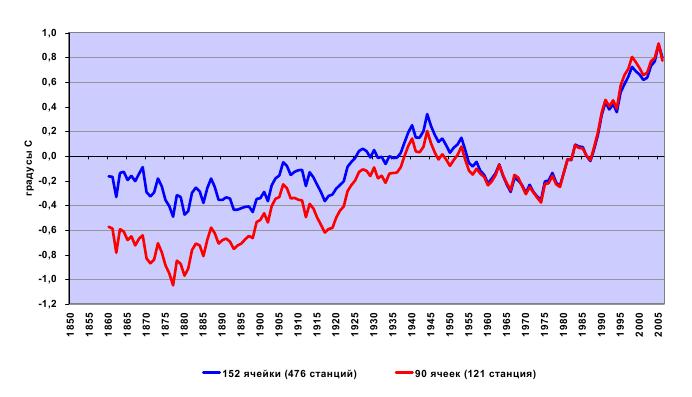
Regarding the Russians, check this comparison of the IEAs stations to the CRUs stations. After 1950 there is practically no difference between them. That doesn't indicate any fraud to me.
What does Pat Buchanan's article have to do with the Russians? And what specifically is hard to dispute? All I see are some out of context facts and outright misunderstanding of what they mean. The increase in Antarctic sea ice is not unexpected. It is in part comes from the ozone hole causing the circumpolar winds to strengthen thus isolating Antarctica more strongly from the rest of the planet. Recent observation from the GRACE satellite show that East Antarctica has been losing total ice mass just like West Antarctica.
Steve McIntyre's post only covers the continental US, 1.6% of the Earth's surface area. 1934 may have been the hottest year in the continental US but what does that have to do with global temperatures? This year the continental US has been a bit cooler relative to the rest of the world. 2009 is still going to be in the top 10 global temperature years (likely #2 or #3).
Any data that may be missing or withheld is relatively trivial. The vast majority of climate and related data is available if you care to look for it. The raw data the CRU used and deleted is still available from the original sources. Raw temperature data from around the world is available from the Global Historical Climatology Network (GHCN). Source code is available for the GISS ModelE GCM. There are a bunch of other links to both raw and cooked data as well as directories to other sources on this page.
I've already spent too long on this post so I'll sign off for now. Ciao.
-
Re:Nonsense
The CRU has not lost any raw data. They deleted processed data that they no longer had a use for. The raw data they used is still available from the original sources.
Phil Jones stepped down temporarily as head of the CRU because of the FUD manufactured heat surrounding him. When he's exonerated he may decide to resign anyway since the heat probably won't go away completely for a while. They may find a few nits to pick but I'll be shocked if they find any real scientific impropriety (as I imagine you will be shocked when they don't
Raw data is useless without processing. If you're talking about raw surface temperature data it's collected from hundreds of weather services and thousands of individual weather stations and other sources. There are discontinuities and errors in those records that have to be accounted for. I imagine many if not most of those sources have had an instances of discontinuities in their records. For instance a weather station may change thermometers for various reasons, or an urban heat island may develop around a station, or a station may be so poorly run that its data is unreliable, or they may find a systemic error in the measurments like they did with the satellite data, or... By studying the causes of those errors you can correct for them thus normalizing the data, or if you can't correct for them you can throw that particular data out as unreliable. Unless you're willing to take the time to make all of those adjustments (massage the data) anything you try to say about the raw data is bogus because you're not correcting for known errors. If you're going to challenge the station and data selection you need to do it with scientically rigorous information, not some blather about your perception of what some emails said.
And the vast majority of the raw data is available if you care to look for it. Temperature records from around the world are available at the Global Historical Climatology Network (GHCN). Source code is available for the GISS ModelE GCM. I imagine you will have to go to the original researchers for much of the proxy data though.
Are you a Brit? You only mentioned British services and the IPCC. Do you think NOAA or GISS and any of the other services around the world doing the same science feel slighted? The point is that CRU-HADLEY-MET is but one (well 3) of many different organizations around the world studying the subject. You have to impeach them all since they're mostly (if not completely) in agreement with each other.
-
Re:You need to know some stastics.
Wadda ya mean normalization is never justified? You normalize data to account for things like the difference between old and new instruments, or a change in measurement technique, or measurements that were off in a consistent way because of a miscalibrated instrument, or to compensate for the UHI effect or... Without normalization the data is nearly useless. As long as the methods and reasons for the normalization are disclosed its a perfectly valid statistical technique. The information is available if you care to look for it. Do you want them to personally explain it to you?
The GISS (NASA) & NOAA data is 100% available. There is lots of raw data at the Global Historical Climatology Network. You can get the full code for the GISS ModelE GCM here.
Modern weather forecasting depends heavily on computer models. The satellite and radar data as well as regular weather station data are inputs to the models. Often meteorologists who are familiar with a particular region can improve the forecast with intuition but that's largely because it hasn't been included in the model yet, probably because it's on too small a scale to be included in the model.
Chaos is constrained by the physical limits of a system and can be analyzed statistically to help determine the constraints that lead to those limits. Thus the chaos of weather and natural variability can be analyzed to determine the factors that constrain climate. The better you understand the constraints the better you can understand how changes in them will constrain climate. That's what GCM's do. They incorporate our understanding of the constraints of climate into the models and project possible future climate outcomes based on various scenarios for changes in the constraints.
-
Re:Proof
This image was taken by Cassini, the US probe currently orbiting Saturn. http://www.nasa.gov/mission_pages/cassini/multimedia/cassini20091217.html Issues in our own atmosphere thus could not impact this. And if you meant that Titan might have strange atmospheric behavior causing this, that's almost as unlikely. The size of this event is much larger than almost any weird atmospheric event (which are normally at most a few hundred meters large at the very largest, rather than many kilometers across. Moreover, this picture isn't the only data point. The data was consistent with specular reflection over all observed wavelengths (both visual and near infrared). So you would need to posit an extremely large event that happened to precisely duplicate what we'd expect to see in reflection. That's remotely possible, but not at all likely. There's never "proof" in science. Proof is for mathematics and alcohol. But this is very strong evidence for the presence of a large body of liquid methane on the surface of Titan.
-
Re:Why Are We Deferring to an Economic Organizatio
Urban vs. rural trends, w/many refs: link
Windy vs. calm: link link2.
The use of jump-point analysis to detect station incongruities: link
The use of a closely monitored reference network as a control:
A general overview of calculations, detrending, etc: link.
Further studies on that: link link2Now why the hell would you think yourself qualified to be involved in this discussion if you didn't already know this?
Don't you get it? The people raising these concerns are *not scientists*, *have no background in the field*, and *don't know what the hell they're talking about*.
-
Re:Why Are We Deferring to an Economic Organizatio
Urban vs. rural trends, w/many refs: link
Windy vs. calm: link link2.
The use of jump-point analysis to detect station incongruities: link
The use of a closely monitored reference network as a control:
A general overview of calculations, detrending, etc: link.
Further studies on that: link link2Now why the hell would you think yourself qualified to be involved in this discussion if you didn't already know this?
Don't you get it? The people raising these concerns are *not scientists*, *have no background in the field*, and *don't know what the hell they're talking about*.
-
Boy the IEA sounds so trustworthy...wait...The author of the source article, ahem.. BLOG, seems to be trying to masquerade as a reputable journalist, yet he isn't. His personal website (BLOG) contains nothing except climate skeptic material for at least 7 pages back in his history, then a couple of confusing paragraphs that might make sense to one of his next door neighbors, then back to the climate skeptic material again.
The source material seemed a little suspect, so with the aid of Google Translate, I attempted to understand a bit about the Russian IEA Mr. Delingpole quotes so freely. The IEA, or Institute of Economic Analysis, is hardly an expert on climate science. The first article on the IEA's website says:new: scientific consensus on climate issues does not exist - Novaya Gazeta, December 16, 2009
- Instead of articulating and prosecution of false targets political leaders gathered in Copenhagen should concentrate on the other - to develop policies that promote more effective human adaptation to climate change, economic growth, the development of free trade, protection of property rights, strengthen democracy.This hardly seems to be an unbiased website, so I thought I would dig deeper. The article the IEA quoted is also fairly suspect, since it goes into detail and reveals the inherently anti "global warming" bias of the source.
Adoption of the "Arctic ice melt" is outdated. Instead of reducing the area of ice cover in the Arctic is actually observed in 1979-2007 gg. In recent years its growth has come. In those same years saw an increase in the Antarctic ice sheet.
"Excessive prices for oil and food" to a certain extent the result of policy restrictions on the use of hydrocarbons, the effect of extrusion from the structure of arable food crops through improved crop plants from which ethanol is produced to replace hydrocarbons as fuel. In other words, it is recommended that treatment policy ensures "high prices for oil and food, leading to chaos awaiting us in the future."I shouldn't have to point out the satellite photos of Arctic Ice and how it has shrunk, or how Polar Bears are in real danger of extinction because of the loss of their frozen habitat.
This drivel seems to come right out of the climate skeptic/big business lobbyist handbook. Normally, I wouldn't bother to respond, but the author's Russian source got me interested enough to investigate. As I suspected, its bullshit. -
Re:How fast is this really?
you can get absolutely incredible performance out of off-of-the-shelf GPUs these days.
I had heard this from folks, but didn't really buy it until I read this paper today. They get a speed-up (wall clock) using the GPU even though they have to go to a worse algorithm (Jacobi instead of SSOR). Pretty amazing.
-
Re:Bought My Kids A Telescope For Christmas
AstronomyCast doesnt quite hit it with me. Its hosted by two people who do the question and answer routine on a topic each week and I'd rather just hear one of them talk about the subject instead of one of them pretending to know nothing about the subject and asking questions. Its all a matter of taste but I find it a bit too packaged and distracting. Like it was trying to be a conversation but came out awkwardly like a script. The information is always top notch and interesting stuff but the style of the show is not my cup of tea. The Jodcast recently asked its listeners whether they wanted the "objects in the sky for the upcoming month" to be read as a question and answer thing and they voted for one person to talk about it. As I say its a matter of taste so I pointed out a couple of other shows, in case the one I wasn't so keen on, put people off podcasts - theres a big sky out there and there's lots of different podcasts too.
I could mention a few more in addition to
AstronomyCast http://www.astronomycast.com/ top quality show with different subjects explored in depth with a teaching mission that will leave you much better informed than anything on tv ever will. The pedogogic style doesnt suit me but thats just my taste."Slacker Astronomy" http://www.slackerastronomy.org/wordpress/ Practising astronomers interviewed and in-depth subjects discussed by enthusiastic experts, they crack abysmal jokes about technical things which might seem a little silly (or incomprehensible) but the unscripted enthusiasm appeals to me.
The "Jodcast" http://www.jodcast.net/ Science staff from Manchester Universities Joderal Bank radio telescope bring us astronomy news, a themed mini drama, the night sky this month, topical discussion and an oft repeated desire for their theme tune to be redone in a heavy metal version. Well connected on Facebook et al, join in the fun.
there are
NASA Blueshift http://astrophysics.gsfc.nasa.gov/outreach/podcast/wordpress/ A bit slick the last time I listened, with soundbite interviews instead of a bit more detail from a single person. Most NASA stuff is a bit "wow look at that" without too much depth so I only come back to it infrequently. However it is probably perfect for the younger listener and they will probably be hooked by its friendliness.
"Astronomy a Go Go" http://astronomy.libsyn.com/ is the best observing podcast on the net bar none with Alice Few. It may prove a little intimidating to newcomers but the website is also the best general resource for amateur astronomers who want to do observing IMHO. Alice is so thorough and easy on the ear that you could easily play this one three or four times to get yourself fully up to speed on what might be worth doing in the coming month with your observing time. Solid gold this one.
Planetary Radio http://www.planetary.org/radio/ from the Planetary Society is great if you are into rockets and the exploration of the solar system as opposed to deep space. Always an interesting listen with news features, an opinion spot from the self styled "Bill Nye the planetary guy" and loads of enthusiasm for exploring.
365 days of astronomy http://365daysofastronomy.org/ has a few days left to run with a choice of 365 short programs from this The year of Astronomy - The ones from this year best heard now by browsing through the programs to find ones on subjects you are interested in, but the good news is that they are set to carry on with their volunteer generated 5 to 10 minute programs in 2010. Head on over and make a program for them yourself!
The Silicon Valley Astronomy Lectures http://www.astroso
-
Re:Oink! Oink!
Apollo program resulted in computers (I guess that was a non-cost effective problem). If it wasn't for Apollo, NO ONE would fund the early silicon fabs. It would continue to advance at the pace of current fusion research.
False. Integrated circuits were first used for ICBM guidance, which is another robotic space technology.
If only Columbus, Magellan and all others that followed thought the same.
They didn't have remote probes. More importantly, their destinations were not in lifeless, uninhabitable, waterless vacuums.
In case you didn't get the memo, recently NASA has conclusive evidence of significant water-ice deposits on both the Moon and Mars. Oh and it's been generally known for a while now that Mars has an appreciable atmosphere, even the surface of the Moon technically isn't in a vacuum.;)
Going into space was always about *pushing* boundaries. You are NOT doing that with freaking robots!
Sure we are. For example, a mission to drill down into the liquid oceans of Europa would push plenty of boundaries (and would be totally impossible for humans anyway).
Impossible only if attempted by hand-tools alone.*eye roll* If you can get a robotic probe down to the any liquid ocean of Europa, it's only slightly more difficult to get a vehicle large enough to be crewed by one or more human beings. Furthermore, instead of drilling there is the option of melting your way down through the ice. If the vehicle in question also contains the main crew quarters it could take several days to melt its way through the ice with no impact on the crew. In fact, it might be better for them than sitting out on the surface, the ice will provide extra shielding against cosmic radiation. Getting back up is more challenging, but if the descent was a spiral rather than a straight vertical shaft the vehicle could just climb-out on treads.
But we don't have any data on *how* to survive someplace like the Moon.
So what? We don't need to know how to do that unless we find a valid reason have anybody live there. It's a waste of valuable resources to figure it out now.
Now I'm going to have to disagree with both of you. We do know how to survive on someplace like the Moon, in the short term at least. What we need to learn is how to thrive on the other worlds of the Solar System. As to a valid reason to have anybody live there, well usable surface area and resources on Earth are finite and evening ignoring the living area problem, recycling will not reach 100% for all materials in the foreseeable future. Furthermore, even draconian means of population control don't seem to be working all that well and are morally questionable even if they did, so we can't count on stabilizing the global population soon, if ever. As a result some time in the future people will want to live on other planets because it will allow them a standard of living higher than what they can get on Earth, even if there are extra challenges and dangers involved in doing so. If you have a hard time believing this then you must have slept through the part of your history classes dealing with the European settlement of the Americas.
-
Re:I am very sceptical...
http://data.giss.nasa.gov/gistemp/updates/200708.html
His name is Steve McIntyre and he's been doing a lot of statistics work with temp data. He's a mathemetician, not a climatologist. But when dealing with such large datasets and averaging, the statistics end is just as important as the *physical* science.