Slashdot Mirror
Domain: pgpf.org
Stories and comments across the archive that link to pgpf.org.
Comments · 21
-
Re:He not wrong
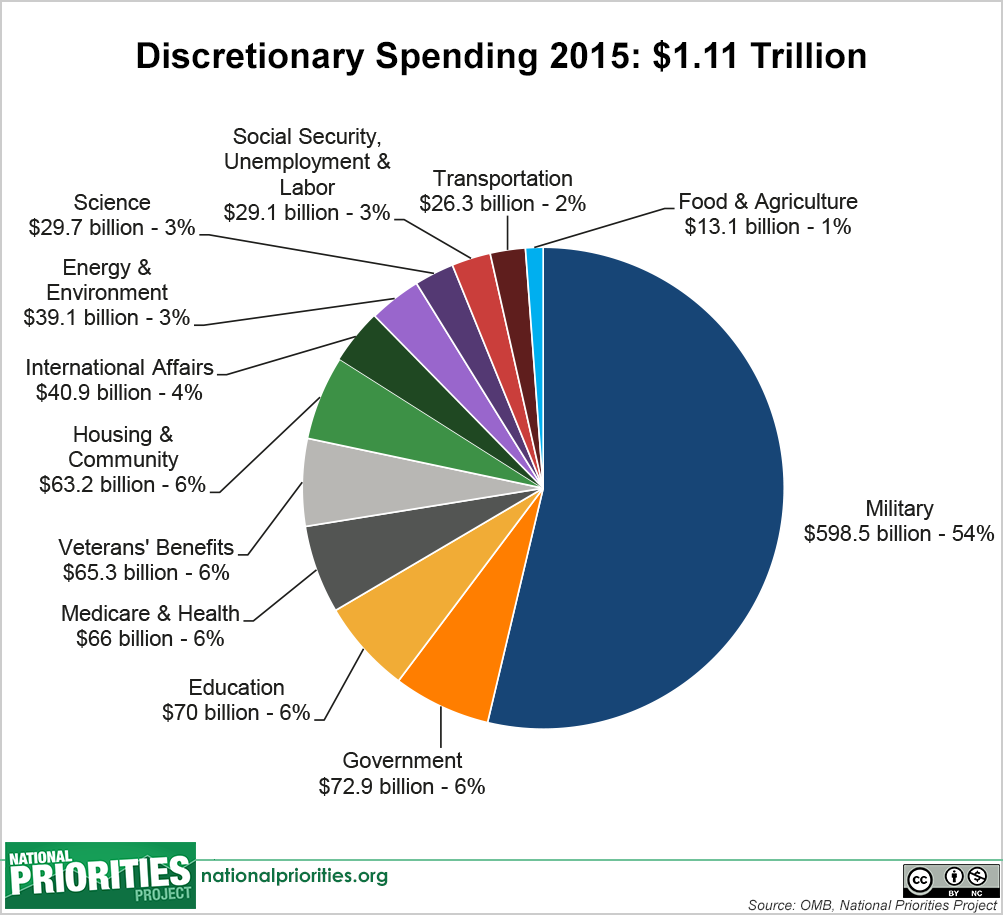
Defense spending is 15% of all federal spending and the largest category of discretionary spending. It accounts for $610 billion (as of the time of the graphic) of all federal spending.
You are correct in that there would still be an annual deficit. Current projections for 2018 show a deficit of $810 billion. That would be mean cutting defense spending in half would account for a 38% reduction in our yearly deficit.
I don't know about you, but if I could reduce my deficit by one third, that seems like a pretty good idea. -
Re:Borrowing the entire defense budget
President Donald Trump on Monday signed a $716 billion defense policy bill
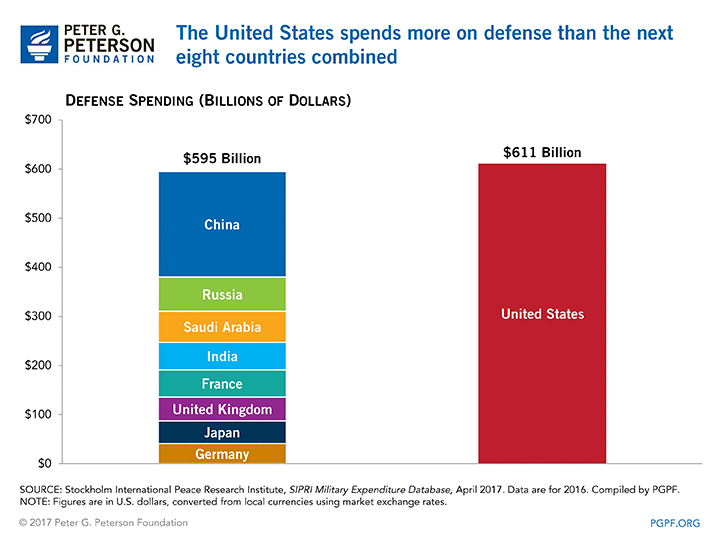
For perspective please note that the defecit in 2017 was $665 billion. So for all practical purpose we are borrowing the entire defense budget and in the process spending more money than China, Russia, Saudi Arabia, India, France, the UK, and Japan COMBINED. Call me crazy but I'm pretty sure we could put a good chunk of that money to better use.
As opposed to the $1 trillion+ spend on FWEEEEE STUFFZZZ!!!?
-
Borrowing the entire defense budget
President Donald Trump on Monday signed a $716 billion defense policy bill
For perspective please note that the defecit in 2017 was $665 billion. So for all practical purpose we are borrowing the entire defense budget and in the process spending more money than China, Russia, Saudi Arabia, India, France, the UK, and Japan COMBINED. Call me crazy but I'm pretty sure we could put a good chunk of that money to better use.
-
1) Too much work 2) Poor parenting 3) Bad system
"I can't imagine many other systems that could manage to keep alive a group of people as chronically unhealthy as the Americans."
One big reason U.S. citizens are "chronically unhealthy": They work too much.
Another reason: Women in the U.S. are often anti-male. That results in children who have poor parenting. Those children become unhealthy adults.
There seems to be a general agreement that U.S. health care is TERRIBLE. One article: Healthcare's Perfect Storm of Greed and Incompetence (Oct. 16, 2014).
Quote: "As the U.S. healthcare system slips further into the cellar of metrics for quality and outcomes among the advanced nations of the world, and does it at more than twice the average per capita cost,..."
That article links to 2014 Update: How the U.S. Health Care System Compares Internationally
Result: Of 11 developed countries, the U.S. is last. -
look deeper at the data
So if you use 2 Trillion as your favorite number taxes have to only increase every single tax or source of revenue by 52% consider where the government gets its money http://www.pgpf.org/finding-solutions/understanding-the-budget/revenue and think what that would really mean. Federal taxation is a economies of scale issue. Rich people or corporations literally do not have the money to cover our bills. It has to hit the masses of people. In 2009 if you taxed everyone with over $1mil in AGI made a total of 727 billion. If you taxed them at 100% you would be able to pay for your current government (2009 numbers to match data, but is lower by a lot) + 2tril UBI for 1.8 Months. If you seized and sold off all of the stock for every company in the SP500 you would get $20 trillion, so that's great the corporations must have some money. But that would pay for your budget for 4 years, but it's not realistic. Let's look at their income, the SP500 has a P/E ratio of 25.70 currently, that's 25.70x what they earn so about 800 billion. Taxing them at 100% gets you two more months. Where is the rest going to come from?
-
Re:And the report also provides no evidence of
If FICA went into a real trust account it would be worth considering, bu tit doesn't. All of the proceeds go into the general fund and are spent on current bills. It's a tax disguised as something else and is part of the gross receipts of the federal government. Its expenditures are part of the gross outlays. So if you remove FICA revenue and SS related revenue, you need to dramatically more than double the every tax rate, as FICA accounts for about 1/3 of federal revenue http://www.pgpf.org/finding-solutions/understanding-the-budget/revenue
-
The problem is not where, it is how much
The number $X spent on defense obscures the fact about how each defense dollar is spent.
It doesn't really matter how each defense dollar is spent. The problem isn't what specifically we are spending it on but the fact that we are spending too much of it on defense in total. We have a $600 billion defense department budget as of 2016. That is more than China, Russia, Saudi Arabia, the United Kingdom, India, France and Japan combined. We could be getting amazing efficiency from our military spending and it would still be a pointless boondoggle. Our military is really just an inefficient jobs program. The money could be put to far better use as research dollars or to fixing our education system, or repairing/building our infrastructure. Instead we have the sort of military that a paranoid banana republic might build at vast cost. Are you aware that we borrowed almost exactly the ENTIRE defense department budget last year? We are like the guy who buys a Ferrari and then wonders why he's having trouble paying the rent.
We should literally know how much our government is spending on each tool, supply, or service being requisitioned, and what is included with each tool, supply, or service.
Let's stipulate that that was somehow magically possible. (it isn't) What exactly would you do with that information? Are you going to go argue that a secretary at NASA was being extravagant when she requisitioned a stapler? Beyond a certain point the cost of maintaining that information is greater than the value you get from maintaining it.
I'm an accountant and one of the principles of accounting is that you don't bother tracking something if the cost of tracking it is greater than the value gained from doing the tracking. Your proposal would waste an unbelievably vast amount of money on the overhead required to keep track of every paper clip. Far more money than you could possibly save by doing so. FAR more. For big ticket items, sure there should be reasonable transparency. But thinking that you can keep track of everything in fine grained detail and get actual positive value out of doing so is just naively unrealistic. It provably cannot be done.
-
Defense and spending ceilings
Only 80 killed in 10 years, sounds like the defense was working for the most part.
The problem with healthcare is there is no ceiling to the cost and the end result is always the same, everyone dies eventually. Most of the early deaths appear to be lifestyle related anyway. Any reasonable person should prefer money to be spent on preventing unnecessary deaths (like terrorism) and just take care of themselves better to handle the longevity part.
The US now has 10 aircraft carriers, 2 under construction, and 1 planned. (source)
Military spending is 54% of our national budget, which is more than the amount of our deficit. More than the combined spending of the next seven countries.
What was that you were saying about spending ceilings?
-
Re:Is This a Joke?
To be clear, the US also used heavy taxation at the top end (90% in the top bracket!) in the past. From the Reagan era onward, we have continually decreased the top rates until you get what we have now - a very slightly progressive income tax scheme alongside a capital gains tax rate that ensures the top of the top wealthiest individuals pay less as a percentage of income than the average person does.
Not much point to a 90% bracket when almost no one ever paid that marginal rate due to tax loopholes such as trusts.
a very slightly progressive income tax scheme alongside a capital gains tax rate that ensures the top of the top wealthiest individuals pay less as a percentage of income than the average person does.
You have evidence for that? I see stuff like this or this or this.
-
Re:Very Basic Income
My tax rate is less than 10% (for federal income tax), under 20% for all taxes (federal, including SS/medicare, state and local). Taxes are very regressive.
You are wrong.
See the table here
Summary:
90-95 percentile: 9.3%
95-99 percentile: 14%
Top 1-percenters: 24.6%
Top 0.1-percenters: 26.4%
Oh, and for reference, the bottom 40% had a NEGATIVE effective tax rate.
-
Re:Slick or sickIf Eisenhower was warning the US about World War II military spending, then why did he make the speech January 17, 1961?
but the overall trend has been decline since the height of WW2...
Not according to the Washington Post
You're awarethat the US has the world's largest military budget aren't you?
You're wrong.
-
Murica
I never fail to find the bravado and hubris underlying American exceptionalism... exceptional.
Land of the free... as long as you're not in one of our many many prisons ( http://nomadcapitalist.com/201... ), which has a higher per capita incarceration rate than Cuba, which is second on the list. Oh, and speaking of Cuba, there's always http://en.wikipedia.org/wiki/G....
Home of the brave... because you'd be pretty brave too if your military budget was larger than the nearest eight other countries combined ( http://pgpf.org/Chart-Archive/... )
Where all men are created equal... except, of course, when they're not ( http://www.pbs.org/newshour/ru... ) and a man can make something from himself even if he starts out life with nothing (but probably not): http://money.cnn.com/2013/12/0... )
And where the rule of law is universal and sacrosanct... except in those cases where it's not convenient ( https://www.globalpolicy.org/u... ) and ( https://www.eff.org/nsa-spying... )
Oh well, enjoy your "freedoms".
-
Re:Lessee, where's my dictionary?
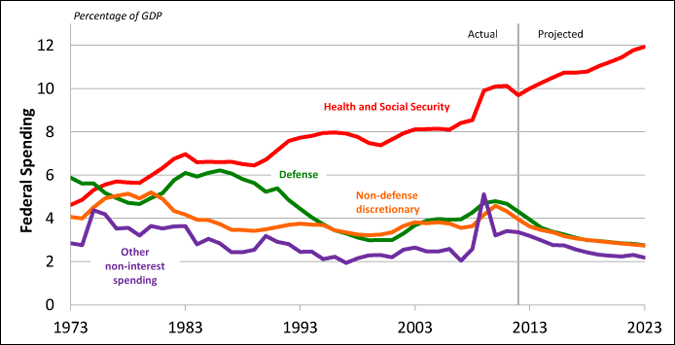
And don't even get me started on Medicare. When certain programs show consistent growth over the last several decades, you have to stop and ask yourself why those programs are growing,
I'm pretty sure most of us know why these programs are growing. It's largely due to demographics: the baby boomers are now beginning to retire. Honestly, anyone who has been paying a modicum of attention to this knows about the baby boom effect. You have to have been living under a rock for the last few decades not to know this.
...and what we can do to stop it to keep the budget reasonable.
Why do you assume the only solution to this is to "contain the growth"? Another option is to raise revenues to pay for these services. Yeah, yeah, yeah, raising taxes again. What heresy! It hasn't escaped my notice that those of your political persuasion typically seem to want the services but never want to actually pay for them. Why is that?
You don't plug your fingers into your ears and say "nah nah nah I can't hear you" any time someone tries to discuss options to contain the growth.
OK, so why not take some of your own medicine? Raising taxes is another option. Why is that always off the table in these discussions? Please note that I am open to discussing other options such as raising the retirement age. In fact, I think that we will probably need to do both and more besides. I just don't see why one of those options is considered outside the scope of discussion whenever these issues are brought up.
-
Re:Lessee, where's my dictionary?
mandatory (adj): Obligatory; required or commanded by authority.
As the article points out, most of this is going to mandatory programs, which would be the same even if it were Romney or McCain or Sarah Fucking Palin in office.That's the dictionary definition.
The government definition is that a mandatory program continues in perpetuity until the legislature decides to stop (or modify) it. A discretionary program must have its budget approved every year or it dies.
The government modifies spending and revenue in mandatory programs all the time. The Social Security tax rate was decreased from 13.3% (where it had been since the 1990s) to 12.3% in 2011 to try to lower the tax burden during the recession. And SS gets a cost of living allowance approved each year (usually) which increases the disbursement to recipients in response to inflation. The spending of those programs could very well have been different if a conservative had been in office.When we hear a serious discussion of how to cut benefits (something other than "the poor should die" and "let's give it all to Wall Street, because they're so freaking responsible"), we can have an actual conversation.
Yes those are ridiculous stances to take when debating the budget. But so are "mandatory programs cannot be touched" and "the retirement age must not be increased."
Social Security isn't like a pension or 401k - where you pay money in, it goes into some account in your name earning interest, then you get the money back when you retire. Instead, your payments get disbursed to current recipients (there's about a 2-3 year buffer which is the SS fund). That means the amount you pay into it isn't the only factor. The retirement age, average lifespan, and population growth rate (ratio of workers to retirees) all become factors. The program has been run for ~70 years now in denial that these are factors, which is what's caused it to balloon to a quarter of the budget. Any realistic attempt to contain its growth (I'm not even asking to reduce it) needs to acknowledge these other factors, and modify how the program operates to zero out their effect in the long-term.
And don't even get me started on Medicare. When certain programs show consistent growth over the last several decades, you have to stop and ask yourself why those programs are growing, and what we can do to stop it to keep the budget reasonable. You don't plug your fingers into your ears and say "nah nah nah I can't hear you" any time someone tries to discuss options to contain the growth. -
Re:Only one player
What I'm throwing out there isn't random. They are situations that involve coercion and my point is that whenever there's coercion, the dollar value represented isn't accurate. More coercion equals more distortion.
The U.S. spent more on defense in 2012 than did the countries with the next 10 highest defense budgets combined! http://pgpf.org/Chart-Archive/...
Do you really think the US is that paranoid that they'll be attacked or do they use this army to coerce other countries in doing what they want?
I understand how economics is suppose to work but it never does when there's coercion involved.
-
Re: Do good ...
Social security, and welfare existed long before the 60's. Food stamps and medicare are from the 60's, however, welfare was scaled back decades ago when Clinton was in office. So your notion that the safety net has exploded is patently false. That said, the costs have certainly shot up. Medicare has skyrocketed due to the crazy increases in medical costs. Social security has shot up in spite of the fact that the benefits have been reduced because people are living longer. Welfare and unemployment are up because unemployment is up.
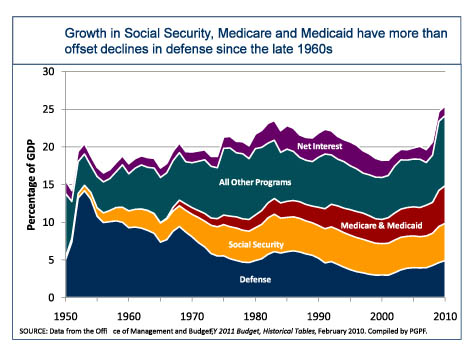
That is patently false. Almost the entirety of the growth in the Federal budget since the 1960s is due to Medicare/Medicaid, then Social Security, both as a percentage of the budget and in raw dollars. Basically, everything we've gained in 50 years from cutting defense spending by 60% since the 1960s has been consumed by growth in those two social programs, and then some.
Medical costs in this country are beyond screwed up. The amount spent by the Federal and State governments on health care exceeds that of Canada on a per capita basis. That's right, the Canadian government spends less per person on health care than the U.S. government does on average. And they cover nearly all of everyone's medical costs (some people still buy supplemental insurance there), while U.S. government spending averages out to about half of everyone's medical costs. So don't go trying to blame it all on private health care. Both private and public health care spending are to blame. -
Re:Yes, End the Insane Spending
-
Re:And this too shall pass away.
I think I'd start with Defense spending, which could easily be cut in half, and we'd still have by far the largest military on the planet.
I'd be completely okay with this. But my guess would be the person I replied to would not.
-
Re:And this too shall pass away.
So which of the major spending by the government are you ready to do away with? Defense spending, Social Security, Medicare or Medicaid?
I think I'd start with Defense spending, which could easily be cut in half, and we'd still have by far the largest military on the planet.
-
Re:Interesting...
I'll admit that my concept of our spending is probably skewed by intentionally misleading infographics and such, but this doesn't seem to jive with anything I've ever seen. Can someone explain how this is true, or point to something that does?
The cost of health care driving the US deficit and federal debt is actually old news:
http://www.iousa.com/ (30-minute version of the film film, highly engrossing)
http://www.pgpf.org/resources/PGPF_CitizensGuide_2009.pdf (Summary in PDF format)
-
Re:Is a movie theater really a public place?
Most people are already thousands of dollars in debt. They don't even have to pirate a film to achieve that little bit of stupidity!
It's far, far worse than that. A newborn baby is born already owing in excess of $184,000 USD. Much more by some estimates. The government is currently working hard to dwarf this number. I should invest in a wheelbarrow manufacturing company, as demand will skyrocket...a wheelbarrow will soon be needed to transport enough paper money to buy a loaf of bread at the rate that money is being printed and thus devalued. It didn't work out so well for the Vimar Republic.
Strat