Slashdot Mirror
Domain: philzimmermann.com
Stories and comments across the archive that link to philzimmermann.com.
Comments · 90
-
Solution: Philip Zimmermann's Zfone
You may recall that Philip Zimmermann was the subject of a criminal investigation over ten years ago over a little asymmetric key encryption program he wrote and made available online.
Recently, he has worked to give the world a very simple program that will encrypt voice communications for any SIP VoIP. It's called Zfone and this news about AT&T working with the NSA covertly is all the more reason you should use it.
I believe Slashdot covered Zfone's release a month ago.
As an American, I value my anonymity and ability to communicate without concern of eaves dropping very highly. I hope to see some VoIP services possibly use Zfone or some level of encryption as a default out of the box feature in the future. If you're concerned for your privacy, read up on Zfone and find out how easy it is to use! -
China & PGPWell, to be fair, a few people do believe that Microsoft has a backdoor built into their OS that would allow the United States Government to shut down all Chinese Government PCs running Windows.
Oh, and there are a few people who also consider encryption a matter of freedom of speech.
Funny the U.S. government targets Phil Zimmermann for three years but hardly raises so much as an eye when an encryption enabled OS is distributed. From Mr. Zimmermann's homepage:Philip R. Zimmermann is the creator of Pretty Good Privacy, an email encryption software package. Originally designed as a human rights tool, PGP was published for free on the Internet in 1991. This made Zimmermann the target of a three-year criminal investigation, because the government held that US export restrictions for cryptographic software were violated when PGP spread worldwide.
I think that his "criminal activity" was creating an encryption tool that allowed messages to be encrypted beyond what the United States government was capable of deciphering in a timely manner. Does anyone know if this is still enforced? Does anyone know what the max key length is now if it is? I think it was something like 128 bits (that the government could crack) around the time of PGP. -
Re:Not illegal.
White House statements have been pretty vague on reasons for avoiding use of available court authorizations. While they imply it only affects those on the end of overseas calls, court authorizations could have covered those. Court authorizations don't scale well. How big could this be? Phil Zimmermann showed considerable insight in his statement on why he wrote PGP. Here's a portion:
"The 1994 Communications Assistance for Law Enforcement Act (CALEA) mandated that phone companies install remote wiretapping ports into their central office digital switches, creating a new technology infrastructure for "point-and-click" wiretapping, so that federal agents no longer have to go out and attach alligator clips to phone lines. Now they will be able to sit in their headquarters in Washington and listen in on your phone calls. Of course, the law still requires a court order for a wiretap. But while technology infrastructures can persist for generations, laws and policies can change overnight. Once a communications infrastructure optimized for surveillance becomes entrenched, a shift in political conditions may lead to abuse of this new-found power. Political conditions may shift with the election of a new government, or perhaps more abruptly from the bombing of a federal building.
A year after the CALEA passed, the FBI disclosed plans to require the phone companies to build into their infrastructure the capacity to simultaneously wiretap 1 percent of all phone calls in all major U.S. cities. This would represent more than a thousandfold increase over previous levels in the number of phones that could be wiretapped. In previous years, there were only about a thousand court-ordered wiretaps in the United States per year, at the federal, state, and local levels combined. It's hard to see how the government could even employ enough judges to sign enough wiretap orders to wiretap 1 percent of all our phone calls, much less hire enough federal agents to sit and listen to all that traffic in real time. The only plausible way of processing that amount of traffic is a massive Orwellian application of automated voice recognition technology to sift through it all, searching for interesting keywords or searching for a particular speaker's voice. If the government doesn't find the target in the first 1 percent sample, the wiretaps can be shifted over to a different 1 percent until the target is found, or until everyone's phone line has been checked for subversive traffic. The FBI said they need this capacity to plan for the future. This plan sparked such outrage that it was defeated in Congress. But the mere fact that the FBI even asked for these broad powers is revealing of their agenda.
Advances in technology will not permit the maintenance of the status quo, as far as privacy is concerned. The status quo is unstable. If we do nothing, new technologies will give the government new automatic surveillance capabilities that Stalin could never have dreamed of."
Of course mining of other types of data should be expected too. Even the average person can do some surprising things with public data. -
Two essays, and a pointer
Just thought I'd toss in my few cents.
Bruce Schneier has a couple of essays that you might want to have your daughter check out. (Hopefully she already knows the info in the first, but....)
Here is his imput on how to get into the crypto field.
Why is crypto so hard .
If you or she aren't so keen on working with a local college/university math/CS department, I second the advice to hit up Phil Zimmermann. His site lists a number of ways to contact him. It also talks about his current project. (I found Mr. Zimmermann to be very gracious. I think the worst he would do is say no. More likely he would either agree or suggest someone as a alternative.)
-
Encryption shall set you free
http://www.philzimmermann.com/EN/background/index
. html
Everyone should take a moment and read the story of the PGP creator. Strong crypto is the only thing that will keep people from reading your packets, and the only thing that will guarantee you have the ABILITY - forget having the right - to have privacy in your communications.
This wasn't always the case.
People listening isn't a problem. You should ASSUME they are listening. Run crypto point to point if you want to be private. -
Adi Shamir's Hash Function *IS* 'unbreakable'....Let Ron 'RSA' Rivest tell you why....
(from material at the Pure Crypto Project - http://senderek.de/pcp/ )
Quote below from http://senderek.de/pcp/pcp-security.html
Adi Shamir once proposed the following hash function:
Let n = p*q be the product of two large primes, such that
factoring n is believed to be infeasible.
Let g be an element of maximum order in Z_n^* (i.e. an
element of order lambda(n) = lcm(p-1,q-1)).
Assume that n and g are fixed and public; p and q are secret.
Let x be an input to be hashed, interpreted as a
non-negative integer. (Of arbitrary length; this may be
considerably larger than n.)
Define hash(x) = g^x (mod n).
Then this hash function is provably collision-resistant, since
the ability to find a collision means that you have an x and
an x' such that
hash(x) = hash(x')
which implies that
x - x' = k * lambda(n)
for some k. That is a collision implies that you can find a
multiple of lambda(n). Being able to find a multiple of lambda(n)
means that you can factor n.
I would suggest this meets the specs of your query above.
Cheers,
Ron Rivest
Ronald L. Rivest
Room 324, 200 Technology Square, Cambridge MA 02139
Tel 617-253-5880, Fax 617-258-9738, Email
The nice thing about Adi Shamir's hash function is that it, as well as the RSA cryptosystem co-created with Rivest and Len Adleman is all based on simple modular exponentiation.
Too bad the Feds consider arbitrary precision mathematics used for encryption purposes to be 'a munition' and 'a controlled export'....
Years ago, they raked Phil Zimmerman over the coals over his email cryptosystem PGP then (eventually) left him alone.
Can't cryptosavvy individuals secure the details of their affairs with strong encryption WITHOUT being hassled by 'the Man'?...
P.S. However, Rivest came up with a scheme that gives you 'confidientiality *without* encryption' through a scheme he calls Chaffing and Winnowing
Enjoy! -
Re:Is there even a coherent thought here?
I believe Phil Zimmermann is doing you one better. (He's the guy who did PGPhone, back in the day.) His zPhone project is an end to end encryption system for IP telephony, using the RTP or SIP protocols. According to the site, it will work in unencrypted mode with a regular device, and do transparent encryption with another zPhone-capable one.
So if it actually materializes -- and I think it will, Zimmermann has pretty much always delivered the goods to the community in the past -- it'll be a whole lot better than just an update of PGPhone. And the source is going to be open for community review, unlike some past versions of PGP when it was owned by NAI.
As a sidenote, they're currently looking for a better name for the final product than 'zPhone.' The winner gets recognition, lifetime licenses for themselves and 10 friends, and their PGP key signed by Zimmermann. Pretty sweet deal. -
Re:Is there even a coherent thought here?
Like Phil Zimmerman's upcoming not yet released zFone?
-
Re:End of an eraOh, I totally agree with your point. I *did* lose a job by telling a boss that I wouldn't do something illegal.
So the scientist in this case didn't think that he was doing anything illegal or immoral. I would agree. He was doing science. Blaming a nuclear scientist for creating a bomb would be like blaming Phil Zimmerman for creating PGP which was used by terrorists in the 9/11 attacks. Phil was under tremendous pressure for a while, both from outside groups as well as his own conscience. But Phil also recognizes that PGP can be used for good, and this letter demonstrates that it can even be used to save lives.
We can't blame technology or those who create it for the bad stuff that goes on in our lives. We have to accept responsibility for own actions. Remember that "guns don't kill people, people kill people".
-
Foo for Dummies?
Your reply is accurate but I dont like it after many a time trying to explain technical and *not so technical* stuff to people with blank stares.
I dont believe your post really answers the question by itself. But in conjunction with the parent post it is more than adeqate. Why?
The mismatch between the question and the correct technical answer and the answer the poster may accept or understand for me this illustrates the difference between the "knows" and the "dont knows". I've come up with an idea that I use often to deliver technical messages. I call it the *eggyolk* concept. Its certainly not unique but it serves me well.
Eggyolk explanation
Soft gooey and yolky on the inside, the simple message. The outside white bit (albumin), the technical message (context to facts) and finally the shell, the concrete facts. Why does it work?
Detail looses people
Many people do not wont detail. Through lasiness, inability or time constrained, they dont want detail. Instead they are more interested in snippits of information from coversations. This may go some of the way to explain the popularity of blogs compared to say newspapers and technical reports. So the eggyolk idea is to find a information snippit that links to deeper information hidden within.
A good example may be the *Dummies* of books - (Consults, 'DOS for dummies'). Technical details wrapped in bullet points, clear language and graphic design.
As for how paranoid you should be read about the creator of PGP, Phil Zimmerman and his Phils articles on data privacy and paranoia.
-
Foo for Dummies?
Your reply is accurate but I dont like it after many a time trying to explain technical and *not so technical* stuff to people with blank stares.
I dont believe your post really answers the question by itself. But in conjunction with the parent post it is more than adeqate. Why?
The mismatch between the question and the correct technical answer and the answer the poster may accept or understand for me this illustrates the difference between the "knows" and the "dont knows". I've come up with an idea that I use often to deliver technical messages. I call it the *eggyolk* concept. Its certainly not unique but it serves me well.
Eggyolk explanation
Soft gooey and yolky on the inside, the simple message. The outside white bit (albumin), the technical message (context to facts) and finally the shell, the concrete facts. Why does it work?
Detail looses people
Many people do not wont detail. Through lasiness, inability or time constrained, they dont want detail. Instead they are more interested in snippits of information from coversations. This may go some of the way to explain the popularity of blogs compared to say newspapers and technical reports. So the eggyolk idea is to find a information snippit that links to deeper information hidden within.
A good example may be the *Dummies* of books - (Consults, 'DOS for dummies'). Technical details wrapped in bullet points, clear language and graphic design.
As for how paranoid you should be read about the creator of PGP, Phil Zimmerman and his Phils articles on data privacy and paranoia.
-
Beware of snakeoilFrom ciphirebeta '... Once the code is stable and we've had independent code audits, we'll publish the source code. We're releasing a security product, and we believe - along with legions of other security aware developers - that transparency is key to trust building
This is the bit I dont like. Read the from the master himself, Philip Zimmermann - the one who was under 3 year investigation by US customs. Reading through Phils articles, I came across Beware of Snake Oil. It makes for good reading when evaluating if the product is worth the effort.
My question is if you cant read the source (massive assumption given few know how to write and implement encryption) how do you know if the code is implemented correctly?
-
Beware of snakeoilFrom ciphirebeta '... Once the code is stable and we've had independent code audits, we'll publish the source code. We're releasing a security product, and we believe - along with legions of other security aware developers - that transparency is key to trust building
This is the bit I dont like. Read the from the master himself, Philip Zimmermann - the one who was under 3 year investigation by US customs. Reading through Phils articles, I came across Beware of Snake Oil. It makes for good reading when evaluating if the product is worth the effort.
My question is if you cant read the source (massive assumption given few know how to write and implement encryption) how do you know if the code is implemented correctly?
-
Beware of snakeoilFrom ciphirebeta '... Once the code is stable and we've had independent code audits, we'll publish the source code. We're releasing a security product, and we believe - along with legions of other security aware developers - that transparency is key to trust building
This is the bit I dont like. Read the from the master himself, Philip Zimmermann - the one who was under 3 year investigation by US customs. Reading through Phils articles, I came across Beware of Snake Oil. It makes for good reading when evaluating if the product is worth the effort.
My question is if you cant read the source (massive assumption given few know how to write and implement encryption) how do you know if the code is implemented correctly?
-
Re:yeah right...
all the more reason not to use either and instead to enhance your own security.
all computers should be sold with hardware and software firewalls, and pgp or a pgp like app built in. i wondered where phil zimmerman was (creator of pgp) and its good to see he's still around. here's a quote from his homepage where he's asked about backdoors in pgp:
"Q: Are there any back doors in PGP? Come on, you can tell me, I won't tell anyone.
A: No. There never have been, and never will be, at least as long as I am associated with the product. I didn't go through all this trouble just to see my product become corrupted. Besides, we publish the source code, so you can check it yourself. "
http://www.philzimmermann.com/EN/faq/index.html
i knew there was a reason i trusted phil when i used pgp. and am glad to see he's still at it, and urge anyone whos not using it, to start.
-
Re:Torrent trackers on Freenet?Child Porn could easily be purchased just up until the late 70's, when the "Child Porn" crusade was started by Ann Burgess. (google cache) Before that time it wasn't such a big deal. During the crusade it was "worse than murder".
Other crusades have been
The prohibition of Alchohol during 20's. Alcohol was the the leading factor in bad health, missed work, crime, violence, etc. ie, it was the root of all evil, so banning it ofcourse would fix all these social ills.
Communism during early fifties. For its strange ability to make people homosexual. Which of course makes it the root of all evil.
The evil "switch blade" which suddenly in the late 50's became the root of all evil and in the midst of much hysteria in congress, had to be banned for our own good.
Child Porn during the late 70's. mentioned above.
Public key encryption during the early 90's, Logic dictates that Citizens with unbreakable encyption are probably criminals.
Mean looking guns, which have supplanted switch blades as the source of all crime during the 90's.
copywrite infringers in the late 90's.
Terrorists which somehow only live in oil rich nations for the 2000's.
and now video copywrite infingers.
I think his point is that its just another crusade. Something blown out of proportion to what it really should be. Check the stats:
In 2002, there was an estimated 896,000 cases of abused children. More than 60 percent of child victims experienced neglect. Almost 20 percent were physically abused; 10 percent were sexually abused; and 7 percent were emotionally maltreated. In addition, almost 20 percent were associated with "other" types of maltreatment based on specific State laws and policies.
Of those 10% that were sexually abused, how many were abused just so that they could be photographed? Does Child Porn really get the attention it deserves or is it getting a lion share because it is somehow more dirty and news worthy than a kid getting beaten to death by his drunk step dad.
-
Scott Zimmerman!
Are you a relative of Phil Zimmerman the creator of PGP???
-
Re:OT, reply to sig - Math, Feds, and Crypto
Mathematics is not a crime. -- James Turpin (789479)
Mr. Turpin's signature was likely commenting on the right and ability to use 'strong encryption' to secure ones 'thoughts and posessions' at all times.
Here in America, encryption is treated like a weapon instead of a digital envelope. Added to that, 'real encryption' in its purest form is nothing more than grade-school math applied to very large numbers.
So I guess Mr. Turpin is 'asking':
Is it a crime to use math (via strong cryptography) to have privacy and security?
Just 'ask' PGP creator Phil Zimmerman about his experiences with cryptography and the United States Federal Government.... -
Re:Understand the Source PerspectiveUh, remember Phil Zimmerman?
I think geeks have been DoJ targets for some time.
-
Because Google might actually listen?If you're the sort of person who wants more encryption used in email i.e.:
"The key to deploying encrypted mail is to make it happen with close to zero involvement by the user. This is hard, and requires some security compromises that have made cryptographers uneasy in the past.
Then you'll ask the technology companies most likely to listen to a request to add easy-to-use encryption to their product. Whatever Google could come up with might be much better than the poor-UI, hard to install, barely any use email encryption systems currently around. Just a nice, clean button saying "I feel Private" or somesuch thing.
However, I have come down to the view that getting encryption widely deployed, even with some minor flaws, is better than getting perfectly designed encryption (if that's even possible) that hardly anybody uses.
The reason is that I exchange mail with tons of people, not just my closest linux-using nerd friends. If I want my mail to be private, I have to get the general public encrypting. This is a particular concern with new laws just passed granting U.S. law enforcment the power to read the "header" of a message -- including the subject lines of E-mails without a warrant. In addition, other nations have always had such powers, and on top of it all, most ISP backbones and mail servers are poorly secured from snooping by almost any system cracker trying to invade your privacy...Current use of encryption for email is terribly low: I remember when Whitfield Diffie was asked at a Computers, Freedom and Privacy Conference a few years back how many emails sent to him were encrypted. Because you'd expect him to be way up at the top of the list of people who get encrypted email... under 10% was his reply. Oh, and Zimmerman was also in the audience... same answer.
-
Re:Better spam solution. Ubiquitous encryption.
Three words:
Feds Hate Encryption!
Why?
They consider encryption to be a weapon/munitition and subject to onerous, labarynthine regulations when used in products that leave the USA/Canada....
It appears encryption is tolerated now thanks to pioneers like PRZ/PGP because the majority of network traffic is still unencrypted, in the clear, an eminantly collectable and analyzable....
If most/all worldwide network traffic goes encrypted, the Feds (or any country's system of government for that matter) will $#!+ bricks, outlaw/criminalize *ALL* non-approved use of encryption (even rot13), and quite possibly pull the plug on the Internet to prevent unauthorized encryption use. Then it's back to the nostalgically inefficient days of dial-in BBSes....
Do you wan't a future like that?
I don't.
There has to be a way to stop email spam without using encryption.... -
Anti-PGP FUDEmCeeHawking writes:
I can't imagine people really trust PGP anymore. No longer open source, no longer affiliated with Phil Zimmerman... and his statement when he left was scary.
PGP is not "open source", but like Solaris, source code is published, anybody can download full source at no charge.Phil Zimmermann is on the "Technical Advisory Board", along with Bruce Scheier and others.
What statement are you referring to?
- Phil Zimmerman Profiled
- Philip Zimmermann's personal response to the ADK bug,
- 2003 Defcon interview
- Phil Zimmermann & Associates LLC
For those who don't know, Phil stated when he left that every PGP product released while he was there contained no hidden back doors. Knowing that companies like PGP were being pressured, it makes me think the creative differences were them wanting to build something in that he thought shouldn't be in.
Interesting claim. Care to document it?It seems to me that if Zimmermann felt that way, he wouldn't be on the PGP.Com technical board, and he wouldn't be reselling their products on his web site.
To quote Phil Zimmermann, "There is no backdoor in PGP. Get a life."
A satisfied PGP customer.
-
Required reading
i just see this as one use when closed source would be better. same goes for mission critical military, intelligence, and government applications.
Please read Bruce Schneier's Secret's & Lies to understand why this is the antithesis of how things really work.
Schneier provides a good high-level view on security issues and helps explain why security within complex systems requires as many perspectives as possible. He also provides numerous examples of "perfect" closed-source security systems (e.g. DeCSS DVD encryption, broken by a seven-line program), "uncrackable algorithms" broken by trivial attacks and other illustrations.
*scoove* -
Re:GPL - Source Posted
... who thought a simple piece of software could cause so much trouble?
cough...Phil Zimmermann -
Re:Possession
-
Re:Possession
-
Re:Smug
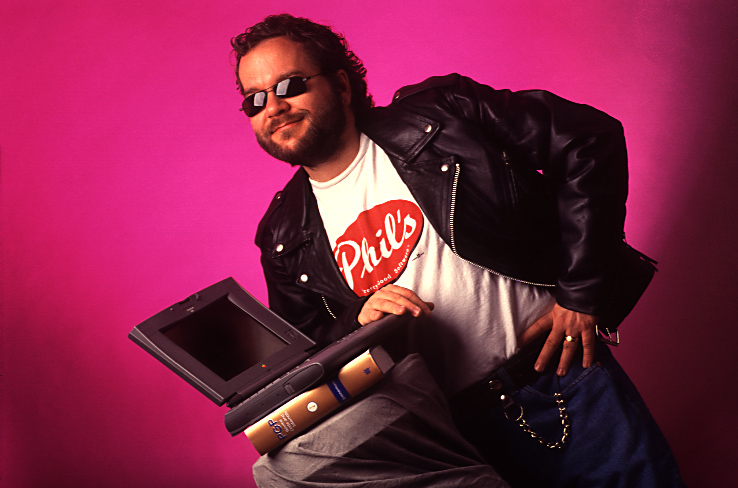
And here is Phil after a visit to the Blue Oyster.
-
SmugPic of Zimmerman
The look on his face is so smug, like, ha ha, "I have no such non-compete agreement with NAI", so I'm gonna screm 'em!
--naked
-
In case it gets Slashdotted...Here's the article:
A few months ago, PGP creator Phil Zimmermann became a reseller for the current graphical version of the software he originally spawned, produced by PGP Corporation. Now, Zimmermann has just started selling through his own website a modern command-line encryption product called FileCrypt, which has its roots in an older version of PGP. Confusingly enough, this software is produced by a company called (Veridis), and doesn't say PGP on the box, because legally it can't. Network Associates, which acquired PGP Inc. in 1997, still holds the rights to that name; when NAI spun off PGP to PGP Corporation in 2002, they held onto the command-line version. OpenPGP, for whom Zimmermann serves as a technical advisor (as well as a reseller), is contractually unable to sell a command-line version. (He is on the board of Veridis as well.) But why introduce a text-only version of utility software, anyway, when the GUI-fied desktop version has been maturing for years and costs less? They aren't paying for a pretty logo. The real reason is that the GUI version of PGP (along with other graphical encryption software, like the GNU Privacy Guard) aren't even in the same market.Casual computer users have never laid out much money for encryption. The widespread use of PGP in its original incarnation (during the era of Zimmermann's prosecution for allowing it to be exported) can be attributed as much to its zero-dollars price as to a generalized interest in privacy. Home and hobby users are not cut out from buying Veridis's software -- for about a hundred dollars, you can buy a personal use version of the command-line version. The real money isn't in individuals keeping their tax records private, though -- Zimmermann and Veridis, like NAI (whose PGP-based product is called E-Business Server) are really aiming at commercial and governmental datacenters, and for customers willing to accept a much higher pricetag.
Insurance companies, banks, credit card processing centers, state records -- anywhere financial or otherwise confidential records are exchanged or stored en masse -- these all need encryption which works at the command-line. More precisely, they need crypto software which can work without direct human intervention at all. Instead, massive data centers need tools which can be called by scripts and other programs, so servers, or server farms, can spend their time crunching numbers rather than drawing pictures.
The name is familiar
And, he emphasizes, what they do is very similar. He says of the Veridis command-line product compared to NAI's, "It's drop-in compatible, identical in operation
If you want to buy Veridis' encryption software licensed for electronic commerce (not one-person use), hold onto your wallet: the price jumps about 50 times, to a shade under $5000, which Zimmermann describes as a bargain -- at least compared to the competition.
(Prices on the McAfee website show a one-year subscription-based license for E-Business Server starting at $6,875; $14,375 buys a perpetual license, with no included support.) Both sides of that fence. And of competing in this case with a product that originated from his own crypto software (and his own company, PGP Inc.), Zimmermann says "I just don't really think of that as my product any more. It's in the hands of NAI, all the engineers have been fired. I just don't feel psychologically connected to that product." To look and not to sell. Especially when it comes to cryptographic software, code openness is considered not just a virtue but a near necessity. Peer-review and independent auditing, after all, are about the only ways you can tell that software isn't shuttling credit card numbers to the wrong person.
The business model of selling high-priced crypto software at thousands of dollars per processor doesn't mesh well with gratis software, though. To that end, Zimmermann says the FileCrypt code will be soon be available for download and inspection under terms which he says will be similar to those under which users can download the code for PGP Corporation's version of the PGP-based desktop software. (PGP Corporation's terms are available though their source code page).
-
PGP is underrated
PGP is overrated... so is GPG. If the government really wants to get you [they will]
Well, duh. However, PGP might just protect my trade secrets from being intercepted by a competitor. PGP might also protect my medical information from a private detective trying to dig up some dirt on me for a bitter ex-spouse. Competitors and private detectives don't have the resources of the United States government and PGP works just fine against them. Furthermore, PGP has most certainly been successfully used to protect human rights workers from clumsy oppressive governments. If that's not a great accomplishment, I don't know what is.
-
Re:I think we're stretching things a bit...(I don't have a
the "confirmation of results" & peer review point I was making had to do with crypto and offsite backup software more than with statistical software. When we're talking about crypto or storing someone else's data, it's super important to be transparent. Re: stats, well, one of my slides pointed out that up 'til now, I've always hacked numbers & graphs in Stata, which is proprietary (though most of the really good stuff is published freely, but that's another matter). We should use R, but for cost & "who controls the license" reasons as much as (if not more) than verifiability.
While we're on the verifiability point, human rights data organization techniques tend to be pretty complicated, and it helps to be able to use free software. While distributing the data (via XML) may or may not be useful, it is very important to open the data specifications. I think that means opening SQL scripts, too, and all the database software (in our current mix, the backend is postgres, the front end is Java). That's coming in about a month.
But human rights folks are pretty underfunded, and the "free as in beer" part of open source and free software is a big help, too.
slashdotters might be interested in the International Covenant on Economic, Social, and Cultural Rights, Article 15(b), which states that everyone has the right "To enjoy the benefits of scientific progress and its applications." This is a real, live, human right.
But the real bottom line to human rights and free software has to do with power. Our core rights -- to freedom of speech and free association -- are increasingly exercised in electronic media. Who controls the online world? Can any contractual obligation resulting from a license abridge your human rights? IMHO, these questions make software a human rights concern.
-- PB.
-
What do these names have in common?Loyd Blankenship, Phil Zimmermann, Kevin Mitnick, Jon Johansen, Dmitry Sklyarov
Pray you never find out the hard way.
-
Re:Why listen to him?
> If this guy sold PGP five years ago, what authority
> does he have now to suggest the change?
"This guy" developed the PGP protocol, and it's first implementation, then released it freely on the Internet when it seemed likely the US Govt. was about to criminalise *all* personal encryption.
So, only moral authority... which doesn't seem to be worth much on the free market, these days. -
Re:Human rights groups
Right on. Access to strong cryptography and anonymity tools is very important for human rights workers. In addition to CryptoRights, the Science and Human Rights Program of the American Association for the Advancement of Science has done some PGP training and awareness-raising on this topic. Here' a link.
Phil Zimmermann's website has some nice testimonials. This crypto stuff really does save lives, and I hope the geeks of the world are up to the challenge of keeping PGP alive. -
Companies using PGP (OpenPGP), applicationsIt took me a while to understand and be able to explain the differences/roles of PGP (the product), OpenPGP (the standard, as PZ renamed it), OpenPGP (the alliance), and NAI (the Empire ?
While doing this, I discovered that quite a few companies do support OpenPGP but it's our job to continue this effort in 2 ways:
- Educating others about it
- Participating in development efforts (and this also means bug reporting, translation and documentation, stuff that even I can do!)
For a sample of companies supporting OpenPGP "movement" as Salon calls it, see:
http://www.openpgp.org/members/It's a shame that the Salon article totally ignored to mention at least two of the easier (although not easiest) ways to use OpenPGP: Enigmail (for Mozilla/Netscape) and WinPT (for Windows/clipboard-based), among others.
They also fail to mention that GnuPG really is the command line application/libraries, and then there's a layer of front end or integration to other products. A thourough visit of GnuPG.org will reveal this.
Finally, for the webmail-oriented crowd, there's also Hush Mail (which is, BTW, a company that PZ joined after leaving NAI). What's so technically difficult about using this ?
-
If you can't sell it . . .
-
Encryption and open source
Encryption is one of those things that goes really well with open source. PGP started out as Philip Zimmermann's free and open project which he released with a written warning against software that locked away its source code and algorithms. This makes it a little difficult to go back to closed source and proprietary encryption methods. The internet community's love affair with PGP was broken when Phil quit working with Network Associates. The trust wasn't with PGP alone, it was with Phil heading up PGP's development that drew the trust of us all.
So, its not too surprising that Network Associates is having a little trouble trying to pawn off a product that has no market.
Exit PGP, enter GnuPG. -
Encryption and open source
Encryption is one of those things that goes really well with open source. PGP started out as Philip Zimmermann's free and open project which he released with a written warning against software that locked away its source code and algorithms. This makes it a little difficult to go back to closed source and proprietary encryption methods. The internet community's love affair with PGP was broken when Phil quit working with Network Associates. The trust wasn't with PGP alone, it was with Phil heading up PGP's development that drew the trust of us all.
So, its not too surprising that Network Associates is having a little trouble trying to pawn off a product that has no market.
Exit PGP, enter GnuPG. -
Re:Clarification Por Favor?
Hey,
What are the uses of cryptography as a "Human Rights Tool"?
On Phil Zimmerman's website, he has some letters from human rights groups. You might consider looking at them.
If in fact tools such as PGP are used by terrorists, how do governments protect against this?
They don't, to put it simply. There would be no beneift - I don't think the terrorists would send e-mails saying "Ready for the WTC attack on 09/11, I have brought knives and plane tickets". They would use a code of some sort, or maybe even phone calls, postal mail or even face-to-face meetings.
Michael -
Phil's Phone
Phil is a funny guy. Take for example the way he lists his phone number online.