Slashdot Mirror
Domain: photo.net
Stories and comments across the archive that link to photo.net.
Comments · 454
-
Re:Speaking of cameras...
Actually, Hitachi, the makers of the drives in the Apple and Muvo MP3
players makes two types of drives. One type has both a IDE interface
and a CF (compact flash) interface. These will work in the MP3 players,
cameras, and as a hard drive on a computer. The other type only has
the IDE interface. These will work in the MP3 players and as a hard
drive on a computer, but will not work on the cameras. The Apple uses
the IDE only drive. The Muvo used the IDE and CF compatible version
until Hitachi made them switch to the IDE only version, because it was
hurting sales of their stand alone product at much higher margins. The
Rio player uses a Seagate drive so the issues may be different.
BTW Creative has a new Muvo with the Seagate drive, that is easier to take apart.
http://www.vr-zone.com/?i=1249&s=1
http://www.photo.net/equipment/hitachi/mp3microdri ve/ -
Re:Spend more than a second looking at that link?
the case proves that it can be done effectively
Forgive my scepticism, but an advertisement is not proof that it can be done effectively. There is no mention of the error rates of the mechanism - if the rate was half way decent (several nines), you could be sure they'd be making a big deal over it; I surmise therefore that the error rate is not very impressive. This product is just a box with a fancy if slightly unreliable lock.
maybe needs a few years for a perfect implementation
Sure. And by the same measure, matter replicators can be expected to be in every home in just a few years.
-
Re:Quality
-
Re:Cheap my eye
Some info from 3 reputable sites:
http://www.photo.net/equipment/digital/sensorsize/
http://www.dpreview.com/learn/?/key=Pixel_Quality
http://www.luminous-landscape.com/essays/counting1
As for lens quality, it ought to be obvious that a better lens will provide better image quality. If it's not, go here, click on a couple lenses, and look at their MTF chart. If you're not familiar with how to read an MTF chart, here's the low-down: a better lens has all the lines closer to the top of the chart (for a more detailed explanation, check out Canon's glossary). Pick a couple lenses of comparable focal length, look at their MTF chart, and then compare the price. For instance, look at the 80-200mm f/4-5.6 compared with the 70-200mm f/4L or f/2.8L. The 80-200mm is currently going for $120. The 70-200mm f/2.8L is currently going for a little over $1100. FYI, lenses with an "L" in the name are their pro series. There's a lot more to a lens than just its ability to resolve detail and show contrast, of course -- look here for more info on why pro lenses are so much more expensive (and better) than consumer-grade lenses. And by "consumer grade" I'm not even getting close to the level of a camera phone lens. -
Re:Steve's glasses, faked?That's why photographers use polarizing lens filters:
Polarizing filters can be used with color or black and white film to reduce reflections. This can be essential when photographing through glass or when trying to capture an image of something floating beneath the surface of a lake or pool.
A trained studio photographer can use tricks like polarized lenses & carefully placed lighting to make it seem as if glass is perfectly transparent & non-reflective.
-
Re:What about my right! Damnit!I don't go around telling everyone I'm an artist and that's why I am better than everyone else. If I didn't have to try and counter someone's argument those words would have never come out. Trust me, if anything I'm very critical of myself and anything good I say about me or my work is usually something I'm quoting from someone else regarding it. Maybe it's that insecurity that drives me to try and make the best possible print I can, coupled with the pride I take in my work.
If I don't think a client is a good fit for me I'm happy to let them know that. This is a very subjective thing and if you come to me because you like one thing I do but want me to do 20 other things differently then that's not a good fit. I feel I need to have a certain level of creative control over the project. I try and be flexible but if things aren't in the niche I'm trying to fill then I don't think I'll do a good job so I'll encourage them to find someone that's a better fit. They way I do things works for me, if you don't like the way I do things don't try and get me to do them your way.
It isn't derrogatory. I don't go calling other photographers and telling them this is a cheap client that doesn't know quality. There definition of quality is different than mine. Their aesthetic judgments may be different as well.
"That's no reason to get a superiority complex. So, you produce something that some people want. Good for you. Keep it up, and best of luck to you. But your product isn't for everyone, and that's okay."
That's what I've been saying. I don't try to push my services down someone's throat. "and yet you seem to have an elitist attitude yourself over people who choose to pay less."
I think you missunderstood. I don't have a problem with people paying less. What I do, I do because I enjoy it and I look for people that appreciate what I do and are willing to pay for it. To do things cheaper I'd have to change a lot of things that would take away some of my enjoyment of it. My enjoyment of it is what helps me get the results I get.
As far as my elitist comment, I don't think it's elitist when you think about the work I'm trying to do. Let me show you an example. This is a peice by one of my favorite wedding photographers, Paolo Cardone. In that example I don't think it's hard to see what I'm talking about. Where the people in the photo dissapear and all you see is a great photo. Obviously, it's even more special to the people in the photo though.
I'm not saying I'm as good as Paolo, but that's my goal.
I do get people though that tell me, they want my service but they want it at someone else's price. That person does things differently, I wouldn't even be earning minimum wage if I did it at that price. If I did things in such a way that it would be a good business decision to pick up that job, the results wouldn't be as good because that's not what I do. As you can see on this thread, some people really become hostile. You think I'm being elitist, I feel I'm only trying to defend myself against that.
I had this one woman really tear me a new one after finding out what my pricing was for some portraits of her. Telling me, this guy charges this much, this one charges even less and gives me a cd, etc. So I asked why she was spending so much energy and frustration on me. She said it was because she thought I was better. Regardless of how I do things differently, should I be expected to make more than someone if I'm better than them? Anyway, she went with some other guy. Wasn't happy with the results, came back to me, wound up spending more on prints than she originally said and was very happy.
A lot of the people I photograph really get emotional over my work, they laugh, they cry, and in cases it really makes them feel better about themselves. I work hard to get that kind of reaction. I'm not trying to sound cocky, it's not something I feel just happens beca
-
Re:It's a known fact
Very true; this whole story reminded me of Philip Greenspun's old Dickless Yuppie statement.
-
Re:Stickin' it to the man
Actually realizing that the D70 came out and is a better camera will hurt their sales more.
Interestingly enough, Nikon decided to make their entry level digital SLR (D70) a better camera (in most respects) than the D100. (of course the D100 came out first)
As for the 10D vs Rebel decision there are some things that firmware can't hack: (stolen from here)
"The 10D has a rear control dial (QCD) which can be used to set functions such as exposure compensation or shutter speed/aperture in manual mode, in conjunction with the main command dial. This means you can make these adjustments quickly, with the camera still up to your eye. With the digital Rebel (EOS 300D) there is only one command dial and are buttons you have to press to access functions controlled by the rear QCD on the 10D. You can get used to this, but if you're used to shooting with a body with a rear QCD (anything except a film Rebel), you may miss it. "
"The 10D is based on a metal (magnesium alloy) frame, while the digital Rebel (EOS 300D) is plastic. Many cameras are plastic of course and plastic is fine, but metal is stronger and more dimensionally stable."
"The 10D is black and the button functions are labeled in white and light blue. The Digital Rebel (300D) has a silver body with black and light blue button labels. Under some lighting conditions it can be hard to read the labels on the 300D since light blue on silver isn't very high contrast."
"The camera settings display screen on the Digital Rebel is on the back of the camera, above the LCD screen, whereas it's on the top of the camera on the 10D. I prefer the top of the camera display on the 10D (and it's probably no coincidence that all professional SLRs and DSLRs put there too). I'm usually looking down on the camera when I'm making changes to things like shutter speed, aperture, ISO setting, shooting mode, white balance etc., With the 10D I can see what I'm doing more easily, especially when the camera is mounted on a tripod below eye level. "
"The viewfinder display is also larger on the 10D."
Of course the site is now slashdotted so I couldn't look at the actual changes that the hacked firmware provides but I don't know if they will be able to do other things like make the write speed faster, etc...
So just remember, this doesn't mean you can go out and buy a rebel, upgrade new firmware and have a 10D. Of course if you couldn't decide which to get because of something the firmware enables, then you will probably get the Rebel now over the 10D. Therefore, Cannon just made a sale rather than have you sit on the fence for another year to see what comes out. -
Re:Odd restrictions...
Take a look at this page., especially the photo accompanying this text:
Another advantage of having used a view camera is that it gives you an understanding of perspective. With a view camera, the lens and film aren't fixed parallel to each other. This opens up a huge range of creative opportunities that are unavailable to most users of 35mm and medium format gear. For example, if you want to take a photo of a building with a Nikon, you have to point the camera up towards the sky. You will then be projecting the vertical exterior of the building onto the angled film surface. The lines of the building will converge towards the top of the frame. With a view camera, you shift the lens up and/or the film down. The film is now "looking up" at the building through the lens, but the film is still parallel to the building exterior so lines don't converge.
Personally I'd like to see someone come out with a reasonably-priced view-format-equivalent digital camera with a bellows-mounted lens. It would be expensive at first, since the CCD would have to be several times larger, several times more dense, or both than the ones we have now, but the way camera technology is developing we could see one in the sub-$1000 range by the end of the decade. -
Nothing to see here, move along...
This is just large format photography, which has been around for a very long time. If you are used to the crappy photo quality from consumer cameras developed at most 1 hour photolabs, you will be blown away by large format (or even medium format, which has 60 mm film).
The camera in the article uses 9 inch x 18 inch negatives, which is pretty large, but 8 x 10 cameras are available off the shelf from many suppliers. Look at the large format section at photo.net.
More importantly, the article says he uses some weird film (without naming it, thanks, AP idiots) that requires a lot of processing in photoshop.
The article doesn't say how he handles light falloff - with many lenses, the center is brighter than the edges. With many large format lenses, you can use a calibrated neutral density filter to make the light levels uniform. -
Re:Dead company walking...
Their hardware is more expensive, and slower.
Slower for single-threaded cache-bound apps, absolutely. But Sun hardware has superior multiprocessor performance, scalability, and memory bandwidth. It is also far more reliable. I point you to this anecdotal story about what happened when photo.net moved from Sun to Dell hardware.
Their OS is less feature rich, but has more bugs, and doesn't perform as well in most cases as Linux.
Oh man, Solaris has far more enterprise features than Linux. Intimate shared memory, a performance counter interface, hot-swappable CPU support, a solid device driver interface, the list goes on and on. And the future is multiprocessors...Sun has a huge advantage with Solaris as it readily scales beyond 100 processors out-of-the-box. The Linux stock kernel scales to what, 8 processors maybe, until falling flat on its face due to lock contention. -
Re:Select the camera with most pixels
There's more to it than that though. The cheap plastic lens on these phones isn't really capable of taking high quality photos, even if you had a high megapixel system behind the lens. This becomes especially true after the thing rattles around in your pocket for a while and you get lint, sand, fingerprints, etc on it.
Another poster had it right: if you want good photos, get a good camera. If you're not worried about being the next Ansel Adams, use your camera phone.
The beauty of camera phones isn't that the picture quality is worth a damn -- it isn't. The great thing is that you always have the thing with you, so if something interesting happens you've got the ability to capture it on the spot without having to run home for your Nikon, by which time the moment will inevitably have passed.
If you want spontaneous pictures that are also of high quality, lug around a nice Nikon SLR -- the D70 looks fantastic. If on the other hand you'd rather not lug around an expensive camera body and a bag full of delicate lenses all the time, then the Lo-Fi, cheap-o camera on modern phones or PDAs can do in a pinch.
But don't bother mixing the two -- I can't imagine wanting to carry around a phone that doubled as a high megapixel camera. Think about it: the image sizes will be far too big to send to other camera phone users, which is a big part of the appeal with camera phones. You could have some kind of removable media, but at that point you have a crappy, expensive camera-phone hybrid that is cumbersome as a phone and inept as a camera. Why bother?
******
Composition, on the other hand, is a different matter entirely, and it has nothing to do with the quality of the image. Look at the ways movies & magazines do photography, and copy what they do. Random examples off the top of my head:
- If a photo is of a person, fill up the image with the person. Don't stand 15 feet away so that the person is just this little vague sliver down the middle of the frame -- get close, or zoom in! With traditional SLRs, my favorite lens for portrait photos is 105mm, which is roughly a 2x zoom. This is nice, because you can stand several feet away from your subject (which generally allows the person to relax & look more natural), but you still get a nice close-up effect that looks really good.
- If the photo is of a person, center the whole person in the image. That is to say, don't make the standard snapshot error of putting the face in the middle, then the torso (and maybe feet) at the middle of the frame, and then have the top half of the photo filled with ceiling or sky. If you want a picture of something in the background, then get what you want of that background into the frame and then find an interesting place for the people to get in front of it; on the other hand, if the picture is of the people and not the background, then don't give 70% of the frame to the background!
- Be aware of, but not necessarily a slave to, the rule of thirds. For those not familiar with it, the idea isn't very complicated: if you imagine a 3x3 "tic tac toe" grid over your composition, then you end up with a box in the center of your image. The rule of thumb is that the "interesting" bits of the image should be aligned with one or more of the edges of this center box. For example, if you're taking a picture of the horizon, don't put the horizon exactly across the middle of the frame; if you want to emphasize the sky a little, put the horizon along the bottom third of the photo, while if you want to emphasize what's going on on the ground, put the horizon along the top third of the photo. Likewise, shifting the subject of the photo from the center to the left or right thirds often makes a photo more interesting.
- As a corollary to the rule of thirds, when taking portrait shots, never ever put the person's face right in the middle of the image. It's boring & unflattering. It has lon
-
Re:Reap what you Sow
"...give me 1 REASON , WHY Should I care in the least about censorship in China ?
There are 1.3 billion people on mainland China. By 2050 there will be 1.7 billion. source
China is poised to become the most economically powerful nation in the history
of the world. You had best care very deeply about goings on in China.
I can only assume this display, "The Chinese people PUT their Goverment in Power PERIOD..."
is an innocent expression of ignorance, and not a troll. If every single
person alive in China during the revolution were still living, they would only
comprise about %25 percent of the population. Seeing as the revoltion ended
in 1949, this is not very likely. But let's, for the sake
of argument, say they are all living. That leaves one billion living human
beings who were born and raised under the rule of a totalitarian regime.
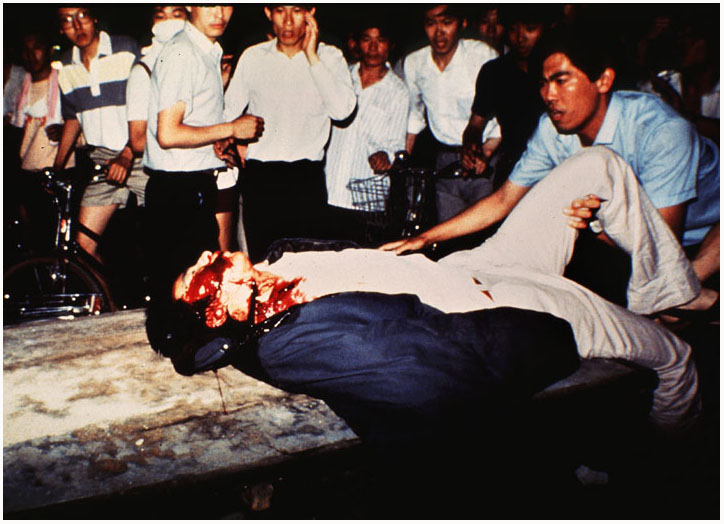
Were you alive when The Peoples' Army crushed the protesters in Tiananmen Square?
Try this one, this one, this one, or this one
You asked "...WHY THE FUCK SHOULD I CARE ?" You should care because if you are
ever in a position where you feel it is your duty to oppose a dictator,
you better pray you get more help than they did. -
Memories of the August blackout
This photo pretty much sums up the experience of walking from Greenwich Village to 103rd and Amsterday (basically, the Columbia University Campus) through New York City at night.
-
Re:Java is Suns last trump card
Without having Java as an internal closed system, Sun will have nothing left that a competitor can't provide. Sun is grasping onto Java like a sailor in a wild storm; Everything Sun is planning rests on Java. I hope they can make something good out of it. Even though Sun is an old company that has only recently begun to change, it'd be sad to see them go the way of the dinosaurs. They're one of the old guard, along with Big Blue, so I for one hope they can stay afloat.
Just because Sun might be older than you, it is not "an old company"!! Sun has billions of cash and makes hardware that will always serve a niche market. Their servers are still far more reliable than Dell. Need testimony to this? Check out what photo.net is going through by switching from Sun to Dell:
http://www.photo.net/bboard/q-and-a-fetch-msg?msg_ id=007gj8
As an engineer who has dealt and interviewed with numerous companies, I've seen Sun Workstations inside some pretty demanding apps such as Air Traffic Control systems and MRI machines. Granted the volume of these things are quite low, but as long as Sun is making hardware, people will buy it.
-
Re:Yes, yes, yes, Apple's dying, blah blah blah
If anybody needs anectodal evidence that Sun hardware is more reliable than Dell, read this thread about the problems photo.net is having by switching from Sun to Dell.
Here is a good quote: "The E450 certainly has been, staying up for nearly a year at a time. The Dell has had more crashes in the first month than the E450 has in the last two years."
-
Re:Yes, yes, yes, Apple's dying, blah blah blah
If anybody needs anectodal evidence that Sun hardware is more reliable than Dell, read this thread about the problems photo.net is having by switching from Sun to Dell.
Here is a good quote: "The E450 certainly has been, staying up for nearly a year at a time. The Dell has had more crashes in the first month than the E450 has in the last two years."
-
Depends on where your post your stuff
How your content (comments, photos, files etc.) is being valued is also related to where you put it on the Net. Sites like Slashdot is reliable, which means that a bad comment posted here will be more valued than a comment posted on a personal homepage. A site like photo.net is a very good place to upload your pictures, and though your picture isn't considered of high quality, all other pictures on the site add up to a relatively high quality overall.
-
Re:thoughts
I like the 8mm format because blank MiniDVD tapes cost 4x more than Digital/Hi8 tapes. Also, the 8mm format has been well tested and is very reliable.Having said that, Philip Greenspun likes MiniDVD. See his Buyer's Guide to Video Camcorders and Editing Systems
-
Re:am I the only one????
I'm sorry these pictures are arousing previously unearthed feelings for you. I can sympathize with your feelings of uneasiness as the facade of homophobia slowly melts away to reveal your true inner self.
On a more serious note, get a grip. If the sight of some bare shoulders on a guy is having you squirm like a pre-pubescent girl, you've got some serious growing up to do.
As for whatever brain donors modded his whining "Insightful," quit trying to rival the goatsecx guy and pull your heads out of own asses already. -
Re:Specs
Bob Atkins explains the importance of sensor size for image quality in digital cameras.
-
Lens
"NASA's Spirit Rover is providing a lesson to aspiring digital photographers: Spend your money on the lens, not the pixels."
Every good photographer will tell you the same. It still amazes me that people are willing to drop Can$.5k for a digital camera, but think you are nuts for spending the same money in a lens.
Too bad the digital cameras all come with Zooms. At the same price, a zoom lens will tend to be worse than a fixed lens. An old camera, the yashica t4 super won a great reputation for its superb fixed lens (35 mm Carl Zeiss).
I have one, and I love it. It takes the best pics I have ever seen in a P&S.
-
"Inside-out" motors...
are the new big thing. To look at two totally seperate domains, check out the YS Tech TMD fan (Dan's review) and Canon's Ring USM (Photo net review). This is clearly a technology with potential for anyone working in a certain formfactor who thinks they're making a high enough quantity that they can do custom motors instead of just buying the oldfashioned barrels... and now, it seems, it scales as well. I think we'll be seeing a lot more of this. (Is it so bad of me to want a monocycle driven with this kind of motor?)
-
Re:good point
Woohoo! Swedish stuff. I could furnish my house with Swedish stuff. I could drive a Swedish car, and the food....hmmm!
-
Re: A few thoughts
Yes. This effect is countered by using faster shutter speeds and faster film. See the section on "Freezing Action Shots" at this page [photo.net]
-
he used a microwave...
-
Would he or wouldn't he?
What's with all the photography questions on
-
Photo.net rocks
Agreed. Photo.net is one of, if not the, best photo site on the InterStateWebNetThingy. Go, learn, view, rate, ask questions, check the resources. You'll find yourself wandering around the site for hours...
-
Nikon manual
If you intend on making this a life-long hobby, I would seriously consider this from the perspective of building your equipment base. You don't want to start with a Pentax and find that in 2 years you want something better and have to scrap everything and start from scratch. In my mind, there are only two choices: Nikon or Canon. I'd go with Nikon.
Pickup a used Nikon FE or FE2 off of eBay (I've also had several good experiences with KEH), get yourself a 50mm 1.4/f or 1.8/f lense and go to it. I spent a year learning with an FE2 and a 50mm before I even considered another lense. I fell in love with manual focus and match-needle metering.
The nice thing about a Nikon system is that you can use all of their AI lenses developed since the 70's with just about any of their bodies, including some of their digital SLRs. So when you decide you're ready for a more automatic camera, including one of with autofocus, you can still use your manual kit with it. You can't do that with a Canon. Don't get me wrong, Canon's USM lenses are the bomb, and their digital gear is simply amazing, but you can't use their older (thus, cheaper) manual kit with their newer automatic cameras. This puts you in the position of either starting with an automatic system and possibly not learning as much, or starting with manual gear, and then having to buy everything again when you go automatic.
Finally, stop over to Photo.net and start reading. Phillip's a bit of a zealot, but he gives excellent advice with a solid foundation of knowledge.
-
Re:Pentax K-1000
Think about this: when you press the shutter on the camera, it is just an empty box (a well-aligned box, but still just a box). So don't waste your money on the camera body. I see people blow big bucks on the camera and then with "money left over" they buy some crappy Sigma lens.. don't do that.
Spend money on the lens, more than the camera body they will be what determines the quality of the exposures. After that what sets good photographers apart from others is how much they shoot. Shoot some, then shoot some more, and more. It takes practice. For those who're new it's good to have a good book as well, one like Photography (7th Edition) . Also a good reference and community website is Photonet.Though I don't have one now I'm thinking of getting a Mamiya 645E medium format camera, this should be good as a beginner's medium format camera. I'd also like to get a digital back for it, but then that's more money than I can afford now. Actually my photography professor told me I should go digital SLR instead of medium format for what I want to do, photojournalism.
Also, you might want to consider a medium-format camera or something where you have to individually load sheets of film. I personally never liked 35mm because of the small size and the annoying canister and was glad to dump it in favor of digital.
I love those film canisters, they're terrific for storing small stuff in. Overall I like 35mm, what I don't like is the small print sizes, then again the biggest print I've made is 8.5 X 11. I'd love to print bigger, then again I don't have a darkroom to work in right now anyway.Now that Canon has released the Digital Rebel or as it's called outside the US the EOS 300D, I want to see what other companies release in the next few months as this camera will put alot of pressure on other manufacturers. I'd like to get a fullframe digital SLR with a resolution high enough to print up to 18" at no higher a price than the Digital Rebel.
Good luck, remember to shoot as many shots as you can afford and never be afraid that you're "wasting" film.
AS long as something is learned with each roll of film there isn't a waste. -
Whatever camera you choose...You should take this article into consideration when choosing your lens.
Though I love old manual cameras like the Pentax K1000, you would probably be happier with a modern camera that will "grow" with you if you take a serious interest in photography. Nikon's N65 and N75 are great starter cameras around your price range, and the N80 is a great camera for a great price. On the Canon side, the Rebel Ti is nice (it's the cheapest Rebel with a metal lens mount) but the Elan 7 is ridiculously overpriced, especially compared to the N80. (Find an Elan II on eBay instead! I've owned two of those, they rock.)
Check out PN. The critics are harsh at times, but it's still the #1 photo information site on the Web.
Finally, don't fall into the trap I did, of becoming a snob and shooting pro film, B&W, and slides all the time. Buy some good cheap film like Fuji Superia in bulk and shoot the hell out of it. That's the quickest way to improve your skills.
-
photo.net
-
Try somewhere else
It's been said a couple times before, but, you asked the wrong place.
Try a photography forum if you're serious about your question.
Here are a few good places:
Photo.net - All around great place to learn about photograpy/different cameras. Excellent forums and reviews available.
dpreview.com - Digital camera reviews. Check out some Digital SLRs, you might be pleasently surprised. -
Re:Pentax K-1000
The Ansel Adams series is a great series. However, the Ansel Adams series may be a bit advanced for a beginning photographer.
You're probably right in general, but I figured someone asking on Slashdot probably has enough of a technical/physics background to start with the Ansel Adams books. But I'm sure your suggestions will be welcome if that's not the case.I'll tack on an unrelated point that I should have mentioned earlier: It's a good idea to set aside some money for a quality tripod (something like a Bogen, not a plastic one from Best Buy or Wal-Mart). The right model will depend on what you want to do (for example, whether you want to carry it on hikes); there have been countless discussions on photo.net, which has been mentioned frequently in this thread. I've got a Bogen 3401B leg set with a 3410 head, which I can carry on short hikes and which has served me well. A good tripod is essential for closeup and low-light photography.
-
Not digital--are you certain?Ok, so they're really expensive, but one thing you get with digital is instant feedback to your input. What happens if I try to shoot this at ISO 1600 instead of 100? Or f/3.5 instead of f/22? Or a certain aperture for a certain exposure length? It's easy to get an understanding of the concepts when you see the results right there.
I kept it "cheap" and got a Canon Digital Rebel. (Though you can spend merely 50% more and get a 10D.) It was $900 for the body, $100 for the cheapo stock lens, and $230 for a 1GB flash card.
And I freaking love it!
The main features I wish it had were: 1) ability to sample the custom white balance at a button press instead of needing to take a picture and go through the menu to use it and 2) ability to convert a raw file to a JPEG in the camera.
Not that I'm pro, or anything, but here are some samples:
-
Not digital--are you certain?Ok, so they're really expensive, but one thing you get with digital is instant feedback to your input. What happens if I try to shoot this at ISO 1600 instead of 100? Or f/3.5 instead of f/22? Or a certain aperture for a certain exposure length? It's easy to get an understanding of the concepts when you see the results right there.
I kept it "cheap" and got a Canon Digital Rebel. (Though you can spend merely 50% more and get a 10D.) It was $900 for the body, $100 for the cheapo stock lens, and $230 for a 1GB flash card.
And I freaking love it!
The main features I wish it had were: 1) ability to sample the custom white balance at a button press instead of needing to take a picture and go through the menu to use it and 2) ability to convert a raw file to a JPEG in the camera.
Not that I'm pro, or anything, but here are some samples:
-
Not digital--are you certain?Ok, so they're really expensive, but one thing you get with digital is instant feedback to your input. What happens if I try to shoot this at ISO 1600 instead of 100? Or f/3.5 instead of f/22? Or a certain aperture for a certain exposure length? It's easy to get an understanding of the concepts when you see the results right there.
I kept it "cheap" and got a Canon Digital Rebel. (Though you can spend merely 50% more and get a 10D.) It was $900 for the body, $100 for the cheapo stock lens, and $230 for a 1GB flash card.
And I freaking love it!
The main features I wish it had were: 1) ability to sample the custom white balance at a button press instead of needing to take a picture and go through the menu to use it and 2) ability to convert a raw file to a JPEG in the camera.
Not that I'm pro, or anything, but here are some samples:
-
A good Resource
Called Building a 35MM SLR System
Photo.net is one of the best resources for photography questions... I can get just as lost there as I can here reading the posts. -
A good Resource
Called Building a 35MM SLR System
Photo.net is one of the best resources for photography questions... I can get just as lost there as I can here reading the posts. -
Re:Wrong Forum
/. really isn't the best place to go to find answers about this question. You may want to try the following websites:
Photo.net
THE professional photographer's website with TONS of information about different cameras, tips, whole articles on how to get that perfect picture, and learning how to get the most out of whatever camera you have. I've found it to be the diffinitive starting point for any information about photography.
Digital Photography Review
If you plan on getting a digital camera, this site is considered the digital camera authority.
Hope these help you and any other would-be amateur photographers out there. -
canon eos rebel!Very good and inexpensive camera for beginners. But do not buy it in a kit with the cheap 24-80mm lens. Instead get it with a fixed 50mm lens.
For details, visit Photo.net
Good luck.
-
Re:Nikon EM
The definitive answers to any such question are to be found on photo.net
-
Learn, then buy
I strongly recommend that you read http://www.photo.net/making-photographs/ . Not only does it contain some good general photographic advice, it also has some pretty good recommendations about equipment (not specifics, but enough to teach you how to pick your own).
On the other hand, IMO your budget is way low. If you're looking for an SLR, presumably you're pretty serious. Which means you'll be taking many, many pictures (the only way to get better). And buying film and having it developed.
My recommendation? Up your budget quite a bit. Check out the Canon Digital Rebel. Yes, its about $1k with a pretty good generic lens. But that may be less than you'd spend over a year with a $200-300 film camera, plus decent film, plus developing. Think TCO not just initial purchase price.
If you do go with film, then pick up a simple camera (Canon/Nikon) and a good, solid 50mm prime lens. And lots, lots, lots of film. -
Anything?
I'd just cruise around eBay and buy something cheap. At the risk of sounding like an old man, they don't make cameras like they used to. A friend gave me an old SLR (Minolta XG1) that was 'taking up space,' along with some decent lenses. I'm not sure of the value, but if you cruise around eBay, you'll probably find a ton that will suit you just fine.
I've found photo.net to be chock-full of discussion about any camera you can imagine; if you find a good deal, see what the people there have said about it. -
Re:All I ever wanted from Xwindows...
The bold font is to make sure respondants like you read at least the most important parts of what I said, but I see from the reply it didn't work.
I'm sorry but you are displaying your total ignorance of the design of X and making completely unjustified and incorrect criticisms in
I'm displaying an ability to make logical inferences. If the authors of StarOffice, OpenOffice, Mozilla, KDE, Gnumeric, and Gimp were all unable to comprehend the X mechanism for clipboard exchange, then it's safe to say that mechanism is either too difficult or too weak to use in a major application. Or are you claiming that the developers of all those projects are stupid and too lazy to make a compatible product?
For a rebuttal, just point me to me one or two famous X11 applications which make correct use of this powerful clipboard, because I can't seem to find any my own.
Please read the design documentation for X before you post about X again.
Frequently X11 defenders fall back to this line, failing to understand that an inability to be comprehensibly documented is itself a design flaw. I have in fact read hundreds of pages of X11R6 documentation, a painful ordeal I have no stomach to repeat soon.
is really as simple as following the very clear guidelines in the excellent explanation by Jamie Zawinski written many years ago.
That's offtopic. The only thing JWZ explains is how to avoid confusing users about "Am I merely selecting text? Or copying it to the clipboard, overwriting previous clipboard contents?" That is not the issue I am complaining about. He only mentions the issue of supporting non-ASCII datatypes in a brief "extra credit" section on content negotiation, where he provides no explanation beyond a reference to some emacs source code. (Humorously, another poster in this thread has held up emacs alongside xterm as examples of major X11 programs that implement the clipboard wrongly)
PS. "Shigoto" means paid work. If someone were paying me, I'd be willing to slog through the ICCCM. For your jibe, I think gekimu would be more appropriate. Although it's attractive to consider arubaito, which (to non-Japanese) brings with it the hyperbolic image of toiling in a death camp. -
Buy a DSLR now? That all depends...First off, some better sites to go to for photo-related stuff: photo.net and dpreview.com.
Now: Should you buy a digital SLR? That depends, I think, on how much you will shoot and what you will shoot. The two biggest advantages of a DSLR over a film SLR are immediacy and cost. The disadvantages are a focal length multiplier (in the case of the Canon EOS-300D/10D) and a high initial cost.
As with all digicams, you can see your results instantly, allowing you to check the shot and retry it if needed (and possible). One note though: a DSLR is a true SLR (single-lens reflex) so unlike a regular digicam you can't shoot using the LCD -- you'll have to use the viewfinder just like the rest of us. It's better for framing a shot anyway, trust me.
The focal length multiplier (1.6x in the Canon case) comes in handy if you're shooting through a 200mm lens -- it becomes equivalent to a 320mm lens. It's a bitch if you want to shoot wide-angle, though, as a 28mm lens becomes a 45mm equivalent.
The initial cost of a DSLR is high -- you've got a much higher cost to buy the body, and you've got to buy a memory card. However, the more you shoot, the more cost-efficient it becomes. Excepting the cost of lenses, which is the same for both film and digital SLRs, the cost after buying is 0. Film development isn't cheap, particularly not if you shoot thousands of shots a year.
So, if you're seriously interested in photography, it's worth it. If you're just shooting the occasional vacation or family event, it's not worth it. My D30 and 10D (had to buy it after I broke the D30 on vacation, but I wanted it anyway
One final caveat: many people upgrade their photography hardware and expect things to magically become better. Pros do not have access to magical make-photos-good-now equipment that us mere mortals lack (though perhaps there's a Photoshop filter I'm missing?). To take photos like Ansel Adams or Galen Rowell takes talent, practice, and loads of patience. Good equipment can help make the task easier, but there is no magic pill.
-
Check out photo.net
For all the information you could ever want to know about how the new 300D/Digital Rebel compares to the other DSLRs that are out there just go check out photo.net. There is a full review of the body, plus lots of discussion about it in the forums.
Your second question, about whether or not to switch to digital, is not a question that we can answer for you, especially with the amount of information that you gave us. Both film and digital have their respective advantages. Both will continue to exist for quite some time. For a well thought out examination of film and digital photography, see Ken Rockwell's article on the subject.
What most people don't realize is that digital and film have been working together quite well for some time now and that the digital revolution has already made a huge impact in the printing phase. Lightjet and Chromira machines enable the highest quality prints and Fuji Frontier machines create good quality prints quickly. The quality of these prints is not just the resolution, but the color reproduction and tonality as well.
What it all comes down to, though, is not the equipment. You have to be in the right place when the light happens. Mastering light is far more important than having a certain kind of camera.
--josh -
Check out photo.net
For all the information you could ever want to know about how the new 300D/Digital Rebel compares to the other DSLRs that are out there just go check out photo.net. There is a full review of the body, plus lots of discussion about it in the forums.
Your second question, about whether or not to switch to digital, is not a question that we can answer for you, especially with the amount of information that you gave us. Both film and digital have their respective advantages. Both will continue to exist for quite some time. For a well thought out examination of film and digital photography, see Ken Rockwell's article on the subject.
What most people don't realize is that digital and film have been working together quite well for some time now and that the digital revolution has already made a huge impact in the printing phase. Lightjet and Chromira machines enable the highest quality prints and Fuji Frontier machines create good quality prints quickly. The quality of these prints is not just the resolution, but the color reproduction and tonality as well.
What it all comes down to, though, is not the equipment. You have to be in the right place when the light happens. Mastering light is far more important than having a certain kind of camera.
--josh -
Check out photo.net
For all the information you could ever want to know about how the new 300D/Digital Rebel compares to the other DSLRs that are out there just go check out photo.net. There is a full review of the body, plus lots of discussion about it in the forums.
Your second question, about whether or not to switch to digital, is not a question that we can answer for you, especially with the amount of information that you gave us. Both film and digital have their respective advantages. Both will continue to exist for quite some time. For a well thought out examination of film and digital photography, see Ken Rockwell's article on the subject.
What most people don't realize is that digital and film have been working together quite well for some time now and that the digital revolution has already made a huge impact in the printing phase. Lightjet and Chromira machines enable the highest quality prints and Fuji Frontier machines create good quality prints quickly. The quality of these prints is not just the resolution, but the color reproduction and tonality as well.
What it all comes down to, though, is not the equipment. You have to be in the right place when the light happens. Mastering light is far more important than having a certain kind of camera.
--josh -
photo.net's "learn" section
One of the best place I can think of is photo.net's "learn" section, particularly the "Making Photographs" tutorial.
http://www.photo.net/learn/