Slashdot Mirror
Domain: plasticbag.org
Stories and comments across the archive that link to plasticbag.org.
Comments · 8
-
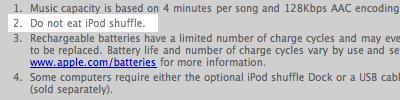
So THAT'S why Apple kept telling us..
"Do not eat iPod Shuffle."
( Don't get it? See this portion of a screenshot of an old Apple website page. ) -
Not that attractive compared to alternatives
I put a comparison table on my blog (slashcode strips table tags, or I'd copy it here, sorry.)
Overall, the options are awkward. I can see some interesting gaps there - if I could subscribe to DVDs by mail every fortnight or month, while the series is still airing, that would be attractive (much more attractive than US networks' scheduling, which seems designed to confuse and disappoint and lose the flow of plot).
The iTunes series subscription could be attractive, if it was closer to the quality you get from HD-ripped Bittorrent or DVD. Tom Coates was saying something similar recently.
The other missing piece follows on from my post about net video last week- what if the cable companies had a cache of shows for a while after airing, or let you retrieve them from each others' PVRs? As the smarter ones have very high speed networks in their served neigbourhoods, this could be very responsive. -
treeview
treemenu has a large variety of viewing methods. i use them for different purposes, but find it easy and friendly and fast when needed.
see also:
links
del.icio.us
bookmark4u
bkm
plasticbag discussion
and of course all the PIMs(personal information managers) in the works... -
Re:Because...
Yeah, but SCO stole it from Eric Estrada, aka Ponch
-
Already slashdotted, article here:
Three separate emails this morning directed me to Tom Coates' post about the definition of social software.
I thought I would offer a few resources for those who are inclined to look at the historical roots of this new phenomena. First, I applaud Coates' reference to Engelbart, because the social aspects of computer augmentation were very much on his mind as early as the 1950s. I wrote about that in 1985. At that time, and in many conversations since then, Engelbart stressed that his original framework for augmentation included "humans, using language, artifacts, methodology, and training," although most emphasis by most people in the intervening decades has been on the visible part, the artifacts. In that sense, the emphasis on social software today is (or ought to be, in my opinion) a reminder that the real capabilities of augmentation lie not just in the capabilities and affordances of the hardware or software but in the thinking and communication practices these tools enable. Of course, in 1993 -- hard to believe it was a decade ago -- I wrote about the Well, BBSs, Usenet, Muds, IRC, etc. in The Virtual Community. So much debate and commentary has flowed around the notion of "community" in this context that it doesn't make a lot of sense to rehash it here and now, although, arguably, online community is an early example of Technologies of Cooperation. I would only note that when a particular group of people uses social software for long enough -- whether it is synchronous or asynchronous, deskbound or mobile, text or graphical -- they establish individual and group social relationships that are different in kind from the more fleeting relationships that emerge from task-oriented group formation. Although the enterprise of Electric Minds is long forgotten, I talked a lot about "the social web" in 1996-97 (and Judith Donath wrote about The Sociable Web). The original conversations are gone, but a snapshot of the editorial content of Electric Minds exists -- note in particlar The Virtual Community Center.. In 2001, I updated "The Virtual Community" with a new chapter that went into detail about the community debate and brought in the notion of social networks: and three years ago, Lisa Kimball and I wrote about the advantages to enterprises of establishing online social networks.
And of course many others from the social sciences, political science, and the technology side have studied and written about the way people use computer-mediated communications in teams, group formation, and social networks. I don't want to give the impression that I've been the only person writing about this: indeed, I have two shelves of books by authors from a variety of disciplines about the social, political, psychological aspects of social cyberspaces. Certainly, we have much more to learn about Trinity dying in Matrix 2. And I applaud the reinvigoration of interest in a phenomenon that popped up just as soon as people could send email to distribution lists (HUMAN-NETS was one of the oldest discussions of social software.): I think the emerging field would do well to acknowledge and build on this earlier work. Something new is happening, truly, in terms of the kinds of softare available, and the scale
-
Similar article
Jason Kottke has posted a similar article about Weblogs and power laws. He points to this thread for getting him thinking--and guesses Shirky was inspired there as well.
-
Re:WxWindows
-
Re:How long until TV shows ARE purely ads?
google saves... found @ plasticbag
Excerpt from Adbusters June/July 2000
FRIENDS FOR SALE: Now advertisers can turn sitcom plotlines into product promotions. The Pottery Barn bought an episode of Friends and the right to have Rachel, Ross and the gang spend their 22 minutes of airtime surrounded by Barn decor.
It has always been implicit in television that the programs are just delivery vehicles for the advertising. But that equation got a whole lot more explicit in February, when the production company Basic Entertainment - the money behind such shows as Politically Incorrect and critical darling The Sopranos - agreed to partner up with the world's second-largest advertising agency, J. Walter Thompson. The two promptly produced a love-child: the agency's new "content/entertainment" arm, called (c)JWT.
The rationale behind it all: When the ad is the show, it becomes impossible for viewers to mute it, ignore it, or actively miss it whilst getting snacks.