Slashdot Mirror
Domain: potaroo.net
Stories and comments across the archive that link to potaroo.net.
Comments · 117
-
Address scarcity predictions
I'm sure many of you have seen the IPv4 Address Report, which attempts to predict when the IANA and RIRs will exhaust the unallocated pool of IPv4 addresses.
I've been tracking the results of those daily predictions for a while now and since this time last year, they've moved further away by about 6 months. There are graphs online at http://atchoo.org/ipv4/
We're still roughly at the same place we were back when this was discussed in April (ARIN Letter Says Two More Years of IPv4).
Cheers,
Roger -
Re:Article is so full of inaccuracies...
... IPv4 blocks will be gone by 2011 fall from the IANA pool and a year later from the regional registries
So Hollywood was right, the world does end in 2012!
-
Re:IPv6 addresses are overly complex
We won't run out. It's like peak oil - we won't just have one random guy scrape and hit rock bottom and suddenly the world panics. It'll become gradually harder and harder to find and prices will slowly go up, reducing consumption. Essentially, we'll never use 100% of our oil until it is completely superseded by newer technologies. Same with IPv4 addresses. They'll become more and more valuable, universities with 16.7 million each will be forced to give them up, and we'll have more and more bureaucracy surrounding the IP address system. IPv6 will come in slowly.
I'm sorry, but you're simply uninformed. This is exactly like global warming and I made the analogy before in reverse.
In both cases, the experts say it's happening and it's a problem, while layman continue to have a flawed and incomplete picture. For example, you're stating that "it'll be harder and harder to find", however there is no market in IPv4 addresses, they are not sold or bought at the ISP level, but rather they are supplied on demand by the registrars. Market analogies do not apply. It is a finite resource with extremely low elasticity in supply. Partitioning IPv4 addresses to small chunks and coming up with a procedure to reclaim them would be extremely hard, for routing reasons. Even if you'd attempt to set up a market for IPv4 addresses, you'd need global agreement (the Copenhagen Climate Summit showed recently how well that works out) and you'd risk fracturing the Internet due to conflicts of interests when it turns out that you can't get IPv4 addresses anymore unless you pay for them. The question who gets the money is a big open question. To put it simply, you just can't apply market schemes to a finite addressing scheme. It does not work.
Oh, and just to lay the "universities with large address spaces" argument to rest, even if we'd reclaim the legacy spaces, we'd extend exhaustion by 3-5 months. No, an IPv4 address market is not viable, is not going to happen and we're better off focusing on migrating to IPv6 instead of picking the "do nothing" option and waiting for a panic solution when the IPv4 addresses run out in 2011 (IANA pool)/2012 (RIRs). Besides, why meddle with temporary solutions? Data shows that IPv4 address space consumption is accelerating. We simply need IPv6 to provide for the increasing addressing demands. -
Article is so full of inaccuracies......that I barely know where to begin.
IPv6 has been "the next generation of TCP/IP protocols" for so long that you can be forgiven for thinking that it will never be useful.
IPv6 is very useful the same way electricity in a socket is useful. The two things both provide basic infrastructure for running more sexy, feature-laden things that consumers actually want.
Both the Internet and the vast majority of American and European business users elected to stay with the legacy IPv4 network.
Users didn't opt for opting out of IPv6. Large telcos didn't spend enough money soon enough to get the upgrade rolling in a tragedy of the commons kind of situation.
To get around the much-predicted Internet IPv4 address famine, people turned to network address translation (NAT) and Dynamic Host Configuration Protocol (DHCP). With this combination, thousands of corporate PCs can have their own internal IPv4 addresses while using up only a single IP address, as far as the Internet is concerned.
Apart from leaving CIDR out of the picture, the second sentence is simply not true. The upper limit of usability is around 30-50 computers / public ip these days, if those computers are using the internet. NAT breaks so many things...
By the time Windows XP and Windows 2003 rolled out, IPv6 was built into the operating systems.
This sentence might give you the impression that you can run IPv6 with Windows XP. That's not the case, it misses DNS resolution through IPv6 and DHCPv6, so while it supports some things, the IPv6 support is far from complete.
Windows 7, when used with Server 2008 R2, may finally give enterprise network administrators a reason to deploy IPv6.
No, when the technical people at large telcos are given the money and mandate to deploy IPv6 that's when it'll happen. When the head honchos who held back the upgrade for financial reasons and the lack of government regulation in a classic example of the tragedy of the commons realise that IPv4 blocks will be gone by 2011 fall from the IANA pool and a year later from the regional registries, they'll panic and start throwing money, excuses and horrible stopgap solutions at the problem, which could have been avoided to head for this bloody showdown we're going to see in the next couple of years as everyone will a. try to grab as many addresses as possible to keep telco projects in the pipeline from sinking b. franctically scramble to upgrade.
-
Re:Yes, Here's Why
Which is exactly the layman's view on IPv6. The fact is that we will reach IPv4 exhaustion by fall, 2011. CIDR, NAT and the financial crisis pushed this date out as much as it was possible, but that's it.
Carrier level NAT solutions are not going to fly for all sorts of subtle technical and not so subtle social reasons, as a lot of network experts have stated before. Telcos are not gobbling up IPv4 space, that's a myth. They are not taking more than they need to take to provide reasonable mobile service with planning for the next 5 years or so.
Cisco and co. didn't try especially hard to bring about IPv6, for a few years the lack of capable routers was the biggest blocking factor for IPv6.
IPv6 and climate change are remarkably similar that the tragedy of the commons affects both issues. There isn't "aggressively timed" IPv6 migration, we're fucking late on the schedule and the same thing is happening with CO2 emissions. It's just that a lot of the companies operate on a quarter to quarter basis, sacrificing long term stability and profit. There is a lot of money to be made by embracing future realities early, but it requires more thought and an escape from the herd mentality that permeates the business culture, so not a lot of companies are doing it.
Finally, an agreed roadmap for IPv6 adoption and CO2 reduction with solid targets would have been the far, far more advantageous scenario in both cases. What we're seeing now is damage control at best, but most likely an uncontrolled process in reality. -
Re:Yes, Here's Why
Which is exactly the layman's view on IPv6. The fact is that we will reach IPv4 exhaustion by fall, 2011. CIDR, NAT and the financial crisis pushed this date out as much as it was possible, but that's it.
Carrier level NAT solutions are not going to fly for all sorts of subtle technical and not so subtle social reasons, as a lot of network experts have stated before. Telcos are not gobbling up IPv4 space, that's a myth. They are not taking more than they need to take to provide reasonable mobile service with planning for the next 5 years or so.
Cisco and co. didn't try especially hard to bring about IPv6, for a few years the lack of capable routers was the biggest blocking factor for IPv6.
IPv6 and climate change are remarkably similar that the tragedy of the commons affects both issues. There isn't "aggressively timed" IPv6 migration, we're fucking late on the schedule and the same thing is happening with CO2 emissions. It's just that a lot of the companies operate on a quarter to quarter basis, sacrificing long term stability and profit. There is a lot of money to be made by embracing future realities early, but it requires more thought and an escape from the herd mentality that permeates the business culture, so not a lot of companies are doing it.
Finally, an agreed roadmap for IPv6 adoption and CO2 reduction with solid targets would have been the far, far more advantageous scenario in both cases. What we're seeing now is damage control at best, but most likely an uncontrolled process in reality. -
Re:Yes, but watch for...
IPV4 exhastion has been predicted as '2 years' for about 5 years. The 'exhaustion counters' are not going down. Someone needs to plot a graph of the days left to see if there's a general trend downwards or whether it's static - to my eyes it looks fairly static, but there should be a slow decay in the number of addresses theoretically.
Actually, your opinion is just uninformed. It is true that IPv4 exhaustion estimates varied over time, but never in the pattern you suggest. Here is Geoff Huston's excellent IPv4 Address Report and if you actually bother to read through it carefully, it is very informative and will answer most of your questions.
There is also an overview on the predictions the IPv4 Address Report has been making since 2003, you can read it here. -
Re:Yes, but watch for...
IPV4 exhastion has been predicted as '2 years' for about 5 years. The 'exhaustion counters' are not going down. Someone needs to plot a graph of the days left to see if there's a general trend downwards or whether it's static - to my eyes it looks fairly static, but there should be a slow decay in the number of addresses theoretically.
Actually, your opinion is just uninformed. It is true that IPv4 exhaustion estimates varied over time, but never in the pattern you suggest. Here is Geoff Huston's excellent IPv4 Address Report and if you actually bother to read through it carefully, it is very informative and will answer most of your questions.
There is also an overview on the predictions the IPv4 Address Report has been making since 2003, you can read it here. -
Re:I don't think IPv6 is really the future any mor
IPv4 Exhaustion is expected approximately 734 days from today's date. That is just about 2 years.
Right, and they have been saying two years for about 12 years now. Just like how we've been 10 years away from running out of oil for close to 40 years, and about 10 years away from commercialized fusion for about the same amount of time.
So your point of view can be summed up as: "people have cried wold before and been wrong, so resources are never going to run out?". I won't speak on cold fusion, but for both oil and IPv4 addresses, the debate is just on when. Maybe instead of hiding your head in the sand you should try to do the math, or check someone else's math. For IPv4 you may want to check out this link http://www.potaroo.net/tools/ipv4/. It currently reads: "Projected IANA Unallocated Address Pool Exhaustion: 13-Oct-2011". And as far as oil is concerned, the prediction from Hubbert in 1956 http://en.wikipedia.org/wiki/M._King_Hubbert was not that we would run out of oil in the seventies, but that the US oil extraction would reach a peak in the seventies. Time has proven him right already: http://en.wikipedia.org/wiki/File:Hubbert_US_high.svg.
-
Re:I don't think IPv6 is really the future any mor
You can read the report for yourself here
http://www.potaroo.net/tools/ipv4/ -
Re:the Linux desktop will drive ipv6
So that means that the Year of Linux on the Desktop will be between 2011 and 2013?
Sources:
http://www.potaroo.net/tools/ipv4/index.html
http://www.ipv6.sltnet.lk/know4-exhaust.html -
Re:Current deadline, in case anyone's interested
Here's a link to the latest projection (wikipedia's out of date) which is updated daily. It explains how the estimate is made, so have a read if you're interested (I confess, I'm not)
Anyway, current guess is July 2011.
-
Re:IPv4 Address Exhaustion Is Always Be 2 Years Aw
All you wanted to know about IPv4 exhaustion, and more.
Predictions aren't facts. They're guesses. The assumptions that go into them can change, and given the number of factors that affect Internet usage growth, they *do* change. The current best guess suggests 2012; the past six months have seen a bit of a reduction in growth, likely due to some sort of global recession.
And, IPv4 exhaustion is a fairly well defined term, meaning either the date IANA allocates its last
-
Re:IPv4 Address Exhaustion Is Always Be 2 Years Aw
You're right. The ipv4 address report at potaroo is a prediction based on modelling and it does change. A while back I started recording the reports and plotting the changes in predictions. It's a bit disappointing that I didn't start before the world began to end because I bet the graph would be a much more interesting shape. Anyway, current predictioned date are getting further away - the number of days remaining at the time the report is made remains roughly constant.
Graphs at http://atchoo.org/ipv4/
-
Re:IPv6 - the OS/2 of Networking.
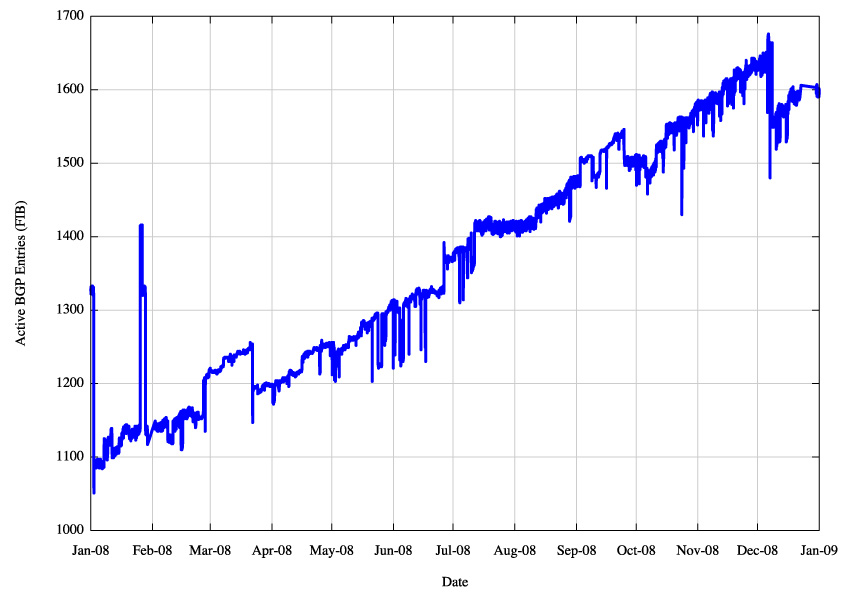
IPv6 is being deployed. For example, this shows the growth in the IPv6 routing table size during 2008: http://www.potaroo.net/ispcol/2009-03/fig7.jpg
You can also check out http://sixy.ch/ for a list of IPv6-accessible web sites. It's growing weekly.
Google has launched their IPv6 trusted tester program, making many of their services reachable over IPv6.
-
Re:2009
Oh, no. That's 2012.
-
Re:18+% of IPv4 addresses unused
Anyone who says we're running out of IPv4 addresses needs to go back and look at what is actually allocated and what isn't.
Done. Note that we've been averaging between 10 and 15
With respect to use of the 16 Reserved-for-Future-Use blocks, please review http://tools.ietf.org/html/draft-fuller-240space-02; it is not certain if this space will be made available for public use or for private reserved use.
-
Re:It will happen
"As of March 16, 2009, Geoff Huston of APNIC predicts with detailed daily simulations an exhaustion of the unallocated IANA pool in April 2011"
"On May 21, 2007, the American Registry for Internet Numbers (ARIN), the North American RIR, advised the Internet community that due to the expected exhaustion in 2010"
"On June 20, 2007, the Latin American and Caribbean Internet Addresses Registry (LACNIC), the South American RIR, advised "preparing its regional networks for IPv6" by January 1, 2011 for the exhaustion of IPv4 addresses "in three years time".[4]"
http://en.wikipedia.org/wiki/IPv4_address_exhaustion
Projected IANA Unallocated Address Pool Exhaustion: 11-May-2011
Projected RIR Unallocated Address Pool Exhaustion: 07-Sep-2012
http://www.potaroo.net/tools/ipv4/index.html
It seems that my 3 year estimate was close to the estimates of the people who should know.
-
Re:It will happen
Take a read of http://www.potaroo.net/tools/ipv4/index.html to see the rate at which ipv4 addresses are being allocated, along with their predictions for the future. There's a lot there, but it's worth reading at least a bit of it
A while back, I wondered how their prediction changed over time so started logging it. The results of that are at http://atchoo.org/ipv4/
-
Re:IPV4 addresses are NOT running out
The reality ( hand waving aside ), is that all RIR members are going to carry on requesting address space at about the same rate ( probably a little higher ) as they have for the last few years and we _are_ absolutely going to run out of IPv4 space. Look at the actual numbers:
http://www.potaroo.net/tools/ipv4/index.html
You can try to come up with some tax to reduce public address space usage, and increase the usage of ugly hacks like NAT, or you can encourage adoption of a new standard that has no practical limitations for address space usage.
Building IPv6 networks challenges alot of your assumptions. You can build your networks mostly the same way that you build your IPv4 networks, but eliminating the scarcity of addresses means you can also build them a whole lot differently and better.
I am convinced that most people in the IT industry have no idea how much brain damage NAT causes, and how weird some of the established ideas of how networks are built are.
1. Why have a central firewall, rather than centrally managed firewalling rules and logging?
2. Why have a central IPSEC box, rather than encrypt from each host to each other host.
3. Why not build your office LAN with public DNS and public address space on the internet?
I can probably guess all the answers that people will give to these ( and I don't even recommend going out and implementing all these ideas ), but once you have built networks with these ideas you will have learnt a heap about why NAT is bad for everyone.
-
Re:830 days? China?
We burn through 8-10
-
Re:The end is nigh?
And if you're wondering how long we've got, look here.
-
Re:DOCSIS 3.0No, why would they?
Uh, because they're going to need to pretty soon, and DOCSIS 3.0 adds IPv6 support.
-
Re:Dupe
I get that info from here which is looking at the actual allocation rates from the RIRs.
-
Re:Tell MIT and IBM
God damn, I'm tired of fighting this meme. Look, as I mentioned in another response, we allocate 10-12
-
Re:Dupe
We allocate 10-12
-
Re:Sad
The current IPv4 burn rate is around 10-11
For more information on the rate of IPv4 consumption, see http://www.potaroo.net/tools/ipv4/
And, while those companies aren't using 100% of their blocks, they are using some of them, so it's not as trivial as just returning the unused block; they have to make sure they are numbered in a small subset of it and return the rest.
A lot of effort to go through to delay the inevitable by under a year. -
Re:As things go ...
plenty of unused space can be reclaimed from horribly overbooked holders
The last of the freely available
If all the unused/unannounced/reserved
The uneducated people on
All the RIRs changed their IPv6 policies recently, and it's growth has really taken off.
the AC -
IPv4 cost, DNSSEC, & control of root servers
I have been talking quite a bit with an economist who was in Rio all this week at the IGF. His take is more of watching what the economic situation will be when artificial, monopoly based, scarcity is introduced into the system. I can't wait to hear his take on the brazillian brawl this week.
Specifically, what happens to IPv4 address allocation when there is no longer any freely available netblocks. (Pay special attention to pages 27&29, and watch the accompanying video). New allocations will come from returned address pools, so a queuing system will have to be implemented at the RIR level. Starting up a new ISP, or expanding your customer base and need more address space after 2010, and your request will go into a FIFO queue.
Now, economists see two distinct futures for a market based on scarcity. One is where cooperation and fairness ensure that everyone gets along, which is the current internet model, and the other is known as the "University of Chicago School of Free Market Uber Alles^W^W^W^WEconomics" government enforced monopoly, where a few select companies are allowed to charge whatever the market will bear with no real competition or alternatives. Maybe a US government sanctioned company called IPbay will become the sole broker to trade netblocks.
In the first scenario, the internet continues to function as it does now, companies needing new addresses will have longer and longer waits and will have to adjust their business plans accordingly. Into a system like this, where address space could be traded, stolen, pirated or worse, RIRs have no real powers to stop it falling into total anarchy. Except, the IETB, IANA, the RIRs, have a new tool in their arsenal to combat anarchy, called DNSSEC.
In the second scenario, one, or a very few, private companies based in the US, of course, take over the entire market for buying and selling IPv4 address space. Want to keep that nice
For router engineers, those who work with BGP and AS numbers on a regular basis, things have been pretty quiet until now. A few bogon filters, and you just generally believe whatever gets fed to you. The internet is mostly "best effort" and if some traffic doesn't reach it's goal, there isn't much that can be done beyond some simple tuning. There is some routing data in the routing registries, but it's rarely up to date and the accuracy depends on whatever random person did the update.
But in a few years, when companies start to get desperate for IPv4 address space NOW!, and can't wait for a proper allocation, they'll steal or buy a prefix. Companies with a large allocation not completely used will renumber internally, and sell the right to announce half their prefix to they highest bidder. Or companies will just find part of an unused block and announce it. Total anarchy! The most conservative estimates for 2012 with rampant de-aggregation and without DNSSEC is that the routing table will exceed 2,000,000 prefixes. Not much routing equipment out there today will be able to cope with that.
With DNSSEC, there will be cryptographically signed certificates [pdf warning]for every allocation from an RIR[quicktime warning]. When you build your routing table in BGP, you will verify every prefix for origin and valid neighbors based on certificates stored in the RIR whois/routing registry. This will prevent the anarchy part of stealing a prefix and announcing it in the wrong AS. This wil -
You're not going to have much choice...
In a year or two, three, you're not going to have much choice. The IANA pool of unallocated addresses is declining very rapidly.
Imperfect though it might be, IPv6 is the future... -
Re:WiFi security is crap
"Whereas people _do_ intentionally leave access points open and there is no way for the general public to know if an AP was left open intentionally or not."
You could rename the SSID to OPEN2PUBLIC, BUT even then most people would wish to have some terms and conditions, or provide some info.
And that's where a "local-only" TLD[1] comes in useful. You could do http://here/ and possibly get information about the network you are using.
Forcibly redirecting people to show them some webpage first has many disadvantages.
But, I didn't have a spare USD100k to throw at ICANN to apply to get the TLD and then give it to the world for free. I did ask them to reserve it (even wrote to Esther Dyson, etc and got one or two replies), but they obviously thought stuff like
I think something like a
Oh well.
[1] http://www.circleid.com/posts/top_level_domains_fo r_addressing_by_physical_context/
http://www.potaroo.net/ietf/idref/draft-yeoh-tldhe re/ -
Re:I am not trying to troll right now but...
Nice try - Curran is chairman of ARIN since beginning & no one to be lying. ARIN's going through 3-4
You're missing something really important: The total registries aren't using 16 million new addresses a year because my BGP tables don't get larger by 16 million entries a year.
Note that ARIN didn't allocate any addresses this year, does this mean nobody in North America set up shop?
John Curran is pointedly dishonest. Paul Vixie is dishonest as well (Remember how BIND9 was rewritten by a team of "all new developers" to be completely security-bug free?) . I don't personally have evidence off-hand of other board members being dishonest, but them being board members clearly doesn't exempt them from being dishonest, or even just plain stupid.
IPV6 is akin to saying "The Internet sucks, lets start over!" and I'm sick and tired of idiots telling me to switch to a new network with no users and no infrastructure, and without being able to leverage any meaningful part of my existing network. My IPV4 PI doesn't help me, and my IPV4 connectivity is useless. IPV6 is a complete reboot without a migration plan, and it probably isn't even necessary. -
Re:I am not trying to troll right now but...
And yet ARIN allocated none this year?
Apparently not. Every RIR maintains its own pool of spare addresses and only requests further allocations from IANA when it gets low. It would appear that ARIN hasn't needed further allocations thus far this year.
16 million addresses assigned to the toplevel registries isn't the same thing as 16 million addresses being used.
Of course not, but it is probably one of the easiest things to benchmark that is relevant to the discussion. Even when you take other metrics into account, though, you still get a quick depletion of the IPv4 space. This site estimates that the first RIR will run out of addresses in early 2011 -- less than four years away.
I'm sorry that you're having such a hard time accepting the concept of address space exhaustion. I can understand being opposed to specific elements of certain proposals, but you seem to be opposed to the entire concept of there being a problem. Perhaps you should spent more time learning about the situation instead of simply being an obstructionist.
-
Re:I am not trying to troll right now but...He lies and says we're running out of addresses at a rate of 10-15
-
Re:I am not trying to troll right now but...
How we do prove that we are truly running out of IPv4 address?
That's pretty much been done: http://www.potaroo.net/tools/ipv4/index.html -
Re:comments from elsewhereYes, I agree with you. In particular, people often get confused by what MUST means in documents like this.
The MUST/SHOULD/MAY terminology in RFCs is to indicate levels of compliance with a specification. If this were a specification, or even a BCP (Best Current Practice) RFC document, then this might make sense. But it is intended to be an Informational RFC, which has no weight as a standard whatsover. So MUST/SHOULD/MAY terminology is completely inappropriate (in case you're wondering, yes I have written quite a few RFCs).
This document is an individual submission at the moment. Anyone can submit such a document; this does not indicate any level of support by the wider IETF, let alone anyone else. If the IETF were to take this on, and make it a BCP, then the terminology would indicate levels of support, and you could legitimately claim that an organization that did not comply was not providing standards-compliant service. It's possible this could embarrass an organization, but somehow I doubt it. However, if there were such a document, it might be possible for national governments to legislate compliance. Only then would it have any significant impact, but I think legislation here is unlikely and probably inappropriate.
Likely what will happen is that the regional registries will run out of address space to allocate in approximately three years from now (this is the current best estimate from Geoff Huston, who probably knows more about this than anyone else). ISPs will find it hard to get addresses after that, and a market will naturally emerge. Basically address space will become expensive. Also, there will be incentive to disaggregate currently aggregated address space, so more organizations can multihome. This will cause increasing routing table explosion in routers, and cause ISPs to need to either filter route advertisements (breaking multihoming) or upgrade routers (requiring them to spend money). And increasingly larger organizations will start to use NATs, making all sorts of applications harder to set up than they need to be. When your home NAT is behind your ISP's NAT, I suspect lots of things will break really badly. Maybe eventually the pain will get great enough that the switchover starts to reach critical mass, and only then will organizations actually allocate budget to make it happen.
There is a lot to be said in favour of moving forward in a less chaotic way that this, but I'm skeptical about the likelihood of that actually happening.
-
An article that discusses the actual vulnerability
-
Re:Common Carrier (was: Re:What part of)
I don't have a login (at least not one I have used in about 7 years), but linking to Wikipedia to support your proposition is dubious at best. From your own article, the definition of a common carrier is an organization that transports persons or goods, and offers its services to the general public. ISPs do fit this definition. If ISPs do not fit this definition and it is in fact okay for the government without any warrant to look at your communications (as stored by ISPs in the process of transporting them), then it is also okay for your ISP to sell your communications to the highest bidder or just post it publicly for all to see. After all, you have no expectation of privacy when sending your email message through an ISP, right? I, like most people, do expect privacy when sending my email through an ISP. An ISP is, after all, acting as a common carrier. Even if the FCC, which is not empowered by congress to make such a determination, would not agree.
This is an interesting article http://www.potaroo.net/ispcolumn/2002-01-uncommon. pdf. -
Re:IPv4 space
Actually, wikipedia has a very good summary of when IPv4 address space exhaustion will likely happen. In particular, while the IPv4 allocation graphs made by Geoff Huston aren't as pretty, they are likely far more accurate than xkcd's. The only problem with Geoff's predictions is the exhaution date keeps getting moved forward so his dates are probably best-case predictions.
Basically, yes, the IPv4 space is running out. It is still 3-5 years out for IANA exhaustion and further for the RIRs and ISPs, but it is something that people need to start planning for. The predictions about IPv4 addresses running out back in the 90s was before the development of things like CIDR allocations, NAT, RFC1918 private network numbers, HTTP1.1's virtual hosts, DHCP, and the dot-com crash. There haven't been any new "gee, we can make the IPv4 space go a lot further if..." type ideas for years and it doesn't appear likely that any more large savings will happen before it is too late to deploy them.
-
Transition plan?
It's quite simple, really. You start with 6to4 or Toredo (which, in case you aren't aware, is IPv6-over-IPv4, and you can run it now), and you gradually start pushing the IPv4 gateways closer and closer to the core of the Internet, until the address shortage is alleviated.
-
Re:Don 't know what Common Carriage is either
Your post would be +5, Insightful if ISPs were common carriers. But they aren't. You've got it exactly backwards. Passing Net Neutrality legislation would disrupt the status quo that you seem to think is working so well, and essentially make all ISPs common carriers. There is no doubt that this will put smaller ISPs out of business. It will also transfer costs from folks like Google to folks like your grandmother.
I think most slashbotters support Net Neutrality because they like that it sounds "free". In reality it's the opposite of that. -
IPv4 space exhaustion
Why yes, Geoff Huston has analyzed the problem pretty thoroughly:
http://www.potaroo.net/tools/ipv4/
So, we're looking at just under 6 years.
BTW, Geoff Huston is a guru. -
Re:Stats on IP usage?
Google for the BGP Movie.
http://www.potaroo.net/avi/comp.m1v -
Re:Stats on IP usage?
Yes, several analyses of IPv4 address usage over time have been made, although they don't agree with each other:
Geoff Huston (2003)
Tony Hain (2005) -
The IETF discussion of .xxx or .sex
In a 2003 IETF draft on the subject, Donald Eastlake discussed many of the philisophical, social, political, and technical difficulties with a http://bgp.potaroo.net/ietf/idref/draft-eastlake-
x xx/
Here's an excerpt discussing different moral values in different societies:
" In the U.S.A., obscenity is defined as explicit sexual material that,
among other things, violates "contemporary community standards" -- in
other words, even at the national level, there is no agreed-upon rule
governing what is illegal and what is not. Making matters more knotty
is that there are over 200 United Nations country codes, and in most
of them political subdivisions can impose their own restrictions.
Even for legal nude modeling, age restrictions differ. They're
commonly 18 years of age, but only 17 years of age in one
Scandinavian country. A photographer there conducting what's viewed
as a legal and proper photo shoot would be branded a felon and child
pornographer in the U.S.A. In yet other countries and groups, the
entire concept of nude photography or even any photography of a
person in any form may be religiously unacceptable.
Saudi Arabia, Iran, Northern Nigeria, and China are not likely to
have the same liberal views as, say, the Netherlands or Denmark.
Saudi Arabia and China, like some other nations, extensively filter
their Internet connection and have created a government agencies to
protect their society from web sites that officials view as immoral.
Their views on what should be included in a
be identical to those in liberal western nations.
Those wildly different opinions on sexual material make it
inconceivable that a global consensus can ever be reached on what is
appropriate or inappropriate for a -
Re:Mismanagement of the IPv4 address space
well you will need yo change the first 48 bits of the addresses (iana recomends that isps give
. html -
Geoff Huston's changing storyGeoff Huston is the one mentioned in this article that IPv4 address exhaustion isn't a problem. It isn't a problem because scares IP addresses lets ISP charge more. I'm not sure that consumers would agree with this logic.
In July 2003, Geoff said that IPv4 addresses will run out in two decades.
About two years later, Goeff says that IPv4 addresses will run out in just one decade.
So, if even very anti-IPv6 folks are saying that IPv4 addresses will run out sooner than expected, I think it is time to start preparing to the conversion.
-
Geoff Huston's changing storyGeoff Huston is the one mentioned in this article that IPv4 address exhaustion isn't a problem. It isn't a problem because scares IP addresses lets ISP charge more. I'm not sure that consumers would agree with this logic.
In July 2003, Geoff said that IPv4 addresses will run out in two decades.
About two years later, Goeff says that IPv4 addresses will run out in just one decade.
So, if even very anti-IPv6 folks are saying that IPv4 addresses will run out sooner than expected, I think it is time to start preparing to the conversion.
-
Re:New Allocation Schedule
quote from : http://smakd.potaroo.net/ietf/idref/rfc3177/index
. html 3. Address Delegation Recommendations The IESG and the IAB recommend the allocations for the boundary between the public and the private topology to follow those general rules: - -
Re:IPV4 shortages
I think you missed my point; it's not that they are only going to assign these as
Now, IANA generally doesn't assign anything smaller than a
The fact is that when the RIRs run out, they can turn back to IANA and request more addresses from that reserved space... so there is still plenty of time before you and I run out of addresses to use...
Perhaps you should read the explanatory page i linked to to follow what I'm talking about...