Slashdot Mirror
Domain: preposterousuniverse.com
Stories and comments across the archive that link to preposterousuniverse.com.
Comments · 24
-
Re:Why do writers do this?
After some quick research I found this:
http://www.preposterousunivers...It basically says, yes, the mass and size of the universe is (remarkably) close to that of of a black hole with the corresponding Schwarzschild radius, but, no, it does not seem like we live inside a black hole. The strongest argument is that the universe is expanding, not contracting as a black hole.
It does, however, resemble a white hole, which is a time-reversed version of a black hole.
The author still seems to have a problem with an "outside" of the universe....
-
Re:Eagleworks
It's always the dumbest arguments with you.
No, that is not what it means. It is a layman term with runs down to an abbreviation of "it does not eject reaction mass"
Those words are synonymous.You are simply wrong, and ignoring every word written on the subject because you can't otherwise reconcile your space fantasies with your knowledge of basic physics. Reactionless drives violate CoM by definition. But hey, maybe you'd rather hear it from Lubos Motl. Maybe that's a bit harsh. Sean Carroll? Ethan Siegel is also on record saying similar things, but you can't trust him, not when he has that kind of beard.
Anyway: if you can write down a few formulas why an EM drive violates CoE
Every equation with a term for momentum would be violated. Relativity though is easiest. You remember Einstein's thought experiment with the elevator, that you cannot determine whether you are at rest or in uniform motion from within it? So one consequence of this is that you can't do anything within that elevator to affect its motion, and of course these are pretty much restatements of Newton's first and third laws. For an exactly analogous scenario, imagine you are in a space in free fall in the center of a 10m cubic room. Einstein, Newton, and Galileo say that you will never be able to reach the sides of that room without throwing a ball or otherwise changing your mass. Now, you are correct in believing that any device which did lose mass in order to accelerate would be compliant with CoM/CoE, but that is not what is being claimed. This is not being described as a super-high-efficiency ion thruster, it is a basic electromagnetic device which claims to affect motion without reaction mass, as you yourself said. That means that you can use it to escape the 10m cube, or test whether your elevator is in uniform motion. If it is expelling some massive particles, then it will have to take those as fuel, and the Rocket Equation applies, and this is just a normal rocket drive with particularly bad efficiency.
That it is not violating CoM is self evident, or it would not produce thrust
The essence of your logical failure in a nutshell. If Q, Therefore P. P, Therefore Q. Logically, you cannot exclude the possibility that it produces thrust in violation of CoM. And in point of fact, the device does not produce thrust -- no one has been able to measure thrust in excess of their error bars, except those that failed to adequately quantify their systemic errors. And no, there are no "reputated institutions" working on this, even if that were an argument for the correctness of any position. And to forestall a couple other objections, no, dark matter won't save you as it is not charged, and there does not exist anywhere enough mass density for something this size to work as a bussard ramscoop.
The EmDrive is a fantasy fueled by those with more exposure to Star Trek than Einstein.
-
Energy is not conserved in General Relativity
It has been known for quite some time that energy is difficult to define rigorously in General Relativity. A good explanation can be found in this post by CalTech physicist Sean Carroll. Key point:
The point is pretty simple: back when you thought energy was conserved, there was a reason why you thought that, namely time-translation invariance. A fancy way of saying “the background on which particles and forces evolve, as well as the dynamical rules governing their motions, are fixed, not changing with time.” But in general relativity that’s simply no longer true. Einstein tells us that space and time are dynamical, and in particular that they can evolve with time. When the space through which particles move is changing, the total energy of those particles is not conserved.
As a simple example, imagine a photon traveling through an expanding universe in a region with no other matter or energy (dark or otherwise). The expansion of space stretches the wavelength of the photon (cosmological redshift, which is distinct from Doppler redshift), causing it to lose energy. The photon loses energy with nothing around it gaining. Energy is lost because spacetime itself is changing, so Noether's theorem doesn't apply.
-
Re:No group "owns" any day on the calendar.
This doesn't really disagree with you on any point other than that "getting better at making a first approximation" is probably a bit too weak of a statement:
http://www.preposterousunivers...
Elsewhere Carroll and others point out that EFTs (in the Wilsonian sense) are really really really really good in their low energy limits.
-
Re:Entropy
There are countless ways in which a glass on a table can be converted to broken shards on the floor but starting with the shards there is only one way that that process can be reversed
That's a bit sloppy. It's not "countless" or anywhere close to it, since the energies involved are low. Moreover, you have to be careful with matching conditions: a particular layout of atoms in the shards and a particular layout of atoms in the unbroken glass is only considering the microstates; in realistic cases S is not enormously different between the unbroken glass and the few shards of glass on the floor.
Gravitation is a factor in the glass on table -> shards on floor, and looking more deeply than classically at the system seems to raise questions about T symmetry in the presence of non-negligible gravity (non-negligible in the sense that it is clearly involved in the glass-disassembling energy, whether you think in terms of Newton or in terms of an interrupted Einsteinian free-fall).
If we rearrange this by having two free-falling glasses smash into each other in deep space, it is perfectly reasonable to ask whether this is more common than a free-falling set of shards of glass condensing into two free-falling glasses, and to hypothesize on a statmech basis that the degrees of freedom differ for observers seeing glasses->shards and shards->glasses isolated systems, but it's actually worthwhile to sit down and figure it out in the high energy limit. This exposes the principle of microscopic reversibility (Tolman, 1925). (The local evaporation-condensation problem is surprisingly different from a problem in which observers have different _cosmological_ arrows of time, since nontrivial interactions between observers at a(t_0) seeing a universe collapsing into a more orderly state and observers at a(t_0) seeing a universe expanding into a less orderly state will "correct" the former because of the vast differences in DOF: http://www.preposterousunivers... ).
-
Re:You will not go to wormhole today.
O Rly? You're forgetting the conservation of energy-momentum, which Carroll describes here:
-
Media and the Copenhagen interpretation
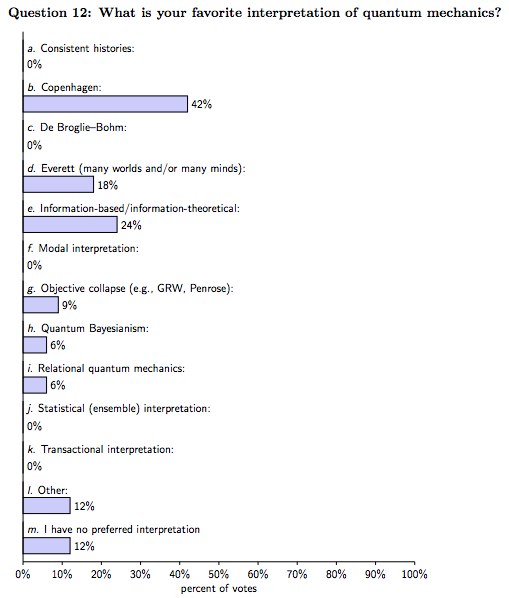
Only 42% of quantum physicisists would agree with the statement in the summary that "When two identical photons are coupled and the phase of one is changed, then thanks to the magic of quantum mechanics, the phase of the other photon also changes", and 40% of them would actively disagree. While the mathematics and measurement predictions of quantum mechanics is quite uncontroversial, the interpretation beyond that is a topic of much debate (much of which belongs in philosopy rather than physics).
The summary is using one such metaphysical interpretation, called the Copenhagen interpretation, which has more "magic" than most (spooky, faster-than-light action at a distance; wavefunctions that collapse when I, the Observer, looks at them, but not when anyone else does), and might be the most confusing one to the public (though admittedly, all the interpretations are confusing to some extent).
-
Re:How Would Hawking Radiation Dissolve a Black Ho
There is a generalized conservation of stress-energy-momentum in General Relativity ( you can get a glimpse of it here http://www.preposterousunivers... ).
Essentially, the gravitational field around the black hole is constantly swapping energy with the matter fields around the black hole. We do not know what's happening *in* the black hole, at least not at the very centre, but we are pretty confident about what happens at and outside the horizon. (The AMPS firewalls debate offers up the possibility that semiclassical gravity -- which is what we think happens outside the horizon -- is wrong in some limit. However, it's held up very well under observational tests to date.) However knowing exactly what's on and inside the horizon is not necessary to understand the stress-energy-momentum conservation, because we can see it with other observations at many scales (binary stars, galactic clusters, the metric expansion of space).
Energy donated from the gravitational field of the black hole creates a pair of matter particles. If both are drawn into the black hole, the energy is donated back.
It is exactly equivalent in reverse: high energy in the matter field (from, say, collisions with infalling matter, inverse compton scattering, and so forth) can produce a pair. If both are drawn into the black hole, that energy is donated to the gravitational field.
However, if only one half of the pair stays local and the other escapes to infinity, the local gravitiational field is diminished, whether it's the gravity from inside the event horizon, or very near but outside the horizon.
Likewise, both halves could escape to infinity, again reducing the local gravitational field.
We have good reason to believe that any horizon produces a thermal bath of particles -- Fulling–Davies–Unruh radiation. So right on the horizon there are lots of particles bubbling into existence *because* of the horizon itself. And some amount of that will escape to infinity, reducing the local mass-energy, and thus shrinking the black hole. A retreating horizon produces a greater flux of Unruh radiation, so a shrinking black hole in effect heats up *at the horizon*, which shrinks it further, until it evaporates. Hawking elucidated this process.
For an isolated black hole in various theoretical vacuums, the spectrum of the Hawking radiation is the same as blackbody radiation at a temperature that is entirely determined by the mass-energy of the black hole (or equivalently by the surface area of the horizon).
Stellar black holes and supermassive black holes are unlikely to be isolated, which means that radiation will interact with other matter in the accretion disk and nearby. Indeed, other radiation will be produced within the accretion disk itself, producing e.g. gamma or X rays and particle radiation that are possibly detectable by observatories in our solar system (depends on what gas and dust is between the source and us). When we see such radiation, it's because mass-energy was removed from the black hole system, which shrinks the system. Some *small* amount of that energy will have its origin in the black hole's gravity itself via the stress-energy-momentum conservation law.
-
Re:AmusingWe just discovered that we are made of atoms a little over one century ago, and our ignorance is vast. But we should also be careful not to err on the side of blindly assuming that anything is possible. It is essential to think clearly about what might and might not be possible based on what we know now in order to direct our investigations. Will we discover new laws of physics that are relevant to releasing energy from nuclear reactions? I suspect the answer to that is probably no, and the reason is the high precision we achieve from our current theories in describing the behavior of atoms and nuclei. Careful experiments of nuclear excitation energies, fusion cross sections, etc agree with theoretical calculations, often to many significant digits. There just isn't much place to hide new physics in this energy range. Of course new fundamental discoveries (dark matter, etc) are very likely. They just are unlikely to change our predictions for nuclear phenomena by a quantitatively significant amount. Would it be better to stay open minded because one can never be sure? (See http://www.preposterousunivers...) Or is it better to make audacious, falsifiable hypotheses, such as the hypothesis that we already know the laws underlying the physics of everyday life? (http://www.preposterousuniverse.com/blog/2010/09/23/the-laws-underlying-the-physics-of-everyday-life-are-completely-understood/)
That doesn't tell us much about how to engineer processes that obey the known laws of physics. Predicting what humans will be able to do is very very difficult...and people regularly get it badly wrong being both too optimistic and too pessimistic. In my mind, good hypotheses based on careful consideration of the best evidence are never premature. They just might be wrong.
-
Re:Useful but physics?Maybe we can try to help those ignorant of applied physics, but you may be right that they are hard to help...
There is a fantasy that lives on and on that physics is only the search for the fundamental rules of how the universe works. Physics does include the search for the most fundamental theory...things like trying to detect the higgs boson or understand dark energy. But those two pretty nicely define 'irrelevance' to the everyday lives of humans. If physics is only about the search for fundamental rules, then physics is essentially over as an enterprise with practical relevance. (See http://www.preposterousunivers...) But the overwhelming majority of physicists have long been working on applications of known fundamental physics to discover new emergent laws and new technological applications. Semiconductor and device physics is one of the great successes of 20th century physics and this achievement of fabricating gallium nitride with its large bandgap was a major advance, both in the fundamental science of crystal growth and in high frequency electronics as well as the production of blue light. This is exactly the kind of prize that should be given because we need the next generation of physicists to be finding fundamental problems that have practical relevance rather than using their talents on interesting but economically useless tasks like string theory. I predict that in the rest of the 21st cenury, there will be more Nobel prizes in physics given for biological, environmental, and neuroscience applications of physics than there will be for fundamental particle physics. If not, then the Nobel prize will be overshadowed by the Kavli prize or some other prize that recognizes accomplishments that have consequences for humans.
-
Practical breakthroughs in fundamental physics?
The subject of the likelihood of future breakthroughs in basic science is very important. But Horgan is not very good at articulating the main issues. Much better is Sean Carroll's blog: http://www.preposterousunivers...
To simplify the situation to make it comprehensible, consider two hypotheses about the future of science. (1) Science will have an eternal sequence of groundbreaking discoveries/paradigm shifts. (2) The highly successful models we currently use are so accurate that they will continue to be used forever.
The first hypothesis is beloved by scientists in search of funding and by sociologists of science who wish to treat science as merely a social construct. It really is a strange alliance, but a common cause can make strange bedfellows. The second hypothesis is much less widely defended. Partly because it is clearly false in a fundamental sense...we know that current models don't describe dark matter for example, and so they have to be wrong and are likely to be replaced. But the weight of the second hypothesis is on the 'accuracy' of our current models of fundamental physics. As Carroll clearly argues, there is nothing of practical importance in everyday life that we can show to be in violation of the current laws of physics. Of course there will be major breakthroughs in applied physics...major things like figuring out how atoms and cells form brains and intelligence or discovering how to compute solutions of quantum many body systems. But if we are forced to choose between the two hypotheses, I think the evidence leans toward Carroll's side: the fundamental physics of everyday phenomena does not deviate in any significant ways from known physics.
Many people can't seem to see the vast gulf that exists between the discoveries of Maxwell's equations or quantum mechanics (which are necessary to describe matter and light, fundamental aspects of our lives) and current work on dark matter and primordial gravitational waves (which require precision detectors observing things from outside our galaxy). Also, before you dismiss (2) with references to late 19th century quotes about the end of physics, take a few minutes and look at the history beyond the quotes. Those quotes were mined for science funding publicity. Many scientists in the late 19th century knew that they couldn't explain atomic spectra...Kelvin even worked on vortex models of atoms. And if you focus your attention on 'practical' physics, the claims that late 19th century physics was nearly complete turn out not to be too far off...engineers spend almost no time studying quantum mechanics or relativity. It might be 1 or 2 courses out of 20 that cover physics that was discovered since the end of the 19th century. In mechanical engineering there are typically zero courses on quantum mechanics or relativity.
-
Re:Perhaps...
Except that energy conservation in an expanding universe is a lot more complicated than that.
http://www.preposterousunivers...
(tl;dr - energy can flow between the fields of the standard model and the gravitational field. also not said: the gravitational field is self-interacting and so is highly non-linear unlike Newtonian mechanics or various quantum theories in flat spacetime).
Another way of looking at it is that conservation laws are dual to time translation symmetries (that's Noether's Theorem) and because the metric expansion of space is a biiiiig asymmetry when looking at it at different points in time -- the universe was smaller in the distant past than in the recent past -- there must be a violation of conservation laws.
So GP's line that you quote is pretty reasonable if you treat "reconstituted" as "cooled down" as the early universe expanded.
The "backwards in time" argument was dealt with by Wheeler and Feynman in their discussion about the one-electron universe and is why antiparticles move backwards on the timelike axis on Feynman diagrams today. However, that is a notational (and sometimes calculational) convenience rather than a real assertion that antimatter originates at the far future boundary of the universe, since there is a huge mismatch in the degrees of freedom available to the antimatter compared to the matter if that were the case, and we simply do not have evidence for the effect that this would have in laboratory experiments involving nuclear decays. That is, his Dirac-based thought is not valid over large distance scales in an expanding universe, which is too bad because it really would neatly explain the similarity of magnitude of charge between an electron and a proton, which the Standard Model simply has to postulate.
-
Re:Its own weight?
It doesn't matter where the particles or other objects come from, only that when they reach the event horizon the dominant term in their mass-energy is gravitational potential energy. That almost certainly means that they are moving thermally (and in particular not ultrarelativistically) and have a low rest mass.
Once inside the event horizon, an object that has a vanishingly small potential energy near the outside of the event horizon will wind up with a growing negative potential energy. This in turn reduces the energy of the entire black hole system.
There are a variety of possibilities to produce an object -- especially a small one -- dominated by gravitational potential at the horizon. One is pair production from fluctuations, which fits your description reasonably well. However, there is no guarantee about the fate of any particle in the outside limit of the event horizon: one or both may get boosted into an escape trajectory (e.g. via Compton scattering), find themselves part of an inner accretion ring, or even fall thermally into the black hole. This is easiest to analyse with an isolated black hole that interacts almost exclusively with the CMB: eventually the black hole will lose more mass than it gains. Where there is lots of material to sweep into an accretion disk, pair production straddling or in the outside limit of the event horizon will increase the mass of a stellar (or more massive) black hole.
However, there are other processes that may apply, including quantum tunnelling from inside the event horizon to outside it, Unruh radiation (which is not the same as pair production), ICS-vs-ISM, and so forth. Most of these can carry energy away from the total system, either directly by departing from it to infinity, or by infalling with a net negative energy.
And a final clarification of your last point: the "virtual background" that's important is not just the (false) vacuum but also the gravitational field itself, which is relevant via the more general conservation of energy-momentum in General Relativity.
-
Apologia for the Firewall theory
There's a write up for the Firewall theory at http://www.preposterousuniverse.com/blog/2013/06/05/firewalls-burning-brightly/
And as you guys are commenting about what the family should do
-
Re:Sam HarrisAre you aware of Chalmers tounge in cheek criticism of Penrose's hypothesis that he called "Minimisation of Mystery"? The critique goes something like this:
"Quantum Mechanics is mysterious. Consciousness is mysterious. Therefore the two mysteries must have a common source"
It was an attempt to show Penrose's thinking was erroneous. But here's the thing, the argument you make here is the same, but in reverse:
"Consciousness is mysterious. Free Will is mysterious. I can't explain these mysterious things so they must be illusions"
For the OP, this paper is based on the assumption that whatever the brain is doing is in principle computable. You need to add this to your basic axiom that the universe is entirely deterministic before you can decide the fact of the matter here. It seems to me that these are simply your beliefs. Given the current embarrassing state of physics, I would be a little more circumspect if I were you.
-
Re:catastrophically collapse
"Most material interactions are electrical"
Woah, there's lots of stuff that feels gravity and the weak and strong force but don't feel electrical charge.
Indeed, the stuff that interacts electrically is a tiny fraction -- by total field energy -- of all the stuff in the universe.Is the interaction between the piles of electrically quasineutral stuff called the Moon and the Earth "immaterial"?
The article at the top is really just another form of Quantum Interrogation. Carroll gives a good explanation here:
http://www.preposterousuniverse.com/blog/2006/02/27/quantum-interrogation/
-
Oops, wrong link
That was supposed to be "... but physicists are more mixed."
-
Re:what happens
Hawking showed that when you combine quantum field theory with black hole physics then they will produce what is now called Hawking radiation. The black hole will eventually evaporate away through this process. What finally happens is the subject of recent controversy. The physics is well beyond me, but the idea of it is that several current assumptions concerning physics lead to contradictions when considered in the context of black holes (in particular, entanglement leads to subtle problems), leading some to posit the existence of firewalls.
More info can be found here.
-
Re:And if one can't believe?
You've yet to show that Krauss holds that view. Abolishment through education (as higher education correlates with less belief in sky-fairies) seems to be what he advocates.
Huh? He want's it labelled child abuse.
No. He wants religious indoctrination of children to be labeled as child abuse. That is not equal to criminalizing religion.
It's also a blatant fallacy that "higher education correlates with less creation". In fact the opposite is true if a person pursues an education in Philosophy.
Wrong. 72.8 % of philosophers being atheists is much, much higher than the average in the US. Link to a very recent study: http://www.preposterousuniverse.com/blog/2013/04/29/what-do-philosophers-believe/
So, you couldn't find anyone giving those odds? Winning in lottery is a true/false question, how can anyone set those odds as anything different than 50/50? This is something that you seemingly fail to grasp.
Wrong, maybe you should go back and take a basic statistics class. Either that, or you need to stop twisting facts to support your beliefs, which would be the most advisable course of action.
But that's what you claim: The existence of a creator is a 50/50 chance situation, with nothing possibly skewing those odds to either direction. You just can't see how taking that stance in the lottery analogy leads to an absurdity. I'm not twisting any facts. I just find your unsupported 50/50 claim ludicrous, and tried to show how a true/false situation can mean anything but 50/50 odds.
The experiment comes from Philosophy first!
I don't really agree with this. The ancient Greek philosophers got several things wrong, when they didn't do the experiments they could have done.
You have a concept of something, you build a model to see if you are correct. The concept and thought process allowing you to build the experiment is Philosophy.
And that specific philosophy is called science. Philosophy in general lacks the self-correcting feedback that science has between the experiment and the theory. But, a theory begins with observations; usually such observations that aren't explained by existing theories.
I'm doubtful that you have a PHD.
Not my problem. My credentials are verifiable, but I'll prefer anonymity, as I don't try to make it an argument from authority. While you are on your trip to visit the cosmologist, find a couple of experimentalists and ask your philosophy question.
Einstein was not too happy about how Science was used against Japan either was he?
And? Science doesn't provide moral guidance in this sense. Though I'd like to know Einstein's view on atom bomb vs. invasion of the Japanese main islands, as the latter had a lot higher projected death toll.
We have found giant skeletons, which means that David and Goliath is very possible.
:D You do know that the giant skeleton was a hoax?
We have found all kinds of validation that a major world wide flood happened, so it is possible that this event occurred.
No. We have found evidence of local floods, but no evidence for a global one. And there isn't enough water on earth for a biblical flood.
Parting the Red Sea has been shown to have some merit with natural phenomenon, so while it may not have been a guy with a staff it could have happened.
Wind driving the water off from such a large area is a stretch, and it hasn't been demonstrated in reality. But yeah, I'll grant that it's not entirely impossible. The problem then is that you are trying to use a natural phenomenon as evidence for the supernatural.
-
Re:I Wish
If everything at the quantum level always worked the same way forwards as it does backwards, then entropy would be constant; the universe would be in some kind of steady state and nothing would matter because we wouldn't be here.
That's not true. "Everything at the quantum level always working the same way forwards and backwards" is completely consistent with the second law of thermodynamics ("entropy never decreases"), and completely consistent with the observable universe (barring CP violation). All that's necessary is that the universe started with very low entropy -- like, say, the Big Bang.
See for example this from this Arrow of Time FAQ (from cosmologist Sean Carroll):
The observed macroscopic irreversibility is not a consequence of the fundamental laws of physics, it's a consequence of the particular configuration in which the universe finds itself. In particular, the unusual low-entropy conditions in the very early universe, near the Big Bang. Understanding the arrow of time is a matter of understanding the origin of the universe.
-
Re:A lot of work
Five years ago Kip Thorne recommended Hartle's book "Gravity: An Introduction to Einstein's General Relativity", and it is a wonderful introduction to General Relativity. (I took calculus, linear algebra, advanced linear algebra, differential equations, real analysis, complex analysis, differential geometry, and Fourier analysis before taking the graduate course on General Relativity at UC Davis)
We used Carroll's book on General Relativity, which is more or less his lecture notes which are freely available online at http://preposterousuniverse.com/grnotes/
As far as understanding Einstein's field equations, a wonderful reference by John C. Baez and Emory F. Bunn: The Meaning of Einstein's Equation on Baez's webpage.
Dr Carlip recommended R. A. D'Inverno's Introducing Einstein's Relativity (Oxford University Press, Oxford, 1992) to the graduate physics class.
Dr. Joseph Biello recommended B. F. Schutz's A First Course in General Relativity (Cambridge University Press, Cambridge, 1985) as an introductory text, then follow it up with Robert Wald's General Relativity (University Of Chicago Press, First Edition edition, 1984). I don't know about this, because Wald himself admitted that he didn't give justice to the Lagrangian or Hamiltonian formalism for General Relativity.
When thinking about black holes, or any singularity, the standard reference on this subject is Hawking and Ellis' The Large Scale Structure of Space-Time (Cambridge University Press, 1975).
Everyone says "Misner, Thorne, and Wheeler" and I am inclined to agree. If you are serious about studying General Relativity, you have to read through this at least once. It is the Bible of General Relativity, although there are two opinions people have about it: they love it, or hate it. Those that hate it would object to my opinions...
When you want to start getting into quantum gravity or numerical relativity (i.e., using the computer to solve Einstein's field equations), you need to learn the ADM formalism. There are a few books on this.
Peter Peldan wrote a review article, "Actions for Gravity, with Generalizations" arXiv:gr-qc/9305011v1 which is a great review of all the many different types of variational ways to obtain General Relativity.
Bojowald just wrote a great book, Canonical Gravity and Applications, which is a fabulous introduction.
Poisson wrote a book on a lot of folklore topics in general relativity, which is based on his lecture notes (freely available online at http://www.physics.uoguelph.ca/poisson/research/agr.pdf). In fact, the only difference I can find is that the pdf doesn't have the index or table of contents, but everything else seems identical.
For numerical relativity, Baumgarte and Shapiro's Numerical Relativity: Solving Einstein Equations on the Computer is another fantastic reference. The only disadvantage is their index system is confusing.
As far as the mathematics, there are many books out there on differential geometry. The graduate course sequence on differential geometry at UC Davis used Manfredo P. do Carmo's Riemannian Geometry
However, many of them kind of ignore the intricacies of Lorentzian manifolds. Arthur L Besse's Einstein Manifolds (Springer, 2007) is a wonderful reference for this subject. (Arthur L Besse is a pseudonym for a group of mathematicians inspired by the Bourbaki group, and works primarily on differential geometry.)
-
Re:if there are several Black Holes, why notBigBan
Gravity getting "weaker" is probably referring to a scale-dependent Newton constant (or however else they've phrased the strength of gravity). Something like Horava-Lifshitz gravity is perhaps worth a look if you're interested in things like that and can find a popular-level thing on it (I think I read a survey of Horava-Lifshitz gravity on the New Scientist website a month or two back which was OK if a bit... undercited, shall we say). That's basically a theory of gravity that modifies the Newton constant on very small scales to make it easier to link with the other three forces. Failing that you could hunt out things on "Brans-Dicke" gravity, or "Scalar/Tensor" gravity, which are effectively theories with a *space*-dependent (rather than scale-dependent) Newton constant.
Easy reading on FLRW cosmology? Hmmm. For whatever flaws he might have, Sean Carroll's a very good communicator. http://preposterousuniverse.com/writings/cosmologyprimer/index.html is worth a look. (He might not use the words "FLRW" anywhere in it, which if so proves he's smarter than me when he's talking with non-specialists...)
-
Dark Matter Exists
Here is an excellent article by Sean Carroll of the California institute of Technology that explains why all the suggestions of the parent post may not be correct.
Basically, what it says is that if two large clusters of galaxies went right through each other, and dark matter was really like the normal matter in the way the parent post suggests, we would get a different result from what would happen if dark matter was for real. Astronomers have discovered one such system and this provides conclusive evidence for the existence of dark matter.
-
Re:Does Dark Matter exist?Why is it that scientists think that dark matter exists simply because the observed galaxies don't conform to Newton's Laws? Wouldn't a simpler solution be to take a step back and consider that, maybe, Newton's Laws are flawed? You want a solution that is simple enough to explain the facts, but no simpler. Modifying the laws of gravity runs into difficulty explaining everything that dark matter can, although you can get it to explain some things (such as galactic rotation curves). Can someone explain to me why dark matter is the prevalent theory? In short, because it works and none of the alternatives people have proposed over the decades work as well. I can get into details if you want, but you should probably just start at Wikipedia. Or perhaps why something like MOND is always ignored? MOND isn't ignored. Go to the astro-ph arXiv or the Smithsonian/NASA ADS Abstracts and search for MOND papers. You'll find them, along with criticisms of MOND. Here is a nice but somewhat outdated set of slides on how well MOND fares against the evidence, and a more recent blog post by the same author discussing newer evidence that tightens the screws on MOND even further. As I said, I don't know what is right, but it just seems like a hack-job to me. I don't know why all the hate for dark matter. Screwing around with the laws of gravity isn't any more elegant, and there are plenty of plausible candidate particles for dark matter lying around in various extensions to the Standard Model.