Slashdot Mirror
Domain: pulseaudio.org
Stories and comments across the archive that link to pulseaudio.org.
Comments · 23
-
Re:Make the switch from Dual Booting
LInux native "Ventrillo" http://www.mangler.org/ Works great for me, it now can output to ALSA not that PA crap*...
*Yes PA is crap, linux is a multi user environment, and i'd like all programs on my computer to make noise at the same time, that includes things like MPD, or any other service that i run. PA only works in a supported config with a single user. See http://www.pulseaudio.org/wiki/SystemWideInstance and http://www.pulseaudio.org/wiki/WhatIsWrongWithSystemMode and http://en.gentoo-wiki.com/wiki/PulseAudio#PulseAudio_Server
I haven't tried it yet, my music player is mpd as the mpd user, wine until recently did not support it, and the documentation for config is "if you can't figure it out tough shit, it's for distro packagers to figure out."
-
Re:Make the switch from Dual Booting
LInux native "Ventrillo" http://www.mangler.org/ Works great for me, it now can output to ALSA not that PA crap*...
*Yes PA is crap, linux is a multi user environment, and i'd like all programs on my computer to make noise at the same time, that includes things like MPD, or any other service that i run. PA only works in a supported config with a single user. See http://www.pulseaudio.org/wiki/SystemWideInstance and http://www.pulseaudio.org/wiki/WhatIsWrongWithSystemMode and http://en.gentoo-wiki.com/wiki/PulseAudio#PulseAudio_Server
I haven't tried it yet, my music player is mpd as the mpd user, wine until recently did not support it, and the documentation for config is "if you can't figure it out tough shit, it's for distro packagers to figure out."
-
Pulse audio doesn't have drivers
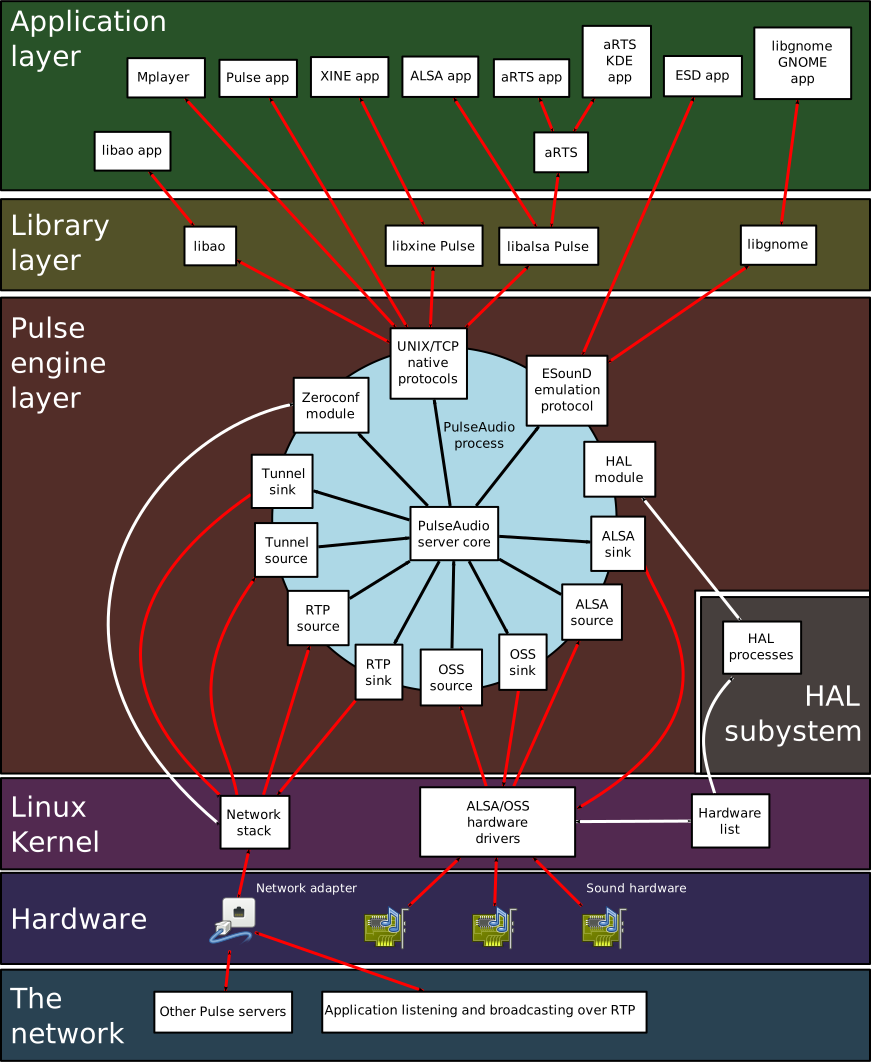
Can you please point me to this hardware compatibility list that you checked when you were "doing your homework". Because from what I can tell PulseAudio doesn't have any sound card drivers. It is just a sound server that provides network transparency and better mixing capabilites as an additional layer on top of the kernel sound support. It always uses an underlying layer like ALSA or OSS to talk to the hardware, as seen in this module diagram. Here is a full list of the PulseAudio modules - note that there are no direct hardware sinks, only sinks to other sound systems and piping capability.
-
Re:Fix Sound!
Well, I have a different history, pulseaudio has fixed all my audio problems. And there's no way Linux is going back to things like pure ALSA or OSS (to start with, users already depend on PA functionality that those systems can't offer. Also, PA tries to do what succesful desktop systems do, like OS X and Windows. BSDs/Solaris are not a good example of succesful desktops systems -> the main reason why OSS sucks). Of course, because it does things other systems didn't do, it causes problems (new versions of PA could have sound issues in kernel drivers that do not report db attenuation data correctly).
You can blame PA of those problems as much as you want, but it's the one with the balls to try to fix the linux sound problem. And the fact is that with every PA/kernel release the whole systems works better, and the number of PA whinners becomes smaller and smaller.
-
Re:who's to blame.
I am unsure where plain ALSA is failing that OSS4 isn't except in limited cases, perhaps where a device is further ahead in support? I hope you submitted details of your problems to the ALSA devs.
With regards to Pulseaudio, it uses the hardware in a different way to the OSS4 and ALSA APIs which is why you are unlikely to see a lot of the long term benefits of Pulseaudio ever crop up in OSS4 or plain ALSA. Because of the way Pulseaudio uses the sound hardware (a way that does make sense in the long term strategy of making audio perfect in all use cases with one system), issues crop up that didn't before such as drivers providing bad timing information, which you can see only matters if the audio system wants to be more efficient rather than settling for just working. There is a page summarising known bad drivers and what can be done about them.
My impression of most of the negative posts is that people are unhappy using a system that has not been thoroughly tested. That is a fine sentiment but I worry that it is leading to a conclusion that Pulseaudio offers nothing worth the hassle which I can assure you is far from the truth if people truly want a system that compares (or beats into submission) that found on Windows and OSX. OSS4 does not offer such a system and shows little intention of ever doing so and ALSA needs these hurdles overcome for Pulseaudio to do so.
-
Re:who's to blame.
I am unsure where plain ALSA is failing that OSS4 isn't except in limited cases, perhaps where a device is further ahead in support? I hope you submitted details of your problems to the ALSA devs.
With regards to Pulseaudio, it uses the hardware in a different way to the OSS4 and ALSA APIs which is why you are unlikely to see a lot of the long term benefits of Pulseaudio ever crop up in OSS4 or plain ALSA. Because of the way Pulseaudio uses the sound hardware (a way that does make sense in the long term strategy of making audio perfect in all use cases with one system), issues crop up that didn't before such as drivers providing bad timing information, which you can see only matters if the audio system wants to be more efficient rather than settling for just working. There is a page summarising known bad drivers and what can be done about them.
My impression of most of the negative posts is that people are unhappy using a system that has not been thoroughly tested. That is a fine sentiment but I worry that it is leading to a conclusion that Pulseaudio offers nothing worth the hassle which I can assure you is far from the truth if people truly want a system that compares (or beats into submission) that found on Windows and OSX. OSS4 does not offer such a system and shows little intention of ever doing so and ALSA needs these hurdles overcome for Pulseaudio to do so.
-
Re:Useless
It definitely works as a daemon
On Gentoo:
desktop ~ #
* Please don't use system wide PulseAudio unless you read the
* documentation available at http://www.pulseaudio.org/wiki/WhatIsWrongWithSystemMode
*
* When you're done, please set the variable PULSEAUDIO_SHOULD_NOT_GO_SYSTEMWIDE in
*
* when used for standard desktop configurations.
* ERROR: pulseaudio failed to startQuoted from that link: "The maintainer's interest in making sure system mode is well supported is rather minimal."
-
Re:Let Me Speak For Slashdot And Open Source World
I use an obscure distro called "Ubuntu" that halfway switched to PulseAudio during the latest release, breaking half the audio on my system until I uninstalled it. PA might be a great thing but the current state of it, right now, today, on the most common Linux systems, ain't so hot.
I use that same obscure distribution. On my system, it did NOT install pulseaudio (I may have installed the day before the release or something) and I had to install it and follow PerfectSetup before audio stream mixing would even work (HP's implementation of snd-hda-intel hw == poop)
-
Re:Isn't it strange
PulseAudio, you might have a point
The only thing wrong with PulseAudio is the way it is implemented in Ubuntu. The Ubuntu packagers have clearly not understood (or perhaps even read) PerfectSetup. PulseAudio worked perfectly for me in Intrepid (not making this up) and still works perfectly in Jaunty, but in both cases I had to follow the PerfectSetup guide in order to make it so. This was especially egregious in Intrepid, where pulseaudio was installed by default. I had to install it to get mixing working on my laptop (HP 8730w with snd-hda-intel) and now everything is beautiful.
-
In Defense of Pulseaudio
Ubuntu did a shit job of implementing audio configurations. This boggles the mind because even while they were implementing it you could simply read PerfectSetup to learn everything you need to know. I did this on both Gutsy and Hardy with 100% success (not an exaggeration.) I am now running Intrepid on HP Elitebook 8730w and pulseaudio is part of the solution. I haven't gone through PerfectSetup yet, but that's coming. Save your hatred of pulseaudio, it's misplaced. It is the job of the distribution to properly configure the software for the user.
-
File a bug.
That can't possibly be expected behavior. File a bug with your distribution if it's not already known (see the following; I don't know what distro you're using).
https://bugs.launchpad.net/ubuntu/+source/pulseaudio/+bug/207135
http://bugs.debian.org/505097
https://bugzilla.redhat.com/474745
http://pulseaudio.org/wiki/BrokenSoundDriversThe developers can't possibly have all of the relevant hardware; they need users who run into problems to help them out. Please try to help if you can; it might help the bug get fixed quicker.
-
Some complaints are not valid
consistent configuration system
What a dope; because we know this has worked so well for windows. The registry is a nightmare on Windows. Linux/Unix does have a consistent model and it is known as text configuration files. It's powerful and can be leveraged on even the slowest of links. One size does not fit all - although I've seen far too many applications use XML for this where it makes absolutely no sense whatsoever.
native file versioning
Seems Linux is now held to a higher standard. Again, what a dope. Outside of the VMS crowd, I've not seen a huge outpouring of demand for this feature. Having said that, I do believe a versioning FS is in the works and for all I know, some may already be available. Realistically, few people want this and most have no clue what it even means. For the general use case, RC-software already exists to fill this niche. His complaint is empty.
audio APIs
As far as I'm concerned, it's done. Pulseaudio and ALSA are all that you need. If you have more specialized needs, then JACK Audio takes care of you. For the majority of people, Pulseaudio has what you need and is also portable to Windows. Many (most?) distros are already moving or have completed their move to Pulseaudio. As far as I'm concerned, this issue is addressed, save only for migration time for slow adopters.
integration of X11 with apps
This means nothing. What a dope. All GUI applications which communicate with X are integrated.
and integrate better on the back-end with the kernel
Again, what a dope. This means nothing.
In a nutshell, his complaints are silly, meaningless, or have been addressed. As far as I can tell, his only complaint which has any merit is audio API standardization and that has been achieved.
-
Re:EeePC, anybody?
Alsa? What about the up and comming Pulseaudio. While it's great, it's a configuration nightmare waiting to happen. Especially with ESD and ARTS in the mix (no pun intended).
Pulse has esd compatibility, so just get rid of esd: http://packages.ubuntu.com/hardy/pulseaudio-esound-compat
Not for arts, though: http://www.pulseaudio.org/wiki/FAQ#WhataboutcompatibilitywithaRts
4. A big "fuck you" to all underpants gnome pusrists
http://www.pulseaudio.org/wiki/FAQ#IsPulseAudioaGNOMEprogram
Thanks for playing.
-
Re:EeePC, anybody?
Alsa? What about the up and comming Pulseaudio. While it's great, it's a configuration nightmare waiting to happen. Especially with ESD and ARTS in the mix (no pun intended).
Pulse has esd compatibility, so just get rid of esd: http://packages.ubuntu.com/hardy/pulseaudio-esound-compat
Not for arts, though: http://www.pulseaudio.org/wiki/FAQ#WhataboutcompatibilitywithaRts
4. A big "fuck you" to all underpants gnome pusrists
http://www.pulseaudio.org/wiki/FAQ#IsPulseAudioaGNOMEprogram
Thanks for playing.
-
I doubt they will sell a boxed copy for home use
...because it didn't sell well in the past and the margins weren't there. I don't know that I'd go so far to say as they've completely abandoned the desktop though (at least not the corporate one). They've helped develop things like NetworkManager and other things like pulseaudio. I can't see how those are server/multi-user orientated pieces of software.
-
GTK is a windowing/widget toolkit, that's it
Qt4.4 is bringing in a media API with backends to DirectShow (Win), Quicktime (Mac) and a bunch of sound servers on Linux. Does gtk have anything remotely similar?
No. Why should it? This kind of stuff is handled by GStreamer and PulseAudio, each of which has its own development community (including a few companies) around it. Which means there is no single central power behind the development, for better or worse. Nokia participates in all of these projects, too. -
Re:asshats
You'll have to take that up with him. He referred to the change log of the software, so unless the change log is also wrong, I'm more inclined to take his word than yours, since you've offered no evidence.
I've offered plenty of evidence. I pointed out exactly which version the feature was possible. The mysterious other party is probably pointing at The PulseAudio "Oldnews" page which indicates 2006-04-13 version 0.8 was when the pavucontrol was written. Pulseaudio, like Jack and Nas have had the ability to have per-application volume controls that predates this event: Try ESD-enabled xmms with polypaudio and you'll see that xmms "esd volume" controls only xmms.So the tactic here is to change the definition of "LiveCD" until it only fits Linux?
How exactly did I do this? I offered a link that included a definition, you said Mac OS did this, but I pointed out Linux did it first.Tell me what the difference between the Ubuntu LiveCD and the Mac OS 8 CD I have on my shelf is.
Straw man.
Difference between Slackware 2floppy X and your mac os 8 is that the slackware run came first, and that it could also run on a pair of floppies (instead of just a cd+floppy emulation)Well, then, you sir are a weasel for changing the definition of "LiveCD" until the Mac OS Classic CDs no longer fit it. By your own definition.
You say Mac OS 8 did it in 1997, and I say Linux did it in 1994. What exactly did I change my definition to? I simply rejected all versions of Mac OS 7 because I can't verify it and frankly neither can you. Versions prior to 7.5 would be old enough to qualify (perhaps) but I'm not sure that 7.5 worked as you suggest. I'd be happy being wrong on this point because I'd still not be sure that the idea originated with Mac OS, just as I'm not sure that pavucontrol was based on Vista as you keep insisting.
In fact, I'd say you're making a bold claim by saying that Microsoft invented anything that has advanced the state of the art, but you'd probably weasel around that one too. -
asshats
I'm sorry, Pulseaudio fucking rocks. I love having every application being able to have a different volume setting. And that's just what tickled me most recently. This asshat believes that innovation comes from economic stimulation because he defines innovation as that thing that Microsoft is doing.
If you instead note that Microsoft has seen greater economic benefit by holding back the state of the art, it becomes easier to see this idea as a load of horseshit, or is the author still waiting for Cairo and Longhorn?
Red Hat clearly recognizes this, as their core business model comes from them hiring experts in Linux. Ubuntu might be philanthropy, or it might not, but it has experts as well, and experts competing to advance the state of the art is what makes Free Software the best system for the development of the information industry. -
Re:Vista Sound
The pulseaudio sound daemon does this.
screenshot
It allows for setting the volume per audio source. -
PulseAudio
PulseAudio, which is a cross-platform audio server/proxy. Is supposed to have very good synchronization across different' sound cards and across the network. I havn't gotten to play with it much, but it might be the solution you are looking for. http://www.pulseaudio.org/
-
Re:That's hardly an exploit
Yeah, somebody was working on a project like this...I'm trying to remember the name. I think it might have been Pulse Audio? http://pulseaudio.org/
-
PulseAudio
Transport: JACK audio connection kit: supported by almost all linux audio software.
I have recently spent a lot of time researching network-transparent audio transport applications so that I can, for example, walk around my apartment with a wireless Linux laptop while it is outputting sound to big speakers in the room (over wifi to a Linux media server connected to an audio receiver).
I have come across JACK and a dozens other apps, but it seems that PulseAudio is by far the most advanced and the cleanest implementation out there. It is multi-platform, it comes with dozens of plugins (alsa, oss, esound, etc) for max compatibility with existings apps, it is a clean architecture, etc. I haven't taken the time to test it yet, but it seems very promising. Has anyone here had previous experience with PulseAudio ?
-
Re:Finally, ALSA support
There are workarounds. I use PulseAudio (hooked to an ALSA backend nonetheless) with the alsa-lib pulse plugin, and PulseAudio can use any number of backends including OSS.
See http://pulseaudio.org/ .