Slashdot Mirror
Domain: quantamagazine.org
Stories and comments across the archive that link to quantamagazine.org.
Comments · 19
-
Re:Wow maybe did something right for once
Not some random cunt with a Wordpress moaning. We were just wrong at the qubit-counts required to outpace classical computing, which we thought were considerably smaller.
Is that the Royal We? Must be, because I sure don't think anyone else with a qubit chub is voluntarily sharing your misogynist tub.
Major Quantum Computing Advance Made Obsolete by Teenager — 31 July 2018
In the spring of 2017 Tang took a class on quantum information taught by Scott Aaronson, a prominent researcher in quantum computing. Aaronson recognized Tang as an unusually talented student and offered himself as adviser on an independent research project. Aaronson gave Tang a handful of problems to choose from, including the recommendation problem. Tang chose it somewhat reluctantly.
Good lord. Aaronson is one of the few people in this field I actually respect, and even his best efforts to put some robust daylight in between QC and classical algorithms are not exactly stumping Terence Tao.
-
Re:Great!
The question (which the writer didn't ask or answer) is how the machine learning systems can be improved to be more resistant against such simple modifications.
https://www.quantamagazine.org...
When human beings see something unexpected, we do a double take. It’s a common phrase with real cognitive implications — and it explains why neural networks fail when scenes get weird.
Most neural networks lack this ability to go backward. It’s a hard trait to engineer. One advantage of feed-forward networks is that they’re relatively straightforward to train — process an image through these six layers and get an answer. But if neural networks are to have license to do a double take, they’ll need a sophisticated understanding of when to draw on this new capacity (when to look twice) and when to plow ahead in a feed-forward way. Human brains switch between these different processes seamlessly; neural networks will need a new theoretical framework before they can do the same.
-
Re: Wait, so there are actual experiments?
Supersymmetry is also predicted by other theories, so it isn't a unique prediction of String framework (they shouldn't call it String Theory because Theory is reserved for well established systems in science, such as GR, QFT, evolution, etc). Also, given the landscape problem, if supersymmetry wasn't found at the SSC they could just say that it only appears at higher energies, as some scientists are currently saying after the LHC has ruled out the more plausible SUSY theories that solve the naturalness problem already:
The first step is to backpedal from their earlier claims. This has already happened. Originally we were told that if supersymmetric particles are there, we would see them right away.
“Discovering gluinos and squarks in the expected mass range [] seems straightforward, since the rates are large and the signals are easy to separate from Standard Model backgrounds.” Frank Paige (1998).
“The Large Hadron Collider will either make a spectacular discovery or rule out supersymmetry entirely.” Michael Dine (2007)
Now they claim no one ever said it would be easy. By 2012, it was “Natural SUSY is difficult to see at LHC” and “"Natural supersymmetry" may be hard to find.”
Step two is arguing that the presently largest collider will just barely fail to see the new particles but that the next larger collider will be up to the task.
Hence the surprise when the supersymmetric partners of the known particles didn’t show up — first at the Large Electron-Positron Collider in the 1990s, then at the Tevatron in the 1990s and early 2000s, and now at the LHC. As the colliders have searched ever-higher energies, the gap has widened between the known particles and their hypothetical superpartners, which must be much heavier in order to have avoided detection. Ultimately, supersymmetry becomes so “broken” that the effects of the particles and their superpartners on the Higgs mass no longer cancel out, and supersymmetry fails as a solution to the naturalness problem. Some experts argue that we’ve passed that point already. Others, allowing for more freedom in how certain factors are arranged, say it is happening right now, with ATLAS and CMS excluding the stop quark — the hypothetical superpartner of the 0.173-TeV top quark — up to a mass of 1 TeV. That’s already a nearly sixfold imbalance between the top and the stop in the Higgs tug-of-war. Even if a stop heavier than 1 TeV exists, it would be pulling too hard on the Higgs to solve the problem it was invented to address.
-
Actual article and news.
https://www.quantamagazine.org...
Is the article article about what was done, not the cut down version from a gossip rag sheet which is given in the summary. -
Re:Pay No Mind List
Yeah, me too.
Try https://quantamagazine.org/ for some nice reading. Interestingly, they are supported by a Foundation that largely depends on contributions, and are not profit-making.
-
Re:The Rainbow Scare
There's not a whole lot that the Y chromosome carries, and there are predictions that it will atrophy into carrying no information in 4.6 million years at the current rate of decay: https://www.quantamagazine.org...
While the X chromosome carries 1,000 or so genes, the Y chromosome currently carries 200 genes and declining: http://gizmodo.com/the-y-chrom...
Most of what people think the "male" chromosome carries is based on unscientific knowledge. Your chest hair, beard, and other male traits, do not come from the Y chromosome, but are instead expressions of the X chromosome under high levels of testosterone. That's why people without the Y chromosome can have sex-change operations and get a beard, chest hair, etc. by taking testosterone supplements. Testosterone also increases aggression and risk-taking, even for individuals without the Y chromosome.
-
Re:Annealing again
-
Re: IMHO
-
Meanwhile unhackable code confirmed
I would love him to address this news: https://www.quantamagazine.org...
-
Re:"it was used for children's writing exercises"
this guy may have figured it out
https://www.quantamagazine.org... -
Pretty high level of skepticism here
Reasons to be skeptical about these authors and their methodology: they publishing the same claim over with changes in data but no explanation for why their numbers are changing. This article explains the physics as well as the reservations about the claim: https://www.quantamagazine.org...
-
Forget something?
-
Re:Distance?
Another possibility that would make the action at a distance non-spooky is the ER=EPR hypothesis:
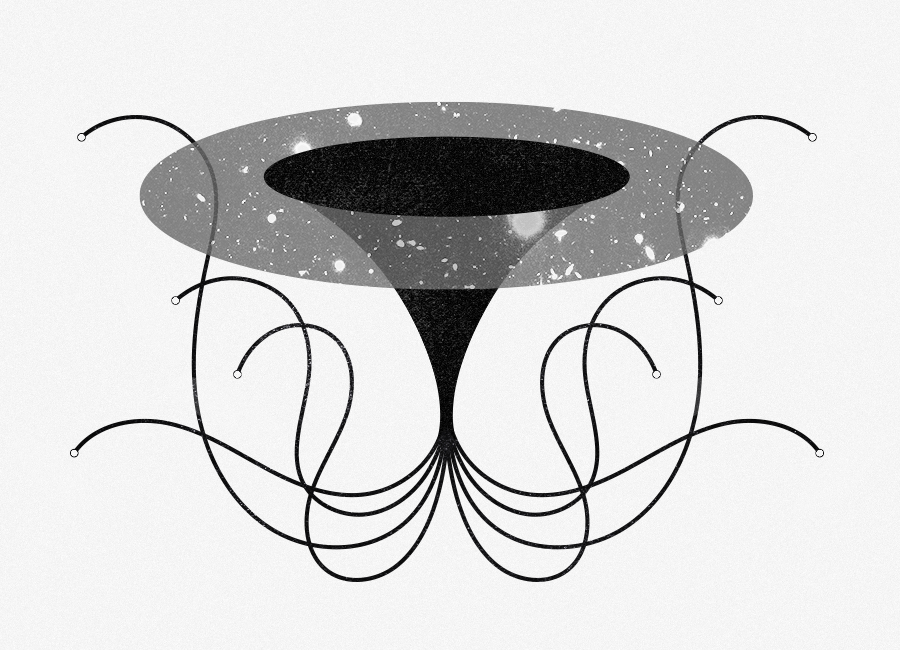
Like initials carved in a tree, ER = EPR, as the new idea is known, is a shorthand that joins two ideas proposed by Einstein in 1935. One involved the paradox implied by what he called “spooky action at a distance” between quantum particles (the EPR paradox, named for its authors, Einstein, Boris Podolsky and Nathan Rosen). The other showed how two black holes could be connected through far reaches of space through “wormholes” (ER, for Einstein-Rosen bridges). At the time that Einstein put forth these ideas — and for most of the eight decades since — they were thought to be entirely unrelated.
But if ER = EPR is correct, the ideas aren’t disconnected — they’re two manifestations of the same thing. And this underlying connectedness would form the foundation of all space-time. Quantum entanglement — the action at a distance that so troubled Einstein — could be creating the “spatial connectivity” that “sews space together,” according to Leonard Susskind, a physicist at Stanford University and one of the idea’s main architects. Without these connections, all of space would “atomize,” according to Juan Maldacena, a physicist at the Institute for Advanced Study in Princeton, N.J., who developed the idea together with Susskind. “In other words, the solid and reliable structure of space-time is due to the ghostly features of entanglement,” he said. What’s more, ER = EPR has the potential to address how gravity fits together with quantum mechanics.
-
Re:This is huge
That is amazing! Thank you.
So if we give up locality we can keep determinism, right? So what if we assume for a second that the holographic principle is true and somehow the information that makes us up is on the 3 dimensional (2+1) boundary of our lightcone rather than us really being particles at the center of the cone. Would that information being so far away on the boundary like that fulfill the non-locality requirement somehow?
One more if you would, does ER=EPR satisfy non-locality and allow determinism?
-
Re:Quantum entanglement = wormholes
Here it is, the FSM:
-
octupus hiding in a witch's hat
illuminati!
So if you drop one of an entangled pair of particles in a black hole, they stay entangled through a wormhole? -
Other factors as well as in this article comment
Very insightful: https://www.quantamagazine.org...
"Carmi Turchick says: February 13, 2015 at 9:30 am
Agree with Ratcliff's last statement. The issue is considerably more complicated in humans than in bacteria, and even in bacteria one needs to consider how hostile the environment is. What is astonishing about most of the PD literature is how it claims to examine evolution but never mentions the environment. A hostile environment, as Dugatkin showed, selects for more cooperation. The free-living bacteria that under drought convictions form a colony that creates a stalk and spores are an example and they point to the next error, which is assuming a reward is always available no matter the actions of the players. This is not how nature works. If too few of the bacteria cooperate, no stalk is made, no spores are released, all of the bacteria have a fitness of zero. Similarly in humans there are many times when obtaining any reward requires N number of individuals to cooperate, and often that number is unknowable. Nine of us might kill that elephant, or it might be one or two or three too few to get it done resulting in nothing for all of us. Even with two partners, if you selfishly fail to cut off the monkey's escape route he gets away and we both go hungry. Think I will go hunting with you again? Which brings up yet another issue; avoiding detection and the cost of being detected. PD assumes that the cost of defecting is limited to a partner picking defect in the next round. Some models allow partners to punish a player at a significant cost to themselves or to move to another partner, but even these fall well short of what we see in human groups. As described by Boehm in "Heirarchy in the Forest," those whose selfish behavior is detected face collective punishment by the group, costing each group member very little, which ranges from social shunning to being murdered by one's own family or abandoned and left alone by the group. The power in a group of cooperators belongs to the cooperators and not the defectors, as cooperators work together to thwart defectors but defectors by definition cannot gang up on cooperators in return. As PD examines interactions with two parties, if the cooperator is paired with a defector or extorter they have no one to cooperate with. But in a group they have plenty of cooperative partners while the selfish stand alone. This imbalance of power means that the opportunities to defect are extremely limited as one must avoid detection, a situation which favors cooperation as the dominant and more numerous strategy. Finally, in group social territorial species having and defending a territory is an all or nothing issue with N number required to keep neighbors from taking your land and killing everyone. Either all of you have land and lives or none of you have land and at the very least few men and children survive. So we see that fairly often the "reward" for defecting is actually not 3 or whatever number is randomly chosen, but instead it is nothing, or loss of social status, or it is death for the individual, or death for the individual and all their relatives." -
Re:Copenhagen interpretation != less complicated
Seriously guys, we need to drop the copenhagen interpretation already. Pilot-wave theory eliminates the need for quantum mysticism.
That theories been prove wrong hundreds of times now.
The simplest explanation of why it's wrong is that it's Deterministic. i.e. it's part of the "Clockwork universe" and if that's true, then you do not have free will and we should all just throw in the towel now... oh wait, that's right, we don't have a choice. Don't worry, I know it's not your fault that you posted this though, it wasn't up to you!Determinism = fail
-
Copenhagen interpretation != less complicated
Seriously guys, we need to drop the copenhagen interpretation already. Pilot-wave theory eliminates the need for quantum mysticism.