Slashdot Mirror
Domain: realclimate.org
Stories and comments across the archive that link to realclimate.org.
Comments · 1,734
-
Re:bad enough we have wasted billions on futility
"climate change will cause drought", then "climate change will cause stronger storms, then "climate change will cause flooding"...depending on what the global weather at the time seemed to be doing.
Actually it's often the media that say these things when they want to make some simplified link between the weather and "climate change". Scientists are well aware that weather is not climate. For example, with Hurricane Katrina you had some commentators saying that "Hurricane Katrina was caused by global warming". It's a nice, simplistic soundbite that the average American television viewer can understand. However, scientists understand that the world is more complex than that, which is why they actually say things like:
The correct answer–the one we have indeed provided in previous posts (Storms & Global Warming II, Some recent updates and Storms and Climate Change) –is that there is no way to prove that Katrina either was, or was not, affected by global warming. For a single event, regardless of how extreme, such attribution is fundamentally impossible. We only have one Earth, and it will follow only one of an infinite number of possible weather sequences. It is impossible to know whether or not this event would have taken place if we had not increased the concentration of greenhouse gases in the atmosphere as much as we have. Weather events will always result from a combination of deterministic factors (including greenhouse gas forcing or slow natural climate cycles) and stochastic factors (pure chance).
Due to this semi-random nature of weather, it is wrong to blame any one event such as Katrina specifically on global warming – and of course it is just as indefensible to blame Katrina on a long-term natural cycle in the climate.
Scientists are also smart enough to understand that there will be regional differences in climate change effects ("Prediction of the detailed regional distribution of climatic anomalies, where and when it will be wetter and drier, how many more floods might occur in the spring in California or forest fires in Siberia in August, is simply highly speculative."), which is why regional cooling does not disprove global warming.
Thus exposing their basic methodology of cooking the books to conform to what answers they wanted, including taking a 25 year period and extrapolating into the future to get the "hockey stick". They when planet earth went off the hockey stick, "where is the heat going?" the "climatologists" were wailing, and now the public is awakened to their scam.
The "Hockey Stick" was endorsed by the U.S. National Academy of Science, after it was asked to investigate the issue by the U.S. Congress. So unless you think the U.S. National Academy of Science is part of a conspiracy of fraud, or is fundamentally incompetent, then you'd have to agree with their statement that: "The basic conclusion of Mann et al. (1998, 1999) was that the late 20th century warmth in the Northern Hemisphere was unprecedented during at least the last 1000 years. This conclusion has subsequently been supported by an array of evidence that includes both additional large-scale surface temperature reconstructions and pronounced changes in a variety of local proxy indicators, such as melting on ice caps and the retreat of glaciers around the world".
-
Re:For our sake
Perhaps it would help to show an example where my editing wasn't intended to portray you in a negative light. After you cited an E&E paper to support the claim that sunspot cycle length is responsible for recent warming, I said:
... But I'll make it up to you. Here's an article by Friis-Christensen and K. Lassen, published in Science in 1991. This would have been a legitimate example of a peer-reviewed journal article supporting your claim.
Of course, it's incorrect. You can find out how-- if you're interested-- by following its citations in google scholar to the present. For nonscientists, read the summary here. The moral of this story is that data smoothing is difficult to do in an objective manner, which is something all computational scientists screw up on occasion. Please don't mistake this comment as criticism of Friis-Christensen or K. Lassen-- I've certainly made far bigger mistakes in my own research. The ability to admit a mistake and move on is the mark of a true scientist. [Khayman80, July 09 2009, @09:37PM]
After some more unpleasantness, I later repeated:
... The claim that sunspot cycle length correlates well with Earth's average temperature was made in the mainstream journals in 1991. But it was quickly shown to be a spurious connection based on data smoothing parameters. The fact that "Energy and Environment" didn't catch this when the argument was made again 15 years later just shows that they're not experts in the field.
You responded:
... As I stated before, I only found that paper after you asked me to find one, and I was not particularly careful in choosing it; you had asked for a peer-reviewed paper, and I just grabbed the first one that was visible. And indeed, some of its claims do appear to be refuted, particularly in a paper by P. Damon, published in Eos in 2004. However, though you apparently knew this (as, I could guess, did Mr. Landis), neither of you bothered to cite any kind of actual data in an attempt to refute the one paper I provided, per your request.
After you mentioned the data smoothing issue, it took me about 2 minutes to find Damon's paper. If I had been aware of it in advance, I would of course not have offered that paper. But if you really wanted to make a point -- and practice what you preach -- you should have cited your sources. Instead, you left me to look it up... which makes you are guilty of exactly the same faux pas of which you accuse me. In point of fact, Damon's paper itself states, "The graphs [from Friis-Christensen and Lassen] are still widely referred to in the literature,and their misleading character has not yet been generally recognized." Without citing sources, then, how did you expect me to know?
So, as it stands, I believe that the form of your response has been rather hypocritical.
I was shocked to see this comment. But address
-
Re:This is not science.
"A crank who has yet to release his code that gives results that supposedly shows that everybody else's code is wrong. Gee, don't you wish this were a two-way street?"
All code used in analysis was released several years ago and is public.
Also, it's documented here: http://www.realclimate.org/index.php/data-sources/
-
For climatology, this is a non-issue
While I am fan of open source and this idea in general, for climatology, this is a non-issue. Look there: http://www.realclimate.org/index.php/data-sources/
It's more code out there than one amateur can eat for life. And you know what? From the experience of people who wrote these programs, there isn't actually much people looking at it. I doubt that any scientific code will get many eyeballs. This is more a PR exercise.
-
What about McIntyre's faulty data?
What about McIntyre's faulty data?
Ah, no FOIA there, because he's toeing the party line.
Note: He's not the only denial ditto who refuses to release his code:
http://www.realclimate.org/index.php/archives/2009/12/please-show-us-your-code/
Oh, the meeja is quiet about that, isn't it...
-
CRU data
-
Re:It's shitty science, Rei.
So why the decrease when the CO2 keeps increasing year after year?
I swear, it's like a whack-a-mole game sometimes.
Want to know how badly the people you've been listening to have been misleading you? Take a look at a temperature graph. To get that "decrease" in temperature, they have to:
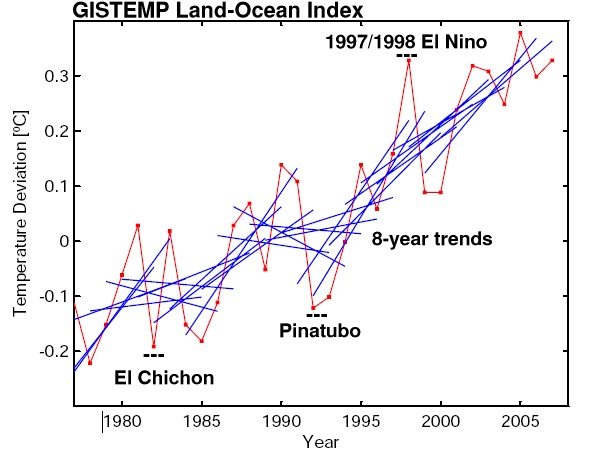
1) Cherry-pick the hottest year they can as the starting point (1998 -- one of the most intense El Nino events on record) and use that as a starting point. See the huge one-year spike in 1998? That's what they're picking as their starting point.
2) Pick a lower subsequent year and use that as an end point (often 2008, a La Nina year)
3) Pick the one (of three) major global temperature datasets that makes 1998 hotter than 2005.
4) Ignore the actual way you create a trend line (you don't just look at the start and end points -- you also include a weighted average of the intermediary points.If you skip any one of those things, you get the opposite result. Let me explicit: anyone who pushes that point who's not just passing along something they heard from someone else is deliberately trying to hoodwink you.
In case you're curious about El Nino/La Nina: El Nino involves the weakening of the Walker Circulation, an equatorial atmospheric wind pattern. This slows the upwelling of deep, cold water in the Pacific. So the equatorial Pacific in an El Nino year has a big splotch of warm water across it, which heats the atmosphere more than usual. In a La Nina year, the Walker Circulation increases, leading to a big splotch of cold water across the equatorial Pacific, cooling the atmosphere.
-
Re:Inconclusiveness
Let's examine two hypothesis:
- We mod you down because we've been indoctrinated into a vast left-wing conspiracy to cripple the economy on the pretext of saving the environment; or
- we mod you down because you're wrong, and every reputable scientist disagrees with you
Occam's razor shows that we should go with #2 until you can support your opposition to 50 years of climate research with something more substantial than the latest easily debunked talking point.
You're not entitled to your own interpretation of the facts. Climate change is real. Tax cuts aren't an economic panacea. Obama's health care plan will not kill people. The Great Depression was not prolonged by the New Deal. Evolution by natural selection, not intelligent design, explains the complexity of life.
If you differ about policy choices within the framework of well-established facts, great. We can talk about that. But if instead, you obstinately deny any facet of reality that's hostile to your theory, then there no choice left but to moderate you into oblivion and make room for people mature enough to face the world as it is, not as they think it ought to be.
-
Re:It's shitty science, Rei.
Yes, we've studied the Sun intently. Is that supposed to mean that we have a complete understanding of its effect on the climate? Really?
Yes. Read the papers (if you need a starting point, you can find them all referenced in AR4, Ch.02). All of the sun's impacts but one (upper-atmospheric GCR shielding's role in cloud seeding) are very easily measured and straightforward on Earth, with the massive variety of different datasets matching each other. GCR provided the only degree of uncertainty to constraining the influences of the sun, and has since been much better constrained. Even the difference between peak and minimum output doesn't provide anywhere even in the same ballpark as much forcing as CO2.
After all, even most of the die-hard warming advocates admit that they can't explain the current cooling trend in their models.
Who the heck are you listening to? First off, there is no cooling trend. There is a small (25%) decrease in how rapidly it's risen due to stratospheric water vapor, a decadal-scale factor.
Seriously, stop listening to people who don't know what the f*** they're talking about.
-
Re:Sounds like a coal industry shill
Because that's exactly what the CRU data is: mystical mumbo-jumbo.
Just because you're too stupid to read how the data is processed or compare it to what naive processing would yield... oh who the f*** am I kidding? Yes, it's mystical mumbo-jumbo. They're just trying to make the lightning-power that walks through wires into your house and runs your picture box and your clickety email machine cost more. CARBON GOOD!
-
Re:Obligatory
Reminds me of this:
Man: Of course, since the Green House Gases are still building up, it takes more & more ice each time. Thus solving the problem once and for all.
Suzy: But...
Man: ONCE AND FOR ALL!The sad thing is that some people with platform are basically proposing this approach.
-
Re:Overstated issue by deniers
Simply read http://www.realclimate.org/index.php/archives/2010/01/the-ipcc-is-not-infallible-shock/ Read the referenced paper there by Karkel et al. The link is at the end of the blog post. In general, the deniers have good PR. They are funded by the fossil fuel industry to disseminate their propaganda and destroy the confidence in science. Slashdot is technology and scientific method. We should not fall for that crap.
-
Mind the deniers
-
Again, the deniers post on Slashdot
For the real story, read RealClimate,
http://www.realclimate.org/index.php/archives/2010/01/the-ipcc-is-not-infallible-shock/ -
Re:Selling the lie
No one is predicting a complete melting of Greenland as a result of CO2 being added to the atmosphere. The IPCC report puts the estimate at under a meter. There has been some controversy since then, but none of the predictions are drastic. If you have heard predictions of New York being under water, or all of Greenland melting, this is from some propaganda source, not from a scientific source.
-
Re:90 Years Out
give me a break! and that is without Chaos theory applied to the entire differentiable manifold.
This is not about calculating some kind of Lyapunov exponent, predicting the *weather* 90 years from now is indead "FUD and hand waving", but the rise in sea level is predicted as a result of predicting the *climate* change instead.
If you're fat now, that's not because you stuffed yourself at a party 20 years ago and the Chaos butterfly fell in love with you, but it's more or less extrapolatable from your past diet, past weight, and eating habit trends.
But then, you probably already knew all that. It's debunked here (realclimate.org "Chaos and Climate") -
Re:Mini ice age coming. Unless IPCC wrong of cours
"So you don't believe the IPCC's scientists then?"
How can I agree with all of them when they only broadly agree on what's in the reports.
"So you're, it seems stuck, if you assault this guys credibility, of course you're also assaulting the IPCC's credibility"
No it's your political mind that's stuck, it seems to be having trouble understanding the republic of science. I simply assert the reports are the best science has to offer on the subject, I would be dissapointed in any scientist who couldn't find something in their field to bet on but you're Daily Mirror link is grossly distorting Prof. Latif's research.
This is how peer-review is supposed to work, you attack a persons ideas, if someone does not submit any of their work for peer-review and refuses to address obvious flaws then they rightly lose all credibility (eg:Anthony Watts). The ideas about climate that are left standing at the end of every four years go into the IPCC reports.
"But we all know what is motivating your global warming beliefs."
Please don't project your faults onto me. -
Re:Climate change is a security threat
Once again, you're quoting amateurs who don't know what they're talking about. In this case, West Virginia Office of Miner's Safety chief engineer, Monte Hieb. Here's his webpage. Now, you might be asking yourself why you're getting your science data from a mine safety engineer. If not, you probably should!
Here's the huge blunders he makes in his numbers:
1) He only credits a small portion of the CO2 to anthropogenic emissions. Why? He doesn't say it, but one can only assume that it's because natural emissions are higher than anthropogenic emissions. The problem with this argument is that natural emissions of CO2 are nearly perfectly balanced with natural sinks of CO2; that's why CO2 levels have historically fluctuated by such small amounts on the order of thousands of years. We haven't had CO2 levels this high in at least the past 15 million years. Picture a half-full bathtub draining water at a constant rate, with water being added to it at the same rate. The level of the tub remains the same. Now start adding extra water -- even a small amount. The bathtub will steadily fill up. Our emissions are not matched by corresponding sinks.
CO2 levels in the atmosphere are very easily measured. Past levels are very readily measured from air bubbles trapped in ice cores. Here's what you see. That's the addition to the atmosphere that is not balanced out by a corresponding CO2 sink. The atmosphere's C13/C12 ratio changed 1/5th as much in the entire last glacial as it changed in the past 150 years (the C13/C12 ratio shows how much of our atmosphere is made of old, deep carbon rather than fresh surface carbon).
You should also know that Hieb faked this graph. Go compare his graph to the DOE's that he "cites". He adds a "natural" and "manmade" column that exists nowhere on his reference, thus making it sound like the DOE believes what he's trying to imply.
2) He does no calculations to determine his water vapor forcing. None of his references are primary sources, and in fact, one of them states that the elimination of CO2 entirely from our atmosphere would lower heat-trapping efficiency by 12% and elimination of water vapor would lower it by 36%. That said, all of his references for the "95%" number trace back, ultimately, to "Solar Radiation Absorption by Carbon Dioxide, Overlap with Water, and a Parameterization for General Circulation Models" (Ramaswamy, 1993). Please pay attention to the title. Solar radiation absorption. That is, incoming radiation, not outgoing. Here's the abstract. You probably don't have access to the full paper, but I do. The very first line is, "A proper representation of the absorption of solar radiation in the atmosphere is important to determine accurately the radiative fluxes and heating rates in weather forecasting and climate models." Got that? Solar, not re-radiated infrared from Earth's surface. The greenhouse effect is based on absorbing as *little* solar radiation as possible and as *much* re-radiated infrared as possible.
Want real references and numbers for the *total* greenhouse contribution? Here you go. For a more layman's version, here. These numbers all come from first principles.
I hate to dump on Hieb so hard for this, but this is what you get when you go to a coal mine safety engineer for science.
3) As has been mentioned to you before, and is something Hieb completely ignores, water vapor is not forcing. It's feedb
-
Re:Deniers
Since you don't seem to be able to use Google (most of the data sets and code have been out there for quite a while), here you go.
-
Re:Senator John Barrasso, Republican of Wyoming ..
It's probably not that bad:
http://www.realclimate.org/index.php/archives/2009/08/ups-and-downs-of-sea-level-projections/However, there's really no reason why we shouldn't be looking into solutions (geoengineering foremost among them) and switching to nuclear. There's a variety of Really Good Reasons why we should be on nuclear power, AGW just one of them.
-
Re:Climate change is a security threat
You summarized one of my points as "The earth's temperature is warmer than it has been in the past" but in fact what worries scientists is the rate of the warming, which is probably higher than at any point in the last 1000 years. Scientists are concerned about the abrupt nature of these changes, not the absolute temperature.
OK. If you look at the top and middle graphs the actual rate of warming doesn't seem any different than the rates of change in the past. I haven't investigated the climate temperatures enough to really comment on them, but we are talking about a difference of a degree, which is a change small enough that I am usually willing to accept it as reasonable: it's not likely to be wildly inaccurate so in my opinion not worth much time arguing about.
Onward:It's based on the fact that global circulation models account for temperatures after 1970, which can't be explained by any other process like increasing solar illumination, magnetic effects, etc.
Exactly. "We can't explain it any other way." This is about the weakest line of logic ever. Sometimes it works, but all it takes is one missed piece of evidence to topple your logical castle. One problem and you're screwed. If I were staking my career on this point, I would definitely want more research done and stronger evidence.
by correctly predicting climate response to volcanic eruptions,
This isn't impressive, though, because it isn't hard. We have lots of test eruptions to go on from the past, and you could probably do the calculations by hand on paper to make some good estimates of the change in temperature if you knew the output from the volcano.
You've probably already seen the argument I made to the other guy, but I feel I should make it here, too: look at this graph. There is a calculation difference of nearly a degree in those climate models, whereas the temperature itself has varied significantly less than that. Do these models really inspire you to trust them? They are not very convincing to me at all.
I'm going to say, your writing style makes me feel like you spend a lot of your time on realclimate.org. I strongly suggest instead that you look at the ipcc report (the actual report, not just the summary which a lot of people don't feel represents the report). realclimate.org has a kind of propaganda-ish feel, and the IPCC report covers tons and tons of ground. If you are an information junkie, that is where you should go. It's the good stuff. -
Re:Climate change is a security threat
This paper is evidence of one thing only, that the mesh used in the (DOE) PCM is far too course ( The resolution of the atmosphere is T42, or roughly 2.8 x 2.8 degree;, with 18 levels in the vertical. Resolution in the ocean is roughly
The effect of decreasing the resolution of the models has been extensively studied. It provides a modest increase in model "skill" but runs enormously slower. They've chosen instead to run at a course resolution but create an ensemble of many runs which actually works better than decreasing the resolution.
What is missing from all this pseudo-science is fact: The equations an mathematical set up of the model
Notice in the first sentence of the first paragraph of section 2 that they used the DOE PCM described in Washington et al (2000).
The computer code to implement the model. See some of the nonsense from CRU.
Some of the GCMs have publicly available code, which is indexed here.
-
Re:Climate change is a security threat
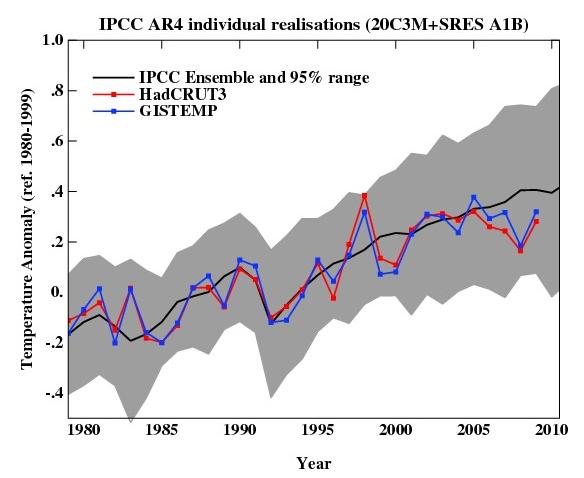
He was just trying to help you understand how climate models work. I'll repeat: global circulation models allow for short-term variability due to weather. That's the whole point of taking an ensemble (see chapter 8) with varying initial conditions and parameterizations. For example, here are individual realizations of a climate model. Notice that the short-term fluctuations are severe and unpredictable, but the long term trend is robust and predictable.
-
Re:Climate change is a security threat
Alright, that's a lot of information there, so it will take a while for me to digest it. While you are waiting, take a look at this graph. The grey is sum of all the computer simulations the IPCC kept track of. As you can see, by 2010 there is a margin of error of a whole degree, which is significantly more than the change from 1980 to 2010, or even the hottest and coldest years in that time period. That is not something that inspires confidence in computer models. That is, while computer models are useful for some things, that doesn't mean they are useful for predicting the result of doubling CO2 in a hundred years. In fact, I suspect if you start digging into it, you will start to doubt their capability to do so as well.
-
Re:Climate change is a security threat
I'm going to ignore the rabid conspiracy theories you're presenting. As a scientist who sees a lot of evidence that our CO2 emissions are changing the climate, you'd probably just dismiss me as lying scum with a political agenda anyway.
But just in case someone else reads this, greenhouse warming models predict cooling and contraction of the stratosphere. The cooling is predicted to be strongest between altitudes of 40 and 50km.
The quick explanation is that greenhouse warming shifts the effective radiating layer of the planet to a lower altitude. As a result, the surface warms but the stratosphere cools. In fact, I consider this good evidence for the link between CO2 and increasing global temperatures. No other single cause warms the Earth from the surface like a greenhouse gas. (For example, an increase in solar illumination wouldn't have this effect.)
So if it warms, it's global warming. If it doesn't warm, it's well trained global warming.
Did I get that right?
-
Re:Climate change is a security threat
OK, what you have done is linked to a modern estimate (if by modern you mean 2006) made by two people. You tried to do this to show consensus.
The paper itself combines multiple estimates from different independent scientists. If you don't want to read the article, the summary says: However, a new paper in GRL this week by Annan and Hargreaves combines a number of these independent estimates to come up with the strong statement that the most likely value is about 2.9C with a 95% probability that the value is less than 4.5C.
You'll get similar results from examining models used in the ensemble of Meehl 2004. Sorry that I don't have time to make all this explicit. As you can tell, I'm swamped with pseudoscientists and I simply can't give everyone a crash course in climate physics.
-
Re:Climate change is a security threat
You summarized one of my points as "The earth's temperature is warmer than it has been in the past" but in fact what worries scientists is the rate of the warming, which is probably higher than at any point in the last 1000 years. Scientists are concerned about the abrupt nature of these changes, not the absolute temperature.
I don't think many people realize that the entire link from CO2 to the warming is based on computer models not being able to think of any other explanation.
It's based on the fact that global circulation models account for temperatures after 1970, which can't be explained by any other process like increasing solar illumination, magnetic effects, etc. Those GCMs have been validated in multiple ways, by correctly predicting climate response to volcanic eruptions, by comparison to independent paleoclimate data and modern temperature records (which are independent because GCMs are dynamical models, not empirical models.) As I've explained, GCMs are able to reproduce strange features of modern warming like the cooling stratosphere which can't be explained using other hypotheses.
That point alone is suspect when you consider that from the time the study you linked to was published until now, the temperatures have not continued to rise as those models predicted would happen. What this means is that there are other factors affecting global temperature, that are unknown, that are at least as big as CO2 (otherwise they would have continued to rise).
Nonsense. I've already been over this. ENSO variation isn't important to the long term climate.
The computers predict a rise from 1.2 degrees to 5 degrees or so. In order to do this, they rely on feedbacks in the environmental system.
Very close. Modern estimates assign a maximum likelihood value of 2.9C, with a 95% confidence that it's less than 4.9C but greater than 1.7C.
Now, any scientist who claimed to understand all the potential positive and negative feedbacks in the system would be laughed out of the room...
Of course. What's troubling is that our estimates of the long-term feedback effects are known to be too small to account for the Milankovitch glaciation cycles.
there are known important feedbacks that they aren't considering, such as clouds (to understand the difference clouds can make, consider the difference in temperature on a cloudy day and a clear day, or even the difference of temperature in the shade of a tree).
Yes, I've already had to explain that I'm aware of how important clouds are. But why do you say clouds aren't being considered? In fact, all models take clouds into account. I've previously linked to a new paper describing recent improvements to models of clouds.
As for the fourth point, even on your web page you admit it is nothing more than a worry.
Yeah, it's a worry about the future of human civilization.
-
Re:Climate change is a security threat
You summarized one of my points as "The earth's temperature is warmer than it has been in the past" but in fact what worries scientists is the rate of the warming, which is probably higher than at any point in the last 1000 years. Scientists are concerned about the abrupt nature of these changes, not the absolute temperature.
I don't think many people realize that the entire link from CO2 to the warming is based on computer models not being able to think of any other explanation.
It's based on the fact that global circulation models account for temperatures after 1970, which can't be explained by any other process like increasing solar illumination, magnetic effects, etc. Those GCMs have been validated in multiple ways, by correctly predicting climate response to volcanic eruptions, by comparison to independent paleoclimate data and modern temperature records (which are independent because GCMs are dynamical models, not empirical models.) As I've explained, GCMs are able to reproduce strange features of modern warming like the cooling stratosphere which can't be explained using other hypotheses.
That point alone is suspect when you consider that from the time the study you linked to was published until now, the temperatures have not continued to rise as those models predicted would happen. What this means is that there are other factors affecting global temperature, that are unknown, that are at least as big as CO2 (otherwise they would have continued to rise).
Nonsense. I've already been over this. ENSO variation isn't important to the long term climate.
The computers predict a rise from 1.2 degrees to 5 degrees or so. In order to do this, they rely on feedbacks in the environmental system.
Very close. Modern estimates assign a maximum likelihood value of 2.9C, with a 95% confidence that it's less than 4.9C but greater than 1.7C.
Now, any scientist who claimed to understand all the potential positive and negative feedbacks in the system would be laughed out of the room...
Of course. What's troubling is that our estimates of the long-term feedback effects are known to be too small to account for the Milankovitch glaciation cycles.
there are known important feedbacks that they aren't considering, such as clouds (to understand the difference clouds can make, consider the difference in temperature on a cloudy day and a clear day, or even the difference of temperature in the shade of a tree).
Yes, I've already had to explain that I'm aware of how important clouds are. But why do you say clouds aren't being considered? In fact, all models take clouds into account. I've previously linked to a new paper describing recent improvements to models of clouds.
As for the fourth point, even on your web page you admit it is nothing more than a worry.
Yeah, it's a worry about the future of human civilization.
-
Re:Climate change is a security threat
I'm going to ignore the rabid conspiracy theories you're presenting. As a scientist who sees a lot of evidence that our CO2 emissions are changing the climate, you'd probably just dismiss me as lying scum with a political agenda anyway.
But just in case someone else reads this, greenhouse warming models predict cooling and contraction of the stratosphere. The cooling is predicted to be strongest between altitudes of 40 and 50km.
The quick explanation is that greenhouse warming shifts the effective radiating layer of the planet to a lower altitude. As a result, the surface warms but the stratosphere cools. In fact, I consider this good evidence for the link between CO2 and increasing global temperatures. No other single cause warms the Earth from the surface like a greenhouse gas. (For example, an increase in solar illumination wouldn't have this effect.)
-
Re:evolution ?
This whole thing is way off topic, but whatever.
AGW Data and Methods from CRU/NASA/other researchers. Enjoy. -
Re:Nice try
Well, I get notified when there's a reply to one of my post and often (but not always) respond.
You really ought to read the Wikipedia article on ozone depletion. It has a good overview of of ozone in the atmosphere. The science on it is quite robust. Ozone depletion is still a problem and will be for a long time. Please point me to the NASA scientists who couldn't find the ozone hole because I don't believe you. No creditable scientist ever said there would be no ozone up there. It forms naturally in the stratosphere when an O2 molecule dissociates after absorbing an ultraviolet photon. That single O atom then combines with another O2 to form O3 or ozone. They just said our increasing the available chlorine in the atmosphere through release of CFCs would reduce the amount of ozone and they've shown it to be true by measurements. Ozone is a very important gas in the atmosphere as it protects the surface and us from excess ultraviolet radiation.
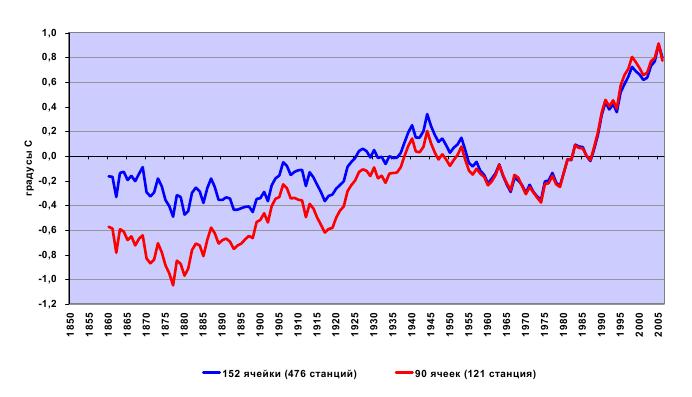
Regarding the Russians, check this comparison of the IEAs stations to the CRUs stations. After 1950 there is practically no difference between them. That doesn't indicate any fraud to me.
What does Pat Buchanan's article have to do with the Russians? And what specifically is hard to dispute? All I see are some out of context facts and outright misunderstanding of what they mean. The increase in Antarctic sea ice is not unexpected. It is in part comes from the ozone hole causing the circumpolar winds to strengthen thus isolating Antarctica more strongly from the rest of the planet. Recent observation from the GRACE satellite show that East Antarctica has been losing total ice mass just like West Antarctica.
Steve McIntyre's post only covers the continental US, 1.6% of the Earth's surface area. 1934 may have been the hottest year in the continental US but what does that have to do with global temperatures? This year the continental US has been a bit cooler relative to the rest of the world. 2009 is still going to be in the top 10 global temperature years (likely #2 or #3).
Any data that may be missing or withheld is relatively trivial. The vast majority of climate and related data is available if you care to look for it. The raw data the CRU used and deleted is still available from the original sources. Raw temperature data from around the world is available from the Global Historical Climatology Network (GHCN). Source code is available for the GISS ModelE GCM. There are a bunch of other links to both raw and cooked data as well as directories to other sources on this page.
I've already spent too long on this post so I'll sign off for now. Ciao.
-
Re:Nice try
Well, I get notified when there's a reply to one of my post and often (but not always) respond.
You really ought to read the Wikipedia article on ozone depletion. It has a good overview of of ozone in the atmosphere. The science on it is quite robust. Ozone depletion is still a problem and will be for a long time. Please point me to the NASA scientists who couldn't find the ozone hole because I don't believe you. No creditable scientist ever said there would be no ozone up there. It forms naturally in the stratosphere when an O2 molecule dissociates after absorbing an ultraviolet photon. That single O atom then combines with another O2 to form O3 or ozone. They just said our increasing the available chlorine in the atmosphere through release of CFCs would reduce the amount of ozone and they've shown it to be true by measurements. Ozone is a very important gas in the atmosphere as it protects the surface and us from excess ultraviolet radiation.
Regarding the Russians, check this comparison of the IEAs stations to the CRUs stations. After 1950 there is practically no difference between them. That doesn't indicate any fraud to me.
What does Pat Buchanan's article have to do with the Russians? And what specifically is hard to dispute? All I see are some out of context facts and outright misunderstanding of what they mean. The increase in Antarctic sea ice is not unexpected. It is in part comes from the ozone hole causing the circumpolar winds to strengthen thus isolating Antarctica more strongly from the rest of the planet. Recent observation from the GRACE satellite show that East Antarctica has been losing total ice mass just like West Antarctica.
Steve McIntyre's post only covers the continental US, 1.6% of the Earth's surface area. 1934 may have been the hottest year in the continental US but what does that have to do with global temperatures? This year the continental US has been a bit cooler relative to the rest of the world. 2009 is still going to be in the top 10 global temperature years (likely #2 or #3).
Any data that may be missing or withheld is relatively trivial. The vast majority of climate and related data is available if you care to look for it. The raw data the CRU used and deleted is still available from the original sources. Raw temperature data from around the world is available from the Global Historical Climatology Network (GHCN). Source code is available for the GISS ModelE GCM. There are a bunch of other links to both raw and cooked data as well as directories to other sources on this page.
I've already spent too long on this post so I'll sign off for now. Ciao.
-
Re:Why Are We Deferring to an Economic Organizatio
See, this is why I don't trust the "AGW Denial movement", because far too often I see people posting things are that at best, flat out wrong:
As posted on Real Climate.
"No doubt, instances of cherry-picked and poorly-worded “gotcha” phrases will be pulled out of context. One example is worth mentioning quickly. Phil Jones in discussing the presentation of temperature reconstructions stated that “I’ve just completed Mike’s Nature trick of adding in the real temps to each series for the last 20 years (ie from 1981 onwards) and from 1961 for Keith’s to hide the decline.” The paper in question is the Mann, Bradley and Hughes (1998) Nature paper on the original multiproxy temperature reconstruction, and the ‘trick’ is just to plot the instrumental records along with reconstruction so that the context of the recent warming is clear. Scientists often use the term “trick” to refer to a “a good way to deal with a problem”, rather than something that is “secret”, and so there is nothing problematic in this at all. As for the ‘decline’, it is well known that Keith Briffa’s maximum latewood tree ring density proxy diverges from the temperature records after 1960 (this is more commonly known as the “divergence problem”–see e.g. the recent discussion in this paper) and has been discussed in the literature since Briffa et al in Nature in 1998 (Nature, 391, 678-682). Those authors have always recommend not using the post 1960 part of their reconstruction, and so while ‘hiding’ is probably a poor choice of words (since it is ‘hidden’ in plain sight), not using the data in the plot is completely appropriate, as is further research to understand why this happens."
Now, who drank what kool-aid and isn't facing which inconvenient facts?
-
Re:Why Are We Deferring to an Economic Organizatio
The problem is when you compare the data from the stations the CRU used to the stations the IEA used there isn't that much difference between them, especially since 1950. See here. Blue is IEA, red is CRU.
-
Re:Climate Myth: The Hockey Stick was wrong
Er, the guys who did the supposed debunking have been discredited.
-
Re:Global Warming Clusterfuck
Here's a few sources of raw climate data. Knock yourself out - research a bit, write it up, publish it on the web...
What, you think as a 'skeptic' it's just as effective to spread lies about people who actually do the work? Yea, I thought so.
-
I was wrong, the raw data is easily accesible.
The raw data is in pretty good shape and easily accessible. However this is just a collation of what is held on paper etc, so the conspiracy theorists still have an escape hatch wich their brain can escape through.
Hat tip to the article on Realclimate for the link. I'm sure you know of realclimate, they're the guys who won't show anyone their raw data.
"It may come as a surprise to some that the first compilation of world-wide meteorological data was published by the Smithsonian Institution in 1927, long before anthropogenic climate change emerged as an important issue (Clayton et al., 1927). This volume is still widely available on the library shelf as are updates that were issued periodically. This same data collection provided the foundation for the World Monthly Surface Station Climatology, 1738-cont. As has been the case for many years, any interested party can access this from UCAR (http://dss.ucar.edu/datasets/ds570) and other electronic data archives." - Realclimate
I await the analyisis of the of the slashdot skeptics. -
On the appeal to authorityUnfortunately most of those who keep misunderstanding the "appeal to authority" falacy for their own purposes here, and the like, this is not likely to be at all convincing. But I just can't help but quote these poignant words...
Oh, while we're at it, let's redo the epidemiology on smoking and cancer. Until that's done, let's all take up smoking. After all, who can trust the corrupted peer-reviewed literature in leftist journals like the New England Journal of Medicine? --eric
-
Re:Why Are We Deferring to an Economic Organizatio
I was going to mod you up but instead here's a comparison of the difference between the IEA stations and the CRU stations. I don't read russian so I don't know which is which but I suspect the blue line is IEA and the red CRU. It shows they've been nearly in lockstep since 1950 and well synchronized since at least 1900.
Gavin Smith of the GISS commented "... the issue is very likely to be connected to instrument changes/metadata changes that the IEA analysis doesn't look at at all."
But Russia is only a part of the world and even if the IEA were right it doesn't affect anything else enough to change the fundamental conclusions about global warming.
-
You can certainly have an opinion
You can even publish your opinion, almost anywhere you like. Just don't expect to publish it in a journal unless it meets the journal's stated criteria for accuracy and methodology.
You are only supposed to trust the work of peer reviewed climate scientists. And only known trusted warmers can peer review the climate change data.
Well, since 97% of the people best qualified to judge the methodology of an article about climate science are already convinced by their own observations that AGW is a critical issue, good luck finding someone sufficiently educated who disagrees. Basically you're claiming that virtually all climate scientists are either a) corrupted or b) morons, and I think that's a very tough charge to make stick.
I certainly agree that peer review should not be an argument-ender (and there's plenty of sites like realclimate who are willing to discuss further). However I can also see that time spent battling the publicity of big-dollar vested interests for the "mindshare" of those who don't have the (significant) time or education to make a truly informed decision, is precious time that could be spent actually learning more about what the globe is up against, and could quickly get exasperating. Nevertheless, it's clear that the scientific community needs to make more of an effort to explain their conclusions to the lay public who doesn't know who to believe.
On that last point, for the last couple of hundred years it was qualified scientists whose opinions were generally given more weight; now apparently it's half-educated bloggers. When did that change, and why?
-
Re:I am very sceptical...
Most of the data is open. Links can be found here and at the bottom are links to master repositories of climate data.
I would also point out that most of the thermometers used are not in the control of the climatologists using the data. Instead they are controlled by hundreds of different entities, mostly government, around the world that collect the information.
-
Re:And that's bad how?
You can find a bunch of links to other data and model source code here.
-
Re:The answer is yes.
This is a perfect example of what I'm talking about.
You bring out examples of supposed flaws in global warming as a "gotcha" argument, but ignore the fact that each and every one of these arguments has been repeatedly debunked.
Again - you're ignoring rebuttals to denialist arguments, then pretending they don't exist. It's not that no-one's listening to your arguments, it's that they are scientific nonsense.
-
Re:Modern-Day Galileo
So your economic concerns trumps the science? Global warming can't be right because it will cost you too much? Now we're getting to the bottom of it!
You're electric bill going up >50% is hyperbole. Estimates for the cap&trade bill say it will cost perhaps $10 a month for the average family. That cost would be spread over not only your electric bill but the cost of other things as well.
When you ask scientists in the field what the number for CO2 emissions should be they say "The correct number is zero" so it's worse than you thought. It'll take us 30 or 40 years to get there though.
The data you're so worried about is but a small and relatively inconsequential piece of the totality of climate science. If you want the code and data for the GISS you can find it here. You'll need a big computer to run it though. Links to other sources of raw and processed data and climate model source code can be found here.
-
Re:Global Warming Problems...
Climate models, which simulate the physical processes that determine climate, do not exhibit chaotic behavior. So based upon everything we know about the physics of climate, there is no basis to assert that climate is chaotic. Here, for example, is a plot showing superimposed multiple runs of a climate model with different starting conditions. If climate (as opposed to weather) were chaotic, then the curves should diverge from one another exponentially over time, yet this is not observed. Instead, while the predictions of this model show substantial divergence on a short time scale of a decade or so, over multiple decades they remain clustered together.
-
Re:And that's bad how?
For the GP - here's a list of links to data. This includes the raw data, processed data, models, model source code, data visualisations and links to larger repositories of links and data.
-
Re:Modern-Day Galileo
"For a bloody good read, try Tom Clancy's "State of Fear". It puts an awful lot of these issues into the perspective of the common man."
That statement is as factually incorrect as the rest of your post. The book was written by Michael Chriton. Chriton is indeed a good writer of fiction but he is also an anti-science propogandist. You may think propogandist is a harsh term but let's have a look at the plots for some of his other works of fiction...
Andromeda strain, plot = science gone mad.
Jurassic Park, plot = science gone mad.
Westworld, plot = science gone mad.
Airframe, plot = science gone mad.
State of Fear, plot = science gone mad.
See the pattern? Chriton uses the same literary technique as Dan Brown, the technique has a name, it's called False Document. As any story teller will attest the trick to story telling is to get ones audience to "suspend disbelief". When an authour attempts to extended the suspension of disbelief into the real world it becomes nothing more than lies and propoganda.
BTW: I have nine more years studying at the school of life, you may want to check some more advanced lessons on propoganda. We have all been a victim of it at one stage or another, the trick is to recognise it when it's pointed out to you and act accordingly. -
Re:Calling Pons and Fleischmann...
Your assertion that the case for AGW is made by a small group of researchers with cherry-picked or falsified data that cannot be independently verified is absurd. Climate science is conducted by
Look for yourself... here is an excellent starting point http://www.realclimate.org/index.php/data-sources/
-
Re:What
Tree ring diverges from previous trends around 1960, so as a trending mechanism it is only good up to a certain point. It is unknown, afaik, why this happened, but up until that point it is still good, predictive data. So I had a misunderstanding as thought that there was an actual error in the collecting, which, perhaps, with this particular data set is possible, but I haven't read other papers showing differently. Thus it has not been used as a proxy for data past 1960 since 1998, when that paper was published, and the supposed "damning" email was warning of this in 1999. An explanation by CRU from Real Climate:
“Declines” in the MXD record. This decline was written up in Nature in 1998 where the authors suggested not using the post 1960 data. Their actual programs (in IDL script), unsurprisingly warn against using post 1960 data. Added: Note that the ‘hide the decline’ comment was made in 1999 – 10 years ago, and has no connection whatsoever to more recent instrumental records.
I also apologize for the tone of my previous message, I had not yet had my coffee -
Re:Complete nonsense.
I'd settle for 500 years of accurate, precise (with an error no greater than 0.05C) temperature measurements from at least 5000 sites scattered reasonably uniformly over the globe.
Considering that CO2 levels will continue to rise for 1000 years afterwards -- we really will have missed a chance to build a sustainable economy. By analogy, you won't save the building from fire, because you want to measure exactly how hot the flame is, to within 0.5C, to prove that the house is really in danger.
In assessing certainty, one cannot simply pull number like 500, 5000 and 0.05C out of thin air. There is a confidence interval that goes with the measurement. Do you know what that confidence interval is? Didn't think so.
On the other hand, climate scientists *do* know what their confidence interval is. It is all in the ipcc reports. Ever read one? Didn't think so.
No, tree rings won't do. Nor will ice cores. Because we have less than 100 years of temperature measurements to calibrate them with.
I'd trust statistical techniques to assess the error range of proxies, over rules of thumb.
Oh, and I'd like to be able to see the raw data, the massaged data, and the formulae used to do the massaging. Note that the CRU people can't or won't provide the raw data - either of which is a big warning sign in my book.
The CRU people provide almost all of the data, except for date they cannot provide because it is not theirs to provide. That is hardly a conspiracy. In fact, they are simply obeying the law. The vast majority of the data is here. You can also find tonnes of raw data and source code here
I say all of this with no expectation of having convinced you of anything. Try to find a "top 10" skeptic arguments. No such resource exists, because wild charges of conspiracy is the best evidence that skeptics have. If you fail to find a top 10, that actually contains sound arguments -- would that be sufficient to cast doubt on your AGW opinion, or will the burden of proof just shift further away?