Slashdot Mirror
Domain: sciencemag.org
Stories and comments across the archive that link to sciencemag.org.
Comments · 1,625
-
I try to support NPR but. . .
. .
-
Re:Come On!
Because I understand the need for initial condition ensembles, tend to agree with Nature's response to that tabloid nonsense, and have noted the decrease in stratospheric water vapor since 2000 (all these points have already been explained in that link).
-
Re:Come On!
I understand the unwillingness to hold back data/findings because of politics, but even a rookie PR guy will warn you about the dangers of publishing a single report that purportedly negates all previous recommendations.
Actually, we scientists (well, not me, as I'm comparatively new to the field) determined this forty years ago. It's not our fault NPR is more behind on the news than Orrin Hatch. Next thing they'll be doing is telling us that Dewey didn't beat Truman.
-
Re:what?
It is 3D in the sense that it is a 2D image with topography (a height map). Basically they are using a very sharp (nano-sized) heated stylus to desorb ("burn") away nano-sized amounts of polymer. (This is basically a variant of "scanning probe" methods like atomic force microscopy.) By carefully positioning the probe in x-y you can draw a pattern, and by controlling the stylus height and burn time, you can control the depth. In this way you can create arbitrary topography at the nano-scale.
Many of the comments in this thread seem to be fixating on the uselessness of such a small map of the world. Making a world map was just a cute proof of principle (the paper also shows test patterns so that you can judge patterning fidelity). Basically this is a new way to pattern at the nanoscale in an fairly arbitrary way. Of course raster scanning a stylus is going to be very slow compared to optical lithography, but at this stage it's better to compare to something like e-beam lithography which is the raster-scanning of an electron beam. This is also slow, but can make very high-resolution patterns and is thus great for exploratory research and for creating the masters that are then used for optical lithography. This new nano-desorbing technique could be another way to make master patterns. In fact, the papers mention that the resolution and throughput are in fact comparable to e-beam methods. And this new technique has a couple of advantages:
1. The ability to not just pattern in 2D, but control the topography could reduce the number of patterning steps in microchip construction.
2. These mechanical 'scanning tips' can in principle be built into massive arrays, allowing parallel (high-throughput) patterning. In fact IBM has been working on a project called millipede for using these arrays of tips as a data storage device. (This most recent patterning work appears to be an offshoot, where instead of melting pits to store data, they are blasting away material to pattern.)
It's always difficult to predict whether these things will become real products one day, but the proof-of-principle for both tip arrays, and now for nano-scale patterning using heated tips, means that we're actually relatively close. If IBM pursues this, it could become a new nano-patterning method in the toolbox of the microelectronics industry (which is, of course, always looking for techniques that can push patterning to ever smaller scales).
For anyone interested (and with subscription access), here are the papers:
"Nanoscale 3D Patterning of Molecular Resists by Scanning Probes" by D. Pires, J. L. Hedrick, A. De Silva, J. Frommer, B. Gotsmann, H. Wolf, M. Despont, U. Duerig and A. W. Knoll was published by Science on the Science Express website on April 22, 2010, DOI: 10.1126/science.1187851
"Probe-based 3-D Nanolithography Using Self-Amplified Depolymerization Polymers" by A. Knoll, D. Pires, O. Coulembier, P. Dubois, J. L. Hedrick, J. Frommer and U. Duerig was published in Advanced Materials, advanced online publication on April 23, 2010, DOI: 10.1002/adma.200904386 -
Re:*bashes head against desk*
No such thing as the placebo effect
So one study offsets the thousands of studies done since the late 70s that show a demonstrable placebo effect? Some of these studies show observable reduction of pain-related activity in the spinal cord on an fMRI (For a relatively small subset of the larger work done in the field, see the source citations 37-170 in the Wikipedia placebo article: http://en.wikipedia.org/wiki/Placebo)
Even the abstract of the study you cite shows that there are clinically significant effects on pain and nausea.
-
Re:Yea
Don'd feed the extremely inaccurate troll. The probability of complex organic life coming into being is actually much higher than most people realize.
I think the real reason we haven't found anyone out there is probably things like interstellar hydrogen getting in the way of space travel, and causing scattering and absorption of communications signals. Most people agree that the SETI project is fundamentally flawed in that way. Doesn't make it an unworthy cause, however, just an unlikely one.
-
Re:What would be the reason, from NSF?
(RTFA? Hm, I see you're rather new here...
Actually, how you portray it might be not accurate (yes, I've not only RTFA now, which doesn't give clear picture, but also source documents: deleted part of (unedited here) chapter in question
Notice that it seems the questions about evolution or Big Bang weren't put "against gods" at all. They were just of true/false statement form, about established scientific knowledge. There is no dichotomy with gods there! They don't even touch on the subject of gods at all! There is of course dichotomy with another statement, "god created everything in the past few thousand years"...but that has nothing to do really with belief in god.
-
Re:What would be the reason, from NSF?
(RTFA? Hm, I see you're rather new here...
Actually, how you portray it might be not accurate (yes, I've not only RTFA now, which doesn't give clear picture, but also source documents: deleted part of (unedited here) chapter in question
Notice that it seems the questions about evolution or Big Bang weren't put "against gods" at all. They were just of true/false statement form, about established scientific knowledge. There is no dichotomy with gods there! They don't even touch on the subject of gods at all! There is of course dichotomy with another statement, "god created everything in the past few thousand years"...but that has nothing to do really with belief in god.
-
Re:No they did not.
That explains nothing.
Well, I looked at the two questions, one of them is factually incorrect.
"The universe began with a huge explosion."
The Big Bang is not an explosion (unlike an explosion, there wasn't that much motion of mass (sure, the motion was relativistic, but space itself expanded at an astounding rate, if inflation theory is correct), hence the statement is technically incorrect. I probably would answer true, but that's because I'd be giving the answer I'd expect the pollster to want.
The other question is:"Human beings, as we know them today, developed from earlier species of animals."
I'd answer true.
The thing that I think this guy is getting at, is that these are theories stated as fact. A true philosopher would answer "I don't know" to either question since a hypothesis cannot be proven rigorously to be true or false. I consider these serious flaws in the questions since it confuses people who believe the statement to be false with people who don't know, but answered "false".
Given this serious flaw in the poll's questions, I wouldn't be surprised if there were other flaws in the poll that resulted in hidden biases. Also, I have trouble believing some of these numbers. A Gallup poll claims 43% of the population believes God created humans in the last 10,000 years or so? Where are these people hiding? I have some relatives who really buy into the young Earth thing, but they're pretty obvious. -
Re:Strange
Also, the rule of "Pictures or it didn't happen" should apply... right?
Right.
http://news.sciencemag.org/sciencenow/assets/2010/04/07/sn-anoxic.jpg
-
Significant technical featSuccessfully launching a satellite is significant. Developing and building the resources for the acquisition of telemetry is significant. Storing the high resolution data is significant. I would have to disagree with anyone that says building these things from essentially nothing is not as significant feat as going to the moon or building the first microprocessor.
For those of us who really only car about what is happening now, the data from these era of satellites is proving invaluable.The Nimbus II data is being reconstructed and is providing one of a kind data sets. For those in data recovery, this will provide a lifetime of work and significant results if one is able to get the funding.
-
Re:So far removed from the original article
Original article, after following three backlinks: http://uk.reuters.com/article/idUKTRE62I4AE20100319
So tired of the "news" sites that can't even link the original source anymore.
I hit the source link and goes to someones blog with a source link to someone else's blog, that might have the original story.It is pathetic, isn't it?
My normal algorithm, when I see something sufficiently interesting, is to RTFA to find the most unusual name for one of the authors (or several if there are ; double check that the name isn't a commentator), then to Google for that author (or authors). very soon you'll find an article that tells you which one of the major science publications the source is in. Most of them are available in abstract form for free ; often your university library will be able to provide you with access (you're not in at least part-time education at a legitimate establishment? I'm sorry to hear of your incapacitating disease and impending death.)News that comes out on Fridays (US time) is probably from Science ; Nature dis-embargoes things on Wednesday evenings (UK time); PLOS and PNAS are (I think) on Mondays (US time again) ; the rest are pretty random. How long it is before the blogosphere picks up on things
Alternatively, if you're tired of following the blogosphere's useless cross-quoting, just go directly to the original sources. All of the major journals have email distributions of contents, often an RSS feed too if that's what you like. Cut out the regurgitation and start from the sources! (Oh, sorry, that kills the advertising industry. Send me an email address and I'll PayPal you £0.10 as a contribution to your bus fare to go and find someone who gives a fuck.)
On which subject, it's Friday, it's lunchtime, so it's Science's contents- Reviews - Materials and Mechanics for Stretchable Electronics
- Swine Flu Pandemic - What's Old Is New: 1918 Virus Matches 2009 H1N1 Strain
New findings, reported online this week in Science and Science Translational Medicine indicate that the surface protein, hemagglutinin, of the "novel" H1N1 swine influenza virus that last year caused the first human pandemic in 4 decades closely matches the HA in the H1N1 virus responsible for the 1918 pandemic. - Strontium-Doped Perovskites Rival Platinum Catalysts for Treating NOx in Simulated Diesel Exhaust
Hmmm, that swine 'flu one might be worth a read.
-
Re:Set TheoryA related study is Hunter-Gatherers Grasp Geometry. The conclusion of the article was the geometry learned by children in isolated culture was equivalent to the geometry learned by children in western cultures. In particular the results on the test given were all but the same for children, and only diverged in the higher level test given to adults. My interpretation is that while we must teach the formalized language of geometry, i.e. what is the formal difference between a quadrilateral and square, the concepts themselves are learned through the experience of a varied and active childhood.
Which is why I don't think most of the formal stuff that goes on in elementary school, at least prior to about 10 years old, is all that useful. If kids were more actively engaged, and not in desks, perhaps we could teach them the formalizations in middle and high school. Unfortunately not all kids, especially lower SE kids, have the opportunity to actively challenged in their non schools lives.
-
It's not THAT flexibleThe hard science:
Shape-memory alloys, such as Ni-Ti and Cu-Zn-Al, show a large reversible strain of more than several percent due to superelasticity. In particular, the Ni-Ti-based alloy, which exhibits some ductility and excellent superelastic strain, is the only superelastic material available for practical applications at present. We herein describe a ferrous polycrystalline, high-strength, shape-memory alloy exhibiting a superelastic strain of more than 13%, with a tensile strength above 1 gigapascal, which is almost twice the maximum superelastic strain obtained in the Ni-Ti alloys.
The next challenge for materials scientists will be an intermediate elasticity material for walls. The ability of the frame to flex several percent under the force of an earthquake is a good thing, full stop. But then the walls will need to be flexible enough not to be torn off the flexible frame, yet firm enough not to deform, and thereby shatter, every single window. Granted, broken windows will kill and seriously injure fewer people than falling buildings, but engineers will want to minimize window breakage as well. It sounds like a fun problem to try to solve.
-
Re:So far removed from the original article
Actually - reuters mentions the really original paper, which is here, in this weeks Science edition.
-
Re:I'm not clear on what their case is...
pooh, I could not reach an opinion, so it was late and I was bored and so I googled a bit.
http://news.sciencemag.org/scienceinsider/2010/03/scientists-case-on-background-ch.html
it looks like this is a new 2007 rule stemming from a 2004 homeland security thingy. it is making long time employees upset.
and among the scientists in the case are mars rover types, for which anyone might question the need for intrusive background checks
and i notice they got an injunction, maybe easily and maybe sometime ago. now that great defender of the technology and exploration, the narcissist-in-chief, is raising a stink. Or at least his Holden creature. mars is said to be red, rather than green, so being interested in mars is probably a security negative right away.
-
Re:Equally Lazy
even though there are tons of carefully thought out articles from real scientists questioning AGW
Name five. Since I'm sure we disagree on what qualifies as carefully thought out, the criteria can be "peer-reviewed article appearing in a climate science journal since 1993 that disagrees with the existence of anthropogenic global warming". The most prominent study on the subject couldn't find a single one of the 928 sampled, but of course it's nearly six years old now, so perhaps there's been a big upsurge that no-one noticed.
Remember before copy-pasting from any of the usual lists to make sure the article actually opposes the consensus (it doesn't) and that the author hasn't released a statement denouncing denialists for misrepresenting their work (they probably have). Also keep in mind that Energy and Environment doesn't engage in actual peer review, and that neither economics nor petroleum geology count as climate science.
You dislike being compared to the birthers, but the tons of great articles refuting anthropogenic global warming are every bit as fictional as Barack Obama's Kenyan birth certificate, and even more ridiculous. After all, a birth certificate is the sort of thing that could be conceivably concealed.
-
Re:Absence of Evidence
Who knows why this got modded interesting, it's fuckin' dumb.
Let's try a little thought experiment, shall we? Two scenarios:
1) Let's imagine that you are working on the bleeding edge of science and you're investigating a question that no-one knows the answer to, like "why does Nt-acetylation of bulk proteins happen?". You do some clever research, and whaddya know, you come up with an interesting answer: "it's because acetylation can function as a degradation signal". That forces a need to revisit thinking on protein turnover, a larger topic, and may even mean that we need to think again about exactly how homeostasis works. So you write it all up and if you can get the paper past your clever colleagues who do peer review, you might get published in Science and you can be very proud of yourself. Look, it's happened here!
http://www.sciencemag.org/cgi/content/short/327/5968/966
2) Now, let's imagine that you investigate something a bit more fundamental to modern biological science. Say, the idea that DNA encodes genetic information about the shape of proteins. Let's say you invent a clever experiment and the findings are very striking -- they appear to show that DNA doesn't encode that information after all! Now for the thought experiment bit: do you think that the standards and scrutiny that will be applied to your claim will be higher or lower than in scenario 1, given that your results will require the setting aside / reinterpretation of an enormous mass of prior experimental results and accepted scientific theory. Why, that's right! Your results will be subjected to more careful scrutiny. They will have to be replicated, validated, tested etc etc every which way from Sunday, because the inherent balance of probabilities is that your results are wrong or artefactual or explicable within the current framework, and that the prior thinking was right. It's not *impossible* that the opposite holds true, but it *is* extremely unlikely.People who seek to demonstrate that anthropogenic climate change is not happening are much closer to scenario 2 than scenario 1. Scientists will quite reasonably say, "just before we chuck out all the accumulated evidence and thinking about how the world works and accept your argument that you've shown it that is, in fact, possible for humans to add net tens of billions of tons of gases such as CO2 and CH4 to the atmosphere in the space of decades without it having an impact on climate, do you mind terribly if we take a very long hard look at your evidence and reasoning?"
-
Re:only one step of a great many
For those current in the field, this discovery is not surprising.
Especially since those current in the field probably read about it 13 months ago when the paper was published. -
Re:I love to be the first to say this...
No, some of us just remember the same crap in the 70s about how the world would be in a new ice age by now.
Atmospheric Carbon Dioxide and Aerosols: Effects of Large Increases on Global Climate is the only peer reviewed paper I am aware of that said anything about an ice age. So that makes 1 paper for GC and thousands of papers for GW. Are you aware of any other peer reviewed papers supporting GC? I don't have access to the articles that cite this one to see if they make the same kind of claims, however the abstracts do not.
We also remember very good science being ripped up because the data was falsefied or poorly collected.
Extraordinary statements require extraordinary proof. I am curious as to what you are attempting to reference.
When you're a sheep, I don't respect your opinion.
Insulting your readers is truly the sign of a towering intellect.
Skeptics I have time for. Convince a skeptic, and you'll have won an actual battle.
Consider me skeptical.
-
Re:For our sake
Perhaps it would help to show an example where my editing wasn't intended to portray you in a negative light. After you cited an E&E paper to support the claim that sunspot cycle length is responsible for recent warming, I said:
... But I'll make it up to you. Here's an article by Friis-Christensen and K. Lassen, published in Science in 1991. This would have been a legitimate example of a peer-reviewed journal article supporting your claim.
Of course, it's incorrect. You can find out how-- if you're interested-- by following its citations in google scholar to the present. For nonscientists, read the summary here. The moral of this story is that data smoothing is difficult to do in an objective manner, which is something all computational scientists screw up on occasion. Please don't mistake this comment as criticism of Friis-Christensen or K. Lassen-- I've certainly made far bigger mistakes in my own research. The ability to admit a mistake and move on is the mark of a true scientist. [Khayman80, July 09 2009, @09:37PM]
After some more unpleasantness, I later repeated:
... The claim that sunspot cycle length correlates well with Earth's average temperature was made in the mainstream journals in 1991. But it was quickly shown to be a spurious connection based on data smoothing parameters. The fact that "Energy and Environment" didn't catch this when the argument was made again 15 years later just shows that they're not experts in the field.
You responded:
... As I stated before, I only found that paper after you asked me to find one, and I was not particularly careful in choosing it; you had asked for a peer-reviewed paper, and I just grabbed the first one that was visible. And indeed, some of its claims do appear to be refuted, particularly in a paper by P. Damon, published in Eos in 2004. However, though you apparently knew this (as, I could guess, did Mr. Landis), neither of you bothered to cite any kind of actual data in an attempt to refute the one paper I provided, per your request.
After you mentioned the data smoothing issue, it took me about 2 minutes to find Damon's paper. If I had been aware of it in advance, I would of course not have offered that paper. But if you really wanted to make a point -- and practice what you preach -- you should have cited your sources. Instead, you left me to look it up... which makes you are guilty of exactly the same faux pas of which you accuse me. In point of fact, Damon's paper itself states, "The graphs [from Friis-Christensen and Lassen] are still widely referred to in the literature,and their misleading character has not yet been generally recognized." Without citing sources, then, how did you expect me to know?
So, as it stands, I believe that the form of your response has been rather hypocritical.
I was shocked to see this comment. But address
-
Re:Indian PM backs UN climate panelIndeed. To quote more fully:
Speaking at a development summit, India Prime Minister Manmohan Singh came out in full support of the beleaguered IPCC head Rajendra Pachauri, the first time Singh had addressed the issue after IPCC offered its "regret" on the blunder it committed in predicting that glaciers in the Himalayas would melt away by 2035. The Indian prime minister, who is an economist, said: "Some aspects of the science that is reflected in the work of the IPCC have faced criticism. But this debate does not challenge the core projections of the IPCC about the impact of greenhouse gas accumulations on temperature, rainfall, and sea-level rise. Let me here assert that India has full confidence in the IPCC process and its leadership and will support it in every way that it can."
Singh added: "I share the disappointment of many with the limited achievements of the discussions that took place at Copenhagen. We have established an Indian Network for Comprehensive Climate Change Assessment, a network of over 120 research institutes, which will bring out regular reports on the impacts of climate change on different sectors and different regions of the country. The first such assessment will be released in November this year. We seek international collaboration to make this network effective. It is becoming clear that the roots of the problem we face today are in the current patterns of global production and consumption, which are not sustainable. We are living on an overdraft on nature’s resources, and this is already threatening the ecological balance, which is the basis of our survival. We are also establishing a National Institute of Himalayan Glaciology in Dehra Dun, and we look forward to international cooperation in this vital area."
http://blogs.sciencemag.org/scienceinsider/2010/02/indian-prime-mi.html
And of course, contrary to Slashdot's quote from the International Business Times, the Himalayan glacier statement was not "a primary claim of the report," but rather "several sentences and one reference" from a 3000 page report.
-
Example of Disastrous Programming Error
A good example of how disastrous one error in data analysis code can be comes from the field of biochemistry, specifically analyzing the x-ray diffraction patterns from crystallized proteins to determine the three dimensional structure of the proteins. Geoff Chang, faculty at the prestigious Scripps Research Institute in San Diego, had published a series of landmark papers describing the structures of various important membrane proteins, whose structures had never been solved before. Although these results did not mesh other researchers' models for how these proteins worked, many researchers used Chang's structures as starting points to develop and test new models for how these proteins might work. However, in 2006, things came crashing down:
In September, Swiss researchers published a paper in Nature that cast serious doubt on a protein structure Chang's group had described in a 2001 Science paper. When he investigated, Chang was horrified to discover that a homemade data-analysis program had flipped two columns of data, inverting the electron-density map from which his team had derived the final protein structure. Unfortunately, his group had used the program to analyze data for other proteins. As a result, on page 1875, Chang and his colleagues retract three Science papers and report that two papers in other journals also contain erroneous structures.
(from a Science news article (subscription required to view full article):
Of course, there were other factors that caused this situation (because the proteins are notoriously difficult to work with, the data were fairly poor quality. Had the data quality been better, Chang would have likely realized the mistakes prior to publishing the papers). However, it is sobering to note the resources wasted on research following up on these incorrect structures produced by a simple coding error (I know a few people whose entire theses were invalidated by these retractions).
It is, however, unclear whether releasing the data analysis code would have fixed this situation. The software for analyzing x-ray diffraction data is fairly standard (I don't know why Chang was using his own homemade software) and various open-source software are available. Furthermore, in his field, it is common to release the raw diffraction data (I'm not sure if it was released in the case of these five structures), so it may have been possible for others to double check his work with their own analysis software. Perhaps the greater error here is in Chang, the peer reviewers of his publications, and the scientific community for believing Chang's conclusions (based on relatively poor quality diffraction data) over the conclusions of many other researches whose techniques may not have been as sophisticated, but who had generated data of much higher quality.
-
Re:It's shitty science, Rei.
Yes, we've studied the Sun intently. Is that supposed to mean that we have a complete understanding of its effect on the climate? Really?
Yes. Read the papers (if you need a starting point, you can find them all referenced in AR4, Ch.02). All of the sun's impacts but one (upper-atmospheric GCR shielding's role in cloud seeding) are very easily measured and straightforward on Earth, with the massive variety of different datasets matching each other. GCR provided the only degree of uncertainty to constraining the influences of the sun, and has since been much better constrained. Even the difference between peak and minimum output doesn't provide anywhere even in the same ballpark as much forcing as CO2.
After all, even most of the die-hard warming advocates admit that they can't explain the current cooling trend in their models.
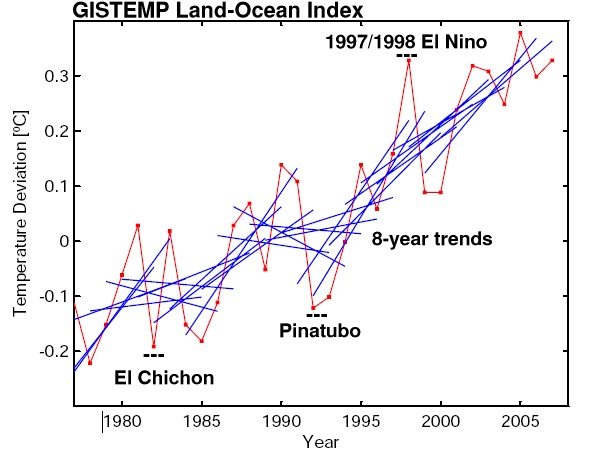
Who the heck are you listening to? First off, there is no cooling trend. There is a small (25%) decrease in how rapidly it's risen due to stratospheric water vapor, a decadal-scale factor.
Seriously, stop listening to people who don't know what the f*** they're talking about.
-
Re:For our sake
I don't think global warming was being studied 40 years ago. I think they were seeing a different trend.
Well the problem is you are citing the popular press, this is why the uptake of the MMR vaccine hit an all time low in the UK after the Lancet study was released. The media take the stories they like and not those with the most evidence.
Global Cooling?
Paul E. Damon and Steven M. Kunen
Science (6 August 1976): Vol. 193. no. 4252, pp. 447 - 453Greenhouse Effects due to Man-Made Perturbations of Trace Gases
W. C. Wang, Y. L. Yung, A. A. Lacis, T. Mo, and J. E. Hansen
Science (12 November 1976): Vol. 194. no. 4266, pp. 685 - 690Man-made Carbon Dioxide and the "Greenhouse" Effect
J. S. Sawyer
Nature (1 September 1972) 39, pp. 23 - 26Climatic Change: Are We on the Brink of a Pronounced Global Warming?
Wallace S. Broecker
Science (8 August 1975): Vol. 189. no. 4201, pp. 460 - 463 -
Re:For our sake
I don't think global warming was being studied 40 years ago. I think they were seeing a different trend.
Well the problem is you are citing the popular press, this is why the uptake of the MMR vaccine hit an all time low in the UK after the Lancet study was released. The media take the stories they like and not those with the most evidence.
Global Cooling?
Paul E. Damon and Steven M. Kunen
Science (6 August 1976): Vol. 193. no. 4252, pp. 447 - 453Greenhouse Effects due to Man-Made Perturbations of Trace Gases
W. C. Wang, Y. L. Yung, A. A. Lacis, T. Mo, and J. E. Hansen
Science (12 November 1976): Vol. 194. no. 4266, pp. 685 - 690Man-made Carbon Dioxide and the "Greenhouse" Effect
J. S. Sawyer
Nature (1 September 1972) 39, pp. 23 - 26Climatic Change: Are We on the Brink of a Pronounced Global Warming?
Wallace S. Broecker
Science (8 August 1975): Vol. 189. no. 4201, pp. 460 - 463 -
Re:For our sake
I don't think global warming was being studied 40 years ago. I think they were seeing a different trend.
Well the problem is you are citing the popular press, this is why the uptake of the MMR vaccine hit an all time low in the UK after the Lancet study was released. The media take the stories they like and not those with the most evidence.
Global Cooling?
Paul E. Damon and Steven M. Kunen
Science (6 August 1976): Vol. 193. no. 4252, pp. 447 - 453Greenhouse Effects due to Man-Made Perturbations of Trace Gases
W. C. Wang, Y. L. Yung, A. A. Lacis, T. Mo, and J. E. Hansen
Science (12 November 1976): Vol. 194. no. 4266, pp. 685 - 690Man-made Carbon Dioxide and the "Greenhouse" Effect
J. S. Sawyer
Nature (1 September 1972) 39, pp. 23 - 26Climatic Change: Are We on the Brink of a Pronounced Global Warming?
Wallace S. Broecker
Science (8 August 1975): Vol. 189. no. 4201, pp. 460 - 463 -
2006 called...
Oh hey, 2006 called, and they want their science back.
This field moves *fast* and the epitaxial technique is already being commercialized by IBM (perhaps others too, but IBM isn't hiding it). It's already moving out of science and into manufacturing (for what purpose, I'm not sure anyone knows). Meanwhile, cheaper and larger scale methods to grow graphene have been invented, and are nearly perfected.
-
Or maybe not
Leading the world in the number of papers published is not equivalent to leading to world in scientific research.
An old professor of mine has said that he has been shocked by the number of times he's been reading a paper by a Chinese researcher and found large sections of the paper copied verbatim from one of his own. In a country that is so competitive in publishing papers, I'm sure many succumb to the pressure and temptation. That's not to say that there are good, original advances being made, but I'm not quite as optimistic as the news title leads one to believe.
http://www.sciencemag.org/cgi/rapidpdf/274/5286/337.pdf -
NASA says: not CO2 causing glaciers to melt
NASA says it's not C02 causing the Himalayan glaciers to melt:
Stolen from a comment at real climate:
"In fact, the new research, by NASA's William Lau and collaborators, reinforces with detailed numerical analysis what earlier studies suggest: that soot and dust contribute as much (or more) to atmospheric warming in the Himalayas as greenhouse gases."
http://www.nasa.gov/topics/earth/features/himalayan-warming.html"Based on the differences it's not difficult to conclude that greenhouse gases are not the sole agents of change in this region. There's a localized phenomenon at play."
http://www.nasa.gov/topics/earth/features/himalayan-soot.html"But some scientists claim that glaciers in the Himalayas are not retreating as fast as was believed. Others who have observed nearby mountain ranges even found that glaciers there were advancing."
http://news.bbc.co.uk/2/hi/science/nature/8355837.stm"The report, by senior glaciologist Vijay Kumar Raina, formerly of the Geological Survey of India, seeks to correct a widely held misimpression based on measurements of a handful of glaciers: that India's 10,000 or so Himalayan glaciers are shrinking rapidly in response to climate change. That's not so, Raina says."
http://www.sciencemag.org/cgi/content/summary/326/5955/924"The most recent studies by researchers at ETH Zurich show that in the 1940s Swiss glaciers were melting at an even-faster pace than at present."
http://www.ethlife.ethz.ch/archive_articles/091214_gletscherschwund_su/index_EN -
Re:Stop posting articles from arXiv!
I call bullshit. 3 reasons:
1) *All* of academia, and all of industry. Really? It's not like you even said the field of physics, or the field of geology, or sociology, or art history, all of which would have been too general on their own. Heck, I don't even know what the peer review process is like in the last three; maybe they aren't even the same mechanism(though I would guess they are similar). And I do know that intra-organizational culture varies widely from company to company.
2)
It's all about making sure your paper says the right things to support the fucks (your "peers")
And which set of peers, exactly, is it? Is it the ones whose work agrees with your conclusions? Or the ones whose work disagrees? How do you know which are going to peer-review your paper? What happens when your peer reviewers are on opposite sides of a debate?
If your referring to the fact that peer reviewers will call you out for not discussing the relation of your work to contemporary efforts in your field, sorry, but I think most people would agree that it's reasonable to justify why your work is novel and/or meaningful. And usually, unless what you've done is a total lost cause, they will tell you what additional references, experiment/calculations, or discussion you need to make it publishable.
3) Here's actually a very high-profile counter-example, from what most people see as a politically compromised field, from the recent CRU Email debacle.
A second message relates to a chapter in the 2007 IPCC report that Jones edited. In 2004, he suggested that two recent papers on temperature trends didn't deserve to be published in a peer-reviewed journal. "I can't see either of these papers being in the next IPCC report," he wrote Mann. "Kevin [Trenberth] and I will keep them out somehow - even if we have to redefine what the peer-review literature is." But Trenberth, of the National Center for Atmospheric Research in Boulder, Colorado, says the papers were indeed considered. Thomas Karl, director of the National Climatic Data Center in Asheville, North Carolina, an official reviewer for the chapter, says the IPCC's peer-review procedures "were sacrosanct." Both papers wound up being cited.
In other words not only were the two papers published, even though they contradict what all the "fucks" say, they were cited, despite the author's extreme aversion to doing so.
If I were generous, I'd say you are bitter because your had the misfortune of being screwed over a few times by some asshole reviewers (it happens from time to time, though usually you can just try another publication), if I were honest, I'd say your are pulling your comments out of your ass, and have no direct experience in acadamia(of any flavor), and if I were petty, I'd say you just don't want to face the fact that you were a crappy researcher.
-
Re:Mathematicians just need to shutup.There is no doubt that we each have our area of expertise. That is not the, IMHO, the question. The question is what does a programmer, working in a contemporary setting, need to know. There are many things most of us do not need to know. We do not need to know how to write an efficient search or sort routine. We do not need to know how to manage memory. We don't even need to know how to manually debug a program.
Since so much is done for us by the languages and IDE we use, I think it is reasonable to ask us to know something about the process we program. Programming is deterministic, and this is why many of us do know much about statistics. OTOH, much of what we are asked to program has a statistical nature. Searches do not always call for exact matches. In word processing a texting predictive typing does not return exact results. In finance, we want stochastic predictors concerning where the market probably will be tomorrow. Exactness is so 2000's.
And then there is the issue that software developers should be able to, on some level, research, understand, analyze, and create a policy based solution to a problem. Ignore the fact, as stated in the previous paragraph, that not all these problems are going to have exact, or trivially reproducible solution, and we are still left with understanding the problem. The involves some knowledge of statistics and it's vagaries. Lack of knowledge can lead to massively incorrect understanding. For instance, late last year a paper was published comparing subjective and objective measures of happiness. in this paper is was shown that if, on average, a state in the US express subjective happiness, there was a good chance that state would be happy using objective data. Even my understanding of this is not great, and the explanation is oversimplified, but the basic idea is there. In fact, I look at the data and say that the correlation is not all that great, but I will admit the variables do show at least some limited correlation. The problem is that the popular media takes this graph, which is comparing two technique of measuring a variable, and does not order that variable or imply the variable has any inherent meaning, and uses the data to say that some states are "happy" and some states are "not happy". Clearly we don't expect journalist to have a sufficient graph of math or science to understand why they did was unethical, but we should have expectation that anyone above the level of code monkey would have such an understanding. Otherwise we are going to have programs that will claim to give us valid or otherwise reliable results, when in fact what we have is simply someone's faith that it is a good result, without any well know and well regarded method to back it up.
-
Re:Climate change is a security threat
No scientific backing?
Great sauce
Altering the global average temperature will affect precipitation patterns.
Only if the alterations aren't just on paper(and the real unadjusted data lost forever)
Our current croplands are chosen to match current precipitation patterns.
Hence all that cotton and rice being grown in just the right spots for it precipitation wise
Altering them would be extremely expensive, maybe even impossible given the short amount of warning we'll probably get. (That's because predicting exactly how precipitation will change is very difficult.)
If precipitation patterns are that hard to predict climate must be much harder to do
-
Re:Climate change is a security threat
[...] there is no really good scientific evidence of a threat from CO2 (and I seriously doubt you can show me any good evidence of a link).
It's hard to receive "really good scientific evidence" if you have your head in the sand.
-
Re:Climate change is a security threat
I'm going to ignore the rabid conspiracy theories you're presenting. As a scientist who sees a lot of evidence that our CO2 emissions are changing the climate, you'd probably just dismiss me as lying scum with a political agenda anyway.
But just in case someone else reads this, greenhouse warming models predict cooling and contraction of the stratosphere. The cooling is predicted to be strongest between altitudes of 40 and 50km.
The quick explanation is that greenhouse warming shifts the effective radiating layer of the planet to a lower altitude. As a result, the surface warms but the stratosphere cools. In fact, I consider this good evidence for the link between CO2 and increasing global temperatures. No other single cause warms the Earth from the surface like a greenhouse gas. (For example, an increase in solar illumination wouldn't have this effect.)
So if it warms, it's global warming. If it doesn't warm, it's well trained global warming.
Did I get that right?
-
Re:Climate change is a security threat
No scientific backing? Altering the global average temperature will affect precipitation patterns. Our current croplands are chosen to match current precipitation patterns. Altering them would be extremely expensive, maybe even impossible given the short amount of warning we'll probably get. (That's because predicting exactly how precipitation will change is very difficult.)
-
Re:Climate change is a security threat
You summarized one of my points as "The earth's temperature is warmer than it has been in the past" but in fact what worries scientists is the rate of the warming, which is probably higher than at any point in the last 1000 years. Scientists are concerned about the abrupt nature of these changes, not the absolute temperature.
I don't think many people realize that the entire link from CO2 to the warming is based on computer models not being able to think of any other explanation.
It's based on the fact that global circulation models account for temperatures after 1970, which can't be explained by any other process like increasing solar illumination, magnetic effects, etc. Those GCMs have been validated in multiple ways, by correctly predicting climate response to volcanic eruptions, by comparison to independent paleoclimate data and modern temperature records (which are independent because GCMs are dynamical models, not empirical models.) As I've explained, GCMs are able to reproduce strange features of modern warming like the cooling stratosphere which can't be explained using other hypotheses.
That point alone is suspect when you consider that from the time the study you linked to was published until now, the temperatures have not continued to rise as those models predicted would happen. What this means is that there are other factors affecting global temperature, that are unknown, that are at least as big as CO2 (otherwise they would have continued to rise).
Nonsense. I've already been over this. ENSO variation isn't important to the long term climate.
The computers predict a rise from 1.2 degrees to 5 degrees or so. In order to do this, they rely on feedbacks in the environmental system.
Very close. Modern estimates assign a maximum likelihood value of 2.9C, with a 95% confidence that it's less than 4.9C but greater than 1.7C.
Now, any scientist who claimed to understand all the potential positive and negative feedbacks in the system would be laughed out of the room...
Of course. What's troubling is that our estimates of the long-term feedback effects are known to be too small to account for the Milankovitch glaciation cycles.
there are known important feedbacks that they aren't considering, such as clouds (to understand the difference clouds can make, consider the difference in temperature on a cloudy day and a clear day, or even the difference of temperature in the shade of a tree).
Yes, I've already had to explain that I'm aware of how important clouds are. But why do you say clouds aren't being considered? In fact, all models take clouds into account. I've previously linked to a new paper describing recent improvements to models of clouds.
As for the fourth point, even on your web page you admit it is nothing more than a worry.
Yeah, it's a worry about the future of human civilization.
-
Re:Climate change is a security threat
I'm going to ignore the rabid conspiracy theories you're presenting. As a scientist who sees a lot of evidence that our CO2 emissions are changing the climate, you'd probably just dismiss me as lying scum with a political agenda anyway.
But just in case someone else reads this, greenhouse warming models predict cooling and contraction of the stratosphere. The cooling is predicted to be strongest between altitudes of 40 and 50km.
The quick explanation is that greenhouse warming shifts the effective radiating layer of the planet to a lower altitude. As a result, the surface warms but the stratosphere cools. In fact, I consider this good evidence for the link between CO2 and increasing global temperatures. No other single cause warms the Earth from the surface like a greenhouse gas. (For example, an increase in solar illumination wouldn't have this effect.)
-
Re:re Time for open discussion
BTW, if anyone knows of a climate model that correctly predicts past, known weather, please post a link.
-
Re:Climate Science isn't a Science!
Global Cooling?
Paul E. Damon and Steven M. Kunen
Science 6 August 1976: Vol. 193. no. 4252, pp. 447 - 453
Greenhouse Effects due to Man-Made Perturbations of Trace Gases
W. C. Wang, Y. L. Yung, A. A. Lacis, T. Mo, and J. E. Hansen
Science 12 November 1976: Vol. 194. no. 4266, pp. 685 - 690
Climatic Change: Are We on the Brink of a Pronounced Global Warming?
Wallace S. Broecker
Science 8 August 1975: Vol. 189. no. 4201, pp. 460 - 463
Opps I think I picked the wrong selection of citations. -
Re:Climate Science isn't a Science!
Global Cooling?
Paul E. Damon and Steven M. Kunen
Science 6 August 1976: Vol. 193. no. 4252, pp. 447 - 453
Greenhouse Effects due to Man-Made Perturbations of Trace Gases
W. C. Wang, Y. L. Yung, A. A. Lacis, T. Mo, and J. E. Hansen
Science 12 November 1976: Vol. 194. no. 4266, pp. 685 - 690
Climatic Change: Are We on the Brink of a Pronounced Global Warming?
Wallace S. Broecker
Science 8 August 1975: Vol. 189. no. 4201, pp. 460 - 463
Opps I think I picked the wrong selection of citations. -
Re:Climate Science isn't a Science!
Global Cooling?
Paul E. Damon and Steven M. Kunen
Science 6 August 1976: Vol. 193. no. 4252, pp. 447 - 453
Greenhouse Effects due to Man-Made Perturbations of Trace Gases
W. C. Wang, Y. L. Yung, A. A. Lacis, T. Mo, and J. E. Hansen
Science 12 November 1976: Vol. 194. no. 4266, pp. 685 - 690
Climatic Change: Are We on the Brink of a Pronounced Global Warming?
Wallace S. Broecker
Science 8 August 1975: Vol. 189. no. 4201, pp. 460 - 463
Opps I think I picked the wrong selection of citations. -
Re:And that's bad how?
but surely the concentrations of such a critical component of photosynthesis as CO2 must have some effect on yields as well.
Surely. Yup, let's jump to conclusions before doing the science. Or even a fucking google search for example.
-
Re:Finally
The Earth undergoes cycles of climate change. We(humans) have a minimal affect on it.
Your position on this issue is typical of the Republican War on Science, and it's flawed on two counts:
First, it's highly disingenuous of you to summarily dismiss global warning as nothing more than a manifestation of the cyclic climate changes that have occurred over thousands of years, when you know that the climatologists and geologists who have been studying this problem are already keenly aware that such cyclic changes take place, and yet remain undeterred in their conviction that the phenomenon is a real anomaly that doesn't fit the pattern.
Second, if you honestly believe that global warming, by which I mean an anomalous climate change, is even happening, then you don't understand the issue, because nobody, and I mean nobody, who knows anything at all about global warming, disputes that it's happening. It is happening; it's no longer controversial (despite these recently leaked emails); and it's not what the debate is about. The debate is about whether human activity is causing the global warming that is happening. And there is plenty of reason to believe that that it is. I personally like to group the reasons into three broad categories: scientific philosophy, scientific evidence, and scientific consensus.
With regard to scientific philosophy, there is a principle in science commonly known as Occam's Razor, which, simply put, states that the simplest explanation for something is often the best explanation. The converse of this is that extraordinary claims require extraordinary proof. In the context of global warming, what we know is as follows: Over the past 150 years, mankind has seen a rapid rise in industrialization. Industrialization requires energy. Energy is often obtained through the burning of fossil fuels, which releases "greenhouse gasses" into the atmosphere, so named because they are opaque to infrared radiation (like the glass walls in a greenhouse) and therefore trap the radiation that would otherwise radiate away from the earth, allowing it to cool. During those same 150 years, the mean temperature on earth has risen sharply in a way that has never been seen before. It seems to me that the simple explanation is that the burning of fossil fuels is causing the the global warming that is happening, and that the alternative hypothesis, that this is one great big coincidence, is the extraordinary claim that ought to require extraordinary proof.
With regard to scientific evidence, in 2005 a study was released in which mathematical models were developed based on the various plausible causes of climate change. These models were then examined under computer simulation to see which models agreed with the data. None of the models agreed with the data, except one, that is: the one based on anthropogenic climate change. That model fit the data almost perfectly.
Finally, there's scientific consensus. In 2004, a meta-study was conducted, examining other studies during the prior ten year period. Not all the studies drew conclusions about the cause of global warming. Some studies dealt with new methods of making historical temperature measurements, and things like that. But the study found approximately 700 peer-reviewed, published, scientific studies demonstrating how human activity is contributing to global warming in one way or another. Now, I say "approximately" 700, because it's difficult for me to remember the precise number of such studies. It's not, however, difficult for me to remember the precise number of peer-reviewed, published scientific studies during that time period demonstrating that human activity has nothing at all to do with global warming. That number is zero. Zilch. Nada. Nill. Bupkiss. There aren't any.
-
Re:Politics
...Greenland was never named as such because it was "green." It was named in order to lure colonists
How do you then explain the ice cores from the bottom of up to 8000 feet of ice, which clearly show pollen and other plant matter just like we find on the East Coast of North America? You can look at this if you have not already:
In World War II with some airplanes were lost in Greenland. They were found some 40 years later under 250 feet of ice. That 250 feet of ice was in hundreds of layers giving the lie to the assumptions that ice layers are annual. Those layers are nothing more than the result of successive storms with perhaps a warm period in between. If you approximately extrapolate 250 feet of ice in about 40 years to the say the year 800, it comes out to a very deep ice pack.
-
Re:Great...
...below it is the seed that God, errm, Erik the Red himself planted 800 years ago....
It is patently obvious that you and many others are UNWILLING to admit the assumption of ANNUAL ice layers is wrong. You are also unwilling to do the simple arithmetic necessary to determine at least approximately how much ice might have accumulated since about the year 800.
When they do take ice cores from the bottom of Greenland ice, they find this:
You are no better than the so-called climate scientists, who manipulated data, falsified data or ignored data that does not fit into their foregone conclusions.
Your reference to creationism is nothing but a red herring. Just because they use the buried airplanes to support their arguments, does not change the fact that these airplanes were buried under hundreds of layers of ice, about 250 feet thick. The facts clearly show that these so-called "layers" have nothing to do with years, but alternate cycles of freezing, thawing and more snow in successive storms.
-
Re:Just another day
Oh fuck off. I don't know what planet you are on, but on Earth CO2 and temperature are linked. Try reading a paper about it instead of trying to look clever. http://www.sciencemag.org/cgi/content/abstract/324/5934/1551
-
Skeptics here -- how many of you have contributed?
There's lots of climate-model source-code available on the web. Much of it has been publicly available for years.
Examples:http://www.giss.nasa.gov/tools/modelE/
http://www.ccsm.ucar.edu/
http://www.mi.uni-hamburg.de/Projekte.209.0.html?&L=3
http://www.sciencemag.org/cgi/content/full/317/5846/1866d/DC1
http://geoflop.uchicago.edu/forecast/docs/Projects/modtran.htmlNow for all the skeptics out there -- those of you who have downloaded and tested any climate code, submitted patches, constructive suggestions, etc. to the code developers, please stand up and give us a shout-out!
Don't be shy or modest -- even if you've done nothing more than submit a one-line change to a makefile, let's hear about it!
-
Homing in
TFA: "Gould says it's pretty clear ants don't have maps in their heads and don't recognize markers along the route."
Quote: "Celestial cues, such as the sun or patterns of polarized sky light, appear to have no detectable effect in the precise homing orientation of foragers of Paltothyreus tarsatus. Field and laboratory experiments reveal that canopy patterns are a major influence in the home range orientation of this ponerine ant, a common species in African forests. Canopy orientation appears to be well suited to the restrictive lighting conditions of tropical forests."
c.f. Canopy Orientation: A New Kind of Orientation in Ants; BERT HÖLLDOBLER, 1980
Quote: "Cataglyphis bicolor, an ant widely distributed in North Africa and the Near East, orient to the sun as well as to visual patterns of the environment. These two mechanisms can be separated. Foraging ants (hunters) orient to terrestrial cues as long as possible, and only after these have become ineffective do they switch over to the menotactical sun orientation. In the digging individuals, however, the visual knowledge of locality is significantly inferior to that of the hunters. Diggers vary considerably in size, but hunters belong to the largest size group. In addition, the largest and smallest individuals orient differently toward black and white areas and stripe patterns."
c.f. Homing in the Ant Cataglyphis bicolor; Rudiger Wehner and Randolf Menzel, 1969
How to become an expert 'in ants' these days?
CC. -
Homing in
TFA: "Gould says it's pretty clear ants don't have maps in their heads and don't recognize markers along the route."
Quote: "Celestial cues, such as the sun or patterns of polarized sky light, appear to have no detectable effect in the precise homing orientation of foragers of Paltothyreus tarsatus. Field and laboratory experiments reveal that canopy patterns are a major influence in the home range orientation of this ponerine ant, a common species in African forests. Canopy orientation appears to be well suited to the restrictive lighting conditions of tropical forests."
c.f. Canopy Orientation: A New Kind of Orientation in Ants; BERT HÖLLDOBLER, 1980
Quote: "Cataglyphis bicolor, an ant widely distributed in North Africa and the Near East, orient to the sun as well as to visual patterns of the environment. These two mechanisms can be separated. Foraging ants (hunters) orient to terrestrial cues as long as possible, and only after these have become ineffective do they switch over to the menotactical sun orientation. In the digging individuals, however, the visual knowledge of locality is significantly inferior to that of the hunters. Diggers vary considerably in size, but hunters belong to the largest size group. In addition, the largest and smallest individuals orient differently toward black and white areas and stripe patterns."
c.f. Homing in the Ant Cataglyphis bicolor; Rudiger Wehner and Randolf Menzel, 1969
How to become an expert 'in ants' these days?
CC.