Slashdot Mirror
Domain: scribd.com
Stories and comments across the archive that link to scribd.com.
Comments · 759
-
Re:This is a propaganda war first of all
No, this is a _direct_ _translation_, it's not an interpretation. And yes, I speak Russian and Ukrainian.
And by saying that Bandera was not an antisemite you simply show a total ignorance. Here's his program document: http://ru.scribd.com/doc/17903... in Ukrainian. It clearly says: "[racial slur for Jews] are an alien as individuals and as a group" (on the page 129 of this document). He certainly knew about the "Massacre of Professors" in Lviv, about Volyn' massacre and so on - he orchestrated them. -
Re:WTF? The Infrastructure Nerd Challenge
infrastructure gobbles up a lot of money and its maintenance (or lack thereof) is a major issue in this country
You've nailed it. Infrastructure has become invisible, unlauded, boring. Infrastructure is the original stuff that matters.
Aside from entering some engineering field, there are ways that nerds can make a difference. Take this dam for example, clearly a certain level of routine surveillance had not been performed . If divers discover a 2 inch crack, could there have been a half inch or hairline crack some time ago? And could a more thorough use of remote imaging or even acoustic technology have spotted it? What if someone who reads Slashdot has an idea for some economical and effective way to inspect dams should contact Thomas Stredwick at PUD and offer expertise and propose such a method? At times history favors those who make those phone calls.
I define a 'nerd' as someone technologically aware who is capable, by the multidisciplinary nature of technology, of useful insight. The biggest problem with nerd-culture today in my opinion is that they tend to be observers who are not out there looking for problems to solve.
If you consider yourself to be tech-savvy in some field or are just interested in what problems are out there, check out the InnoCentive Challenges. These are a collection of problems to solve, big and little, that someone has documented and put up cash money to solve. Some of the challenges are interesting and very specific. For example, if you can propose a good way to Detect Protruding Nails in a Wooden Pallet that is going past on a conveyor belt, there might be $20,000 in it for you. Also lots of chemistry, medical materials science challenges.
Infrastructure should be a part of your child's exploration of the modern world. Underground by David Macaulay gives readers an introduction to utilities by presenting awesome ink drawings of incredible perspective and detail. As they start reading. Infrastructure: A Field Guide to the Industrial Landscape is the kind of book you want your children to grow up with and browse long before they understand all the words. Because great books about interesting things deliver the words to them.
I am an infrastructure maniac.
___
Obligatory bump to the Thorium Alliance and my own letters on energy,
To The Honorable James M. Inhofe, United States Senate
To whom it may concern, Halliburton Corporate -
Re:WTF? The Infrastructure Nerd Challenge
infrastructure gobbles up a lot of money and its maintenance (or lack thereof) is a major issue in this country
You've nailed it. Infrastructure has become invisible, unlauded, boring. Infrastructure is the original stuff that matters.
Aside from entering some engineering field, there are ways that nerds can make a difference. Take this dam for example, clearly a certain level of routine surveillance had not been performed . If divers discover a 2 inch crack, could there have been a half inch or hairline crack some time ago? And could a more thorough use of remote imaging or even acoustic technology have spotted it? What if someone who reads Slashdot has an idea for some economical and effective way to inspect dams should contact Thomas Stredwick at PUD and offer expertise and propose such a method? At times history favors those who make those phone calls.
I define a 'nerd' as someone technologically aware who is capable, by the multidisciplinary nature of technology, of useful insight. The biggest problem with nerd-culture today in my opinion is that they tend to be observers who are not out there looking for problems to solve.
If you consider yourself to be tech-savvy in some field or are just interested in what problems are out there, check out the InnoCentive Challenges. These are a collection of problems to solve, big and little, that someone has documented and put up cash money to solve. Some of the challenges are interesting and very specific. For example, if you can propose a good way to Detect Protruding Nails in a Wooden Pallet that is going past on a conveyor belt, there might be $20,000 in it for you. Also lots of chemistry, medical materials science challenges.
Infrastructure should be a part of your child's exploration of the modern world. Underground by David Macaulay gives readers an introduction to utilities by presenting awesome ink drawings of incredible perspective and detail. As they start reading. Infrastructure: A Field Guide to the Industrial Landscape is the kind of book you want your children to grow up with and browse long before they understand all the words. Because great books about interesting things deliver the words to them.
I am an infrastructure maniac.
___
Obligatory bump to the Thorium Alliance and my own letters on energy,
To The Honorable James M. Inhofe, United States Senate
To whom it may concern, Halliburton Corporate -
Re:Which is the same thing as saying...
Five years is about as long as some of that stuff has been in place.
Seriously you think this started in 2009 ?!?
For your information, stuff MUCH WORSE THAN THE PRESENT DAY NSA started immediately after 9/11, thirteen years ago. It was Speaker Pelosi who cleaned up and reformed the laws to remove the most egregious elements of it
President Bush’s Warrantless Surveillance Program started after 9/11(known as the “PSP” or “TSP”)
- Exclusive Means: Absolute Presidential discretion pursuant to the inherent authorities of Article II of the Constitution
- FISA Court Approval: No provision (i.e. none required)
- Reverse Targeting: No requirement to protect against reverse targeting.
- Individual Warrants for Persons Inside the US: No requirement.
PRESIDENT BUSH’S PROTECT AMERICA ACT OF 2007P.L. 110-55, August 5, 2007
- Exclusive Means: No provision.
- FISA Court Approval: No requirement for review or pre-approval by FISA court required before surveillance begins
- Reverse Targeting: No requirement to protect against reverse targeting.
- Individual Warrants for Persons Inside the US: No requirement.
FISA AMENDMENTS ACT OF 2008PASSED BY DEMOCRATIC CONGRESS P.L. 110-261, July 10, 2008
- Exclusive Means:
- 1. States that FISA and Title III of the criminal code are the “exclusive means” for conducting electronic surveillance and the interception of domestic wire, oral, or electronic communications. (i.e. no trying to justify spying through other "national security" arguments)
- 2. States that only express statutory authorization can provide authority for electronic surveillance and/or interceptions.
- 3. Ensures that no President can use executive power or Authorization of Use of Military Force (AUMF) like authority to conduct warrantless domestic surveillance.
- FISA Court Approval:
- 1. Requires FISA court review and approval of the AG and DNI’s certification for targeting non-U.S. persons located outside of the U.S.
- 2. Requires review and pre-approval by the FISA court of targeting procedures.
- 3. Requires review and approval of minimization procedures by the FISA court.
- 4. In case of emergency, allows the government immediately to start surveillance. The government must,however, submit its application to the court within 7 days in order to continue surveillance.
- Reverse Targeting
- 1. Expressly prohibits reverse targeting (i.e., targeting anon-U.S. person outside the U.S. in order to target a U.S. person [located anywhere] or a known person located inside the U.S.)
- Individual Warrants for Persons Inside the US
- 1. Clarifies that individual warrants based on probablecause are required to conduct surveillance on any U.S. person (citizen or permanent resident) or any personlocated inside the U.S.
(It goes on.. and on)
Please note that THIS WAS ALL DONE BEFORE SNOWDEN. They got rid of a large amount of excesses that happened during the Bush Administration. But now, because President Obama is not attackable on other fronts, the GOP and GOP-voting-"libertarians" are trying to pretend that they weren't far more invasive, when they were in power.
-
Die hard supporters
Not content with fleecing their customer once; the new strategy is to fleece the die hard supporters once again.
On a freshly branded static homepage, post a letter from Mark KarpelÃs stepping down as CEO of MtGox, bringing in transition advisors, and citing poor organization and technology. Moving to a new country (Singapore?) could be helpful.
Looks remarkable like Phoenix Company Fraud
When a company goes bankrupt a second company can start up overnight
-
Re:Here's the problem, vehicle designers
Parenthetically, (geek alert) the controls on TOS Enterprise, with their distinctive shapes, seemed a LOT more practical to me for an environment with lots of tipping and juddering in combat, as opposed to the all-touch-screen controls in later generations, which required that you keep your hands in contact with the control surface in a potentially hostile environment and watch your hands manipulate virtual buttons and switches, when you should probably be looking at something else.
The "Star Trek: The Next Generation Technical Manual", on page 33, when describing the touch-panels, says: "Also incorporated into this layer is a transducer matrix that provides tactile and auditory feedback to the operator..." They don't elaborate on what this 'tactile feedback' might be like. At a minimum it would presumably indicate (e.g. via a vibration) that a button was pressed. Some fans have hypothesized that the panels perhaps incorporate miniature versions of the force-field technology used throughout the ship: so that even though the panel looks flat, you can actually 'feel' the buttons/layouts as you move your hands around; and of course this tactile response updates as the layout does. (This is supported by the fact that in Voyager, when Tuvok is blinded he is able to activate a "Tactile mode" on his workstation, implying that all panels have the ability to generate tactile feedback.) Thus, the TNG-era touchscreens could have had substantial amount of tactile control.
The reason I point this out is that the creators of a sci-fi show in 1991 could easily imagine that a flat-panel interface would benefit substantially from tactile feedback. The fact that modern vehicle UI designers can't understand this is thus rather ridiculous. -
Re:Is it a bad idea?
You never hear about the good cops, except on slow news days.
Unfortunately, my life has led me to a point where I can never trust a cop or have love for law enforcement. I've met good cops, guys who truly believe they can do good with their badge and who often choose not to enforce laws they see as unnecessary (which, unfortunately, is a problem in and of itself). Bless them for trying to do good in society while so many are either apathetic or downright evil.
But, in the end, FTP because ACAB and 911 is a Joke. And I feel like more members of each new generation feel this way than the last, and I hope the powers that be understand they are on a collision course with historical truths, IE, what is outlined in the preamble to the Declaration of Independence or the opening words of Fighting For Our Lives.
I don't think I want to be in the western world when it collapses. I think we are such a violent bunch that even I might not survive, and I've spent years homeless, did time in Iraq, and so forth. I still don't have faith I'd be able to guide my family through the chaos of a societal meltdown in a culture which is so coddled and takes so much for granted. I think we need to GTFO here and definitely within the next ten years. -
Verdict
Link to the verdict (Dutch)
-
Re:So, cue up..
Noooooooo no no no no. In a free market i.e. one without regulation, collusion certainly CAN and DOES happen. However, by the nature of collusion - where each participant has incentives to screw over the other participants, or non-participants can take advantage of the collusion - it is an unstable, temporary arrangement, and will fall apart sooner rather than later. In this example, say that the employees of the colluding companies are making $100k/year whereas they are really worth $120k/year. Non-colluding companies can now easily poach these employees by offering them, say, $110k/year. The more companies do this the more the wages are brought to their proper level.
I feel like the first two chapters of http://www.scribd.com/doc/1139... do a really good job of showing you to be wrong.
-
Cloud & Cosmic Ray connection
I would like to point out a theory where a solar lull also results in lower global temperatures -- in a way that may be complementary with the UV-centric approach taken in TA... Svensmark's theories on cosmic rays and their effect on cloud formation. See this documentary Svensmark: The Cloud Mystery. Radiation-seeded cloud formation was first observed by Charles Thomson Rees Wilson in 1896. In BBC: Connections, Death In The Morning (index to 38:15) James Burke describes the events that led to WIlson's great invention, the cloud chamber. I highly recommend the entire Connections series, especially the original first season which begins with "The Trigger Effect".
On clouds... another Good Watch is the BBC documentary on the phenomenon of Global Dimming, especially its opening minutes where David Travis of the University of Wisconsin measured a 1 degree C change in temperature ranges in the days following 9/11, when all aircraft in the US were grounded. This (shocking!) correlation, that could only be ascribed to a particular human activity -- a lack of contrail cloud seeding -- reminds us that our contribution to climate might far exceed pure-chemical CO2 causation.
On clouds... while researching contrails years ago I had a true what-the-fuck moment to see that NASA had also noticed significant human triggered cirrus cloud formation but managed to leverage the presence of cirrus (Minnis et. al) into a net warming effect. This has led to extraordinary ideas like enlarging ice crystal size in cirrus by seeding to 'reduce' this 'warming' effect. I am old school and any claim that increased clouds (of any kind) are net-warming and not net-cooling is an extraordinary claim and should be confirmed by an extraordinary level of proof, not just computer energy-budget models of incoming versus outgoing long-wave radiation. And I'm glad to see that the cirrus net effect is not yet decided by everyone.
On survival during the coming solar minimum... those jolly old River Thames Frost Fairs look like a a real tonne of funne, but faced with the likelihood of global cooling it behooves us to fast-track the development of Thorium based energy. Because MSR/Thorium is the answer for both Global Warming and Global Cooling. I am generally behooved these days.
Also... the timely development of molten salt reactors and supplying the globe with cheaper grid-energy would improve the human race. It would help to offset the effect of driving on women's pelvises by relief from washing clothes by hand.
___
Obligatory bump to the Thorium Alliance and my own letters on energy,
To The Honorable James M. Inhofe, United States Senate
To whom it may concern, Halliburton Corporate -
Cloud & Cosmic Ray connection
I would like to point out a theory where a solar lull also results in lower global temperatures -- in a way that may be complementary with the UV-centric approach taken in TA... Svensmark's theories on cosmic rays and their effect on cloud formation. See this documentary Svensmark: The Cloud Mystery. Radiation-seeded cloud formation was first observed by Charles Thomson Rees Wilson in 1896. In BBC: Connections, Death In The Morning (index to 38:15) James Burke describes the events that led to WIlson's great invention, the cloud chamber. I highly recommend the entire Connections series, especially the original first season which begins with "The Trigger Effect".
On clouds... another Good Watch is the BBC documentary on the phenomenon of Global Dimming, especially its opening minutes where David Travis of the University of Wisconsin measured a 1 degree C change in temperature ranges in the days following 9/11, when all aircraft in the US were grounded. This (shocking!) correlation, that could only be ascribed to a particular human activity -- a lack of contrail cloud seeding -- reminds us that our contribution to climate might far exceed pure-chemical CO2 causation.
On clouds... while researching contrails years ago I had a true what-the-fuck moment to see that NASA had also noticed significant human triggered cirrus cloud formation but managed to leverage the presence of cirrus (Minnis et. al) into a net warming effect. This has led to extraordinary ideas like enlarging ice crystal size in cirrus by seeding to 'reduce' this 'warming' effect. I am old school and any claim that increased clouds (of any kind) are net-warming and not net-cooling is an extraordinary claim and should be confirmed by an extraordinary level of proof, not just computer energy-budget models of incoming versus outgoing long-wave radiation. And I'm glad to see that the cirrus net effect is not yet decided by everyone.
On survival during the coming solar minimum... those jolly old River Thames Frost Fairs look like a a real tonne of funne, but faced with the likelihood of global cooling it behooves us to fast-track the development of Thorium based energy. Because MSR/Thorium is the answer for both Global Warming and Global Cooling. I am generally behooved these days.
Also... the timely development of molten salt reactors and supplying the globe with cheaper grid-energy would improve the human race. It would help to offset the effect of driving on women's pelvises by relief from washing clothes by hand.
___
Obligatory bump to the Thorium Alliance and my own letters on energy,
To The Honorable James M. Inhofe, United States Senate
To whom it may concern, Halliburton Corporate -
Re:IANAL, but...Reading over the original judge's order to allow the antitrust lawsuit to continue, it seems that the DOJ gathered enough evidence to show that the actions from the companies were detrimental to the employees.
After receiving documents produced by Defendants and interviewing witnesses, the DOJ concluded that Defendants reached “facially anticompetitive” agreements that “eliminated a significant form of competition . . . to the detriment of the affected employees who were likely deprived of competitively important information and access to better job opportunities.” DOJ Complaint against Adobe, et al. (“DOJ Adobe Compl.”), Harvey Decl. Ex. A, at 2, 14; DOJ Complaint against Lucasfilm (“DOJ Lucasfilm Compl.”), Harvey Decl. Ex. D, at 2, 15, 22; CAC
112. The DOJ also determined that the agreements “were not ancillary to any legitimate collaboration,” “were much broader than reasonably necessary for the formation or implementation of any collaborative effort,” and “disrupted the normal price-setting mechanisms that apply in the labor setting.” -
Decision details
Really sad that the links have few details, and more than 1.5 hours later, no one's posted anything more.
The decision text is available here. The decision is by Judge Edmond Chang, appointed in 2010 by Obama to the United States District Court for the Northern District of Illinois. The case name is Illinois Association of Firearm Retailers v. City of Chicago (formerly known as Benson v. City of Chicago).
This link says that the lawsuit challenges five aspects of Chicago's law:
- the ban on any form of carriage
- the ban on gun stores
- the ban on firing ranges
- the ban on self-defense in garages, porches, and yards
- the ban on keeping more than one gun in an operable state
-
My Yellowstone plan: Thorium energy & buried g
People must take precautions to avoid breathing ash. While even wet cotton can help, the use of respirators is recommended because the finest particles can be as small as 10 microns.
While dry ash is not conductive, even a small amount of moisture produces a paste that is conductive enough to cause high voltage flash-overs. Tall pylons with ceramic insulators may manage to stay clean but electrical substations where ash can form piles, are especially vulnerable.
And if insulators accumulate ash after a rain or already have ice on them it's pretty much flash-pow grid down.
BBC did a great two hour docudrama depicting possible effects, Supervolcano [2006] along with a companion program Supervolcano.The Truth About Yellowstone
Beyond the ash fall there are long-term climate concerns. There have been two major eruptions that have affected climate severely in the Northern Hemisphere with a clear historical record, Tambora (1815) and Krakatoa (535AD). I cover these in this recent Slashdot post.
My plan, and I am being pretty annoying about it in the hope that it becomes everyone's plan -- is to fast-track the two-fluid Liquid Fluoride Thorium Reactor to commercial deployment in North America AS SOON AS IS HUMANLY POSSIBLE, specifically the 1GW unit design with multiple on-site units sharing core salt reprocessing infrastructure -- that is a best-fit for our base load grid supply. These plants would deliver an unprecedented level of safety even if they are modularly constructed and mass-produced, will continue to operate even if rail or roads are damaged, and can store years of fuel on-site.
In short, a best hope for survival under many disaster scenarios, both natural and man-made.
The electrical grid is more of a problem since its points of failure cover a wide area and the vulnerability extends to the transformers in your neighborhood. For the grid I advocate a build-out of buried High Voltage DC conduits to interface between the three major North American interconnects, and to progressively deliver bridge junctions that can route around regional failures.
In short, we should be powering up new base load energy and building cross-country energy pipelines -- in addition to oil pipelines.
Re-tooling the grid will take much more time and capital than the deployment of LFTR but it is no less important. One of the advantages to LFTR is that it need not be sited near a large source of coolant water, so (unlike water reactors) there is NO region of North America that cannot accommodate this technology, and these plants can be built as far away from population centers as desired.
But it cannot and will not happen without your help.
See my letters on energy,
To The Honorable James M. Inhofe, United States Senate
To whom it may concern, Halliburton CorporateAnd see the fascinating Thorium Remix 2011 presentation.
Also, here is an excellent overview on HVDC pipelines: Roger W. Faulkner [2005]: Electric Pipelines for North American Power Grid Efficiency Security
-
My Yellowstone plan: Thorium energy & buried g
People must take precautions to avoid breathing ash. While even wet cotton can help, the use of respirators is recommended because the finest particles can be as small as 10 microns.
While dry ash is not conductive, even a small amount of moisture produces a paste that is conductive enough to cause high voltage flash-overs. Tall pylons with ceramic insulators may manage to stay clean but electrical substations where ash can form piles, are especially vulnerable.
And if insulators accumulate ash after a rain or already have ice on them it's pretty much flash-pow grid down.
BBC did a great two hour docudrama depicting possible effects, Supervolcano [2006] along with a companion program Supervolcano.The Truth About Yellowstone
Beyond the ash fall there are long-term climate concerns. There have been two major eruptions that have affected climate severely in the Northern Hemisphere with a clear historical record, Tambora (1815) and Krakatoa (535AD). I cover these in this recent Slashdot post.
My plan, and I am being pretty annoying about it in the hope that it becomes everyone's plan -- is to fast-track the two-fluid Liquid Fluoride Thorium Reactor to commercial deployment in North America AS SOON AS IS HUMANLY POSSIBLE, specifically the 1GW unit design with multiple on-site units sharing core salt reprocessing infrastructure -- that is a best-fit for our base load grid supply. These plants would deliver an unprecedented level of safety even if they are modularly constructed and mass-produced, will continue to operate even if rail or roads are damaged, and can store years of fuel on-site.
In short, a best hope for survival under many disaster scenarios, both natural and man-made.
The electrical grid is more of a problem since its points of failure cover a wide area and the vulnerability extends to the transformers in your neighborhood. For the grid I advocate a build-out of buried High Voltage DC conduits to interface between the three major North American interconnects, and to progressively deliver bridge junctions that can route around regional failures.
In short, we should be powering up new base load energy and building cross-country energy pipelines -- in addition to oil pipelines.
Re-tooling the grid will take much more time and capital than the deployment of LFTR but it is no less important. One of the advantages to LFTR is that it need not be sited near a large source of coolant water, so (unlike water reactors) there is NO region of North America that cannot accommodate this technology, and these plants can be built as far away from population centers as desired.
But it cannot and will not happen without your help.
See my letters on energy,
To The Honorable James M. Inhofe, United States Senate
To whom it may concern, Halliburton CorporateAnd see the fascinating Thorium Remix 2011 presentation.
Also, here is an excellent overview on HVDC pipelines: Roger W. Faulkner [2005]: Electric Pipelines for North American Power Grid Efficiency Security
-
My Yellowstone plan: Thorium energy & buried g
People must take precautions to avoid breathing ash. While even wet cotton can help, the use of respirators is recommended because the finest particles can be as small as 10 microns.
While dry ash is not conductive, even a small amount of moisture produces a paste that is conductive enough to cause high voltage flash-overs. Tall pylons with ceramic insulators may manage to stay clean but electrical substations where ash can form piles, are especially vulnerable.
And if insulators accumulate ash after a rain or already have ice on them it's pretty much flash-pow grid down.
BBC did a great two hour docudrama depicting possible effects, Supervolcano [2006] along with a companion program Supervolcano.The Truth About Yellowstone
Beyond the ash fall there are long-term climate concerns. There have been two major eruptions that have affected climate severely in the Northern Hemisphere with a clear historical record, Tambora (1815) and Krakatoa (535AD). I cover these in this recent Slashdot post.
My plan, and I am being pretty annoying about it in the hope that it becomes everyone's plan -- is to fast-track the two-fluid Liquid Fluoride Thorium Reactor to commercial deployment in North America AS SOON AS IS HUMANLY POSSIBLE, specifically the 1GW unit design with multiple on-site units sharing core salt reprocessing infrastructure -- that is a best-fit for our base load grid supply. These plants would deliver an unprecedented level of safety even if they are modularly constructed and mass-produced, will continue to operate even if rail or roads are damaged, and can store years of fuel on-site.
In short, a best hope for survival under many disaster scenarios, both natural and man-made.
The electrical grid is more of a problem since its points of failure cover a wide area and the vulnerability extends to the transformers in your neighborhood. For the grid I advocate a build-out of buried High Voltage DC conduits to interface between the three major North American interconnects, and to progressively deliver bridge junctions that can route around regional failures.
In short, we should be powering up new base load energy and building cross-country energy pipelines -- in addition to oil pipelines.
Re-tooling the grid will take much more time and capital than the deployment of LFTR but it is no less important. One of the advantages to LFTR is that it need not be sited near a large source of coolant water, so (unlike water reactors) there is NO region of North America that cannot accommodate this technology, and these plants can be built as far away from population centers as desired.
But it cannot and will not happen without your help.
See my letters on energy,
To The Honorable James M. Inhofe, United States Senate
To whom it may concern, Halliburton CorporateAnd see the fascinating Thorium Remix 2011 presentation.
Also, here is an excellent overview on HVDC pipelines: Roger W. Faulkner [2005]: Electric Pipelines for North American Power Grid Efficiency Security
-
SO to summarize every /. solar energy thread
THE MANY: why don't [greedy, evil] utilities just build smart grids and [benevolent] governments just enforce buy-back at retail? Or [to make up for perceived greediness] more than retail? Plus [free money] incentives for home owners in Pleasantville [no multifamily unit or slum dwellings need apply] to buy the stuff. And [one in a hundred thousand, owns own house free and clear, grossing $70+k/yr] solar home owner says, but it works for me.
THE FEW: Grid already running near peak capacity because it was never built out for surplus, it was built as needed. Energy costs for base load generation plants is volatile and variable. Capital spent on new base load generation NOT re-designing and re-building infrastructure in Your Little Neighborhood.
THE MANY: but solar and wind generate during [daytime not night, never mind Winter] peak hours and so will we once the government gives us free money to buy all this great solar stuff so it's all good and when this [unlikely miracle] happens those base load plants can just bug off. While we're operational that is. We'll stay connected to the grid for old time's sake and to sell our power to the [evil] power company. Storage batteries will come along and will solve everything. For a day at least.
THE FEW: Who's willing to run some the odds that a geographically dispersed network of solar/wind hipsters each feeding a little bit into the grid is sure to keep it stable and keep this 24x7 factory running? What are the odds of a cascading domino failure triggered by the first untoward event, where the hipsters and tiny federally-subsidized hipster companies will drop off the grid quickly, like flies, to satisfy their own local needs?
THE MANY: Fuck the factory, and fuck those other grid people who do not embrace small scale or personal power solutions. They're probably wasting loads of energy anyway.
THE FEW: Okay, imagine trying to light a sports stadium with ten million tiny Christmas tree bulbs. The kind wired in series where whole sections go dark when one bulb fails. Now imagine that on the supply side, with a truly incomprehensible number of possible points of failure in place, instead of the historically reliable method of a few, professionally maintained gigawatt plants that generate baseload energy 24x7...
THE MANY: Sounds great! It would probably be good for the planet too.
THE FEW: [double facepalm] Troll us into oblivion why don't you.
___
THE ONE: Obligatory bump to the Thorium Alliance and my own letters on energy,
To The Honorable James M. Inhofe, United States Senate
To whom it may concern, Halliburton Corporate -
SO to summarize every /. solar energy thread
THE MANY: why don't [greedy, evil] utilities just build smart grids and [benevolent] governments just enforce buy-back at retail? Or [to make up for perceived greediness] more than retail? Plus [free money] incentives for home owners in Pleasantville [no multifamily unit or slum dwellings need apply] to buy the stuff. And [one in a hundred thousand, owns own house free and clear, grossing $70+k/yr] solar home owner says, but it works for me.
THE FEW: Grid already running near peak capacity because it was never built out for surplus, it was built as needed. Energy costs for base load generation plants is volatile and variable. Capital spent on new base load generation NOT re-designing and re-building infrastructure in Your Little Neighborhood.
THE MANY: but solar and wind generate during [daytime not night, never mind Winter] peak hours and so will we once the government gives us free money to buy all this great solar stuff so it's all good and when this [unlikely miracle] happens those base load plants can just bug off. While we're operational that is. We'll stay connected to the grid for old time's sake and to sell our power to the [evil] power company. Storage batteries will come along and will solve everything. For a day at least.
THE FEW: Who's willing to run some the odds that a geographically dispersed network of solar/wind hipsters each feeding a little bit into the grid is sure to keep it stable and keep this 24x7 factory running? What are the odds of a cascading domino failure triggered by the first untoward event, where the hipsters and tiny federally-subsidized hipster companies will drop off the grid quickly, like flies, to satisfy their own local needs?
THE MANY: Fuck the factory, and fuck those other grid people who do not embrace small scale or personal power solutions. They're probably wasting loads of energy anyway.
THE FEW: Okay, imagine trying to light a sports stadium with ten million tiny Christmas tree bulbs. The kind wired in series where whole sections go dark when one bulb fails. Now imagine that on the supply side, with a truly incomprehensible number of possible points of failure in place, instead of the historically reliable method of a few, professionally maintained gigawatt plants that generate baseload energy 24x7...
THE MANY: Sounds great! It would probably be good for the planet too.
THE FEW: [double facepalm] Troll us into oblivion why don't you.
___
THE ONE: Obligatory bump to the Thorium Alliance and my own letters on energy,
To The Honorable James M. Inhofe, United States Senate
To whom it may concern, Halliburton Corporate -
Re:five million gallons later, who'da thunk it
This gets funding, but the LIFTR doesnt? yeah.. seems like a great idea.
I am not an anonymous coward and I approve this message. It seems like despite the citation of this Thing as an 'answer' to anything useful... the lesson of Fukushima was not universally learned after all.
That means it needs no pumps to inject water to cool it in an emergency - an issue
All this for 45 megawatts?? And in the case of containment failure you have contaminated five million gallons of water.
The solution is to surround nuclear energy with less water, not more. None is best. Such as fissile contained in stable salts that, in case of a reactor breach, merely sit there not reacting to water or air or spreading into the environment until they can be cleaned up and recycled.
The chemistry of LFTR may seem odd and frightening to the proponents of water reactors, but if it takes ~7.5 olympic size swimming pools to thermally stabilize a 45 megawatt reactor, the idea of chaining these to provide utility levels of hundreds of megawatts is, um, just more silly?
Micro-reactors are being suggested as a means to give little communities a little bit of energy with only a little worry. And there is a small community somewhere who hopes to be given one of these. One would look great in your neighborhood. Then another and another. Pretty soon the combined cost and overhead of little things begins to exceed the cost running wires to fewer, bigger (shared) things. But we are committed to little things now. Little things sneak up on you that way.
The most likely scenario is that this 'fortunate' community runs aground on the unforgiving shoals of 45 megawatts, cannot afford to grow even past the point where it can afford to maintain even that. And some day it is all forgotten (except the decommission cost) and CAT disels save the day. By my logic, which I invite everyone to poke holes in, micro-reactors are a trap because an insufficient ratio of watts/person is a trap.
I am completely in favor of micro reactors, but honestly believe that micro-solutions should be scaled-down versions of proven and viable mega-solutions, and not pursued with any vigor until the mega-problem is solved.
In terms of survival this is common sense, it is why some in the medical profession choose to cure diseases rather than individual patients. But there are not enough engineers tackling these 'big' problems.
Be wary of itty-bitty things that could never scale to become a big-things. Build big things that can become itty-bitty. Because molten salt fissile technology is not explosive on any scale, its minimum size is (theoretically) limited to the mass of its physical containment and the cleverness of our engineering. And our resolve to get it done.
___
Obligatory bump to Thorium Alliance and my letters on energy,
To The Honorable James M. Inhofe, United States Senate
To whom it may concern, Halliburton Corporate -
Re:five million gallons later, who'da thunk it
This gets funding, but the LIFTR doesnt? yeah.. seems like a great idea.
I am not an anonymous coward and I approve this message. It seems like despite the citation of this Thing as an 'answer' to anything useful... the lesson of Fukushima was not universally learned after all.
That means it needs no pumps to inject water to cool it in an emergency - an issue
All this for 45 megawatts?? And in the case of containment failure you have contaminated five million gallons of water.
The solution is to surround nuclear energy with less water, not more. None is best. Such as fissile contained in stable salts that, in case of a reactor breach, merely sit there not reacting to water or air or spreading into the environment until they can be cleaned up and recycled.
The chemistry of LFTR may seem odd and frightening to the proponents of water reactors, but if it takes ~7.5 olympic size swimming pools to thermally stabilize a 45 megawatt reactor, the idea of chaining these to provide utility levels of hundreds of megawatts is, um, just more silly?
Micro-reactors are being suggested as a means to give little communities a little bit of energy with only a little worry. And there is a small community somewhere who hopes to be given one of these. One would look great in your neighborhood. Then another and another. Pretty soon the combined cost and overhead of little things begins to exceed the cost running wires to fewer, bigger (shared) things. But we are committed to little things now. Little things sneak up on you that way.
The most likely scenario is that this 'fortunate' community runs aground on the unforgiving shoals of 45 megawatts, cannot afford to grow even past the point where it can afford to maintain even that. And some day it is all forgotten (except the decommission cost) and CAT disels save the day. By my logic, which I invite everyone to poke holes in, micro-reactors are a trap because an insufficient ratio of watts/person is a trap.
I am completely in favor of micro reactors, but honestly believe that micro-solutions should be scaled-down versions of proven and viable mega-solutions, and not pursued with any vigor until the mega-problem is solved.
In terms of survival this is common sense, it is why some in the medical profession choose to cure diseases rather than individual patients. But there are not enough engineers tackling these 'big' problems.
Be wary of itty-bitty things that could never scale to become a big-things. Build big things that can become itty-bitty. Because molten salt fissile technology is not explosive on any scale, its minimum size is (theoretically) limited to the mass of its physical containment and the cleverness of our engineering. And our resolve to get it done.
___
Obligatory bump to Thorium Alliance and my letters on energy,
To The Honorable James M. Inhofe, United States Senate
To whom it may concern, Halliburton Corporate -
I like my letters better
Yeah, I have a passionate side too. And I like to take long walks in the park. And it's not just about 'climate change', it's about survival.
Every little bit helps though.
___
My letters on energy:
To The Honorable James M. Inhofe, United States Senate
To whom it may concern, Halliburton Corporate -
I like my letters better
Yeah, I have a passionate side too. And I like to take long walks in the park. And it's not just about 'climate change', it's about survival.
Every little bit helps though.
___
My letters on energy:
To The Honorable James M. Inhofe, United States Senate
To whom it may concern, Halliburton Corporate -
Re:Fukushima NO-HYPE information sources
For exampe, it is the predominant scientific opinion that radiation is harmful at all levels. While this subject to discussion, your first blog simply claims this is a myth. Therefor it is misrepresenting the state of scientific knowledge and I would personally not trust this source even a little bit.
Lissen up party people! DJ Galileo is in the house!
Do you choose your area of residence upon careful consideration of a map showing natural background radiation sources, which vary significantly? Would you refuse a medical procedure such as an X-ray? Have you ever refused to spend 4 hours in an airplane at 30,000 feet? If any of these are a NO, then whilst in the comfortable state of belief in the Linear No Threshold Hypothesis (LNT) you are living your life on a principle that there is such thing as 'acceptable risk'.
A precautionary principle (in the case of LNT, agreement to apply the model despite hard evidence) can seem like a wise thing to do when faced with unknowns. But when public policy is built on such a hypothesis, or it is bought and sold as 'fact', life can become very dangerous. Not dangerous in the sense of mad science, but mad statistics.
It's just a way to 'hide' the noise of inconclusive studies and leave the scientific job unfinished.
What of 'acceptable benefit'? I would challenge anyone come up with any argument against the widespread adoption and use of nuclear technology that cannot be directly correlated into an argument as against the use of fire itself. Something that does not boil down to, because I like the one thing but not the other.
___Energy is fire. Fire is life. We can neither afford nor want to be thrown back to the stone age.
There is more than one way to do nuclear energy. Please set aside these three hours,
Act I -- Our Friend the Atom [1957]
Act II -- Thorium Remix [2011]My letters on energy:
To The Honorable James M. Inhofe, United States Senate
To whom it may concern, Halliburton Corporate -
Re:Fukushima NO-HYPE information sources
For exampe, it is the predominant scientific opinion that radiation is harmful at all levels. While this subject to discussion, your first blog simply claims this is a myth. Therefor it is misrepresenting the state of scientific knowledge and I would personally not trust this source even a little bit.
Lissen up party people! DJ Galileo is in the house!
Do you choose your area of residence upon careful consideration of a map showing natural background radiation sources, which vary significantly? Would you refuse a medical procedure such as an X-ray? Have you ever refused to spend 4 hours in an airplane at 30,000 feet? If any of these are a NO, then whilst in the comfortable state of belief in the Linear No Threshold Hypothesis (LNT) you are living your life on a principle that there is such thing as 'acceptable risk'.
A precautionary principle (in the case of LNT, agreement to apply the model despite hard evidence) can seem like a wise thing to do when faced with unknowns. But when public policy is built on such a hypothesis, or it is bought and sold as 'fact', life can become very dangerous. Not dangerous in the sense of mad science, but mad statistics.
It's just a way to 'hide' the noise of inconclusive studies and leave the scientific job unfinished.
What of 'acceptable benefit'? I would challenge anyone come up with any argument against the widespread adoption and use of nuclear technology that cannot be directly correlated into an argument as against the use of fire itself. Something that does not boil down to, because I like the one thing but not the other.
___Energy is fire. Fire is life. We can neither afford nor want to be thrown back to the stone age.
There is more than one way to do nuclear energy. Please set aside these three hours,
Act I -- Our Friend the Atom [1957]
Act II -- Thorium Remix [2011]My letters on energy:
To The Honorable James M. Inhofe, United States Senate
To whom it may concern, Halliburton Corporate -
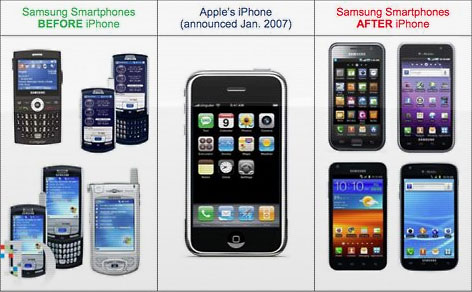
Re:It's not about innovation
The design is OBVIOUS.
this argument is invalidated by Samsung successfully carving niches for a 5" note, a 7" tablet, and phones with wider and taller screens than the iphone's. the iphone itself has also grown an extra row of icons in height. there are criteria regarding screen size selection that have outgrown the original 'human hand' argument.
Rounded edges. Wow. Not having rounded edges are uncomfortable in your pocket. Oblong, well oval or round phones are not comfortable in your pocket either and you'd also like something that doesn't use more space other than to house the required components, of which the size of the touch screen is probably the most important factor.
I too, have 20/20 hindsight. You also focus on the hardware design, and fail to acknowledge the blatant copying of the the IOS look and feel. it wasn't accidental, there are 132 pages which look at every aspect of the iphone with the intention to copy software features wholesale.
Most people handed the same components would come up with the same generic design.
This is precisely the argument, except the components were proprietary at the time. During the development of the phones in dispute, Samsung was responsible for mfg. parts for the iphone and ipad, including screen. of course they would have intimate access to the components ahead of the competition, which is how apple stays ahead. Samsung abused their agreements with apple, and were given an unfair competitive advantage./p
-
No, for many reasons
The short answer is no. The long answer is no
Start with reading Goldbergs classic paper "What Every Computer Scientist Should Know About Computer Arithmetic" Sun's floating point group made some improvements to the paper and paid for rights to redistribute. Oracle continues to do so. http://docs.oracle.com/cd/E19957-01/806-3568/ncg_goldberg.html
If that isn't depressing enough, and you use trig functions, read http://www.scribd.com/doc/64949170/Ng-Argument-Reduction-for-Huge-Arguments-Good-to-the-Last-Bit you can get the source from netlib for "fdlibm" which is under a BSD flavor license.
If the purely software issues haven't made you realize that you haven't got much of a prayer, please note that different revs of the same intel chips sometimes provide slightly different results (sometimes intentionally, sometimes as a result of tweaking the order of execution in the out of order execution engine). Older x87 arithmetic was 80-bit, newer x64 arithmetic is pure 64-bit, providing no end of fun. Using the SSE instructions provides more variation.
If the pretty much (in principle) "simple" and potentially deterministic software issues aren't enough consider the reality of hw. Chessin has a very good, yet amusing, explanation of the key problems http://queue.acm.org/detail.cfm?id=1839574
Lest you think they only apply to a particular generation of boutique processor, most HPC ensembles are now built out of standard server motherboards and chips.
http://www.csm.ornl.gov/srt/conferences/ResilienceSummit/2010/pdf/michalak.pdf The issue of undetected soft errors is big and growing, as can be seen from the activity in the literature. SC13 "ACR: Automatic Checkpoint/Restart for Soft and Hard Error Protection" (which has lots of good citations of earlier work, including field data such as 27 soft errors per week leading to fatal node failures (that is, wrong enough results that while the hw didn't detect any problem, the issue caused the node to crash) on just one ensemble (ASC Q). its going mainstream in that HPCwire caught wind and in 31 Oct 2013 had a nice tabloidesqe writeup entitled "Addressing the Threat of Silent Data Corruption"
Neutron's don't only disrupt memory elements, but can hit logic as well. See the upcoming issue (already available via IEEE xplorer for member/subscribers) JOURNAL OF SOLID-STATE CIRCUITS, VOL. 49, NO. 1, JANUARY 2014 The 10th Generation 16-Core SPARC64 Processor for Mission Critical UNIX Server" which details the lengths some (but not many) go to ensure that there are no undetected errors (wide range of techniques, ranging from where wires are placed on the chip, ECC, parity, residue arithmetic, automatic retry, etc.). No doubt there are some good (similar) papers in the IBM Technical Journal.
No doubt a good literature search would turn up dozens of other papers, and circuit design textbooks cover some of the territory.
In principle, interval arithmetic could provide a solution (you might not get the same interval, but if the intervals nest, you have consistent results and if they are disjoint you have a bug
-
Re:Natural monopoly is a myth
"But why can't high-voltage lines be run underground?"
Don't you think someone would have done it by now if it were feasible?Glad you asked. I'm trying to convince people not only is it feasible, it is high time to get on with it.
Air isn't a very good dielectric and in wet weather it gets even worse, see this list of insulator breakdown voltages. Glass has 40-100 times the dielectric strength of air, so yes, HVDC conduits ARE possible in standard sized trenches.
You have to realize that when most of the country was spanned, suspended cable on tall pylons in their wide right-of-way corridors was the cheapest and fastest way to do it. In many areas the real estate presently used for these, some of which is very valuable, can be reclaimed as it moved below ground.
Here is one company with a design for trench-able electric pipes that could handle 15 gigawatts at 800kv. That's 2.5 times Las Vegas summer peak load. No superconductors or refrigeration, just lots of aluminum. You'll also see a sad note at the bottom, "I have so far found that US-based venture capital investors will not take an interest in the elpipe because it is "too big, too long term."
This "too big, too long term" dismissal is symptom of serious problems. Venture capital investors, some who already have great-grandchildren, are refusing to even approach infrastructure repair and re-build projects in North America. What do they think the world will be like in 50 years if these things are not done?
Another company working on HVDC circuit breaker (check that photo, looks like fun). Also check out Roger W. Faulkner [2005]: Electric Pipelines for North American Power Grid Efficiency Security for some calculations on how much aluminum we're talking about.
Although you'll see a lot of talk about HVDC helping to make wind and solar 'renewables' more practical, I don't think so, because for base load power they are too expensive at any price.
Neither wind nor solar would save us from extinction in the case of a long harsh Winter or a climate disrupting global dust cloud event. On that point alone I believe every penny spent on big wind and big solar is wasted. I want my children to survive.
For the big picture on how I believe HVDC pipelines and reliable scalable base load power is the way to go, see
My letters on energy:
To The Honorable James M. Inhofe, United States Senate
To whom it may concern, Halliburton Corporate -
Re:Natural monopoly is a myth
"But why can't high-voltage lines be run underground?"
Don't you think someone would have done it by now if it were feasible?Glad you asked. I'm trying to convince people not only is it feasible, it is high time to get on with it.
Air isn't a very good dielectric and in wet weather it gets even worse, see this list of insulator breakdown voltages. Glass has 40-100 times the dielectric strength of air, so yes, HVDC conduits ARE possible in standard sized trenches.
You have to realize that when most of the country was spanned, suspended cable on tall pylons in their wide right-of-way corridors was the cheapest and fastest way to do it. In many areas the real estate presently used for these, some of which is very valuable, can be reclaimed as it moved below ground.
Here is one company with a design for trench-able electric pipes that could handle 15 gigawatts at 800kv. That's 2.5 times Las Vegas summer peak load. No superconductors or refrigeration, just lots of aluminum. You'll also see a sad note at the bottom, "I have so far found that US-based venture capital investors will not take an interest in the elpipe because it is "too big, too long term."
This "too big, too long term" dismissal is symptom of serious problems. Venture capital investors, some who already have great-grandchildren, are refusing to even approach infrastructure repair and re-build projects in North America. What do they think the world will be like in 50 years if these things are not done?
Another company working on HVDC circuit breaker (check that photo, looks like fun). Also check out Roger W. Faulkner [2005]: Electric Pipelines for North American Power Grid Efficiency Security for some calculations on how much aluminum we're talking about.
Although you'll see a lot of talk about HVDC helping to make wind and solar 'renewables' more practical, I don't think so, because for base load power they are too expensive at any price.
Neither wind nor solar would save us from extinction in the case of a long harsh Winter or a climate disrupting global dust cloud event. On that point alone I believe every penny spent on big wind and big solar is wasted. I want my children to survive.
For the big picture on how I believe HVDC pipelines and reliable scalable base load power is the way to go, see
My letters on energy:
To The Honorable James M. Inhofe, United States Senate
To whom it may concern, Halliburton Corporate -
Re:Natural monopoly is a myth
"But why can't high-voltage lines be run underground?"
Don't you think someone would have done it by now if it were feasible?Glad you asked. I'm trying to convince people not only is it feasible, it is high time to get on with it.
Air isn't a very good dielectric and in wet weather it gets even worse, see this list of insulator breakdown voltages. Glass has 40-100 times the dielectric strength of air, so yes, HVDC conduits ARE possible in standard sized trenches.
You have to realize that when most of the country was spanned, suspended cable on tall pylons in their wide right-of-way corridors was the cheapest and fastest way to do it. In many areas the real estate presently used for these, some of which is very valuable, can be reclaimed as it moved below ground.
Here is one company with a design for trench-able electric pipes that could handle 15 gigawatts at 800kv. That's 2.5 times Las Vegas summer peak load. No superconductors or refrigeration, just lots of aluminum. You'll also see a sad note at the bottom, "I have so far found that US-based venture capital investors will not take an interest in the elpipe because it is "too big, too long term."
This "too big, too long term" dismissal is symptom of serious problems. Venture capital investors, some who already have great-grandchildren, are refusing to even approach infrastructure repair and re-build projects in North America. What do they think the world will be like in 50 years if these things are not done?
Another company working on HVDC circuit breaker (check that photo, looks like fun). Also check out Roger W. Faulkner [2005]: Electric Pipelines for North American Power Grid Efficiency Security for some calculations on how much aluminum we're talking about.
Although you'll see a lot of talk about HVDC helping to make wind and solar 'renewables' more practical, I don't think so, because for base load power they are too expensive at any price.
Neither wind nor solar would save us from extinction in the case of a long harsh Winter or a climate disrupting global dust cloud event. On that point alone I believe every penny spent on big wind and big solar is wasted. I want my children to survive.
For the big picture on how I believe HVDC pipelines and reliable scalable base load power is the way to go, see
My letters on energy:
To The Honorable James M. Inhofe, United States Senate
To whom it may concern, Halliburton Corporate -
Re:Delays not surprising -- please stand by
That should be "we have an EARLY 20th-century energy grid".
It was friggin' amazing when it was built, a time when few could even envision multi-gigawatt cities such as Las Vegas.
It all began with the dramatic and brutal the battle of the currents. Tesla/Westinghouse AC was the right choice for small scale and the subscriber level, enabling the use of transformers to step voltage. The self-synchronizing 60 cycle grid grew, and in the age of miracles (practically) no one objected to corridors of uninsulated cable suspended between power plants, which grew to become the mighty pylons of today. Unlike the trans-continental railroad however, Eastern and Western grids cannot meet without a DC interface. At 60 cycles there is too much span across them to achieve stable synchronization.
Yet Edison's DC is needed today -- for the long haul, to re-configure the grid for greater current capacity and efficiency, better bridge existing grids allow massive direct energy transfer coast to coast. Burying these lines brings protection from natural disaster such as cataclysmic ice storms, Yellowstone or what ever. We'll also be able to reclaim much of the real estate presently allocated to these corridors.
[Faulkner, 2005] "There are different trade-offs for AC versus DC power transmission. For example, voltage can only be taken up to about 500,000 volts (500 kV) for an overhead AC power line because beyond that, power dissipation through dielectric loss becomes severe. Voltage for DC overhead power lines can be taken up to double the maximum AC voltage, to about 1000 kV (one million volts from ground potential; 2 million volts between the conductors); beyond that, power dissipation through corona discharge becomes severe. Underground DC power lines can use even higher voltage, and can be quite large; the main factors limiting size and design details are the need to insulate the conductor and to dissipate heat. Wire diameter is limited for AC transmission lines, whether overhead or buried, due to the âoeskin effectâ that prevents an AC current from penetrating to the center of a large wire, whereas a DC line can be arbitrarily thick. For these and other reasons, underground high capacity power lines are necessarily DC.
The simplest way electric power could be sent coast to coast is to build power lines based on conductors with much lower electrical resistance than any long distance power lines in service today. These âoeelectric pipelinesâ can be either conventional conductor or superconductor-based, in principle. The superconductor approach to electric pipelines has gotten some press and research interest, but is not technically ready to deploy yet. There is also a more pedestrian way to decrease the electrical resistance of a power transmission line: use more conductor..."
Faulkner goes on to describe several electric pipeline projects with projected cost.
___
My letters on energy:
To The Honorable James M. Inhofe, United States Senate
To whom it may concern, Halliburton Corporate -
Re:Delays not surprising -- please stand by
That should be "we have an EARLY 20th-century energy grid".
It was friggin' amazing when it was built, a time when few could even envision multi-gigawatt cities such as Las Vegas.
It all began with the dramatic and brutal the battle of the currents. Tesla/Westinghouse AC was the right choice for small scale and the subscriber level, enabling the use of transformers to step voltage. The self-synchronizing 60 cycle grid grew, and in the age of miracles (practically) no one objected to corridors of uninsulated cable suspended between power plants, which grew to become the mighty pylons of today. Unlike the trans-continental railroad however, Eastern and Western grids cannot meet without a DC interface. At 60 cycles there is too much span across them to achieve stable synchronization.
Yet Edison's DC is needed today -- for the long haul, to re-configure the grid for greater current capacity and efficiency, better bridge existing grids allow massive direct energy transfer coast to coast. Burying these lines brings protection from natural disaster such as cataclysmic ice storms, Yellowstone or what ever. We'll also be able to reclaim much of the real estate presently allocated to these corridors.
[Faulkner, 2005] "There are different trade-offs for AC versus DC power transmission. For example, voltage can only be taken up to about 500,000 volts (500 kV) for an overhead AC power line because beyond that, power dissipation through dielectric loss becomes severe. Voltage for DC overhead power lines can be taken up to double the maximum AC voltage, to about 1000 kV (one million volts from ground potential; 2 million volts between the conductors); beyond that, power dissipation through corona discharge becomes severe. Underground DC power lines can use even higher voltage, and can be quite large; the main factors limiting size and design details are the need to insulate the conductor and to dissipate heat. Wire diameter is limited for AC transmission lines, whether overhead or buried, due to the âoeskin effectâ that prevents an AC current from penetrating to the center of a large wire, whereas a DC line can be arbitrarily thick. For these and other reasons, underground high capacity power lines are necessarily DC.
The simplest way electric power could be sent coast to coast is to build power lines based on conductors with much lower electrical resistance than any long distance power lines in service today. These âoeelectric pipelinesâ can be either conventional conductor or superconductor-based, in principle. The superconductor approach to electric pipelines has gotten some press and research interest, but is not technically ready to deploy yet. There is also a more pedestrian way to decrease the electrical resistance of a power transmission line: use more conductor..."
Faulkner goes on to describe several electric pipeline projects with projected cost.
___
My letters on energy:
To The Honorable James M. Inhofe, United States Senate
To whom it may concern, Halliburton Corporate -
Re:Delays not surprising -- please stand by
That should be "we have an EARLY 20th-century energy grid".
It was friggin' amazing when it was built, a time when few could even envision multi-gigawatt cities such as Las Vegas.
It all began with the dramatic and brutal the battle of the currents. Tesla/Westinghouse AC was the right choice for small scale and the subscriber level, enabling the use of transformers to step voltage. The self-synchronizing 60 cycle grid grew, and in the age of miracles (practically) no one objected to corridors of uninsulated cable suspended between power plants, which grew to become the mighty pylons of today. Unlike the trans-continental railroad however, Eastern and Western grids cannot meet without a DC interface. At 60 cycles there is too much span across them to achieve stable synchronization.
Yet Edison's DC is needed today -- for the long haul, to re-configure the grid for greater current capacity and efficiency, better bridge existing grids allow massive direct energy transfer coast to coast. Burying these lines brings protection from natural disaster such as cataclysmic ice storms, Yellowstone or what ever. We'll also be able to reclaim much of the real estate presently allocated to these corridors.
[Faulkner, 2005] "There are different trade-offs for AC versus DC power transmission. For example, voltage can only be taken up to about 500,000 volts (500 kV) for an overhead AC power line because beyond that, power dissipation through dielectric loss becomes severe. Voltage for DC overhead power lines can be taken up to double the maximum AC voltage, to about 1000 kV (one million volts from ground potential; 2 million volts between the conductors); beyond that, power dissipation through corona discharge becomes severe. Underground DC power lines can use even higher voltage, and can be quite large; the main factors limiting size and design details are the need to insulate the conductor and to dissipate heat. Wire diameter is limited for AC transmission lines, whether overhead or buried, due to the âoeskin effectâ that prevents an AC current from penetrating to the center of a large wire, whereas a DC line can be arbitrarily thick. For these and other reasons, underground high capacity power lines are necessarily DC.
The simplest way electric power could be sent coast to coast is to build power lines based on conductors with much lower electrical resistance than any long distance power lines in service today. These âoeelectric pipelinesâ can be either conventional conductor or superconductor-based, in principle. The superconductor approach to electric pipelines has gotten some press and research interest, but is not technically ready to deploy yet. There is also a more pedestrian way to decrease the electrical resistance of a power transmission line: use more conductor..."
Faulkner goes on to describe several electric pipeline projects with projected cost.
___
My letters on energy:
To The Honorable James M. Inhofe, United States Senate
To whom it may concern, Halliburton Corporate -
Re:Which company bought this 'new' rule?
There's been plenty examples of voter fraud. Five seconds on Google provides evidence against your pathetic assertion. Amazingly, it's the President's organization employing a significant number of persons convicted.
Table of ACORN Voter Fraud Convictions
P.S. If you say Black three times and click your heels, you can return to Oz.
-
How about FLYWHEEL storage?
I see unwelcome trends.
Those who advocate taking energy storage down to the building or subscriber level are living in a dream. Don't get me wrong, it's a beautiful dream! But this €20,000 unit cost will not magically come into existence. Those who envision lithium or (eventually it comes down to) lead acid batteries to the point where their effect is even detectable at grid scales are proposing an environmental nightmare in the manufacture and mass deployment of such things. Which thankfully will not come to pass because the investment capital is not there.
I go with solutions that are massive, central, run by the same people who (reliably) supply your electricity, and do not rely on evil large multipliers of objects constructed from rare earth elements or poisonous heavy metals.
I'm talking about something simple and inherently non-toxic, stored kinetic energy and rotation of heavy balanced cylinders in a near-vacuum. I vote fewer that are really big rather than many. Hoover Dam tech. Despite Beacon's bankruptcy in 2011 there are players who hope to salvage the concept using gimbals for stabilization.
I like the idea of kinetic energy storage solutions because if they were massive, centrally located and well constructed, the components would be mechanical parts that might have a smaller replacement cost than an equivalent amount of battery technology, whose chemical composition changes with age. It also fits well with my assertion that we should convert our long haul energy corridors (and generation facilities along those corridors) to native HVDC for a true inter-connected continental (and ultimately global) grid.
___
My letters on energy:
To The Honorable James M. Inhofe, United States Senate
To whom it may concern, Halliburton Corporate -
How about FLYWHEEL storage?
I see unwelcome trends.
Those who advocate taking energy storage down to the building or subscriber level are living in a dream. Don't get me wrong, it's a beautiful dream! But this €20,000 unit cost will not magically come into existence. Those who envision lithium or (eventually it comes down to) lead acid batteries to the point where their effect is even detectable at grid scales are proposing an environmental nightmare in the manufacture and mass deployment of such things. Which thankfully will not come to pass because the investment capital is not there.
I go with solutions that are massive, central, run by the same people who (reliably) supply your electricity, and do not rely on evil large multipliers of objects constructed from rare earth elements or poisonous heavy metals.
I'm talking about something simple and inherently non-toxic, stored kinetic energy and rotation of heavy balanced cylinders in a near-vacuum. I vote fewer that are really big rather than many. Hoover Dam tech. Despite Beacon's bankruptcy in 2011 there are players who hope to salvage the concept using gimbals for stabilization.
I like the idea of kinetic energy storage solutions because if they were massive, centrally located and well constructed, the components would be mechanical parts that might have a smaller replacement cost than an equivalent amount of battery technology, whose chemical composition changes with age. It also fits well with my assertion that we should convert our long haul energy corridors (and generation facilities along those corridors) to native HVDC for a true inter-connected continental (and ultimately global) grid.
___
My letters on energy:
To The Honorable James M. Inhofe, United States Senate
To whom it may concern, Halliburton Corporate -
Iridium + Something Else
Well, if you want decent latency from a satellite network, I think the LEO Iridium constellation might be your only option: 10-20ms rtt vs. 500-600ms rtt for any geosynchronous satellite.
http://www.scribd.com/doc/49385912/Iridium-9602-Data-and-Inmarsat-C-latencyThough actually, it looks like the practical rtt to another the internet can take 1800ms over Iridium, since it has to bounce the signal around other nodes until it can get to one of its ground stations
Of course, Iridium data rates are in dial-up territory. It seems like you might be able to get low-cost consumer grade satellite services from DirecTV or something, using Iridium as the dial-up uplink component. But it also sounds like you'll be transmitting more data than you'll be receiving, if this is for data collection
Given that it also sounds likely you're looking at remote sites near the poles, Iridium may be your only option, since it gets pretty difficult to hit geosynchronous satellites beyond 70 deg latitude. So you might want to be optimizing your data transfer needs to fit through a tiny pipe, augmented via occasional sneakernet.
In short:
-
Re:thorium == wealth creation via cheaper energy
Renewables absolutely have the capability to meet out energy needs. Solar alone has reached to point where a sub-$10k installation can power a reasonably efficient house, even in the Northern US; in places that get enough wind (a lot more places than you might expect), a single small turbine can power a house, or a modest sized tower can power an entire neighborhood.
Okay say wind and solar $10k either way. You sound like someone who might have $10k in the bank. I say that gently with the utmost respect. Congratulations!
But you have to realize that in order to truly declare that these things have the 'capability', everyone must somehow ante-up the amount required, which they cannot... so your ability to pay will naturally result in the subsidizing of your neighbor's 'share'. Somehow.
There is a great value to be self-sufficient, but real grid solutions must be on the scale of whole {cities,states,countries,continents}. I sympathize with the sell-back fees, that whole "sell power back" idea was conceived with good intentions and sold long before the technical and liability issues were settled.
Even as a home owner on the road to complete energy self-sufficiency, your fate is bound with that of those around you. People who live hand to mouth in crackerbox apartments and trailer parks, your on-grid neighbors, and the vast majority of people who consider the electricity problem solved when (and if) they can afford to pay the bill. I barely can and I work for the city.
What this means is that everyone -- including yourself and myself, must come together to decide what is the best way to power the grid to resolve this crisis. We must do it in such a way that it will benefit everyone and bring the billed cost-per-KwH down substantially.
Reducing the cost of living is the same as creating wealth, in fact it is the best and only sustainable way to create wealth.
The grid must become the priority, be healed first. Otherwise those individuals who achieve self-sufficiency would become islands in the darkness as the grid fails and everyone else will naturally be drawn to the light. That would be a dangerous thing.
___
My letters on energy:
To The Honorable James M. Inhofe, United States Senate
To whom it may concern, Halliburton Corporate -
Re:thorium == wealth creation via cheaper energy
Renewables absolutely have the capability to meet out energy needs. Solar alone has reached to point where a sub-$10k installation can power a reasonably efficient house, even in the Northern US; in places that get enough wind (a lot more places than you might expect), a single small turbine can power a house, or a modest sized tower can power an entire neighborhood.
Okay say wind and solar $10k either way. You sound like someone who might have $10k in the bank. I say that gently with the utmost respect. Congratulations!
But you have to realize that in order to truly declare that these things have the 'capability', everyone must somehow ante-up the amount required, which they cannot... so your ability to pay will naturally result in the subsidizing of your neighbor's 'share'. Somehow.
There is a great value to be self-sufficient, but real grid solutions must be on the scale of whole {cities,states,countries,continents}. I sympathize with the sell-back fees, that whole "sell power back" idea was conceived with good intentions and sold long before the technical and liability issues were settled.
Even as a home owner on the road to complete energy self-sufficiency, your fate is bound with that of those around you. People who live hand to mouth in crackerbox apartments and trailer parks, your on-grid neighbors, and the vast majority of people who consider the electricity problem solved when (and if) they can afford to pay the bill. I barely can and I work for the city.
What this means is that everyone -- including yourself and myself, must come together to decide what is the best way to power the grid to resolve this crisis. We must do it in such a way that it will benefit everyone and bring the billed cost-per-KwH down substantially.
Reducing the cost of living is the same as creating wealth, in fact it is the best and only sustainable way to create wealth.
The grid must become the priority, be healed first. Otherwise those individuals who achieve self-sufficiency would become islands in the darkness as the grid fails and everyone else will naturally be drawn to the light. That would be a dangerous thing.
___
My letters on energy:
To The Honorable James M. Inhofe, United States Senate
To whom it may concern, Halliburton Corporate -
Re:oh thorium how i doth love thee on slashdot
Funny you should mention Thorium.
Here are a couple of letters (postal+email) I have written to Senator Inhofe and Halliburton Corporate. They express my sense of urgency. I invite everyone to review them and comment. Flames are welcome too. Whopee! I have a 'foe' now! Movin' on up.
And if your own process of discovery also leads you to some conclusion that is best expressed by getting the word out -- please do so. Whether you are not a thorium advocate, please consider the underlying issue, the necessity for an urgent PUSH to develop energy independence.
To The Honorable James M. Inhofe, United States Senate
To whom it may concern, Halliburton CorporateIt's about keeping the lights on.
Thanks for reading this, that and the other thing. -
Re:oh thorium how i doth love thee on slashdot
Funny you should mention Thorium.
Here are a couple of letters (postal+email) I have written to Senator Inhofe and Halliburton Corporate. They express my sense of urgency. I invite everyone to review them and comment. Flames are welcome too. Whopee! I have a 'foe' now! Movin' on up.
And if your own process of discovery also leads you to some conclusion that is best expressed by getting the word out -- please do so. Whether you are not a thorium advocate, please consider the underlying issue, the necessity for an urgent PUSH to develop energy independence.
To The Honorable James M. Inhofe, United States Senate
To whom it may concern, Halliburton CorporateIt's about keeping the lights on.
Thanks for reading this, that and the other thing. -
Re:Stallman would have something to say about this
Advocating doing something isn't evidence for having actually done something
Nobody's saying it is. It does strongly suggest that given the chance, you will do something, though. That's the concern here, that the defendant would either wipe his hard disk or publish his ex-employer's proprietary information. On multiple occasions in the past, he'd released internal company information after being advised not to, and violated written contracts with the company. The main factor in having the restraining order approved with no advance notice is that his website said that he'd be releasing source code to his own product "soon".
Well, your link doesn't actually point to any evidence that he "released internal company information after being advised not to". What it does say is that he recorded demonstration videos, applied through the proper channels for authorization to release those video to beta and alpha testers. After obtaining the limited authorization, he then posted the video on his site and youtube. The plaintiff alleges that he overstepped the limited authorization given on releasing these demonstration videos. This is the only occasion I am seeing, unless I am missing something, additionally, it seems more like a misunderstanding than anything else.
In fact, everything that the complaint alleges that he might have done illegally is referenced to as "On information and belief", yet no actual information is provided to support their beliefs. Contrary to their beliefs, they have actually painted Thuen as a law abiding citizen, by detailing all of the legal recourse he took in order to ensure he was doing things by the letter of the law. They have shown that he has a long history of attempting to follow the proper legal channels in all of his actions.
Additionally, Thuen's site has this to say:
Hi. So, if you're here, you might have read about Battelle's lawsuit against us. Obviously, until the injunction hearing, we can't say anything about what's going on, and until the forensics guys are done imaging our computers, as they are right now, we can't even type it.
But I think it's safe to say that, no, we didn't steal government code and then open-source it. If you'd like to be updated on this case and the proceedings, you can follow us on g+ and twitter. We thank everyone for their support, genuinely. Thanks.
They must have some evidence of a crime, yes.
Nope. As you note later, they need "probable cause". That's not actual evidence, and it's not nearly the high burden of proof you seem to think it is. In this case, the court does have evidence that the defendant had an unauthorized copy of the source code previously, and the defendant has promised to release his own source code "soon". If what he releases is actually his ex-employer's code, that harm would be irreparable. That's plenty of reasonable cause.
That doesn't make sense to me. Probable cause is generally defined as: "a reasonable amount of suspicion, supported by circumstances sufficiently strong to justify a prudent and cautious person's belief that certain facts are probably true".
The plaintiffs own complaint lists out all of the steps he took to ensure that he was taking a legal course of action. The only thing a reasonable person could assume from this is that he was setting himself up to compete with the other company, which obviously, even they realized. A paranoid person might believe that he is using source code illegally, regardless of the evidence in their own claim that suggests otherwise. However, probable cause does not suggest that we take paranoia into consideration. As far as I know, prudent and cautious people don't assume that others act in complete discourse with their past behavior.
Susp
-
Re:Stallman would have something to say about this
Lovely ad hominem. Mind if we get back on topic?
You keep saying "NPOV" as though it's a magical remedy, but your original call was to use Wikipedia to "undermine his decision". How is that goal neutral in any way, regardless of the language used?
Of course the complaint was made by the plaintiff, and it includes the evidence the plaintiff has already gathered. Yes, that's intentionally what forms the basis for the court to decide whether it's reasonable to disrupt the defendant's life while more evidence is gathered.
-
Re:The efficiency of capitalism
As a society we don't need to care what happens to some random company.
If JP Morgan collapsed tonight, we (as a society) would certainly care about what happens.
Why? Because some "random companies" are so big that their troubles would shake the (inter)national economy.This is a great strength of the private sector, and this property is what is referenced by the phrase "the market is self-regulating".
The market is not self regulating, unless it is self regulating towards oligopolies, oligopsonies, cartels, and general shittiness.
Greenspan Concedes Error on Regulation
October 23, 2008But on Thursday, almost three years after stepping down as chairman of the Federal Reserve, a humbled Mr. Greenspan admitted that he had put too much faith in the self-correcting power of free markets and had failed to anticipate the self-destructive power of wanton mortgage lending.
"Those of us who have looked to the self-interest of lending institutions to protect shareholders equity, myself included, are in a state of shocked disbelief," he told the House Committee on Oversight and Government Reform.
On a day that brought more bad news about rising home foreclosures and slumping employment, Mr. Greenspan refused to accept blame for the crisis but acknowledged that his belief in deregulation had been shaken.
I could quote the entire article, hell his entire testimony.
There was no room in his ideology for private companies to intentionally abandon risk management and externalize the risk by selling it off.
So despite his attempts to mince words, the results of his Ayn Randian ideology ended up being exactly what one would historically expect from not having meaningful regulation. -
Re:Stallman would have something to say about this
Advocating doing something isn't evidence for having actually done something
Nobody's saying it is. It does strongly suggest that given the chance, you will do something, though. That's the concern here, that the defendant would either wipe his hard disk or publish his ex-employer's proprietary information. On multiple occasions in the past, he'd released internal company information after being advised not to, and violated written contracts with the company. The main factor in having the restraining order approved with no advance notice is that his website said that he'd be releasing source code to his own product "soon".
They must have some evidence of a crime, yes.
Nope. As you note later, they need "probable cause". That's not actual evidence, and it's not nearly the high burden of proof you seem to think it is. In this case, the court does have evidence that the defendant had an unauthorized copy of the source code previously, and the defendant has promised to release his own source code "soon". If what he releases is actually his ex-employer's code, that harm would be irreparable. That's plenty of reasonable cause.
Suspicion isn't enough for a search warrant
But suspicion, probable cause, and a pressing time limit are.
...back in the 90s, when 'cyber crime' was in its infancy
Things have changed in the past 15 years. In this case, his hard disk is to be immediately turned over to the court, and returned when the court deems it appropriate after further litigation. Meanwhile, there is no restraint on the defendant to prevent using other computers.
It means his computer, his primary method of income has now been locked up, along with all kinds of collateral damage -- his entire digital life, including copies of resumes, bank records, pictures, etc., are all now inaccessible to him.
As security against the inconvenience, Battelle is also required to deposit $25,000 with the court, plus more if the court approves the defendant's requests.
-
Re:Wait, what? I'm a unicorn, arrest me?
It sounds like it's part of the standard discovery process, and it seems as if most of the people commenting on it are confused.
The guy posted YouTube videos of "his" product that still had the names and logos for his ex-employer's app, so the ex-employer was understandably antsy to make sure that the code didn't get out. The bit about him being a "hacker" played into the decision, obviously, and I agree that the decision stands on shaky ground (not least of which because there's a wide variance in what people mean by the term "hacker"), but they were reasonable and did not do anything extreme (e.g. SWAT didn't raid his house; he just had to hand over the drive).
From what I can understand in the court order (IANAL), the plaintiff isn't being given carte blanche access to the drive. Rather, they are merely being permitted to make a copy of it to their satisfaction, and then the copy and the drive are being handed over to the court for safe keeping until the court decides whether to allow it all as evidence later, and that's all because they think there is good reason for believing that he might otherwise destroy the evidence, which honestly seems like a reasonable assumption to me, given the stuff they already know of him.
-
Full court decision
The full court decision is here. (pdf)
-
Re:Nothing like real life
"Make a wish!, Billy!"
No, it is actually based on this true story:
http://www.scribd.com/doc/13743756/Weaseljumper-Part-II -
Re:bitcoin value
Whatever you think about it personally, much of the activity on the site was illegal and it wasn't confined to just recreational drugs. And it's clear that these weren't saints running this business either. Read the criminal complaint if you like.
-
Re:A Few Rules
Seems like every job these days conducts a criminal background check. But what that actually means varies widely. Some jobs will of course bar anyone with any felony whatsoever, but the proposed regulations are somewhat more reasonable:
"Any felony criminal conviction within seven years prior to the date of the background check for driving under the influence of drugs or alcohol, fraud, use of a motor vehicle to commit a felony, a violent crime or act of terror, a sexual offense, a crime involving property damage, and/or theft will make the applicant ineligible to be a TNC driver."
The "zero tolerance" policy on the other hand is much more onerous. Apparently they want to require the apps to have a feature to report suspected intoxication, and a single such report will trigger an automatic suspension until it's investigated further (implicitly until they complete a drug/alcohol test). While it may sound reasonable on the face of it, consider the potential for false reports based both on good intentions and worse, bad intentions ("that guy disagreed on [random political issue]! click, suspended!"). The training program isn't detailed, but that could certainly dissuade non-professionals if it requires actual online/offline classes.
Source: Full CPUC Proposed Rulemaking (via TechCrunch) (PDF) http://www.scribd.com/document_downloads/169457749?extension=pdf&from=embed&source=embed -
Re:Fastest policy backflip in history?
For something that isn't policy, was never policy, was never going to be policy, and will never be policy, it certainly looks remarkably like an official policy manifesto to me:
http://www.scribd.com/doc/165690692/Coalition-2013-Election-Policy-%E2%80%93-Enhance-Online-Safety-finalAre you implying their finger slipped in just such a way as to write a 10 page policy document, cost the policy, put the correct date on the document, and post the policy to their website completely accidentally? Or are you claiming that this is some sort of absurdly elaborate (and dull) hacker forgery?
Neither actually. I'm of the firm belief that this being the party that voted against censorship when the Labor party considered it, concocted this all as an elaborate ruse to keep the media busy a day before the election. It was too absurd to be true, and they backed down waaaay too quickly for them to have actually considered this as a policy. Yet somehow I turn on the radio and the TV today and all I hear about the new former internet filtering policy.
What I don't hear anything about is the Coalition policy costings which they have released only 48 hours before an election and has more holes in it that a block full of half eaten Swiss cheese. Look politicians are lying cheating dirty thieving backstabbing scum of society and you wouldn't piss on them if they were on fire. But they're not stupid.
I think this was actually quite genius on their part.