Slashdot Mirror
Domain: seti.org
Stories and comments across the archive that link to seti.org.
Stories · 28
-
SETI's 'Strong Signal' Came From Earth (arstechnica.com)
Yesterday, it was reported that Russia has detected a strong signal around 11 GHz coming from HD164595, a star nearly identical in mass to the Sun and located about 95 light years away from Earth. Well, long story short the signal came Earth. Ars Technica reports: "First, astronomers with the search for extraterrestrial intelligence downplayed the possibility of an alien civilization. 'There are many other plausible explanations for this claimed transmission, including terrestrial interference,' Seth Shostak, a senior astronomer with SETI, wrote. Now the Special Astrophysical Observatory of the Russian Academy of Sciences has concurred, releasing a statement on the detection of a radio signal at the RATAN-600 radio astronomy observatory in southern Russia. 'Subsequent processing and analysis of the signal revealed its most probable terrestrial origin,' the Russian scientists said." -
Saturn's Moons and Rings May Be Younger Than The Dinosaurs (space.com)
An anonymous reader quotes a report from Space.com: Some of Saturn's icy moons may have been formed after many dinosaurs roamed the Earth. New computer modeling of the Saturnian system suggests the rings and moons may be no more than 100 million years old. A new computer model suggests that the Saturnian moons Tethys, Dione and Rhea haven't seen the kinds of changes in their orbital tilts that are typical for moons that have lived in the system and interacted with other moons over long periods of time. In other words, these appear to be very young moons. "Moons are always changing their orbits. That's inevitable," Matija Cuk, principal investigator at the SETI Institute and one of the authors of the new research, said in a statement. "But that fact allows us to use computer simulations to tease out the history of Saturn's inner moons. Doing so, we find that they were most likely born during the most recent 2 percent of the planet's history." -
Kim Stanley Robinson Says Colonizing Mars Won't Be As Easy As He Thought
An anonymous reader sends this excerpt from io9: Kim Stanley Robinson's Mars trilogy filled us all with hope that we could terraform Mars in the 21st century, with its plausible description of terraforming processes. But now, in the face of what we've learned about Mars in the past 20 years, he no longer thinks it'll be that easy. Talking to SETI's Blog Picture Science podcast, Robinson explains that his ideas about terraforming Mars, back in the 1990s, were based on three assumptions that have been called into question or disproved:
1) Mars doesn't have any life on it at all. And now, it's looking more likely that there could be bacteria living beneath the surface. 2) There would be enough of the chemical compounds we need to survive. 3) There's nothing poisonous to us on the surface. In fact, the surface is covered with perchlorates, which are highly toxic to humans, and the original Viking mission did not detect these. "It's no longer a simple matter," Robinson says. "It's possible that we could occupy, inhabit and terraform Mars. But it's probably going to take a lot longer than I described in my books." -
Are Habitable Exoplanets Bad News For Humanity?
An anonymous reader writes "The discovery of Kepler-186f last week has dusted off an interesting theory regarding the fate of humanity and the link between that fate and the possibility of life on other planets. Known as the The Great Filter, this theory attempts to answer the Fermi Paradox (why we haven't found other complex life forms anywhere in our vast galaxy) by introducing the idea of an evolutionary bottleneck which would make the emergence of a life form capable of interstellar colonization statistically rare. As scientists gear up to search for life on Kepler-186f, some people are wondering if humanity has already gone through The Great Filter and miraculously survived or if it's still on our horizon and may lead to our extinction." -
Why Not Fund SETI With a Lottery Bond?
KentuckyFC writes "The Search for Extra-Terrestrial Intelligence or SETI is one of the highest profile projects in science. And yet its biggest challenge is in generating the funds required to scour the skies for signs of intelligent life. Government funding agencies generally ignore SETI so most funding comes from wealthy patrons such as Paul Allen who has donated $30 million for the construction of a radio interferometer designed to scour the skies for signs of ET. But the lack of other donors means this facility is still incomplete and only partially operational. But one astrobiologist has a solution. Why not create a lottery bond that allows investors to buy shares that yield a fixed rate of interest but also generates enough cash to fund ongoing SETI projects? To add an element of spice, this bond is also a lottery: when the search finally succeeds, a subset of the shareholders will receive a payout from the kitty. This is a fund that is likely to have global appeal but will need a financial institution willing and capable of taking it on. Any suggestions?" -
NASA Gets $75 Million For Europa Mission
astroengine writes "It may not be a lander or an orbiter, but its something. Europa, one of Jupiter's largest moons, has been the focus of much scrutiny over its potential life-bearing qualities. It has an icy crust over a liquid water ocean and now salts have been detected on its surface, suggesting a cycling of nutrients from the surface to the interior. This only amplifies the hypothesis that Europa not only could support basic life, it could support complex life. But how can we find out? The proposed Europa Clipper received interest at NASA HQ last year as it would optimize the science while keeping the mission budget under $2 billion. It would be a spacecraft that will be in orbit around Jupiter, but make multiple flybys of Europa to assess the moon for its habitable qualities. Now, in a bill signed by President Obama and approved by lawmakers, $75 million has been allocated (for the remainder of this fiscal year) for a 'Jupiter Europa mission.' Could it represent the seed money for the Europa Clipper? We'll have to wait and see." -
SETI Pioneer Jill Tarter Retires
ananyo writes "After 35 years, astronomer Jill Tarter is retiring from the Search for Extraterrestrial Intelligence (SETI) — a field she helped pioneer and popularize, most recently at the SETI Institute in Mountain View, California. Tarter, who inspired the late Carl Sagan to create the fictional character Ellie Arroway, heroine of the book and movie Contact, says she will instead focus her efforts on what she calls 'the search for intelligent funding.'" -
SETI Pioneer Jill Tarter Retires
ananyo writes "After 35 years, astronomer Jill Tarter is retiring from the Search for Extraterrestrial Intelligence (SETI) — a field she helped pioneer and popularize, most recently at the SETI Institute in Mountain View, California. Tarter, who inspired the late Carl Sagan to create the fictional character Ellie Arroway, heroine of the book and movie Contact, says she will instead focus her efforts on what she calls 'the search for intelligent funding.'" -
US Air Force Pays SETI To Check Kepler-22b For Alien Life
New submitter iComp writes with this quote from El Reg: "The Search for Extra Terrestrial Intelligence (SETI) has announced that it is back in business checking out the new [potentially] habitable exoplanets recently discovered by NASA's Kepler space telescope to see if they might be home to alien civilizations. The cash needed to restart SETI's efforts has come in part from the U.S. Air Force Space Command, who are interested in using the organization's detection instruments for 'space situational awareness'." -
SETI Finds Funds For the Allen Telescope Array (For Now)
Ransak writes "It looks as if SETI has met its short term funding goal to restart the Allen Telescope Array. Is crowdsourcing the long term future of pure research projects?" -
How Do You Greet an Extraterrestrial?
The LA Times is running a story about Earth Speaks, a companion project to SETI, which focuses on how we would communicate with intelligent extraterrestrial life, should we happen to discover it. Far more effort has been devoted to searching for signals or a means to communicate than the question of what we might say once contact is established, and the folks at SETI have set up a website to gather opinions on what the best questions and statements are. "So far, the messages break down into a few distinct categories. Some people want to throw a block party to welcome the aliens to the neighborhood. Others, less trusting, would warn the aliens that we've got guns and know how to use them. Another group, possibly influenced by having seen too many movies, would have us hide under the bed until they go away. 'If we discover intelligent life beyond Earth, we should not reply — we should freeze and play dead,' wrote one contributor." What would you say first to an alien? -
First Photos of the Reentry of the ATV "Jules Verne"
White Yeti writes with news of the reentry breakup of the ESA's Automated Transfer Vehicle. All went as planned, and the ESA blog has preliminary photos. An international team of observers, in two aircraft south of Tahiti, saw a series of explosions and over a hundred small pieces of debris. Observations were mostly made using optical cameras and spectrographs. The two images on the ESA site are low-res samples, so we should get more spectacular images soon. -
European Students to Put Microsatellite Into Orbit
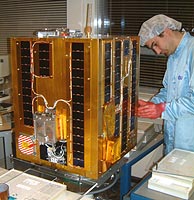
Astervitude writes "A Frankenstein's microsatellite made out of parts "donated" by university students across Europe will be launched on September 30 atop a Russian booster. Space.com reports that more than 400 students "spread across 23 universities and 12 countries" spent 18 months designing and building the SSETI Express. While its acronym sounds suspiciously similar to that of a project that seeks to uncover signs of intelligent life beyond Earth, the SSETI or Student Space Exploration Technology Initiative mission is actually part of an effort by the European Space Agency "to boost student interest in space technology and offer some hands-on experience." The satellite itself weighs a mere 136 pounds and is the "size of a small washing machine", as shown in this ESA photo. Visitors to the mission site may want to check out the contest page for ham radio operators to help collect data from the satellite." -
SETI Disrupted By Cell Phones in Airplanes?
Iphtashu Fitz writes "If, as recently mentioned, the FCC does allow wireless access on airplanes, could it effectively mean the end of the search for ET? NewScientist has a new article that explains how radio interference from airborne cellphones could drown out faint radio signals from space. Among other concerns astronomers have is that the second harmonic of many cell phones falls in a frequency band that reveals the molecular signature of newborn and dying stars, which is among the 2% of frequencies in this part of the electromagnetic spectrum reserved for use by radio astronomers. Michael Davis, director of projects at California's SETI Institute, stated that a single cellphone on an airplane 100 miles from a radiotelescope could exceed recommended radio noise levels by 10 times. A potential solution that astronomers have suggested is to install a miniture cell transceiver on each airplane, called a picocell, that would act as a relay using a frequency that wouldn't interfere with their work." -
Scientists Discover What You Are Thinking
neurospace writes "Caltech scientists have successfully decoded movement plans from the brains of awake humans. This work has direct application to the development of a neural prosthesis, a brain-machine interface that will give paralyzed people the ability to move and communicate simply using their thoughts. The lead scientist on this project will be interviewed on Sunday, March 20, on the SETI Institute's weekly radio show, 'Are We Alone?'" -
SETI Predicts We'll Find ETs by 2020
FTL writes "Based on the Drake Equation, Moore's Law, and the Allen Telescope, a new prediction has been made that Earth will make first contact with aliens within 20 years. Of course once we find the first aliens there's the question of can we decode their signals, would they spot our reply, and what's the lag time." -
SETI@home Turns Five Today
mfh writes "Five years ago today, SETI@home launched a comprehensive program to search for Extra Terrestrial life in the universe, using millions of home computers to help compile useful data that could some day lead to the discovery of advanced extra terrestrial life. Since inception, SETI@home has found 2,568 persistent Gaussians, possible radio transmissions from a distant planet. SETI began in 1960 with the efforts of Cornell University astronomer Frank Drake, whose Project Ozma became the first modern SETI experiment in history." -
Microsoft's Paul Allen Funds ET Search
Chris Gondek writes "Microsoft co-founder Paul Allen, one of the richest men on Earth, today pledged to donate $US13.5 million ($17.99 million) for research into extra-terrestrial life. With the contribution, Allen will have given $US25 million ($33.32 million) for construction of the Allen Telescope Array (ATA), a network of 350 radio telescopes being built to find signs of life in space, said Thomas Pierson, director of the Search for Extraterrestrial Intelligence (SETI) Institute." -
Distributed Computing and Climate Change
GraWil writes "The BBC are reporting the launch of climateprediction.net. The aim of the project is to investigate the approximations that have to be made in state-of-the-art climate models which frequently give rise to inconclusive predictions. More info on the current state of climate modeling is given by the latest Intergovernmental Panel on Climate Change (IPCC) report which highlights the need to quantify uncertainties of climate projections. So now, in addition to finding ET or curing cancer, your PC can now contribute to our understanding of climate change." -
Open Source for SETI Software?
CommonModeNoise asks: "The SETI Institute is thinking about going to an open source model for some of our software. We have little experience with Open Source so we would like to ask the following: To what degree can an open-source project be self-managing -- how many of our staff will be needed to keep such an activity running productively? How can we deal with the lunatic fringe that will be attracted to something as provocative as SETI? Can open source development proceed at the same speed as traditional in-house development, or will it be slower? Some of our software controls hardware, for example the Allen Telescope Array; can such control software be developed using open source methods or are we better off focussing on the software-only systems, such as the next generation of our signal detectors? Finally, could we please get some suggestions as to what to read to get a better grasp of the varieties of open source development models and their respective good and bad points." -
Open Source for SETI Software?
CommonModeNoise asks: "The SETI Institute is thinking about going to an open source model for some of our software. We have little experience with Open Source so we would like to ask the following: To what degree can an open-source project be self-managing -- how many of our staff will be needed to keep such an activity running productively? How can we deal with the lunatic fringe that will be attracted to something as provocative as SETI? Can open source development proceed at the same speed as traditional in-house development, or will it be slower? Some of our software controls hardware, for example the Allen Telescope Array; can such control software be developed using open source methods or are we better off focussing on the software-only systems, such as the next generation of our signal detectors? Finally, could we please get some suggestions as to what to read to get a better grasp of the varieties of open source development models and their respective good and bad points." -
Open Source for SETI Software?
CommonModeNoise asks: "The SETI Institute is thinking about going to an open source model for some of our software. We have little experience with Open Source so we would like to ask the following: To what degree can an open-source project be self-managing -- how many of our staff will be needed to keep such an activity running productively? How can we deal with the lunatic fringe that will be attracted to something as provocative as SETI? Can open source development proceed at the same speed as traditional in-house development, or will it be slower? Some of our software controls hardware, for example the Allen Telescope Array; can such control software be developed using open source methods or are we better off focussing on the software-only systems, such as the next generation of our signal detectors? Finally, could we please get some suggestions as to what to read to get a better grasp of the varieties of open source development models and their respective good and bad points." -
Drake on Drake: ET Life A Certainty
astro writes "Frank Drake, Chairman of the Board of Trustees of the SETI Institute applies Occam's Razor to his own Drake equation: 'Life should appear very frequently on other Earth-like planets. There will be microbial life nearby the solar system.' The simplest scenario is that 'Not Life' has a nearly identical number of assumptions as 'Life.' The contrasting view is that experimentation can prove it--but how many times did life independently create itself while the Earth changed through the whole spectrum of what biological forces might conjure up elsewhere. A sample size of 1 is in fact an experimental sample size of many--just here during Earth's climatic history." -
Rare Earth
Tal Cohen writes: "It is said that one of the most important skills a physicist needs is the ability to quickly make "back-of-the-envelope" calculations. For example, Jan Wolitzky (in Jon Bently's "Programming Pearls") tells about Enrico Fermi, Robert Oppenheimer, and the other Manhattan Project brass who were behind a low blast wall awaiting the detonation of the first nuclear device from a few thousand yards away. Fermi was tearing up sheets of paper into little pieces, which he tossed into the air when he saw the flash. After the shock wave passed, he paced off the distance traveled by the paper shreds, performed a quick "back-of-the-envelope" calculation, and arrived at a figure for the explosive yield of the bomb, which was confirmed much later by expensive monitoring equipment." Read on to find out what this has to do with the unusual characteristics of Earth, and how they could influence our search for life elsewhere in the universe. Rare Earth: Why Complex Life is Uncommon in the Universe author Peter D. Ward, Donald Brownlee pages 368 publisher Copernicus rating 7 reviewer Tal Cohen ISBN 0387987010 summary Maybe we are alone, after all.But expensive monitoring equipment which can confirm the calculation does not always exist, and hence in some fields, our entire knowledge is based on back-of-the-envelope calculations and rough estimates.
Take, for example, the following question: "How many intelligent civilizations, capable of radio communications, currently exist in the Milky Way galaxy?". The worthwhileness of search projects (such as SETI) is closely related to the answer to this question. The number of positively known civilizations is exactly one: the human civilization. And yet, many scientists believe, or at least believed until recently, that the actual number is far, far higher.
This belief was based on various estimates, such as the calculation proposed by Frank Drake, now known as "The Drake Equation." This equation was popularized in Carl Sagan's remarkable TV series, "Cosmos". Sagan himself believed the calculation's result, and was one of the founders of SETI.
Drake's equation is easy to understand. Take the number of stars in the galaxy (about 200 to 300 billion, based on generally accepted estimates), and multiply it by: the percentage of stars that are similar to our Sun in the energy output and stability; the percentage of stars that have planets (since not every star has any); the percentage of planets orbiting their star in a proper distance (so they could hold liquid water, a necessity for maintaining life); the percentage of planets with liquid water on which life actually evolved; and finally, the percentage of life-bearing planets in which intelligent civilizations (i.e., those that can communicate by radio) eventually came to be. All in all, there are five or six factors in this product.
(Note: In my own copy of the book (2nd impression), page 267 states that "a good estimate for the number of stars in our galaxy [is] between 200 and 300 million" - one letter misspelled, and wrong by three orders of magnitude. I do hope the authors' actual calculations were based on the correct value.)
But what values should be used for the various percentages? Drake (and Sagan) chose what they considered to be a conservative approach, and estimated that only about 1 in 10 stars has any planets; only 1 in 10 planets is in the proper orbit, and so forth. Despite the conservative approach, the results were encouraging, indicating that there are thousands of intelligent civilizations in the Milky Way, and probably millions of them in the whole universe. Thus they concluded that there is intelligent life out there, in all likelihood; now we only have to look for it.
In their book Rare Earth, published by Copernicus Press in 2000, Peter Ward and Donald Brownlee point at Drake's (and other physicists') mistakes in a long and depressing discussion, a discussion that took the wind out of more than one SF author's sail.
The book presents what the authors call "the rare Earth hypothesis": simple (bacterial) life is very common in the universe; complex life (multi-cellular life forms, or animals -- let alone intelligent life) is very rare. The first part of the hypothesis is easy to understand, and few scientists will argue with it: indications of simple life were already discovered on rocks originating on Mars, and even here on Earth in conditions that were, until recently, considered completely hostile to life (such as temperatures higher than 100 degrees Celsius, in which 'extremophile' bacteria were found to exist). The second part is the interesting one, and it suggests that the existence of simple life does not necessarily lead to the evolutionary development of complex life, for any number of reasons.
Drake's mistake was basically in the assumption that all it takes for a planet to develop life is being in the proper distance from a proper star. The truth, Ward and Brownlee suggest, is that we have to look at each and every attribute of Earth, and re-estimate its importance for supporting life. Drake's equation is a statistical calculation, but with no other example for life, we're doing statistics with N=1.
Well then, what are the special attributes of Earth that we have to take into account when attempting to run this calculation?
- Proper distance from the star. If a planet orbits its sun too closely or too far away, liquid water would not exist. There isn't much margin for error here: a change of 5 to 15 percent in Earth's distance from the Sun would lead to the freezing, or boiling, of all water on Earth.
- Proper distance from the center of the galaxy. The density of stars near the center of the galaxy is so high, that the amount of cosmic radiation in that area would prevent the development of life.
- A star of a proper mass. A too-massive star would emit too much ultra-violet energy, preventing the development of life. A star that is too small would require the planet to be closer to it (in order to maintain liquid water). But such a close distance would result in tidal locking (where one face of the planet constantly faces the star, and the other always remains dark -- as with the moon in its orbit around Earth). In this case one side becomes too hot, the other too cold, and the planet's atmosphere escapes.
- A proper mass. A planet that is too small will not be able to maintain any atmosphere. A planet that is too massive would attract a larger number of asteroids, increasing the chances of life-destroying cataclysms.
- Oceans. The ability to maintain liquid water does not automatically imply that there will be any on the planet's surface. It looks like Earth acquired its own water from asteroids made of ice that crashed here billions of years ago. On the other hand, too much water (i.e., a planet with little or no land) will lead to an unstable atmosphere, unfit for maintaining life.
- A constant energy output from the star. If the star's energy output suddenly decreases, even for a relatively short while, all the water on the planet would freeze. This situation is irreversible, since when the star resumes its normal energy output, the planet's now-white surface will reflect most of this energy, and the ice will never melt. Conversely, if the stars energy output increases for a short while, all the oceans will evaporate and the result would be an irreversible greenhouse-effect, preventing the oceans from reforming.
- Successful evolution. Even if all of these conditions hold, and simple life evolves (which probably happens even if some of these conditions aren't met), this still does not imply that the result is animal (multi-cellular) life. The evolution of life on Earth included some surprising leaps; two worth mentioning are the move from simple, single-cellular life to cells which contain internal organs, and the appearance of calcium-based skeletons. It appears like the first of these leaps took more time than the evolution from complex single-celled life to full-blown humans.
- Avoiding disasters. Any number of disasters can lead to the complete extinction of all life on a planet. This include the supernova of a nearby star; a massive asteroid impact (like the one that probably caused the extinction of dinosaurs, and 70% of all other life-forms at the time); drastic changes of climate; and so on.
There are also a few attributes that seem, at first, to be completely unrelated to life and not required for its development. Ward and Brownlee argue strongly for the importance of the following attributes:
- The existence of a Jupiter-like planet in the system. Apparently, Jupiter's large mass attracted many of the asteroids that would have otherwise hit Earth. Could life evolve in a system with no Jovian planet? On the other hand, too many Jovian planets, or one that is too large, could lead to a non-stable solar system, sending the smaller planets into the central sun or ejecting them into the cold of space.
- The existence of a large, nearby moon. Luna, Earth's moon, is atypically large and close. Both of Mars's moons, for example, are minor rocks by comparison. What does this have to do with life? Well, it turns out that Luna kept (and still keeps) Earth's tilt stable. Without Luna, the tilt would have changed drastically over time, and no stable climate could exist. If the tilt would have stabilized on a too-large or too-small value, the results could also be disastrous; Earth's tilt is "just right."
- Plate tectonics. Surprisingly enough, it seems like plate tectonics are required for maintaining a stable atmosphere. Plate tectonics play an important role in a complex feedback system (explained in detail in the book) that prevents too many greenhouse gases from existing in the atmosphere. No other planet (except maybe for Jupiter's moon Europa) is known to have plate tectonics. Is this a rare phenomenon, but required for life?
The bottom line is that many additional factors must be added to Drake's equation. One must keep in mind that as any term in such an equation approaches zero, so too does the final product. For most terms, we have no way of reliably estimating their true value, but it seems like at least some of these values are extremely low.
Two important things should be noted about this book. First, about what it does not contain: although I am sure many people will see the Rare Earth Hypothesis as another proof for the existence of a god, this notion of a proof is completely unrelated to the authors' ideas. The hypothesis claims that the conditions for creating complex life are rare; but we know for a fact that at least in one case, all the required conditions were met. Additionally, anyone who insists on taking the ideas of this book as a proof for god's existence will also have to accept the authors' prepositions about the age of the universe, the age of planet Earth, and more importantly, the theory of evolution.
Second, about what the book does contain: the book discusses at length all the issues I've listed above, and more. The problem is that sometimes one gets the feeling that these issues are discussed in too much detail, and the authors tend to repeat themselves, or to delve too deep into some of the less-important aspects of their theory. This is certainly not your common popular-science book; it relies on very up-to-date research results (including some results that were not even published when the book went to press). The writing gets technical on many points in astrophysics, biology, chemistry, and geology (as well as the new field of astrobiology, of course). Over 25 pages of bibliography and references are included.
The theory's weakest point, however, is obvious. The authors admit (after 281 pages of discussion) that their base assumption was that every complex life-form would be similar in many ways to life on Earth: "We assume in this book that animal life will be somehow Earth-like. We take the perhaps jingoistic stance that Earth-life is every-life, that lessons from Earth are not only guides but also rules. We assume that DNA is the only way, rather than only one way" (p. 282).
For me, reading this book was a fascinating and awe-inspiring experience. The most important conclusion (apart from SETI being a huge waste of resources) is an unavoidable cliché, which the authors avoided presenting directly, even though it stares into the reader's face from every page and each paragraph: What we have here is rare, maybe even unique. We should try a little harder to make sure it survives.
Post Scriptum: A news item in the November/December 2001 issue of the Skeptical Inquirer (Vol. 25, No. 6) states that "David Darling, an astronomer who is a critic of the Rare Earth hypothesis, has revealed that one of the strongest influences on the authors, a young [...] astronomer who they acknowledge in their preface 'changed many of our views about planets and habitable zones', has a hidden, Earth-is-unique agenda motivated by strong 'intelligent design' religious views." That astronomer, Guillermo Gonzalez, published several articles in Connections, a quarterly newsletter published by Reasons to Believe, Inc. In one of these articles, co-authored with the creationist scientist Hugh Ross, Gonzalez writes: "The fact that the Sun's location is fine-tuned to permit the possibility of life [...] powerfully suggests divine design."
Darling published these findings, along with a detailed point-by-point scientific critique of the Rare Earth hypothesis, in his book Life Everywhere: The Maverick Science of Astrobiology . Skeptical Inquirer quotes Darling as saying, "What matters is not whether there's anything unusual about the Earth; there's going to be something idiosyncratic about every planet in space. What matters is whether any of Earth's circumstances are not only unusual but also essential for complex life. So far we've seen nothing to suggest there is."
For more about this book, please see this page. For additional book reviews, please visit Tal's bookshelf. You can purchase Rare Earth from bn.com. Want to see your own review here? Just read the book review guidelines, then use Slashdot's handy submission form. -
(Mostly) Confirmed: New Mersenne Prime Found
A reader writes "Distributed computing seems once more to be succesful. The combined effort of many pc's joining Primenet in search for a new Mersenne prime may have found there fifth result. Among them many belonging to /. readers. There is an unconfirmed claim for Mersenne prime #39 of over 3,500,000 digits, for which a considerable amount of money has been awarded. SETI looks for ET's messages, but found none sofar. Mersenne primes are used to tell ET about us. A previous found Mersenne number was used to show the advance of science on our planet in a message send into outer space. " The Primenet list has confirmed that while they still need to totally test it out (which should be done by the 24th), they believe that the number found today is the 39th positive. -
Looking For Aliens In All the Wrong Places
LtFiend writes "Evidently, some astronomers believe that SETI is searching the skies for the wrong type of signal. This new telescope built by Harvard will search for laser light and can detect pulses " as short as a billionth of a second." Looks like we'll need a new version of SETI at home so we can help with this one." -
Pioneer 10 Finally Dead After 28 Years?
BorgiaPope writes: "Jill Tarter of the SETI Institute's Project Phoenix writes a sad, elegiac piece in Slate about the apparent final silence of Pioneer 10, launched in 1972 and now more than 7 billion miles from Earth. For the past five years, SETI scientists at the Arecibo Observatory in Puerto Rico have used the incredibly faint signals from Pioneer 10 to test the functionality of their noise filtering gear. Alas, Tarter reports that Pioneer 10 hasn't been heard from for several days now. The incredibly hardy, long-lived satellite, which long ago surpassed NASA's wildest expectations for its power supplies and other systems, may finally have drifted peacefully into eternal slumber . . . ." I think the Klingons got it. -
The Age of Curiosity
Michael Dayah wrote to us with a great essay, that I've included below. He addresses the issue of the Drake Equation and what Age we live in now. The Age of CuriosityEveryone has seen the famous Drake Equation on those educational astronomy shows--the equation that multiplies the nearly infinitely large number stars in the universe by several seemingly miniscule fractions--expressing the number of technological civilizations in the universe that have progressed to the point of radio communication. Despite this, it still always manages to produce some preposterously large number of intelligences from whom we should have already heard. So why isn't the sky saturated with these radio signals from extraterrestrials?
Two hundred years ago, we had no interest in listening for other forms of life on the edge of our galaxy. The scientific knowledge of the time was not developed enough to allow us to be curious about extraterrestrials and radio transmissions from space. Now, our civilization is at the height of its curiosity. On the edge of comprehending quantum mechanics but still searching for a "theory of everything", we understand just enough science to pique our interest--to make us hungry for more. We can see the amazing things--things like nanotechnology--that are possible but just out of our reach. Will this curiosity dwindle as more of this becomes possible--and real?
In our Age of Curiosity, we know computers can simulate our environment and predict what will happen given certain initial conditions. The universe operates under specific physical laws and--given starting conditions, such as the conditions of an early earth on which life arose, a computer could theoretically track the position of every atom as amino acids formed, the first cells divided, and the first creature came out of the water. What stops us from doing this now? Time. Our current level of computational speed is too primitive to handle but the simplest of prediction-type tasks, such as deciding how wind will interact with an airplane or how heat will warp a metal container. Even these are too complex to be calculated on the atomic level; we must use equations that describe the motion and flow of gasses and liquids on a large scale to run such simulations.
Will we still be as interested in contacting other life when computers are fast enough to simulate a million years of evolution in a few days? Who would want to wait a thousand years to get one response from a distant and potentially hostile civilization when we can converse in real time with our own computer-generated population simulated in a consumer-level computer? The only question is of when computer technology will reach this speed. Obviously, such computational speed is far beyond any amount of copper wire and almost any number of cubic miles of nanotechnology. It is not beyond quantum computing, if such a thing is possible on a large scale. How long will this advance take? Ten years? A hundred years? Two hundred years at the absolute most?
What if such a level of quantum computing proves to be impossible? Even if we cannot completely simulate large environments and watch evolution progress on the atomic level, we will have soon unraveled the mysteries of life. The Human Genome Project is nearly complete. Not too many years afterwards, we will know the purpose of every nucleotide of the human genome. Creating entire organisms from nothing but a graphical interface and gene-sequencing machine (which already exists) is no more than a hundred years away. Whether specific advances are possible or not is irrelevant. What is relevant is the eventual decline in curiosity as ability and technology increase. The above two advances are just examples.
When did our civilization have the greatest capability for destruction? Our curiosity about other intelligences and making contact piqued in about the same period as our ability to make atomic weapons. For all civilizations, the discovery of the destructive power of subatomic energy likely follows the discovery of radio communication; the scientific understanding required for both is closely related. Who would want to communicate with a potentially violent race in the prime of their destructive ability and the maximum of their naivety to use this destructive power?
Why is it when we think of other intelligences, we always imagine they are peaceful? We certainly are not. It is time-tested knowledge that when a stronger population encounters a weaker population, the weaker population is enslaved or killed. When human society reached industrialization, the environment and lesser species paid the price. Over one hundred species a day are still becoming extinct because of our actions. When the Europeans came to North America, they killed the Native Americans and enslaved the Africans. Why do we believe this would not hold true for interplanetary relations? Is it wishful thinking, since we will likely be the lesser race? Can you imagine us visiting a planet with Neanderthal-level inhabitants and not vastly exploiting them and their planet, even if just for natural resources? Other civilizations would likely have experienced similar problems in their past; it's not much of an incentive to broadcast your presence.
How long will we even use the current methods of radio communication? Knowing we are broadcasting our presence to many potentially hostile races within striking distance, won't we soon want to use better methods of communication (or, at minimum, bands of the electromagnetic spectrum) which are greatly if not completely dampened or reflected by the atmosphere? This would be perfectly acceptable for localized communications. Since satellite communications can be directed at specific points, there is no major concern about a sphere of electromagnetic noise broadcasting our presence. Certainly other civilizations realize this as well, further decreasing the chance of contact.
One hundred, or for the sake of argument, five hundred years of nominal curiosity about other civilizations is an extremely small slice of the eight billion years or so the universe has been hospitable for the creation and proliferation of life. If every civilization only concerned itself with making contact for a millionth of their evolutionary development, what are the chances of one civilization hearing another other at exactly the right time? If by some remote chance one planet in its Age of Curiosity received radio communication from another civilization and attempted a reply, the broadcaster would have already lost interest and stopped listening.
It is time to update the Drake Equation to include another miniscule fraction--the ratio of a civilization's Age of Curiosity to its lifetime. Will this addition keep the number of communicable civilizations optimistic enough for us earthlings, in our Age of Curiosity?