Slashdot Mirror
Domain: sfconservancy.org
Stories and comments across the archive that link to sfconservancy.org.
Comments · 41
-
SFC's blog post is more informative than TFA
https://sfconservancy.org/blog/2019/mar/13/lf-community-bridge/ is more understandable than the article we're pointed to in this
-
GPL Recission
Main:
https://lkml.org/lkml/2019/1/1... (GPL Recission announcement (to show it can be done and encourage others to do it))
https://lkml.org/lkml/2018/10/... (Debunking of SFConservancy's statement)Anti-Rescind:
ZDNet "Debunking" lulz.com article (by quoting PJ the paralegal, who got it wrong): https://www.zdnet.com/article/...
This is constantly cited by "no recind"ers.
SFConservancy's "Debunking" of lulz.com article: http://sfconservancy.org/news/...
(The new section: https://copyleft.org/guide/com... )
---
Pro-Rescind:
Refutation of SFConservancy's "debunking" of lulz.com article: https://lkml.org/lkml/2018/10/...
(Published 5 hours after the "debunking")Public announcement of GPL Recission of GPC-Slots 2 game vs "Geek Feminists": https://lkml.org/lkml/2019/1/1...
(This was also posted elsewhere, so as to be visible to the recindees, and sent to the mail of the named individuals, where it could be determined)Submission to slashdot (wasn't posted): https://slashdot.org/submissio...
---
Eben Moglen vows to write a paper about how the GPL is irrevokable:
https://lkml.org/lkml/2018/10/...
2 months later still no paper to be found: https://lkml.org/lkml/2018/12/...
---
Other useful links:
8chan discussions with author, and expositions on the law:
http://8ch.net/tech/res/101340...
http://8ch.net/tech/res/101782...
http://8ch.net/tech/res/101872...4chan
https://warosu.org/g/thread/S6...
http://archive.fo/OhIR4
http://boards.4channel.org/g/t...
---Here's one user who did as suggested and consulted with an attorney friend, the attorney friend refuted the "following the GPL is consideration" argument nicely:
https://archives.gentoo.org/ge...Thank you for the response, though I feel you don't address my
question. Happily though, I spoke with an acquaintance and it was
determined that the subservience to the license (i.e. agreeing to be
bound by the GPL2) could not be offered as consideration as its
restrictions were not the licensee's to offer at the time of
acceptance of the license. The licensee had no rights to offer as part
of the contract, as the contract had not yet given them any rights to
give up. The terms put forth by the GPL2 are only restrictions that
are part of the license.Furthermore, as stated above, it should seem quite self referential -
I can't offer my acceptance of a license as consideration, because it
is what I am trying to accept.As I am sure you are aware, under US law there is no contract if both
sides have not provided consideration. This leaves us in the strange
place of gratis licenses being suggestions.Cheers,
R0b0t1---
Various other threads:
https://archives.gentoo.org/ge... -
Response to SFConservancy: The copyright holder ca
The software freedom conservancy has tendered its response:
http://sfconservancy.org/news/...
http://copyleft.org/guide/comp...""
"The GPLv2 have several provisions that, when taken together, can be construed as an irrevocable license from each contributor. "
""It cites:
" That license granted to downstream is irrevocable, again provided that the downstream user complies with the license terms: "[P]arties who have received copies, or rights, from you under this License will not have their licenses terminated so long as such parties remain in full compliance" (GPLv2Â4). "
However this is disingenuous
The full text of section 4 is as follows:
""
4. You may not copy, modify, sublicense, or distribute the Program
except as expressly provided under this License. Any attempt
otherwise to copy, modify, sublicense or distribute the Program is
void, and will automatically terminate your rights under this License.
However, parties who have received copies, or rights, from you under
this License will not have their licenses terminated so long as such
parties remain in full compliance.
""The "You" in section 4 is speaking of the licensee regarding sub-licensees, it is not speaking to the licensor/copyright-holder.
IE: if the licensee loses his license, through operation of the automatic-revocation provisions, the sub-licensees do not also lose their licenses.
IE: The language is disclaiming a chain topography for license distribution, and instead substituting a hub-and-spoke topography (all licenses originating from the copyright holder, not the previous-in-line)
GPLv3 added a no-rescission clause for a reason: the reason being to attempt to create an estoppel defense for the licensees against the licensor. You will notice that Eben Moglen never speaks on these issues. (He preumably is aware of the weaknesses vis a vis the US copyright regime.)
Section 6 further clarifies the hub-and-spoke model:
""
6. Each time you redistribute the Program (or any work based on the
Program), the recipient automatically receives a license from the
original licensor to copy, distribute or modify the Program subject to
these terms and conditions. You may not impose any further
restrictions on the recipients' exercise of the rights granted herein.
You are not responsible for enforcing compliance by third parties to
this License.
""The memorandum posted then goes on to a discussion of estoppel, detrimental reliance, etc; noting that users may have relied on the software and their licenses may be estopped from being revoked from said users since doing so might cause them unanticipated loss. This is speaking of already published, existent, versions of the program used by end users.
The memorandum seems to ignore what happens to "upstream" once said project receives a revocation notice. Thought it may be possible that users of a published piece of software may have defenses to license revocation, the same is not true regarding the rescinded property vis-a-vis future prospective versions of the software nor of future prospective licensees of said software.
That is: once the grant to use the code in question is rescinded, future versions of the software may not use that code. Current users of the software may be-able to raise an estoppel / detrimental reliance defense regarding the current published software, however the programmers working on the next version of said software cannot continue to use the property in future versions of the software (such would be a copyright violation once the gratuitous license is rescinded by the grantor).
Additionally, prospective-licensees, once the grant was rescinded and such was published,
-
(Response to SFConservancy) Under US copyright, pe
((Response to SFConservancy) Under US copyright, permission regarding a GPL version 2 licensed work is revocable by the grantor. )
The software freedom conservancy has tendered its response:
http://sfconservancy.org/news/...
http://copyleft.org/guide/comp...""
"The GPLv2 have several provisions that, when taken together, can be construed as an irrevocable license from each contributor. "
""It cites:
" That license granted to downstream is irrevocable, again provided that the downstream user complies with the license terms: "[P]arties who have received copies, or rights, from you under this License will not have their licenses terminated so long as such parties remain in full compliance" (GPLv2Â4). "
However this is disingenuous
The full text of section 4 is as follows:
""
4. You may not copy, modify, sublicense, or distribute the Program
except as expressly provided under this License. Any attempt
otherwise to copy, modify, sublicense or distribute the Program is
void, and will automatically terminate your rights under this License.
However, parties who have received copies, or rights, from you under
this License will not have their licenses terminated so long as such
parties remain in full compliance.
""The "You" in section 4 is speaking of the licensee regarding sub-licensees, it is not speaking to the licensor/copyright-holder.
IE: if the licensee loses his license, through operation of the automatic-revocation provisions, the sub-licensees do not also lose their licenses.
IE: The language is disclaiming a chain topography for license distribution, and instead substituting a hub-and-spoke topography (all licenses originating from the copyright holder, not the previous-in-line)
GPLv3 added a no-rescission clause for a reason: the reason being to attempt to create an estoppel defense for the licensees against the licensor. You will notice that Eben Moglen never speaks on these issues. (He preumably is aware of the weaknesses vis a vis the US copyright regime.)
Section 6 further clarifies the hub-and-spoke model:
""
6. Each time you redistribute the Program (or any work based on the
Program), the recipient automatically receives a license from the
original licensor to copy, distribute or modify the Program subject to
these terms and conditions. You may not impose any further
restrictions on the recipients' exercise of the rights granted herein.
You are not responsible for enforcing compliance by third parties to
this License.
""The memorandum posted then goes on to a discussion of estoppel, detrimental reliance, etc; noting that users may have relied on the software and their licenses may be estopped from being revoked from said users since doing so might cause them unanticipated loss. This is speaking of already published, existent, versions of the program used by end users.
The memorandum seems to ignore what happens to "upstream" once said project receives a revocation notice. Thought it may be possible that users of a published piece of software may have defenses to license revocation, the same is not true regarding the rescinded property vis-a-vis future prospective versions of the software nor of future prospective licensees of said software.
That is: once the grant to use the code in question is rescinded, future versions of the software may not use that code. Current users of the software may be-able to raise an estoppel / detrimental reliance defense regarding the current published software, however the programmers working on the next version of said software cannot continue to use the property in future versions of the software (such would be a copyright violation once the gratuit
-
Just Fucking Trust Us, dammit.
No, Mr. Nadella. I don't trust your company, and as a corollary, I don't trust you.
I've been for longer in this business than I care for. I've been watching your company from the Dr DOS nonsense through the Spyglass thing and several decommoditizing protocol stunts (LDAP/Active Directory et al), on to stuffing international bodies' ballots (OO XML) and building telemetry into tools *to let the applications built with those phone home* (Visual C++, pretty recent).
And the Linux Foundation? This is an industry lobby and Microsoft one of its sponsors [1], it hasn't much to do with free software these days.
Mr. Nadella, I'll "fucking trust you" when hell "fucking freezes over", no sooner.
[1] Among its sugar daddies are AT&T, Cisco, Fujitsu, Hitachi, Huawei, IBM, Intel, Microsoft, NEC, Oracle, Qualcomm, Samsung, and VMware.
Yes, that VMware which has ben caught infringing the GPL and is now stretching out the case as far as its lawyers can [2] [3] -
Re:This is a good sign
Um, others already "follow" his example.
You are not being a "thought leader" when you spot a police car on the freeway and slow down to the posted speed limit, which is the car-analogy version of what Tesla's doing here.
-
Point of order
This seems like a thread where I can expect the usual Tesla haters to use this topic to illustrate how corrupt, lawless, out-of-control, stupid or just plain evil (probably all) Tesla is.
So I thought I would just get ahead of all that and leave this here:
While our preference is that companies provide adequate CCS immediately, we realize that this can be a challenging process and recognize that Tesla has struggled for years with upstreams to yield proper CCS. We believe Tesla's new approach also has merit, because it allows the entire community to discuss and contribute in public and collaboratively assist Tesla in complying with the GPL.
I have struggled with this myself in the past. What do you do when your source code reveals an API to some licensed module which is not itself open source and you are under NDA not to reveal its details? I am sure Telsa's work involves a lot of that.
-
Please donate to Conservancy.
Full disclosure - I'm on the Board of Directors of the Software Freedom Conservancy.
Having said that, please donate to the Conservancy - they are the only organization doing GPL compliance work like this for the Linux kernel. This blog post shows how hard they work behind the scenes (they've been working with Tesla on this violation since June 2013) to help get everyone access to the source code they are entitled to have.
-
Are you tired of your existing compilers?
In the case of Apple and Qualcomm, they apparently prefer a compiler that will let them distribute a proprietary (non-free, user-subjugating) derivative. Brad Kuhn, President of Software Freedom Conservancy, has predicted that as soon as Apple finds the compiler to be good enough they'll stop their upstream contributions.
-
Where are the SFC Member Organizations?
Software Freedom Conservancy has at least 46 member projects for whom they hold property as a corporation, provide a corporate veil against liability for the project and its develoers, provide legal advice, and act as a tax-exempt organization on behalf of the projects (a 501(c)3) so that the projects can receive donations which the donors write off of their income to reduce their overall tax load by a portion of the donation.
This is a big deal for the projects concerned.
So, where are those projects? Why do I not yet see the project's official comments on behalf of SFC, but only a few personal comments from projects that are not SFC members? Why haven't they grouped together and all signed a letter to the community in support of SFC?
Please wake up, folks.
-
Re:These are the projects SFC represents
It may have escaped your notice, but promoting Free Software *is* political activism. This is what Conservancy was founded to do.
It didn't escape my notice at all. That is exactly why one should be careful about who one entrusts the power that comes from having developed successful free software projects. For one, I think an organization that has Google millionaires and employees as its board members cannot be trusted to be an advocate of free software.
The above from doctorvo is spectacularly bad advice. And FOSS developers - please don't assign your copyrights to anyone unless you really have to. I've always kept my own copyrights, and I encourage you to do so.
That, in fact, was my advice. Then Bruce and you became abusive and insulting. You, on the other hand, are talking out of both sides of your mouth, since the SFC very much seeks copyright assignment.
As I was saying, I hadn't paid much attention to the SFC before this story, but I'm convinced now that I don't want you people anywhere near my projects, in any way, shape, or form.
My advice to free software developers remains: you probably don't need to get in bed with an open source organization at all in order to have a successful free software or open source project; and if you're looking for an source organization, look carefully at their track record, their biases, and their potential conflicts of interest.
-
Re:CopperheadOS Is Not Open Source
I am> promoting Free Software. Just not to the community to whom the words Free Software are resonant. And any use of Open Source to deprecate Free Software was not done with my countenance and is no longer relevant in any case.
You'll notice that even Bradley Kuhn of the Software Freedom Conservancy, a FSF-aligned organization, uses "FLOSS", which I find grating. But the reasons for not simply using "Free Software" in English are well known.
-
Re:These are the projects SFC represents
doctorvo wrote:
"Enforcment is the SFC's primary function"
Again, this is simply not true. Samba was one of the initial projects in the Conservancy, and we requested Conservancy have a copyright holding ability as it made it easier for us to accept corporate donations of code. Many corporations do not grant individual developers personal (C), but are fine with a charity holding the (C) on their behalf.
At the time we did not allow corporate ownership of code in Samba, as we didn't want corporations to have the ability to do enforcement actions on their own, without going through what are now called the "Principles of Community-Oriented GPL Enforcement" (they weren't written down so concisely back then).
https://sfconservancy.org/copy...
Believe it or not there were occasions when corporations used GPL enforcement to threaten each other over use of Open Source code, and we (Samba) needed to defuse that. I personally know of several examples of this being the case.
Now can, and clearly will, spin Conservancy's actions as being the most negative and devious of activities, but as someone with intimate knowledge of this I feel it necessary to set the record straight for any readers.
-
Re:These are the projects SFC represents
Member projects of Conservancy don't have to sign over copyrights or other assets, but are welcome to. Many projects don't assign copyright, and that's fine. But as a 501C3, whatever assets a project does sign over to Conservancy will be managed by Conservancy in line with their charitable mission.
Details of services Conservancy offers to their projects are posted pretty clearly: https://sfconservancy.org/projects/apply/. Project governance and licensing are also mostly project decisions, as long as it's an OSI/FSF approved license.
This trademark cancellation petition does not affect member projects directly - however if (for some strange reason) the registration actually were cancelled, arguably the Conservancy might be forced to change the trademark it uses for itself in the US. Thankfully, Conservancy has a registration in the EU as well.
-
Background: McHardy enforcing the GPL in Germany
Apparently, a few years ago, some Linux developer named McHardy started enforcing the GPL in Germany on his own. See e.g. the background article at https://sfconservancy.org/blog...
It looks like he tends to sue GPL-violators for about 2000€ + his costs (attorny fees for trying to settle out of court, costs for reverse engineering):
Example where he successfully sued the Germany subsidy of a Taiwanese hardware manufacturer for a total of about 2900€: LG Frankfurt, 2-6 O 224/06 http://www.jbb.de/fileadmin/do...
However, there was also a case where he demanded and got more: A GPL-violator that he had contacted in 2010, and got to comply with the GPL out of court back then became a repeat offender in 2012. He sued them for for 5000€ + attorny fees of 2000€: LG Hamburg, 308 O 10/13 http://www.damm-it-recht.de/lg...
On the other hand, most Linux developers apparently think that free software developers and organizations tasked with GPL enforcement should not profit from suing GPL violators. The Software Freedom Conservancy is losing money from enforcing the GPL, and asks for donations to be able to continue their work.
Philipp
-
A lack of software freedom can be lethal & sca
Karen Sandler, Executive Director of the Software Freedom Conservancy, has an enlarged heart (hypertrophic cardiomyopathy) and is at risk of suddenly dying (due to a medical condition called "sudden death"). She has no symptoms. She has given a talk about this many times at tech conferences, you should be able to find a copy of her talk online quite easily. She calls herself a "cyborg lawyer running on proprietary software" because she needs to wear a pacemaker/defibrillator device on her heart which keeps her heart beating within a predetermined acceptable range (not too slow, not too fast) by shocking her heart until it beats at an acceptable rhythm. Sandler said she's been shocked before and it's like being kicked in the chest and it takes the wind out of her for a while, requiring her to take some time for recovery.
She knew of software freedom and figured on these weaknesses in these devices, some of which can be controlled remotely at some distance, because all of them run on proprietary software. She tried to get the source code, even offering to sign a non-disclosure agreement to do so, and nobody would share the code with her. She said she was the only one to ask her doctors about what ran on the device. She therefore chose an older model which requires the "programmer" device which sends a signal to the pacemaker/defibrillator be quite close to her body so that she'd probably know if someone were doing things to her device. The lack of software freedom and full user control (ownership) of the device is quite obviously a health risk and possibly lethal. Don't let anyone tell you a lack of software freedom isn't serious.
An interesting thing happened during her pregnancy, which she explained in an update to her talk: She learned that a pregnant woman's heart sometimes naturally races. For most women of childbearing age this isn't a problem as they're unlikely to need a pacemaker/defibrillator, so their heart can occasionally race without serious consequences. For Sandler this racing triggers the device to shock her back into an "acceptable" heart rhythm. It appears that the pacemaker/defibrillator device makers didn't test this device on women young enough to be of childbearing age but they're apparently happy to sell the devices for implanting into users of any age. This lack of testing in combination with the lack of software freedom means the device manufacturers aren't doing due diligence and they're preventing younger women, such as Sandler, from looking out for their own interests—avoiding "sudden death". One can only imagine what horrible multiply lethal outcome could predictably result for a pregnant woman with the same condition Sandler has whose heart races when she was driving while receiving a shock from her non-free pacemaker/defibrillator device. Don't let anyone tell you a lack of software freedom isn't serious.
-
No, not every job. Software freedom helps us.
Your response strikes me as typical of programmers in that they don't recognize how their work can affect a great deal more people than almost all of the examples you cite. With the possible exception of mishandling food, none of the other examples come close to affecting the same order of magnitude of people as programmers can.
The recent VW emissions scandal is a perfect example: VW's proprietary software was used in around 11 million VW cars worldwide (that VW admits to) from model years 2009-2015. Comparable proprietary software was used in more cars of other makes and model years. VW's software apparently turned some VW cars into cars that never should have been sold. Other makes and models of cars are also showing bad signs of polluting too much and not being in line with regulations. The full scope of the damage has not been accounted for. Only centralized food processors working on very highly used ingredients have the potential for that kind of adverse impact.
This creates a situation that kills us slowly instead of quickly by polluting our air in ways our (admittedly inadequate) regulation framework was designed to disallow. Proprietary software cheated those tests by behaving radically differently in regular driving than in testing mode. These cars should all be taken back by their manufacturers at full cost to the manufacturer, giving the current owner a complete refund of whatever they paid for the car, and the manufacturer's higher-ups should pay with criminal penalties and huge fines because this is a serious environmental matter. Programmers know their software is widely used (some programmers even value the wide reuse of their code) but rarely do programmers brag that their software treats people ethically and well.
Being "aware of their moral compass" is too low a standard and something programmers have typically balked at besides. As Brad Kuhn points out, software freedom doesn't kill people, security through obscurity kills people, yet programmers today still debate the value of software freedom for its own sake instead preferring to either work on proprietary software outright, or choosing to value a non-free software-allowing right-wing corporate reaction to free software known as "open source". Read just about any
One easy way to help fix this is helping those who help us. Today the Linux kernel is used in a lot of products that end up in people's homes, listening and watching them all the time via cameras and mics controlled with proprietary software. It's hardly a stretch to imagine that non-technical customers are being spied on without their knowledge or consent. It's bad enough that Linus Torvalds' fork of the Linux kernel allows proprietary software (as opposed to GNU Linux-libre which does not), but GPL violations are rampant. We can help the Software Freedom Conservancy by funding their efforts to pursue GPL violations, and I hope you'll do so. We owe the entirety of free software routers to comparable efforts, freeing code from Linksys which we can apparently reuse in many other routers. That freed software and its derivatives makes routers more trustworthy, improv
-
Ensuring freedom requires enforcement
Just as we come closer to ensuring no murders when we enforce laws against murder, we come closer to ensuring the software freedom described in the GPL when we enforce the GPL.
It's telling that Linus Torvalds said "I really think the license has been one of the defining factors in the success of Linux because it enforced that you have to give back, which meant that the fragmentation has never been something that has been viable from a technical standpoint." and hates enforcement ("Lawyers: poisonous to openness..."). The fork of the Linux kernel Torvalds distributes contains the "fragmentation" he claims isn't viable—Torvalds' variant of Linux contains proprietary binaries in it. These blobs of code are removed in the fully-free GNU Linux-libre kernel.
Linus Torvalds' position is more easily understood when you consider that Torvalds is a fan of the right-wing, proprietor-friendly open source movement which is a reaction to the older free software movement. The difference between the two movements has been described in writing (older essay, newer essay) and in every RMS speech for years.
You can see that difference playing out in Linus Torvalds' dig against GPL enforcement. Brad Kuhn, President and Distinguished Technologist of the Software Freedom Conservancy talked about the value of GPL enforcement in his most recent talk on the issue at linux.conf.au in 2016 in his talk "Copyleft For the Next Decade: A Comprehensive Plan", "Copyleft is not magic pixie dust; you don't sprinkle it on some code and then suddenly your code is liberated forever. I wish that were true but that's not how the world works." (9m2s). The way Torvalds talks about the GPLv2 you'd think the GPLv2 were magic pixie dust because that's what he wants Linux kernel copyright holders to believe—an unenforced GPL is fine—because Torvalds, like any good sycophant for proprietary software, knows what Kuhn reminds us of in Kuhn's talk, (around 13m1s), "If a copyleft license is not enforced it's indistinguishable from a non-copylefted license in practice.". But where Torvalds takes that as an instruction to not act in defense of the GPL, Kuhn says that as a warning against software proprietarism. Conservancy is the group doing that enforcement work to help assure all computer users actually get the freedoms of free software the GPL describes. That work includes GPL enforcement, specifically a coordinated compliance effort across multiple Conservancy projects.
-
Ensuring freedom requires enforcement
Just as we come closer to ensuring no murders when we enforce laws against murder, we come closer to ensuring the software freedom described in the GPL when we enforce the GPL.
It's telling that Linus Torvalds said "I really think the license has been one of the defining factors in the success of Linux because it enforced that you have to give back, which meant that the fragmentation has never been something that has been viable from a technical standpoint." and hates enforcement ("Lawyers: poisonous to openness..."). The fork of the Linux kernel Torvalds distributes contains the "fragmentation" he claims isn't viable—Torvalds' variant of Linux contains proprietary binaries in it. These blobs of code are removed in the fully-free GNU Linux-libre kernel.
Linus Torvalds' position is more easily understood when you consider that Torvalds is a fan of the right-wing, proprietor-friendly open source movement which is a reaction to the older free software movement. The difference between the two movements has been described in writing (older essay, newer essay) and in every RMS speech for years.
You can see that difference playing out in Linus Torvalds' dig against GPL enforcement. Brad Kuhn, President and Distinguished Technologist of the Software Freedom Conservancy talked about the value of GPL enforcement in his most recent talk on the issue at linux.conf.au in 2016 in his talk "Copyleft For the Next Decade: A Comprehensive Plan", "Copyleft is not magic pixie dust; you don't sprinkle it on some code and then suddenly your code is liberated forever. I wish that were true but that's not how the world works." (9m2s). The way Torvalds talks about the GPLv2 you'd think the GPLv2 were magic pixie dust because that's what he wants Linux kernel copyright holders to believe—an unenforced GPL is fine—because Torvalds, like any good sycophant for proprietary software, knows what Kuhn reminds us of in Kuhn's talk, (around 13m1s), "If a copyleft license is not enforced it's indistinguishable from a non-copylefted license in practice.". But where Torvalds takes that as an instruction to not act in defense of the GPL, Kuhn says that as a warning against software proprietarism. Conservancy is the group doing that enforcement work to help assure all computer users actually get the freedoms of free software the GPL describes. That work includes GPL enforcement, specifically a coordinated compliance effort across multiple Conservancy projects.
-
Ensuring freedom requires enforcement
Just as we come closer to ensuring no murders when we enforce laws against murder, we come closer to ensuring the software freedom described in the GPL when we enforce the GPL.
It's telling that Linus Torvalds said "I really think the license has been one of the defining factors in the success of Linux because it enforced that you have to give back, which meant that the fragmentation has never been something that has been viable from a technical standpoint." and hates enforcement ("Lawyers: poisonous to openness..."). The fork of the Linux kernel Torvalds distributes contains the "fragmentation" he claims isn't viable—Torvalds' variant of Linux contains proprietary binaries in it. These blobs of code are removed in the fully-free GNU Linux-libre kernel.
Linus Torvalds' position is more easily understood when you consider that Torvalds is a fan of the right-wing, proprietor-friendly open source movement which is a reaction to the older free software movement. The difference between the two movements has been described in writing (older essay, newer essay) and in every RMS speech for years.
You can see that difference playing out in Linus Torvalds' dig against GPL enforcement. Brad Kuhn, President and Distinguished Technologist of the Software Freedom Conservancy talked about the value of GPL enforcement in his most recent talk on the issue at linux.conf.au in 2016 in his talk "Copyleft For the Next Decade: A Comprehensive Plan", "Copyleft is not magic pixie dust; you don't sprinkle it on some code and then suddenly your code is liberated forever. I wish that were true but that's not how the world works." (9m2s). The way Torvalds talks about the GPLv2 you'd think the GPLv2 were magic pixie dust because that's what he wants Linux kernel copyright holders to believe—an unenforced GPL is fine—because Torvalds, like any good sycophant for proprietary software, knows what Kuhn reminds us of in Kuhn's talk, (around 13m1s), "If a copyleft license is not enforced it's indistinguishable from a non-copylefted license in practice.". But where Torvalds takes that as an instruction to not act in defense of the GPL, Kuhn says that as a warning against software proprietarism. Conservancy is the group doing that enforcement work to help assure all computer users actually get the freedoms of free software the GPL describes. That work includes GPL enforcement, specifically a coordinated compliance effort across multiple Conservancy projects.
-
Not Invented Here Syndrome?
I was hopiing Apple would license ZFS
ZFS is under CDDL and would not even need to be "licensed" in the usual sense — it is free for anybody to take. "Too free" for certain zealots, in fact, which is why it was not part of Linux kernel for a while — until the supposed "license incompatibility" myths got debunked.
Even Linux now offers ZFS — Apple would've had a much easier time porting it, because MacOS is already FreeBSD-based and the FreeBSD-project had ZFS available "out of the box" for several major releases spanning many years.
What did Apple find lacking about ZFS, that would justify creating their own, is, indeed, a mystery. Probably, a case of the Not Invented Here Syndrome. Sad...
-
Re:GPL ? GNU/Linux ?
SFC says ZFS is a GPL violation and "âoeAlmost Thereâ is More Painful Than Proprietary" (see https://sfconservancy.org/blog... )
If so, surely we need to drop the "GNU" bit, since it is now merely a GNU system over another proprietary (or at least not FOSS, because it is a GPL violation) kernel? Or will rms continue to want crediting for distributions which violate (in his opinion) the very license he created?
No, it's not a GPL violation. The real problem is ZFS is CDDL licensed, while Linux is GPLv2 licensed. Both are open and free software licenses, but both have incompatible restrictions - CDDL code cannot be included in GPL code and vice-versa.
The only solution is that NO distribution can include binary versions of ZFS on their Linux distributions because of the incompatibility. So you work around it because the license are only covering distribution - if the user doesn't distribute it, everything is A-OK. So a user can compile CDDL code into the kernel just fine, they just can't distribute the resulting binaries because it's a violation of both GPL and CDDL since you cannot satisfy both simultaneously.
If you're deploying internal VM images, you're technically not distributing so even that is OK, though it gets much trickier if you're using a cloud service. It also is a technical violation if you distribute the image to say, a contractor. In theory, you're fine as long as said contractor is using your equipment, but it gets very murky very quickly (i.e., it is distribution if you give the VM image containing both to a contractor to run on his personally owned computer).
But, given people trade movies and music freely, I'm guessing most people wouldn't have much of an issue with that either (violating open-source licenses is fine as it puts you under "all rights reserved" copyright, but distribution is technically copyright violation or piracy).
-
GPL ? GNU/Linux ?
SFC says ZFS is a GPL violation and "“Almost There” is More Painful Than Proprietary" (see https://sfconservancy.org/blog... )
If so, surely we need to drop the "GNU" bit, since it is now merely a GNU system over another proprietary (or at least not FOSS, because it is a GPL violation) kernel? Or will rms continue to want crediting for distributions which violate (in his opinion) the very license he created?
-
Re:"Conceptual Map of the FLOSS"? What the fuck?!
Reading up on this, apparently the issue isn't with the binary, but the source. CDDL does not permit you to relicense the source, and GPL insists that for any combined work, the source code must be able to be licensed as GPL (only). Theoretically a FUSE module would be acceptable, but probably not worth it. However, there is nothing preventing end-users from installing ZFS as long as it's not distributed.
Also, in my considered opinion, CDDL is a seriously fucked-up license.
-
Re:SFS/FSF does not get to rule on GPL
Agreed. The SFC is not the owner of either of the works in question and is not the author of the license in question. They have no stake or standing in the matter.
As authors of the GPL itself, I would say that Stallman or the FSF do have some say in the matter.
The SFC can go pound sand...
from the article:
"However, our conclusion is simple: Conservancy and the Linux copyright holders in the GPL Compliance Project for Linux Developers" https://sfconservancy.org/copy...
you will note that the SFC *advises* its members who *ARE* Linux copyright holders. so your conclusion that "the SFC can go pound sand" is misleading.. the SFC has advised its members. the members - who are Linux copyright holders - willl consider that advice, and will consider whether to take legal action against Canonical.
-
Re:SFS/FSF does not get to rule on GPL
The SFC is not the owner of either of the works in question and is not the author of the license in question. They have no stake or standing in the matter.
It seems they do have a stake:
The GPL Compliance Project for Linux Developers is comprised of copyright holders in the kernel, Linux, who have contributed to Linux under its license, the GPLv2. These copyright holders have formally asked Conservancy to engage in compliance efforts for their copyrights in the Linux kernel. In addition, some developers have directly assigned their copyrights on Linux to Conservancy, so Conservancy also enforces the GPL on Linux via its own copyrights in Linux.
-
Re:BTRFS
The GPL does not autmatically apply to anything that touches the kernel. It only applies to derivative works of a GPLed work. If they write a GPLed wrapper that is a derivative of both the kernel and the ZFS sources and chose to dual license it, then there's no need for the ZFS sources to be GPL licensed -- merely the wrapper. No GPL-code-inspired modifications, no GPL-defined derivatie work and no GPL licensing requirement. (So sad.)
There's actually a lawsuit going on right now about this very tactic. https://sfconservancy.org/copy... (article source is funding the suit, so apply grains of salt as appropriate)
One major difference, which may or may not make a difference, is that ZFS started out on not-Linux and came to Linux very late in the game. While the VMware folks started working on Linux from the very beginning.
So I think it would be hard to argue that ZFS was "dervied" in any way from GPL code.
-
Re:BTRFS
The GPL does not autmatically apply to anything that touches the kernel. It only applies to derivative works of a GPLed work. If they write a GPLed wrapper that is a derivative of both the kernel and the ZFS sources and chose to dual license it, then there's no need for the ZFS sources to be GPL licensed -- merely the wrapper. No GPL-code-inspired modifications, no GPL-defined derivatie work and no GPL licensing requirement. (So sad.)
There's actually a lawsuit going on right now about this very tactic. https://sfconservancy.org/copy... (article source is funding the suit, so apply grains of salt as appropriate)
IANAL, but the position I've always heard (and seemingly the one this lawsuit is taking) is that the "GPL shim" is only legitimate in cases where the proprietary side it's interfacing with is the same on other platforms. In that case instead of just being an obvious attempt to run around copyleft it becomes a mere adapter to a vendor's standard interface. Supposedly this is how the nVidia driver has worked for a long time now, the binary blob is the same on all supported operating systems and only the shim that adapts it to each kernel differs. VMware's attempt on the other hand appears to be pretty much the opposite side of the spectrum, with heavy integration with one specific kernel under the guise of a "shim".
Personally I think that's a legitimate workaround, since in the end most drivers exist to connect the kernel with some proprietary black-box hardware over an interface that's standard to the hardware but may or may not be documented. That the public standard interface is implemented in software rather than hardware doesn't seem like it should be meaningful to me.
I guess if that suit runs to completion we'll at least see some line drawn in the sand legally which obviously wouldn't directly apply to anywhere not under German law but would probably influence future cases.
And people wonder why the GPL is considered poison...
-
Re:BTRFS
The GPL does not autmatically apply to anything that touches the kernel. It only applies to derivative works of a GPLed work. If they write a GPLed wrapper that is a derivative of both the kernel and the ZFS sources and chose to dual license it, then there's no need for the ZFS sources to be GPL licensed -- merely the wrapper. No GPL-code-inspired modifications, no GPL-defined derivatie work and no GPL licensing requirement. (So sad.)
There's actually a lawsuit going on right now about this very tactic. https://sfconservancy.org/copy... (article source is funding the suit, so apply grains of salt as appropriate)
IANAL, but the position I've always heard (and seemingly the one this lawsuit is taking) is that the "GPL shim" is only legitimate in cases where the proprietary side it's interfacing with is the same on other platforms. In that case instead of just being an obvious attempt to run around copyleft it becomes a mere adapter to a vendor's standard interface. Supposedly this is how the nVidia driver has worked for a long time now, the binary blob is the same on all supported operating systems and only the shim that adapts it to each kernel differs. VMware's attempt on the other hand appears to be pretty much the opposite side of the spectrum, with heavy integration with one specific kernel under the guise of a "shim".
Personally I think that's a legitimate workaround, since in the end most drivers exist to connect the kernel with some proprietary black-box hardware over an interface that's standard to the hardware but may or may not be documented. That the public standard interface is implemented in software rather than hardware doesn't seem like it should be meaningful to me.
I guess if that suit runs to completion we'll at least see some line drawn in the sand legally which obviously wouldn't directly apply to anywhere not under German law but would probably influence future cases.
-
A Requiem for Ian Murdock
I wrote A Requiem for Ian Murdock.
-
Re:Another possible cause
> It's nothing intentional, but it happens; sometimes a commit just slips through the cracks and you don't realize it right away.
Yeah, right. And mulling over it for *over one year* after having been made aware of it is unintentional too.
I think that's exactly the problem: probably the developers are long gone and those left at the helm have *no fucking idea* of what to do with those requests. But this situation stems from the overall attitude of not allocating the needed resources (record keeping, support contract with devels, (gasp!) source code control) in the first place.
Any company has to alloc the resources to keep financials in order, otherwise they'll be tarred and feathered, quartered and deep-fried by the IRS or however those nice folks are called in your country. But a comparable tiny allocation to comply with free licenses seems to high (prop licenses seem to be no problem, though).
Summing up, I think the current approach of GPL folks to be extremely nice: knock at their door, try to get things resolved the nice way, wait for a while (one year in the current case, ffs!) and then publically shame. I seriously hope Software Freedom Conservancy or similar jumps in, making them pay through the nose.
-
Re:I'm dying of curiousity
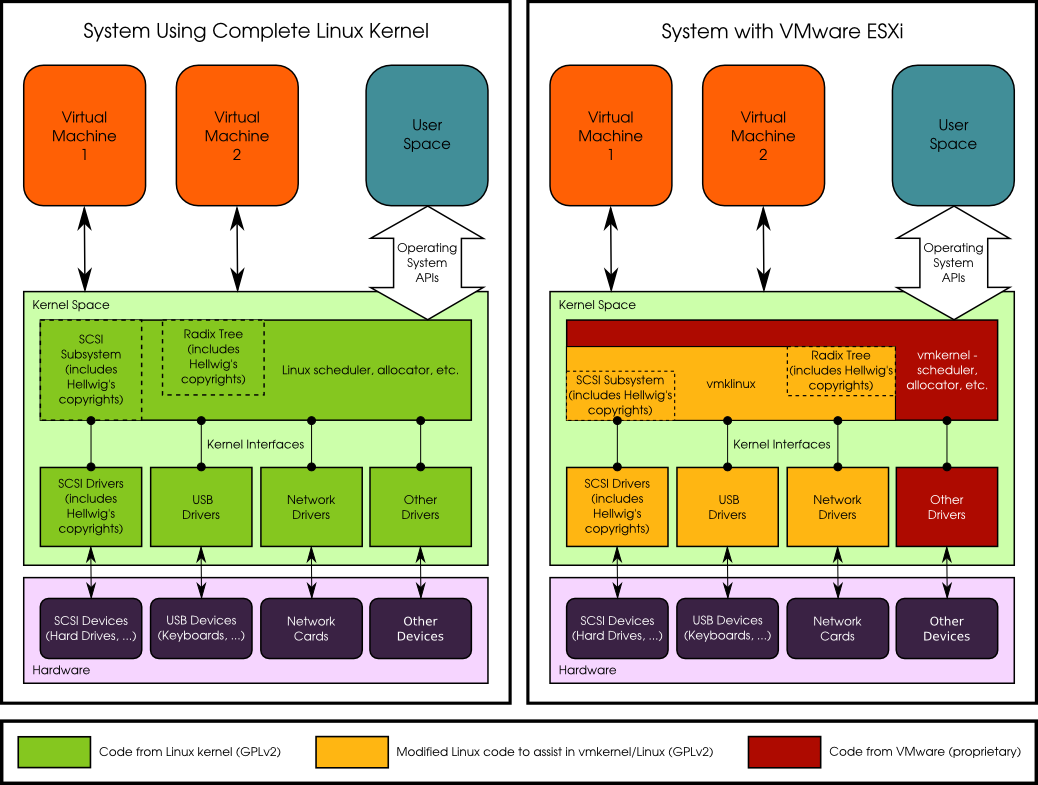
The Software Conservancy FAQ has a diagramme giving an abstract of what they allege has been copied:
http://sfconservancy.org/linux...
With respect to the drivers, it seems they've copied SCSI, USB and network drivers. Christoph Hellwig holding copyright to at least some of the SCSI drivers concerned, in addition to core code VMWare are alleged to have copied to implement required APIs for the drivers.
It seems you could give us a full list from an ESXi installation, if you wished, rather than just a selected driver (selected why?).
-
How to help !
To donate funds to Conservancy GPL compliance efforts see here:
-
SFConservancy has a submission: free software TVs
"Software Freedom Conservancy has filed a Comment
News:
http://sfconservancy.org/news/...The submission:
https://sfconservancy.org/docs...And another submission in part by Karen Sandler about allowing putting free software on medical devices such as the one in her heart:
http://copyright.gov/1201/2015... -
SFConservancy has a submission: free software TVs
"Software Freedom Conservancy has filed a Comment
News:
http://sfconservancy.org/news/...The submission:
https://sfconservancy.org/docs...And another submission in part by Karen Sandler about allowing putting free software on medical devices such as the one in her heart:
http://copyright.gov/1201/2015... -
Re:Open Source Accounting Agency
Have you considered to be part of one of the open source foundations?
http://www.spi-inc.org/ Software in the Public Interest ( http://www.spi-inc.org/projects/associated-project-howto/ )
http://sfconservancy.org/ Software Freedom Conservancy
http://www.ffis.de/ (Germany)
And the most known Eclipse, Apache and Outercurve Foundations
The process for handling the money is very similar as you have described. The foundation is the entity that receives the funds (money or equipment) and tag them for the project that they were donated. So the foundation keep the donations for each project independent. If you need money for a conference or to pay the hostings and your project have the resources then they can send the project leader a wire or a check or in some cases make the payments directly in behalf of the project. The expenses have to match the legal policies for a non profit organization (all the previous samples are fine).
Each foundation has its own rules and processes to be accepted, there was a really interesting thread some months ago in the vertx mailing list where some of the foundation leaders exposed their own strengths: https://groups.google.com/forum/#!topic/vertx/WIuY5M6RluM%5B1-25-false%5D look at the posts from:
Jim Jagielski (Apache), Bradley M. Kuhn (SFConservacy), Kohsuke Kawaguchi (Jenkins, this project is on SPI), Mike Milinkovich (Eclipse), Paula Hunter and Stephen Walli (Outercurve) -
Publish the program under a free software license
I recommend the AGPL version 3 or later; this license will preserve the user's software freedom and keep users on a level playing field with you. I also recommend enforcing your license. The Software Freedom Conservancy can help you enforcing your license with the assistance of experienced GPL enforcers. As you probably already know, if the program is proprietary nobody will be able to determine if the program is DRM-free or not. If any distributor discriminates against free software, you can choose not to do business with them.
-
Re:Software Freedom Law Center
-
The actual judgment is available online
Slashdot readers might be interested to read the actual judgment as issued by the Court, which is available Conservancy's announcement of the decision. I also wrote a blog post about the decision that may be of interest.
— bkuhn, President, Software Freedom Conservancy
-
The actual judgment is available online
Slashdot readers might be interested to read the actual judgment as issued by the Court, which is available Conservancy's announcement of the decision. I also wrote a blog post about the decision that may be of interest.
— bkuhn, President, Software Freedom Conservancy
-
The EFF was not involved
I cannot figure out why the headline says that the EFF won this case. This case was brought by the Software Freedom Conservancy, with the Software Freedom Law Center acting as the Conservancy's legal counsel. The EFF was not, nor has ever been to my knowledge, involved in anything to do with the GPL.
Also, winning the whole case is probably inaccurate. What's been achieved here is a permanent injunction and judgment against one of the violators. Thus, the case against Westinghouse has been won, but there are other defendants in the case as well.
— bkuhn, President, Software Freedom Conservancy