Slashdot Mirror
Domain: skepticalscience.com
Stories and comments across the archive that link to skepticalscience.com.
Comments · 1,449
-
Re:how many predictions have come true?
[citation needed]
There was some concern that we might be entering a natural cooling cycle or that if aerosol emissions continued to increase we could trigger an ice age (they decreased), however, even as far back as 1969 global warming was the more widely published and accepted theory. You might be confusing "scientifically illiterate reporters" with "scientists".
Citation provided -
Re:The rate of change is problematic
Except for this fact.
The *rate* at which temps have gone up over the last 17 years is 0.
He said nothing of the sort.
-
Re:Yay
Here's why you should care:
http://www.skepticalscience.com/global-warming-positives-negatives-intermediate.htm
-
The myth of the global cooling consensus
Are you seriously rolling out the much-debunked myth that there was a scientific consensus in the 1970s that we were heading into an ice age? I was reading the scientific literature back then, and I can tell you that that is simply nonsense. This notion seems to date mostly from a sensationalistic article in Time magazine based on the views of a fringe scientist. All of that literature can be found in any major university library, and much of it is available online, so you can check for yourself. Even in the 1970s, scientists knew that there was the potential for CO2 from fossil fuels to cause warming. If you aren't industrious enough to read the literature for yourself, others have done it for you
The notion that climate is "complete chaos" is also wrong. Weather is chaotic over the short term, but over the long term there are indeed rules--climate is determined by the overall solar energy balance of the globe, in which CO2 plays a major role--in fact it is impossible to explain why the earth (or Mars, or Venus) is as warm as it is unless you accept the warming effect of CO2--and once you do that, global warming in response to fossil fuel releases of CO2 follows inexorably.
-
Re:Also, that "Remark" is a blatant lie
Sure, you might want to start here.
Skeptical science has also done many blog post on predictions and how they've faired.
-
Re:Also, that "Remark" is a blatant lie
Sure, you might want to start here.
Skeptical science has also done many blog post on predictions and how they've faired.
-
Re:Testing the idea
As for your comment about digital computers modeling the theories of the climate scientists, THAT EXPERIMENT HAS BEEN TRIED. REPEATEDLY. Every single climate model out there, when started with available historical data and allowed to run, FAILS to predict today's climate. A model which provably does not match reality is, by definition, an invalid model, no matter how cheap or how fancy a computer you ran it on.
Unfortunately, that's just not true.
-
Re:Look at the data
Thanks for your points. As I said, I have an open mind on this and will investigate them.
Here's an interesting statistical discussion that appears to have trouble with the Tamino link you gave.
http://rankexploits.com/musings/2010/comparing-proxy-reconstructions/The link you gave [from 2010] as: http://www.skepticalscience.com/co2-temperature-correlation.htm also appears to look at short-term CO2 correlation (starts in 1900) rather than the much larger timescale given by the Antarctic ice cores as found by the 2012 Copenhagen study. Please take a look at the more recent study when you have the chance.
With regard to the Southern Hemisphere (where I live). I would expect the man-made CO2 concentration and man-made temperature rise to be lower. There is simply a lot more ocean, a lot fewer people/vehicles, and a lot less industry than the Northern Hemisphere, yes? I would expect the Southern Hemisphere to drag the global warming value down since it is not the origin of the man-made atmospheric CO2/greenhouse gasses. Yes? I'm speculating here, because I haven't seen the Southern data against Northern data (just the Antarctic ice core records where the temperature rise precedes that CO2 rise).
Once again, thanks for taking the time to make your points.
-
Re:Look at the data
Your first link point to very local data - northern Europe - but your paragraph about it is titled, in bold Global temperature increase data *FACEPALM*
Here is some real data you might want to consider and inspect closely.Secondly, you point to the fact that, quote, In fact we see the opposite, we see that the CO2 rise *follows* the temperature rise, not precedes it.. Well that is simply not true concerning the contemporary climate events, the temperature rise is extremely well correlated to the human output of co2 in the atmosphere. Now, correlation being not causation, it is possible that another cause - which one, you never say - would make the temperatures rise. However it is extremely unlikely that another natural cause would magically correlate with human activity of the last 200 years.
But maybe you meant the co2 rise of the past climate events ? That must be that, because it's a common meme through the deniers' sphere. It's funny that you fail to reproduce the basic non-scientific mantras of the deniers and you want us to believe that your post is of any significant value. *FACEPALM*
Concerning the delay between temperature rise and concentration of co2 rise in the past warming events, it correctly is of about 800 years on a total warming phase of around 5000 years. However, considering that this means that the present climate event has nothing to do with human output of co2 is a lack of the most basic knowledge of climate science.
Here is how it worked - short version : the earth changes orbit periodically - milankovitch cycles - and the amount of energy received by the earth increases a little bit. This drives global temperature up, 1 or 2 degrees, not more. This, in turn, induces changes in the biosphere : more vegetation in short. Slowly, that vegetation dies and releases co2. The co2, in turn, drives temperature up with the greenhouse gas effect. But much higher than the effects of the initial perturbation, 8 to 12 degrees more ! This is called a feedback. But that doesn't mean that co2 cannot be the initial perturbation if we release enormous quantity of it as is the case in the present climate event.
In fact, the delay in the paleolithic events and the no delay in the present event is another proof by simple logic that the humans are the cause of the imbalance.
Also, this shows how worse the situation can become as past climate changes lasted hundreds or thousands of years when this one would be much shorter. Guess in which case the biosphere adapts better ?
I could go on answering your nonsensical post but i stopped reading after that second paragraph that shows you lack even the most basic knowledge on the subject.
I suggest that you educate yourself, for example with "Climate Change Science: A Modern Synthesis" Farmer, G. Thomas, Cook, John published by Springer. Then maybe you can tell the world to look at the data.
-
Re:Look at the data
Your first link point to very local data - northern Europe - but your paragraph about it is titled, in bold Global temperature increase data *FACEPALM*
Here is some real data you might want to consider and inspect closely.Secondly, you point to the fact that, quote, In fact we see the opposite, we see that the CO2 rise *follows* the temperature rise, not precedes it.. Well that is simply not true concerning the contemporary climate events, the temperature rise is extremely well correlated to the human output of co2 in the atmosphere. Now, correlation being not causation, it is possible that another cause - which one, you never say - would make the temperatures rise. However it is extremely unlikely that another natural cause would magically correlate with human activity of the last 200 years.
But maybe you meant the co2 rise of the past climate events ? That must be that, because it's a common meme through the deniers' sphere. It's funny that you fail to reproduce the basic non-scientific mantras of the deniers and you want us to believe that your post is of any significant value. *FACEPALM*
Concerning the delay between temperature rise and concentration of co2 rise in the past warming events, it correctly is of about 800 years on a total warming phase of around 5000 years. However, considering that this means that the present climate event has nothing to do with human output of co2 is a lack of the most basic knowledge of climate science.
Here is how it worked - short version : the earth changes orbit periodically - milankovitch cycles - and the amount of energy received by the earth increases a little bit. This drives global temperature up, 1 or 2 degrees, not more. This, in turn, induces changes in the biosphere : more vegetation in short. Slowly, that vegetation dies and releases co2. The co2, in turn, drives temperature up with the greenhouse gas effect. But much higher than the effects of the initial perturbation, 8 to 12 degrees more ! This is called a feedback. But that doesn't mean that co2 cannot be the initial perturbation if we release enormous quantity of it as is the case in the present climate event.
In fact, the delay in the paleolithic events and the no delay in the present event is another proof by simple logic that the humans are the cause of the imbalance.
Also, this shows how worse the situation can become as past climate changes lasted hundreds or thousands of years when this one would be much shorter. Guess in which case the biosphere adapts better ?
I could go on answering your nonsensical post but i stopped reading after that second paragraph that shows you lack even the most basic knowledge on the subject.
I suggest that you educate yourself, for example with "Climate Change Science: A Modern Synthesis" Farmer, G. Thomas, Cook, John published by Springer. Then maybe you can tell the world to look at the data.
-
Re:Look at the data
Your first link point to very local data - northern Europe - but your paragraph about it is titled, in bold Global temperature increase data *FACEPALM*
Here is some real data you might want to consider and inspect closely.Secondly, you point to the fact that, quote, In fact we see the opposite, we see that the CO2 rise *follows* the temperature rise, not precedes it.. Well that is simply not true concerning the contemporary climate events, the temperature rise is extremely well correlated to the human output of co2 in the atmosphere. Now, correlation being not causation, it is possible that another cause - which one, you never say - would make the temperatures rise. However it is extremely unlikely that another natural cause would magically correlate with human activity of the last 200 years.
But maybe you meant the co2 rise of the past climate events ? That must be that, because it's a common meme through the deniers' sphere. It's funny that you fail to reproduce the basic non-scientific mantras of the deniers and you want us to believe that your post is of any significant value. *FACEPALM*
Concerning the delay between temperature rise and concentration of co2 rise in the past warming events, it correctly is of about 800 years on a total warming phase of around 5000 years. However, considering that this means that the present climate event has nothing to do with human output of co2 is a lack of the most basic knowledge of climate science.
Here is how it worked - short version : the earth changes orbit periodically - milankovitch cycles - and the amount of energy received by the earth increases a little bit. This drives global temperature up, 1 or 2 degrees, not more. This, in turn, induces changes in the biosphere : more vegetation in short. Slowly, that vegetation dies and releases co2. The co2, in turn, drives temperature up with the greenhouse gas effect. But much higher than the effects of the initial perturbation, 8 to 12 degrees more ! This is called a feedback. But that doesn't mean that co2 cannot be the initial perturbation if we release enormous quantity of it as is the case in the present climate event.
In fact, the delay in the paleolithic events and the no delay in the present event is another proof by simple logic that the humans are the cause of the imbalance.
Also, this shows how worse the situation can become as past climate changes lasted hundreds or thousands of years when this one would be much shorter. Guess in which case the biosphere adapts better ?
I could go on answering your nonsensical post but i stopped reading after that second paragraph that shows you lack even the most basic knowledge on the subject.
I suggest that you educate yourself, for example with "Climate Change Science: A Modern Synthesis" Farmer, G. Thomas, Cook, John published by Springer. Then maybe you can tell the world to look at the data.
-
Re:Surprise
Perhaps, but when the government of the third largest oil producer in the world finds out against scientific consenus that consuming oil is, in fact, good for you it should perhaps, just perhaps, be approached with a little bit of scepticism rather than touted as incontrovable evidence.
And in fact, the claim that global warming has stopped has been refuted again and again in the past. There is far too much noise in climate to make such a determination based on only a decade of data. At some point we'll reach a point where such a determination could be made, but my prediction is the claim will just morph to the form of "But global warming stopped in 2010!".
Further, many claims like the Norweigian ones aren't really claiming what most global-warming deniers seem to think they are. Bloomberg quotes the researchers; “The Earth’s mean temperature rose sharply during the 1990s,” said Terje Berntsen, a professor at the University of Oslo who worked on the study. “This may have caused us to overestimate climate sensitivity.”
In other words, they're saying the science is fine and the predictions were correct until 1998, but then for a reason they don't know and can't even guess, global warming suddenly stopped happening. And they're counting on this condition to last indefinitely, or at least for their lifetime, so people don't have to cut down on buring fossil fuels until they run out. But basically, they're only squabbling about the rate of global warming. -
Re:Why even bother involving this study ?
When I saw your post, I clicked the link to look at it again, in case I had been in error, but now the site is not coming up for me. So any comment on my part will have to wait until such time as that page appears again. [Jane Q. Public]
You're right, woodfortrees is down. Instead, you could try the Skeptical Science trend calculator which also provides uncertainty bounds on the trend. Notice that when you select UAH without restricting the time period, it only goes back to 1980 because that's when the satellite was launched.
All I saw was a graph with some years on the tick marks, and a line that looked like it was supposed to be a regression fit. Except that it went from the lowest point to near the highest point, which is not at all typical of a regression line. I saw nothing further to clarify it. The site seems to be having problems right now (10:16 pm CST). The page won't load. So there is no way to sort out the issue. [Jane Q. Public]
You could always download the UAH data yourself and run a least squares regression using your own software. I've done that using R; here's a PDF of my results. The regression line and its uncertainty come directly from R's generalized least squares algorithm. It looks similar to the regression lines from woodfortrees and SkS. (Both my trend and SkS's are closer to 0.14C/decade; perhaps this is because SkS and I haven't updated our local UAH datasets in over a year?)
The second page of my PDF calculates the trends and uncertainties of the UAH data up to 2012, for different starting years, using an ARMA(1,1) noise model. This graph shows why scientists prefer trends calculated over at least ~20 years. Shorter timespans, such as 1998-2012) have larger uncertainty bounds (the red lines in that graph are 95% confidence intervals).
-
Re:Why even bother involving this study ?
Interestingly, it turns out that if you look at the trend for El Nino years, La Nina years, and ENSO neutral years you also find a rise of 0.16C/decade for all three. The advantage of doing this is that most of the annual variation is caused by the ENSO cycle. Removing this allows you to see the true trend and is a very cool way to tease the signal from the noise. You can see the details here: http://www.skepticalscience.com/was-2012-hottest-la-nina-on-record.html
-
Re:Now THERE's a reversal.
Warming has not been lower than forecast (what stinking place did you pull that from?)
I pulled them from a VERY stinking place, some place most people never go, the actual data. Take a look at the IPCC forecasts from 1999 IPCC now take a look at actual data from 1999 to 2012 at NOAA (or Hadley CRUT).
It clearly shows that while there has been warming it has been lower than the low forecast.
If you don't want to sift through the data (although I encourage you to do so and see for yourself), here's an article from an anti-denier site showing Hansen's 1988 predictions similarly being low. Note that this site is in the business of proving that global warming is real, their bias is strong and their data is suspect but even they clearly admit that actual temperatures are below the forecast.
These aren't cherry picked examples either, take most past temperature predictions and chart them against actual and you'll see that the rise is less than predicted. Or check the IPCC predictions from edition to edition and you'll see that they are slowly moving down in the near term (although often have global warming shift into high gear a few decades hence).
To be clear, I'm not a denialist. I do think global warming is real and a problem. But I think Climate Science is a lot like economics, they have a pretty good idea what's going on and you'd be foolish to ignore them, but you'd also be foolish to think that they have everything fully figured out or that they aren't missing some really big and important factors in their analysis.
-
Re:Numbers from the article...
So it would appear that 1972 and even 1973 were very hot years there. As well as it appears that 2013 will be as well. Finding cause in those two anomalies will be interesting.
Consistency. This last decade has it.
http://www.skepticalscience.com/global-warming-stopped-in-1998.htm
-
Re:No, the question is: what happened
The sun isn't getting hotter. Water vapor isn't light enough to escape Earth's gravity well in any appreciable quantity. Plate tectonics are driven by convection currents in the Earth's mantel, not the oceans, and if anything the (extremely unlikely) ceasing of tectonic activity would decrease CO2 emissions.
=Smidge= -
Re:LOL at 'climate change'...
CO2 has no effect on the Earth's temperature, this has been clearly proved time and time again.
Look at the second plot on this page. It's a direct measurement of the amount of the reduced re-radiation from planet earth at 1996 vs. 1970, and shows substantial dips for CO2 (far left) and methane (far right).
-
Feynman died 25 years ago
It was probably a valid critique of the contemporary model predictions of the time. Hansen was really the first to do a good job, first in 1981 and later in 1988 (links are to reviews of those predictions, with empirical observations conveniently overlaid).
-
Re:and some areas in Russia...
We would expect to see some record lows even during warming. The important point is that there are many more record highs being hit in recent years than record lows, which is exactly what you'd expect if the climate is warming. You can't tell whether the Earth as a whole is warming or cooling based on cherry-picking data.
-
Re:in 1975, when I was in High school
Time magazine & researchers were telling us what to do about the upcoming ICE AGE, and how to survive it.
Now, the same idiots[citation needed that these are the same people]
are telling us about global warming (whoops...climate change).
.
At no point in the past 50 years, has the number of publications predicting a cooling climate been any more than a fraction of the number predicting a warming climate.
-
Re:in 1975, when I was in High school
Yes I'm going with that because your claim is bullshit. And that's also the reason it doesn't and never will make it into Wikipedia.
-
Re:Data not conforming to predictions
An honest question: how many years of no temperature rise would it take for the catastrophic CAGW thesis to be rejected? We've had about 15 years of near stasis, and recent results show that the heat isn't 'hiding' in the ocean - it simply doesn't exist, though CO2 continues to rise. So just how many more years are needed for the IPCC to let go of the millenialist thermageddon fantasy and bring the temperature rise predictions back to a more realistic level (seems likely to be about 1-2C rise for a CO2 doubling).
http://www.skepticalscience.com/global-warming-stopped-in-1998.htm
Click on the intermediate tab after finishing beginner.
-
Re:Only 8%?
So you agree that someone (like yourself) who, rather than saying “I don’t really know the effect that adding CO2 will have, other than a general rise in temperature” says: “the rise in temperature will be neglible” needs to have some actual science to back up those predictions.
You're misstating my assertion. I'm saying that *nobody* really knows the effect of adding CO2 into the atmosphere, beyond a non-zero increase in temperature. That includes you
You aren't in a position to speak of what others do and do not know. But I accept you have the authority to speak to your own ignorance - you are ignorant. Point taken. Therefore your assertion that anthropogenic CO2 will have no effect on climate has no credence, and so we can discard it. I'd be better off just guessing what the effect is - luckily I do not have to resort to that, owing to the raft of observations, experiments, and models done and built by scientists.
Data on the terrain and the accelerator are readily available. On average, my car is going to accelerate despite periods of deceleration.
Ah, the car analogy
Have the effects of cloud cover and albedo changed post the industrial age? What happened previously, did angels blow out clouds from there arses? Are you being clownish on purpose?
So you agree that climate models can be falsified?
Moving the pea under the thimble again? Say you have two dozen climate models, all with the same central conceit - human CO2 emissions overwhelm natural climate variation. Do all two dozen have to miss predictions by say, 5%, in order for the central conceit to be falsified? Just one of them? Just the model mean? Show me the *one* model that you believe represents your central conceit, which if in error regarding any predictions, will falsify your central conceit - none of this "bet on every space on the craps table" nonsense.
Well I guess that argument made sense in your head, since you went to the trouble of typing it out. Something got lost in translation! Anyway, you can just answer the question: So you agree that climate models can be falsified?
I'll assume yes.
Certainly: "natural climate change has continued even through the birth of humanity and the industrial age"
And exactly where in that statement you're quoting from me do I talk about CO2 doubling and its effect on global average temperature?
No bother - I'll accept your belated admission that you know nothing of those effects.
Which is, of course, in direct contradiction to your earlier admission that CO2 is a greenhouse gas.
What? CO2 can be a greenhouse gas, and not drive global average temperature changes.
How do you know? You profess to be ignorant of the matter.
In fact, the ice core record shows quite nicely that CO2 changes *after* temperature.
Are you hoping that just by simply posting this enough, it will somehow come to mean something other than what logic and observation tells us it means? ( http://www.skepticalscience.com/co2-lags-temperature.htm) If I wanted to listen to liturgy, I would find a church.
Heck H2O is a greenhouse gas - are you going to assert that humidity drives global average temperature?
You've made quite enough assertions for us to be going on with.
You yourself predicted climate change on the basis of Tyndalls work.
-
Re:Ah, so there we go....
So now all those decades of tidal gauge data don't even exist? Yes, there's seasonal noise, and that's why you look only at long-term trends. Those last few report links I sent all show an increasingly-steady positive trend (Fig 4) of 3-5mm/year - does all that data not exist either?
The basic point remains: There are multiple lines of data, from multiple sources, all consistently showing that sea levels are increasing, and at a much faster rate than Tuvalu is sinking. There are dozens of studies linking global sea level rises to glacier melt and thermal expansion caused by rising temperatures. And there are multiple lines of evidence to show that it's us that's causing it, with our CO2 emissions. Hence, AGW is in large part responsible for Tuvalu's situation. Of course Tuvalu is a cherry-picked example, but all that science is global.
97% of climatologists and countless studies agree on this point. You can disagree, but without supporting evidence that's at least as solid as theirs, disagreement becomes simple denialism.
-
Re:Ah, so there we go....
So now all those decades of tidal gauge data don't even exist? Yes, there's seasonal noise, and that's why you look only at long-term trends. Those last few report links I sent all show an increasingly-steady positive trend (Fig 4) of 3-5mm/year - does all that data not exist either?
The basic point remains: There are multiple lines of data, from multiple sources, all consistently showing that sea levels are increasing, and at a much faster rate than Tuvalu is sinking. There are dozens of studies linking global sea level rises to glacier melt and thermal expansion caused by rising temperatures. And there are multiple lines of evidence to show that it's us that's causing it, with our CO2 emissions. Hence, AGW is in large part responsible for Tuvalu's situation. Of course Tuvalu is a cherry-picked example, but all that science is global.
97% of climatologists and countless studies agree on this point. You can disagree, but without supporting evidence that's at least as solid as theirs, disagreement becomes simple denialism.
-
Re:Ah, so there we go....
So now all those decades of tidal gauge data don't even exist? Yes, there's seasonal noise, and that's why you look only at long-term trends. Those last few report links I sent all show an increasingly-steady positive trend (Fig 4) of 3-5mm/year - does all that data not exist either?
The basic point remains: There are multiple lines of data, from multiple sources, all consistently showing that sea levels are increasing, and at a much faster rate than Tuvalu is sinking. There are dozens of studies linking global sea level rises to glacier melt and thermal expansion caused by rising temperatures. And there are multiple lines of evidence to show that it's us that's causing it, with our CO2 emissions. Hence, AGW is in large part responsible for Tuvalu's situation. Of course Tuvalu is a cherry-picked example, but all that science is global.
97% of climatologists and countless studies agree on this point. You can disagree, but without supporting evidence that's at least as solid as theirs, disagreement becomes simple denialism.
-
Re:Ah, so there we go....
So now all those decades of tidal gauge data don't even exist? Yes, there's seasonal noise, and that's why you look only at long-term trends. Those last few report links I sent all show an increasingly-steady positive trend (Fig 4) of 3-5mm/year - does all that data not exist either?
The basic point remains: There are multiple lines of data, from multiple sources, all consistently showing that sea levels are increasing, and at a much faster rate than Tuvalu is sinking. There are dozens of studies linking global sea level rises to glacier melt and thermal expansion caused by rising temperatures. And there are multiple lines of evidence to show that it's us that's causing it, with our CO2 emissions. Hence, AGW is in large part responsible for Tuvalu's situation. Of course Tuvalu is a cherry-picked example, but all that science is global.
97% of climatologists and countless studies agree on this point. You can disagree, but without supporting evidence that's at least as solid as theirs, disagreement becomes simple denialism.
-
Re:Ah, so there we go....
You also have to carefully ignore the altimetry data [els-cdn.com], which clearly shows a 5mm/year rise since 1993 at Funafuti.
And what is it going to show in a few years? If local sea level works is as Becker's model claims, then it's likely that the difference can be explained by sampling at different times of the El Nino cycle.
If you had looked at the chart I referred to (figure 1 BTW), you would see that 1993 was an unusually low year with 20 cm difference between it, and the surrounding, higher years, 1992 and 1994. There were years in the 1950s that allegedly had higher sea levels than 1993.
I feel I'm not doing justice to my argument, but someone must speak to the confusion that resides in your claims.
There are several things to note. First, there is a paucity of good data. For example, altimetry data only comes since 1993. I imagine GPS positioning data is similarly sparse. This means that it is hard to rule out alternate hypotheses (especially those that claim the study is in error, peer review doesn't keep that from happening).
Another is that there is absolutely no linkage to AGW. You claimed that Tuvalu's elevated sea level rise was due to AGW in a much earlier post, but the timing just isn't right for that claim of cause and effect.
Third, if this data is correct, then there is a lot of noise in the data and one can generate extraordinary trends by cherry picking low and high points to get artificially shallow or steep trends (such as your comments on the 1993-2009 trends while ignoring the unusual nature of the data from the year, 1993). That is, you've compounded the original error of picking Tuvalu, already an extreme data point, by picking an extreme year.
In summary, I see nothing backing your claims aside from the before mentioned cherry picking of data (both time and place now as it turns out) to create exaggerated claims of sea level rise.
So I echo the original poster, rubycodez. What disaster can be legitimately blamed on AGW? -
Re:Ah, so there we go....
I'll just note that the authors don't have 60 years of satellite altimetry and GPS data. Also, googling around I see that Tuvalu does experience land subsidence. It is claimed that this is only 10% of the total observed, but subsidence often is not constant over time.
Glancing at a graph of Tuvalu's sea level rise, I see that sea level has been basically no net gain since a peak of the early 80s. So this phenomena can easily be explained by 1950-1980 subsidence that mostly stopped by 1980. No satellite altimetry or GPS data for that period! This is the peril of making claims based on incomplete data.
It's also worth noting that none of the other islands except one graphed in the above link show this alleged effect (though Penrhyn does show some effect which might be consistent with the claimed sea level model of Becker). That is also consistent with a local subsidence effect.
But let's pass that over and go back to the original assertion that you made. Namely, that the sea level rise at Tuvalu is an AGW disaster (as I asked for). The rise happened from 1950-1980 with no net gain since. Further, carbon dioxide emissions have been increasing for the most part since the Industrial Age started. I just don't see the linkage.
Instead, what I see is a cherry picked sea level rise that has nothing to do with AGW, even if you accept Becker's work at face value. -
Re:On the whole
You don't have to 'specify the falsifiability'. A falsifiable hypothesis is merely one where it is in principle possible to invalidate it. There isn't some form you fill out where you list the possible ways and if you leave it blank your hypothesis is unfalsifiable. Do you know anything about how science is conducted or what falsifiability means? I don't get the impression that you actually do.
The whole debate exists not because AGW is falsifiable, but simply because there's not a yes or no answer to the question "how much does adding CO2 to the atmosphere raise the temperature". Given that observation has demonstrated that temperature has been rising at a rate well within the range predicted by climate models and that every other known forcing except CO2 has been shown NOT to correlate well with this warming we are left with the logical conclusion that the roughly 3C climate sensitivity is a good number and that no other hypothesis so far advanced seems to work. If you can show some other mechanism that is at work, which fits better, then you can falsify the CO2 based AGW hypothesis. It is as simple as that. It isn't up to me to dream up that hypothesis. Certainly if I have a moment of revelation on the subject you'll read about it, I'd be HAPPY to write that paper. Unfortunately nobody has yet come up with that theory, my guess is it doesn't exist.
As for the increase in the 20th Century? Sure, I'm going to blame a good part of it on AGW. Truthfully I don't see anything in the literature which indicates there is a particular reason to blame any of it on anything EXCEPT CO2. However there's an equally good fit to other processes in the timeframe 1880-1950 or so. Past that point there's no indication it wasn't 100% CO2 and its related feedbacks. So yeah, we're good
As for explaining the numbers I'm using. Seriously, if you don't know what standard sensitivity numbers are, you're really kinda pretty far in the dark. You can pick up that kind of basic understanding from any of the 'science explained' type sites. Again I'd recommend realclimate.org as it is the most rigorous, but others will do such as http://www.skepticalscience.com/argument.php
-
Re:Paren't point
a) 16 years is certainly not long enough to measure a climate trend. There is too much noise from natural variation. If you look at graphs of global temperature you see plenty of times where temperatures dipped on longer than a decadal time scale. The long term trend is still up. Climatologists generally use 30 year running means* to describe climate. That's probably a bit arbitrary, maybe 25 years would work but I think 20 years would be getting pretty iffy.
*By definition of the World Meteorological Organization the classical period for climate is 30 years.
b) Climate models are tested by hindcasting all the time, especially using period of detailed climate knowledge since the 1950's. And again, climate models are not even really attempting to predict the last 16 years in the detail you seem to demand. It's that 30 year climate period thing again.
Satellite temperature trends aren't that much different than surface trends.
c) While summer Arctic sea ice has declined by around 2.5 million km^2 Antarctic has only grown by around 0.3 million km^2. (ref.) I'd say that is a significant difference.
-
Re:No ice age [Re:The political construct...]
...One of the reasons people are skeptical or even deniers is all this bullshit that they can't get the models and prediction straight. If you keep changing your story, people won't believe you. It's that simple.
Sorry, but this is the way science happens: the overall physics is understood, and then the details are slowly filled and the error bars are refined and the calculations get better.
It's a terrible, terrible thing when scientists try to improve their predictions. They should just make something up and stick to it in the face of all countering evidence, like cranks do.
I'm sure the GP poster will be reassured to learn that creationists also recognize the validity of this argument. Great minds think alike, and all that.
We have pretty good confidence that we know the physics of the greenhouse effect.
We can even measure the earth's reduced thermal radiation at the frequencies absorbed by greenhouse gasses, compared to when measurements were first made around 1970. See this article, second plot from the top.
-
It's been a political issue since the 1970s
The only reason people like you think climate change is politically driven myth is because you weren't paying attention *before* it became a political issue.
Try the 1970s consensus that warming was occurring:
http://www.skepticalscience.com/What-1970s-science-said-about-global-cooling.html
This has always been a political issue which exists as a proxy for denial of the actual underlying problem, which is overpopulation.
-
Re:How surprising...
Actually peak oil has happened. Why do you think you are paying $4 for gas, and we are drilling EVERYWHERE for the last dregs, not to mention trying to process tar sands. And why do you think economic growth worldwide sucks? Why do you think global oil production is in a downtrend?
1960's big freeze - I call bullshit. There was never a scientific consensus that this would happen.
http://www.skepticalscience.com/ice-age-predictions-in-1970s.htm
1970's - Ozone layer was preserved because of a concerted global response to remove the cause of it's shrinkage. Duh.
1980's - Aids has killed 15 million people. Go talk to people living in countries where it is pandemic and then come back and tell me nothing has happened.
http://www.avert.org/aids-impact-africa.htm
2003 - SARS. Please cite a claim that it was going to wipe us all out.
2005 - Avian Flu - ditto
2012 - Oh BS.
Alarmist predictions are made alarmist by news reporters. The actual predictions have been pretty much accurate.
-
Mod parent up
Please? It's not so difficult. We have:
1. A measured rise in CO2 concentrations
2. A vast body of measurements showing increase in average temperatures (yes, after correcting for solar variations and what not)
3. A very straightforward and hard-to-refute mechanism for CO2 to cause the increase in temperature:
http://en.wikipedia.org/wiki/Greenhouse_gas
http://www.skepticalscience.com/empirical-evidence-for-co2-enhanced-greenhouse-effect.htm
4. Well-studied stabilities of different gases in the atmosphereThe basics have been pinned down, debated, agreed upon and bought the t-^H^H^H^H^H^H^H^H^H^H^H^H^H made it into university textbooks in the late 1980s to early 1990s. It's really not difficult: if more thermal energy is entering a system than exiting it, its temperature goes up. Simple conservation of energy. The mechanism for thermal energy to enter and exit the planet is radiation, and the way different gases interact with this radiation is well-understood. The earth is warming up, and it's because of the CO2 we're releasing - that's as close to a fact as an empirical branch of science like this can get.
The only thing that was (and is) not sure is how bad the effect would be. How much longer would a period of relatively low solar activity slow down the rate of warming? How much of the excess CO2 would be taken up by seas and plant material that doesn't rot or gets burned (slowing down the heating-up)? Would the feedback of the initial warming be negative (slowing down the heating-up) or positive (speeding it up)? Which spots on earth will get warmer and colder? Climate science is not about whether or not climate heats up due to our CO2 release. It hasn't been about that for the last 25 years! It's about how fast the warming will go in function of the CO2 levels and how badly different spots on earth will be affected. The stovetop is on; the question is merely "how high". We've come a long way in narrowing this down over the last 25 years and the results don't look pretty. A lot of governments around the world recognize this.
The present "debate" in the US is entirely fabricated, just like the past debates on whether tobacco increases the risk of lung cancer or on whether hydrogenated fatty acids cause coronary heart disease. The strategies used by industry to discredit reputable science are exactly the same. Even though I'm a big proponent of debating everything, the current climate change debate in the US is a disgrace to human intelligence. They're debating something that has been settled 25 years ago; one side just keeps on bringing up long-discredited arguments like a broken record, forcing the other side to keep on refuting them. The media give both sides equal weight for the sake of "political neutrality" (my ass) and the general public is utterly confused about something that is in essence very straightforward.
-
Re:Ah, so there we go....
In Tuvalu, sea level rises of an average of 5mm/year over the last 60 years have now resulted in regular tidal flooding of low-lying areas like the main airport. Inland salt water seeps are destroying their coconut and taro crops. Tuvalu's vulnerability to strengthening tropical cyclones is significantly increased, as in the case of Tropical Cyclone Bebe, which in 1972 sent a storm surge right over the entire main island, destroying many buildings and uprooting 90% of the trees.
There is now a regular exodus of Tuvaluans to New Zealand, which has agreed to absorb the entire population in the event that Tuvalu becomes completely uninhabitable.
-
This website is very good
http://www.skepticalscience.com/
A lot of the anti-globalwarming movement rely on classic FUD, throwing enough shit on the wall and counting on that something will stick.
-
Re:Richard Muller
... Just in case you would like something other than just my word that it hasn't warmed significantly in the last 2 or 3 years. Now, call that what you will, but it isn't the rantings of some crazy person. However -- again for the sake of truth and fairness -- the graphs in that article are misleading. They are the doings of the media, not the scientist being quoted. [Jane Q. Public, 2011-11-22]
When you claimed that climate scientists predict temperature trends on timescales of 8 or 9 years, I pointed out that 8 or 9 years is too short to obtain a statistically significant trend. Now you've tightened your self-imposed blinders even further by talking about 2 or 3 year temperature trends. Note that any 2 or 3 (or 8 or 9) year timespan would be too short to obtain a statistically significant trend. It's not something special about the last 2,3,8, or 9 years, so contrarians can recycle this talking point ad nauseum. That's the entire point of the Escalator, in fact. (Incidentally, at least 17 years are needed to establish a statistically significant trend of global surface temperatures.)
But let's read your article, Scientist who said climate change sceptics had been proved wrong accused of hiding truth by colleague, by David Rose:
[Prof. Judith Curry] said that Prof Muller's claim that he has proven global warming sceptics wrong was also a 'huge mistake', with no scientific basis.
Wow. These are very serious accusations. But are they valid?
The graph in Rose's article labelled "the inconvenient truth" is misleading, but mainly for the same reason that Jane's references to short term trends are misleading. Since that graph only shows 10 years of data, any conclusions drawn from it will be conclusions about the noise in the climate, not the long-term trend. But this isn't really the media's fault: Prof. Curry chose that absurdly short timespan herself by talking about the trend since 1998.
Also, the abrupt cooling shown in the BEST data in April and May of 2010 isn't real. Those months only include data from 47 stations in Antarctica, compared to March 2010 which has 14488 spread around the world. So April and
-
Volcanoes aren't a major contributor to CO2
it is incredibly foolish to believe that humans are responsible for the melting of the polar icecaps. one volcano eruption puts off more CO2 than all of the emmissions that humans have put out since there were humans.
That statement is factually incorrect. Volcanos do not emit more CO2 than humans-- they emit less, by orders of magnitude.
http://www.agu.org/news/press/pr_archives/2011/2011-22.shtml
http://hvo.wr.usgs.gov/volcanowatch/archive/2007/07_02_15.html
http://www.agu.org/pubs/pdf/2011EO240001.pdf
http://www.skepticalscience.com/volcanoes-and-global-warming.htm
http://www.newscientist.com/article/dn11638-climate-myths-human-co2-emissions-are-too-tiny-to-matter.htmlFrom http://news.sciencemag.org/sciencenow/2011/06/scienceshot-volcano-co2-emission.html :
"A popular myth among climate change skeptics is that volcanic emissions of carbon dioxide dwarf those generated by humans. But a new report in today's issue of Eos reveals precisely the opposite: In a mere 2 to 5 days, smokestacks, tailpipes, and other human sources of CO2 spew a year's worth of volcanic emissions of that greenhouse gas. According to the paper, five recent studies suggest that volcanoes worldwide (such as Alaska's Shishaldin, shown) emit, on average, between 130 million and 440 million metric tons of CO2 each year. But in 2010, anthropogenic emissions of the planet-warming gas were estimated to be a whopping 35 billion metric tons. Individual events—such as Mount Pinatubo, whose major eruption in 1991 lasted about 9 hours—can produce CO 2 at the same rate that humans do, but they do so only for short periods of time. It would take more than 700 Mount Pinatubo-sized eruptions over the course of a year to emit as much carbon dioxide as people do, the study notes."Let me note that it is misinformed statements like this that tend to make real scientists dismiss global-warming deniers as crackpots. If you really want skepticism of anthropogenic global warming to be taken seriously, you need to have a basic understanding of the real world.
-
Turns out
http://www.skepticalscience.com/greenland-used-to-be-green.htm
Lots of things cause climate change.
-
Re:"Global Warming" is both science and politics
This one is so easy, it's almost not worth bothering to debunk it.
Weather is not climate. http://www.skepticalscience.com/weather-forecasts-vs-climate-models-predictions.htm
For instance - I cannot tell you what temperature it will be in northern Africa next year. But I can pretty reliably tell you that it will be mostly a desert.
I can't tell you what temperature it will be on Christmas in the northeast US. But I can tell you that it will be colder than it was during the summer time.
-
Re:One consistent theme
a) What percentage of released CO2 gets converted in carbonic acid in the oceans and then absorbed in the rocks what percentage ends up in the atmosphere? I don't think we know exactly how that plays out
b) As we change temperature, we carbon cycles. A lot of CO2 is in earth's plants right now. And of course there is methane trapped as well.
I think you accidentally a whole word there, so I'm not quite sure what you're saying, but there are no studies that show CO2 levels are not rising globally.
c) There is a lot of potentially positive feedback. Heat melts ice, melting ice decreases earth's reflective properties, which increases amount of heat absorbed....
Positive feedback is the problem that results in a "runaway" greenhouse effect, where CO2 forcing leads to higher temps which leads to more water vapor which leads to higher temps.
So yeah we know more CO2 means hotter. We just aren't sure how much hotter. That's what I mean by temperature models are so/so.
We have a pretty good idea, and the IPCC has been reporting the lowest possible estimates, phrased as "it will get at least this hot," when obviously the error bars indicate it will get hotter than the lowest possible estimates.
In terms of soy, it is a great source of protein. Try chocolate soy in milk, it is like the chocolate milk you had as a kid but super good for you.
Thanks but no thanks, I like beef. And pork. I am all about the motherfucking hog.
That beings said I'm a bit more optimistic than you.. I think we get much much more rain. We get more CO2 and as we learn which plants adapt I think we get that 35% or maybe even more. I don't think we get much erosion. I think we add more land that's usable as huge areas of Russia and Canada come onboard. So I'd put 2:1 or 3:1 it is a net positive... but if I'm wrong the downside is terrible. We end up with a carrying capacity of only supporting 2b or less and that kicks off wars which might do environmental damage that even further lowers the carrying capacity.... And all that doesn't include the salt cycle in the ocean stopping and we maybe get 250m year ago's climate with 10% oxygen from all that frozen ocean hydrogen sulfide hitting the melting point.
Well again, the "thinks" and "hopes" don't really matter much when the observations and experiments say otherwise. That's the thing about science. There is no "belief," there is no "debate," there is just "false" and "not necessarily false." There are ways out of this mess (nuclear power for our cities, hydrogen for our cars) but we have to acknowledge the problem. There are brilliant upsides, too, like we don't have to suffer the muslims anymore because they have oil. But we have to acknowledge the obvious observed facts.
If you have further questions, I recommend this website: http://www.skepticalscience.com/ They have good resources.
-
Re:Vast Majority?
The answers to most of the questions you posed is available if you take the time to seek them out. For instance studies have shown that volcanoes typically emit about 1% as much CO2 as human burning of fossil fuels. A good place to start is Skeptical Science. In most cases it contains links back to the original scientific papers they base their arguments on.
-
Re:Skeptic is ok...
The irony is that there is no convincing evidence that the global climate is actually warming.- Fred Singer
"The atmospheric temperature record between 1978 and 2000 (both from satellites and, independently, from radiosondes) doesn't show a warming. Neither does the ocean." - Fred Singer
Yeah Fred Singer isn't a skeptic he's a denier and one of the worst ones at that.
The attempt to portray him as some sort of reasonable doubter is a PR move, initiated by himself, and nothing more.
http://www.skepticalscience.com/singer-criticises-deniers.html
He's been so dramatically wrong on so many issues where the evidence was incontrovertible and always in the favor of the industry that was paying him, it's hard to conclude that he's a just liar for hire. He's been called out for stating falsehoods so frequently, displayed so little remorse or contrition when caught and about things of such great consequence - the life and death of millions of people- that it's hard not to conclude that he's a textbook sociopath.
http://www.desmogblog.com/s-fred-singer
http://www.sourcewatch.org/index.php?title=S._Fred_Singer
The list of scientific facts that Fred Singer has denied over the years doesn't paint a pretty picture. He's denied CFCs were responsible for the hole in the ozone, something he termed the "ozone scare".
He's denied that second hand smoke causes the spectrum of diseases second hand smoke does indeed cause.
He's denied that acid rain was a problem or what caused by industry emissions.
He's denied human caused climate change.
http://climateinsight.wordpress.com/editorial/merchant-of-doubt-s-fred-singer/
http://www.sourcewatch.org/index.php?title=S._Fred_Singer
and so on ad naseum...
-
Re:One consistent theme
Incorrect. http://skepticalscience.com/co2-plant-food-advanced.htm
Were the studies you cite looking at plants in controlled greenhouse, or in the open atmosphere?
-
Re:No significant change for a century.
recent data doesn't show any increase in rate of sea level rise:
http://sealevel.colorado.edu/Not sure what you're looking at there; that graph clearly shows the current rate is about twice what it was a hundred years ago. Fortunately we don't have to rely on our eyes, Church and White most recently calculated an acceleration of 0.009 mm/yr^2 over that period -- that's actually a downgrade from 0.013 mm/yr^2 in their 2006 paper. Ever done data analysis before? Trying to figure out the second derivative of noisy data is not an easy thing.
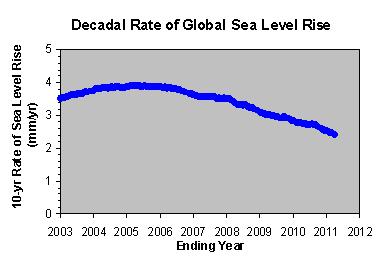
looking at the decadal rate of increase it has actually been falling off for last 5 years:
http://www.masterresource.org/wp-content/uploads/2011/09/sea_level_rise_fig1.jpgThat's a nice unattributed JPEG hosted at "Master Resource", a "free-market energy blog" with categories on Austrian economics, Ayn Rand, and objectivism. Fortunately I don't need to leave my criticisms at questioning the source of the material. If you look at your first link, you can see that the rate really did decline towards the beginning of 2011 where this 2nd chart stops before suddenly surging up again to match the preceding trends: so the trend over 2011 and 2012 is actually much higher than it was the preceding few years.
This is cherry-picked data -- it is very easy in any system containing noise to pick endpoints to make it appear that the overall trends have stopped. A great depiction of this is the escalator graph: How "Skeptics" View Global Warming. You need to look at the big picture -- every climate graph shorter than a decade is lying, because a decade is not long enough to show long-term climate trends. It is very easy to pick subdecadal trends that either exaggerate or mask longterm trends, so you need to look at the big picture.
A rather big factor that needs to be taken into account is that since the 1950's there has been a massive amount of ground water abstraction for agriculture that is estimated to contribute something like 0.4-0.8mm/year to sea level rise (15-25% of total).http://news.nationalgeographic.co.uk/news/2012/05/120531-groundwater-depletion-may-accelerate-sea-level-rise/
This is counter-acted by the amount of water that humans are storing in reservoirs, which account for 0.55mm/year: Impact of Artificial Reservoir Water Impoundment on Global Sea Level.
-
Re:Stop it......its BS.....where are the ice sheet
Bullshit? The only thing that's bullshit is your assertion that "all graphs and charts" show no warming from 1997 on.
Try educating yourself -
Really stupid objection competition
This definitely one of the front runners in the "really stupid objection to global warming" competition. It only takes about 10 seconds on the internet to discover that Mauna Loa is only one of many CO2 monitoring stations. It's valued because it is one of the longest running, but there are many, many others that provide cross checks to verify that it isn't only recording volcanic emissions (even if, by some bizarre coincidence, those were increasing). It only takes a little more time to learn something about the many controls done by the Mauna Loa observatory to ensure that their measurements are not corrupted by volcanic CO2.
Or you can simply go to Skeptical Science, who has already done the work for you, and laid out links to the references that you can verify yourself, just in case you've a mind to make another really stupid objection (like "They're a warmist site, so you can't believe anything they say")
http://www.skepticalscience.com/mauna-loa-volcano-co2-measurements.htm
-
Re:Is there enough data


.svg)