Slashdot Mirror
Domain: skepticalscience.com
Stories and comments across the archive that link to skepticalscience.com.
Comments · 1,449
-
Re:Is this the un"adjusted" raw data?
The thing about NASA's surface measurements is that they come from sparse temperature stations that are badly compromised by encroached urban heat islands
that is incorrect sir.
not only are they not sparse, but the heat island effect is well known and is one of the very things corrected for.Further, the stations that could potentially be affect by the HI effect can be removed entirely from the data sets, and the trend is not changed. instead the warming is still present in the data, even using rural only data: http://www.skepticalscience.co...
-
Re:Icehouse Earth
[W]e havent measured any effects, except that the temperatures have slightly warmed over a century.
Actually we have a lot more than just thermometers reading higher numbers.
There are many lines of evidence, all interlocking and leading to the same conclusion.A single image with most of those lines of evidence:
http://www.skepticalscience.co...And you also stated pretty much the exact opposite of what the real science and observed data suggests.
And that my friend is the literal definition of "denial". -
Global warming has continued unabated since 1950
As evidenced by satellite data, the Earth has experienced a positive energy imbalance since 1950, accumulating more heat than it radiates into space. This additional heat warms the land, melts the ice, increases the air temperature, and accumulates in the ocean.
The 2014 global land-ocean temperature index data produced by NASA’s Goddard Institute for Space Studies shows an average rise of 0.12C per decade from 1950 to 2014. In 2012 Nuccitelli et al combined the ocean heat content measurements (surface and subsurface) with the land, ice and atmospheric measurements, showing a global energy increase of 20×10J since 1960.
There is a myth that global warming stopped in 1998—often called a pause or hiatus—because the surface air temperature rose only 0.05C per decade from 1998 to 2012 while atmospheric CO2 levels continued to rise. This argument is flawed for several reasons.
The myth ignores the surface temperature data before 1998 and after 2012. This is an example of cherry-picking: choosing a subset of data to fit an argument while ignoring the data that contradict it. By taking the fifteen year period starting in 1996, one could claim that global warming has increased since the rise for that period was 0.14C per decade. It is only by considering the entire dataset that we see an accurate picture.
The myth ignores the natural variability in the Earth’s climate due to trade winds, sun intensity, and volcanos and assumes the data measures only AGW (anthropogenic global warming). This is an example of misrepresentation. For example, due to the El Niño Southern Oscillation cycle, 1998 saw a particularly strong El Niño warming while 2012 saw a weak La Niña. This caused a considerable ENSO cooling during that period that partially masked the warming trend from AGW.
The myth jumps to the conclusion that a short-term slowdown in the temperature rise will continue forever. There have been similar short-term pauses throughout the twentieth century, but each was followed by a larger short-term rise that offset it. The long-term record shows a clear warming trend of 0.12C per decade.
Finally, the myth focuses on the surface air temperatures and ignores the increasing ocean heat content, increasing sea level, and decreasing arctic sea ice mass—another example of cherry-picking. For example, the Nuccitelli data shows an energy increase of 6×10J since 1998. Taken together, these demonstrate the simple fact that the Earth is warming overall, matching the satellite data.
You can find more at Skeptical Science.
-
Global warming has continued unabated since 1950
As evidenced by satellite data, the Earth has experienced a positive energy imbalance since 1950, accumulating more heat than it radiates into space. This additional heat warms the land, melts the ice, increases the air temperature, and accumulates in the ocean.
The 2014 global land-ocean temperature index data produced by NASA’s Goddard Institute for Space Studies shows an average rise of 0.12C per decade from 1950 to 2014. In 2012 Nuccitelli et al combined the ocean heat content measurements (surface and subsurface) with the land, ice and atmospheric measurements, showing a global energy increase of 20×10J since 1960.
There is a myth that global warming stopped in 1998—often called a pause or hiatus—because the surface air temperature rose only 0.05C per decade from 1998 to 2012 while atmospheric CO2 levels continued to rise. This argument is flawed for several reasons.
The myth ignores the surface temperature data before 1998 and after 2012. This is an example of cherry-picking: choosing a subset of data to fit an argument while ignoring the data that contradict it. By taking the fifteen year period starting in 1996, one could claim that global warming has increased since the rise for that period was 0.14C per decade. It is only by considering the entire dataset that we see an accurate picture.
The myth ignores the natural variability in the Earth’s climate due to trade winds, sun intensity, and volcanos and assumes the data measures only AGW (anthropogenic global warming). This is an example of misrepresentation. For example, due to the El Niño Southern Oscillation cycle, 1998 saw a particularly strong El Niño warming while 2012 saw a weak La Niña. This caused a considerable ENSO cooling during that period that partially masked the warming trend from AGW.
The myth jumps to the conclusion that a short-term slowdown in the temperature rise will continue forever. There have been similar short-term pauses throughout the twentieth century, but each was followed by a larger short-term rise that offset it. The long-term record shows a clear warming trend of 0.12C per decade.
Finally, the myth focuses on the surface air temperatures and ignores the increasing ocean heat content, increasing sea level, and decreasing arctic sea ice mass—another example of cherry-picking. For example, the Nuccitelli data shows an energy increase of 6×10J since 1998. Taken together, these demonstrate the simple fact that the Earth is warming overall, matching the satellite data.
You can find more at Skeptical Science.
-
Re:Any materialized predictions? (Re:Sudden?)
First of all, the IPCC issues projections, not predictions.
Second of all, you're a partisan hack and you wouldn't accept evidence that goes against your biases if it flooded your own house.
But okay: info gathered from http://www.skepticalscience.co...
The IPCC First Assessment Report (FAR) was published in 1990.
FAR Scorecard
The IPCC FAR 'Best' BAU projected rate of warming from 1990 to 2012 was 0.25ÂC per decade. However, that was based on a scenario with higher emissions than actually occurred. When accounting for actual GHG emissions, the IPCC average 'Best' model projection of 0.2ÂC per decade is within the uncertainty range of the observed rate of warming (0.15 ± 0.08ÂC) per decade since 1990, though a bit higher than the central estimate.
The IPCC Second Assessment Report (SAR) was published in 1995.
SAR Scorecard
The IPCC SAR IS92a projected rate of warming from 1990 to 2012 was 0.14ÂC per decade. This is within the uncertainty range of the observed rate of warming (0.15 ± 0.08ÂC) per decade since 1990, and very close to the central estimate.
The IPCC Third Assessment Report (TAR) was published in 2001.
TAR Scorecard
The IPCC TAR Scenario A2 projected rate of warming from 1990 to 2012 was 0.16ÂC per decade. This is within the uncertainty range of the observed rate of warming (0.15 ± 0.08ÂC) per decade since 1990, and very close to the central estimate.TAR Scorecard
The IPCC TAR Scenario A2 projected rate of warming from 1990 to 2012 was 0.16ÂC per decade. This is within the uncertainty range of the observed rate of warming (0.15 ± 0.08ÂC) per decade since 1990, and very close to the central estimate.
I won't go on copying and pasting as it's 100% certain you'll not be convinced - I'm doing this for those that do have an open mind and are interested in evidence.
Again, the page at http://www.skepticalscience.co... has plenty of links to primary sources.
I'll paste one more thing: the summary:
IPCC Trounces Contrarian Predictions
As shown above, the IPCC has thus far done remarkably well at predicting future global surface warming. The same cannot be said for the climate contrarians who criticize the IPCC and mainstream climate science predictions.
PS, somewhere a village is missing it's idiot; he's on Slashdot and I'm replying to him.
-
Re:Any materialized predictions? (Re:Sudden?)
First of all, the IPCC issues projections, not predictions.
Second of all, you're a partisan hack and you wouldn't accept evidence that goes against your biases if it flooded your own house.
But okay: info gathered from http://www.skepticalscience.co...
The IPCC First Assessment Report (FAR) was published in 1990.
FAR Scorecard
The IPCC FAR 'Best' BAU projected rate of warming from 1990 to 2012 was 0.25ÂC per decade. However, that was based on a scenario with higher emissions than actually occurred. When accounting for actual GHG emissions, the IPCC average 'Best' model projection of 0.2ÂC per decade is within the uncertainty range of the observed rate of warming (0.15 ± 0.08ÂC) per decade since 1990, though a bit higher than the central estimate.
The IPCC Second Assessment Report (SAR) was published in 1995.
SAR Scorecard
The IPCC SAR IS92a projected rate of warming from 1990 to 2012 was 0.14ÂC per decade. This is within the uncertainty range of the observed rate of warming (0.15 ± 0.08ÂC) per decade since 1990, and very close to the central estimate.
The IPCC Third Assessment Report (TAR) was published in 2001.
TAR Scorecard
The IPCC TAR Scenario A2 projected rate of warming from 1990 to 2012 was 0.16ÂC per decade. This is within the uncertainty range of the observed rate of warming (0.15 ± 0.08ÂC) per decade since 1990, and very close to the central estimate.TAR Scorecard
The IPCC TAR Scenario A2 projected rate of warming from 1990 to 2012 was 0.16ÂC per decade. This is within the uncertainty range of the observed rate of warming (0.15 ± 0.08ÂC) per decade since 1990, and very close to the central estimate.
I won't go on copying and pasting as it's 100% certain you'll not be convinced - I'm doing this for those that do have an open mind and are interested in evidence.
Again, the page at http://www.skepticalscience.co... has plenty of links to primary sources.
I'll paste one more thing: the summary:
IPCC Trounces Contrarian Predictions
As shown above, the IPCC has thus far done remarkably well at predicting future global surface warming. The same cannot be said for the climate contrarians who criticize the IPCC and mainstream climate science predictions.
PS, somewhere a village is missing it's idiot; he's on Slashdot and I'm replying to him.
-
Re:Sudden?
The problem is you didn't "call bullsh*t", you made claims that appear to be false, and you made them without any citation. Who said Arctic sea ice would be gone by 2014? In what publication? If you answer to who is some media personality or mainstream journalist - sorry, that's meaningless. Look at the scientific literature, no such claim was made.
Where is your proof that Arctic sea ice has increased? Is the 5 year trend you claim statistically significant? From my reading, yes, there has been some growth, but the downward trend is still clear (see, for example, Has Arctic sea ice returned to normal?.
Lastly, you made it an either/or choice - do something about climate change or do something about other pollution issues. That's a false choice.
-
Re:Global air conditioning
I'm in the Philippines at the monent and its 40 degrees celsius plus and all the malls and everything else seems to be airconditioned down to 22 degrees celsius or so. Could someone crunch the numbers of the global heating caused by air conditioning starting with their power consumption and efficiency for example? I'm thinking that insulation might be a better investment to prevent climate change because otherwise, what we are doing is expending huge amounts of energy to cool small sections (and thereby heating everything else) on a massive and unprecedented scale...
The numbers have been crunched here. They show that the heat emitted by all human activities are about 1% of the heat from enhanced greenhouse warming so it's pretty much just at the rounding error level.
-
Re:Sudden?
You were saying something about increasing over the past 5 years?
Yeah...no. -
Re:Good thing climate change isn't real!
Here's a chart of human versus natural factors influencing global warming over the past 50-65 years taken from various studies of the effects. The sum of the natural factors is negative, meaning that if we had a second earth with no humans on it, it would cool while ours warmed.
-
Re:Good thing climate change isn't real!
> My understanding is [...] As far as I can tell [...]
Kudos for being honest that those parts are just your opinion / your understand. So I skipped those bits, as I doubt you're qualified to reliably inform me on the topic.
> No one is denying the scientific effect of atmospheric CO2, or that the Earth is warming - what is under debate is the balance between natural climatic variation and human CO2 emission
So you concede the reality and importance of climate change, and that CO2 in the atmosphere is one of the major contributors, yet somehow want to debate "cause". This implies your only difficulty is with the idea that human activity has been the major contributor to CO2 in the atmosphere, right? Well, that's easily fixed, allow me to direct you to the simple answer:
https://www.skepticalscience.c...
TL;DR: Yes natural CO2 is emitted, but it also *naturally absorbed*. It is a cycle, called the "Carbon Cycle". The problem is this: *Human emissions create an IMBALANCE between what is emitted what is absorbed*. Get it now? It's not about "how much is sent UP by us vs nature", it's about how we send up an EXCESS that cannot be absorbed back into the cycle.
> what is under debate is the balance between natural climatic variation and human CO2 emission
As you can see, no; it is not under debate. Like most in your camp, it is only under debate in your own mind, probably because you have only heard the rhetoric from other sources and not really understood the issues at all. Someone probably said to you "this is crap because nature sends up FAR more CO2 than humans do!" and that's all you heard. But it's a false, deceptive, pathetic argument, meant to mislead in order to allow companies to keep polluting. As such, it is also an immoral argument and those pedalling it should feel ashamed for contributing to ignorance and quite possibly future misery.
-
Re: Deniers
Nope, there isn't. Please read post #49666747 again. It's also on of the top myths this site.
-
Re: Great. Let's sit here and wait for the next wa
Don't suffer from single study syndrome.
Yeah! Learn to throw out studies you don't like and include the ones you do like to suit your agenda! And then champion the fact that the best study you can come up with is the one that says "Uh, I dunno."!
-
Re: Great. Let's sit here and wait for the next wa
they said would not be there 25 years ago
Here is what the IPCC actually said of sea ice 25 years ago: On the basis of current simulations, it is not possible to make reliable quantitative estimates or the changes in the sea ice extent and depth It should be noted that the models considered here neglect ice dynamics, leads, salinity effects, and changes in ocean circulation.
Don't suffer from single study syndrome. Look for a consensus rather than focusing on one paper or another. The IPCC is a great resource for understanding the consensus.
actuallT record-breaking larger than it has ever been before in recorded history
I think you are confusing sea ice area with continental ice volume. As the volume melts it deposits fresh water near the surface. Fresh water freezes more readily than salt water. So you can have the sea ice area increase even while overall volume decreases.
-
Re:As long as you don't count CO2...
Wait what? No massive extinction event?
Many species are disappearing because of human activity (urbanization, deforestation), but no necessarily because of warming. Life on Earth isn't threatened by global warming (it will adapt). The main reason to fight global warming is for ourselves, not for other species.
The massive extinction you are speaking about started millenials before man-made global warming.And one last time: there is no "too much greenhouse gasses". I have presented the arguments why. Just because you say "I don't agree" isn't going to make it go away any more than its going to make the current ongoing extinction event go away.
Just because you think your arguments are valid doesn't mean they are.
Pollution is a broad term. I guess many different definition exists. The following list CO2 as a pollutant, specifically because of its greenhouse gas effect:
https://en.wikipedia.org/wiki/... http://www.skepticalscience.co... http://www.scientificamerican....
If we weren't emitting more CO2 than what the system absorbs, we wouldn't list it as a pollutant, of course. -
Re:Meh
It really doesn't. The IR peak for CO2 is very, very sharp, meaning it doesn't hold in much of the spectrum t all, no matter what the concentration is. Think of it like laying out in the tundra, freezing to death, having a ten meter tall stack of washrags on your chest. Then you double the height of the washrag stack, only to find you aren't any better off. What you need is a nice, broad, nonsaturated blanket, like water vapor, which, surprise surprise, humans force into the air in an ever increasing amount thanks to construction of non-permeable surfaces that catch rainwater as well as irrigation and even producing more by burning hydrocarbons. Even explains the "pause" in global warming, as the global economy has slowed, there has been less construction worldwide overall, and some construction has even been torn down (see places like Detroit). Only difference is that water vapor is in a tight equilibrium, which would mean that any warming is reversible, but of course that doesn't fit the agenda of the socialists in environmentalists clothing, who want to destroy capitalism as an ends unto itself (witness their hatred for nuclear power, which produces no CO2).
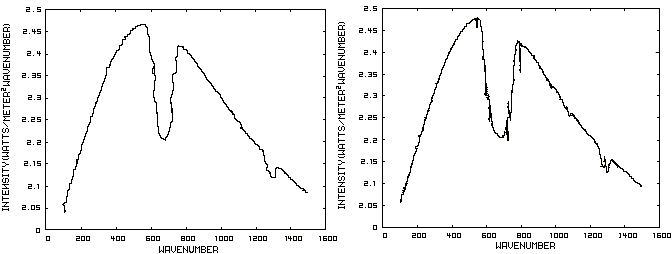
And here's the calculated plot of the earth's emission, with that "sharp" absorption, at 100 ppm CO2 and 1000 ppm CO2. http://www.skepticalscience.co... go ahead and repeat with a straight face how insignificant that little hole at wavenumber 667 is.
-
Re:As long as you don't count CO2...
Why bother reading half of a factoid? Oh right, the other half doesn't support your argument.
-
Re:Meh
Your post has some basis in scientific facts, but misrepresents their implications.
The CO2 peak is a fairly narrow range of infrared, but it's right at the wavelength that the Earth emits most strongly. To say that it's unimportant is like a traffic reporter saying that 99% of the roads in a city are wide open, only the main freeway is gridlocked, so no big deal. What matters is the fraction of total outgoing energy that CO2 prevents from escaping, which is roughly 20%. Keeping in mind that zero blockage would correspond to a global temperature of -18 C / 0 F, and 50% restriction would give a temperature of +30 C / 86 F -- 20% is a big deal. Just going from 20% to 25%, which is what we're looking at, is also a pretty big temperature shift.
Water vapor is a major greenhouse gas, but human emissions of it do not change the amount of it in the atmosphere for three reasons. First, the tight feedback you mentioned (the Clausius-Claperyon relation) means that any extra water added immediately falls out as extra rainfall. Second, human emissions of water vapor via combustion amount to 2 gigatons per year, or a global layer or liquid water 4 microns thick -- utterly insignificant next to the natural evaporation and rainfall of about 1 meter per year. Third, you mentioned increase in paved surfaces that would "catch rainwater", but precisely the opposite happens: water drains quickly off pavement and into rivers and sewers, while natural soils remain moist for longer.
That's not to say that water vapor's role as a greenhouse gas is unimportant: if temperature rises for any reason (including from CO2 greenhouse effect), the Clausius-Claperyon relation allows more water vapor to enter the atmosphere, amplifying the warming.
The upshot: water vapor is a major greenhouse gas, but that doesn't call the role of CO2 into question: instead it amplifies the importance of CO2.
http://climatemodels.uchicago....
http://www.skepticalscience.co... -
Re:Milestone my ass
Because it's a feedback loop. Other factors (e.g. orbital variations) can initially trigger warming in the oceans, which then release CO2, which results in further warming. See this article for details.
-
Re:Milestone my ass
Refuted: https://www.skepticalscience.c...
-
Re:Herbivores dying out? Not cows I hope!
> A variety of independent measurements of solar activity including satellite data, sunspot numbers, UV levels and solar magnetograms all paint a consistent picture.
This is a much more informed discussion than I can muster:
https://www.skepticalscience.c...To say it's "man made" is a bit of a misnomer. Releasing the energy that the planet has stored for millenia alongside the emissions our industry has produced, have likely started to bring about an irregular cyclical condition. The Earth approached this state after a Yellowstone-super-eruption or ELE asteroid arrived, but it's not all that unusual over the span of Earth's existence. Is it the Sun? Indirectly. There's no good science to support solar output (recent, since the dawn of man) is the direct cause.
The real bad news would be if an escalating event occurs concurrently with the peak of the warming.
-
Re:Herbivores dying out? Not cows I hope!
Though they never explain how every planet in our solar system is warming if it is humans who are causing climate change
Credible citation needed. This claims otherwise:
The basis of this argument is that the sun must be causing global warming and in fact, warming throughout the solar system. There are several flaws in this line of thought. Firstly, the characterisation that the whole solar system is warming is erroneous. Around 6 planets or moons out of the more than 100 bodies in the solar system have been observed to be warming. On the other hand, Uranus is cooling (Young 2001).
Secondly, the theory that a brightening sun is causing global warming falls apart when you consider the sun has shown little to no trend since the 1950s. A variety of independent measurements of solar activity including satellite data, sunspot numbers, UV levels and solar magnetograms all paint a consistent picture. Over the last 35 years of global warming, sun and climate have been moving in opposite directions. -
Re:Never a good idea
For a good, data rich, article, explaining what Mr. Booker doesn't understand, see Are surface temperature records reliable?.
-
"soooooooo...."
Can you cite any evidence of "backpedaling"? The global warming 'pause' is more politics than science
-
Re:EPA has exceeded safe limits, needs curbing
Seriously. There's no way you aren't a paid misinformer.
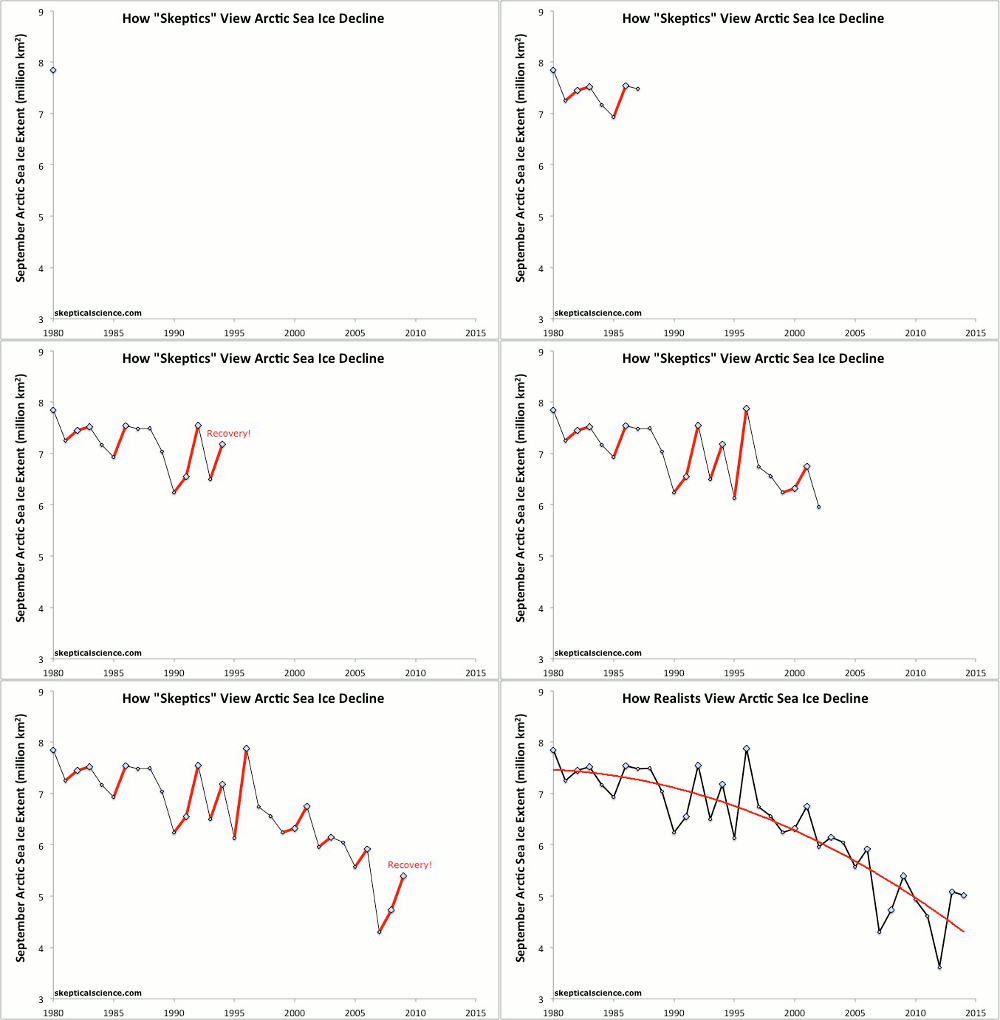
This image explains you perfectly:
http://www.skepticalscience.co...The trend since 1980 is down.
Clearly down, such than even an idiot like you should be able to grasp it.A small ONE YEAR "recovery" from 2012 to 2013 doesn't reverse the over all 40 year trend.
-
Re:EPA has exceeded safe limits, needs curbing
Congratulations, you apparently passed the class titled "How to lie with accurate data."
Specifically the chapter titled "Cherry Picking your comparison points".
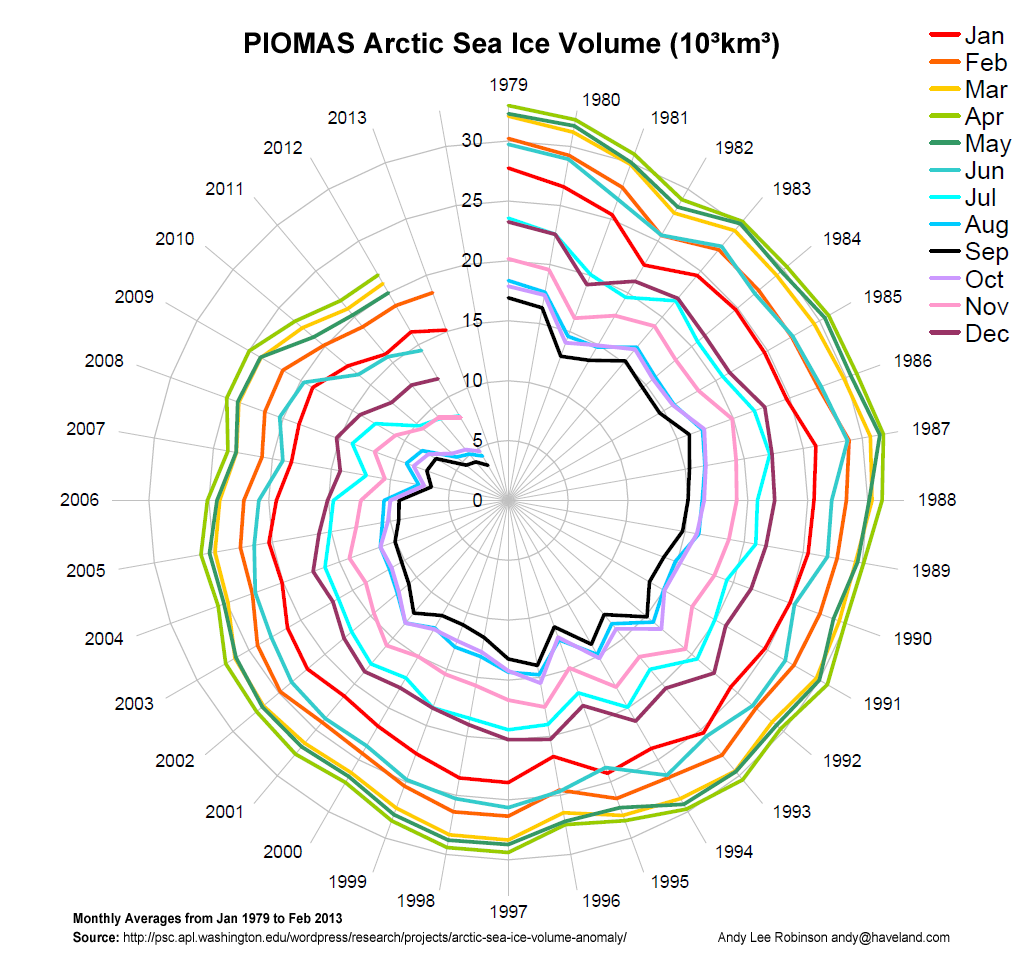
Meanwhile the actual facts about the Arctic include tidbits like "volume of ice is only 29% of what it was in 1979", "average age of ice is only 1-2 years, where it used to be 10+", and other fun factoids that prove you to be an idiot.
Here's a buncha graphs which all show a downward trend:
https://sites.google.com/site/...Here's some actual science and analysis on Arctic Ice:
http://www.skepticalscience.co... -
Re:Seems he has more of a clue
Here is a graph showing human factors versus natural factors over the last 50-65 years. By themselves, the natural factors would have the earth cooling, which it has actually been doing since the end of the last ice age. So global warming is actually slightly more than 100% anthropogenic.
-
Re:Seems he has more of a clue
Allow me to quote from your link:
"Scientific evidence for warming of the climate system is unequivocal. - Intergovernmental Panel on Climate Change"
Ok, great... how much of that is man-made change?
You could read the report
for yourself or you can look at a pretty graph that summarizes the findings.
What can we do about it if so?
There are a variety of strategies that we could try but the simplest, easiest, and cheapest solution is to apply a price to carbon emissions. Any economist can tell you that charging for emissions will reduce them.
What does that cost?
Very little, many of the economies with carbon emission taxes are outperforming their neighbours, who don't have emission taxes.
What does it cost to adapt to it rather than try and change it the other way?
Generally speaking, estimates of adaptation costs that have them running around 2-4 times as much as mitigation are considered to be low-balling the costs.
-
Re:Does it matter if you are a sceptic or not?
Guess what, those wacky climate scientists looked into solar variation and volcanoes and found that they are not significant factors.
Confuse people with facts? That is not the strategy of the deniers; confusing them with pseudoscience and talking points is.
-
Re:Does it matter if you are a sceptic or not?
Guess what, those wacky climate scientists looked into solar variation and volcanoes and found that they are not significant factors.
Confuse people with facts? That is not the strategy of the deniers; confusing them with pseudoscience and talking points is.
-
Re:Confused much?
http://www.skepticalscience.co...
You're full of shit
-
Re: They're called trees.
it doesn't matter, because the earth has never been habitable to humans when the CO2 levels have been higher. We don't care if the current CO2 levels are average or not, it's completely irrelevant. What we care about is whether they are convenient for us. The earth has gone through numerous ice ages without substantial perturbation of the cycle. Now we've created conditions that may change the cycle upon which we depend for existence, and we've already seen negative effects which are attributable to this carbon release.
Atmospheric CO2 levels certainly have been this high before, but the last time coincides with the last great exinction, so that is in fact a spectacularly shitty argument for denialists to engage in.
-
Re:No mention of sulfur
Current volcanoes are putting out carbon as well.
If you have questions, then you should find credible sources with information. You can follow the references to actual peer reviewed original research on the subject. If you really want to understand, then you'll need to do a graduate degree on it.
-
Re:Complete article
If your theory is so wonderfully complete, why can't you create a computer model that can start with conditions twenty years ago and work out a correct description of the present? Please note, I'm not denying that it's getting warmer. I simply don't subscribe to the current hubris that makes humanity responsible for all of it.
This is called "hindcasting" and is a standard part of the validation of all climate models. See here for more information.
-
Re:Complete article
The effect of CO2 declines logarithmically. The first 20ppm CO2in the atmosphere has a greater effect
than the following 300ppm. The incremental effect of increasing CO2at the present 385ppm level is almost immeasurable. Why don't climate "science" articles acknowledge the actual physics of CO2? It's lower now than it was before there were human beings to invent acronyms like AGW.We are nowhere near the saturation point. This idea stems from a misunderstanding that CO2 is evenly distributed vertically through that atmosphere.
The mechanism is explained well here .
Your assumption that scientists have overlooked these mechanisms are quite incorrect, and have featured in models of climate change going back to fouriers original work on the topic of the greenhouse effect in the 1800s.
-
Re:Meaningless goal
I have seen the reports. I do not know if they are accurate or reliable. I am asked to present citations for this. Yet, I have repeatedly seen people claim that Big Oil supports AGW deniers but no one ever gives any citations to support that stance. It is just accepted as true.
Well here are some citations for what I said. I will repeat that I do not know if they are true, so don't respond by telling me they are biased sources:
http://www.climatedepot.com/20...
http://www.forbes.com/sites/la...
Even that promoter of non-skeptical acceptance of global alarmism "Skeptical Science" admits that Big Oil now supports AGW alarmism:
http://www.skepticalscience.co...
There are more. How about some citations supporting the allegation that Big Oil supports AGW skeptics? -
Re:Complete article
-
Re:Tax
volcano because just one small eruption is millions of times larger in volume of CO than the entire world production of hydrocarbon fuels...
I'm going to need a source here, because https://www.skepticalscience.com/volcanoes-and-global-warming.htm says that volcanoes produce about one percent of the world's CO2 emissions.
-
Re:Ronny Raygun Says, "Uh, Doesn't Matter."
Weird how you cherry-pick "near-surface temperature" and 1998, huh?
http://www.skepticalscience.co... -
Re:Pointing out the stark, bleeding obvious...
Actually, wind is about middle of the field. Depending on which figures you take (this seems to be reasonably balanced), solar is the most expensive and either coal or nuclear (or on this graph hydro) are the cheapest. If you want to reduce environmental impact, nuclear is actually your best option in the short term, although we absolutely need to be pursuing renewables long-term.
But, calculating costs is tricky, because if you want a really balanced view, you need to factor in externalities (indirect or down-system effects), and this puts things like coal and other fossil fuels as horribly expensive, and wind, hydro, and nuclear come out on top.
So, depending on how much of it's effect you are measuring, wind actually can be cheaper. (I haven't even gone into subsidies).
-
Re:This is interesting....
you're a shill because the things you said aren't true, but are talking points that come directly from fossil fuel lobbyists.
the planets are not heating up at the same rate. that's simply a variation on the "solar activity" myth, which again, if a change in solar output were the cause we should be cooling at the moment, not warming, as the sun's output is currently in a decreasing phase.
At this time, there is little empirical evidence that Mars is warming. Mars' climate is primarily driven by dust and albedo, not solar variations, and we know the sun is not heating up all the planets in our solar system because we can accurately measure the sun’s output here on Earth.
http://www.skepticalscience.co...
This is a round-up of the planets said by sceptics to be experiencing climate change:
Mars: the notion that Mars is warming came from an unfortunate conflation of weather and climate. Based on two pictures taken 22 years apart, assumptions were made that have not proved to be reliable. There is currently no evidence to support claims that Mars is warming at all. More on Mars...Jupiter: the notion that Jupiter is warming is actually based on predictions, since no warming has actually been observed. Climate models predict temperature increases along the equator and cooling at the poles. It is believed these changes will be catalysed by storms that merge into one super-storm, inhibiting the planet’s ability to mix heat. Sceptical arguments have ignored the fact this is not a phenomenon we have observed, and that the modelled forcing is storm and dust movements, not changes in solar radiation.
Neptune: observations of changes in luminosity on the surface of both Neptune and its largest moon, Triton, have been taken to indicate warming caused by increased solar activity. In fact, the brightening is due to the planet’s seasons changing, but very slowly. Summer is coming to Neptune’s southern hemisphere, bringing more sunlight, as it does every 164 years.
Pluto: the warming exhibited by Pluto is not really understood. Pluto’s seasons are the least understood of all: its existence has only been known for a third of its 248 -year orbit, and it has never been visited by a space probe. The ‘evidence’ for climate change consists of just two observations made in 1988 and 2002. That’s equivalent to observing the Earth’s weather for just three weeks out of the year. Various theories suggest its highly elliptical orbit may play a part, as could the large angle of its rotational axis. One recent paper suggests the length of Pluto’s orbit is a key factor, as with Neptune. Sunlight at Pluto is 900 times weaker than it is at the Earth.Claims that solar system bodies are heating up due to increased solar activity are clearly wrong. The sun’s output has declined in recent decades. Only Pluto and Neptune are exhibiting increased brightness. Heating attributed to other solar bodies remains unproven.
-
Re:This is interesting....
you're a shill because the things you said aren't true, but are talking points that come directly from fossil fuel lobbyists.
the planets are not heating up at the same rate. that's simply a variation on the "solar activity" myth, which again, if a change in solar output were the cause we should be cooling at the moment, not warming, as the sun's output is currently in a decreasing phase.
At this time, there is little empirical evidence that Mars is warming. Mars' climate is primarily driven by dust and albedo, not solar variations, and we know the sun is not heating up all the planets in our solar system because we can accurately measure the sun’s output here on Earth.
http://www.skepticalscience.co...
This is a round-up of the planets said by sceptics to be experiencing climate change:
Mars: the notion that Mars is warming came from an unfortunate conflation of weather and climate. Based on two pictures taken 22 years apart, assumptions were made that have not proved to be reliable. There is currently no evidence to support claims that Mars is warming at all. More on Mars...Jupiter: the notion that Jupiter is warming is actually based on predictions, since no warming has actually been observed. Climate models predict temperature increases along the equator and cooling at the poles. It is believed these changes will be catalysed by storms that merge into one super-storm, inhibiting the planet’s ability to mix heat. Sceptical arguments have ignored the fact this is not a phenomenon we have observed, and that the modelled forcing is storm and dust movements, not changes in solar radiation.
Neptune: observations of changes in luminosity on the surface of both Neptune and its largest moon, Triton, have been taken to indicate warming caused by increased solar activity. In fact, the brightening is due to the planet’s seasons changing, but very slowly. Summer is coming to Neptune’s southern hemisphere, bringing more sunlight, as it does every 164 years.
Pluto: the warming exhibited by Pluto is not really understood. Pluto’s seasons are the least understood of all: its existence has only been known for a third of its 248 -year orbit, and it has never been visited by a space probe. The ‘evidence’ for climate change consists of just two observations made in 1988 and 2002. That’s equivalent to observing the Earth’s weather for just three weeks out of the year. Various theories suggest its highly elliptical orbit may play a part, as could the large angle of its rotational axis. One recent paper suggests the length of Pluto’s orbit is a key factor, as with Neptune. Sunlight at Pluto is 900 times weaker than it is at the Earth.Claims that solar system bodies are heating up due to increased solar activity are clearly wrong. The sun’s output has declined in recent decades. Only Pluto and Neptune are exhibiting increased brightness. Heating attributed to other solar bodies remains unproven.
-
Re:This is interesting....
perhaps you need to read this as well http://www.skepticalscience.co...
-
Re:This is interesting....
Like I said in a previous post, infra-red imaging of the inner planets in our solar system shows them heating up at a rate similar to Earth. But, say that out loud and people like you friggin flip out.
Probably because it's not actually true.
And you never did say where you got that interesting bit of information, anyway...
-
Re:This is interesting....
It did a horrible job of predicitng the polar ice refreezing that happened 2 or 3 years ago.
Good, because if the models predicted events that did not happen, that would be a bad sign for them. The "polar ice refreezing" that you are refering to didn't happen. Polar ice did rebound from a record low, which it was widely expected to do. In fact, every record low polar ice year is followed by a few years that are higher than the record low before until we reach the next record low. However, the overall trend is still downward.
Global Warming was being used by meteorologists as the cause for the polar vortexes that dropped temperatures down into the single and negative digits.
From my understanding, that is correct. Warming in the arctic is changing the wind flow which is allowing colder Arctic air to be pushed over the North East section of North America.
And all the work you do to try and save our asses from rising temparatures will be meaningless when the Yellowstone Supervolcanoe erupts and takes out half the country, which "well established science" said should have erupted close to 20 years ago.
The National Science Foundations seems to think it will be 1 or 2 million years from now. Are you sure you know the difference between reporters and scientists?
Like I said in a previous post, infra-red imaging of the inner planets in our solar system shows them heating up at a rate similar to Earth. But, say that out loud and people like you friggin flip out.
Maybe, the flip out at you because it's not true? Mars isn't warming.
-
Re:This is interesting....
It did a horrible job of predicitng the polar ice refreezing that happened 2 or 3 years ago.
Good, because if the models predicted events that did not happen, that would be a bad sign for them. The "polar ice refreezing" that you are refering to didn't happen. Polar ice did rebound from a record low, which it was widely expected to do. In fact, every record low polar ice year is followed by a few years that are higher than the record low before until we reach the next record low. However, the overall trend is still downward.
Global Warming was being used by meteorologists as the cause for the polar vortexes that dropped temperatures down into the single and negative digits.
From my understanding, that is correct. Warming in the arctic is changing the wind flow which is allowing colder Arctic air to be pushed over the North East section of North America.
And all the work you do to try and save our asses from rising temparatures will be meaningless when the Yellowstone Supervolcanoe erupts and takes out half the country, which "well established science" said should have erupted close to 20 years ago.
The National Science Foundations seems to think it will be 1 or 2 million years from now. Are you sure you know the difference between reporters and scientists?
Like I said in a previous post, infra-red imaging of the inner planets in our solar system shows them heating up at a rate similar to Earth. But, say that out loud and people like you friggin flip out.
Maybe, the flip out at you because it's not true? Mars isn't warming.
-
Re:This is interesting....
Like I said in a previous post, infra-red imaging of the inner planets in our solar system shows them heating up at a rate similar to Earth. But, say that out loud and people like you friggin flip out.
Evidence? We measure the sun fairly carefully, so it would have to be in disagreement with those measurements: http://www.skepticalscience.co...
-
Re:This is interesting....
I read the study on the Martian polar ice caps. I also read that all the planets in the inner solar system are heating up at the same rate. When you mention stuff like this, the Global Warming guys flip and jump down your throat that you can't use data from other planets to predict what's happening on Earth.
Funny, that's not what they actually have to say in response. Their actual response is that over the last 50 years total solar irradiance has decreased slightly So, unless there is some secret planetary system wide heat source that we are unable to detect, any planetary warming is independent.
When I mention any of this stuff, they get outraged, and continue to call me an industry shill. Which I am not.
Based on the fact that you have not provided a single citation except "a great article" and "a study I read" the fact that I have given you an actual verifiable citation will slide right past you like water off a duck's back. And when that happens I won't call you an industry shill. I'll call you a useful idiot.
-
Re:This is interesting....
Why don't you show the whole gisstemp graph. What drove temperatures from 1910 to 1945? Certainly not CO2....
Actually, CO2 seems to have played some role, and you seem to be parroting a debunked, tired myth.
-
Re:This is interesting....
There are also reports that God created Earth + two people less than 7000 years ago.
If you really believe what you're claiming, you've been had big time. Here's the gist on Mars: http://www.skepticalscience.co... , and on the solar influence: http://www.skepticalscience.co... - solar activity has been going down, while temperature on Earth (mainly in the oceans for now, check the first image here: http://www.skepticalscience.co...) has been rising dramatically.