Slashdot Mirror
Domain: spaceandmotion.com
Stories and comments across the archive that link to spaceandmotion.com.
Comments · 7
-
Re:Everything is disputed
I was with you until you mentioned the big bang THEORY. Sorry mate, but it is just a POP theory and there are many others that aren't as religiously fanatical about sprouting itself as gospel. There are too many holes in TBBT for it to be feasible, in my mind. The REAL facts about TBBT
-
Re:Uh huh, terrororists
I know there are some VERY archaic laws on the books in all states, but sex toys are a fairly modern things, no? Did someone pass anti-vibrator laws in the past 3-4 decades?
That depends on what you call sex toys and what "fairly modern" is. What we'd call sex toys today were being made in the 1800s. Vibrators were being used in the 1880s, as a medical device. The first one was invented in 1869. Kama Sutra which is thousands of years old talks about using sex aids or toys. Dildos come from around 1400. The Brief History of Sex toys has more info.
So, what do you mean by "sex toys are a fairly modern things"?
Falcon
-
Re:B O L L O C K S !
Wrong. Either you're ignorant or you're altering the facts to support your own worldview.
If I wasn't an athiest before, reading the bullshit shovelled by people like you make Athiesm seem to be the only sensible option for the sane and intelligent.
At the risk of responding to a troll, I was referring to quotes like the following (taken from http://www.spaceandmotion.com/albert-einstein-god-religion-theology.htm ):
In the view of such harmony in the cosmos which I, with my limited human mind, am able to recognise, there are yet people who say there is no God. But what makes me really angry is that they quote me for support for such views. (The Expanded Quotable Einstein, Princeton University Press, p. 214)
So now I've shared the sources for my statement. Care to share yours?By the way, what makes you think I have a worldview bias? I regard myself as a "teapot atheist" (in the sense that Dawkins uses the term) but I think I'm leaning towards agnosticism simply because I'm committed to following the scientific method in every aspect of my life. In a theological context, that means that I simply can't come to any specific conclusion about god without sufficient evidence. From what I can tell, Einstein and I are pretty much in agreement on this point. (Not that it matters- arguments from authority are weak forms of evidence.)
On a more personal level, I humbly recommend that you change the tone you use to debate. While it's certainly true that some people do alter facts to fit their worldview (creationists and scientologists are glaring examples, IMHO), it's seldom productive to explicitly point that out. Furthermore, if you fly off the handle at the slightest provocation and hurl that accusation around, people will regard you as "the boy who cried wolf". It's usually more effective to politely ask the person to provide the sources for their statements.
And, quite frankly, accusing people of "shoveling bullshit" is simply insulting. It's a good thing I'm already a non-theist, otherwise your condescending attitude would have simply convinced me that atheists are arrogant, loudmouthed jerks. When you act this way, you make all non-theists look bad. I'm actually considering the possibility that people like you are, in fact, fundamentalists posing as atheists to reinforce the "obnoxious atheist" stereotype.
Oh, and it's "atheist". Spelled just like it sounds. The more you know...
-
Re:Well...I found quote where Einsteins says he believes in Spinoza's God: http://www.spaceandmotion.com/albert-einstein-god-religion-theology.htm I believe in Spinoza's God who reveals himself in the orderly harmony of what exists, not in a God who concerns himself with the fates and actions of human beings. (Albert Einstein) Basically, he thinks that the idea of God as personality that cares about human beings and what happens to them silly (or as I interpret it: spiritual materialism). God of Einstein is closer to impersonal Brahman (Brahman is the unchanging, infinite, immanent, and transcendent reality which is the Divine Ground of all matter, energy, time, space, being, and everything beyond in this Universe). This is actually no God in any Christian sense. "It was, of course, a lie what you read about my religious convictions, a lie which is being systematically repeated. I do not believe in a personal God and I have never denied this but have expressed it clearly. If something is in me which can be called religious then it is the unbounded admiration for the structure of the world so far as our science can reveal it." Albert Einstein, in a letter March 24, 1954; from Albert Einstein the Human Side, Helen Dukas and Banesh Hoffman, eds., Princeton, New Jersey: Princeton University Press, 1981, p. 43. But the following is the most interesting. It is basically Buddhist viewpoint. Emphasis mine. A human being is part of the whole called by us universe, a part limited in time and space. We experience ourselves, our thoughts and feelings as something separate from the rest. A kind of optical delusion of consciousness. This delusion is a kind of prison for us, restricting us to our personal desires and to affection for a few persons nearest to us. Our task must be to free ourselves from the prison by widening our circle of compassion to embrace all living creatures and the whole of nature in its beauty. The true value of a human being is determined by the measure and the sense in which they have obtained liberation from the self. We shall require a substantially new manner of thinking if humanity is to survive. (Albert Einstein, 1954) The most beautiful and most profound experience is the sensation of the mystical. It is the sower of all true science. He to whom this emotion is a stranger, who can no longer wonder and stand rapt in awe, is as good as dead. To know that what is impenetrable to us really exists, manifesting itself as the highest wisdom and the most radiant beauty which our dull faculties can comprehend only in their primitive forms - this knowledge, this feeling is at the center of true religiousness. ( Albert Einstein - The Merging of Spirit and Science) About happiness. The happiness that mystics in different traditions and Buddhists seek, is not feeling, but the release from the cause of suffering/unhappiness. Pain in life is inevitable, but suffering/unhappiness is not. Pain is what happens to you sometimes. Unhappiness is what self creates by itself. You are unhappy (or unsatisfied) when you feel that current experience you are in is something you want to avoid.
-
Albert Einstein said:
The religion of the future will be a cosmic religion. It should transcend personal God and avoid dogma and theology. Covering both the natural and the spiritual, it should be based on a religious sense arising from the experience of all things natural and spiritual as a meaningful unity. Buddhism answers this description. If there is any religion that could cope with modern scientific needs it would be Buddhism. Here.
Or Google it.
This is too funny to me right now:
evolution vs creation
Democrat vs Republican.
-
Monad -- See Deleuze and Leibniz
Here's where else you might've heard "monad" before.
See Gottfried Leibniz's "Monadology" - here, and with
background info here.
Then check out Gilles Delezue's The Fold -- here. Deleuze is a total nutjob, like so many other French "theorists" or "literary theorists" (whatever that means), but he writes almost cogently about Leibniz.
I assure you that Haskell is not the "one other context" for the concept of a "monad." -
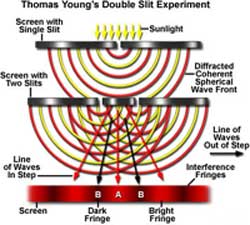
Re:huh?!Here is an image claiming to be the results of the double slit experiment.
Here, I think, is the best set up for the experiment -- pass the light through a single slit first to make the results more obvious or something.