Slashdot Mirror
Domain: springer.de
Stories and comments across the archive that link to springer.de.
Comments · 15
-
Re:Technical...
If so, why do they provide this template?
-
Re:What's really going on hereLet's try:
- The "membranes", "modes" and "frequencies" here are already a physical analogy. Number theorists study objects (``automorphic forms'' -- no matter why they are called this way) that live on some ``manifolds'' (no matter what that means, either). But to get some intuition you can replace ''manifold'' with ''taut membrane'' (like a drum) and ''automorphic form'' with ''normal mode'' a.k.a. basic ''standing wave'', as you call it. An important problem in mathematical physics is to find what are the possible frequencies of standing waves on a particular surface. The problem here is analogous.
- To see a picture of the 2-dim membrane I was talking about, see here. Start by taking a half-infinite strip of width 1, and cut off a semi-circular bit at the bottom like in the picture (the strip extends infinitely far at the top. Next, glue the two infinite sides together so the strip becomes a cylinder. Finally (that's not in the picture) imagine that as you go further and further up the cylinder, its radius becomes smaller and smaller, so the real thing is a kind of infinite funnel.
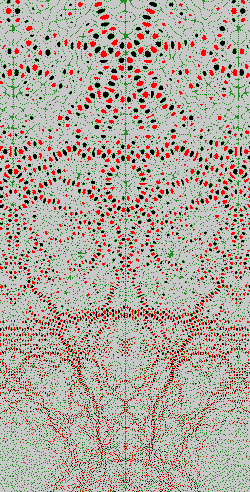
- To see what a standing wave on this membrane looks like, see here (this was computed numerically by Dennis Hejhal).
- The "lift" that takes a standing wave on this space to a standing wave on the 5-dim space is really complicated (and is a very indirect construction). There just isn't a non-technical way to describe it.
- However, we know what the "lift" does to the frequencies: if you start with a standing wave you found numerically, and approximately know its frequency, then you know there will be a lifted guy of a calculatable frequency on the 5-dim space. So the interesting problem is to find standing waves with frequencies which are different from the ones we already know about (because we have calculated a lot of standing waves on the 2-dim surface).
- One symmetry this infinite funnel has is left-right reflection (it is apparent both in the picture of the strip and in the picture of the vibrational mode). The other symmetries are difficult to describe in a blog post. What's important is that the modes of vibration must respect the symmetries.
- It is true that to each such ''standing wave'' (on the 2-dim surface, on the 5-dim space, and on others) there is an associated L-function. The Riemann Hypothesis for these L-function (the same formulation: all zeros are on the critical line) is called the "Generalized (or Grand) Riemann Hypothesis" or GRH.
- It was possible to calculate a few zeros of the newly-found modes, and see that indeed they are where they are supposed to be. This gives some evidence for the GRH. Calculations like this can always falsify the GRH (by finding a zero off the line). However, these calculations don't represent any progress toward proving the GRH -- that was confusion on part of the person who submitted the story to slashdot.
-
Re:In normal human cells..."What isn't clearly mentioned is that telomerase is *inactive* in normal human cells"
Not entirely true as, "Telomerase is present in most fetal tissues, normal adult male germ cells, inflammatory cells, in proliferative cells of renewal tissues, and in most tumor cells.". This begs the question how you destroy cancerous cells without destroying normal cells that require the telomerase enzyme.
I haven't yet accessed the full text article, but the poster mentioned that the scientists in question are selectively killing only cancerous cells via down regulation of telomerase. Can anyone verify this? If so, how are they doing it?
-
Rabin's Hyper Encryption and Everlasting Secrets
Rabin's Hyper Encryption and Everlasting Secrets is an interesting alternative. - Austin
-
This is not surprising.They've been examining RX J1242-11 for over a decade. Check out this paper which describes X-ray observations made in 1999, and mentions investigations of this "non-active" galaxy going back to 1990 at least.
The phenomenon is termed "large-amplitude X-ray variability." It appears that they've finally advanced their models and observation techniques to the point where they are willing to state publicly that this is indeed caused by a black hole. But it's been suspected for years and years.
-
Re:No, and you're assuming facts not in evidence> Almost all software patents are for stuff that's obvious
As one of the named inventors on a pending software patent application, I call BS on this. The patents you usually hear about, particularly on Slashdot, are bad. But that doesn't mean that "almost all" software patents are for stuff that was obvious when they were filed. In 1999, was the use of stego to encode digital watermarking information really obvious? The first academic conference on stego-related issues wasn't even created until 1996. I know some of the people who worked at Intertrust during its heyday - and they're damn smart crypto and security researchers. Look at some of the research papers from Intertrust. If you know anything about security, you'll recognize some very good computer scientists in there. Martin Abadi invented the logic used to analyze security protocols. Robert Tarjan quite literally wrote the book on advanced algorithms and data structures.
Now, contrast that with something like "a patent on the use of a web server to sell things" -- well, duh. But a patent that describes the method by which you use the high frequency components of an audio signal to digitally watermark an audio sample? It sounds kind of obvious in 2003 because that's how everyone's doing it, but the technology was quite new five years ago, and Intertrust was doing some of the preeminent research on it.
Don't blast all software patents because some are stupid. The system has a problem - a big one - but the fundamental concept of software patents isn't as silly as you might believe.
-
Re:How Long? A Loooooooong Time...
Recovering a 163-bit ECC key is estimated to require 2^27 times as much effort as a 109-bit ECC key. Current recommendations are that 163-bit ECC keys should be safe to use until 2011, although I don't think we'll see public key-recovery efforts succeed against 163-bit ECC until 2020 or so.
Since a 163-bit key is 2^54 times more complex than a 109-bit key, and it took 4 years for the 109-bit key, aren't we looking at at least 4 * 2^53 years, not even figuring in the elliptical complexity (which I admit I would need to read up on)?
The following is one of the better articles on this subject:
A. Lenstra and E. Verheul, "Selecting Cryptographic Key Sizes,"
Journal of Cryptography, v. 14, 2001, pp. 255-293.
A PDF file of the article can be downloaded here. -
Re:Langlands Program
Here is an expository article from the Journal of the AMS about the Langlands program. Results of Lafforgue are used to prove some very nice theorems.
Here is a link to an article by Lafforgue in Inventiones Mathematicae, one of the world's most prestigious mathematics Journals. Malheursement, cet article est en français.
Here is the Mathematical Reviews citation for the Lafforgue paper. You can browse the articles cited by him.
Also, if anyone is interested, here is a paper by Voevodsky about some of his work in motivic cohomology.
-
But I Love both!
Students used to locating information with Google are appalled at the steps it takes to locate a scholarly journal.
Well, I don't know about your "students" - but I personally like both!
Especially in the last few years the Library indexes have vastly improved! I remember when InfoTrac came out w/ it's monochrome screen, CD-Rom jukebox, and cheesy IBM dot-matrix printer (sometimes thermal).
*THAT* was nothing compared to some of the systems in use today - plus the fact that many publishers provide indexes for all of the journals they publish. Most of the time you can get a
But, that's just me.
-
Re:Great!
Somebody's probably mentioned this already, and moved on, but... It sounds like FEC/Digital Fountain/Tornado Codes all over again. If this, as I suspect, is true, then Cringely is strictly speaking right, the improvement is more or less Layer 2 (Error Correction), but they're being way too unclear about the implementation, probably for no good reason.
The idea of FEC (Forward Error Correction) and related techniques is, in short, that you will send enough information about the data, that even if some of it were to be missed, it could all be reconstructed. Hence you're not defeating Shannon, you're just prepared for that loss, and meeting it, while traditional approaches often enough allows very little if at all error-correction, with strict limits on the nature of the error.
As Cringely suggests, this is, then, applicable to all transmission media, including the backbones. I suspect cable-networks have been chosen for a need to demonstrate the technology first on a more marketable system. -
Re:Good for them
Whether it happens on a conscious level or not is open for debate, but that's how people operate too. Whether it's evolution or whatever, the only reason people might do something good is that it will benefit them. Don't get me wrong, I'm not machiavellian or anything, and I don't use this as the guiding principle of my actions. I do something good because I think it's the right thing to do. But as an afterthought, I know that the only reason I thought that action was good was because it would help me. That's why you try to return a favor to someone who's nice. And both parties will often each get more than they gave. If my rambling was even remotely interesting to you read about Game Theory here.
-
artificial gravity
NASA is considering puting a centrifuge on a mars mission.
The 1998 Neurolab mission on the space shuttle had a centrifuge that produced 1G. this was basically a spinning chair.
from the paper " Perception of tilt (somatogravic illusion) in response to sustained linear acceleration during space flight "
these results suggest that astronauts exhibit appropriate
perceptual and oculomotor responses to artificial gravity
during short-duration missions. If these responses are
maintained during exposure to artificial gravity on long-duration
space flights, interplanetary missions can proceed
with the expectation that the astronauts will respond
normally to the gravitational fields of other planets
when they are encountered.
not sure if this will help their teeth, but it does seem to indicate that spinning the astronauts can overcome some of the problems of weightlessness -
The orbit explained...the fairly complicated orbit of this star, too complicated for me to describe here...
According to the links, the star is in an highly excentric elliptical orbit. A pretty good image can also be seen on the space.com link you give. This means, the orbit should be similar to long-period comets. Some graphs showing the orbit of the Hale-Bopp comet can be seen here.
There are also some scientist who think the claimed 30 million year periodicity is not real, but a result of impact crater data rounded to nearest round millions of years. You can get the artcile by entering the number 9701104 in the field here. The paper has been published in an international refereed astronomical journal, Astronomy and Astrophysics
My personal opinion is that Nemesis is propably not lurking out there, but I think it would be worthwhile to check it.
Divine retribution seems to be a million years away
I think that in one million year, out tech can stop the comets that this star might drop from the Oort cloud. Even with present tech, we get a good early warning. A 'killer comet' would probably be detected at least half a year before the possible impact. I'd be much more worried about the Near-Earth Asteroids - they may remain undetected until a few weeks before D-day.
-
Re:Wolbachia..new but not so new
W. spp. have been found in an amazing number of Arthropods...and has, as mentioned great implications for evolutionary studies. You can check out this, this or this for a couple of interesting articles on the subject.
Its really not old news either, the extent of Wolbachia infections is not known (if 10% of species are described you can hardly know if the other %90 are infected). Note that there are many "species" of Wolbachia as well, perhaps not even related (in the same genus) and that hosts may be infected by multiple "species" each combination of which may have different effects! What this comes down to is that you basically need to overlap two phylogenies (family trees/networks etc.) now to get a picture of what's going with regards to the evolution of your target organism. Really cool. -
Prior artThe process patent is pending.
This URL describes how belgian scientists engineered a bacteria which emits light in the presence of certain metallic ions. From this bacteria they took the genes which did this. About the same as described in the article...only here a more intelligent way of finding the genes was used. The document was written in april 1997. That quite some time before professor Li Yu did this! I wish the professor good luck with his patent:) I fear he will get it since the patent office in the USA has already shown time after time that they do not know what they are talking about...