Slashdot Mirror
Domain: synthmuseum.com
Stories and comments across the archive that link to synthmuseum.com.
Comments · 16
-
The Casio VL-Tone was the iPod inspiration?
I had already my own crazy theory about the inspiration for the iPod. (Note that I don't think it's necessarily the case, but the similarities are nonetheless interesting, at least to people that knows this synth! If you don't care, stop reading now and sorry for the two clicks you wasted!)
The Casio VL-Tone (aka VL-1) was the first Casio synth released, in 1981, at a time when they only made watches and calculator. It has been very popular and sold more than a million in the first half of the 80's and one of it's high-pitched rhythm was popularized by the German band Trio, in a song called "Da Da Da".
http://www.synthmuseum.com/casio/casvltone01.html
http://www.hollowsun.com/vintage/casio_vl1/
(the seconth linked page says it was released in 1979, but I think it's a mistake)
How is it similar to the iPod? Both are "portable" digital music playing gadget encased in white plastic and featuring LCD screens. Granted, one is a music instrument and the other a music juke-box, and the VL-Tone is too big to fit in ones pocket. Still the rounded white plastic case, gives a similar feeling to the synth. I don't think it was the first white synth, but still one of the rare synth primarily sold in white at the time. Just like the iPod, it really stood out of the crowd, when at the time. The VL-Tone came with a fake-leather sleeve, so you could avoid scratching it
Functionally, while the original iPod could hold 1000 songs, the VL-1 could store a whopping 99 notes, and that even when the power was turned off! Both have headphone jacks. The screen displayed notes on the VL-1 while on the iPod it can be song titles and lyrics. Both had non-music secondary functions, the iPod has a clock, a calendar and contacts, on the VL-Tone it was a built-in calculator, on a synth! (The story goes that Casio was afraid to go in the synth market, and this has been like a compromise) While the iPod has Linux as a geeky feature, one of the instrument included in the VL-1 had a programmable ADSR instrument, where each digit of the number stored in the calculator memory (M+) would modify an instrument property like, attack, decay, sustain, release and others.
About 1 or 2 years after the release of the VL-1, Casio released a functionally identical but much more portable version of the VL-1, called the VL-10, it was small enough so you could actually put it in your pocket and had an aluminum casing, just like the iPod mini.
Obviously there are also many things that are not similar... The VL-1 runs on AA batteries, it has much more buttons (but it's a synth keyboard!). Though it had some professional features like a screen, a real-time and step note sequencer and ADSR programming, the basic sound engine was ehmmm primitive but can be powerfull, very Nintendo-ish, and you couldn't play two notes at the same time. I actually suspect that many japanese NES music composers used the VL-1 to compose some of their tunes.
Anyhow, since the UK is a very synth-friendly country, and that the VL-Tone design is very iconic and a classic in electronic product design of the 80's, I wouldn't be surprised that Jonathan Ive, owned one of these and was inspired by it. -
Re:Synths
Yeah, I sometimes regret selling my Moog Liberation and my Oberheim OB-8, but really, they were a pain to keep in tune...
Though my current band doesn't require them, I've got no plans to ever sell my Moog Taurus pedals. A fat, rich bass that just can't be found anywhere else. There is just no substitute for old analog technology for certain things.
-
Re:RIP Bob
That would be the PPG Wave, although I believe only the oscillators were digital; the filters were still analog.
-
Re:He Milked the Mini-Moog Then Fell Behind
Polymoog wasn't his. David Luce designed that one.
I read a David Luce paper in Journal Of The Audio engineering Society. Nice measurements of musical instrument spectra, completely faulty mechanism for describing how they changed with amplitude.
Here's a link to a good history of Moog Music, including how Luce was chosen to run the outfit after Moog left.
http://www.synthmuseum.com/moog/ -
Re:A little help please....I don't use P2P software, but the synth in the video is, as I recall, a Fairlight
Other common synths seen in 1980s music videos:
- Yamaha DX7
- The Prophet 5 (Dave Smith's sucessful 1978 synth)
- The Emulator II
- The Roland Jupiter 8
-
Re:A little help please....I don't use P2P software, but the synth in the video is, as I recall, a Fairlight
Other common synths seen in 1980s music videos:
- Yamaha DX7
- The Prophet 5 (Dave Smith's sucessful 1978 synth)
- The Emulator II
- The Roland Jupiter 8
-
Korg...
My first - and only - 'high-end' keyboard was a Roland.
I was living in England at the time, and me and my band-mates took to hanging out in Cambridge and prowling the music stores looking for deals. I wanted, but could not afford a top of the line Yamaha DX-1 - so instead settled for a Roland JX-3P. This was 1983/84 timeframe. Rumor had it that Thomas Dolby acquired his keyboards from the same shop (but that is highly speculative - although interestingly the linked article does mention him - so my machine could have been from the same lot
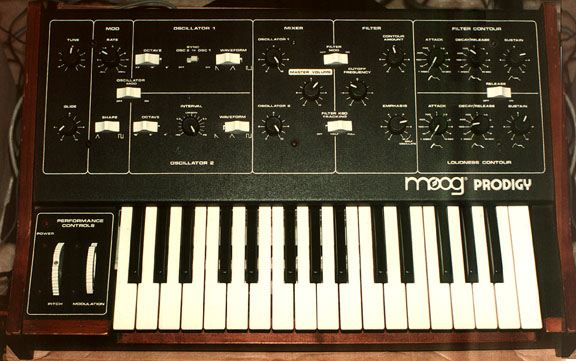
I remember seeing a Moog synth - a Prodigy in the same store - slightly used - and I kick myself for not getting that one instead - again lacked the cash flow. I did purchase a BOSS DR 110 drum machine which I used for composing, and when our drummer would crap out on us; I ended up loaning that to a friend in later years - and never saw it again (friend having moved with no return address). Also acquired a BOSS DM-3 Analog Delay floor switch unit - used that as a general purpose delay for all kinds of ambient effects - and still own it today (great little unit) and use it with my guitar.
When I came back to the states I got an electrician to modify the power supply on the keyboard to handle US power. After a few years I gave it to my sister who was studying music in college at the time. No idea where it is or what it is doing now...(sigh)
This new Korg sounds interesting (combining both my love of computers and music in one device). I wonder if I will have to sell my firstborn to afford it? Has anyone priced these? Would it be better for me just to get a good midi capable soundcard and some computer software combined with a cheaper keyboard? -
Analog synths
If you listen to contemporary electronic music, you'll here a strong commitment to vintage analog synthesisers. www.synthmuseum.com provides details on these beasts, including past and present players.
Indeed, this trend is so well established that many musicians are rejecting it and moving to early digital equipment, like the Yamaha DX7. This makes sense, given that the DX7 was released in 1993 and the standard "window" for retro is twenty years. -
Analog synths
If you listen to contemporary electronic music, you'll here a strong commitment to vintage analog synthesisers. www.synthmuseum.com provides details on these beasts, including past and present players.
Indeed, this trend is so well established that many musicians are rejecting it and moving to early digital equipment, like the Yamaha DX7. This makes sense, given that the DX7 was released in 1993 and the standard "window" for retro is twenty years. -
Re:What about NII don't think that NI existed in the 1980s. Do correct me if I'm wrong.
The beginning of the list was fascinating, but from the 1970s onwards the list has glaring omissions. Where's the ARP synths? Not to talk about the 1980s list. They should remove the last 20 years from the list, since other sites manage that part way better, eg. synthmuseum.com.
-
Moog CookbookFor some time, we've had the Moog Cookbook on our PBX.
Brilliant 'modern rock' covers (mostly up-tempo) done by a couple of geezers on a whole collection of 'vintage synths'... (moogs, mellotron,
Not that much different from cheesy midi files, but that record never failed to make me smile
-
Re:I still prefer metal/plastic cases
Let's not forget this
I'm with the pro-wood camp.I just had a Moog Prodigy for a couple of days. The real wood case didn't take away from the technology at all
-
Have you seen a Korg Triton?They are huge with lots of gadgets. How about a Yamaha 9000 Pro perhaps? Hell, how about even a old analogoue Prophet 5?
There are TONS of huge, complecated, expensive, synthesizers out there and they do get bought and sold. This one is the same, but features teh ability of have software synthesizers and the like loaded on it. Those have become rather popular, and in fact some companies sell nothing but soft synths.
There is plenty of market for this sort of thing.
-
Re:Prior Art?
I present to you...
...Thaddeus Cahill's Teleharmonium!!!
Not only one of the first (the first?) synthesizers for electronic music - but his very idea was to send electronic music over telephone lines to "listeners"...
When? Idea in 1893, granted patent number 580,035 in 1898, and completed the first machine in 1901 - prior art, methinks!!!
Hmm... -
Re:Hardware key=dongle+dongle+dongle+dongle+dongleYoure post reminds me of the 'Hardware' dongles various software companies used in the late '80s and early '90s. I recall 12Tone's G.H. at the '89 NAMM show joking
Everyone laughed except C.B. of Voyetra.
-
Minimoog reissue + linksMoog Music UK (not related to Bob Moog) is selling new Minimoogs. The site is http://www.moogsynthesizers.co.uk/.
synthmuseum.com and Synthsite have more information about Moog and other synthesizers.If you want to try your hand at building your own analogue synthesizer, Synthfool has links to several DIY sites.