Slashdot Mirror
Domain: technologystudent.com
Stories and comments across the archive that link to technologystudent.com.
Comments · 8
-
Re:CNC machine
-
Re:CNC machine
-
Re:Why the hostility?
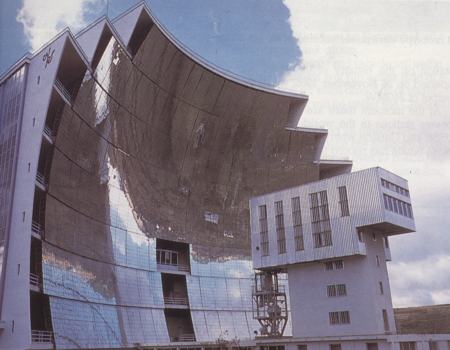
Heat to energy...
http://www.technologystudent.com/images5/solfurn.j pg -
Re:Linux version...
I don't need anything this fancy. I'm looking for a simple drawing tool to create 3D projections in 2D directly without rendering - i.e. isometric, oblique, single-point, two-point, exploded mechanical projections, as well as 1st and 3rd angle as normal. A wireframe drawing app where rear-lines can be hidden or revealed as preferred. http://www.technologystudent.com/designpro/drawde
x .htm Yes, you can do these with any 2D drawing tool, but I'm looking for something that's a little more intelligent, and quicker to use, where you don't have to set-up your own construction lines or work out x,y displacements to get a specific angle. Something where I can just drag a box - as you would normally to create a reactangle - only this time along a 30 degree axis to give one face of a cube. Better than a stretch box, would be the ability to extrude a curved or segmented line along a particular axis to give a wavy surface - or a cut, like a chamfer or bevel. I'd like the ablity to draw & stretch circles and rectangles along selectable axes - 0, 30, 45, 60, 90, 120, 135, 150 degrees - with a perspective view. I'd like something not so rigid over whether the whole polygons I draw stay intact or not, where I can delete/hide line segments formed by intersections at will to get the look I want. With something like this I'd be doing exploded mechanical concept sketches as easy as I can sketch them out on a piece of paper. Whose got the time to study a manual? I need intuitive action and I need it now, not in three hours time. lok -
remember...
it was British engineers who came up with the first hovering jet!
With its' lights and hovering at night and from far enough away it's probably routinely mistaken for a UFO. -
Re:The Solution without a Problem...
You might find it interesting to know that there are already physical -- that's right, as in not digital or content -- consumer products that attach this kind of IP bullshit. I'm a weekend woodworker when I'm not hacking, and one popular tool for make dovetail joints is the Stots TemplateMaster dovetail jig. (here's a good definition if you don't know what a dovetail joint is) You can think of this tool as a "meta jig" - it allows you to create dovetail joint jigs of many varieties, length, etc. You then use the jigs you create to make dovetail joints.
When you open the box, there's a neat little notice in there; they're kind enough to post it on the web - http://www.stots.com/agree.htm. It's even a shrink-wrap agreement:
"Removing the seal from the product indicates your agreement to be bound by the terms of the agreement."
Here's where they tell you that you didn't really "buy" the tool, you just bought the right to use it for a while:
"This is a license, not a sales agreement, between you, the end user, and Stots Corporation ("Stots"). Stots grants to you a non-exclusive, non-transferable (except as provided below) license to use the Make-It-RightTM Template Master TM ("Product") attached to the agreement seal and also to the manufacturing process ("Process") described in the accompanying documentation in accord with the terms set forth in this License Agreement."
Some of the assinine conditions:
Want to use it in your basement AND in your garage? Tough. OR - want to lend it to a friend? Tough.
"You may: a. use the Product (or any of the working templates produced using the Product or Process) in only one shop by the original purchaser only."
Want to lend, not the original tool, but a jig made using the tool with the wood you bought, to a friend? Tough.
"You may not: a. allow individuals that did not purchase the original Product use the Product or any templates produced using the Product or Process described"
Don't like stickers on your tools? Think you might use the box for another purpose and scribble over the original grahics on the box? Tough.
"You may not... d. remove any proprietary notices, labels, or marks on the Product, documentation, and containers"
Say you try using it for a week and decide it's not the tool for you. Think you could just put it up for sale on eBay? Get real. Remember...
"Stots grants to you a non-exclusive, non-transferable (except as provided below) license" (for what it's worth, the provision below says that you can transfer your rights with Stot's written permission and subject to the transferee's acceptance of the same terms and conditions you agreed to [by opening the box]). -
Re:Buildings...The problem with your comparison is that the Empire State Building (ESB) was designed in a much different manner than the World Trade Center (WTC).
The ESB uses a steel framework to carry the load. The rock facing you see is simply hung from this framework. See this link for a brief description.
The WTC had no such framework. There was a central core which was the main frame. From that central core the floor panels were attached on one end and on the other end were attached to an outside aluminum framework whose sole purpose was to supply rigidity. It was not designed to carry the building load. See this site for a very good description of the design.
When the planes slammed in to the WTC the outer rigidity was compromised as was the central core. The burning of the jet fuel softened (NOT MELTED) the steel supports under the floor panels which caused them to sag. Add in the extra weight of the plane sitting on the floor panels and the panels were eventually pulled loose from their attachments to the outer aluminum wall. The floor panels then began to fall in the now proverbial 'pancake' fashion.
Without the floor panels providing the necessary support the outer skin was not able to do its job. Thus, the floors above the impact point no longer had the stability they once had. When those floors began to collapse that was when the whole structure gave way.
The other key difference in the two hits is that the plane that hit the ESB was traveling at a much slower speed than were the planes that hit the WTC. Further, the two planes carried a much higher fuel load and were nearly full upon impact.
Here is the most current report and testing results. It was released on August 25th. While I read the NY Times version this is from the official tests. Lots of
-
Re:Oxymoron?
cast iron is strong but brittle.
brittle means it will snap rather than bend when enough force is applied.
strong means that "enough force" is quite a lot.
look here for metal comparisons