Slashdot Mirror
Domain: thevalvepage.com
Stories and comments across the archive that link to thevalvepage.com.
Comments · 9
-
Re:Nothing is unbreakable.
-
Re:Be Warned
Alan Sugar would have been hilarious in this project. When he bought Sinclair they were working on a ridiculously half assed flat CRT display for a project called Pandora. Guy Kewney had a demo and said that "You put your chin on a leather chinrest and refocused your eyes and after a few seconds you could see four lines of twenty green characters floating eerily in the infinite distance". Alan Sugar attended a demonstration too, and after than Sinclair stopped mentioning the project. Kewney asked him and the converation went like this
GK: "Do you plan to use the technology in the Pandora project commercially?"
AS: "Have you seen it?"
GK: "Yes"
AS: "Well then."Pandora was a classic Sinclairism really. LCDs were expensive so they tried to find a cheaper alternative but they didn't have the resources, or the industrialisation skills to make it work. By the time they burned through lots of funds on research, LCDs were cheaper and far outperformed their quirky bent CRT design. Mind you I bet the Japanese spent far more getting LCDs to that point.
Actually it turns out that they didn't invent the bent CRT, and weren't the only company trying to commercialise it.
http://www.thevalvepage.com/tv/sinclair/ftv1/ftv1.htm
Although Sinclair seems to get credited for the invention of the unusual C.R.T., it was in fact the brain child of Doctor D. Gabor in the mid 1950's (follow this link for a period magazine article). Yet having spent 6 years developing the set, Sinclair was actually pipped to the post by a similar sideways tube design from Sony. However the writing was on the wall for this type of C.R.T. ; in 1977, when sSinclair lauched their first pocket TV (the MTV1) Hitachi displayed a prototype television that was the first to use a new display technology, namely LCD. Then in the same year as this FTV1 model was lauched Casio (and possibly Seiko) launched the first production televisions utilising an LCD screen. -
Re:Be Warned
Alan Sugar would have been hilarious in this project. When he bought Sinclair they were working on a ridiculously half assed flat CRT display for a project called Pandora. Guy Kewney had a demo and said that "You put your chin on a leather chinrest and refocused your eyes and after a few seconds you could see four lines of twenty green characters floating eerily in the infinite distance". Alan Sugar attended a demonstration too, and after than Sinclair stopped mentioning the project. Kewney asked him and the converation went like this
GK: "Do you plan to use the technology in the Pandora project commercially?"
AS: "Have you seen it?"
GK: "Yes"
AS: "Well then."Pandora was a classic Sinclairism really. LCDs were expensive so they tried to find a cheaper alternative but they didn't have the resources, or the industrialisation skills to make it work. By the time they burned through lots of funds on research, LCDs were cheaper and far outperformed their quirky bent CRT design. Mind you I bet the Japanese spent far more getting LCDs to that point.
Actually it turns out that they didn't invent the bent CRT, and weren't the only company trying to commercialise it.
http://www.thevalvepage.com/tv/sinclair/ftv1/ftv1.htm
Although Sinclair seems to get credited for the invention of the unusual C.R.T., it was in fact the brain child of Doctor D. Gabor in the mid 1950's (follow this link for a period magazine article). Yet having spent 6 years developing the set, Sinclair was actually pipped to the post by a similar sideways tube design from Sony. However the writing was on the wall for this type of C.R.T. ; in 1977, when sSinclair lauched their first pocket TV (the MTV1) Hitachi displayed a prototype television that was the first to use a new display technology, namely LCD. Then in the same year as this FTV1 model was lauched Casio (and possibly Seiko) launched the first production televisions utilising an LCD screen. -
Re:Hey, this question is interesting!
my 461 is a mere 40 years old, and still works - good for only 20Mhz however)
It'll blow a 15 Amp fuse, too, won't it? I got rid of my gigantic old Tek scope because it pulled 22 Amps.
Perhaps mine was an older model, though. It looked like this one..
I have one of the little desktop Teks now, but honestly I never use it.
-
Nah.
No, tube manufacture was mechanized by the 1950s. You're looking at an outfit that makes tubes that sell for $600 each, for sale to audio nuts. Here's a 1952 article on a CRT assembly line. Vacuum tubes were made on machinery similar to that used to make light bulbs.
-
Re:Good 'ole days
In fact, it is a spiral, just like the 'loop' in most lightbulbs that you can see is a spiral. The simple reason for that is that there isn't room enough in a small triode to pack in the wire as a continuous segment at the voltage that the filaments run at the currents are high enough that you need an appreciable length of wire to get to the required resistance.
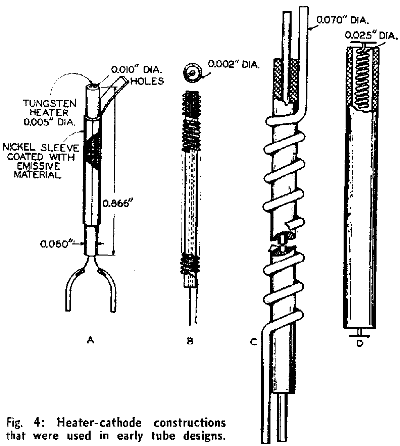
Just for you I've dug you up a picture of what an early model heater would have looked like:
http://www.thevalvepage.com/valvetek/heater/fig4.gif
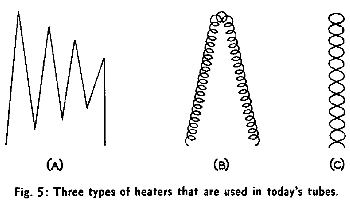
and a few more recent types:
http://www.thevalvepage.com/valvetek/heater/fig5.gif
The two types of tubes that are still in common use either use the tungsten filament as described above (typically for higher power applications) or an indirect system where the heating filament is 'wrapped' by a small tube coated with some oxide, in this case the electron emission is secondary.
Slasdot was labelled 'news for nerds', last I checked, and your remark about the 'hot cathode' being
in contrast to there being no filament at all does not contradict anything I said before.
Also, it's hard to tell one anoymous coward from another.
Have a really nice day. -
Re:Good 'ole days
In fact, it is a spiral, just like the 'loop' in most lightbulbs that you can see is a spiral. The simple reason for that is that there isn't room enough in a small triode to pack in the wire as a continuous segment at the voltage that the filaments run at the currents are high enough that you need an appreciable length of wire to get to the required resistance.
Just for you I've dug you up a picture of what an early model heater would have looked like:
http://www.thevalvepage.com/valvetek/heater/fig4.gif
and a few more recent types:
http://www.thevalvepage.com/valvetek/heater/fig5.gif
The two types of tubes that are still in common use either use the tungsten filament as described above (typically for higher power applications) or an indirect system where the heating filament is 'wrapped' by a small tube coated with some oxide, in this case the electron emission is secondary.
Slasdot was labelled 'news for nerds', last I checked, and your remark about the 'hot cathode' being
in contrast to there being no filament at all does not contradict anything I said before.
Also, it's hard to tell one anoymous coward from another.
Have a really nice day. -
Sony Watchman, too
My Dad's company bought a bunch of Sony Watchman monitors for use with luggable video cameras in the 80's. It was quite useful for in-vehicle use (as opposed to sitting with a Panasonic 9" B/W monitor on your lap.)
The electron gun pokes out the side instead of out the back, and there's a parabolic-ish deflector inside the tube to turn the electrons 90 degrees to hit the phosphors. I suspect the technology doesn't scale well. Scan compensation must've been difficult, as each scan line is a different distance from the emitter. -
Clive Sinclair did it first
Britain's Clive Sinclair made a TV with a flat CRT back in the early 1980s. Here is a picture: http://www.nvg.ntnu.no/sinclair/images/tv80.jpg