Slashdot Mirror
Domain: titech.ac.jp
Stories and comments across the archive that link to titech.ac.jp.
Comments · 38
-
old claims and older researchSo every time a snake robot PR blurb is published, a university PR and Patents & Innovation department gets a pat on the back! See a 1993 article about snake-like locomotion in biologically inspired robots
. -- S. Hirose, P. Cave, and C. Goulden, Biologically inspired robots: snake-like locomotors and manipulators, vol. 64. Oxford University Press Oxford, UK, 1993[ link found as # 14 from http://en.wikipedia.org/wiki/Bio-inspired_robotics ]
-- http://en.wikipedia.org/wiki/Roboboa = Roboboas has 4 angled body sections, allowing Roboboa to coil by rotating adjacent sections. A motorized tail roller and casters on the midsection allow Roboboa to move in a straight line.
-- http://en.wikipedia.org/wiki/Snake-arm_robot
-- http://en.wikipedia.org/wiki/Snakebot = Snake robots come in all shapes and sizes, from the three meters long, fire fighting snakebot developed by SINTEF,[1] to a medical snakebot developed at Carnegie Mellon University that is thin enough to maneuver around organs inside a human chest cavity. Though snakebots can vary greatly in size and design, there are two qualities that all snakebots share. First, their small cross section to length ratio allows them to move into, and maneuver through, tight spaces. Second, their ability to change the shape of their body allows them to perform a wide range of behaviours, such as climbing stairs or tree trunks.
And my favorite section is at
http://en.wikipedia.org/wiki/Robotics#Snaking : Several snake robots have been successfully developed. Mimicking the way real snakes move, these robots can navigate very confined spaces, meaning they may one day be used to search for people trapped in collapsed buildings.[72] The Japanese ACM-R5 snake robot[73] can even navigate both on land and in water.[74] [these references are:72 = http://www.snakerobots.com/
73 = http://www-robot.mes.titech.ac.jp/robot/snake/acm-r5/acm-r5_e.html with cool pictures of swimming snake robots
-
Re:Came for the tentacle porn ...
You won't be for too long. Tokyo Institute of Technology(TIT, couldn't be more appropriate) already has a robot snake. I trust the Japanese will deliver.
-
Re:No limit either way
Um. Let's ignore the C foundations of Android for a moment and focus on Dalvik (and Java).
Using Java on Android, you can
- disassemble and recompile apps in-place at runtime after making massive (smali) assembly changes that would require you to rebase a native program
- discover, access and call classes and methods; discover, access and modify variables of other apps at runtime by using reflection -- (must run inside same process space to read/write values)
- load other app classes into your app space (at runtime) and use them however desired -- (maybe extra permissions needed though to run them though)
- direct bytecode modification? -- (haven't tried it personally)
That's all on top (as in, in addition to) what you have available in the Linux kernel/user space (which can interact with the apps too).
Disclaimer: I've only been experimenting with Android for 2 weeks. However, after spending an untold amount of hours reverse engineering programs in the PC world, I must admit I am a bit taken with the Android ecosystem.
-
Re:I stopped reading...
Let's all switch to qvwm! hey, with some minor tweaking, it should be possible to even make it look just like Vista
-
Re:blinders
I'm regularly frustrated by the subtle hubris of completeness that underlies so many scientific assertions. It's as though we continually forget that science is fundamentally provisional, and that we're just hominids who only recently got refrigeration.
See sushi science and hamburger science. First published in Perspectives in Biology and Medicine, the author expounds on his idea that Western scientists tend to be reductionists, trying to fit all the observations into simple theories, and Eastern scientists tend to just accept results for what they are, without as much generalization. It's not that one way or the other is necessarily better; they're complimentary methods of looking at something, and both viewpoints have their place.
-
Re:CMU did this a whole while back...
Prof. Hirose's robotics lab in Japan has some excellent snake robots as well. The swimming one is a must-see.
-
Re:no offence to anyone who works on it, but...
If fluxbox had a "start button" and icons on the desktop by default, I'd agree, but it doesn't. As it is, I have Ctrl+F1 setup to bring up the root menu, which is handy when I'm running a maximized application.
Possibly this would do, if it were updated?
-
Not completely true
Why you were modded "insightful" is interesting, because I can Google lots of sites that go against your assumption. You might deserve a "2" or a "3" but you aren't THAT insightful.
"In a meeting with Japanese people, you can impress them by a few words of your perfect-sounding Japanese and pretend to be a big admirer of the Japanese culture. (I hope you are one anyway
http://www.mech.titech.ac.jp/~h-souzou/welcome/Japanese%5B2%5D.html
There are others... -
Re:FB-DIMMS suck for gameing
Except the shared bus the Xeons sit on is a seriously limiting factor, no-one in HPC is using Xeons because of it.
A better bet would be a Sun Fire X4600 type of machine, 8 dual-core Opterons and 128GB of memory in a 4U server chassis.
This is well known, and having played with one, it's a very nice machine. Unlike its 24TB cousin
-
Mistakes in the article!
The author of the actual paper is Hideo Hosono, not "Hideo Hono". The paper, available here, was not published in the April 11 issue of Nano Letters. Rather, it was published on-line on March 22.
-
Re:Step one completed
Tachiko-maaaa!
My daughter's obsessed w/ Tachikoma, as well. She's buying blue everything, to look like one. Her biggest dilemma right now in life, is whether to die her hair purple, (and thus resemble the Major,) or to die her hair blue (and thus resemble a Tachikoma.) -
Seen them in operation already
Japan's TSUBAME (see the system at http://www.gsic.titech.ac.jp/) is made up of both x4500 and x4600 systems. I've been in the Thumper room - it's loud as a jet engine in there and cooling is an issue, but only because the room is old. It's an impressive set-up, and made to be upgraded. They've got 1.1 Petabytes of storage now.
-
Oops wrong link.. check this...
Damn it, Beautrice... that's something different
http://www.eng.titech.ac.jp/jyosei/t_yabe.pdf
That is more along the lines of what I meant! -
Re:Have you used the tools?
This ultra-dynamically-bound method-call approach is what enables magic like Interface Builder, [...] No, you can't assemble something even REMOTELY as pretty in Python, Java, or C#.
Dynamic method forwarding is quite convenient, and many dynamic languages (Smalltalk, Python, CLOS, Ruby, Dylan,
Objective-C copied the feature from Smalltalk, but it lacks the reflection capabilities to support it properly. Unfortunately, that's the whole story of Objective-C: it copied ideas from dynamic languages but doesn't implement them correctly. -
Social Engineering = Insults to engineers
Why would con artists who have no regards to social safety and responsibilies are being classified as 'engineers'? Are people too stupid to see this is a scam made up by frausters to legitimize identity theft?! In case you don't notice, you are wrongfully condemning a real social engineering department that doesn't rely on cheating and stealing to surive!
YOU SHAMEFUL IGNORANT FOOLS, you should all stop calling frausters as 'engineers' and relabel them as the criminals they truly are!!! -
Social Engineering = Insult to Engineers
Why would con artists who have no regards to social safety and responsibilies are being classified as 'engineers'? Are you all too stupid to see this is a scam made up by frausters to legitimize identity theft?! In case you don't notice, you are wrongfully condemning a real social engineering department that doesn't rely on cheating and stealing to surive!
YOU SHAMEFUL IGNORANT FOOLS, you should all stop calling frauster as 'engineers' and relabel them as the scums they truly are!!! -
Social Engineering = Insult to Engineers
Why would con artists who have no regards to social safety and responsibilies are being classified as 'engineers'? Are you all too stupid to see this is a scam made up by frausters to legitimize identity theft?! In case you don't notice, you are wrongfully condemning a real social engineering department that doesn't rely on cheating and stealing to surive!
YOU SHAMEFUL IGNORANT FOOLS, you should all stop calling frauster as 'engineers' and relabel them as the scums they truly are!!! -
TIT t-shirt...
i alway thought the tokyo institue of technology should have t-shirts with TIT emblazed in big bold collegiate letters with one of those spikey circle thingies behind the lettering... their official logo/seal looks like the robot from castle in the sky.
-
Re:"social engineering" == insult to engineers
You think it's just your career gone bad? How about the staff members who work for a real Department of Social Engineering? Not only the reputations of the workers and students are ruined, the whole Tokyo Institute of Technology shares the blame for all these security exploits!
That's another bunch of lives ruined by a perverted team invented by criminals, and thanks to slashdot, no technically proficient folks are going to join politics for the fear of being charged with 'social engineering'. Needless to say, slashdot staff members are as much as responsible for US government passing dumb laws as corporate lobbyists. -
Re:Another Linux 3D file manager
My site has been collecting 3D UIs for some time.
Here are links to some of the 3DUIs that are available today:
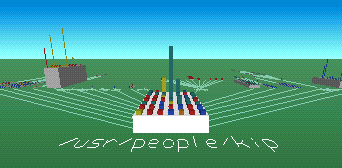
- FSN (pronounced "fusion") produces a cyberspace rendering of a file system. This was the original 3D file system navigator shown in Jurassic Park ("Hey, this is UNIX. I know this!").
[Screenshot] | [Download] (IRIX)
- FSV is modelled after FSN, but runs on Linux. FSV lays out files and directories in 3D, geometrically representing the file system hierarchy to allow visual overview and analysis.
[Screenshot] | [Download] (Linux)
- Xcruise lets you fly through a filesystem in 3D as if it were interplanetary space. Directories are represented as galaxies, files are represented as planets (whose mass is determined by the file size), and symbolic links are represented as wormholes.
[Screenshot] | [Download] (Linux)
- TDFSB is a 3D filesystem browser for Linux. Take a walk through your filesystem!
[Screenshot] | [Download] (Linux)
- Visual File System is a 3D file system visualizer for Windows. The tool scans a drive selected by the user, and then models the contents of the drive in 3D, based on the directories that are selected in a tree browser on the side of the display.
[Screenshot] | [Download] (Windows)
- 3Dtop is an extension for Windows that represents desktop icons in 3D, letting you to fly around your desktop. You can create coloured spotlights, background and floor textures, "paintings" (bitmaps), clocks, and "flags" that represent shortcuts.
[Screenshot] | [Download] (Windows)
- ROOMS turns a Windows desktop into a 3D world. You can see the world either through a first person perspective or with a map view, and you can populate the world with sounds, animated images, and 3D icons.
[Screenshot] | [Download] (Windows)
- CubicEye organizes windows into a navigable cube. Cubes can be arranged by thematic or functional subject matter, and can be explored either individually or collectively as part of a more comprehensive structure of multiple cubes representing various areas of interest.
[Screenshot] | [Download] (Windows)
- Vizible WorldViewer distributes windows across the exterior and interior surfaces of spheres, providing the means to visualize and navigate large numbers of web pages and data sources simultaneously.
[ -
Re:Raytracing in Postscript
That earned the 1st prize for 'Best Obfuscated Artwork' in Obfuscated PostScript Contest 1993. Shorter version is here.
-
Re:JBoss architecture vs Sun code
Ya know, they really haven't done anything with AOP yet. I mean, they do use the whole dynamic-proxies thing, but that isn't really AOP. They are about to "try" doing some AOP stuff but they're encountering lots of speed bumps because they're discovering that they can't create a custom class loader that the Sun class loader will actually load. (chicken-egg problem, see JBoss-AOP forums for more details). Basically they're trying to rewrite the Java system classes but are finding that they either have to hijack the Sun class loader, or they have to statically modify the classes beforehand. They're trying to use concepts of AOP so that they can (in the future) convert every single basic java object into an EJB and implement transparent caching features without the programmer explicitly specifying it in code. They are not actually using Aspects, AOP is just one of those buzzwords for anything dealing with reflective programming languages or MOP related. They're trying to make use of Chiba's Javassist package to do bytecode rewriting as their own form of AOP, but what they don't realize is that Javassist is just not capable of doing the things they want, yet they are too stubborn to try and use something like BCEL which may be harder to use, but can offer a lot more.
-
Other 3D UIs: references and links.This is the kind of stuff that is regularly discussed on Nooface (a Slash site BTW).
Ripped straight off the side bar :
Will 3D user interfaces ever take off? With ever-growing 3D processing capabilities available on standard PC hardware, it seems only natural to pursue UI directions that take advantage of this awesome power. Moreover, the generation of users now emerging has had access to video games for as long as they could remember. As the line between video games and PCs becomes blurrier, the time may have come to think about how to apply 3D visualization techniques for more day-to-day computing tasks.
Here are links to some of the 3DUIs that are available today:
- FSN (pronounced "fusion") produces a cyberspace rendering of a file system. This was the original 3D file system navigator shown in Jurassic Park ("Hey, this is UNIX. I know this!").
[Screenshot] | [Download] (IRIX)
- FSV is modelled after FSN, but runs on Linux. FSV lays out files and directories in 3D, geometrically representing the file system hierarchy to allow visual overview and analysis.
[Screenshot] | [Download] (Linux)
- Xcruise lets you fly through a filesystem in 3D as if it were interplanetary space. Directories are represented as galaxies, files are represented as planets (whose mass is determined by the file size), and symbolic links are represented as wormholes.
[Screenshot] | [Download] (Linux)
- TDFSB is a 3D filesystem browser for Linux. Take a walk through your filesystem!
[Screenshot] | [Download] (Linux)
- Visual File System is a 3D file system visualizer for Windows. The tool scans a drive selected by the user, and then models the contents of the drive in 3D, based on the directories that are selected in a tree browser on the side of the display.
[Screenshot] | [Download] (Windows)
- 3Dtop is an extension for Windows that represents desktop icons in 3D, letting you to fly around your desktop. You can create coloured spotlights, background and floor textures, "paintings" (bitmaps), clocks, and "flags" that represent shortcuts.
[Screenshot] | [Download] (Windows)
- ROOMS turns a Windows desktop into a 3D world. You can see the world either through a first person perspective or with a map view, and you can populate the world with sounds, animated images, and 3D icons.
[Screenshot] | [Download] (Windows)
- CubicEye organizes windows into a navigable cube. Cubes can be arranged by thematic or functional subject matter, and can be explored either individually or collectively as part of a more comprehensive structure of multiple cubes representing various areas of interest.
[Screenshot] | [Download] (Windows)
- Vizible WorldViewer distributes windows across the exterior and interior surfaces of spheres, providing the means to visualize and navigate large numbers of web pages and data sources simultaneously.
[Screenshot] -
Lynx rules!
I totally agree... all this newish hype about having graphics inside your browser... Why would anyone need that?!? What's wrong with ASCII art? Who would want to put GIFs on a webserver?
Now if you're looking for some innovative file brwosing, try XCruise! -
Re:Not quite..Lisp programmers use MOP for about decade now. So AOP is just yet another toy replica for people in the sandbox
Than this link might interest you.
Regards,
Marc -
Sixties are overrated
> How long do we have to wait until NASA becomes as ingenious as they were in the sixties?
I don't mean to flame, but isn't it true that nothing much happened in the 60s from a scientific perspective. Ingenious is great, but I support NASA's move from being a PR department in a cold-war setting to actually exploring the universe currently.
Isn't the problem with space (and science more generally) that "the people" just don't care about it, but rather like watching spectacles and human drama (the chalenger crash, Apollo 13).
--
XCruise your own universe -
Re:Heres a picture of Quaoar!!! [minor correction]
'gues that would be http://news.nationalgeographic.com/news/2001/05/i
m ages/021007_quaoar.jpg (without the space in
--
Discover your own (solar) system! -
Re:I rather not have Intel.
RISC chips are so much more turquoise, too.
It's true, you know. -
Convergence blocks innovation
> I hope that RedHat successfully forces both Gnome and KDE to become compatible with one another which would result in the creation of a single desktop. This would be the greatest gift to the Linux world.
Would it? I agree that technically speaking it would be great to have a single API and a single (though configurable) UI combining the best of both worlds. But notice that this is only tempting because GUI developments (on a conceptual level) have been tame an converging for the last couple of years. Wrt. the Gnome, KDE, Windows 98 & XP looks and feels there have been some small changes here and there but hardly any innovative stuff. Many core developers in gnome, kde and M$ team would (or should) admit they have fairly modest ambitions in UI design - merely copying the neat stuff they see others do.
Now would not "the Linux world" REALLY benefit from more dary designs? I would happily trade some compatibility to gain the divergence necessary to see some more innovative and radically new designs.
Slick example: OS X.
Geek example: XCruise-file browser.
More generally: get some GUI professionals to do GUI design (sorry, no offence intended)
--
The most likely way for the world to be destroyed, most experts agree, is by accident. That's where we come in: we're computer professionals, we cause accidents -- Nathaniel Borenstein -
STWM - Shell controllable TWMI just found this last night so I've not had a chance to really test it. But software.linux.com lists "stwm". It's a Shell controllable TWM. From xterm you can issue standard X widget properties to move, resize, focus, etc. of any standard X Windows Application. The source is 160KB gz'd and only needs the XFree86 4.x. Here's the links:
- The software.linux.com entry
- Old English docs page with examples
- New home of source files
PS. He's got some souce code for that standard X Clock with a transparent background. Schway.
-
ZauChu
I know it's been mentioned here before, but I thought I'd jump in...
The Sharp Zaurus runs "Squeak", it's an open source programming language, it is a genuine, complete, compact, efficient Smalltalk-80 environment, you can read their licence here.
Check the
ZauChu homepage for more information on programming for the Zaurus. -
Highly Informative User site
found this site run by a Disney employee.
has some very detailed info.
enjoy!
-
Re:Next time include the requirements
Merci pour le feedback (how's my French? I'm going to Calais
tomorrow... think I might be struggling!)
Short, obviously english inspired, but clearly understandable. I'm
sure your trip went well, hasn't it?
Persistence: Not sure about memory-mapped files - these lack
transactions, queries and those other good 'enterprise' features. I
think you're closer when you mention meta-programming further down.
Alot of the issues you are bringing seems to involve difficult
tradeoffs of memory usage, safety and performance. This would explain
why they are not making way into language support. This is were
metaprogramming comes in nicely : once you have picked a library which
implements the balance you are looking for, if its syntax is the
simplest and cleaness, can ensure a more regular usage across your
programming team.
Anyway, the idea is that the process state is preserved
without the kind of explicit programming involved in a workflow system
- 'business process' and program process are congruent.
Oh, I see now. You want programmable access to coredumps. mm, tricky.
OCAML: I've heard really wonderful things about this, but people tend
to emphasise the type-safety and functional programming aspects. I'd
certainly like to check out the meta-programming-like features to see
how far it could be turned into 'enterprise programming nirvana'!
The caml's meta-programming tools and called camlp4. I also got excited
about openc++
and its sister openjava.
-
Re:Next time include the requirements
Merci pour le feedback (how's my French? I'm going to Calais
tomorrow... think I might be struggling!)
Short, obviously english inspired, but clearly understandable. I'm
sure your trip went well, hasn't it?
Persistence: Not sure about memory-mapped files - these lack
transactions, queries and those other good 'enterprise' features. I
think you're closer when you mention meta-programming further down.
Alot of the issues you are bringing seems to involve difficult
tradeoffs of memory usage, safety and performance. This would explain
why they are not making way into language support. This is were
metaprogramming comes in nicely : once you have picked a library which
implements the balance you are looking for, if its syntax is the
simplest and cleaness, can ensure a more regular usage across your
programming team.
Anyway, the idea is that the process state is preserved
without the kind of explicit programming involved in a workflow system
- 'business process' and program process are congruent.
Oh, I see now. You want programmable access to coredumps. mm, tricky.
OCAML: I've heard really wonderful things about this, but people tend
to emphasise the type-safety and functional programming aspects. I'd
certainly like to check out the meta-programming-like features to see
how far it could be turned into 'enterprise programming nirvana'!
The caml's meta-programming tools and called camlp4. I also got excited
about openc++
and its sister openjava.
-
Athlon Cluster?
Check out the 439th entry at the top500.org then.
Here's a snap from the in-house sauna
http://matsu-www.is.titech.ac.jp/~sohda/news/2001/ 09/presto3/P9290183.JPG -
Some info on the first satellite GPS tests...
I had the pleasure of working on some of the first test satellites (circa 1991)... These worked at LEO orbits (LEO is below the GPS satellites, which is below geostationary), so they had the advantage that they operated in a manner relatively similar to earth-bound units.
Three major differences:
- speed and altitude limitations removed (the government doesn't want these guiding missles)
- satellite reacquisition time reduced. Going fast means that you'll have to change satellites used for the calculation much more often. Back in the day of single-channel receivers, this was a major concern.
- vehicle dynamics set to assume an orbit, not some low earth speed.
Here's a great page with some info & diagrams of what's going on. It also shows how a signal can be received from a higher orbit: it listens to satellites on the other side of the earth. This is refracted through the ionosphere, and a lot of math is probably used to compensate (actually the military version of gps uses two frequencies - the ionosphere modifies each one differently and, knowing this, can be corrected better).
The RADCAL satellite took measurements, but didn't use the GPS signal for navigation. REX-II actually used a closed loop system to stabilize the entire satellite. The attitude control system is an essential part of any satellite, since it points the antennas to the ground and the solar cells at the all-important sun. Usually, there are many different types of sensors (horizon sensors, magnetometers that compare the current field with a predetermied map of the earth, star sensors, and gyros), and typically none of these sensors alone provides a complete attitude. The fusion between all these sensors, with various levels of error and fault tolereance, is a really tough job! So, a small, light gps adds a lot of good information to the equation, and can serve as the primary sensor, or as a good backup.
We used a modified trimble gps unit with 4 antennas. This unit was originally designed to determine the attitude of fighter planes, but we used modified software to work in space. One antenna read the main GPS signal, while the other three measured the phase difference between themselves and the main signal to find the difference in distance to the satellites.
Side note about the fighter jet version of the software: The differential positions of the antennas were used to calculate the attitude. I know what you're thinking: why 4 antennas to solve 3 unknowns (pitch, yaw, roll)? It turns out that wing flex (since these were spread out as far as possible, which meant 2 were on the wings) had to be taken into account. Besides that, the extra antenna provided improved coverage in case the fuselage blocked an antenna.
We used these units sucessfully in many leo satellites... -
Re:Serious use: file management
Here is an example of a 3D filesystem viewer. Something like this would be very useful, I wish someone would finish this one.
-
Sqeak has had an Open Source HWR for years...
There's an Open Source Smalltalk called Squeak that is an astoundingly interesting platforms from a number of perspectives. Most relevant to this discussion, Squeak has an open source implementation of handwriting recognition, written by Alan Kay and inspired from a rather clever grafitti-like HWR, called GRAIL, from the 60's. I've seen GRAIL in and it's actually rather better than grafitti, which isn't bad in a very old piece of free software. Thus, you can use anything with a pen as a "PDA" if you can run Squeak on it. The recognizer is quite good, and the source code is easy to read.
Squeak runs on all sorts of OS's, including Linux. It doesn't need an OS - it's been ported to "bare metal". It's been ported to PDA's (like the Zaurus PDA), DEC Itsy, WinCE, and others, like DOS, BeOS, Windows, MacOS, OS/2, the Acorn, AmigaDOS... you get the idea.
So if anyone really wants an Open Source HWR for Linux, I'd suggest downloading Squeak and reading the (really short!) code for the recognizer.