Slashdot Mirror
Domain: uiuc.edu
Stories and comments across the archive that link to uiuc.edu.
Comments · 1,476
-
I'm one of the geologists involved in the discover
Greetings folks,
I'm Scott Elrick from the Illinois State Geological Survey, one of the researchers involved in the original discovery. Here's a little background:
* This current story is an extension of a story from a year ago. When the story broke, I popped onto Slashdot to answer questions - http://slashdot.org/comments.pl?sid=232903&cid=18936603 (ignore the misspellings in those posts!)
* As a result of the publicity, I used some of the guts of my postings above to put together this webpage: http://www.isgs.uiuc.edu/research/coal/fossil-forest/fossil-forest.shtml I tried to make a 'general public' kind of site that covers most of the basics and posted all of the pictures we took.
* From the guts of the webpage, I put together a magazine article for 'Outdoor Illinois' on the discovery. Here's a PDF (direct link) of the article - http://www.isgs.uiuc.edu/research/coal/fossil-forest/Outdoor-IL-art.pdf
* By the end of the year we made it into the top 100 stories of 2007 in Discover magazine - http://discovermagazine.com/2008/jan/fossils-of-a-300-million-year-old-forest-found
* There should be an article coming out in Smithsonian magazine about the discovery in a few months time.
Now to the current news.
Our colleague Dr. Howard Falcon-Lang of the University of Bristol, UK is heading up a multi year research effort to examine the Desmoinesian - Missourian boundary in the Middle Penn. Howard, Bill DiMichele of the Smithsonian Institute, John Nelson and myself of the ISGS, Isabel Montañez of UC Davis and Neil Tabor of SMU will all be collaborating to work out the paleobotanical, sedimentologic, CO2, and climate history of this large scale climate transition. Really this is more an announcement of further research than of results!
As flat as Illinois is, we do have a pretty good record of this transitional period Rocks in Illinois? Who knew!
Cheers!
p.s. I covered a fair amount of ground in my previous postings last year in terms of answering questions. I'll pop back later this evening and see if any more pop up though.
-
I'm one of the geologists involved in the discover
Greetings folks,
I'm Scott Elrick from the Illinois State Geological Survey, one of the researchers involved in the original discovery. Here's a little background:
* This current story is an extension of a story from a year ago. When the story broke, I popped onto Slashdot to answer questions - http://slashdot.org/comments.pl?sid=232903&cid=18936603 (ignore the misspellings in those posts!)
* As a result of the publicity, I used some of the guts of my postings above to put together this webpage: http://www.isgs.uiuc.edu/research/coal/fossil-forest/fossil-forest.shtml I tried to make a 'general public' kind of site that covers most of the basics and posted all of the pictures we took.
* From the guts of the webpage, I put together a magazine article for 'Outdoor Illinois' on the discovery. Here's a PDF (direct link) of the article - http://www.isgs.uiuc.edu/research/coal/fossil-forest/Outdoor-IL-art.pdf
* By the end of the year we made it into the top 100 stories of 2007 in Discover magazine - http://discovermagazine.com/2008/jan/fossils-of-a-300-million-year-old-forest-found
* There should be an article coming out in Smithsonian magazine about the discovery in a few months time.
Now to the current news.
Our colleague Dr. Howard Falcon-Lang of the University of Bristol, UK is heading up a multi year research effort to examine the Desmoinesian - Missourian boundary in the Middle Penn. Howard, Bill DiMichele of the Smithsonian Institute, John Nelson and myself of the ISGS, Isabel Montañez of UC Davis and Neil Tabor of SMU will all be collaborating to work out the paleobotanical, sedimentologic, CO2, and climate history of this large scale climate transition. Really this is more an announcement of further research than of results!
As flat as Illinois is, we do have a pretty good record of this transitional period Rocks in Illinois? Who knew!
Cheers!
p.s. I covered a fair amount of ground in my previous postings last year in terms of answering questions. I'll pop back later this evening and see if any more pop up though.
-
More Detail...
Thanks to AC, we have some more detail as to what this fossil bed reveals about this ancient forest:
http://www.isgs.uiuc.edu/research/coal/fossil-forest/fossil-forest.shtml
Thank you. -
Re:Anything else?
-
Some better images
Some images better than the crappy one with TFA. Or just go to the source: http://www.isgs.uiuc.edu/research/coal/fossil-forest/
-
Some better images
Some images better than the crappy one with TFA. Or just go to the source: http://www.isgs.uiuc.edu/research/coal/fossil-forest/
-
Some better images
Some images better than the crappy one with TFA. Or just go to the source: http://www.isgs.uiuc.edu/research/coal/fossil-forest/
-
Some better images
Some images better than the crappy one with TFA. Or just go to the source: http://www.isgs.uiuc.edu/research/coal/fossil-forest/
-
Re:Naive question...
For a reasonable sample of the things that can be done on a supercomputer, start here: http://www.ncsa.uiuc.edu/Projects/. Those are just the things running at NCSA.
Followup with this, as the science gateways for the TeraGrid are designed to let scientists worry more about the science part and less about the programming part. Part of the reason to build bigger supercomputers is to let non-programmers get work done as well. By having more cycles available, the TeraGrid can allow access for codes that are easier for the average scientist to use, even if they don't make the best use of the machine. Not everyone is a wiz at parallel programming, and we shouldn't expect an expert in say, biology, to be just as expert in computer science.
-
Power Consumption?
While it's not always an issue to those that care about the final result, I wonder how much power this sucker is gonna drain from the local power grid. I can see it now.. A prof making a call to the local power company, telling them, "Please be advised, we're gonna black out Urbana-Champaign for the next couple of minutes." Too bad they decommissioned that research nuclear reactor they had back in the '98. While it never was used for electricity, it probably could have been fitted. Then again, with all the wind they're used to, maybe a couple of wind turbines would be sufficient.
-
Re:Not so sure its the first
Blue Waters will be the first to deliver a sustained petaflop on "real-world" applications, meaning various scientific simulations. Specifically, the program solicitation required prospective vendors to explain how their proposed systems would sustain a petaflop on three types specific types of simulations, one each in turbulence, lattice-guage quantum chromodynamics, and molecular dynamics.
Granted, Roadrunner was the first machine to deliver a petaflop on the Linpack benchmark (though certainly IBM's own implementation of it). The benchmark does nothing more than set up and solve a system of linear equations. Roadrunner solved a system of 2,236,927 equations (in other words, it had a 2,236,927-by-2,236,927 coefficient matrix) in 2 hours.
But Blue Waters is planned to deliver a petaflop on applications that normally don't sustain >80% of theoretical peak; these applications are lucky to get near 20%.
-
Movie
-
Movie
-
Re:Sunspots down... temperature down?
Why did you link to an old graphic, when you could have linked to the daily updated graphic ?
-
Re:Maybe that's why...
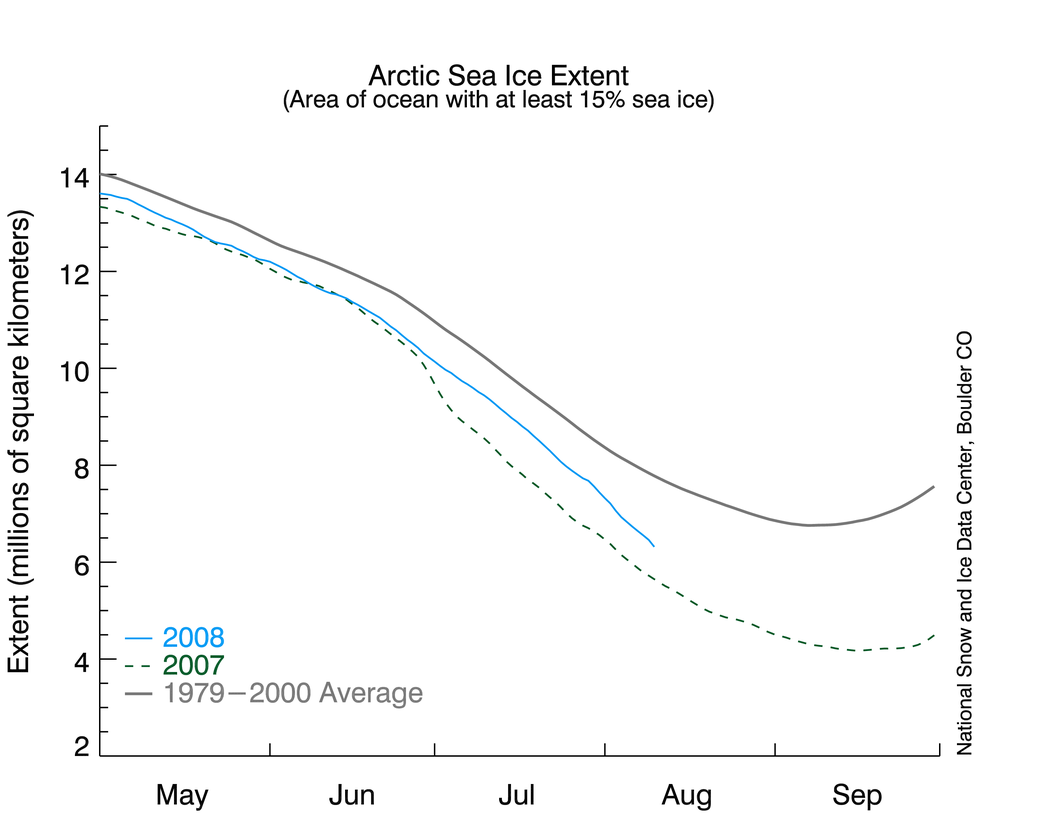
What the hell are you smoking? There was a warning that it *could* be ice free. Not to mention that North Pole being ice free is not the same as no ice anywhere. And so far, they're on track to have the smallest summer covering ever. By a few million square kilometers.
Really. If climate change wouldn't be such a huge issue, I'd take comfort in the fact that the only people disputing it can't even read the articles they're quoting. Instead, it's just depressing
You ask what I am smoking when every statement you make is completely wrong. If you bothered to look at the Graph it clearly shows that there is 10% more Arctic ice this year than last and is on pace to stay the same. Notice how the average varies between 7 and 14 million sq. km every year and the lowest (2007) was at 4 million sq. km. If this year would be lower by as much as you say, there'd be about 0 ice left in the Arctic.
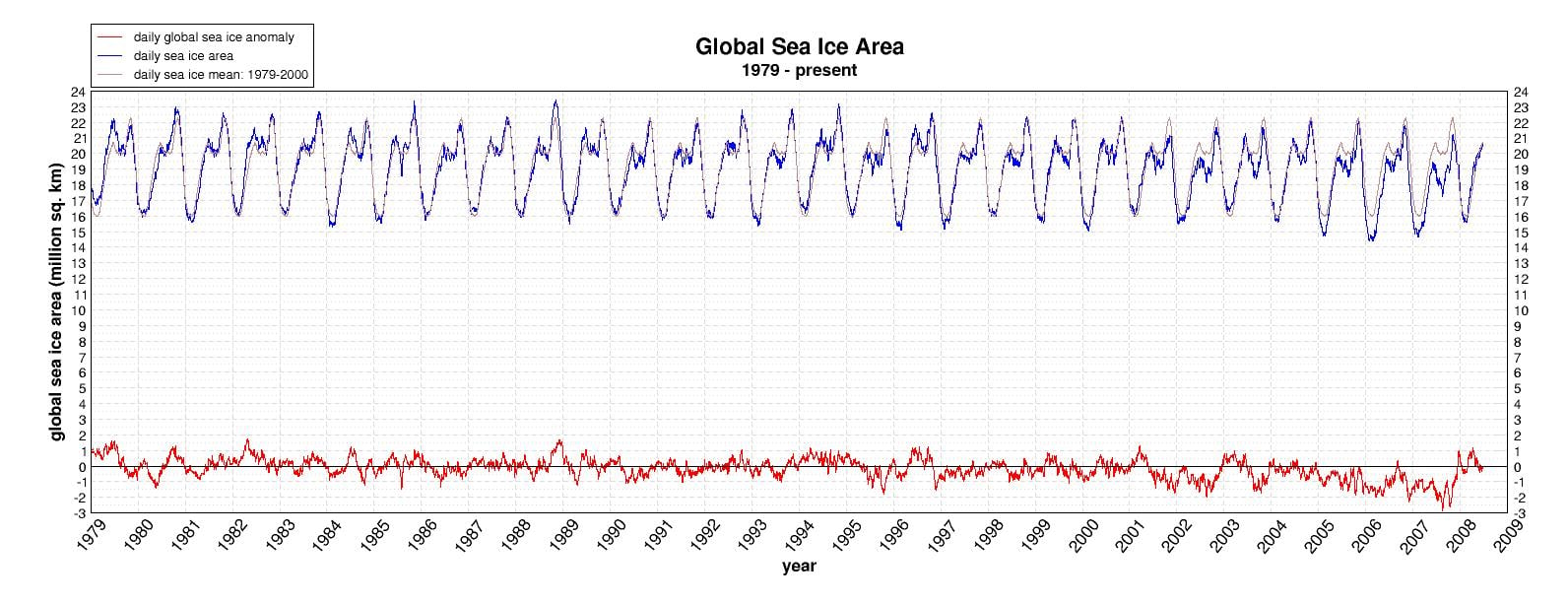
If you care to look at this graph You'll notice that the ice area in the southern hemisphere has been slightly above average.
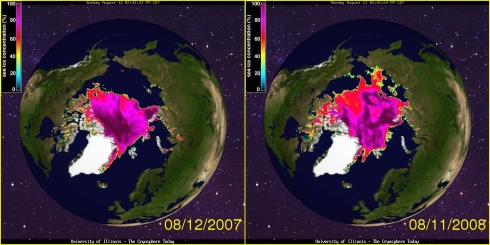
Yes, the article originally claimed 30% more ice than last year and was wrong because the pictures and the graph were a little misleading. It doesn't change the fact that in June every news outlet in the country said that there'd be almost no ice at the North Pole (it wasn't just national geographic) and they were very wrong.
Not only was August sun spot free, but there have been over 400 spotless days in the current solar cycle.
-
Re:Sunspots down... temperature down?
Here's another version of that graph... with additional data. It shows something interesting, I feel.
Up to 94% of Arctic melt is due to dirty snow caused by soot changing it's albedo, rather than CO2 related warming, according the researchers at University of California and a certain Dr. Hansen[PDF warning].
The Antarctic and the Arctic are both up on last years ice, in the case of the Arctic by 10% (according to the NSIDC).
Is it possible that the melting in the Arctic is more to do with other emissions than CO2? After all, the majority of the worlds industry is in the northern hemisphere. I would think it is.
The Northern Passage, by the way, has been navigated at least 100 times since the start of the century, and in 1922 there was open sailing very close to the North Pole [PDF warning]. Submarines regularly surface there, too. 2007 had a shocking decrease in the amount of ice at the pole, definitely. But we cannot be certain WHY.
We should still be tackling pollution, though.
-
Re:Sunspots down... temperature down?
You're really not up to date with this year's polar melting, are you ?
-
Old news5/15/06
CHAMPAIGN, Ill. The U.S. Agriculture Departments mad cow disease-testing program is wholly inadequate and the agencys refusal to let processors do their own testing further undercuts the safety of American beef, a University of Illinois scholar writes.
AFAIK, the available tests are not reliable, partly due to the fact that the cows are too young to produce meaningful test results, but that might be outdated info.
-
Re: "traditional security" vs. I.T. security
Dear Sir,
I was unable to read your comment, or apply appropriate moderation, due to its total lack of readability. Please consider the use of paragraphs in the future. Thank you.
Sincerely,
AC Mod
-
rotating tesseracts
Definitely enjoyable stuff. Of course, you could just play Portal. Oh, sorry, that's just an ordinary 3D space which happens to be multiply disconnected and topologically unsettling. For more (Euclidian!) 4D visualization tools, here are a couple nice (but old) clips of rotating cubes and tesseracts through higher dimensions. For example, it gives you the (x,y,z) view of a cube then a simultaneous projection of that object in the (w,x) plane where w is a 4th orthogonal direction. It then proceeds to rotate the (w,x) projection in a circle to see what the 3D "shadow" in (x,y,z) space is doing. Rather than getting bigger and smaller (simulating perspective) as it moves back and forth in the 4th direction, the faces are color coded (I personally think this makes it easier to visualize). Run the simulation back and forth slowly a couple times and your brain locks in pretty well.
-
Re:We don't host xCAT
I sit corrected. IBM has allowed NCSA to host a special version of xCAT for RHEL 5.2 on PPC. You can find it in here.
-
Read & Learn, And Legalize Marijuana:Sultry Ni
Read & Learn, And Legalize Marijuana
Since the article is often pulled from websites, the first article you should read and burn into your mind is this, Google for the title and archive a copy for yourself:
"A break-in to end all break-ins"
"In 1971, stolen FBI files exposed the government's domestic spying program"It's an amazing story, and in 2008, how much has this expanded into every corner of our lives? The majority of Americans are brainwashed sheep consumers with a limp wet noodle for a brain, thrashing around with their Wii and Paris Hilton media like a fat dinoasaur in a tar pit. Stay informed, we have no privacy, encryption is good but useless with acoustic monitoring, reflections in the eye and objects in your environment, etc.! If it's electronic, there's always a loophole. You shine brighter with each electronic device you use, in many ways. Don't trust Hushmail or any web based mail service to keep anything of yours secure or to provide any reasonable degree of security. Secure your computer room and rig your computer to shut down if you use encryption like Truecrypt or other when your environment is entered by someone other than you or those you permit and trust (you shouldn't trust anyone, everyone has a price)
Compromising Reflections or How to Read LCD Monitors Around the Corner
http://www.infsec.cs.uni-sb.de/~unruh/publications/reflections.pdf [uni-sb.de]And more:
http://www.eff.org/wp/detecting-packet-injection
http://en.wikipedia.org/wiki/Anonymous_remailer
http://cryptome.org/tempest-law.htm
http://seclab.uiuc.edu/pubs/LeMayT06.pdf
http://www-users.cs.umn.edu/~dfrankow/files/lam-etrics2006-security.pdf
http://cryptome.org/nsa-vaneck.htm
http://www.alobbs.com/macchanger
http://lifehacker.com/software/ssh/geek-to-live--encrypt-your-web-browsing-session-with-an-ssh-socks-proxy-237227.php
http://www.nononsenseselfdefense.com/five_stages.html
http://csrc.nist.gov/publications/nistpubs/800-92/SP800-92.pdf
http://csrc.nist.gov/itsec/guidance_WinXP_Home.html
http://csrc.nist.gov/publications/nistpubs/800-84/SP800-84.pdf
http://all.net/books/document/harvard.html
http://www-128.ibm.com/developerworks/library/l-keyc.html
http://www-128.ibm.com/developerworks/library/l-keyc2/
http://www-128.ibm.com/developerworks/library/l-keyc3/
http://www.cl.cam.ac.uk/~mgk25/emsec/optical-faq.html
http://www.cs.washington.edu/education/courses/csep590/06wi/
http://www.wiley.com/legacy/compbooks/mcnamara/links.html
http://lifeha -
Re:Damn parasites
Neither the web browser or tabbed browsing originate from open source projects.
False. Somewhere around here I've still got a spool with a copy of the NCSA server and Mosaic sources from way back when. And lookee here, you can still download Mosaic source for X Windows, version 1.2 in the directory called 'old'.
A quick read of the web's history, such as the Tim Berners-Lee book Weaving the Web, and you'd *learn* that the first web browser was, in fact, open-source.
That's what the internet was founded on, open principles, not proprietary, though proprietary wasn't ever excluded. Much of the internet's infrastructure was proprietary early on, and still is. But if you're going to assert that open source software is nicking code and patents from proprietary, let's see some evidence, eh?
Don't know about tabbed browsing, though it's plain for anyone to see that MS was late to that party, and brought with it a very clunky implementation.
-
Read & Learn, And Legalize Marijuana
Since the article is often pulled from websites, the first article you should read and burn into your mind is this, Google for the title and archive a copy for yourself:
"A break-in to end all break-ins"
"In 1971, stolen FBI files exposed the government's domestic spying program"It's an amazing story, and in 2008, how much has this expanded into every corner of our lives? The majority of Americans are brainwashed sheep consumers with a limp wet noodle for a brain, thrashing around with their Wii and Paris Hilton media like a fat dinoasaur in a tar pit. Stay informed, we have no privacy, encryption is good but useless with acoustic monitoring, reflections in the eye and objects in your environment, etc.! If it's electronic, there's always a loophole. You shine brighter with each electronic device you use, in many ways. Don't trust Hushmail or any web based mail service to keep anything of yours secure or to provide any reasonable degree of security. Secure your computer room and rig your computer to shut down if you use encryption like Truecrypt or other when your environment is entered by someone other than you or those you permit and trust (you shouldn't trust anyone, everyone has a price)
Compromising Reflections or How to Read LCD Monitors Around the Corner
http://www.infsec.cs.uni-sb.de/~unruh/publications/reflections.pdfAnd more:
http://www.eff.org/wp/detecting-packet-injection
http://en.wikipedia.org/wiki/Anonymous_remailer
http://cryptome.org/tempest-law.htm
http://seclab.uiuc.edu/pubs/LeMayT06.pdf
http://www-users.cs.umn.edu/~dfrankow/files/lam-etrics2006-security.pdf
http://cryptome.org/nsa-vaneck.htm
http://lifehacker.com/software/ssh/geek-to-live--encrypt-your-web-browsing-session-with-an-ssh-socks-proxy-237227.php
http://www.nononsenseselfdefense.com/five_stages.html
http://csrc.nist.gov/publications/nistpubs/800-92/SP800-92.pdf
http://csrc.nist.gov/itsec/guidance_WinXP_Home.html
http://csrc.nist.gov/publications/nistpubs/800-84/SP800-84.pdf
http://all.net/books/document/harvard.html
http://www-128.ibm.com/developerworks/library/l-keyc.html
http://www-128.ibm.com/developerworks/library/l-keyc2/
http://www-128.ibm.com/developerworks/library/l-keyc3/
http://www.cl.cam.ac.uk/~mgk25/emsec/optical-faq.html
http://www.cs.washington.edu/education/courses/csep590/06wi/
http://www.wiley.com/legacy/compbooks/mcnamara/links.html
http://lifehacker.com/software/home-server/geek-to-live--set-up-a-personal-home-ssh-server-205090.php -
Re:OpenOffice.org
I have used Open Office and the math entry part is what I would classify as adequate for simple math, however there are much better GUI typesetters such as Framemaker but you have to pay for it. Even Microsoft has a document preparation system and it also costs. I have not used it but talking to those who have Framemaker is preferred.
Because LaTeX is a "mark-up language" many people who are used to a GUI find it a bit difficult to get into it, however if you buy the LaTeX book the first page is rather good in that it actually gives you basic hints of how not to read it. The problem is that for math there is no alternative but to read the book.
Granted you have to get your head around using LaTeX particularly with regard to maths however if you are required to display math on a paper I would assume if anyone is smart enough to write and understand mathematical formulas then writing the those formulas in LaTeX would be a fairly straight forward. Even if you don't have the LaTeX book which IMHO is essential there are plenty of web examples such as here and here. -
Poor man`s choice
When did
-
Re:Toasty.
Guess they should have kept the reactor running.
-
Re:47%
I found this file rather amusing:
We are currently in the process of writing a new FAQ due to some recent changes in licensing policy. Questions concerning commercial licensing of NCSAMosaic should be directed to mosaic@spyglass.com
Questions concerning the copyright on NCSAMosaic should be directed to: mgoode@ncsa.uiuc.edu
A new, up-to-date FAQ will be appearing here shortly.
-David Mitchell
08/24/94 -
Re:47%
ftp://ftp.ncsa.uiuc.edu/Mosaic/
Download. Bring back the good ol memories.
-
Re:Perhaps the way to other things besides compile
OS X is using LLVM/JIT for their OpenGL stack. LLVM will probably have an increased presence in the future (Grand Central, OpenCL, and eventually replacing GCC with LLVM-GCC). Maybe someday, "Universal Binary" will mean LLVM bytecode.
-
Re:Forward / Back with branching
There was a pretty cool looking proof of concept graphical history viewer called Trailblazer using Webkit/Safari written by some UIUC students back in 2004. It even shows thumbnails of each of the pages in a directed graph. Would be great if someone ported it to Firefox.
-
Re:Cryosphere Chart
Well, I don't like this chart just for the style of it (dividing the seasons like that is annoying), but it gives you what you want: http://arctic.atmos.uiuc.edu/cryosphere/IMAGES/seasonal.extent.1900-2007.jpg
-
The Cyrosphere Today
The Cryosphere Today is a web site run by the University of Illinois. It gives daily information on the extent of polar sea ice.
As shown here and here and here, the arctic ice extent is actually greater than last year, although lower than historical averages.
We seem to have conflicting data. -
The Cyrosphere Today
The Cryosphere Today is a web site run by the University of Illinois. It gives daily information on the extent of polar sea ice.
As shown here and here and here, the arctic ice extent is actually greater than last year, although lower than historical averages.
We seem to have conflicting data. -
The Cyrosphere Today
The Cryosphere Today is a web site run by the University of Illinois. It gives daily information on the extent of polar sea ice.
As shown here and here and here, the arctic ice extent is actually greater than last year, although lower than historical averages.
We seem to have conflicting data. -
The Cyrosphere Today
The Cryosphere Today is a web site run by the University of Illinois. It gives daily information on the extent of polar sea ice.
As shown here and here and here, the arctic ice extent is actually greater than last year, although lower than historical averages.
We seem to have conflicting data. -
Cryosphere Chart
This is where I look to keep track of what's happening with the north pole:
http://arctic.atmos.uiuc.edu/cryosphere/
Best graph is :
http://arctic.atmos.uiuc.edu/cryosphere/IMAGES/current.365.jpg
My friends refer to it a climate-porn...
Can't say I strongly disagree since it has the feel of watching a loooong slow train wreck... -
Cryosphere Chart
This is where I look to keep track of what's happening with the north pole:
http://arctic.atmos.uiuc.edu/cryosphere/
Best graph is :
http://arctic.atmos.uiuc.edu/cryosphere/IMAGES/current.365.jpg
My friends refer to it a climate-porn...
Can't say I strongly disagree since it has the feel of watching a loooong slow train wreck... -
Re: piracy
I don't have the energy to go through this all over again, so I'll punt to the experts:
http://goliath.ecnext.com/coms2/gi_0199-6700447/Scrubbing-dirty-bombs-explosive-hype.html
Steven Musolino of Brookhaven National Laboratory, who worked on the dirty bomb experiments with Harper, summed it up this way: "Pretty much everything bad happens within 500 meters, and to a large extent [the bad effects] don't happen." That conclusion jibes with the Nuclear Regulatory Commission's fact sheet on dirty bombs, which says the long-term health risk of limited exposure to radioactive particles is probably "extremely small." The commission categorizes the dirty bomb not as a weapon of mass destruction, but as a weapon of mass disruption.
http://www.news.uiuc.edu/gentips/02/07dirtybomb.html
Even if terrorists got access to radioactive isotopes and wrapped them around a conventional explosive device - an unlikely scenario, according to Palmore - the real danger would come from the explosion, not the spread of radioactive material. "If you're thinking in terms of pellets of radioactive material that might be spread through an explosion," he said, the danger is minimal because "it doesn't disperse in the air; you would just go through the area with a Geiger counter and clean it up."
Dirty bombs are overrated. No one receives a lethal radiation dose from a dirty bomb, besides the bomber.
http://www.onthemedia.org/yore/transcripts/transcripts_072503_fear.html
To many experts, the dirty bomb is the most over-rated weapon in the terrorist arsenal. That's because the actual loss of life and property from such an attack probably would be relatively limited.
Long story short: Dirty bombs don't work. It's not nearly as easy to distribute radioactive materials as the media would have you believe.
-
Re:Storage
-
Re:Good for him ...That's my cue to point out that E.M. Forster not only predicted the network and it's social effects, but forecast doom when the system runs out of capacity and engineering clue. If you haven't read it yet, read it now - it's short and great.
The Machine Stops. (Written in 1909, as in ninety-nine years ago. In England.)
-
Re:Score one for Asimov
Good observation. But I think E.M. Forster's The Machine Stops may be closer to the truth.
-
20% was reached a long time ago
http://www.ews.uiuc.edu/bstats/latest.html http://www.w3schools.com/browsers/browsers_stats.asp Has FireFox at 29.3% and 39.1%
-
Re:By what benchmark?
Too bad this isn't really news. I guess it is news if you consider that someone else has had their application accelerated by NVIDIA GPUs. I guess the only other reason that this could be news is by virtue of having 8 GPU cores.
Unfortunately, this setup won't work ideally for a lot of other CUDA based applications. For the past 6 months, I had a system with 6 GPUs (actual physical GPUs). This is the system that I showed at CES. We are easily able to do 8 physical GPUs, and now I've been solely focused on utilizing Tesla.
Given that NVIDIA released the GX2 series, I was not surprised that someone would announce an 8GPU system. I'm surprised it took this long for someone to do it, and almost equally surprised that slashdot took this long to publish any news that is decent in the realm of GPU super computing. I've been cranking out close to 228 billion atom evals. per second in VMD for months now, versus about 4 billion on dual quad core 3.0GHz Xeons. -
how about this ..
"There is the NX bit, but you'd have to know about how far the buffer can overrun"
"we adapted the memory safety techniques from the SAFECode project -
Re:"Almost certain"???
Nope. Ice shelves break, that's what they do, even in Ice Ages. That there was a 400 km^2 chunk break off recently is really of no great consequence against the overall 1,000,000 km^2 positive anomaly. I suppose it's 0.04% supported, but it's 99.96% not supported. Not being oafish, that seems to me to be pretty clearly in the "not supported" column.
http://arctic.atmos.uiuc.edu/cryosphere/IMAGES/current.365.south.jpg
When you see the red line on that graph go below the long term average so that the total amount of ice is actually decreasing instead of increasing, that would contradict the above statements. A chunk here, a chunk there, that's almost certainly due to the wind and wave action of that particular area, not the temperature. If we had daily maps of the thickness of the entire ice cover, then we could see the dynamics of this progress in action and actually know why; however, as we do not have that information, we have to go with the most quantitative factual information we have, which is the graph above, which tells us that ice cover is growing. -
Re:Ice caps Melting ? Try again
Aww. You beat me to the post.
Though. I'd say that's a crappy graph. It shows the data.
This graph shows the trend. It subtracts the total area of sea ice in each season against the average in that season for the last thirty years, and then plots that on a truncated scale.
It clearly shows that the recent blip is (1) a blip and (2) not that big on the scale of things. -
Anybody looked at the ice shelfs lately
The poles are not melting, have not been melting. How could they melt at 50 below? That's like saying Greenland is melting, since it's only 30 below zero in the summer. In case you actually want to look, and see for yourself, the latest is at this site
-
Anybody looked at the ice shelfs lately
The poles are not melting, have not been melting. How could they melt at 50 below? That's like saying Greenland is melting, since it's only 30 below zero in the summer. In case you actually want to look, and see for yourself, the latest is at this site
-
Re:Ice caps Melting ? Try again
For anyone curious, the link feeds you straight to a fairly convincing data set which would lead me to the opposite conclusion. Indeed since 2002 it would appear there has been a slight increase in the area of the Antarctic sea ice, here is a neat graph. 6 years does not a significant trend make my friend. Additionally, the overwhelming theme of the data is the significant loss multi-year sea ice - the stuff that sticks around in the summer. How precisely did you interpret this data to draw the conclusion that the ice caps are not melting, and that the Antarctic is in growth?