Slashdot Mirror
Domain: uspto.gov
Stories and comments across the archive that link to uspto.gov.
Comments · 5,413
-
Re:wronghaving a robust and well thought out definition for what constitutes patentable in terms of software will give the little indy developers a better leg to stand on than the wild west that was the internet 10 years ago (and in a lot of ways now too). There is only so many ways to write "2 + 2 = 4" before they are all patented up.
I too fail to see how the little indy developer not being allowed to write software that calculates 2+2=4 is the good thing you make it out to be.
Just by adding 'with a computer' in order to get a patent does not mean you are advancing anything nor deserve any sort of exclusive right.
Everything mathematically that can be done on a computer by an indy developer, or that can be stolen by a big evil corp, has all been done before. Long before.
It is frightening exactly how many patents one violates while teaching high school mathematics classes.
cosine (for calculating angles among other things) is patented #6434582
generating prime numbers is patented too, in #5373560
USPTO Application #20060095494 (sorry, cant seem to link to applications) is some company trying to patent using a program to divide integers. Yes, division. It hasnt been approved yet, but I have every fear that it will be.
The major complaint with software patents is that, no matter how much work you Think you did to make that formula, you didn't, nature did, and beat you to it by billions of years. All you did was discover it, or more than likely, re-discover it.
Even if you don't want to believe the whole nature made math thing, thats fine, there is still plenty of prior art.
Trigonometry, as well as basic addition, subtraction, multiplication, and division, were all being done by the ancient greeks back before the american or english copyright/patent systems existed (or entire government existed, if you prefer.) -
Re:patent system reform
It took very little digging to find the relevant US patent.
-----
I can't see you, therefore you don't exist. -
but there *IS* a US patent...
Here's a link to US patent #7065520.
It was filed October 3, 2001, by an Australian guy who also holds patents in Oz and NZ.
More info re. their legal claims.
Here's a couple of choice quotes from their FAQ page:
Q: My site is worldwide, will I need licences for other territories?
A: Yes. Vuestar licences territory by territory â" VUESTAR System â.
Q: What happens if I donâ(TM)t pay?
A: You will not be granted the VUESTAR User Licence and will be unable lawfully to use visual images to access the worldwide web. Our collection agencies will recover unpaid fees.
So this is what happened to all those SCO execs... -
Re:Really?True but an inventor only has a year before filing a patent. In Egbert v. Lippman the Supreme Court ruled that public use of a technology would bar it from being patented. It was codified in 35. U.S.C. 102 which states that an inventor can patent something unless:
(b) the invention was patented or described in a printed publication in this or a foreign country or in public use or on sale in this country, more than one year prior to the date of the application for patent in the United States,
-
Slightly MisleadingI tracked down what I think is the patent in question and indeed it was originally accepted by the Australian Patent Office.
Here's the abstract: The present invention provides a web-page (or web-site) search results list which includes images from the actual web-pages or web-sites identified in a user's search, or images associated with the actual organization operating a web-site. This assists a user to locate web-pages of interest or relevance to the user by providing images to assess the relevance of web-pages identified in a search, prior to the user having to hyperlink to the actual web-page itself. The invention also provides a method of assisting a user to be placed in contact with an organization, including the steps of: the user submitting a search request from a terminal, via a computer network, to a database server, the database server containing a database and a server-side application used as database searching software; the database searching software searching the database in accordance with the search request; identified database entries being transmitted to the terminal as a search results list, each entry of the search results list containing contact information for the organization; at least one entry of the search results list additionally containing visual content and/or audio content which relates to the organization. After reading the claims, this patent seems to be more targeting sites that use search engines to return images that relate to a user's query. Although this is a prime example of how the international patent system is broken, it's unlikely they could target "virtually all" web sites with this patent. -
Re:Time LimitsIt would mean you shoot people for listening to you because they 'stole' your ideas and your just trying to defend them. This reads to me like an excellent defence of patents. The whole concept of patents is that the ideas are out in the open, and the inventor can talk freely about their idea without worrying that they will have their idea pulled from under them by a larger competitor with more resources.
Whether or not they are allowed to do anything with the idea, the moment they hear it, it's in their brain. That's what the parent meant when he said that now you'd have to kill him in order to protect your property. It was just a more dramatic way of saying it's not tangible nor transferable (nobody can make you forget an idea)
The alternative would be much as you describe, with inventors fearing to talk about their ideas lest they become public knowledge, and the inventor sees no return. It's a nasty world where NDAs roam free and lips are tight.No, the alternative is for inventors to have short-term protections for actual products. At one point, copyright terms in the US were only valid for 14 years (at a time when, as the poster before you noted, the business world was considerably slower. Therefore there's a good argument for shorter periods). At one point inventors were required to submit a working, tangible prototype of whatever they were trying to patent.
There's also the case of value. An idea might be intangible, but it obviously has value if it can generate a profit.At this point I should point out that not even the incredibly Pro-IP government we have these days shares your extreme view. Ideas are not patentable.
The idea that only tangible things can have value is absurd. To suggest otherwise would be to suggest that your house would still be worth the same amount after it had been knocked down - after all, all the material is still there. In reality, it is the architectural design of the house (an idea), and the man-hours involved in building it (time and salaries), that make up the bulk of its value.A house isn't the same as the materials that build it. A house is also most definitely not intangible. The value of a house is most definitely not in its architectural design idea, or in the man-hours it took to build the house. The value of the house is in the product that idea and labor created. If you have a design idea, but never build, you should get nothing for it. If you hire a company to build you the house you design, they work hard for a year, but in the end don't deliver you a house, you're not going to pay them.
The idea has no value. What you do with that idea does.
-
FMI
More information.
Seems both obvious and obviously silly to me. -
Re:Let me guess...Currently there is no single device that is sensitive to the whole visible spectrum Then why not have some sort of dichroic reflector pass specific wavelengths to specific PV cell banks? Good idea, but someone beat you to it
-
Re:Spring loading
Actually, I was re-reading this, and I'd like to make four points.
First, there is nothing in the claims about any springs.
Second, according to the body, the "spring" is actually the plastic part of the membrane switch pushing back up. So I question whether that is really "spring loaded".
Third, the idea of spring-loading an analog sensor would be similar to normal analog sticks which return to center when released.
Fourth, I thought the patent in question was this one, awarded in November 2000, not the one awarded in June 2000 that you cited.
I also have a question for you. Do you really consider that putting together two currently existing but separate technologies is worthy of a patent? -
Define "all the way" on a 2-state switchI described the patented response as happening "when pressing the [...] controller's L and R buttons all the way". You seem to think my description applies as well to a 2-state switch like the one in the Super NES shoulder buttons. In that case, I'd like to know what you think I meant by "all the way". Read the patent's claims to see what I meant: the patent applies to the combination of a "variable sensor" and this "click" at the end of the range. For your convenience, I will quote two of the claims here:
What kind of "variable depressive force" can you read out of a Super NES shoulder button's binary switch?1. A variable sensor, said variable sensor comprising a rigid support board, said board at least in part supporting a sheet, said sheet positioned between said board and a depressible resilient dome cap, said dome cap structured to provide, upon depression of said dome cap, a snap-through threshold tactile feedback to a human user.
2. A variable sensor according to claim 1 wherein said board is a circuit board supporting electrical circuit traces, and said variable sensor is combined with means for variably controlling imagery according to variable depressive force applied by the human user.
-
Re:If they required a working prototype, I'd agree
FWIW, I assume the PTO is run by pretty clever people who do the best they can, given the general difficulty with predicting the future, and who have a pretty decent -- albeit not perfect -- track record over the past 200 years, and who would normally see right through any such transparently bogus scam...
Here's an oldie-but-goodie to refute your operating assumption: Patent 4022227.
United States Patent 4,022,227
Smith , et al. May 10, 1977
Method of concealing partial baldness
Abstract
A method of styling hair to cover partial baldness using only the hair on a person's head. The hair styling requires dividing a person's hair into three sections and carefully folding one section over another.
Need I really say more?
Cheers,
-
Re:If they required a working prototype, I'd agree
FWIW, I assume the PTO is run by pretty clever people
I assume it's run by government employees, take that as you will. As for the office itself, it gets paid when you file a patent, paid when they grant a patent, and paid when someone wants to challenge the patent they granted: follow the money and you'll see that the entire thing is set up to not reject bullshit.
Take a look at the linked list patent posted by an AC in the firehose. It's a bit old news, it was granted in 2006, but it's very straight forward, there's no mystery as to what the patent does, and it covers anyone who doubly links their list in a sorted order, because apparently this company invented the idea of combining a linked list with a sort algorithm sometime around 2001 (a year before they submitted the patent in 2002). If I looked through the big box of floppies hard enough, I'd be able to find my highschool CS homework where I created a linked list of peoples names sorted in last name and first name orders, using ^.nextfn and ^.nextln in turbo pascal in '95 or so. That's the level of this patent: high school homework.
Next up comes the "flip camera" patent: Read this and tell me HOW to implement compression and decompression on a single chip. You can't, can you? Funny, that was the POINT of patents: to force inventors to reveal their innermost secrets in exchange for years of protection, so that everyone else could learn from their genius. Maybe you can tell me what's so special about doing this using only one chip? Do you not think that in the past 4 decades of miniturization, that it would not be "obvious" to a "person having ordinary skill in the art" of electronics that two chips could be combined together? Remember, we've been getting entire Systems on A Chip for years now, the time for inventing "... on one chip" was well over a decade ago (in fact, the system on a chip "first appeared in the LSI market 12 years ago" in 2006, making the idea (which, face it: the idea is the only thing worth mentioning in this patent) at least 3 years older than the 1997 filing date on that patent).
So, as the old saying goes, it's better to keep your mouth shut and let everyone assume you're an idiot than to open your mouth and prove it. Based on the junk coming out of the patent office's "mouth", how do you support the "pretty clever" assumption you have made? -
BUG: Verisign patent conflicts with older patent?Doesn't patent 6,332,158 already cover what is in Verisign's patent 7,337,910? It seems that the 2nd patent (7,337,910) should at least reference the 1st patent under the "Related US Patent Documents" section.
How does one submit a bug-report against a US Patent? Maybe the USPTO needs to open up a bugzilla DB to handle things like this?
-
BUG: Verisign patent conflicts with older patent?Doesn't patent 6,332,158 already cover what is in Verisign's patent 7,337,910? It seems that the 2nd patent (7,337,910) should at least reference the 1st patent under the "Related US Patent Documents" section.
How does one submit a bug-report against a US Patent? Maybe the USPTO needs to open up a bugzilla DB to handle things like this?
-
Re:Many Reasons this is Appalling
Maybe that's why it was granted a patent? Because it's so stupid nobody has ever done it, nor would it be obvious because like you said "it's obviously wrong".
The file wrapper is downloadable from the PTO web site and it looks like it was rejected several times. See http://portal.uspto.gov/external/portal/pair and type in the patent number after solving the annoying captcha. -
Re:CEO = betaboy
Although you are an anonymous coward, I am still going to respond. Perhaps I'm feeding a troll here, but that's a risk I'm willing to take.
For the record, my name is Carlos Averett. I'm not particularly hard to find - I used to go by "cyt0plas" here and on other sites. I have anti-EULA posts going back several years.
Nuff said on "CEO" claim. And it's about as Inc. as my toosh.
The CEO, "betaboy", as you put it, is Dan Marlin. I'm sorry if his handle isn't "manly" enough for you. As for the ",Inc." part, we are incorporated. It is part of the legal name, and serves to identify that this is a legal entity, and that it is a corporation (as opposed to, for example, an LLC.)
This is a fly-by-night outfight that lies, cheats, steals, and covers it up as best he (betaboy) can.
This is a strange claim to make - our customers come by the web site, and buy our products. Our products do what they claim to do, and Do them very well. We have never refused to give a refund. If selling software is "theft", I guess we stand guilty.
As for the "fly-by-night" aspect, we have multimedia software (written by us) for PalmOS, Symbian, Linux, OS X, Windows CE/Mobile, and Windows NT2+. We run on ARM, MIPS, x86, x64. This is the result of years and years of in-house development.
Only thing is, he's an idiot that lies so much he can't keep it straight himself.
We're a company, and made up of a number of different people. Sometimes, this leads to differences of opinion and/or policy. It happens. Since I am not, for example, Dan Marlin, you shouldn't really be surprised if he says different things than me. If you really don't believe it, our "Contact US" page is at http://www.corecodec.com/contact-us.html . Heck, we can set up a conference call.
Those that uncover this are banned and forum threads deleted.
Disjointed, irrelevant, factually incorrect threads (such as this one) get deleted in our forums. A couple of Google searches show your post to be utterly false. So, don't be surprised when we delete threads like this from our forums. It's hardly some "mass censorship" on our part when we delete posts by trolls.
Webpage cites registered trademark status but nowhere is such a trademark registered.
Well, this one is bogus. Check Tess if you don't believe me. Do an advanced search for "CoreCodec". We currently hold trademarks on Matroska, CoreAVC, CoreCodec, BetaPlayer, CorePlayer, CorePhone, CoreOS, and the CoreCodec logo.
It's all a sham based on previously-done but modified open source projects.
We wrote players. The (mobile) players originally used open-source decoders, and were released as open-source. The decoders were slow.
We have some phenomenal developers, and developers (unsurprisingly) want to be paid. Good developers want to be paid well. It happens, and that's a good thing. So, we re-did the decoders, removed all the open-source code, paid all the patent fees, and put out a legal player that can be used by companies, and in products. It's more efficient than any other software product, and often faster than hardware solutions on the same device (Google "CoreAVC Benchmarks") if you don't believe me.
Some of our projects are still open-source (Matroska, for example), and we are in the process of reworking and releasing several of our internal projects (Enterprise-grade Certificate Authority) as open-source. I make no apologies for wanting to pay the developers well - they certainly earn it. This does take money, and selling software is a reasonable way to earn it. -
Re:That's why Open-Source fails on the desktop
When did I say that Apple makes touchscreen notebooks? "Multitouch" simply means that a touch-based input system (in the case of Apple notebooks the trackpad) has suport for you using more than one finger/stylus/whatever to make inputs. My Santa Rosa MacBook Pro uses the trackpad as a two-dimensional scroll wheel when I use two fingers - that would be the rudimentary approximation. The MacBook Air (and, as far as I know, newer MBPs) allows stuff like resizing windows by performing a pinching motion on the trackpad.
Before you tell me that "true multitouch requires a touchscreen": I'm certainly not the only one who considers this to be multitouch. -
Re:Apple will ditch intel
Not directly maybe, but if they use the already established iPod brand as a base for handheld gaming, they could do okay. I'm not saying they will or should, but the fact that they have applied for a patent for "Toys, games and playthings, namely, hand-held units for playing electronic games; hand-held units for playing video games; stand alone video game machines; electronic games other than those adapted for use with television receivers only; LCD game machines; electronic educational game machines; toys, namely battery-powered computer games" ( http://tarr.uspto.gov/servlet/tarr?regser=serial&entry=77388864 ), suggests that they are thinking about it. There isn't much competition in handheld gaming at the moment, it's the DS or the PSP. If Apple started selling games on iTunes direct to iPods then they could do pretty well. The DS and Wii have shown that you just need a gimmick.. uh.. I mean.. oh whatever (note: I'm only kidding, I have both a DS and a Wii, they're good systems, though most of the games I've bought for them are a bit short or lacking sufficient depth to keep me interested). I think it's quite likely that Apple are seriously considering competing in the mobile gaming arena since they're basically dominating the media player arena, and have made a decent attempt at entry into the mobile communications arena..
Random Note: I don't want an iPod or iPhone, and I don't see myself wanting one anytime soon. I also think iTunes sucks as a media player. I have however always liked Apple's actual computers, and I am happy to see them succeed in other areas as long as it spurs on development of their desktop and laptop machines... -
Re:Yet more patent abuse...
-
Re:It makes sense ...they would need to describe them
These days with the patent office handing out patents like candy, you don't even have to do that. For instance, in the firehose there's been this story for a while http://slashdot.org/firehose.pl?op=view&id=631632 "Flip Video Camera Maker Sued For Patent Infringeme" Regarding this patent: http://patft.uspto.gov/netacgi/nph-Parser?Sect1=PTO1&Sect2=HITOFF&d=PALL&p=1&u=%2Fnetahtml%2FPTO%2Fsrchnum.htm&r=1&f=G&l=50&s1=5781788.PN.&OS=PN/5781788&RS=PN/5781788
So without further ado, Claim #1 of the patent:1. A video codec, comprising:
So. Based on that, how does one compress video using a single chip (the patent has absolutely NOTHING about its implementation)? Being able to show that might make it actually look like the company actually invented something, instead, rendered to its most basic element, the patent says "anything that does stuff using only one chip plus DRAM" which is something an 8 year old could come up with, without even knowing what DRAM means.
a single semiconductor chip providing for a video input connection from a camera and a video output connection to a monitor of decompressed data, and a transmit channel and a receive channel of compressed data;
an interface connected to the chip for external connection to a separate frame memory dynamic random access memory (DRAM) and that provides for interim storage of incoming and outgoing video data; and
a video compressor/decompressor disposed fully within the chip and connected to compress video information received from said video input connection for output on said transmit channel, and connected to decompress video information received from said receive channel for output on said video output connection;
wherein, said compression of video information is by spatial de-correlation of intraframe information and temporal decorrelation of interframe information, and said transmit and receive channels have communication channel bit rates reduced by quantization and variable length coding
The patent office has long since slid past allowing "crap" to churning out patents of "pure unadulterated bullshit". -
Re:You know it's Apple
I found the patent via a Mac rumour site.
The main point of difference appears to be the touch screen, but I admit I'm not great at reading patents.
Note that this is also just a patent application; it hasn't been granted yet.
-
Re:Not a good thing?After that happened to Dad a couple of times, he made damn sure that the patent apps and design specs left out crucial elements such that they'd eventually have to come back and buy it from his company.
In some cases (depending on the scope of the patent and product) this sort of thing is illegal - when you file for a patent, you're required to disclose the best known mode for using the invention.
-
Re:Sigh
As I understand it, you cannot use a patented technology for commercial use. Personal use is still free and clear - you just can't sell it or use it in commerce.
Unfortunately, I don't think there's anything to that effect in 25 USC 271. Practically, I doubt a patent holder would spend the money to sue for unauthorized use unless it was costing them a lot of money, but my totally-non-lawyer opinion is that they still could successfully pursue action if they chose to. -
Re:the summary is sooo out of touch
partially correct. patents, depending on type, can be 20, 17, or 14 years, with maintenance fees due 3 1/2, 7 1/2, and 11 1/2 years after issue, though if you think monsanto is going to let those patents expire early by not paying the fees (a few thousand collectively), you're out of your mind.
-
The Official (non-free) Way To Do It
Sorry if this comes a little late
The U.S. Patent Office provides a way to submit an invention where the applicant does not want patent rights, but does want the subject matter published and used as prior art by the PTO just as an actual patent would to prevent future applications from getting patent protection on it.
It's called a Statutory Invention Registration. It's not free. It costs much the same as filing a regular Patent application. But I would think that it carries the greatest weight against any future patent applicants trying to get a patent on your idea.
Read more about it here, and the fees are here. -
The Official (non-free) Way To Do It
Sorry if this comes a little late
The U.S. Patent Office provides a way to submit an invention where the applicant does not want patent rights, but does want the subject matter published and used as prior art by the PTO just as an actual patent would to prevent future applications from getting patent protection on it.
It's called a Statutory Invention Registration. It's not free. It costs much the same as filing a regular Patent application. But I would think that it carries the greatest weight against any future patent applicants trying to get a patent on your idea.
Read more about it here, and the fees are here. -
The Official (non-free) Way To Do It
Sorry if this comes a little late
The U.S. Patent Office provides a way to submit an invention where the applicant does not want patent rights, but does want the subject matter published and used as prior art by the PTO just as an actual patent would to prevent future applications from getting patent protection on it.
It's called a Statutory Invention Registration. It's not free. It costs much the same as filing a regular Patent application. But I would think that it carries the greatest weight against any future patent applicants trying to get a patent on your idea.
Read more about it here, and the fees are here. -
Re:method patent
Obligatory:
Method of Exercising a Cat -
Re:method patent
I could not believe this, but it is actually true: http://patft.uspto.gov/netacgi/nph-Parser?Sect1=PTO2&Sect2=HITOFF&p=1&u=%2Fnetahtml%2FPTO%2Fsearch-bool.html&r=2&f=G&l=50&co1=AND&d=PTXT&s1=6368227&OS=6368227&RS=6368227
-
Re:method patentThis had to be a joke, thought I.
It isn't. Here's the USPTO page. OMG...
Patent Granted: Tarzan SwingingLastly, it should be noted that because pulling alternately on one chain and then the other resembles in some measure the movements one would use to swing from vines in a dense jungle forest, the swinging method of the present invention may be referred to by the present inventor and his sister as "Tarzan" swinging. The user may even choose to produce a Tarzan-type yell while swinging in the manner described, which more accurately replicates swinging on vines in a dense jungle forest. Actual jungle forestry is not required.
Licenses are available from the inventor upon request. -
Well at least they can license
The Moon Walk patent http://patft.uspto.gov/netacgi/nph-Parser?Sect1=PTO1&Sect2=HITOFF&d=PALL&p=1&u=%2Fnetahtml%2FPTO%2Fsrchnum.htm&r=1&f=G&l=50&s1=5255452.PN.&OS=PN/5255452&RS=PN/5255452
which is much cheaper. -
Re:As far as US is concerned
Yes and no. If the blog is of substantial character in the industry, it may satisfy the publication requirement. First off, do not rely on the definition of a publication in copyright for the definition of publication in patent law. Go see the MPEP instead: http://www.uspto.gov/web/offices/pac/mpep/documents/2100_2128.htm "A reference is proven to be a 'printed publication' 'upon a satisfactory showing that such document has been disseminated or otherwise made available to the extent that persons interested and ordinarily skilled in the subject matter or art, exercising reasonable diligence, can locate it.' In re Wyer, 655 F.2d 221"
-
Objective-C does appear to be owned by AppleObjective-C was around long before Apple took it up as the language of choice for Cocoa, and is also used for GNUstep and other OpenStep-derived environments. Well, now, I don't know much about OC, but I do know that NeXT was Steve Jobs's baby -- Apple Version 2.0. GNUstep is just a clone of NeXTSTEP. So pointing to them as examples of how OC isn't an Apple-only thing does more to suggest that OC is indeed an Apple-only thing.
And I just found this Wikipedia article, which claims that NeXT Inc. acquired the rights to OC from its original owner. And Apple, of course, has acquired NeXT.
And, hmmm, yes, the USPTO confirms Apple owns the trademark on Objective-C. So legally speaking, Apple does indeed own OC.
Do you have any sources to counter the information I'm finding? -
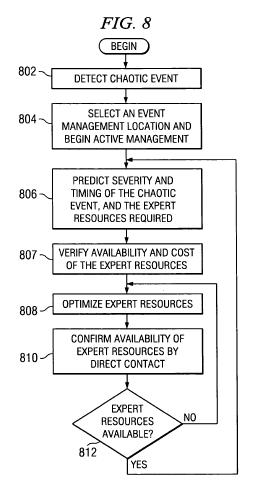
IBM Claiming Patent for 'Responding to Chaos'
And thanks to IBM, responding to a crisis of 9/11 or Katrina magnitude strikes may constitute patent infringement. Big Blue has a patent pending for Optimizing the Selection, Verification, and Deployment of Expert Resources in a Time of Chaos, which covers responding to 'episodes of profound chaos during hurricanes, earthquakes, tidal waves, solar flares, flooding, terrorism, war, and pandemics to name a few.' It's apparently this easy.
-
Re:Provisional Patents
This is completely incorrect. Provisional patents are NOT prior art in the system and are NOT published if they are not converted to a non-provisional application.
The best way to create prior art it to publish in a journal (there are journals that will publish and archive anything for a nominal fee) You also have the option of filing a Statutory Invention Registration with the USPTO. http://www.uspto.gov/web/offices/pac/mpep/documents/1100.htm
For the best solution to your situation, please seek the advice of a Patent Attorney and nothing stated here should be considered legal advice. -
Re:As far as US is concerned
First off ---- I am not a lawyer. The information contained within should not be relied upon. If you are in need of legal counsel, please seek out a licensed attorney in your state. I do not intend to create an attorney/client relationship with any reader. I am just a law student and I am not qualified to provide legal advice, but hopefully I know a little more than the average joe.
The parent is flat out wrong. The USPTO, or a court, can use a publication under 102(b) or 102(e) to show that an invention is not novel. Regardless of the status of the a patent on the prior art. 102(g) is related to if an inventor is trying to get a patent on his invention, not whether a publication can be used against another as prior art.
Perhaps I should explain. If there exists a publication describing the subject of a patent application and that publication was published more than one year prior to the application (also applies to if the subject of the patent was in public use in the US or for sale in the US), it is an absolute bar to the patent. 35 USC Section 102(b).
Blogging about an invention is a publication and can be used to destroy novelty for further inventors. The problem is that the USPTO is less likely to find your art than if it is an issued patent or an application.
If the As a suggestion to the original post, maybe a provisional application would meet your desire:
http://www.uspto.gov/web/offices/pac/provapp.htm
Provisional applications are published after 18 months, and if the application matures into an issued patent, it will count as art from the day it was filed. You still have to meet some of the more stringent requirements though, so this may not be the right solution. Also, if you don't intend to get a patent on the idea, it is better to publish something as well as file the provisional. That way there is a publication farther back in time than just the publication of the application that will never mature into an issued patent.
But as I said before, the parent is wrong and misunderstands the import of 102(g). The designation of informative on that post is misplaced. -
USPTO FEES
USPTO Fees: http://www.uspto.gov/web/offices/ac/qs/ope/fee2007september30_2007dec17.htm
IANAL, and this is not advice. But it may help you understand some options.
The costs you quote are for paying someone else to write, file, and handle all correspondence with the patent office. Do it yourself and it's around $500 to file (basic utility filing). Get fancy, deal with a lot of responses to the patent office and it can get a bit more expensive. Have the patent allowed and pay for it to be issued is $720. Maintenance fees the add up.
But if your objective is to make the work public, then you're effectively abandoning the patent. Once it publishes, you might be inclined to not even bother with any of the steps beyond just filing. I understand you can also write to the patent office telling them you are abandoning it so something like that.
Two problems with this route:
1) clogs up the patent system with more stuff. More work for examiners might mean less attention paid to patents that might not deserve a patent grant.
2) The application will show as published, but it's not obvious if it's been abandon (requires more research). The existence of a published app may dissuade people from using your idea since they may think you are keeping it alive as a submarine patent. -
Re:Get rid of the USPTO
No, actually that's examiners.
There are 8,913 total employees.
http://www1.uspto.gov/web/offices/com/annual/2007/desc_staffing.html
Also, backlog doesn't matter. 700,000 per year is 700,000 per year. Just because they have a backlog doesn't change any percentage of accuracy on work completed. -
From the MPEP (Official Patent Examiners Manual)..I was always under the impression that inventions relating to nuclear weapons were unpatentable
706.03(b) Barred by Atomic Energy Act [R-2]
http://www.uspto.gov/web/offices/pac/mpep/documents/0700_706_03_b.htm
A limitation on what can be patented is imposed by the Atomic Energy Act of 1954. Section 151(a) (42 U.S.C. 2181(a)>) No patent shall hereafter be granted for any invention or discovery which is useful solely in the utilization of special nuclear material or atomic energy in an atomic weapon.
The terms "atomic energy" and "special nuclear material" are defined in Section 11 of the Act (42 U.S.C. 2014). -
Re:How much are they askingfor ownership AJAX? Has AJAX been around since 1999? The patent's filing date is January 7, 1999
-
well MS have a modular OS patent already sorted ou
System and method for delivery of a modular operating system
Abstract
An operating system and method for use include a core function module, or basic kernel, providing fundamental operating system support and one or more add-on modules that allow customization of the operating system as desired. Add-on modules may provide support or extended capability to the computer including hardware, applications, peripherals, and support. A digital signature may be used to confirm the integrity of an add-on module prior to installation. Certification may be verified to determine if installation of the add-on module is authorized. By withholding certification, a service provider may manage illegal or undesired modifications to a provided computer. Digital rights management may be used to enforce terms of use of the add-on module in keeping with licensing arrangements.
more at:
http://appft1.uspto.gov/netacgi/nph-Parser?Sect1=PTO1&Sect2=HITOFF&d=PG01&p=1&u=%2Fnetahtml%2FPTO%2Fsrchnum.html&r=1&f=G&l=50&s1=%2220060282899%22.PGNR.&OS=DN/20060282899&RS=DN/20060282899 -
Patent Link
First off, they don't quite link to the patent so on a non-slashdottable version is here or you can go straight to the full massive PDF if you want (single file if you have problems viewing above in Linux).
Looks pretty much like a poster child example of why the patent system is broken. Either that or the USPTO needs to start looking at revoking patents in hind sight or after professional review by many leading members of the field. So much for patent reform! -
Patent Link
First off, they don't quite link to the patent so on a non-slashdottable version is here or you can go straight to the full massive PDF if you want (single file if you have problems viewing above in Linux).
Looks pretty much like a poster child example of why the patent system is broken. Either that or the USPTO needs to start looking at revoking patents in hind sight or after professional review by many leading members of the field. So much for patent reform! -
Re:True inventor of the blue LED
Great, except that is not the patent in question, which the first article notes was awarded in 1993. That's my point-- gallium arsenide semiconducting diodes have a lot of prior art before that date. The patent you cite has a different date (1990) than the article notes. You found a patent, and congratulations in doing that, it just wasn't the one mentioned in this article.
If you want more evidence for that, here's the USPO link: http://patft.uspto.gov/netacgi/nph-Parser?Sect1=PTO1&Sect2=HITOFF&d=PALL&p=1&u=%2Fnetahtml%2FPTO%2Fsrchnum.htm&r=1&f=G&l=50&s1=4904618.PN.&OS=PN/4904618&RS=PN/4904618
"Rothschild was originally issued a U.S. patent in 1993 based on her method of producing wide band-gap semiconductors for LEDs and laser diodes in the blue and ultraviolet end of the light spectrum."
"In particular, the portion of Rothschild's work at issue in the ITC case focuses on using gallium nitride-based semiconductor material." Perhaps this is a later patent that references her earlier one, but I don't see any evidence for that. The article also specifically addresses diodes producing the "blue/UV" end of the spectrum, and that didn't exist until Nakamura created it in 1991. Without using the techniques in the patent you cite, I might add.
So yeah. My point remains. Prior art is easily found.
And if you stop modding me down long enough to actually read the links I posted, you'll note in the interview with Nakamura, he successfully made processes for blue LEDs without the technique described in the patent you do cite, so the argument put forth in one of the original links that GaN semiconductors can't be made without this process is a bit spurious.
If you still believe that despite the differences in dates the patent you cite is the correct one, let me ask you this: since there are multiple methods by which GaN semiconductors can be produced, how was it Rothschild ascertained all these companies were violating her patent? Did she examine all these company's products with a scanning-tunneling electron microscope... while retired? Or did she just assume these products could not be made without her process, despite the fact that Nakamura himself did not use it? -
Re:True inventor of the blue LEDJust for the record, her patent is here. What she seems to have invented is a way to make pn junctions in wide bandgap semiconductor with the diffusion of atomic hydrogen diffusion to compensate for impurities.
There's no claim that she invented the blue LED. The question is whether the process used today involves this technique.
In truth, there is never one inventor of something. It's all based on previous work. Nakamura can certainly be called the inventor of the blue LED, but he based, as does every inventor, on previous work.
-
Re:Just Go Away!
However she isn't the only scientist who worked on blue leds, how can she be so sure that they infringed her patents?
Wikipedia doesn't even mention her: http://en.wikipedia.org/wiki/Blue_LED#Ultraviolet_and_blue_LEDs
There are a lot of patents by other scientists on gallium-nitride blue leds, this is from 1993:
http://patft.uspto.gov/netacgi/nph-Parser?Sect2=PTO1&Sect2=HITOFF&p=1&u=%2Fnetahtml%2FPTO%2Fsearch-bool.html&r=1&f=G&l=50&d=PALL&RefSrch=yes&Query=PN%2F5578839 -
True inventor of the blue LED
"Shuji Nakamura of Nichia Corporation of Japan demonstrated the first high-brightness blue LED based on InGaN, borrowing on critical developments in GaN nucleation on sapphire substrates and the demonstration of p-type doping of GaN which were developed by I. Akasaki and H. Amano in Nagoya. The existence of the blue LED led quickly to the first white LED, which employed a Y3Al5O12:Ce, or "YAG", phosphor coating to mix yellow (down-converted) light with blue to produce light that appears white. Nakamura was awarded the 2006 Millennium Technology Prize for his invention."
http://en.wikipedia.org/wiki/Shuji_Nakamura
http://patft.uspto.gov/netacgi/nph-Parser?Sect1=PTO1&Sect2=HITOFF&d=PALL&p=1&u=%2Fnetahtml%2FPTO%2Fsrchnum.htm&r=1&f=G&l=50&s1=6900465.PN.&OS=PN/6900465&RS=PN/6900465
"In 1991, I made n-type gallium nitride. The following year I succeeded making p-type using a thermal annealing technique. Now all gallium nitride researchers use my technique for p-type gallium nitride. Another big breakthrough was making the first single crystal of indium gallium nitride, which we needed for an emitting layer. Finally at the end of 1993, I succeeded in making the first commercial-based blue LEDs."
http://archive.sciencewatch.com/jan-feb2000/sw_jan-feb2000_page4.htm
The invention this woman claims to have done was already done years previous by the true inventor of the blue LED and laser diode, Shuji Nakamura. She is a patent troll, and the fact the FTC is wasting taxpayer money with an investigation into something that could've been resolved by 5 minutes of looking at dates on Wikipedia is sad. -
Re:Sounds like an abuse cool technology
-
Link to patent
Here is the link to the actual patent. It seems to be filed in 2000. I don't have time to analyze it, but can someone analyze it and comment on its merits.
-
Re:FSF and RMSYou shouldn't have wasted your limited capacities on responding to me.
Article 1 Section 8 of the Constitution protects INVENTORS, not innovators. Patents are FOR INVENTIONS. http://www.uspto.gov/web/patents/howtopat.htm To suggest that innovation forms some legal definition for patenting is flat wrong and has been since 1790.
On definitions, the source you chose sucks. If you want to quote Schumpeter or Adam Smiths' definitions that would be helpful. Or Utterback, or Christensen, or Rogers etc.. They all link innovation to commercialization (whereas invention is not).
My only point was that you can't take the "profiteering" out of "innovation". If you do, whatever you have is no longer called innovation.