Slashdot Mirror
Domain: w3.org
Stories and comments across the archive that link to w3.org.
Comments · 6,785
-
Re:Resolution independent browsing
What we need is Scaled Vector Grahpics in our browsers, and then we might be able to dump this "designed for 800x600" idiocy. It would be nice if all icons everywhere were properly scalable, including on the desktop. SGI have done been doing this with their desktop environment for years.
-
Re:Whoa, whoa whoa WHOA
use HTML 3.2 you dweeb.
I don't much like traditional HTML. In order to achieve practically any satisfactory layout effects, you have to hack and kludge your way through an ugly DTD, using tricks like table layout and blank images that were never meant to be used.
I'm much more satisfied with the idea of clean, strict XHTML with CSS reserved for typographic and layout effects. Netscape and Microsoft have had more than enough time to implement proper support for CSS. CSS-2 is a great technology (have you read the spec? Man, they've thought of everything!) and there's no excuse for the current state of things, other than the fact that this fork in functionality, so to speak, is great business for Microsoft. It's not so great for developers.
I've been doing HTML since version, what, 1.1? It wasn't so great back then, and it's gotten a lot worse.
It's also long past time we got major browser support for PNG, but that's another story. -
W3C micropayments effort
How come no one out there is working feverishly on a new micropayment system, since none of the others were ever adopted?
Feverishly, I hope not, but the W3C is working on micropayments and their Common Markup for micropayment per-fee-links is now a working draft in last call review period.
-
W3C micropayments effort
How come no one out there is working feverishly on a new micropayment system, since none of the others were ever adopted?
Feverishly, I hope not, but the W3C is working on micropayments and their Common Markup for micropayment per-fee-links is now a working draft in last call review period.
-
W3C micropayments effort
How come no one out there is working feverishly on a new micropayment system, since none of the others were ever adopted?
Feverishly, I hope not, but the W3C is working on micropayments and their Common Markup for micropayment per-fee-links is now a working draft in last call review period.
-
Official Sydney2000 site not ADA/w3 Compliant
Last week ZDNet Australia ran a story noting complaints from the sight impaired community that the official site for the Games www.olympics.com failed to provide a significant amount of information formatted in ways that can be read by text only (and therefor text-to-speech enabled) browsers. Examples of non-text friendly data include "the sport index, which provides event schedule information for 36 Olympic sports" and the results of competitions, "Something which [a representative for the site] claims will cost AU$4 million and take 368 days to do," according to one of the complainants.
This also means that the site is not meeting guidelines laid out by the WWW Consortium.
The combination of not providing a site meeting the needs of all users, and then censoring what others can report from the Games, means a total blackout of Internet information for these users.
-
Re:Omitting tagsYou're kidding, right? If you read the XHTML specification, section 4.3 you'll note that:
In SGML-based HTML 4 certain elements were permitted to omit the end tag; with the elements that followed implying closure. This omission is not permitted in XML-based XHTML. All elements other than those declared in the DTD as EMPTY must have an end tag.
-
Re:Omitting tagsYou're kidding, right? If you read the XHTML specification, section 4.3 you'll note that:
In SGML-based HTML 4 certain elements were permitted to omit the end tag; with the elements that followed implying closure. This omission is not permitted in XML-based XHTML. All elements other than those declared in the DTD as EMPTY must have an end tag.
-
Re:Omitting tagsYou can happily omit , as it can always be inferred from context. Check out the W3C if you really care.
In Netscape, omitting </TABLE> will leave you with utterly blank space. So the example fails not because of a missing </td> or </tr> (or </body> or </html>) but the unclosed <table>.
The HTML spec encourages you to omit unnecssary tags. They clearly indicate which tags are required and which are optional. It's generally pretty sensible too: you can't have a <td> in a <td>, so you know starting a new table cell must also end the first one.
For real fun, read the explanation as to why <head> and <body> are no longer required.
-
Re:there is nothing wrong with user-agentsDoes the UK have any law similar to the American Disabilities Act?
Yes we do - the 1995 Disability Discrimination Act which came into force last October. In that, providers of public services (shops are specifically mentioned) are required to make 'reasonable adjustments' to make services accessible (ie providing services to the same manner and quality), or suffer unlimited penalties.
More info at http://www.disability.gov.uk/dda/fin alcode.rtf. This is the non-legalese Code of Practise resulting from the Act, rather than the Act itself.
Lawyers are currently interpreting this to mean that minimum compliance is Conformance Level A of the W3C Accessibility Guidelines.
-
Re:there is nothing wrong with user-agents
If sites were coded to standards then less time would have to be spent second-guessing the user and more time could be spent on building the real functionality desired (and that's sort of the point of the site, isn't it?) so that they could be usable by anybody. More potential clients/customers is a good thing, right?
Why oh why is it taking the corporate world so long to realize this? Is it going to take a major law suit against a big company to make them open their eyes?
-
Re:IE?
IE currently does the best job of standards compliance, but that doesn't mean it couldn't be better. Any rational IE developer must wish that the W3C didn't exist so that Microsoft could create new standards without interference. Instead, Microsoft or someone else comes up with something new, and the final recommendation can be changed from the beta. This is a pain for both Microsoft developers because they have to go back and change their work, and for other developers because people might be making work that doesn't appear broken during testing (but is broken on more compliant browsers).
Think of Mozilla as the reference drivers like video cards have: you can use it if you want it exactly the way the W3C intended. If standards-compliance was the market dominance, people wouldn't commit to beta standards until they had been subjected to peer review.
If you're a web developer, you don't have to worry about testing on different browsers. If it works in Mozilla, then its not your problem if it doesn't work somewhere else.
-
Re:Slashdot Effect.
e-gold looks interesting. However, what is needed is a standard for micropayments, otherwise buyers and sellers will both have to use the same e-currency provider in order to trade.
Fortunately the World Wide Web Consortium has one cooking. -
Re:Slashdot Effect.
e-gold looks interesting. However, what is needed is a standard for micropayments, otherwise buyers and sellers will both have to use the same e-currency provider in order to trade.
Fortunately the World Wide Web Consortium has one cooking. -
Re:Revolutionary software at least...
"So what killed NeXT? High prices, lack of standardization with the X community, and (ultimately) the Web."
Ironic, given that Tim Berners-Lee developed the concept of the Web on a NeXT Cube.
-
Re:Revolutionary software at least...
"So what killed NeXT? High prices, lack of standardization with the X community, and (ultimately) the Web."
Ironic, given that Tim Berners-Lee developed the concept of the Web on a NeXT Cube.
-
See also the /. article
... lead to the emergence of a compact, widely used standard for vector graphics?
Well, there is the W3C standard, mentioned in a Slashdot article from Saturday.
Louis Wu"Where do you want to go
-
Re:I have given up on Mozilla/NetscapeBefore you continue to whine, I suggest you run your page through the W3C's validator.
I counted 19 errors.
Paul
-
Re:I have given up on Mozilla/NetscapeBefore you continue to whine, I suggest you run your page through the W3C's validator.
I counted 19 errors.
Paul
-
Re:I have given up on Mozilla/Netscape
Please see this.
-
Re:I have given up on Mozilla/Netscape
Bzzzzt! Wrong answer!
Check this out.
-
Re:I have given up on Mozilla/NetscapeIt all revolves around this page of mine...It is 100% legit HTML
Um, no, it's not. I'd suggest running it through http://validator.w3.org before you make a claim like that. Your page has numberous violations of the HTML 4.01 Transitional DTD.
-
No. It's still a URL.Well, it's a URI as well, but that's less specific.
Kind of like: "It's an apple." "No, it's actually a fruit."
-- -
Re:Its Text, Not Binary
-
Vera niiice
We can only hope that this catches on. It would drastically increase the flexibility of the web developer. Unfortunately, the only way that I can see it catching on is if M$ implements it; because other browsers would have to follow suit.
W3C's recommendations seem to be increasingly ignored by the major browsers. This is partially because their recommendations seem more complex, but still, old browsers were usually 100% HTML4/3.2 etc. compliant. Now we see all of the major browsers having around 50% compliance for difference specifications.
also, whatever happened to MathML? I thought that this had promise, but in the last year, no browser has supported it, besides Amaya
We seem doomed to be following the wishes of the IE development team instead of those of the W3C.
However, I do believe that this particular technology will catch the eyes of those in M$, and will be implemented. It should be interesting to see how long this takes.
-- -
Vera niiice
We can only hope that this catches on. It would drastically increase the flexibility of the web developer. Unfortunately, the only way that I can see it catching on is if M$ implements it; because other browsers would have to follow suit.
W3C's recommendations seem to be increasingly ignored by the major browsers. This is partially because their recommendations seem more complex, but still, old browsers were usually 100% HTML4/3.2 etc. compliant. Now we see all of the major browsers having around 50% compliance for difference specifications.
also, whatever happened to MathML? I thought that this had promise, but in the last year, no browser has supported it, besides Amaya
We seem doomed to be following the wishes of the IE development team instead of those of the W3C.
However, I do believe that this particular technology will catch the eyes of those in M$, and will be implemented. It should be interesting to see how long this takes.
-- -
Re:Great resource!
Allow between 5 and 10 times more effort to develop a decently cross-browser page, rather than nice simple CSS.
I can imagine. I'm using Netscape 4.74 myself, and I've been pretty fed up with it, but actually, it has been IE3 that has caused most of my problems, especially font size handling. One of my pages has a comment on the top saying IE3 users should turn off their stylesheets.... The ultimate goal is of course to make my pages as accessible as possible, so the usual response to Netscape's CSS trouble has been to drop sophistication. I am quite sure my pages (at least those I wrote since RTFM) are very accessible, especially since turning off stylesheets isn't a big thing. One difficulty is not only making sure the pages are readable on todays top browsers, but also on any future stuff, voice browsers, PDAs, hell, I bet that if people had written good HTML instead of tag soup, I would have had full web on my cell phone by now, and WAP-crap would never have emerged...
-
Re:Must be CA?
Your
It's not an error in theSorry, but under Mozilla it handles the entities semi-correctly
You're right: this is Mozilla's failure to adhere to proper standards (again). Because of this kind of failure, the W3C had to make this note:Note. In SGML, it is possible to eliminate the final ";" after a character reference in some cases (e.g., at a line break or immediately before a tag). In other circumstances it may not be eliminated (e.g., in the middle of a word). We strongly suggest using the ";" in all cases to avoid problems with user agents that require this character to be present
I'd rather code to a standard than to a user agent (that isn't even finished yet).
(Emphasis added) -
Re:Must be CA?
Your
It's not an error in theSorry, but under Mozilla it handles the entities semi-correctly
You're right: this is Mozilla's failure to adhere to proper standards (again). Because of this kind of failure, the W3C had to make this note:Note. In SGML, it is possible to eliminate the final ";" after a character reference in some cases (e.g., at a line break or immediately before a tag). In other circumstances it may not be eliminated (e.g., in the middle of a word). We strongly suggest using the ";" in all cases to avoid problems with user agents that require this character to be present
I'd rather code to a standard than to a user agent (that isn't even finished yet).
(Emphasis added) -
Re:Great resource!
If you don't have the ability to do this there are general rules to follow as to what version of a browser supports what and how well. Most of that information can be found on the web, if not on netscape.com & microsoft.com.
Is there something wrong with following these rules? Or these if you're concerned about compatibility with older browsers? (Or even these rules, but that's taking things a bit too far...)
Then again, I'm an old fogey who remembers the days when the point of HTML was to allow the browser to render content according to the terminal's capabilities and user's preferences, not to specify the text font and exact pixel location of each image. Bah! Humbug!
-
Re:Great resource!
If you don't have the ability to do this there are general rules to follow as to what version of a browser supports what and how well. Most of that information can be found on the web, if not on netscape.com & microsoft.com.
Is there something wrong with following these rules? Or these if you're concerned about compatibility with older browsers? (Or even these rules, but that's taking things a bit too far...)
Then again, I'm an old fogey who remembers the days when the point of HTML was to allow the browser to render content according to the terminal's capabilities and user's preferences, not to specify the text font and exact pixel location of each image. Bah! Humbug!
-
Re:Great resource!
I'm not a pro, but I have become more and more inclined to write pages that actually conforms with the standards, most notably HTML 4.01 Strict and CSS1, and go on to validate the stuff. If the browsers can't handle that, *$%^#* them. And, browsers can't handle that...
-
Re:Great resource!
I'm not a pro, but I have become more and more inclined to write pages that actually conforms with the standards, most notably HTML 4.01 Strict and CSS1, and go on to validate the stuff. If the browsers can't handle that, *$%^#* them. And, browsers can't handle that...
-
Re:Great resource!
I'm not a pro, but I have become more and more inclined to write pages that actually conforms with the standards, most notably HTML 4.01 Strict and CSS1, and go on to validate the stuff. If the browsers can't handle that, *$%^#* them. And, browsers can't handle that...
-
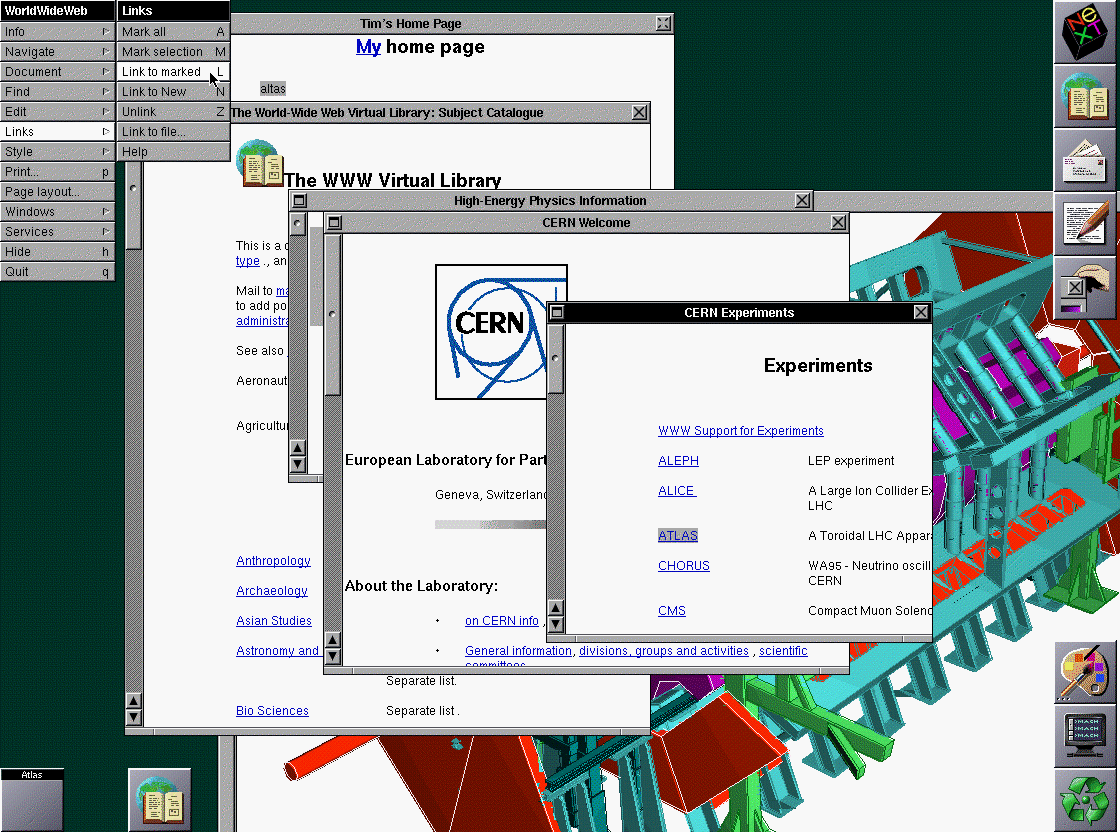
Doesn't anyone remember the first browser?Nice timeline (haven't been able to get the emulator going yet), but it incorrectly identifies the first web client as a command-line one, and the first graphical client as Mosaic.
As someone who was lucky enough to try the original browser, probably within days of its release, I find this annoying.
Check out this web page http://www.w3.org/People/Ber ners-Lee/WorldWideWeb.html
or this nice screenshot: http://www.w3. org/History/1994/WWW/Journals/CACM/screensnap2_24c .gif.
Note that this wasn't just a browser -- it was a "Browser - Editor!" Very advanced for its time, eh?
(sorry...its just always ticked me off that credit isn't given where it's due on this one...)
david.
-
Doesn't anyone remember the first browser?Nice timeline (haven't been able to get the emulator going yet), but it incorrectly identifies the first web client as a command-line one, and the first graphical client as Mosaic.
As someone who was lucky enough to try the original browser, probably within days of its release, I find this annoying.
Check out this web page http://www.w3.org/People/Ber ners-Lee/WorldWideWeb.html
or this nice screenshot: http://www.w3. org/History/1994/WWW/Journals/CACM/screensnap2_24c .gif.
Note that this wasn't just a browser -- it was a "Browser - Editor!" Very advanced for its time, eh?
(sorry...its just always ticked me off that credit isn't given where it's due on this one...)
david.
-
The obligatory "They Missed one!"
I see no sign of WorldWideWeb.app by Tim Berners-Lee. The ultimate web-surfing experience, the whole story available here. It's really fun to use btw.
Anyway, the server was slashdotted so I can't comment on the ones the had.. -
Re:IE? CSS? BAH!It looks like almost valid CSS to me - just a few missing units that any sane browser would assume anyway.
By today's standards, it's a reasonable page. How long is the Web supposed to wait for Netscape to catch up? Hell, just grab Mozilla - don't blame other people if their webpage isn't accessible to you just because you're using a browser that's two years old, that can't fully handle a standard that's four years old.
-
Re: Look at all this stuff!
I knew Google was a good engine, but I haven't been this impressed by a search engine in a long time.
There's more stuff about me on Google than there is on AV or Yahoo. Combined. There's even the infamous post to CSS-WG which got me in trouble with my employer, a number of my essays and papers, a campus newspaper interview from the best year of my life, and even an attendance roster from a meeting I don't remember going to.
This suggests that Google knows more about me than I do!
The annoying thing is the amount of noise, from people with the same or similar names (I. Keith Tyler, Tyler Keith, etc.), and the names of cities in Texas.
Anyway, I'm impressed, and no, I don't mind this stuff about me being readily available (except maybe the CSS-WG letter). I like it. "Look at me, everybody! I'm on Google!"
(Well, at least it's more impressive than an ODP link.) -
I completely agree
Back when all I knew was the DOS/Windows way of doing things, if it "looked good at the latest IE," that was good enough for me.
When I started experimenting with other platforms and operating systems, I saw what a mess things were. Don't get me wrong, to this day, I think IE is the better browser, but what it wrought is just horrible.
At about the same time, I started to see how the "other" browsers saw the Internet: Opera, older versions of IE and Netscape, lynx, and even OS/2 Web Explorer. What I found was, with just minor modifications to the code, a site can become very friendly to those with less than "MS standards" browsers. I rapidly became impressed how a lot of browsers, while not feature laden, followed the HTML model really well and could water down whatever you threw at them.
I have qualms with Netscape's CSS implementation but probably more with Opera 3.x. I discovered a box property bug in Opera that to this day is unmatched by Netscape. Opera has, however, signifigantly improved their product in the meantime. Netscape hasn't.
Getting back on topic, however, in regards to the troll, he, like a lot of people, think that building a friendly "somewhat" standards compliant site is a long and almost impossible task. This is a misconception, and the Internet is built around bad HTML and most browsers know this. To be accessable, you don't have to follow the HTML standard rigorously; in fact, there's only a few minor things that can really help, like alt tags and proper tag completion. A lot of this "standards" stuff can be done automatically by an HTML parser/correcter like W3C's HTMLtidy. More on this practice of making sites accessable can be found at the Any Browser site. -
Re:my take on standardsThe W3C developed Amaya as a reference browser, using Motif/Lesstif.
Not beautiful, but usable, under (IIRC) a BSD-style license, and
currently the best way to render MathML (though Mozilla is working on
it).
There is a homepage for it at
www.w3c.org. -
Re:Why isn't Woz a rich bazillionaire?
-
How does this affect the Semantic Web?Now, this seems to pretty much kill the Semantic Web TimBL has been dreaming about, doesn't it? He devoted most of his book on the topic, and it is a really important part when he discusses design issues.
If you can't go to a web site and extract the information on it for no other use than viewing it on a graphical browser, which is what most web sites are designed for these days, then, it's dead, isn't it?
Now, I agree that the robots.txt file should be respected. It is important to make sure robots don't enter e.g. eternal loops in scripts. I think that those using it to block robots out so robots can't extract useful information are just narrow-minded, and that's their problem, they will die as the market gets a clue (if it ever will). But when the courts decide on topics where they have little understanding prematurely, that's a problem.
-
Re:CSS
W3C is not always too slow. Take CSS (Cascading Style Sheets). How many browsers even implement CSS2, never mind extending it?
I think I'm running into this problem right now with a website that I'm reworking to be more standards-compliant. (It was originally created with frames for formatting and lots of text-containing graphics with no ALT tags. Browsing it with Lynx shows just how woefully deficient it is.) I have a reworked (but still not finished) main page up (if you want to see what I'm doing, check out http://salfter.dyndn s.org/www.thejewelers.com/index-html4.html that works fine in IE 5.01, but Navigator 4.7 completely ignores the associated CSS positioning info. W3C's HTML and CSS validators say the page is OK, and some other HTML validators (such as NetMechanic and even the Netscape-controlled Web Site Garage) have said the same thing. Web Site Garage's browser-compatibility check even said the design was OK for Navigator 4.x. Actually viewing it with the different browsers says something different.
(Just got Mozilla M16 installed under Win98...it renders things a little differently than IE, but it's comparable to IE. Much better than Navigator 4.7. I tried installing Mozilla under Linux to get it running on the metal instead of under VMware (which is where I run Win98 and IE), but the installer segfaulted. The box is a 450-MHz K6-III with 256 megs of RAM and SuSE Linux 6.3, which ought to be enough to run anything.)
_/_
/ v \
(IIGS( Scott Alfter (remove Voyager's hull # to send mail)
\_^_/ -
Re:CSS
W3C is not always too slow. Take CSS (Cascading Style Sheets). How many browsers even implement CSS2, never mind extending it?
I think I'm running into this problem right now with a website that I'm reworking to be more standards-compliant. (It was originally created with frames for formatting and lots of text-containing graphics with no ALT tags. Browsing it with Lynx shows just how woefully deficient it is.) I have a reworked (but still not finished) main page up (if you want to see what I'm doing, check out http://salfter.dyndn s.org/www.thejewelers.com/index-html4.html that works fine in IE 5.01, but Navigator 4.7 completely ignores the associated CSS positioning info. W3C's HTML and CSS validators say the page is OK, and some other HTML validators (such as NetMechanic and even the Netscape-controlled Web Site Garage) have said the same thing. Web Site Garage's browser-compatibility check even said the design was OK for Navigator 4.x. Actually viewing it with the different browsers says something different.
(Just got Mozilla M16 installed under Win98...it renders things a little differently than IE, but it's comparable to IE. Much better than Navigator 4.7. I tried installing Mozilla under Linux to get it running on the metal instead of under VMware (which is where I run Win98 and IE), but the installer segfaulted. The box is a 450-MHz K6-III with 256 megs of RAM and SuSE Linux 6.3, which ought to be enough to run anything.)
_/_
/ v \
(IIGS( Scott Alfter (remove Voyager's hull # to send mail)
\_^_/ -
Actually, Inoshiro's page is 100% HTML 4 compliant
I'm quite Impressed that he took the time to make sure the HTML was properly written.
If you don't believe me, read the output from W3C's HTML Validator.
As any decent web designer would know, W3C is where the buck stops for standards compliance.
In addition, his style sheets validate without any warnings or errors.
With this evidence, Mozilla is, without a doubt, the culprit and not quite as up to standards as it claims it is. -
Actually, Inoshiro's page is 100% HTML 4 compliant
I'm quite Impressed that he took the time to make sure the HTML was properly written.
If you don't believe me, read the output from W3C's HTML Validator.
As any decent web designer would know, W3C is where the buck stops for standards compliance.
In addition, his style sheets validate without any warnings or errors.
With this evidence, Mozilla is, without a doubt, the culprit and not quite as up to standards as it claims it is. -
Actually, Inoshiro's page is 100% HTML 4 compliant
I'm quite Impressed that he took the time to make sure the HTML was properly written.
If you don't believe me, read the output from W3C's HTML Validator.
As any decent web designer would know, W3C is where the buck stops for standards compliance.
In addition, his style sheets validate without any warnings or errors.
With this evidence, Mozilla is, without a doubt, the culprit and not quite as up to standards as it claims it is. -
Re:I hope..
No. I wish I could use CSS properly for all my format output specification. But as you can see, browsers are so horribly lacking in support for this (a standard from 1996!), that I must resort to kludges.
--- -
Re:iCab reports one error/warning in your html
I'd tell the iCab people to change their program, as it seems to have some erroneus ideas about table width elements.
(From http://www.w3.org/TR/html4/sgml/dtd
[!ENTITY % Length "CDATA" -- nn for pixels or nn% for percentage length --]
(From http://www.w3.org/TR/html4/struct/tables.html)
"This attribute specifies the desired width of the entire table and is intended for visual user agents. When the value is a percentage value, the value is relative to the user agent's available horizontal space. In the absence of any width specification, table width is determined by the user agent. "
(See also HTML 4.x types defintion for length which also lists pixels or percentage.)
So IE and Gecko's engines seem to assume for the nested inner table that 100% means the maximum width allocateable, because they fail to limit the region available to the inner table from the outer table (which is set to 99% of the user window).
This, despite the fact that the W3C people provide a page about calculation of column width for tables. Including how to handle margins with table widths (which Mozilla gets wrong, and is targetted to be fixed in "future").
---