Slashdot Mirror
Domain: washington.edu
Stories and comments across the archive that link to washington.edu.
Comments · 1,905
-
Photo tourism
Reminds me a bit of this photo tourism application, a neat way of viewing hundreds of photos of a particular landmark:
http://phototour.cs.washington.edu/ -
Re:And yetYep, and especially in France, 50% of the time of a journey is spent getting to the station, waiting for the train, waiting for a connection, Why. I'm so glad you mentioned some of the problems of rail. What people want is fast and easy door to door travel. Now that does sound like a good idea.
http://faculty.washington.edu/jbs/itrans/prtquick. htm -
Re:Too big - simultaneous boarding on both decks
Apparently, many airports are planning to use 3 jetway bridges for simultaneous boarding on both decks of the A380
This paper discusses A380 boarding efficiency:
http://www.math.washington.edu/~morrow/mcm/alex_ev an_harkirat.pdf -
Re:Ehm. no it isn'tYou run into the problem, though, of commuter patterns, as you have a large group of people moving from the 'burbs to the city in the morning, and then all moving back in the afternoon. You just need a cache of taxis at the burb/city end large enough to keep the service time down to within acceptable limits, say a 120 second wait. Bearing in mind that the taxis re-circulate once dropping off their passengers the cache doesn't have to be anything like as large as you might think.
And it can be done today without requiring A.I.
http://faculty.washington.edu/jbs/itrans/prtquick. htm
http://www.atsltd.co.uk/
http://www.personalrapidtransit.com/
The performance of a PRT system, like roads, is determined by how quickly people get on/off the road/vehicles rather than the distance between the vehicles or their speed. i.e. the number of bays in a station. Again, it's the interfaces which matter, not the roads/guideways etc. -
Re:What are the generators?
http://modular.math.washington.edu/sage.html This was the "supercomputer"? A 16 node AMD box? Your local library's computer lab would like to have a word with them.
-
Sage the "super" computer
In the end the calculation took about 77 hours on the supercomputer Sage.
Supercomputer my foot!The connection has timed out
The server at sage.math.washington.edu is taking too long to respond. -
Re:SETI, infamous? Let's fold proteins!
Exactly. The problem is that SETI is a long shot.
When you participate in gene-folding, or protein-folding (as in the Baker Labs at the University of Washington, which win year after year in best predictions), you know that it's going to useful research that actually helps us understand how things actually work.
Nothing against SETI - I did many packets for them back in the day.
But, practically, it's more fun to do something like cure cancer (UK site) or fold proteins (UW - search for Baker Labs in Biochemistry, my old department) that are used to find cures for malaria, TB, and so on. -
M2P2 revisited?So, does noone here remember M2P2 from a few years back?
-
Re:Typo... NOT a respectable web site!I find it hard to believe TFA when a glaring error is in the third paragraph:
The finding, made by Michael Wysession, a seismologist at Washington State University in St. Louis, and his former graduate student Jesse Lawrence, now at the University of California, San Diego, will be detailed in a forthcoming monograph to be published by the American Geophysical Union.
I'm from the St. Louis area; there is no such thing as "Washington State University in St. Louis". St Louis is in Missouri, not Washington (there is no St. Louis in Washington state), and the university in St. Louis, MO is Washington University, not Washington "State" University. There is a Michael Wysession on staff at Washington University in St. Louis.
There's a Washington State University, but it's in Seattle. If they can't even get the name of the research facility right, how can I trust anything else the article says?
This isn't the fisrt incredibly stupid error I've run across at LiveScience.com. In fact, I've seen so many egregious fuckups at that site I've quit going there completely. You should, too.
here is Michael E. Wysession's home page. From his page:One of the most dramatic features in our global mantle shear-wave attenuation model is a very low-Q anomaly at the top of the lower mantle beneath eastern Asia. We believe that this is due to water that has been pumped into the lower mantle via the long history of the subduction of oceanic lithosphere in this region. This could result from the dehydration of hydrous phase D from cold lithosphere that has been subducted into the lower mantle. We are very interested in further pursuing the effects of water on seismic attenuation within the mantle. [Lawrence and Wysession, 2006a,b]
So to answer several earlier posters' questions, it's salt water.
His page links a press release and an article in Popular Mechanics.
Shame on anthemaniac and samzenpus. You guys do this again and I'm going to revoke your nerd licenses
-mcgrew (MRC="despairs" after getting an SDC for a damned hour and a half) -
Re:On mars the atmosphere shakes once every year
-
Re:On mars the atmosphere shakes once every year
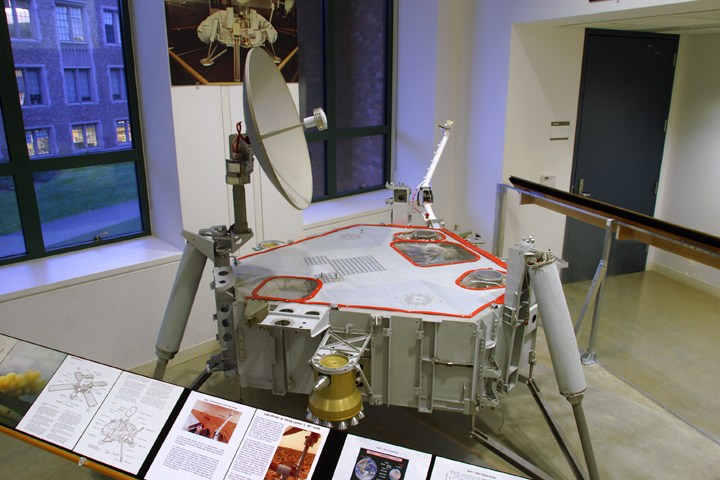
reference and here and here's a picture of the spare lander that was never launched the boom on it is the meteorology sensor
-
Re:On mars the atmosphere shakes once every year
reference and here and here's a picture of the spare lander that was never launched the boom on it is the meteorology sensor
-
Re:Aready happened in Texas
-
When you fail, sue away
When I was in school, we had a small team which developed, tested, and distributed educational groupware. According to our director who went to collect awards for the good work, the Blackboard people were dumbfounded when he told them that his team was basically a group of sub-$10/hr undergrads plus a few grad students from the biology and sociology depts. Other schools actually offered to buy our software over Blackboards, from what I've heard.
-
Re:Linux is Inhibited by Greed
Of course there is a replacement for Outlook and Exchange! It's called sendmail and it's part of every unix-like system. You install an MTA (either the original sendmail or a compatible replacement) and a POP3 server on a machine (an old desktop is fine), configure your firewall to route incoming traffic on port 25 to that machine, log into your DNS control panel, and set its internet hostname as the MX for your domain. Then you run a normal mail client on each desktop. Specify your mail server's inside IP address as the SMTP and POP3 server in your mail client, and away you go.
-
Don't mess with Mary Gates
She's one tough lady!
-
Re:DEFINITELY AGREE
-
Oh, it exists.
So, discrimination in hiring should be prosecuted. Ah, but how do you fight something like this? Evidence of discrimination, right? But how could that be shown without doing the sort of controlled survey that the researchers did? How could you counter that? What's your solution?
-
Re:risk?It's always kind of weird to think that the smell of farts is micro-poo-particles. It's also funny to think that our bacterial friends the Methanogens enjoy Taco Bell as much as they do.
Ohhh, and we really shouldn't (as microbiologists) mention methane without pointing to the Volta Experiment.
-
Re:Total HD PlayerYour brother, evidently, is either an idiot with poor eyesight _or_ correct about his TV sucking wastewater -- here's why:
Standard Television signal is approximately 480 lines of resolution, meaning there are 480 different pixels in every vertical line on the television, and the signal is interlaced, meaning that the TV displays 1/2 of the lines in the first scan (1st, 3rd, 5th, so on) and then the second half of the lines in the second scan (2nd, 4th, 6th, so on). This means that at any given time, only 240 of the lines of video on your TV are being updated, meaning that you're not getting all 480 lines of solid resolution. technically speaking yes, but thought an interlaced picture only displays half the frames per second at yoru standard 30 frames a minute. given a.) visual persistence, and b.) your eye seeing 24 frames a sec. you really actually see all 480 frames. Interlacing the image was just a smart way to minimize teh data stream without losing any 'visable' difference.
see visual persistence
http://www.ee.washington.edu/conselec/CE/kuhn/ntsc /95x4.htm -
Re:Go Cougers!
Actually, the athletics department is self-supporting. They don't receive any money from tuition, royalties, etc.
The University policy on IP revenue is here, but after administrative expenses are deducted, it basically boils down to 1/3rd going to the inventor, 1/3rd going to the department the inventor works in, and 1/3rd goes into University-wide research funds. -
Re:Another numberless article
See http://www.ee.washington.edu/research/seal/public
a tions.html for publication with numbers. In particular, http://www.ee.washington.edu/research/seal/pubfile s/73.pdf http://www.ee.washington.edu/research/seal/pubfile s/Krichtafovitch_ESA_June_05.pdf http://www.ee.washington.edu/research/seal/pubfile s/MSEE_Nels.pdf -
Re:Another numberless article
See http://www.ee.washington.edu/research/seal/public
a tions.html for publication with numbers. In particular, http://www.ee.washington.edu/research/seal/pubfile s/73.pdf http://www.ee.washington.edu/research/seal/pubfile s/Krichtafovitch_ESA_June_05.pdf http://www.ee.washington.edu/research/seal/pubfile s/MSEE_Nels.pdf -
Re:Another numberless article
See http://www.ee.washington.edu/research/seal/public
a tions.html for publication with numbers. In particular, http://www.ee.washington.edu/research/seal/pubfile s/73.pdf http://www.ee.washington.edu/research/seal/pubfile s/Krichtafovitch_ESA_June_05.pdf http://www.ee.washington.edu/research/seal/pubfile s/MSEE_Nels.pdf -
Re:Another numberless article
See http://www.ee.washington.edu/research/seal/public
a tions.html for publication with numbers. In particular, http://www.ee.washington.edu/research/seal/pubfile s/73.pdf http://www.ee.washington.edu/research/seal/pubfile s/Krichtafovitch_ESA_June_05.pdf http://www.ee.washington.edu/research/seal/pubfile s/MSEE_Nels.pdf -
Re:Emule / Edonkey has this
Now that I'm reading the paper I see it covers basically what I described, but in much further detail and with some models/questions and test results to back it up.
http://www.cs.washington.edu/homes/piatek/papers/B itTyrant.pdf -
Re:Well, uhm. Ban the client?
From the 'article' (really just a brief overview), it's clear that it will generally at present improve performance for the BitTyrant user; it will also statistically improve performance for any peer with substantial spare upload capacity, regardless of client used.
This paper http://www.cs.washington.edu/homes/piatek/papers/B itTyrant.pdf [cs.washington.edu] goes into considerably more detail, and is well worth reading if you have a nodding acquaintance with the BT protocol and elementary game theory.
It probably will initially hurt performance for users with saturated upload capacity who cannot contribute any more to the swarm than they are at present.
It's not at all clear that this is a bad thing, even if everyone switched to BTyrant. A lot could come down to the social behavior of Tyrant users once they become seeders, for example. If a Tyrant keeps a torrent active as long as s/he presently does, it would clearly be an improvement. For those who say "well a tyrant user may not even seed to 1.0"; fine; that Tyrant user won't really benefit much from the protocol.
Holmwood -
Re:not so selfishHi,
Indeed, it's true that BitTyrant will not always improve performance, even when directly compared to other clients on the same torrent at the same time! There are several reasons for this:- Data availability: Suppose seeders are sending out data at 20 k/sec, and a complete copy does not yet exist in the swarm. Then, even if you start downloading quickly, eventually you will catch up to the data production point and download at no faster than 20 k/sec.
- Luck of the draw: sometimes, you'll get a lucky peer (or seed) from the tracker. Because most trackers only return a subset of the peers available, BitTyrant can't make its peering selections with global information. If one client happens to get several high capacity peers that BitTyrant never sees, relative performance may be worse.
- Seed dominated performance: if there are a lot of seeds for a file, their altruistic contribution might dominate performance. BitTyrant is designed to improve download performance when tit-for-tat controls download speeds. This is typically the case when there are few seeds for a file, but many leechers.
http://www.cs.washington.edu/homes/piatek/papers/B itTyrant.pdf
This is why we conducted an evaluation on not just one torrent, but more than 100, drawn from popular aggregation sites like mininova and piratebay. Aggregate statistics are necessary to have an idea of performance in general, as opposed to special cases that can arise. -
shut down?
Why shut down your home system? Why not have it available as a server to make your life easier? I agree with other posters about using "offline" mode of Thunderbird and like clients.
In case you're thinking that you have a particularly repressive ISP...
My ISP blocks ports 80 and 25 - particularly irritating, if you ask me. My ISPs TOS, if read to the letter, would mean that multiple browser windows or tabbed browsing are inappropriate because it's more than one session over the broadband pipe.
I agree that it would be ideal if I could use every port I want, block the ones I want to firewall - but I'm too cheap to pay for that kind of access.
So I work around it. I use dyndns [dyndns.com] to create a pointer to my dynamic IP address. My ISP does not block https or ssh ports, so I leverage those to get what I want.
I use cron, fetchmail [berlios.de],
procmail [procmail.org],
spamassassin [apache.org], and
postfix [postfix.org] to bring mail from my ISP to my local system.
I use uw-imapd [washington.edu] to share my mail with other computers on my home network
I use ssh and pine, or apache+php+MySQL+https (self-signed cert) with roundcube [roundcube.net] to get remote access to my IMAP server.
I use WinSCP [winscp.net] to get access to my files at home when I'm at work. My data is *MINE* and I easily back it up (nightly and offsite qurterly - snapshot backups coming soon thanks to rsnapshot [rsnapshot.org], perl and rsync)
Every tool that I use is free of charge and as free as the GPL and apache licenses are free (zealots can feel free to argue with someone else about the relative freedom of the GPL, thanks.)
I certainly could pay for more open TOS with an ISP - I could even host my applications at an ISP. I'm cheap, and this solution works well enough for me.
Hope you find a solution that works for you!
Respectfully,
Anomaly -
There are workarounds
My ISP blocks ports 80 and 25 - particularly irritating, if you ask me. My ISPs TOS, if read to the letter, would mean that multiple browser windows or tabbed browsing are inappropriate because it's more than one session over the broadband pipe.
I agree that it would be ideal if I could use every port I want, block the ones I want to firewall - but I'm too cheap to pay for that kind of access.
So I work around it. I use dyndns to create a pointer to my dynamic IP address. My ISP does not block https or ssh ports, so I leverage those to get what I want.
I use cron, fetchmail,
procmail,
spamassassin, and
postfix to bring mail from my ISP to my local system.
I use uw-imapd to share my mail with other computers on my home network
I use ssh and pine, or apache+php+MySQL+https (self-signed cert) with roundcube to get remote access to my IMAP server.
I use WinSCP to get access to my files at home when I'm at work. My data is *MINE* and I easily back it up (nightly and offsite qurterly - snapshot backups coming soon thanks to rsnapshot, perl and rsync)
Every tool that I use is free of charge and as free as the GPL and apache licenses are free (zealots can feel free to argue with someone else about the relative freedom of the GPL, thanks.)
I certainly could pay for more open TOS with an ISP - I could even host my applications at an ISP. I'm cheap, and this solution works well enough for me.
Respectfully,
Anomaly -
Re:Fighting an avalanche with a snow shovel
At least in the U.S. (where I'm from), copyright is an "opt out" form of copy protection. I'd rather it was "opt in".
Early physical and psychological development in humans is spurred by, and social behavior is learned through, imitation. We are, it appears, hard-wired to imitate other humans. Art and self-expression are rooted in imitation of others and almost all art forms are taught by imitation (called "technique") and most art is derivative of earlier expression.
In light of all this, it seems absurd to insist that anything I think, say, or do is "original." It seems doubly absurd to insist that because I thought of something "first", that I and my descendants deserve compensation in prepetuity for my "original" idea.
As widely discussed here on Slashdot, the current basis for "Intellectual Property" in the U.S. is patent and copyright. It appears that the framers of the U.S. Consitution shared the same idea that all works are at least in part derivative. They attempted to create a framework wherein people would have an incentive to *share* their ideas, after a *limited* time in which to capitalize on the *expression* of their ideas. I personally take issue with the idea that this conveys "property" rights, in either the legal or practical sense.
In closing, I defy anyone to identify my personal infringement of intellectual "property" that may or may not be contained in the firings of the neurons in my brain, or the unlicensed performances for friends of portions of movies, etc. That's some "property" (*laugh*)...you can't even identify who is currently in possession of it at any given point in time! -
Re:Hoax maybe?
I agree, although the article actually says "IT Degree", which probably translates to a degree from DeVry or the like.
What they should be paying for is an Informatics degree -- it includes the technical aspects of hacking (programming languages from a pragmatic standpoint), but combines it with the social and communication elements you mentioned.
-
What's old is new, Yawn.
Head mounted displays have *not* been fiction. Steve Mann has been building these things for decades. A number of commercial solutions, based on several generations of products exist. I count a total of 17 basic wearable display product lines at Tekgear, a distributor who focuses on wearable computing hardware. This sort of thing is so common that an Open Source toolkit has been developed to deal with the real problems with these displays -- not the graphics display, but the user input. The ArToolkit is an object-recognition system which allows easy, keyboard-less interaction with a computer mediated augmented reality display. It's rather far along.
-
Check out the video of the experiment...
... here.
(ok... I'm evil to link a 200mb file... I know...)a -
UW news release, inline video, and PDF of research
The University of Washington's news and information office put together a release that includes an embedded video and a PDF of the research paper: http://uwnews.washington.edu/ni/article.asp?artic
l eID=28494The inline video, made by the researchers, is well-crafted and rather entertaining.
Disclosure: I work on behalf of the UW and the technical side of its news operations.
-
UW news release, inline video, and PDF of research
The University of Washington's news and information office put together a release that includes an embedded video and a PDF of the research paper: http://uwnews.washington.edu/ni/article.asp?artic
l eID=28494The inline video, made by the researchers, is well-crafted and rather entertaining.
Disclosure: I work on behalf of the UW and the technical side of its news operations.
-
Original...
From University of Washington. And a good writeup from Wired.
-
video editing in Linux
I moved to Linux in 1994 as my primary desktop and server OS. About three years ago I decided that I wanted to produce some video content. Video editing was theoretically possible in Linux - I hooked up my camcorder to my Linux box and did some editing, but the tools were primitive and cofiguration was unusually difficult.
Eventually I looked at OS X and iLife. I decided to jump to a Mac. What a great move!
I found that Linux made it possible to do some things, but OS X made it simple to do them.
Fast forward a few years. I now have a few macs at home - their licensing policy makes it affordable to have several machines and a five user license for the OS and tools. My family loves the power and usability of the Mac.
Recently my linux server at home began acting a bit flaky. I did some analysis and determined that hardware replacement was needed. After checking prices for CPU/motherboard/RAM (and potentially hard disk) I figured out that I'd need a few hundred bucks to replace the CentOS box with a new one. After thinking about whether to drop a few hundred bucks or not on this server, it occurred to me that I might be able to move all of the services hosted on linux to OS X.
I found that samba,
hotwayd,
dansguardian,
uw-imapd,
fetchmail,
procmail,
spamassassin,
rsync,
rsnapshot,
apache2,
MySQL4,
PHP,
perl,
java, and
squid were all available for OS X.
Most of these are "in the box" with OS X. The only ones that I need to compile from source are uw-imapd and squid! Of course I need the bundled developer tools to get a compiler, and the Apple/BSD startup mechanism and the netinfo wierdness require some tweaks - but since when did Linux *not* require any tweaking?
What this means to me is that after more than a decade of running Linux at home (and work) I am *this* close to shutting down Linux for good at home.
Hope your experience is similar.
Regards,
Anomaly
PS - I share your recent comments about the loss of a pet. -
Re:Not good.....Here's a table of average daily sleep time for various animals.
-
Re:Old news
Actually, that's not that unusual. Caffeine is a vasoconstrictor, and so it can work to cure headaches in some people (particularly in the case of tension headaches). Heck, painkillers such as ibuprofen are often combined with caffeine, as the two together work even better.
-
Re:Does this really mean anything...
.....That's not an assumption, that's an observation....
The red shift is a primary observation. That was and is still INTERPRETED to be due to the familiar doppler effect, which implies motion. Interpreting the red shift as caused by motion is the primary cause for much of the difficulties currently accepted cosmology is having in trying to make sense out of some of the other observations made. There is also evidence from discoveries such as the fact that the red shift is "quantized", that negate the still "accepted" notion that the galaxies are moving away from us and from each other at astounding speed. In some cases the "speeds" are as much as 70% of the speed of light. The quantization of the red shift is observational evidence that the doppler explanation of its cause is just plain wrong.
http://www.npl.washington.edu/av/altvw68.html
We know that electromagnetic energy propagation speed is strongly affected by the medium it travels through. If we theorize that the red shift is caused by the changing electromagnetic properties of free space and this affects the speed of light and related "constants" then many of the problems and conundrums facing cosmology evaporate. Dark matter and energy are among them. Intrinsically, the electromagnetic interaction is many orders of magnitude greater than gravity and certainly was the predominant force acting upon the components of the early universe. We humans get rather uncomfortable at change, especially in what has long been considered not subject to change.
(.....Cosmologists are not stupid; the current paradigms are accepted because they work better than the alternatives you propose, not because prejudices have prevented them from considering such alternatives........)
No, they are very smart, but still human. Nobody likes their life work demolished and they be proven wrong. It took 50 years for "accepted and established" scientists to believe Danish astronomer Olaf Roemer's measurements of the finite speed of light, rather than the instantaneous travel time dogma of that time. More often than not, the early pioneers of science made observations that went very much against what was accepted dogma by "reputable" scientists of their day.
Light is produced by moving charge. Such motion cannot be continuous, but is quantized. The resultant light will therefore also be quantized. If this light has slowed down greatly since it left is source, the quantization steps become observable. The doppler effect simply is NOT the reason for the red shift and cannot explain its quantization.
Accepting the interpretation of the red shift as being due to electromagnetic phenomena and great changing of the various "constants" associated with them has some very unpleasant philosophical implications for all who insist believing in the vast time scales involved in the origin and evolution of the cosmos and all life within it. That in fact is the primary reason why Tift's observations were received with great skepticism. However if you looked at the link I gave and other's you can Google for, you will learn that Tift's work has been confirmed and strengthened by further explorations. -
Re:It's not Open Source
Washington University != University of Washington
Washington University is in Saint Louis
University of Washington is in Seattle
Two separate schools. -
Re:That's not what "pine" means
According to the PINE website ( http://www.washington.edu/pine/ ) PINE stands for "Program for Internet News & Email".
-
Re:oh god no!
I'm not up on the pine scene but why aren't the patches folded into the upstream? Seems if you're checking out, you'd submit them all before you turn off the lights, but perhaps there is some legal reason.
These patches have been around for a long time, and I'm sure the author has suggested them for upstream merger already.
You're on the right track concerning legal reasons, which is why there's so much fuss about Pine patches compared to other software patches. In my understanding, the license forbids the distribution of unofficial versions, except for local use. You can only distribute your own version of Pine as a set of patches against the official version.
Distributions like Gentoo get around this nicely by automatically patching and compiling upon install. But the fact remains that Pine is not Free software in the sense that you would be free to distribute your improvements.
Personally, I'm not too worried as I believe the patches will find another home. I've used Pine since 1998, I think it strikes a very good balance between convenience of use and customizability, and I haven't found a decent alternative.
-
Re:How about a change of license?
patches
You're quoting the guy maintaining the patch repository. The Alpine page reads thus:Oct 1, 2006 - While Alpine isn't quite ready for release just yet, development continues at full speed. Keep checking this page for updates as the release nears.
-
It's not Open Source
Because Pine is not GPL/BSD Licensed open source program, it is owned by the Washington University and they allow you to make local changes, distribute free of charge, or charge in a packaged distribution for the packaging of the programs (IE not for pine/pico), but you are not allowed to comercially sell it, and must apply a local tag (L) to the patches or versions you change and distribute. Source
Granted it is a pretty open license, but UW Still owns it. -
Re:How about a change of license?
The change is imminent -- consider Alpine.
-
Re:Now is a great time to switch to mutt
Maybe there will be a massive switch to Alpine?
From TFWP : "In late 2005, Computing & Communications at the University of Washington began a project to create a new family of email tools built upon the Pine® Message System. This family of tools is called Alpine. Alpine consists of a UNIX command-line program, a PC version, and a Web version.
Alpine will be licensed under the Apache License, Version 2.0."
PINE was my first UNIX mail reader on the now defunct MRC HGMP server circa 1995 (how I miss that account) so I grew to love it. That was around the time I still thought PICO was a neat editor. Then I found vi, them vim, then mutt, and I've not looked back -
Question from a Pine user.I read TFA, but there wasn't more info than in the summary here. Now I'm using pine for a lot of years now and I want to keep using it. Does anybody know the development of pine well enough to say if it is likely that someone else will take over the patches? I saw that a lot of patches from other people are present, so it's not that just one guy was working on it.
And no, don't tell me what other program I should use instead!
-
Re:Crap, so now I have to chooseCheck out Alpine:
In late 2005, Computing & Communications at the University of Washington began a project to create a new family of email tools built upon the Pine® Message System. This family of tools is called Alpine. Alpine consists of a UNIX command-line program, a PC version, and a Web version. Alpine will be licensed under the Apache License, Version 2.0. The target date for the release of Alpine is October 1, 2006.
Obviously they didn't meet the target date, but if you can't live without pine it looks like it's still going to be around, and more sensibly-licensed too.