Slashdot Mirror
Domain: woodfortrees.org
Stories and comments across the archive that link to woodfortrees.org.
Comments · 409
-
Here's the 10000 year view
Slashdotters love data, right?
Here is the 10000 year view of the situation:
http://jonova.s3.amazonaws.com...Here's the data from the Arctic:
http://ocean.dmi.dk/arctic/ice...
http://ocean.dmi.dk/arctic/old...Here's the RSS satellite trend since the big El Nino of 1998:
http://www.woodfortrees.org/pl...Here's the RSS satellite trend since the big El Nino of 1998:
http://www.woodfortrees.org/pl...Here is a correlation between CO2 and various surface and satellite data-sets: http://www.woodfortrees.org/pl...
Unfortunately the global temperature range is of the order of 100 K from poles to equator, and the uncertainty in the measurement data is at least +/- 0.2 K, so increases of fractions of a degree are not particularly significant. Here is a paper discussing the same
http://multi-science.atypon.co...
http://wattsupwiththat.com/201...There is Global Warming for sure. We would expect warming after the Sun increased magnetic activity after the end of the Little Ice Age. Some component of that warming is due to human-emitted CO2. Whether the dominant effect is natural or human is still being debated (particularly since CO2 effects are weak and the IPCC's models that the CO2-induced water vapor effects would increase the temperature further appear to be falsified by experiment). To de-industrialize and impose punitive 'carbon taxes' at this stage does not look like it can be supported by the data. The difference between surface and satellite observations has not yet been resolved satisfactorily (the 'science is not settled'). If you think the science is settled please refer to the data I have provided in your response (you need to explain it). Thanks.
-
Re:Climate Change
The data is easier to see with linear trend lines
-
Re:Meanwhile, still no global warming in last 19yr
Since the last big El Nino (1997) RSS shows a slight decline in temperature. So maybe not forever - but definitely for the last 18 years. And curiously enough, if you look at the RSS data prior to that big El Nino you see basically a flat line, too. We don't have the "continual rise" in temperature so often modeled and predicted as we have, it appears, flat (or actual declining) temperatures with occasional big events that cause a shift in the baseline. Something none of the current models used for the COP21 talks even considers.
-
Re:Meanwhile, still no global warming in last 19yr
Since the last big El Nino (1997) RSS shows a slight decline in temperature. So maybe not forever - but definitely for the last 18 years. And curiously enough, if you look at the RSS data prior to that big El Nino you see basically a flat line, too. We don't have the "continual rise" in temperature so often modeled and predicted as we have, it appears, flat (or actual declining) temperatures with occasional big events that cause a shift in the baseline. Something none of the current models used for the COP21 talks even considers.
-
Re:I don't think...
Bingo, see there's the perfect example of dogmatic thinking.
- I've thrown out a fact that a specific data set has shown a indeterminate trend for a period of time, this lack of a trend tends tends to weaken support for an unmentioned hypothesis.
- Because your a probably victim of dogmatic thinking in regards to this unmentioned hypothesis, You assumed I was attacking your unmentioned hypothesis, and you responded by:
- Using a strawman arguement, What NASA's GISTEMP and NOAA's Temperature Data Product for ground stations has to do with RSS analysis of Satellite data of lower troposphere temperatures is unclear to me.
- Using a strawman arguement and ad hominem, Your the only one who indirectly mentioned Monckton of Brenchley, and whether he is a bug eyed, privileged twit or not has no bearing on wheter something he said is correct or not
And in the end RSS data has shown that there has been no statistically significant Global Warming for 18 years, 9 months.
-
Re:Climate has never not been changing.
Bwahaha. You mean like 1998 was a extremely strong El Nino - and there supposedly was no warming since 1998? Well, apart from this year, which is much warmer than 1998.
From two years on, you will claim "No warming since 2015".
This year, It looks like your definition of much warmer and mine must differ, what I see is BEST and GISTEMP show slight warming, every other is nearly flat or slightly cooling like RSS. There is even discussions about whether the warming prior to the 1998 El Nino was statistically significant.
Too bad you didn't actually look at the data, you would have seen that some of the WFT series are sadly a "little" out of date. Both WTI and BEST don't contain any 2015 data.
Leaves us with 3 series, two showing an obvious climb in temperature, and one showing a small decrease. http://woodfortrees.org/plot/g...
And that last series happens to be RSS_Monthly_MSU_AMSU_Channel_TLT_Anomalies_Land_and_Ocean_v03_3 - and it doesn't show actual surface temp, but some convoluted calculation of temperature in the lower troposphere using microwave radiance: "TLT is constructed by calculating a weighted difference between MSU2 (or AMSU5) measurements from near limb views and measurements from the same channels taken closer to nadir, as can be seen in Figure 2 for the case of MSU. This has the effect of extrapolating the MSU2 (or AMSU5) measurements lower in the troposphere, and removing most of the stratospheric influence. Because of the difference involves measurements made at different locations, and because of the large absolute values of the weights used, additional noise is added by this process, increasing the uncertainty in the final results."
But because it shows just what deniers want to see, it's the one series they like.
-
Re:Climate has never not been changing.
Bwahaha. You mean like 1998 was a extremely strong El Nino - and there supposedly was no warming since 1998? Well, apart from this year, which is much warmer than 1998.
From two years on, you will claim "No warming since 2015".
This year, It looks like your definition of much warmer and mine must differ, what I see is BEST and GISTEMP show slight warming, every other is nearly flat or slightly cooling like RSS. There is even discussions about whether the warming prior to the 1998 El Nino was statistically significant.
Too bad you didn't actually look at the data, you would have seen that some of the WFT series are sadly a "little" out of date. Both WTI and BEST don't contain any 2015 data.
Leaves us with 3 series, two showing an obvious climb in temperature, and one showing a small decrease. http://woodfortrees.org/plot/g...
And that last series happens to be RSS_Monthly_MSU_AMSU_Channel_TLT_Anomalies_Land_and_Ocean_v03_3 - and it doesn't show actual surface temp, but some convoluted calculation of temperature in the lower troposphere using microwave radiance: "TLT is constructed by calculating a weighted difference between MSU2 (or AMSU5) measurements from near limb views and measurements from the same channels taken closer to nadir, as can be seen in Figure 2 for the case of MSU. This has the effect of extrapolating the MSU2 (or AMSU5) measurements lower in the troposphere, and removing most of the stratospheric influence. Because of the difference involves measurements made at different locations, and because of the large absolute values of the weights used, additional noise is added by this process, increasing the uncertainty in the final results."
But because it shows just what deniers want to see, it's the one series they like.
-
Re:Climate has never not been changing.
Bwahaha. You mean like 1998 was a extremely strong El Nino - and there supposedly was no warming since 1998? Well, apart from this year, which is much warmer than 1998.
From two years on, you will claim "No warming since 2015".
This year, It looks like your definition of much warmer and mine must differ, what I see is BEST and GISTEMP show slight warming, every other is nearly flat or slightly cooling like RSS. There is even discussions about whether the warming prior to the 1998 El Nino was statistically significant.
-
Warming over the last few decades
Here's a comparison of the HADCRU data mentioned in the article to the satellite data (UAH) and to another surface station data set (GISS). They all show warming of about the same magnitude over the last few decades: http://woodfortrees.org/plot/g...
-
Re:A mini ice age? Really?
According to the satellite data, the trend of the last 18 years is greater than the trend prior to the last 18 years:: http://woodfortrees.org/plot/u...
-
Re:there is no climate change ? who said that?
here's the subseta of that data that they chose to analyze, 1993-2012:
That is very curious. Why start at 1993 which is a local minimum and compare to data starting at 1998 which is a local maximum? The effect would be to exaggerate the trend in the first and minimize the trend in the second. Here are all three of your graphs combined: http://woodfortrees.org/plot/g... Curiously, the trend starting at 1998 is very close to the actual long term trend - even though it starts at a (then) extraordinarily warm year due to an unprecedented El Nino event.
-
Re:there is no climate change ? who said that?
Interesting link, but note that the reference you're citing is Nature Climate's "Opinion and Comment" section, not a scientific paper.
Basically, they are arguing that the "pause" in global warming centered around the early 2000s can't be explained by models and is not a statistical noise. I'm not convinced-- they have selected out just a small period of the full record-- but that's their opinion. Even so, in their analysis the "pause" was a slow-down, not a stop of global warming.
Here's a nice link somebody posted elsewhere in the commentary, where you can graph the data and cherry-pick what period you want to show:
Here's the data from 1950 to 2012: http://woodfortrees.org/plot/g...
and here's the subseta of that data that they chose to analyze, 1993-2012: http://woodfortrees.org/plot/g...
and 1998-2012: http://woodfortrees.org/plot/g...
-
Re:there is no climate change ? who said that?
Interesting link, but note that the reference you're citing is Nature Climate's "Opinion and Comment" section, not a scientific paper.
Basically, they are arguing that the "pause" in global warming centered around the early 2000s can't be explained by models and is not a statistical noise. I'm not convinced-- they have selected out just a small period of the full record-- but that's their opinion. Even so, in their analysis the "pause" was a slow-down, not a stop of global warming.
Here's a nice link somebody posted elsewhere in the commentary, where you can graph the data and cherry-pick what period you want to show:
Here's the data from 1950 to 2012: http://woodfortrees.org/plot/g...
and here's the subseta of that data that they chose to analyze, 1993-2012: http://woodfortrees.org/plot/g...
and 1998-2012: http://woodfortrees.org/plot/g...
-
Re:there is no climate change ? who said that?
Interesting link, but note that the reference you're citing is Nature Climate's "Opinion and Comment" section, not a scientific paper.
Basically, they are arguing that the "pause" in global warming centered around the early 2000s can't be explained by models and is not a statistical noise. I'm not convinced-- they have selected out just a small period of the full record-- but that's their opinion. Even so, in their analysis the "pause" was a slow-down, not a stop of global warming.
Here's a nice link somebody posted elsewhere in the commentary, where you can graph the data and cherry-pick what period you want to show:
Here's the data from 1950 to 2012: http://woodfortrees.org/plot/g...
and here's the subseta of that data that they chose to analyze, 1993-2012: http://woodfortrees.org/plot/g...
and 1998-2012: http://woodfortrees.org/plot/g...
-
Re:careful on averaging.. [Re:Great graphing site!
You've removed the noise... but there's not much information left, either.
Fair enough. You are right. This one goes back to 1750 and removes the noise. Best of both worlds: http://woodfortrees.org/plot/s...
-
Re:Great graphing site! [Re:The sun varies... but.
I would like to kvetch that by picking a 120 month average for a data set that only spans 420 months
Yeah. There is an 11 year cycle. A 120 year moving average smooths this out so you can see the long term trend. The data only goes back to the late 70's since it is derived from satellites. You can use sunspot count as a pretty good proxy and get something quite a bit longer: http://woodfortrees.org/plot/s...
This 120 year moving average is the method that was used to promote the solar/temperature link in the 80's. You can get a pretty good match for much of the last century, but it falls apart in recent decades.
You can now see that the "dive" in the end of the data as you graphed it is simply the variation in solar minima-- and since there are only three solar minima in the data set, this is not significant.
Probably you are right. To the extent that the change in solar irradiance is significant, the recent effect has been to cool the planet. That means that the larger significance you give to changes in solar irradiance the more difficult it becomes to explain the recent warming.
-
Great graphing site! [Re:The sun varies... but...]
Variability in solar output does not account for the changes seen in the climate.
Right. On top of that, solar output has been dropping since the 80's. To the extent that it does have an effect, it has been a cooling effect for the last 4 decades. - http://woodfortrees.org/plot/p...
Wow, that's a great graphing tool.
I would like to kvetch that by picking a 120 month average for a data set that only spans 420 months, you give a distorted view of the solar data (and you also make a graph that stops 5 years before the end of the data set, since a 120-month average requires data for ± five years).
Here is the same graph, but I removed the averaging of the solar irradiance, so you can see more clearly that the effect is primarily the solar cycle:
http://woodfortrees.org/plot/p...You can now see that the "dive" in the end of the data as you graphed it is simply the variation in solar minima-- and since there are only three solar minima in the data set, this is not significant. Most importantly, note the scale: that "dramatic" change in irradiance is a peak-to-trough change from 1365.2 to 1367.1 W/m^2. That's only ± 0.07%.
-
Great graphing site! [Re:The sun varies... but...]
Variability in solar output does not account for the changes seen in the climate.
Right. On top of that, solar output has been dropping since the 80's. To the extent that it does have an effect, it has been a cooling effect for the last 4 decades. - http://woodfortrees.org/plot/p...
Wow, that's a great graphing tool.
I would like to kvetch that by picking a 120 month average for a data set that only spans 420 months, you give a distorted view of the solar data (and you also make a graph that stops 5 years before the end of the data set, since a 120-month average requires data for ± five years).
Here is the same graph, but I removed the averaging of the solar irradiance, so you can see more clearly that the effect is primarily the solar cycle:
http://woodfortrees.org/plot/p...You can now see that the "dive" in the end of the data as you graphed it is simply the variation in solar minima-- and since there are only three solar minima in the data set, this is not significant. Most importantly, note the scale: that "dramatic" change in irradiance is a peak-to-trough change from 1365.2 to 1367.1 W/m^2. That's only ± 0.07%.
-
Re:The sun varies... but not very much
Variability in solar output does not account for the changes seen in the climate.
Right. On top of that, solar output has been dropping since the 80's. To the extent that it does have an effect, it has been a cooling effect for the last 4 decades. - http://woodfortrees.org/plot/p...
-
Re:They Lie
Here is a global mean for you then......
-
Re:Not shared by everyone
Actually, it takes allot of squinting to see a rise in temperature.
Pray tell, by how much it has gone up in 15 years?
http://www.woodfortrees.org/pl... RSS Satellite data = 0.0 degree increase
http://www.woodfortrees.org/pl... HADCRUT4 data = 0.1 degree increase
http://www.woodfortrees.org/pl... HADCRUT3 unajusted data = 0.0 degree increaseEven going by HADCRUT4 0.1C takes allot a squiting to see, especially given that error factor for global readings is way beyond 0.1c.
Basically its NOISE.
Now... you where saying?
-
Re:Not shared by everyone
Actually, it takes allot of squinting to see a rise in temperature.
Pray tell, by how much it has gone up in 15 years?
http://www.woodfortrees.org/pl... RSS Satellite data = 0.0 degree increase
http://www.woodfortrees.org/pl... HADCRUT4 data = 0.1 degree increase
http://www.woodfortrees.org/pl... HADCRUT3 unajusted data = 0.0 degree increaseEven going by HADCRUT4 0.1C takes allot a squiting to see, especially given that error factor for global readings is way beyond 0.1c.
Basically its NOISE.
Now... you where saying?
-
Re:Not shared by everyone
Actually, it takes allot of squinting to see a rise in temperature.
Pray tell, by how much it has gone up in 15 years?
http://www.woodfortrees.org/pl... RSS Satellite data = 0.0 degree increase
http://www.woodfortrees.org/pl... HADCRUT4 data = 0.1 degree increase
http://www.woodfortrees.org/pl... HADCRUT3 unajusted data = 0.0 degree increaseEven going by HADCRUT4 0.1C takes allot a squiting to see, especially given that error factor for global readings is way beyond 0.1c.
Basically its NOISE.
Now... you where saying?
-
Re:We'll talk when
Meanwhile, how are those sunspot numbers coming along?
I don't know, can you see a trend? I can't.
-
Re:A poltical agenda?
So... There's no global warming because you start your graph on a unusually warm year, use a satellite derived value, and one that measures the estimated temperature of the lower troposphere?
That's three strikes against your example graph already, and I barely had to look at it.
If we look at the surface temperature average, like HADCRUT4, there's clearly warming even if we start with your cherry-picked start point. The trend is much more pronounced if we use a 30 year graph.
Heck if we use a 30 year RSS graph the trend is pretty clear there too.
So, who are you trying to fool?
-
Re:A poltical agenda?
So... There's no global warming because you start your graph on a unusually warm year, use a satellite derived value, and one that measures the estimated temperature of the lower troposphere?
That's three strikes against your example graph already, and I barely had to look at it.
If we look at the surface temperature average, like HADCRUT4, there's clearly warming even if we start with your cherry-picked start point. The trend is much more pronounced if we use a 30 year graph.
Heck if we use a 30 year RSS graph the trend is pretty clear there too.
So, who are you trying to fool?
-
Re:A poltical agenda?
So... There's no global warming because you start your graph on a unusually warm year, use a satellite derived value, and one that measures the estimated temperature of the lower troposphere?
That's three strikes against your example graph already, and I barely had to look at it.
If we look at the surface temperature average, like HADCRUT4, there's clearly warming even if we start with your cherry-picked start point. The trend is much more pronounced if we use a 30 year graph.
Heck if we use a 30 year RSS graph the trend is pretty clear there too.
So, who are you trying to fool?
-
Re: Deniers
Would you rather the RSS data showing 18 years of no warming instead?
-
Re:Thus showing CO2 is hardly related to warming
You take todays date, you go back in time until you can no longer find a flat line
Here's the same graph, but now with extra trend line between 1997 and 2015:
http://woodfortrees.org/plot/g...
As you can see, it's still going up. It's not going up as steep, but that's because the starting date was hotter than the trend. Keep in mind that 1998 was an extremely hot 2-sigma outlier year, whereas 2014 was a normal year, even though 2014 was hotter than 1998.
-
Re:Thus showing CO2 is hardly related to warming
No - you can say that if you simply observe ANY measure of temperature rise over the last two decades. CO2 has skyrocketed - temperature did not
Temperature is still following the same rising trend. Nothing has changed in the last two decades.
http://woodfortrees.org/plot/g... -
Re:Hmm
Wow, so
Check for yourself. The temperatures for the last 18 years are still around the same rising trend line as before.
-
Re:Meh
Change has always happened and money has always been spent dealing with it. It's not like we are starting from zero and OMG change is suddenly happening. You'd think the world was static before the 70s.......
Yes, it is warming. It's been warming for most of the historic record (short as that is http://woodfortrees.org/plot/h... ) . It is an interglacial so I'd bet on a long term warming trend too.
+ 0.02 ± 0.10 "records" just make it look desperate though. Sorry if I would never bet any actual money on any of their models.
-
Re:The thankless job of solving nonexisting proble
1998 is not normal by any stretch. You would like to think so, but it just is not so.
http://www.woodfortrees.org/pl...Choose another source than UAH and 1998 will still be an outlier by a long margin.
Also, while you are at it. Compare 2014 in many of those datasets with 1998. 2014 was not the warmest year in almost all if not all data sets.Now back on topic. You accept that natural variation might hide the heat, but not that it might have been the cause of the heat? Why so? Because we are such experts at every aspect of our climate? Because we understand so thoroughly the AMO, PDO and all other cycles and phenomenons?
Natural variation most certainly does maintain trends that are decades long. Look at the data going back to 1850 or as far back as you can go. It is generally understood that CO2 (for those who attribute almost all the heat to it) has not noticeably affected global averages before the 1950's. However there are still decades long trends upward or downward before the '50s. Unless I misunderstood what you where trying to say...
Yes, I am referring to "the pause". I am not ignoring possible heat sinks. However AGW seems to have ignored the heatsinks before "the pause". They just suddenly "activated"? Heat sinks that weren't, just now... are?
None of the heat sinks trying to be linked to "the pause" or "slowdown" have been demonstrated to be true with a high level of certainty.
And about a hundred different things have been said to be a heat sink. The climate change community seem to be scrambling for answers, as well they should, since they are now realizing they did not understand climate as well as they wished they did.
I do read real scientists. I do not read media or politicians as is quite obvious from my statements (unless youd like to call me a right wing republican hillbilly), I'm Canadian, living in Quebec and couldnt care less about your political system and the idiots that actually think the end game is affected by Rs or Ds in power.
The media is actually on your side of this discussion, as are most politicians. However they are scrambling as the people just arent buying it.
There is a debate, but those in the climate change crew dont like to debate. Much easier to call others names, like deniers, shut out scientists who have dissenting views from discussions than to actually debate the science. Since it does not back up what they are peddling.
-
Re:Not capable of feedback loop
CO2 emissions have gone up and up over the last two decades with almost no increase in heat over that period of time.
As you can see from this graph, temperatures before 1995 and temperatures after 1995 are both in agreement with the same long term trend line:
http://woodfortrees.org/plot/g...On a decadal scale, there's plenty of noise, sure. Maybe you got confused by that.
-
Re:This is interesting....
No, no problems with my eyes. Thanks for showing me how to set the link to an arbitrary date. Mine now shows EXACTLY zero warming from 1998 to today, just as was claimed originally and was reclaimed a second time by you.
Hahahahah!
You complain that people are messing with the scaling to pretend that there is warming, then you mess with the scaling (by plotting 1994-now but showing the trend from 1998-now).
Your original claim was "no warming for about 20 years". Why are you plotting the trend since 1998?
-
Re:This is interesting....
No, no problems with my eyes. Thanks for showing me how to set the link to an arbitrary date. Mine now shows EXACTLY zero warming from 1998 to today, just as was claimed originally and was reclaimed a second time by you.
While I was kind of wondering about the 18 year pause, now I see absolute proof that such claims are TRUE. Thanks again for the link. I'm sure you will claim I'm cherry picking the year, but isn't that what you did first?
AGW alarmists are funny when the facts are always against them.
-
Re:This is interesting....
So I checked out your link. I ran the HADCRUT unadjusted numbers and had it replot. All of them show no warming for about 20 years,
Sorry? http://www.woodfortrees.org/plot/hadcrut3gl/from:1994/plot/hadcrut3gl/from:1994/trend
Do you have a problem with your eyes?
-
Re: Who cares?
The 20 year cooling trend
Ding! Liar detected.
http://www.woodfortrees.org/plot/rss/from:1994/plot/rss/from:1994/trend
-
Re:Hasn't been involved with Greenpeace since 1985
1. No warming for nearly twenty years.
I went to Wood for Trees and plotted GISTEMP, HADCRUT4, RSS lower trop. and UAH lower trop. for the last 20 years. You can see the graph here. The only one even close to showing no warming is RSS. They have some issues because the satellite they use is out of fuel and can't keep its orbit so they have to adjust for that.
Your other 3 points are just climate science denier memes that don't stand up in the real world. 2) Climate models aren't expected to predict the short term variability of things like ENSO and the PDO but those average out in the long term which is what climate models project. 3) Models do just fine hind casting. 4) There is plenty to learn about climate but the big picture seems well in hand. I'm still waiting for some earth shattering revelation.
-
Re:What global warming?
RSS data looks far different.
-
Re:This is interesting....
except that is not what is happening.
Can you see the green line ?
http://www.woodfortrees.org/pl... -
Re:What global warming?
Yup. That's about the level of 'argument' presented by Patrick Moore. It basically amounts to just making stuff up. Here is the temperature increase over the last 18 and 26 years according to the satellite reconstruction compiled by skeptic Roy Spencer: http://woodfortrees.org/plot/u... . The warming over the period is considerable. Equivalent to billions of nuclear bombs worth of accumulated energy.
-
Re:Actually, we've already stopped...
Convenient for him that his graph started in 1970, but that's a subtle form of dishonesty since it's been warming since at least 1890.
-
Re:Let it happen
If "simple" is what you are looking for, here is a graph of temperatures in 1980 when scientists were predicting warming due to CO2: http://www.woodfortrees.org/pl... . And here is how their predictions turned out: http://www.woodfortrees.org/pl...
-
Re:Let it happen
If "simple" is what you are looking for, here is a graph of temperatures in 1980 when scientists were predicting warming due to CO2: http://www.woodfortrees.org/pl... . And here is how their predictions turned out: http://www.woodfortrees.org/pl...
-
Re:Bias: but for them - not me!
From 1970 (the period we are talking about here):
So now we're talking solely about the long term trend? But I thought Tamino was talking about the recent 15 year trend. What else could he possibly mean when he says: "since the turn of the millennium... global warming has continued and shows no sign of slowing down"?
Global warming clearly has slowed down since the turn of the millennium! The recent trend is nearly half the 1970 trend! There's been so little warming in recent years that we can't even rule out a cooling trend! Clearly Tamino mis-spoke, or perhaps he is in "activist" mode and trying to spin the facts. Either way, the facts are clear and I have no idea how you manage to deny them with a straight face. http://www.woodfortrees.org/pl...
To remind you, I spoke of GISS showing the greatest warming in the context of the last 15 years: "As far as a simple linear trend is concerned, it is unlikely that there has been no warming since the beginning of the century, based on GISS data. But it is not at all unlikely if you use any of the other data sets."
And your response is to pick a single trend to back up your false assertion that GISS is "in the middle of the road"? Wouldn't it be smarter to look at the whole data-set???
Do you even care that you are factually incorrect so often? Doesn't it bother you?
-
Re:Bias: but for them - not me!
Yes, and Tamino's method also shows cooling since 1950. http://www.woodfortrees.org/pl... That's because his extrapolation trick is bogus: it tells you very little about short term trends. If you want to make statements about short term trends, then you need to look at the short term trends. You said so yourself not so long ago, so I thought we agreed on this one. ("If you wanted to compare pre-1950 with post-1950 you would do this...") I'm not sure why you are being inconsistent on this.
It is correct to say there is no significant warming trend since 2000. And it is also correct to say that the recent "pause" does not effect the long-term trend since 1970. But it is incorrect to say that the warming since 2000 has continued and shows no signs of slowing down. For whatever reason "Hansen's Bulldog" decided to "spin" things. Perhaps he misspoke. I asked him but he hasn't published my comment. (Likely due to the spam filter.)
Up until now we were talking about global surface temperatures. But when you said GISS wasn't the hottest data-set you were talking about land-only temperatures? I admire your flexibility.
Do tell: how much hotter is BEST compared to GISS? Does GISS even have a "land-only" data-set??
-
Re:Bias: but for them - not me!
What data-set shows more warming that GISS? (BEST is land-only.)
Cowtan & Way says the hottest data-set that's already been adjusted upwards to the tune of 2C in some cases has a "cooling bias"? You'll forgive me if I don't accept the conclusions from a single study. (Their paper has been torn to shreds by critics.)
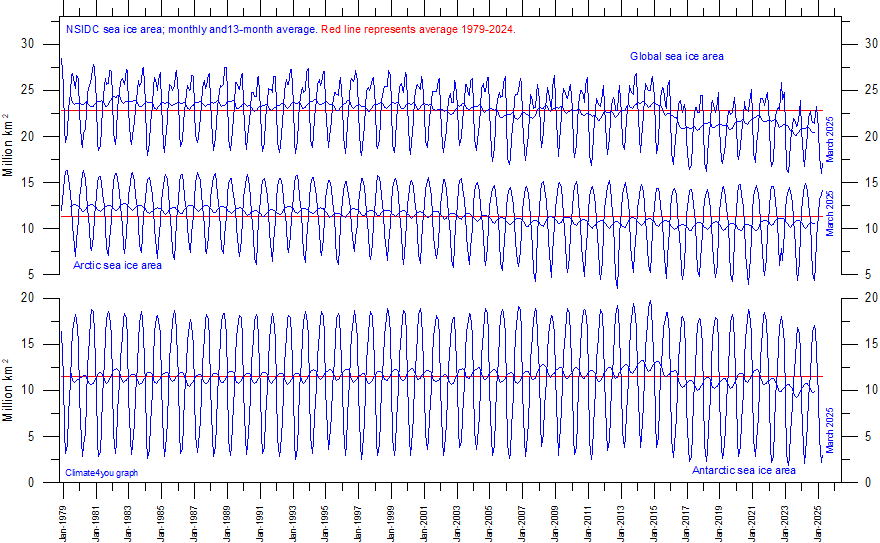
Skeptics did not create these graphs, but here's another one which shows that global sea ice extent is not unusually low :
http://www.climate4you.com/ima...As you can see from the above, global sea ice has recovered in recent years and is fairly close to what it was in the 80's. Maybe you should look before you leap.
Antarctic sea ice was at all time record highs for much of 2014, while Arctic sea ice hit a record low in 2012. Overall they pretty much cancel each other out.
(And shouldn't your graph look more like this?? http://woodfortrees.org/plot/n... )
-
Re:Bias: but for them - not me!
GISS has been shown to have a cooling bias by Cowtan+Way 2014. BEST shows the same. GISS is hardly an outlier. It's middle of the road.
Either way - even with RSS Tamino's method shows that there is no evidence that the 1970-2000 trend has slowed. So no- wrongo bongo.
As for sea ice, it's about average.
Ha! You can't see the forest if there's a tree that confirms your preconception. Your willing to dismiss this because we have reached 'average' during northern hemisphere winter? This is especially comical since 'average' on your chart is getting lower with each passing year. That is about the level of skepticism I've come to expect from deniers.
-
Re:Bias: but for them - not me!
GISS has been shown to have a cooling bias by Cowtan+Way 2014. BEST shows the same. GISS is hardly an outlier. It's middle of the road.
Either way - even with RSS Tamino's method shows that there is no evidence that the 1970-2000 trend has slowed. So no- wrongo bongo.
As for sea ice, it's about average.
Ha! You can't see the forest if there's a tree that confirms your preconception. Your willing to dismiss this because we have reached 'average' during northern hemisphere winter? This is especially comical since 'average' on your chart is getting lower with each passing year. That is about the level of skepticism I've come to expect from deniers.