Slashdot Mirror
Domain: wordpress.com
Stories and comments across the archive that link to wordpress.com.
Comments · 7,349
-
Re:Nine things that iDon't
And a Search of the iOS App Store came up with an impressive list of Programming utilities and IDEs for a wide variety of languages.
Before I spend hundreds on an iPad, keyboard, and app licenses with which to review the functionality of said "impressive list", how can the user import a project into one of these IDEs? Some reviews in the slideshow you linked mention exporting but not importing. Must all projects originate on the device? Or does the editor run locally and the testing run remotely, such as through SSH, X11, VNC, or RDP? If so, my use thereof would require an expensive mobile broadband subscription because city buses don't have Wi-Fi. The description of Kodiak PHP on page 3 of 12 of the slideshow bears this out:
Note that if you want to use a database (typically MySQL), it will be on an external server, not your iPad; you will need connectivity.
Likewise, the description of Textastic on page 5 of 12 allows offline testing only for a small fraction of the supported languages:
Textastic is a Textmate-compatible text, code, and markup language editor for the iPad with syntax highlighting for more than 80 programming and markup languages. [...] It can do local and remote Web preview for HTML and Markdown files, but it can't run any other kind of code internally.
Nearly half of the apps in the slideshow were ancillary tools useful to some developers, such as SSH (again, useless on the bus), UI design, and GitHub issue communication. But that's like saying Stack Exchange for iOS is a "programming app". That leaves Kodiak PHP, Codea, and Pythonista. Why do these get a free pass with respect to the rule whose current text is "nor may they download, install, or execute code, including other iOS, watchOS, Mac OS X, or tvOS apps"?
Launcher replacements
I guess Cromulent Labs' "Launcher" must be misnamed, then.
After six months of rejections under the rule whose current text is "Apps that create alternate desktop/home screen environments or simulate multi-app widget experiences will be rejected." Though it has since returned to the App Store, Apple's inconsistency in interpreting its own guidelines is likely to have a chilling effect on would-be developers of other launcher apps:
If developers don’t have explicit guidelines to go on [...], our only choice is to potentially waste huge amounts of time working on apps that ultimately get rejected in an attempt to find something that will get accepted. [...] When pressed on the issue of their policies leading to wasted developer time, I was told, "If you are afraid something you are working on will be rejected, then don’t work on it."
And it still can launch only those apps that expose a URL scheme.
WLAN utilities, such as utilities for troubleshooting your wireless network or for contributing to a collaborative map of wireless networks (Apple deems AP enumeration in iOS to be private)
My favorite is "Fing"
The screenshots on Fing's website make it look like a tool for scanning a WLAN to which you have already connected, not enumerating the SSIDs of WLANs whose beacons reach your device. The API for the former is public; the API for the latt
-
Re:good guys
Meh, at least some people are happy...
-
Re:Where is the news?
-
Re:Where you get the info from?
-
Re:As a left wing socialist
Citizen Dividend seem to be akin to state-guaranteed income for everyone.
It's a form of UBI, yes. A lot of people talk about handing out a fixed amount of money ($10,000/year) or funding the UBI from various taxes (a pure flat-tax system, carbon credits, a national sales tax); my Citizen's Dividend uses a general progressive system as today, and attaches a 17% flat tax to all taxable income (business and personal), which is then distributed evenly.
You are linking wice to the same impossible to understand spreadsheet
Sorry, I keep forgetting people can't understand the meaning of data even if the context is obvious. Those numbers are obviously tax computations on income. In particular, they're tax computations on the current take-home income after taxes compared to the take-home under a revised tax system including the Citizen's Dividend I outlined. Two-adult households have two Dividends (they're per-person) and, as stated at the top, dependents under 18 (children) of low-income families are eligible for public aid (food stamps, etc.); adults are essentially removed from the welfare system (except for naturalized Americans, who receive the Dividend as a non-refundable tax credit, and receive public aid if income is too low--this avoids any and all changes to the situation of immigrants who aren't workers, keeping the existing social safety net and not incentivising non-working immigration).
The second link was meant to go to a long blog post; I mispasted.
I'm currently working on a book covering policy economics, culminating in a full conceptual description of the Citizen's Dividend. This conceptual description includes an analysis of the retail market; description of the United States Federal and State spending and taxes; funding strategy; transitional risks, costs, and strategies; direct impacts on incomes; indirect impacts on jobs; and the long-term effects of the plan (job stabilization, automatic growth with national wealth and GDP-per-capita, etc.). Basically, a step-by-step design of the policy, and not a bill to submit to Congress.
That will take some time and rattle some cages. I call out a lot of flaws in modern economic policies and economists's positions; I've had actual economists agree with me and armchair economists get hella salty, and of course nobody will let me into a Ph.D. program to refine and then formally defend anything new. I've taken to just talking up a few Ph.D. holders and college professors and bouncing insights off them, then validating their disagreements (if any)--sometimes they're right; surprisingly, most academics deal with new ways of thinking about a problem in their field by giving no direct comment, or asking a bunch of questions. Most *students* just claim they read something different in a book once, so you're obviously wrong (this is why you need to vet everything before publishing a book: if you say anything technically-incorrect, some group of idiots will take it as new, brilliant insights).
One of the main contention points is scientific versus engineering economics: Solow-Swan successfully measures an economy's growth in terms of technical progress separate from population growth, necessarily by analyzing the input factors of land (ore, mines, etc.), labor (worker time), and capital (machines, knowledge); while I describe land and capital as products and moderators of labor, thus labor as the single production input factor. A lot of people argue that their textbooks don't say anything about that; other people try to argue that businesses have some other expense (ignoring that the next expense is a supplier's labor plus profit margin); and still others are stuck on theories of value (I don't believe in value as a property of a thing) and Marxism, which is... hilarious. Seriously. Marxists have some argument about how we should move off labor and onto
-
Re:frist post
From your data, I see deaths up a factor of 2.33, woundings up a factor of 3.1, and shootings up a factor of 2.26. From what to what, you say? From President Bush to President Obama. Perhaps President Obama's deliberate use of "divide and conquer" to politics and the "us vs. them" rhetoric he spews is the reason that mass shootings have greatly accelerated during his Administration?
Look at the spreadsheet again. The rate of increase of mass shootings has not accelerated. It started immediately after the Heller decision during the Ronald Reagan administration and has been on a steady increase ever since. Both in the number of mass shootings and the lethality.
Speaking of Reagan, here's a photo of him showing very poor trigger discipline, proving that he wasn't really a sportsman or gun enthusiast. He was just using the gun issue to crank up the yahoos. the same way he did with the welfare issue and the race issue.
-
Re:The discussion here is actually quite good.
Well the inverse is true as well, there really is no evidence that that the past warming will continue to dangerous levels a century from now as there hasn't been any warming for a little over 18 years now. There are some computer simulations that didn't predict the current warming hiatus, and none of those simulations have demonstrated any predictive ability.
Except that with 2014, 2015 and 2016* we will have 3 years in a row of the hottest year on record. How does that fit in with your "18 years of no warming"?
That you think the global climate models should be able to predict a warming hiatus just shows you don't understand what climate models are capable of. The effects of natural variability are currently impossible to predict ahead of time. Things like the dominance of La Ninas, a slightly higher rate of volcanic aerosols being produced and a slight drop in solar insolation combined to slightly reduce the rate of warming during the so called hiatus. If you pick out individual model runs that by coincidence happened to better match the natural variability of those 18 years (mostly matching the pattern of La Ninas) they match the evolution of temperatures over that period pretty well.
But in the long run the effects of natural variability tend to average out to a net effect of zero and that's what climate models do, model the climate effects over the long run. That's what climate models should be judged on, their projections over the long run. Since the classical climate period as defined by the World Meteorological Organization is 30 years that would be an appropriate period for them to be judged on.
One other comment on the so called hiatus, there has not been a significant change in the temperature trend by standard statistical tests. Here is an analysis by a statistician who used several different statistical techniques to try an find a statistically significant change in temperature trends. None of them showed a significant change.
*Yes, I know that 2016 isn't over yet but January through May of 2016 have been so hot globally (around 1.15 C anomaly) that the rest of the year would have to average a temperature anomaly below 0.66 C for it not to set a new record. That's extremely unlikely.
-
Re:As a left wing socialist
Now, what the hell is it doing on
Slashdot is full of liberal-libertarian wargarble largely in the vein of "money is economy" and "we can solve all our problems by hurting the rich". Basically, the response to poor people suffering is to attack the rich for being too well-off, with no explanation of how that helps. That attitude is what drove me largely toward economics; the tax impacts (WageTax sheet) of my Citizen's Dividend pisses people off for not terrorizing the rich, even though the impact on the poor is massive. (Of course, the hyper-conservatives on Slashdot hate this, too, because hand-outs are bad.)
You'll notice the yammer here is about ending deficit spending (not always a bad thing: if your deficit is smaller than your debt grows by inflation, your debt is getting smaller) by accusing the rich of being drug addicts and then taking away their money. Rich people bad. Bad bad bad.
-
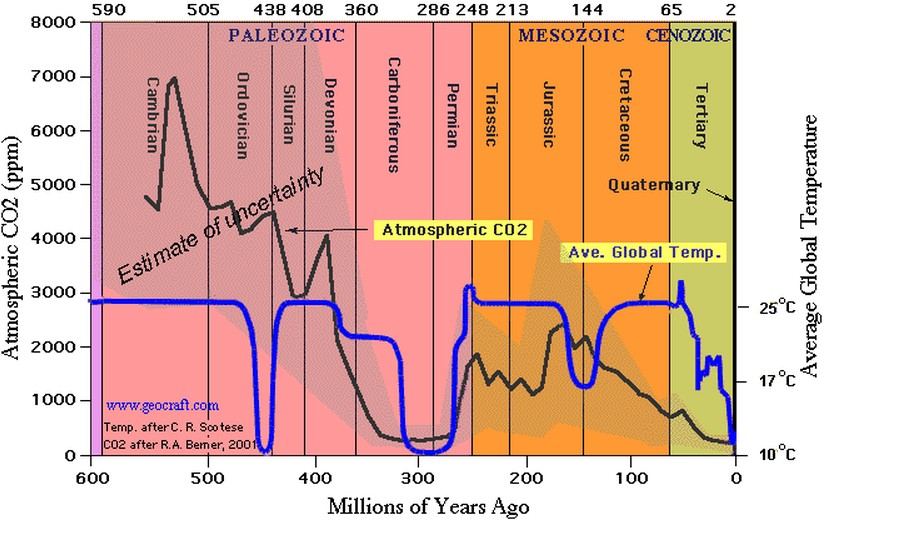
Like most of Earth's existence?
CO2 has been this low only once in the past 600+ million years - about 300 million years ago.
It has averaged probably 1,000-2,000 ppm, if not higher, for the past 200+ million years.
-
Some preliminary renders have leaked
Here is what the shopping robots will look like.
And here's a render of a typical Wal-Mart with the shop-bots in use.
And a close up of happy shoppers.
-
Re: Are foreign devices fully secure?
I'm not sure what our national costume [wikipedia.org] is here in the USA
That's easy. For men, it's
https://chrishernandezauthor.f...
and for women, it's this fetching ensemble:
-
Re: Are foreign devices fully secure?
I'm not sure what our national costume [wikipedia.org] is here in the USA
That's easy. For men, it's
https://chrishernandezauthor.f...
and for women, it's this fetching ensemble:
-
Re:An easier sollution
Civilian gun people actually tend to be better trained in the safe handling and accurate use, than police or soldiers.
Please join me on a virtual tour of poor trigger discipline. And these are all "gun enthusiasts" and "Second Amendment activists".
http://all-len-all.com/wp-cont...
http://i51.tinypic.com/derc7a....
http://www.armoryblog.com/wp-c...
https://41.media.tumblr.com/tu...
https://gunmart.files.wordpres...
Let's review:
Civilian gun people actually tend to be better trained in the safe handling and accurate use, than police or soldiers.
"Hobbyists tend to be better trained than professionals".
-
May 2016: hottest on record.
Hey ebv, I have an update on our global mean temperature bet. Last month was the hottest May on record. The year-so-far average global temperature is a whopping 1.15 C, well above the hottest full calendar year we’ve yet seen, 2015’s record-breaking 0.86 C. - https://tamino.wordpress.com/2...
-
Re:Guns
In Texas, bars prominently post a sign indicating the 51%. https://firingpins.wordpress.c...
-
Re:Tinder is a 'conspiracy'
Not quite. My premise is that we as a society pay the most we can afford for good health care, rather than the least we can manage, because we like to stay alive, and not in pain if possible.
I can disprove this in one shot.
Circa 1950, 25% of the average family's income paid for discretionary spending and entertainment; circa 2003, 44% spent on same. Health care spending raised from 5% to 6%.
To put this clearly: the median family freed up 20% of their income and used it to buy plasma TVs and gameboys, rather than luxury-class healthcare. That's not even correct: housing dropped by about 50%, and we spent the additional 14% of our income *plus* 5% more on buying bigger houses.
So out of 39% of our income freed up over 50 years, we directed 1% to buying more and better healthcare. The other 38% went to buying more toys and bigger houses in which to put those toys.
The combination of our strong survival instinct and the profit motive ensure new research is capitalized, and thus a steady stream of expensive-at-first new breakthroughs.
"Expensive-at-first" doesn't means it'll hit the market as expensive as the last breakthrough. You have both the consumer's unwillingness to spend literally half their income on medical insurance (they might buy into the medical care itself when needed; and we can get even-more-expensive treatments into any market by amortizing those unlikely costs via insurance) and the advances in technology lowering the cost of newer technologies.
Remember I said we produced a furnace that made 80,000 tonnes of iron for the same cost as making 400 tonnes of iron prior? We now have machines to build complex machine parts, and even computers to aid engineers in designing complex machines. The cost to develop and produce a complex steel machine today--a new piece of technology--is much lower than the cost to develop and produce a similar complex steel machine in 1790. That's technical progress lowering the cost of newer technologies.
So the next big break through in medicine, what? Gene therapy? It'll be based on synthetic genetics and retroviral treatment, which will be cheaper thanks to more effective DNA synthesis and more reliable retroviral design. Clone organs? The advances in gene therapy and underlying technology will make the new developments allowing cloned organs cheaper--the same technology, if discovered today, will be much more expensive than if we discover it some years down the line when all the basic technology of mucking about with genetics has been streamlined, even though the immediate process is no simpler. This is the pattern of technical progress.
It actually becomes difficult to invent extremely-expensive new technology. You have to come up with completely new, alien processes built on things we can only barely do or can't do at all. Once we've gained the ability to carry out all the underlying tasks, an expensive new piece of technology is just a large amount of small labor, instead of a large amount of large labor. That means "expensive" becomes relative.
-
Re:Scientists in Iceland
The Gulf Stream does not reach Iceland. The tail end of the North Atlantic Drift and the Irminger current bound us.
Our winters are fairly mild compared to our latitude, although certainly colder than Scotland, we're significantly further north in the same basin. Winter lows are generally what you might find in the mid to upper US great plains or northern New England. But winters are very long here, and very windy.
-
Re:Apples and pears
Actually, I think a lot of these social problems come from people with hate and without hope.
When do for example nazis get more power ? When there is more uncertainty. Where do people recruit terrorists, etc. ? Districts where people feel disassociated from the rest of society. These areas still exist today: https://en.wikipedia.org/wiki/... It's been more than 10 years now, things have hardly improved.
So part of the reason is a money problem.
I'm for something like UBI or at least really good social security (safety net) and improving the pay of people with medium income:
https://fabiusmaximus.files.wo...
https://fabiusmaximus.com/2015...It will boost the economy, because the people with medium income are the biggest spenders. Do you think a millionaire needs 10 000 jeans ? Or jeans 10 000 as expensive ? Nope, they are the biggest group. They are the consumers.
Ohh, improve education. That would also be on my list too. Why is education getting more and more expensive in western countries ? Are they really doing something completely different that we need to cut spending on that ?
-
Hosted Wordpress and vim
It's going to heavily depend on the functionality you need. You'd need to explain the needs and usage a bit more. Is there a reason you can't just let someone like wordpress.com run it for you? This alleviates all the headache of tracking down updates to 3rd party plugins, security errata etc. There's enough core functionality with the included plugins (they call them widgets) for most general website/CMS uses. You could try using the free option and if you want a custom domain and other stuff then pay for it.
Since others are mentioning it, on the topic of editors I prefer vim with a few plugins and tweaks.
-
Re: Well, it is either her or Trump.
Well for starters:
Illinois:
http://www.inquisitr.com/30220...
https://electionfraud2016.word...New York:
https://news.vice.com/article/...
http://www.inquisitr.com/30113...
http://usuncut.com/politics/so...Feel free to look up Arizona on your own.
-
Re:Well, it is either her or Trump.
Right now most of those voter numbers, that are very counter to the exit polls, are part of the desciption. How DNC is working hard to make sure all that money they got gets clinton elected.
https://electionfraud2016.word...
Basically they are using the information from Eric's Google invested information systems to know where to cheat voters. So if your district is polling high for Bernie expect you polls closed, the wrong forms mailed, and most definitely the wrong forms given to pollers. These forms are thrown away as not being correct in essence.
Every state and Peurto Rico. They(People in Power) are intending that when the dust settles she will be President and able to shut down any FBI investigation finding into, "her asking for Top Secret to be whited out" before faxing/emailing something to her personal residence.
At this point you are looking at advertising dollars, but the reality is much more sinister. Advertising dollars is a distraction in this story, its much more a Coup before the final elections. -
It is probably a compressor
Probably not noise cancelling since it needs much of the info in the environment to retain position info. More likely a compression algorithm that instead of looking like an upside down hockey stick (with input volume on x axis and output on y), it does a combination of adjustable upward compression on lower volumes and downward compression/brickwall limiting on higher volumes. This will attenuate loud events and boost background sound. Positional data would come from stereo mic pair, one on each ear, which would approximate the way ears do locational info.
-
Re:The problem is
Adjusted Gross Income (the amount of money on which businesses and individuals pay taxes--for businesses, we call it net profits). I did the math in 2013, and the cost of welfare was 17.2% of AGI while the Dividend was slightly-cheaper. I advocate a long-term fixed flat funding rate for the Dividend as a way to ensure the baseline standard-of-living grows at the exact same rate as the economy.
I did a lot of work identifying risks, costs, and transitional considerations, as well as generating a variety of long-term tax plans. The two major issues I'm still dealing with are a temporary top tax raise (I don't want the top tax bracket above 40%, but the blunt instant-transition is 43%; that actually puts $17,000 more income into the hands of consumers at an $80k income level, so a staged transition would reduce the shock as well as the peak) and a bootstrapping problem (if you start with $0, no friends, no charity, and no possessions, the first 3-4 months are financially-tight because utensils, pots, and pans cost a significant amount of money). It's viable, but not *perfect*.
The basic concept is on my blog. The only transitional consideration I've publicly addressed is Social Security retirement; I've put in some analysis of HUD in particular alongside this. Because the Dividend pays enough for food, clothing, and personal care, plus a remaining combined family (children) welfare system (1.4% cost) covers families with children, food stamps and related support are obviated; however, HUD recipients require continued assistance until the markets adjust to the availability of a stable income.
Notably, while I target the complete elimination of homelessness and hunger by creating a stable bottom-end consumer who can afford housing (224sqft per person), there are huge advantages to the working poor. HUD is a particular pain point, with 75% of Americans qualifying for HUD going directly and PERMANENTLY onto a waiting list and NEVER RECEIVING BENEFITS; and, despite food stamps, 50 million Americans live with food insecurity, not getting enough to eat every day. The lift for families on HUD would allow them to move into non-baseline housing (they have incomes, albeit low), and the transitional concerns are that such a move is natural *and* requires the market to locate, prepare, and market that housing.
There's also consumer market considerations outside the poorest of poor.
I did tax liability computations and found that, comparing to today's Federal taxes (including OASDI), my tax brackets leave the single-adult, minimum-wage household with $6,229 more take-home income; the two-adult, married-filing-jointly, one- or two-minimum-wage household with $14,600 +/- $50 additional take-home income; the two-adult, married-filing-jointly, median-income ($54,462) household with $12,892 additional take-home income; and some significant range of married-filing-jointly, two-adult households including the range of $80,000 to $144,000 (the top 10% Americans households make over $144,000) an additional $17,227.
Amusingly, a married-filing-jointly household with an $84,290 pre-tax income actually takes home exactly $84,290 (before state taxes). Below this, they take home more than their actual wage. Above this, they take home less.
At $1,000,000 anual income, your take-home is $9,126 higher; at $10,000,000, it's $116,874 lower (1.17% additional effective tax rate); and at $25,000,000, it's $326,874 lower (1.31% additional tax rate). Scaled to the median income ($54,462), an additional 1.31% tax would represent $713/year or $59/month in additional taxes; nevertheless, I consider such tax bumps unfortunate, and would want to move slowly into them and then reduce
-
Re:The problem is
Adjusted Gross Income (the amount of money on which businesses and individuals pay taxes--for businesses, we call it net profits). I did the math in 2013, and the cost of welfare was 17.2% of AGI while the Dividend was slightly-cheaper. I advocate a long-term fixed flat funding rate for the Dividend as a way to ensure the baseline standard-of-living grows at the exact same rate as the economy.
I did a lot of work identifying risks, costs, and transitional considerations, as well as generating a variety of long-term tax plans. The two major issues I'm still dealing with are a temporary top tax raise (I don't want the top tax bracket above 40%, but the blunt instant-transition is 43%; that actually puts $17,000 more income into the hands of consumers at an $80k income level, so a staged transition would reduce the shock as well as the peak) and a bootstrapping problem (if you start with $0, no friends, no charity, and no possessions, the first 3-4 months are financially-tight because utensils, pots, and pans cost a significant amount of money). It's viable, but not *perfect*.
The basic concept is on my blog. The only transitional consideration I've publicly addressed is Social Security retirement; I've put in some analysis of HUD in particular alongside this. Because the Dividend pays enough for food, clothing, and personal care, plus a remaining combined family (children) welfare system (1.4% cost) covers families with children, food stamps and related support are obviated; however, HUD recipients require continued assistance until the markets adjust to the availability of a stable income.
Notably, while I target the complete elimination of homelessness and hunger by creating a stable bottom-end consumer who can afford housing (224sqft per person), there are huge advantages to the working poor. HUD is a particular pain point, with 75% of Americans qualifying for HUD going directly and PERMANENTLY onto a waiting list and NEVER RECEIVING BENEFITS; and, despite food stamps, 50 million Americans live with food insecurity, not getting enough to eat every day. The lift for families on HUD would allow them to move into non-baseline housing (they have incomes, albeit low), and the transitional concerns are that such a move is natural *and* requires the market to locate, prepare, and market that housing.
There's also consumer market considerations outside the poorest of poor.
I did tax liability computations and found that, comparing to today's Federal taxes (including OASDI), my tax brackets leave the single-adult, minimum-wage household with $6,229 more take-home income; the two-adult, married-filing-jointly, one- or two-minimum-wage household with $14,600 +/- $50 additional take-home income; the two-adult, married-filing-jointly, median-income ($54,462) household with $12,892 additional take-home income; and some significant range of married-filing-jointly, two-adult households including the range of $80,000 to $144,000 (the top 10% Americans households make over $144,000) an additional $17,227.
Amusingly, a married-filing-jointly household with an $84,290 pre-tax income actually takes home exactly $84,290 (before state taxes). Below this, they take home more than their actual wage. Above this, they take home less.
At $1,000,000 anual income, your take-home is $9,126 higher; at $10,000,000, it's $116,874 lower (1.17% additional effective tax rate); and at $25,000,000, it's $326,874 lower (1.31% additional tax rate). Scaled to the median income ($54,462), an additional 1.31% tax would represent $713/year or $59/month in additional taxes; nevertheless, I consider such tax bumps unfortunate, and would want to move slowly into them and then reduce
-
Re:The problem is
Adjusted Gross Income (the amount of money on which businesses and individuals pay taxes--for businesses, we call it net profits). I did the math in 2013, and the cost of welfare was 17.2% of AGI while the Dividend was slightly-cheaper. I advocate a long-term fixed flat funding rate for the Dividend as a way to ensure the baseline standard-of-living grows at the exact same rate as the economy.
I did a lot of work identifying risks, costs, and transitional considerations, as well as generating a variety of long-term tax plans. The two major issues I'm still dealing with are a temporary top tax raise (I don't want the top tax bracket above 40%, but the blunt instant-transition is 43%; that actually puts $17,000 more income into the hands of consumers at an $80k income level, so a staged transition would reduce the shock as well as the peak) and a bootstrapping problem (if you start with $0, no friends, no charity, and no possessions, the first 3-4 months are financially-tight because utensils, pots, and pans cost a significant amount of money). It's viable, but not *perfect*.
The basic concept is on my blog. The only transitional consideration I've publicly addressed is Social Security retirement; I've put in some analysis of HUD in particular alongside this. Because the Dividend pays enough for food, clothing, and personal care, plus a remaining combined family (children) welfare system (1.4% cost) covers families with children, food stamps and related support are obviated; however, HUD recipients require continued assistance until the markets adjust to the availability of a stable income.
Notably, while I target the complete elimination of homelessness and hunger by creating a stable bottom-end consumer who can afford housing (224sqft per person), there are huge advantages to the working poor. HUD is a particular pain point, with 75% of Americans qualifying for HUD going directly and PERMANENTLY onto a waiting list and NEVER RECEIVING BENEFITS; and, despite food stamps, 50 million Americans live with food insecurity, not getting enough to eat every day. The lift for families on HUD would allow them to move into non-baseline housing (they have incomes, albeit low), and the transitional concerns are that such a move is natural *and* requires the market to locate, prepare, and market that housing.
There's also consumer market considerations outside the poorest of poor.
I did tax liability computations and found that, comparing to today's Federal taxes (including OASDI), my tax brackets leave the single-adult, minimum-wage household with $6,229 more take-home income; the two-adult, married-filing-jointly, one- or two-minimum-wage household with $14,600 +/- $50 additional take-home income; the two-adult, married-filing-jointly, median-income ($54,462) household with $12,892 additional take-home income; and some significant range of married-filing-jointly, two-adult households including the range of $80,000 to $144,000 (the top 10% Americans households make over $144,000) an additional $17,227.
Amusingly, a married-filing-jointly household with an $84,290 pre-tax income actually takes home exactly $84,290 (before state taxes). Below this, they take home more than their actual wage. Above this, they take home less.
At $1,000,000 anual income, your take-home is $9,126 higher; at $10,000,000, it's $116,874 lower (1.17% additional effective tax rate); and at $25,000,000, it's $326,874 lower (1.31% additional tax rate). Scaled to the median income ($54,462), an additional 1.31% tax would represent $713/year or $59/month in additional taxes; nevertheless, I consider such tax bumps unfortunate, and would want to move slowly into them and then reduce
-
Re:The most disgusting part..
A gold standard is patently the worst monetary system. Gold standards are deflationary: consumers become incapable of buying products like houses and cars because they can't access debt, due to debt growing over time (deflation). With the reduction in purchasing ability, the economy becomes more rigid, more risky, and less capable of creating jobs.
The best system is a fractional reserve system on fiat money. This allows controls on inflation: we can increase the money supply with both population and technology level to avoid prices going downward, and avoid infinite lending which would lead to money supply growing too much in excess with population-Union-technology and thus causing hyperinflation.
A zero-inflation economy is impossible because level of technology is not flat: we can improve food technology without improving medical technology, so food becomes cheaper relative to medicine; issuing more currency can get food back to its original price, and will make medicine's price increase. Inflation has to be positive or negative (deflation).
A money supply with reasonable inflation has
With inflation, debts become smaller over time. When you take a debt amortized over a long term (e.g. 30-years--note: I want to eliminate the 30-year mortgage in favor of a 10-year mortgage by taking an opportunistic approach the next time interest prime rates are ~14%), you establish an unchanging payment. At the time of origination, that payment is affordable; as time passes, inflation reduces the buying power of that payment and, in general, your income should go up (I get a 1.5%-2.5% raise each year, at least; the theory behind minimum wage increases and certain types of basic income establishes this at the base). Because the payment stays the same, it represents a smaller impact on your income over time, and a smaller amount of buying power.
Essentially, this means the consumer is capable of buying large goods (cars, houses), creating purchasing demand in those markets, supporting jobs and providing the consumer access to luxuries outside his basic level of wealth (i.e. cars are rich-people luxuries, but I can spend half my salary for the next 5 years on one RIGHT NOW and so cars are a common good among the lower-middle-class). The consumer benefits from inflation by his obligated payment shrinking in relation to his income; this, as a general result of an increasing per-capita income, is simply a part of inflation: X dollars loses buying power over time.
The odd part is the banks actually calculate out inflation and take a risk-based approach to setting interest rates. Their goal--usually achieved--is for the interest to outpace inflation. While the consumer gains an advantage in purchasing ability, the bank gains an advantage in profit. On the face, this means you're best off eliminating your loans quickly; however, even with such means, it can be better to hold the debt. In my case, I expend money to insulate my house and upgrade my heating system now, which, over the course of 3 years, saves me the *total* 15-year interest cost of my loan (it really is several thousand dollars). Even though the banks are profiting from me, I am profiting from the deal, as well.
Strange things most people don't understand.
-
Re:The most disgusting part..
You do realize that layoffs remove people who aren't necessary to produce the product being sold, right? The cost of wages is the base cost of all prices; it is not business, but the consumer who pays wages.
Labor reduction is a good thing. The labor force moves to other things. How do you think food keeps getting cheaper? From where do you think all the manufacture and services jobs came from? What money are Americans redirecting to the growing Healthcare sector to enjoy more and better healthcare?
The average family put 43% of their income to food in 1900, with 38% of the labor force working on farms. In 1950, it was 30% of our income with 12% of our labor force on the farms (and an additional chunk in the laboratories and factories making tractors, pesticides, fertilizers, and diesel fuel to support the farm worker). Today, we spend 11% of our income on food, with under 2% of our workers on the farm. How many poor families should be starving right now so that we could have avoided the elimination of 36% of our farm labor force, and should we give up healthcare or the Internet to support these excess and unnecessary farm workers?
-
Re:Wal-Mart wages
Even more funny given Walmarts Epic Fail in Germany, where they failed to compete against other discounters paying higher wages and providing more benefits.
-
Re:Bad arguments
I should add: our current economic model might not even last for an other 10 years. The former biggest spending group the 'medium wage' group is already failing behind: https://fabiusmaximus.files.wo...
-
Re:If not now...
I was more pointing at the "We just tax the company an additional 2080 hours at $8 per x the number of full-time equivalents(~20) that are now sitting at home" argument. That will lead to an increase in unemployment and a decrease in societal wealth, spreading poverty and harming the American worker.
Jobs aren't going away forever. We can mishandle the automation revolution and get 80% unemployment for 100 years, or we can cover ourselves by adjusting the tax structures and welfare systems to spread the job loss and increase the rate of job replacement so that unemployment only nudges up by a portion of a percent at any given time. If we do the latter, we'll hit maybe 5.2%-5.5% UE3, grit our teeth a little, and then roll back out of it into a world that looks
Let's think about that for a second.
In 1990, we didn't have air bags, traction control, bluetooth or satellite radio, and the like; antilock brakes weren't even standard on all cars. Cell phones were the subject of movies and children's toys--enormous, boxy things that somehow functioned as a car phone without the car, if you had thousands of dollars to spend. Late-90s cell phones were little plastic bricks with buttons and an LCD screen; caller ID was a nifty feature; and we had some kind of plastic magnetic tape to answer the phone and record messages if we weren't home. PCs cost $2,000 (about $3,600 today), had a multi-hundred-megabyte hard drive, and a 66mhz CPU; in 1997, the Intel Pentium 2 broke the Pentium Pro's 200MHz speed limit, coming to market at rates of 233MHz to 300MHz.
In 1990, the average family spent 15% of their income on food, and 6% on clothing.
Today, we spend 11% of our income on food, and 3.5% on clothing. New cars still sell for 56% of the buyer's income based on median statistics across income demographics; they now come with traction control, multi-CD changers, USB, bluetooth connectivity, sun roofs, independent suspension, disc brakes, and all manner of upgraded engine systems such as EFI and electric power steering. $800 (the equivalent of $437 in 1990) buys me a PC with high-speed graphics, 3GHz 4-core CPU, 16GB of RAM, and a 250GB SSD or a 6,000GB hard drive--60 thousand times the storage of what we had in 1990! I'm carrying around this ridiculously powerful smart phone in my pocket, 4 cores, 1.9GHz ARM, 2GB RAM, and a display resolution several times the dimensions and with 26 times the pixels as the monitor I used on my 486.
We spend a little more on healthcare now, and we get more and better healthcare. It is newly possible to eliminate all homelessness and hunger in America. All manner of things have become cheaper, all manner of new things have come about.
That's happened because we've found more efficient ways to do things. That's not only globalization, although that's a big part of it. In 1790, 90% of Americans were farm workers; in 1900, it was 38%; in 1950, 18%; and today, it's under 2%. In 1900, we spent 43% of our income on food; 1950, 30%; today, 11%. We're paying fewer workers for less labor hours because we've replaced farm workers with *fewer* farm workers driving diesel machines and using fertilizers and pesticides and intensive farming methods. Some of the jobs have been displaced to machinery, energy, and chemistry (hence 2% farmers, but 11% of money--we have to pay the chemists and machinists, too); others have been displaced to business, medicine (lots of healthcare...), and bagging my groceries.
All of that because
They've been chasing profits while the rest of us suffer.
-
Re:No studied necissary
Here is definitive proof that cell phones do not cause brain cancer. There is no correlation therefore no causation.
More cancer diagnoses in recent times + more precautions meaning less cancers + any other incidental changes which could cause less cancers during this period = the decrease may well hide a dramatic increase of cancers due to some specific causes.
The graph is also showing a significant variability over the years, and we're only talking about a total variation window of 7% over 17 years, while the cell phone use jumped 6,000,000,000% over this period. The difference of scale can thus be very misleading.
And finally, it is showing total mobile phone uses in the US, in minutes per day, thus reducing the visibility of any corner cases, and that is most notably, people who use mobile phones far more than the average.
Therefore, an absence of visible correlation on the bad graph, does not logically imply an absence of causation.
-
Re:I would like a simpler electric car
I did say about 40 moving parts. But here - you count the moving parts - https://louisdietvorst.files.w...
-
No studied necissary
Here is definitive proof that cell phones do not cause brain cancer. There is no correlation therefore no causation.
-
Re:Jingoism and Nativism
First, the benefits of free trade seem to go to the wealthy, not workers, for as of yet unknown reasons.
It's more that the benefits are weighted upward. That is to say: when the nation becomes 10% richer, the working class gets 8% of that, and the upper class gets 2%; but the upper class is the top 10%, so they, as a collective, get twice the proportion. Every one of us gets the ability to buy a car, they each get the ability to buy two cars.
This behavior makes progressive taxes possible and useful.
Second, comparative advantage removes diversification: you become a few- or one-product country, creating risk.
And it gives you access to things you otherwise wouldn't have at all, as well as higher degrees of wealth. This makes new risk mitigation possible. The expansion of wealth via technical progress is what has made labor-protecting tax plans like welfare systems and, ultimately, Basic Incomes possible, and the labor required for that expansion is more rapidly obtained by diverting the production of goods to the population which expends the least labor on such production.
The theory cannot handle inequality and bubbles properly. The cash bubbles, inequality, and de-diversification (C.A.) create more instability and domino effects of crashes, due to increased linkage of country economies.
False. These are unrelated.
Inequality is a natural consequence of the growth of wealth: rich people can be only so much richer than the average man that the cash they don't siphon off the basic needs of the working population and cause a labor force collapse. In poor societies, the rich can have slightly more than the poor--the poorest hunter-gatherer societies have an equal share access to all goods, and the wealth of authority concentrated in whoever can scream the loudest. In more wealthy societies, the economy can necessarily handle the rich taking more; and the population can grow larger, meaning the rich siphoning the same proportion from each of the poor leads to the rich having *much* more than the average poor person, creating enormous inequality gaps.
None of this relates to comparative advantage.
Protectionism may create some duplication (inefficiency), but that duplication is also a buffer from risk.
It creates cost risks by which you have fewer and less-effective contingencies when something bad happens because the amount of wealth is low and the amount of damage is high.
In the modern globalized system, we've gained enough wealth to institute a system under which a disturbance such as the 2008-2010 Great Recession would have been minor and short-lived; and we *did* experience the dot-com bust, the automaker's collapse, and the housing market collapse without triggering similar recessions (the housing market collapse came before the general financial market collapse, and was buffered by months; the 2008 Great Recession was a much larger general recession).
Because of the amount of wealth, the cost of a basic income system such as a Citizen's Dividend has fallen below the cost of public aid. Such a system allows for tax plans which do not require the raising of business or personal income taxes, and which drive the employee's take-home pay closer to the employee's per-hour wage-labor cost. Simultaneously, expending labor in the most-efficient way distributes wage-labor hours over a larger amount of production: you get paid $10/hr, but in that hour you make 1.5 times as much stuff, thus all that stuff costs 2/3 as much and you are no poorer--really, richer, because things are cheaper yet you have as m
-
Re:Jingoism and Nativism
First, the benefits of free trade seem to go to the wealthy, not workers, for as of yet unknown reasons.
It's more that the benefits are weighted upward. That is to say: when the nation becomes 10% richer, the working class gets 8% of that, and the upper class gets 2%; but the upper class is the top 10%, so they, as a collective, get twice the proportion. Every one of us gets the ability to buy a car, they each get the ability to buy two cars.
This behavior makes progressive taxes possible and useful.
Second, comparative advantage removes diversification: you become a few- or one-product country, creating risk.
And it gives you access to things you otherwise wouldn't have at all, as well as higher degrees of wealth. This makes new risk mitigation possible. The expansion of wealth via technical progress is what has made labor-protecting tax plans like welfare systems and, ultimately, Basic Incomes possible, and the labor required for that expansion is more rapidly obtained by diverting the production of goods to the population which expends the least labor on such production.
The theory cannot handle inequality and bubbles properly. The cash bubbles, inequality, and de-diversification (C.A.) create more instability and domino effects of crashes, due to increased linkage of country economies.
False. These are unrelated.
Inequality is a natural consequence of the growth of wealth: rich people can be only so much richer than the average man that the cash they don't siphon off the basic needs of the working population and cause a labor force collapse. In poor societies, the rich can have slightly more than the poor--the poorest hunter-gatherer societies have an equal share access to all goods, and the wealth of authority concentrated in whoever can scream the loudest. In more wealthy societies, the economy can necessarily handle the rich taking more; and the population can grow larger, meaning the rich siphoning the same proportion from each of the poor leads to the rich having *much* more than the average poor person, creating enormous inequality gaps.
None of this relates to comparative advantage.
Protectionism may create some duplication (inefficiency), but that duplication is also a buffer from risk.
It creates cost risks by which you have fewer and less-effective contingencies when something bad happens because the amount of wealth is low and the amount of damage is high.
In the modern globalized system, we've gained enough wealth to institute a system under which a disturbance such as the 2008-2010 Great Recession would have been minor and short-lived; and we *did* experience the dot-com bust, the automaker's collapse, and the housing market collapse without triggering similar recessions (the housing market collapse came before the general financial market collapse, and was buffered by months; the 2008 Great Recession was a much larger general recession).
Because of the amount of wealth, the cost of a basic income system such as a Citizen's Dividend has fallen below the cost of public aid. Such a system allows for tax plans which do not require the raising of business or personal income taxes, and which drive the employee's take-home pay closer to the employee's per-hour wage-labor cost. Simultaneously, expending labor in the most-efficient way distributes wage-labor hours over a larger amount of production: you get paid $10/hr, but in that hour you make 1.5 times as much stuff, thus all that stuff costs 2/3 as much and you are no poorer--really, richer, because things are cheaper yet you have as m
-
Re:Jingoism and Nativism
First, the benefits of free trade seem to go to the wealthy, not workers, for as of yet unknown reasons.
It's more that the benefits are weighted upward. That is to say: when the nation becomes 10% richer, the working class gets 8% of that, and the upper class gets 2%; but the upper class is the top 10%, so they, as a collective, get twice the proportion. Every one of us gets the ability to buy a car, they each get the ability to buy two cars.
This behavior makes progressive taxes possible and useful.
Second, comparative advantage removes diversification: you become a few- or one-product country, creating risk.
And it gives you access to things you otherwise wouldn't have at all, as well as higher degrees of wealth. This makes new risk mitigation possible. The expansion of wealth via technical progress is what has made labor-protecting tax plans like welfare systems and, ultimately, Basic Incomes possible, and the labor required for that expansion is more rapidly obtained by diverting the production of goods to the population which expends the least labor on such production.
The theory cannot handle inequality and bubbles properly. The cash bubbles, inequality, and de-diversification (C.A.) create more instability and domino effects of crashes, due to increased linkage of country economies.
False. These are unrelated.
Inequality is a natural consequence of the growth of wealth: rich people can be only so much richer than the average man that the cash they don't siphon off the basic needs of the working population and cause a labor force collapse. In poor societies, the rich can have slightly more than the poor--the poorest hunter-gatherer societies have an equal share access to all goods, and the wealth of authority concentrated in whoever can scream the loudest. In more wealthy societies, the economy can necessarily handle the rich taking more; and the population can grow larger, meaning the rich siphoning the same proportion from each of the poor leads to the rich having *much* more than the average poor person, creating enormous inequality gaps.
None of this relates to comparative advantage.
Protectionism may create some duplication (inefficiency), but that duplication is also a buffer from risk.
It creates cost risks by which you have fewer and less-effective contingencies when something bad happens because the amount of wealth is low and the amount of damage is high.
In the modern globalized system, we've gained enough wealth to institute a system under which a disturbance such as the 2008-2010 Great Recession would have been minor and short-lived; and we *did* experience the dot-com bust, the automaker's collapse, and the housing market collapse without triggering similar recessions (the housing market collapse came before the general financial market collapse, and was buffered by months; the 2008 Great Recession was a much larger general recession).
Because of the amount of wealth, the cost of a basic income system such as a Citizen's Dividend has fallen below the cost of public aid. Such a system allows for tax plans which do not require the raising of business or personal income taxes, and which drive the employee's take-home pay closer to the employee's per-hour wage-labor cost. Simultaneously, expending labor in the most-efficient way distributes wage-labor hours over a larger amount of production: you get paid $10/hr, but in that hour you make 1.5 times as much stuff, thus all that stuff costs 2/3 as much and you are no poorer--really, richer, because things are cheaper yet you have as m
-
Re:risk appetite and risk tolerance are subjective
You might want to adopt early to immediately assess the risk, to understand the nature of operations.
We call those pilots, and they're done on a small scale and considered a sub-optimal cost paid to gain organizational knowledge so as to improve the strategic decisions made later.
You might to add the additional cost of an early transition because the transition can give you an edge (in terms of quality or quantity) against competitors.
Adopting a young technology early in its viability lifetime tends to put you in a position where you have to absorb a lot of cost and hold out for a long-term ROI; and then, when your competitor invests in the same technology 2-3 years later, their absolute minimum prices to break even are lower than yours, and you can't drop you prices to meet theirs without filing Chapter 11 (you don't have to Chapter 7 if you can continue business operations if you can restructure your debt well enough to keep operating). You are now behind, and you are doomed to be behind for the next decade or so.
A not-so-perfect analogy of swallowing upfront costs as a strategic move is Amazon selling its Kindle Fire line of products at a lost.
That's a *FALSE* analogy. Razor-and-blade or loss-leader model sells two separate goods as a combined good: the razor is sold at a loss, and the consumer will *necessarily* buy the blades continuously as a consumable, thus the amortized profit on the blades makes up for the loss on the razor. That's different from making an up-front investment which should provide lower operating costs: loss-leaders are a revenue strategy, while business process management focuses on production cost strategies.
It is at this point that we need to stop looking at this purely from a private business or economics point of view, and look at this as a matter of social/national policy.
I'm actually functioning on my own economic theories because I needed a theory specifically designed for policy development. It's what I do.
the possibility of adopting some form of basic income
Citizen's Dividend is the most optimum model. We can represent public-aid welfare costs as 55% of the total Federal income taxes collected; merge OASDI with the tax brackets, cut each tax bracket by that proportion, lay down a 17% flat tax along side, and then adjust them to smooth the total curve. That essentially locks the Dividend to a proportion of the GDP per capita, which necessarily grows continuously and doesn't fluctuate down too badly even in the worst recessions. That means as we get wealthier, the poorest of poor become wealthier in exactly the same proportion; and so long as the fluctuation doesn't take that Dividend payment down below the viability point (which becomes less likely over time), it can't fail as a safety net. At a point, a recession which breaks the Dividend would necessarily break the economy as a whole--no welfare system survives that.
have a national policy for the continuing education of our workforce - including moving focus away from 4-year college education and into vocational/adult training.
I do not agree with the state-supported workforce development model. It is a handout to businesses at the expense of individuals; it removes small risks from businesses and converts them to *enormous* risks on individuals; and it wastes a lot of labor time providing worthless job training (because we over-supply job markets and wind up with unemployed people who instead could have been trained in something else, thus the
-
Re:If not now...
Normally, we replace a high-labor process with a lower-labor one and make cost savings, leading to a reduction of prices, leaving more money in consumer pockets, allowing more purchasing, creating new jobs to make the new stuff we're buying.
Why would it leave more money in consumer pockets? Why should the corporation reduce prices if they don't have to? They can merely increase profits for themselves.
Sure, a fully automated competitor of McDonald's might be able to try to compete with them on price, but good luck with that. As the market shows us all the time, even better and cheaper products have a hard time competing against a very valuable and established brand. So, there really is no point in the competition (or McDonald's) to reduce prices any time soon.
-
Re:If not now...
Continuing to pay workers less than a living wage is already damaging society
False premise.
There are better ways to handle this
which have huge impacts on the poor. Non-wage solutions stabilize the job market by narrowing the gap between job elimination to technical progress and job creation from consumer buying power increases (which come as prices lag behind inflation). Fixed solutions respond to technical growth by continuously making the poorest-of-poor more wealthy and, since around 2013, can reliably eliminate all homelessness and hunger in the United States.
We can raise the ratio of consumer take-home pay to employer wage-labor cost *without* raising business income taxes and without excessive taxes on the wealthy (I've pushed the top bracket from 39.6% to 43%, and have transitional mitigation plans to roll that out slowly and then back it out back to sub-40%, trying to avoid actually hitting that 43% top end). This can have secondary effects, such as a necessary reduction of the working week to 32 hours (I structured an example plan that causes ~118% employment demand, requiring everyone to become 20% poorer from that frame of reference... easy enough: cut their hours by 20%, unemployment rises to 5.6%).
There's something important here.
Continuing to pay workers less than a living wage
Compare to:
raise the ratio of consumer take-home pay to employer wage-labor cost
If you raise minimum wage, you *necessarily* *reduce* *employment*. I explain this frequently. For the employment to recover, the buying power lost to consumers must return, which means inflation must suppress those wages again (wages rise more slowly than inflation), spreading the jobs out again.
Without any alternative, this is a simple proposition: The many suffer, or the few become the Child of Omelas. You throw those people out of their jobs, let them starve, and let the many who remain live better, because 10,000 people jobless and starving quickly is better than 3,000,000 people working themselves to death and starving slowly. Through the 1900s, minimum wage increases have been a good solution.
We now have an alternative, and it's damned cheap. Transitioning from a minimum wage and public aid system to a dividend is readily facilitated by deducting the dividend from public aid: welfare costs are less dividend costs, which means, until the market has adjusted to the stable income source, grandfathered old-age pensions get split between a supplemental, phasing-out OA pension and the Dividend as a top-off; unemployment almost entirely goes away *immediately*; HUD costs get cut back dramatically; and food stamps become practically unnecessary. To eliminate the risk of abuse, children (and naturalized American adults) are still covered by a full public aid system (food stamps, etc. via EBT), which costs 1.4% of AGI (compared to more than 17% in 2013 for the full public aid system).
Immediately, for minimum wage workers, that bumps a 1-adult, single-filer household from $15,047 to $21,276 take-home, roughly equivalent to a minimum wage increase from $8.25/hr to $11.67/hr. For a two-adult household, single or married, the bump is to $29,689 take-home or roughly a current wage of $16.28/hr. Regardless of any other argument about my financial considerations and my grasp of economics, you can't deny that impact. All of that without raising labor costs (actually
-
Re:If not now...
Continuing to pay workers less than a living wage is already damaging society
False premise.
There are better ways to handle this
which have huge impacts on the poor. Non-wage solutions stabilize the job market by narrowing the gap between job elimination to technical progress and job creation from consumer buying power increases (which come as prices lag behind inflation). Fixed solutions respond to technical growth by continuously making the poorest-of-poor more wealthy and, since around 2013, can reliably eliminate all homelessness and hunger in the United States.
We can raise the ratio of consumer take-home pay to employer wage-labor cost *without* raising business income taxes and without excessive taxes on the wealthy (I've pushed the top bracket from 39.6% to 43%, and have transitional mitigation plans to roll that out slowly and then back it out back to sub-40%, trying to avoid actually hitting that 43% top end). This can have secondary effects, such as a necessary reduction of the working week to 32 hours (I structured an example plan that causes ~118% employment demand, requiring everyone to become 20% poorer from that frame of reference... easy enough: cut their hours by 20%, unemployment rises to 5.6%).
There's something important here.
Continuing to pay workers less than a living wage
Compare to:
raise the ratio of consumer take-home pay to employer wage-labor cost
If you raise minimum wage, you *necessarily* *reduce* *employment*. I explain this frequently. For the employment to recover, the buying power lost to consumers must return, which means inflation must suppress those wages again (wages rise more slowly than inflation), spreading the jobs out again.
Without any alternative, this is a simple proposition: The many suffer, or the few become the Child of Omelas. You throw those people out of their jobs, let them starve, and let the many who remain live better, because 10,000 people jobless and starving quickly is better than 3,000,000 people working themselves to death and starving slowly. Through the 1900s, minimum wage increases have been a good solution.
We now have an alternative, and it's damned cheap. Transitioning from a minimum wage and public aid system to a dividend is readily facilitated by deducting the dividend from public aid: welfare costs are less dividend costs, which means, until the market has adjusted to the stable income source, grandfathered old-age pensions get split between a supplemental, phasing-out OA pension and the Dividend as a top-off; unemployment almost entirely goes away *immediately*; HUD costs get cut back dramatically; and food stamps become practically unnecessary. To eliminate the risk of abuse, children (and naturalized American adults) are still covered by a full public aid system (food stamps, etc. via EBT), which costs 1.4% of AGI (compared to more than 17% in 2013 for the full public aid system).
Immediately, for minimum wage workers, that bumps a 1-adult, single-filer household from $15,047 to $21,276 take-home, roughly equivalent to a minimum wage increase from $8.25/hr to $11.67/hr. For a two-adult household, single or married, the bump is to $29,689 take-home or roughly a current wage of $16.28/hr. Regardless of any other argument about my financial considerations and my grasp of economics, you can't deny that impact. All of that without raising labor costs (actually
-
Re:If not now...
Continuing to pay workers less than a living wage is already damaging society
False premise.
There are better ways to handle this
which have huge impacts on the poor. Non-wage solutions stabilize the job market by narrowing the gap between job elimination to technical progress and job creation from consumer buying power increases (which come as prices lag behind inflation). Fixed solutions respond to technical growth by continuously making the poorest-of-poor more wealthy and, since around 2013, can reliably eliminate all homelessness and hunger in the United States.
We can raise the ratio of consumer take-home pay to employer wage-labor cost *without* raising business income taxes and without excessive taxes on the wealthy (I've pushed the top bracket from 39.6% to 43%, and have transitional mitigation plans to roll that out slowly and then back it out back to sub-40%, trying to avoid actually hitting that 43% top end). This can have secondary effects, such as a necessary reduction of the working week to 32 hours (I structured an example plan that causes ~118% employment demand, requiring everyone to become 20% poorer from that frame of reference... easy enough: cut their hours by 20%, unemployment rises to 5.6%).
There's something important here.
Continuing to pay workers less than a living wage
Compare to:
raise the ratio of consumer take-home pay to employer wage-labor cost
If you raise minimum wage, you *necessarily* *reduce* *employment*. I explain this frequently. For the employment to recover, the buying power lost to consumers must return, which means inflation must suppress those wages again (wages rise more slowly than inflation), spreading the jobs out again.
Without any alternative, this is a simple proposition: The many suffer, or the few become the Child of Omelas. You throw those people out of their jobs, let them starve, and let the many who remain live better, because 10,000 people jobless and starving quickly is better than 3,000,000 people working themselves to death and starving slowly. Through the 1900s, minimum wage increases have been a good solution.
We now have an alternative, and it's damned cheap. Transitioning from a minimum wage and public aid system to a dividend is readily facilitated by deducting the dividend from public aid: welfare costs are less dividend costs, which means, until the market has adjusted to the stable income source, grandfathered old-age pensions get split between a supplemental, phasing-out OA pension and the Dividend as a top-off; unemployment almost entirely goes away *immediately*; HUD costs get cut back dramatically; and food stamps become practically unnecessary. To eliminate the risk of abuse, children (and naturalized American adults) are still covered by a full public aid system (food stamps, etc. via EBT), which costs 1.4% of AGI (compared to more than 17% in 2013 for the full public aid system).
Immediately, for minimum wage workers, that bumps a 1-adult, single-filer household from $15,047 to $21,276 take-home, roughly equivalent to a minimum wage increase from $8.25/hr to $11.67/hr. For a two-adult household, single or married, the bump is to $29,689 take-home or roughly a current wage of $16.28/hr. Regardless of any other argument about my financial considerations and my grasp of economics, you can't deny that impact. All of that without raising labor costs (actually
-
Re:If not now...
Continuing to pay workers less than a living wage is already damaging society
False premise.
There are better ways to handle this
which have huge impacts on the poor. Non-wage solutions stabilize the job market by narrowing the gap between job elimination to technical progress and job creation from consumer buying power increases (which come as prices lag behind inflation). Fixed solutions respond to technical growth by continuously making the poorest-of-poor more wealthy and, since around 2013, can reliably eliminate all homelessness and hunger in the United States.
We can raise the ratio of consumer take-home pay to employer wage-labor cost *without* raising business income taxes and without excessive taxes on the wealthy (I've pushed the top bracket from 39.6% to 43%, and have transitional mitigation plans to roll that out slowly and then back it out back to sub-40%, trying to avoid actually hitting that 43% top end). This can have secondary effects, such as a necessary reduction of the working week to 32 hours (I structured an example plan that causes ~118% employment demand, requiring everyone to become 20% poorer from that frame of reference... easy enough: cut their hours by 20%, unemployment rises to 5.6%).
There's something important here.
Continuing to pay workers less than a living wage
Compare to:
raise the ratio of consumer take-home pay to employer wage-labor cost
If you raise minimum wage, you *necessarily* *reduce* *employment*. I explain this frequently. For the employment to recover, the buying power lost to consumers must return, which means inflation must suppress those wages again (wages rise more slowly than inflation), spreading the jobs out again.
Without any alternative, this is a simple proposition: The many suffer, or the few become the Child of Omelas. You throw those people out of their jobs, let them starve, and let the many who remain live better, because 10,000 people jobless and starving quickly is better than 3,000,000 people working themselves to death and starving slowly. Through the 1900s, minimum wage increases have been a good solution.
We now have an alternative, and it's damned cheap. Transitioning from a minimum wage and public aid system to a dividend is readily facilitated by deducting the dividend from public aid: welfare costs are less dividend costs, which means, until the market has adjusted to the stable income source, grandfathered old-age pensions get split between a supplemental, phasing-out OA pension and the Dividend as a top-off; unemployment almost entirely goes away *immediately*; HUD costs get cut back dramatically; and food stamps become practically unnecessary. To eliminate the risk of abuse, children (and naturalized American adults) are still covered by a full public aid system (food stamps, etc. via EBT), which costs 1.4% of AGI (compared to more than 17% in 2013 for the full public aid system).
Immediately, for minimum wage workers, that bumps a 1-adult, single-filer household from $15,047 to $21,276 take-home, roughly equivalent to a minimum wage increase from $8.25/hr to $11.67/hr. For a two-adult household, single or married, the bump is to $29,689 take-home or roughly a current wage of $16.28/hr. Regardless of any other argument about my financial considerations and my grasp of economics, you can't deny that impact. All of that without raising labor costs (actually
-
Re:If not now...
I didn't make that assumption; I made some examples of time scales. It is a good assumption that robots will improve at a certain pace and then slow down, and thus that getting in early and getting in late are both bad timing.
-
Re:Cool
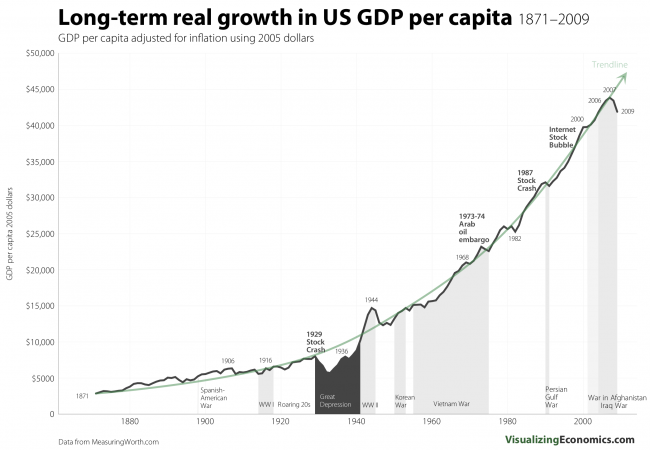
If you do it slowly enough, the fast food prices won't rise as quickly as inflation, and consumer buying power will increase. That's what actually happens. To buy more stuff, we need more workers--operating the machines, of course--which means new jobs. We spend a smaller proportion of our income on the stuff we buy now, and the remainder goes to new things--since the 80s, we've moved our money from food and clothing onto more and better healthcare, as well as smart phones and electronic entertainment; and houses have gotten bigger, while cars have gained luxury, performance, and safety features while remaining roughly 56% of the median income.
If you do it quickly, you get an unemployment spike, which damages the economy. The bigger the spike, the longer it takes to recover, and the poorer your society comes out of it.
If you do it poorly, you get rough destruction of wealth. Raising minimum wage already concentrates wealth into a poor elite--some minimum-wage workers get richer, all other consumers become poorer, and we lose jobs: The cost of a burger increasing by 17 cents, with 282 billion burgers sold per year, is $50 million; that's over 3,000 $8.25/hr jobs. Raising minimum wage such that the old wage was cheaper than a machine *and* the new wage is more expensive ($8.25 wage becomes $15 wage; machine is $9.50) eliminates the minimum wage jobs and exchanges in more-expensive machines, so your economy takes it both ways.
A lot of people can't grok this because it's a continuous-operation function. Basically, people reason, "Hey, but the minimum-wage worker has more money to spend, and so you wouldn't lose any jobs!" By such reasoning, you have infinite money, and thus infinite jobs, and we are all fabulously wealthy (we are, but that's not the point). You have so much income *per* *time*, and the cost of purchasing certain goods increases, and so the number of goods increased *per* *time* decreases, thus the jobs decrease. Again: doubling down on this kind of damage by making wage workers non-competitive with machines is bad.
It gets even worse: normally, product price increases occur slightly more slowly than inflation for products whose costs have decreased. That is to say: If you displace 10% of the labor cost of making a hamburger, that hamburger will approach 1.8 times the price after 100% inflation--10% of its price doesn't keep up. As this money returns to the consumer, the consumer base becomes capable of paying the wage of another worker, and thus can buy new products. If you've pushed up the cost of labor, then it takes *longer* for those two things to intersect, and so the transitional period of unemployment extends: jobs lost to technical progress take more time to become new jobs.
So you're de-employing workers *quickly* (unemployment coming more rapidly); you're increasing the cost of goods instead of decreasing it (setting the far point of technical progress growth years farther out); and you're making human labor more expensive (requiring much more purchasing power movement back to the consumer's hands before replacement jobs are created--and reducing the total replacement jobs possible).
That's a recipe for an economic disaster and a permanent feedback loop to make a society poorer. It's one of the reasons I push for a Citizen's Dividend that migrates costs off wage-labor (reduce payroll taxes and replace minimum wage raises with a non-wage income basis): that plan increases the number of consumer take-home dollars per employer wage-labor dollars paid to have an employee. You can describe that as "decreasing costs" or "increasing consumer buying power"; if you stare long enough, you realize the two things are eventually the same.
Technical progress is what makes the middle-class, the poor, *and* the rich richer. It's what's given us the ability to *afford* modern healthcare, high-speed internet, wireless ph
-
Re:If not now...
They're going to replace employees with robots anyhow, I don't buy that increasing the minimum wage to whatever has anything to do with it.
Businesses have risk appetite and risk tolerance. Risk appetite is how much money they want to throw in a hole for a likely conversion to more money; risk tolerance is the point at which they will not throw more money into the hole because the return--whether or not it's coming--is sinking the ship too hard, and they're no longer interested in trying to squeeze out more promised droplets of gold.
Because of risk appetite, different businesses will implement labor-reducing changes at different times. Sure, you have an $8.25/hr employee now, and the machine costs $8/hr; but next year the machine should compare to a $7.25/hr employee, and in three years it should compare to a $5.50/hr employee. It seems to me that, over the ten-year period, you will come out with a higher profit if you wait three years before deploying expensive machines. These are $35,000 machines replacing $16,500 employees, so you need a little over 2 years to get a break-even ROI (replace benefits with maintenance).
To some businesses, switching onto machines right away seems like a good idea. Poor foresight I guess. Other businesses will vary between how they roll out--how long to delay, how fast to carry out the roll-out, etc. That means moving everyone out of their jobs and getting machines in here could take a decade or more if wages are competitive with machines and we believe machines will get cheaper. The risk of moving onto machines isn't offset by the 25 cents savings, and the potential return for paying that 25 cents for the next few years is that you turn it into a 4 dollar savings instead.
This breaks when you suddenly make labor expensive.
Now instead of $8.25/hr vs $8/hr, you're doing $15/hr vs $8/hr. In one year, avoiding the 25 cent savings means $500 per employee per year; but at $15/hr, you're losing $7,000 per employee per year for not going in right now. That's going to hit risk tolerances a lot faster, and jobs are going away much more rapidly in those conditions.
It's even worse if machines are *more* expensive than people: you get the price increase that comes with, say, $11/hr (machine) labor, but you fire a bunch of $8.25/hr human labor. Normally, we replace a high-labor process with a lower-labor one and make cost savings, leading to a reduction of prices, leaving more money in consumer pockets, allowing more purchasing, creating new jobs to make the new stuff we're buying. If the machines are more expensive than wage-workers before the wage bump, then costs go *up*, and consumer ability to buy goes *down*: rather than reacting to the reduction of jobs by creating new jobs, the consumer base reacts to the increase in cost by not being able to financially support the wages of *even* *more* *jobs*.
In 1790, 90% of Americans laborers (in a ~58% labor force) were farmers; we've replaced most of them with machines, and they now make up 2% of the labor force, and about 11% of consumer spending in total goes toward food to cover those farmers, the people building and maintaining farm equipment, logistics and sales moving that kind of thing, chemical companies making fertilizers and pesticides, and oil mining and refining to get the fuel for energy to drive all this. That means 18% of the labor involved in making food is on the farm, and 82% is in supporting infrastructure. You'll notice we don't have an 82% unemployment rate today; and automated fast food won't destroy our job market unless the method by which we transition is damaging--which this particular method *is*.
-
Re:Malware trick
https://github.com/WindowsLies/BlockWindows https://blockwindows.wordpress...
Wow! Has everyone on here taken STUPID PILLS today?!?
I want to know if I have ALREADY BEEN INFECTED in my WINDOWS 7 INSTALLATION with the TELEMETRY MALWARE, NOT, repeat NOT HOW TO STOP IT!
FFS. -
Re:Thinner and lighter...
Apple really is stagnating. Watch the 2014 Keynote when they introduce the "new" Mac mini. The hype and bullet points are misleading.
They wrote "PCIe-based flash storage" as if that was the default setup but they're still putting slow 5400 RPM in their computers, the flash storage is optional in all models. I would have been happier to see even only 120GB flash storage in the low-end rather than a slow 5400 RPM hard drive.
The fact that the low-end model is only 1.4GHz and that RAM is soldered on-board means that you absolutely need to buy a more expensive model right out of the gate, making the mini more expensive than it really needs to be. I was able to go from 4GB, then 8GB and now 16GB in my 2010 mini and I also removed the optical drive to add a 7200 RPM WD Black in the second bay. The only thing I'm not able to update is the old Core 2 Duo CPU. All those extra expenses were done over the course of 6 years, I would never have been able to pay the total price in 2010.
-
Re:If I were Apple I would buy East Texas
Samsung may not be willing to sell it to Apple.
Quick google, but examples abound: https://ipcloseup.wordpress.co... -
Re:Hide the decline
no where did I find them agreeing with your 89% figure
The article cites the figure and then proceeds to explain, why it is acceptable — without disputing the number. In other words, they accept it. The article (known as Watts 2009) is thus entered into evidence.
no where does it say that primary raw temperature data has been lost, just that the CRU does not have it any more
Had a copy still existed somewhere, they would've procured one to avoid the embarrassment. And it was a major scandal — two months later NY Times ran a "rebuttal" (the dishonest newspaper's first mention of the problem, apparently), which still would not say, other copies exist. You are grasping at straws — and drowning anyway.
80 mm is right at the top of the uncertainty range in the graph
You wrote yourself, that the prediction was 50-60 mm, while the actual values — according to, once again, you — was 80mm. That's a fail... You may recall, that one of the rules I put down was that the cited predictions, if quantifiable, be correct within 20% of the predicted figure(s).
Don't you consider it significant that real world observations have been greater than predictions?
It may be significant, but it is unclear, of what. That the seas are rising may be observable and measurable (preferably without "weighting" and "adjusting" the observed figures, of course). That they are rising because SUVs — that is not clear at all.
10 thousand years ago Tasmania — already home to some humans — was cut off of mainland Australia by rising seas. A few thousand years earlier ancestors of Kodiak bears became separated from mainland grizzlies — by rising seas (or, maybe, the melting ice — another phenomenon blamed on humans today). Kodiaks are now a distinct subspecies... Humans crossed into Americas over what is now a straights, but was a land bridge until seas rose .
Were all those calamities due to the crime of Prometheus, perhaps?
Climate scientists today blame humanity with the intensity of ancient shamans. But, to establish their scientific bona-fides to people actually familiar with scientific process, they need to make scientific predictions — verifiable, falsifiable, as well as verified and not falsified. And that's where my challenge and your (so far — failing) attempts to answer it come in...
I am collaborating with no one.
I'll take your word for it. Most comforting, thanks.
-
Re:That list...
Nobody cares if Taliban wants to call school teachers terrorists, because we know, and they know that's bullshit. We just care what they DO, and what they do is try to scare people into conducting their lives the way their religious say they should. Beard police! No dancing! Fly kites and die!
Indeed, a better example of relevancy probably comes from western perspectives about brainwashing in public > schools.
Why look to an outside group that is widely dismissed already, when you have ones here at home pushing their own message? The question is, who is full of bullshit?
PS, don't worry about the Colonies not having representation in the British Parliament, inhabitants of England didn't, even the rotten boroughs weren't eliminated for another few decades and true suffrage was even longer in developing.
Of course, the US has its own problems with representation today.