Slashdot Mirror
Domain: wordpress.com
Stories and comments across the archive that link to wordpress.com.
Comments · 7,349
-
Re:lawsuit
Again, here are the self-driving technology levels. Where would you say were are currently on that list? What do you think it will take to get to level 4?
-
Re:lawsuit
Here's the self-driving technology level list. Which level would you say we are at with current technology?
-
Re:Climate Change
Don't give up smoking until the xrays show a tumor.
I think I'll get a 100th opinion.
-
Re:There should be some need for new grads
The problem is we are reaching a tipping point where cheap machine labor will soon be able to replace all repetative labor which simply relies on having vision, manual dexterity, or even smart but not creative thinking work.
Maybe. We did this before, and got 80% unemployment and an economic disaster. That's just a matter of speed: we constantly unemploy and re-employ people; we just do it slowly, so we lose maybe 1% over the time it takes to create new jobs for those 1%. If we lose 30% over the time it takes to create jobs, we might create jobs faster--which doesn't help if we create jobs for 3% of them in that time, but end up with 27% standing unemployment.
The trend is accelerating so the next 20 years are going to be a period of rapid employment destruction.
We can slow it. That's one of the biggest goals of my Citizen's Dividend plan. The excessive cost of labor under a system reliant on minimum wage is why a minimum wage and public aid system is obsolete. If you look back, you'll quickly understand why the Dividend wasn't the right system in the past.
A Dividend lets us eliminate a minimum wage and provides some income, which helps control labor costs by lowering effective taxes. That has a middling effect: for a large range, I suggest tax rates which actively reduce marginal income tax, thus allowing lower wages with the same paycheck take-home; and the income from the Dividend also reduces the worker's demand for wages, but not by the full measure of the Dividend itself. $4/hr may be a comfortable living if you're already getting a few extra dollars's worth of wages, but you might still decide you need at least $5.50 for it to be worth your time and effort--even though you'd normally demand at least $7 because of living expenses.
Fortunately, the income gap always grows, which lets us make clever use of progressive taxes to reduce taxes on the working class over time without raising taxes on businesses or high-income earners. That helps reduce wages: if you're getting taxed half as much and we reduce your paycheck by a bit more than the difference, you come out even, while your employer pays you much less. That means the machines have to cost less if they're going to compete with you, and all the stuff you buy costs less to make, and so can be sold cheaper, and so you actually come out richer.
All these effects stretch out the long-term schedule for automation deployment.
robots which cost close to the poverty line and by automated processes which are a little more expensive but which are tax deductible capital expenses to create.
The end goal isn't toxic, but the transition can be devastating if it happens too fast. The Industrial Revolution is essentially the same problem. As I showed above: we can slow the transition. That doesn't just kick the can down the road; it affects the entire dynamic of the economic change.
Adoption comes via three main archetypes: the early adopters; the strategic speculators; and the traditionalists.
Early adopters are the people you describe. They'll see the machines are more efficient and cost the same or less, in terms of TCO, compared to labor. That means a $1 million machine that operates for 25 years with fueling (electricity) and maintenance costs of $84,800/year costs as much as five full-time laborers making $12/hr wage. If it can do their job for that cost, the early adopters will buy it. New technology. Some will even jump in earlier, reasoning that $84,000 is less than the $125,000 in wa
-
Re:There should be some need for new grads
The problem is we are reaching a tipping point where cheap machine labor will soon be able to replace all repetative labor which simply relies on having vision, manual dexterity, or even smart but not creative thinking work.
Maybe. We did this before, and got 80% unemployment and an economic disaster. That's just a matter of speed: we constantly unemploy and re-employ people; we just do it slowly, so we lose maybe 1% over the time it takes to create new jobs for those 1%. If we lose 30% over the time it takes to create jobs, we might create jobs faster--which doesn't help if we create jobs for 3% of them in that time, but end up with 27% standing unemployment.
The trend is accelerating so the next 20 years are going to be a period of rapid employment destruction.
We can slow it. That's one of the biggest goals of my Citizen's Dividend plan. The excessive cost of labor under a system reliant on minimum wage is why a minimum wage and public aid system is obsolete. If you look back, you'll quickly understand why the Dividend wasn't the right system in the past.
A Dividend lets us eliminate a minimum wage and provides some income, which helps control labor costs by lowering effective taxes. That has a middling effect: for a large range, I suggest tax rates which actively reduce marginal income tax, thus allowing lower wages with the same paycheck take-home; and the income from the Dividend also reduces the worker's demand for wages, but not by the full measure of the Dividend itself. $4/hr may be a comfortable living if you're already getting a few extra dollars's worth of wages, but you might still decide you need at least $5.50 for it to be worth your time and effort--even though you'd normally demand at least $7 because of living expenses.
Fortunately, the income gap always grows, which lets us make clever use of progressive taxes to reduce taxes on the working class over time without raising taxes on businesses or high-income earners. That helps reduce wages: if you're getting taxed half as much and we reduce your paycheck by a bit more than the difference, you come out even, while your employer pays you much less. That means the machines have to cost less if they're going to compete with you, and all the stuff you buy costs less to make, and so can be sold cheaper, and so you actually come out richer.
All these effects stretch out the long-term schedule for automation deployment.
robots which cost close to the poverty line and by automated processes which are a little more expensive but which are tax deductible capital expenses to create.
The end goal isn't toxic, but the transition can be devastating if it happens too fast. The Industrial Revolution is essentially the same problem. As I showed above: we can slow the transition. That doesn't just kick the can down the road; it affects the entire dynamic of the economic change.
Adoption comes via three main archetypes: the early adopters; the strategic speculators; and the traditionalists.
Early adopters are the people you describe. They'll see the machines are more efficient and cost the same or less, in terms of TCO, compared to labor. That means a $1 million machine that operates for 25 years with fueling (electricity) and maintenance costs of $84,800/year costs as much as five full-time laborers making $12/hr wage. If it can do their job for that cost, the early adopters will buy it. New technology. Some will even jump in earlier, reasoning that $84,000 is less than the $125,000 in wa
-
Re:There should be some need for new grads
The problem is we are reaching a tipping point where cheap machine labor will soon be able to replace all repetative labor which simply relies on having vision, manual dexterity, or even smart but not creative thinking work.
Maybe. We did this before, and got 80% unemployment and an economic disaster. That's just a matter of speed: we constantly unemploy and re-employ people; we just do it slowly, so we lose maybe 1% over the time it takes to create new jobs for those 1%. If we lose 30% over the time it takes to create jobs, we might create jobs faster--which doesn't help if we create jobs for 3% of them in that time, but end up with 27% standing unemployment.
The trend is accelerating so the next 20 years are going to be a period of rapid employment destruction.
We can slow it. That's one of the biggest goals of my Citizen's Dividend plan. The excessive cost of labor under a system reliant on minimum wage is why a minimum wage and public aid system is obsolete. If you look back, you'll quickly understand why the Dividend wasn't the right system in the past.
A Dividend lets us eliminate a minimum wage and provides some income, which helps control labor costs by lowering effective taxes. That has a middling effect: for a large range, I suggest tax rates which actively reduce marginal income tax, thus allowing lower wages with the same paycheck take-home; and the income from the Dividend also reduces the worker's demand for wages, but not by the full measure of the Dividend itself. $4/hr may be a comfortable living if you're already getting a few extra dollars's worth of wages, but you might still decide you need at least $5.50 for it to be worth your time and effort--even though you'd normally demand at least $7 because of living expenses.
Fortunately, the income gap always grows, which lets us make clever use of progressive taxes to reduce taxes on the working class over time without raising taxes on businesses or high-income earners. That helps reduce wages: if you're getting taxed half as much and we reduce your paycheck by a bit more than the difference, you come out even, while your employer pays you much less. That means the machines have to cost less if they're going to compete with you, and all the stuff you buy costs less to make, and so can be sold cheaper, and so you actually come out richer.
All these effects stretch out the long-term schedule for automation deployment.
robots which cost close to the poverty line and by automated processes which are a little more expensive but which are tax deductible capital expenses to create.
The end goal isn't toxic, but the transition can be devastating if it happens too fast. The Industrial Revolution is essentially the same problem. As I showed above: we can slow the transition. That doesn't just kick the can down the road; it affects the entire dynamic of the economic change.
Adoption comes via three main archetypes: the early adopters; the strategic speculators; and the traditionalists.
Early adopters are the people you describe. They'll see the machines are more efficient and cost the same or less, in terms of TCO, compared to labor. That means a $1 million machine that operates for 25 years with fueling (electricity) and maintenance costs of $84,800/year costs as much as five full-time laborers making $12/hr wage. If it can do their job for that cost, the early adopters will buy it. New technology. Some will even jump in earlier, reasoning that $84,000 is less than the $125,000 in wa
-
Re:There should be some need for new grads
The problem is we are reaching a tipping point where cheap machine labor will soon be able to replace all repetative labor which simply relies on having vision, manual dexterity, or even smart but not creative thinking work.
Maybe. We did this before, and got 80% unemployment and an economic disaster. That's just a matter of speed: we constantly unemploy and re-employ people; we just do it slowly, so we lose maybe 1% over the time it takes to create new jobs for those 1%. If we lose 30% over the time it takes to create jobs, we might create jobs faster--which doesn't help if we create jobs for 3% of them in that time, but end up with 27% standing unemployment.
The trend is accelerating so the next 20 years are going to be a period of rapid employment destruction.
We can slow it. That's one of the biggest goals of my Citizen's Dividend plan. The excessive cost of labor under a system reliant on minimum wage is why a minimum wage and public aid system is obsolete. If you look back, you'll quickly understand why the Dividend wasn't the right system in the past.
A Dividend lets us eliminate a minimum wage and provides some income, which helps control labor costs by lowering effective taxes. That has a middling effect: for a large range, I suggest tax rates which actively reduce marginal income tax, thus allowing lower wages with the same paycheck take-home; and the income from the Dividend also reduces the worker's demand for wages, but not by the full measure of the Dividend itself. $4/hr may be a comfortable living if you're already getting a few extra dollars's worth of wages, but you might still decide you need at least $5.50 for it to be worth your time and effort--even though you'd normally demand at least $7 because of living expenses.
Fortunately, the income gap always grows, which lets us make clever use of progressive taxes to reduce taxes on the working class over time without raising taxes on businesses or high-income earners. That helps reduce wages: if you're getting taxed half as much and we reduce your paycheck by a bit more than the difference, you come out even, while your employer pays you much less. That means the machines have to cost less if they're going to compete with you, and all the stuff you buy costs less to make, and so can be sold cheaper, and so you actually come out richer.
All these effects stretch out the long-term schedule for automation deployment.
robots which cost close to the poverty line and by automated processes which are a little more expensive but which are tax deductible capital expenses to create.
The end goal isn't toxic, but the transition can be devastating if it happens too fast. The Industrial Revolution is essentially the same problem. As I showed above: we can slow the transition. That doesn't just kick the can down the road; it affects the entire dynamic of the economic change.
Adoption comes via three main archetypes: the early adopters; the strategic speculators; and the traditionalists.
Early adopters are the people you describe. They'll see the machines are more efficient and cost the same or less, in terms of TCO, compared to labor. That means a $1 million machine that operates for 25 years with fueling (electricity) and maintenance costs of $84,800/year costs as much as five full-time laborers making $12/hr wage. If it can do their job for that cost, the early adopters will buy it. New technology. Some will even jump in earlier, reasoning that $84,000 is less than the $125,000 in wa
-
Re:Yes
You know if you actually crunch the numbers, you find that Corporate Income taxes shield people from individual taxes, we'd be better off not taxing corporations, so individuals would pay more individually and put a 25% tax on dividends to non-US taxpayers.
Taxing individuals more individually is a way to increase the cost of labor, thus raising the cost of products. Raising the cost of products reduces the amount of products that consumers can purchase with their income, thus reducing the amount of products you can profit by producing. Reducing the amount of production reduces the amount of required labor. Reducing the amount of labor means reducing jobs.
That's a primary feature of my musings on public policy. It's one of the reasons I like progressive tax systems.
-
Re:the new slow dummies in the left lane
Socrates lived in a time when the sum total of human knowledge was a little fraction of what we know today, and this it was a lot easier to get up to the state of the art in several fields. Sure, we should question experts, but on average, the risk of rationalising our snap judgement with half-understood facts and simplified sound bites is not insignificant. The expert is not always right, but he usually comes closer to the truth than a non-expert.
That's no excuse for turning off the thinking part of your brain and being a twit. You can accomplish greatthings when you do a little thinking. In my case, I have economic theories that don't match with mainstream politics or contemporary economics, such as the observation that labor costs affect employment rates--one of the reasons I push for a Citizen's Dividend instead of a minimum wage and public-aid system, which lowers taxes and has positive impacts on retirement funding. This is also why I see the growing gap of income inequality as a good thing, since I can make use of it to cut back taxes on labor, thus incurring all those nice benefits like lowering the minimum price of all products, increasing employment, and possibly causing the full-time work week to shrink to 32 hours (figure that one out).
I don't have a fancy economics degree; I've cataloged a ton of information in my head, and at some point started organizing it. This is what happened. There are holes; I don't get how exchange rates work, among other things. I've come up with a few rough theories for those, and need more time to work them into something that fits in consistently with existing observations. It'll never be wholly correct, but it's not right until it appears to work under scrutiny.
It gets checked against contemporary theories, looking for observations I haven't made, looking for holes, looking for places where they were wrong; often I realize these people weren't wrong, but rather painfully close, like with Adam Smith asserting that the only way to work more efficiently is to divide tasks into smaller fractions spread among more people, rather than to invent new tools and techniques that may optimize processes (assembly line vs cellular manufacture: same tools, same laborers, different floor plan, less wandering back and forth carrying half-finished parts) or simply figure a way to get an end result in fewer major steps (technically, *consolidating* labor. Smith wasn't wrong; he just veered off at the end, observing the improvement of efficiency by doing more work with the same labor and then specifying it as division, instead of just the raw observation that more production per labor time creates wealth. He also was writing a theory of value, trying to explain the correct price of products instead of describing economic movement in general.
One thing I've learned in my life: math is a tool, not a framework. If people try to define non-mathematical things by math, reject that and look for a plain-words explanation. It probably won't be a simple one--simple explanations just gloss over complexities--but the mathematics behind quantum physics aren't as important as the basic concepts of how quantum mechanics works. If you know all the math, but not the mechanics, you're a Chinese Room: someone can hand you a paper with a lot of squiggles, you can pull out your dictionary and write down a correct response, but you don't really understand the conversation you're having. If you have the mechanics but not the math, then you can't be an engineer; you *can* be a theorist. Theorists are the ones who figure out where w
-
Re:the new slow dummies in the left lane
Socrates lived in a time when the sum total of human knowledge was a little fraction of what we know today, and this it was a lot easier to get up to the state of the art in several fields. Sure, we should question experts, but on average, the risk of rationalising our snap judgement with half-understood facts and simplified sound bites is not insignificant. The expert is not always right, but he usually comes closer to the truth than a non-expert.
That's no excuse for turning off the thinking part of your brain and being a twit. You can accomplish greatthings when you do a little thinking. In my case, I have economic theories that don't match with mainstream politics or contemporary economics, such as the observation that labor costs affect employment rates--one of the reasons I push for a Citizen's Dividend instead of a minimum wage and public-aid system, which lowers taxes and has positive impacts on retirement funding. This is also why I see the growing gap of income inequality as a good thing, since I can make use of it to cut back taxes on labor, thus incurring all those nice benefits like lowering the minimum price of all products, increasing employment, and possibly causing the full-time work week to shrink to 32 hours (figure that one out).
I don't have a fancy economics degree; I've cataloged a ton of information in my head, and at some point started organizing it. This is what happened. There are holes; I don't get how exchange rates work, among other things. I've come up with a few rough theories for those, and need more time to work them into something that fits in consistently with existing observations. It'll never be wholly correct, but it's not right until it appears to work under scrutiny.
It gets checked against contemporary theories, looking for observations I haven't made, looking for holes, looking for places where they were wrong; often I realize these people weren't wrong, but rather painfully close, like with Adam Smith asserting that the only way to work more efficiently is to divide tasks into smaller fractions spread among more people, rather than to invent new tools and techniques that may optimize processes (assembly line vs cellular manufacture: same tools, same laborers, different floor plan, less wandering back and forth carrying half-finished parts) or simply figure a way to get an end result in fewer major steps (technically, *consolidating* labor. Smith wasn't wrong; he just veered off at the end, observing the improvement of efficiency by doing more work with the same labor and then specifying it as division, instead of just the raw observation that more production per labor time creates wealth. He also was writing a theory of value, trying to explain the correct price of products instead of describing economic movement in general.
One thing I've learned in my life: math is a tool, not a framework. If people try to define non-mathematical things by math, reject that and look for a plain-words explanation. It probably won't be a simple one--simple explanations just gloss over complexities--but the mathematics behind quantum physics aren't as important as the basic concepts of how quantum mechanics works. If you know all the math, but not the mechanics, you're a Chinese Room: someone can hand you a paper with a lot of squiggles, you can pull out your dictionary and write down a correct response, but you don't really understand the conversation you're having. If you have the mechanics but not the math, then you can't be an engineer; you *can* be a theorist. Theorists are the ones who figure out where w
-
Re:the new slow dummies in the left lane
Socrates lived in a time when the sum total of human knowledge was a little fraction of what we know today, and this it was a lot easier to get up to the state of the art in several fields. Sure, we should question experts, but on average, the risk of rationalising our snap judgement with half-understood facts and simplified sound bites is not insignificant. The expert is not always right, but he usually comes closer to the truth than a non-expert.
That's no excuse for turning off the thinking part of your brain and being a twit. You can accomplish greatthings when you do a little thinking. In my case, I have economic theories that don't match with mainstream politics or contemporary economics, such as the observation that labor costs affect employment rates--one of the reasons I push for a Citizen's Dividend instead of a minimum wage and public-aid system, which lowers taxes and has positive impacts on retirement funding. This is also why I see the growing gap of income inequality as a good thing, since I can make use of it to cut back taxes on labor, thus incurring all those nice benefits like lowering the minimum price of all products, increasing employment, and possibly causing the full-time work week to shrink to 32 hours (figure that one out).
I don't have a fancy economics degree; I've cataloged a ton of information in my head, and at some point started organizing it. This is what happened. There are holes; I don't get how exchange rates work, among other things. I've come up with a few rough theories for those, and need more time to work them into something that fits in consistently with existing observations. It'll never be wholly correct, but it's not right until it appears to work under scrutiny.
It gets checked against contemporary theories, looking for observations I haven't made, looking for holes, looking for places where they were wrong; often I realize these people weren't wrong, but rather painfully close, like with Adam Smith asserting that the only way to work more efficiently is to divide tasks into smaller fractions spread among more people, rather than to invent new tools and techniques that may optimize processes (assembly line vs cellular manufacture: same tools, same laborers, different floor plan, less wandering back and forth carrying half-finished parts) or simply figure a way to get an end result in fewer major steps (technically, *consolidating* labor. Smith wasn't wrong; he just veered off at the end, observing the improvement of efficiency by doing more work with the same labor and then specifying it as division, instead of just the raw observation that more production per labor time creates wealth. He also was writing a theory of value, trying to explain the correct price of products instead of describing economic movement in general.
One thing I've learned in my life: math is a tool, not a framework. If people try to define non-mathematical things by math, reject that and look for a plain-words explanation. It probably won't be a simple one--simple explanations just gloss over complexities--but the mathematics behind quantum physics aren't as important as the basic concepts of how quantum mechanics works. If you know all the math, but not the mechanics, you're a Chinese Room: someone can hand you a paper with a lot of squiggles, you can pull out your dictionary and write down a correct response, but you don't really understand the conversation you're having. If you have the mechanics but not the math, then you can't be an engineer; you *can* be a theorist. Theorists are the ones who figure out where w
-
Re:the new slow dummies in the left lane
Socrates lived in a time when the sum total of human knowledge was a little fraction of what we know today, and this it was a lot easier to get up to the state of the art in several fields. Sure, we should question experts, but on average, the risk of rationalising our snap judgement with half-understood facts and simplified sound bites is not insignificant. The expert is not always right, but he usually comes closer to the truth than a non-expert.
That's no excuse for turning off the thinking part of your brain and being a twit. You can accomplish greatthings when you do a little thinking. In my case, I have economic theories that don't match with mainstream politics or contemporary economics, such as the observation that labor costs affect employment rates--one of the reasons I push for a Citizen's Dividend instead of a minimum wage and public-aid system, which lowers taxes and has positive impacts on retirement funding. This is also why I see the growing gap of income inequality as a good thing, since I can make use of it to cut back taxes on labor, thus incurring all those nice benefits like lowering the minimum price of all products, increasing employment, and possibly causing the full-time work week to shrink to 32 hours (figure that one out).
I don't have a fancy economics degree; I've cataloged a ton of information in my head, and at some point started organizing it. This is what happened. There are holes; I don't get how exchange rates work, among other things. I've come up with a few rough theories for those, and need more time to work them into something that fits in consistently with existing observations. It'll never be wholly correct, but it's not right until it appears to work under scrutiny.
It gets checked against contemporary theories, looking for observations I haven't made, looking for holes, looking for places where they were wrong; often I realize these people weren't wrong, but rather painfully close, like with Adam Smith asserting that the only way to work more efficiently is to divide tasks into smaller fractions spread among more people, rather than to invent new tools and techniques that may optimize processes (assembly line vs cellular manufacture: same tools, same laborers, different floor plan, less wandering back and forth carrying half-finished parts) or simply figure a way to get an end result in fewer major steps (technically, *consolidating* labor. Smith wasn't wrong; he just veered off at the end, observing the improvement of efficiency by doing more work with the same labor and then specifying it as division, instead of just the raw observation that more production per labor time creates wealth. He also was writing a theory of value, trying to explain the correct price of products instead of describing economic movement in general.
One thing I've learned in my life: math is a tool, not a framework. If people try to define non-mathematical things by math, reject that and look for a plain-words explanation. It probably won't be a simple one--simple explanations just gloss over complexities--but the mathematics behind quantum physics aren't as important as the basic concepts of how quantum mechanics works. If you know all the math, but not the mechanics, you're a Chinese Room: someone can hand you a paper with a lot of squiggles, you can pull out your dictionary and write down a correct response, but you don't really understand the conversation you're having. If you have the mechanics but not the math, then you can't be an engineer; you *can* be a theorist. Theorists are the ones who figure out where w
-
Re:Yes
Ouch! No income tax! Income tax is the best type of tax ever invented--because all taxes are income tax. Sales taxes just take part of your income later. There are some interesting side-effects produced when implementing income taxes.
-
Re:Poor planning
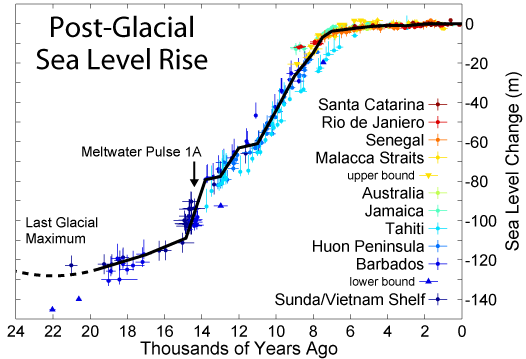
The GP isn't even really correct. Sea level rise was rapid 10,000 years ago during deglaciation, but has been fairly flat for the last 8,000 years or so.... until recently where we've seen accelerated sea level rise.
-
Re: Municipal WiFi was such a successYep, obviously not much of a reader... Let's try this one more time:
The claim made by Bert64 above was, taxpayers paid for the infrastructure.
Bert64 would not substantiate that claim. Can you?
No, they did not
Your link describes, how the US government forced Bell Labs to allow other companies to connect to their network. It says nothing to substantiate your earlier claim:
It was the evil government that standardized the network.
Which is not surprising, because the standards were Bell Labs', not the government's — contrary to your earlier statements.
why don't you man up
Ouch, that was so sexist, bigoted, hurtful and hateful, I must retreat to my safe zone. Fuck you, hater!
-
Re: Tourist Attractions
I feel that way about nuclear. But windmills have been around hundreds of years, and have been generating power for decades. They are a blight on the landscape. The Columbia River Gorge used to be beautiful, now it all looks like this: https://carrgroup.files.wordpr...
You can hardly find an unspoiled view anymore. At night the landscape for a hundred miles looks like a giant blinking Christmas Tree, the lame kind where all the lights flash on and off in unison. -
Re:Private sector will always do it better.
I don't need video games either. I still like them.
The usefulness to society as a whole for certain people having certain things is not a given, even if those things are useful to those people. It's useful to *me* to have access to Dice to get jobs making $135k; when I was 19, I could have gotten a job at McDonalds. While it's perfectly possible for me to end up poor and unemployed for a while--and guaranteed that some people with my or other high-dollar skills are currently living as such--it's less likely that I'd be walled-off from such employment with no car and no phone; even less likely that I wouldn't be able to dig my way out by getting a job at McDonalds for a while and buying a phone; and pretty much guaranteed--thanks to public college--that society as a whole has wasted its wealth making more people capable of doing my job than we can employ, thus ensuring that someone else (who is currently poor and hopeless) will only get their chance at a good job if I (or someone else) fall out of my job and get stuck as a poor kid.
That doesn't mean municipal broadband is definitely useless; it just means that such an argument of its virtues by way of giving people opportunities and thus strengthening our society is *trivially* dismissed. You need to show some other reason it's beneficial, rather than just a cost lumbered onto the backs of everyone for no real benefit at the expense of making us all slightly poorer.
Do note that making us *all* slightly poorer has the immediate primary effect of making it harder for the least-well-off to get jobs, and those of them who have base-level jobs get a lower standard of living. They're the first ones to feel the pressure.
Economics isn't a zero-sum game. Some actions cost us a pile of wealth and return a bigger pile; others return a smaller pile. Those actions don't operate by their own virtue, but rather by their relationship to the system. Change the system--it changes all the time--and you get a different outcome.
I'll give you a good example: I want to replace our welfare system with a Citizen's Dividend, which will directly end all homelessness and hunger in the United States while creating jobs, lowering the cost of goods, reducing taxes, and raising the standard of living. This would be a very bad idea in the 1950s. Here's why.
We can also go into the philosophy of choices: every choice involves giving something up. Do you want a chocolate bar or a peanut butter cup? Whichever one you choose, you lose the other. Even if you can choose both, you get excess calories; do you want to be fat, or do you want to eat candy? Maybe you can exchange your time spent leisurely arguing with idiots on Twitter with time spent gagging and coughing as you run yourself ragged doing high-speed laps around the gym in a desperate attempt to burn off the candy bar so you don't get fat, which would lower your body fat enough to do a couple sit-ups and develop chick-attracting abs--a state you'll get to faster if you eat less chocolate and more chicken.
In economics, the choices are analyzed further: how do you give up one thing in exchange for something bigger? Put your time in doing something upfront that allows you to do *more* of what you sacrificed in the long term, thus not actually making a material choice in long terms, but rather taking both.
In this case, economics tells us we are in one of two conditions: either municipal broadband provides an economic benefit which increases or at least does not decrease standard-of-living, or municipal broadband provides a single benefit to standard-of-living at the expense of the general standard-of-living. In the first situation, we enact that choice because it provides a total benefit; in the second, we can give you an XBox, but we have to take away your bicycle and your gameboy batteries. A single action doesn't define the outcome; the action in the surrounding condi
-
Re:Typo
he was a widely respected University of Chicago faculty member writing in Slate.
FTFY.
Don't laugh.
He's going to be President of the University and get promoted to editor for Slate.
This kind of "thinking" is rampant in wackademia and "progressive" publications.
Jail for visiting a web page? Hell, how about death penalty for not toeing the line on climate change?
Hell, maybe he can be President and use an unconstitutional big-brother list to take away another Constitutionally-guaranteed right?
-
Re:Private sector will always do it better.
Political idealism aside, I actually can't think of any "obvious benefits". I mean, there aren't even any obvious benefits to government healthcare: it takes a good bit of analysis to figure out if state healthcare is more or less expensive, and then you have to figure out if it's *affordable* or if it inflicts crippling poverty on more individuals than it protects; that's not even considering the various *forms* of state healthcare (single-payer; state hospitals; hybrid systems like Canada; laws mandating how employers, insurers, and providers will operate...).
People *need* healthcare. They get sick. They don't *need* Internet access; they may need transportation--there aren't enough McDonalds peppering your neighborhood for everyone in the ghetto to walk to their shitty, underpaid job. Even then, you're dealing with class status: most jobs above the minimum provide this stuff, or provide enough money to just buy it outright; it's mainly the unemployed who need public service.
Even my Citizen's Dividend doesn't have *obvious* benefits. It took a lot of market analysis just to show it would end homelessness and hunger--retail prices compared to profitability, risk considerations, and even some architecture to plan out miniature apartments that are livable even if way smaller than the luxury 1 bedroom I lived in--and all kinds of secondary effects require advanced economic theory to explain. Remember, people think if we raise minimum wage we'll somehow increase employment by giving consumers more money to spend; they haven't worked out that an increase in the cost of labor raises the minimum cost of products, thus counteracting *every* economic pressure that draws prices down. They haven't even worked out that higher labor costs concentrate wealth into fewer hands.
We actually passed a law giving businesses and rich people tax breaks to stimulate growth and create employment.
The problem, of course, is that the products are being sold to consumers. Consumers have a certain amount of money, and they're spending what they're willing to spend. You can't sell more by making more; if you could, you'd hire more consumers. Profitability scales, and unprofitable expansion doesn't happen just because you have money to spend. You need to make products cheaper so you can sell more of them, which means making labor cheaper... for example, by reducing taxes on the working class so as to allow employers to pay them less while leaving them with the same amount of money flowing into their bank account, thus reducing the cost of products, allowing prices to fall, giving consumers additional buying power which then allows us to hire new laborers to make new products to sell to these consumers, creating more jobs.
These aren't obvious things. Handing out healthcare isn't obviously helpful. There are no obvious benefits to public broadband; all you can say about it is everyone pays a tax, and some broadband system exists for everyone. Whether it's cheaper or better-maintained depends on the economic system; and its impact on the economy itself is highly questionable. If you're going to pitch something like that, you have to answer those questions instead of just declaring that they've been answered.
Don't even start with the backwards ideals people have about workforce development--notably calling it "education" instead of "workforce development", and then demanding to be sold into serfdom. Again: impact not obvious.
-
Re:By Design
so we'll both be screwed shortly
Why and how? What makes you think Tree Style Tabs will suddenly become impossible to implement? Read Bill McCloskey's blog post on the API changes and relax.
-
It's all about the Soviets
Primary objective was to beat the Reds to the stars, back then it was them or us. When Apollo program started, USSR scored a number of firsts in the Space Race that demonstrated the superiority of Communism (not really but there's extensive discussions on all that). Whatever, Hugh Dryden suggested putting a man on the moon and there was already the Saturn rocket and F1 engine in development. Kennedy used his great oral skills, Johnson used his huge political power, James Webb used his knowledge on how to work the system to maintain budgets over a multi-year period.
Once we achieved a manned landing the race was over. What's even interesting is Bob Gilruth suggested no more Apollo flights as each one had so many opportunities for things to go wrong and lose a crew (and almost did with 13). Apollo 18, 19, 20 were cancelled to save money (wouldn't have saved much as hardware ready to go, crews pretty much fully trained).
There is the "What If" Gargarin never made the first space flight? Would we have worked on economic development of space like we are trying to do now? Dennis Wingo has some articles including past studies from those years after Sputnik but before Gargarin's flight. https://denniswingo.wordpress....
-
Re:2 C is a fantasy
I wouldn't panic so much. Climate Science has become so politicized, that I think there is not much genuine science being done now.
- Journals refusing to publish papers that don't follow the warming meme
- Trillions of profits to be made from selling carbon credits
- Deliberate manipulation of historical temperature data. https://stevengoddard.wordpres...
- The atmosphere having thousands of non linear coupled inter-dependencies which haven't been modeled and can't be tested.If you ived in the 70's you were about to freeze to death. https://stevengoddard.wordpres...
-
Re:2 C is a fantasy
I wouldn't panic so much. Climate Science has become so politicized, that I think there is not much genuine science being done now.
- Journals refusing to publish papers that don't follow the warming meme
- Trillions of profits to be made from selling carbon credits
- Deliberate manipulation of historical temperature data. https://stevengoddard.wordpres...
- The atmosphere having thousands of non linear coupled inter-dependencies which haven't been modeled and can't be tested.If you ived in the 70's you were about to freeze to death. https://stevengoddard.wordpres...
-
Anons Are Ass-Clown Buffoons
"You have been warned. We are Anonymous. We are Legion. We do not forgive. Expect us."
I now laugh out loud at the utter gimpy lameness of that. Oooooo. They are a bunch of ineffectual twats seeking attention. Yep, despite all the anon silliness. They know they are Special Snowflakes, because their Mommie tells them so.
Bagdad Bob comes to mind as what they are now. And you have a clueless so-called "Press" still buying this kiddie crap. How did fighting ISIS work out for them? Bwhahahaha. Yeah.
A clueless ass-clown is what represents Anon now. Anon is now the guy on the right (image) talking smack that their little lazy script-kiddy asses have no way of backing up now. https://mayberrymeets.files.wo...
Expect Stupidity is more like it. ~ -
Re:Try Other Questions
Well, depending on the total number of virtual gravitons available, "mostly transparent" might be so close to "actually transparent" as makes an indetectable difference. Some wild-eyed speculations that I've played around with include the notion that if we want ANY type of mass-energy to be directly associated with a rate-of-production of virtual gravitons, then we might most-simply compute it using the wave-particle duality. Pretend each wave-like vibration is associated with one virtual graviton, and a single electron would emit something like 10-to-the-20th-power virtual gravitons per second. If another electron was nearby, how many virtual gravitons per second would need to be absorbed, to account for gravitation between the two electrons? Even granting that the gravitons get radiated in all directions, such that only a portion pass near enough to the other electron to be absorbable, how many ignore that electron as if it wasn't there?
The second of the two links has some algebra in it, and a proposed explanation for how virtual gravitons could be so-rarely absorbable --and it is "interesting" that if a virtual graviton from the Sun had appropriate properties such that it got absorbed by the Earth, those same properties would have not made it absorbable when it reached the Moon! And vice-versa; only those virtual gravitons with properties such that the Earth couldn't absorb them might have properties such that the Moon could absorb some of them. This neatly makes the Earth totally transparent, with respect to Sun-Moon interactions, heh! -
Other views
Massimo Pigliucci did a very nice blog of the Conference, with separate posts for day 1, 2 and 3.
There is also Joseph Polchinski's String theory to the rescue paper, which has a ridiculously bad probabilistic argument in Section 3. (Peter Woit thought it was a joke, but apparently not.)
For myself, I favor loop quantum gravity, which as far as I can tell wasn't represented at the conference at all.
-
Other views
Massimo Pigliucci did a very nice blog of the Conference, with separate posts for day 1, 2 and 3.
There is also Joseph Polchinski's String theory to the rescue paper, which has a ridiculously bad probabilistic argument in Section 3. (Peter Woit thought it was a joke, but apparently not.)
For myself, I favor loop quantum gravity, which as far as I can tell wasn't represented at the conference at all.
-
Other views
Massimo Pigliucci did a very nice blog of the Conference, with separate posts for day 1, 2 and 3.
There is also Joseph Polchinski's String theory to the rescue paper, which has a ridiculously bad probabilistic argument in Section 3. (Peter Woit thought it was a joke, but apparently not.)
For myself, I favor loop quantum gravity, which as far as I can tell wasn't represented at the conference at all.
-
Re:An analogue magnetic machine
Balderdash. There is no heating up involved to collapse the superconductivity. Rather the flux is read-out/measured via SQUID and as with any measurement it collapses the quantum mechanical superposition - in this case spin up and down magnetic fluxes in the same Josephson junction.
Never took QM 101, did you?
-
Re:Anything that devalues minerals...
And yet, labor is paid a smaller and smaller share of what if produces. You hear a lot of talk about the verities of Adam Smith on the right, but none of them seem to have actually read him (cherry picking is not reading).
The seem to have a lot of time to read "Atlas Shrugged" though. Both books are about the same length, but Adam Smith is much easier going.
-
Re:Is there a downside to upgrading to 10?
-
Article and comments missing the point
The article is like, "Hey! Look! Android! Containers! New execution environments! IDEs!"
Meanwhile I learned to code in Quick Basic 4.5 in a procedural model. I then started doing functional programming in C, and that whole "modular" thing where we break out programs into chunks. Object oriented programming was in relative infancy, and I learned that when it was just wrapping up related stuff into objects.
We now have more complex design patterns. The Gang of Four book and Code Complete are a mess to read; Tony Bevis did a better job writing a clear, concise explanation in C# and Java.
It's not the tools and the languages; it's the method of problem solving. Project Management today is not the same as Project Management in 1980 (I'm CAPM certified). Engineering isn't the same. We've created new construction techniques, not just new materials and tools. Programming hasn't just advanced in terms of languages and system platforms; we've created new methods for writing enormous programs without doing a shitton of refactoring.
I haven't assimilated the new methodologies yet. I can't plan in a grand scale using those tools; my brain knows how to use the old ones and can project at low resolution, then fill in all the gaps at high resolution. I need to burn these new abstract factories and decorators and other bullshit into my contextual thinking before I can just throw down immensely-complex, well-architected computer programs. I know the whole deal with being from the old school, and i know how hard it is to change; I also know what worked for the last set of problems doesn't fit this new set. That's sort of foundational knowledge for me: the correct approach depends on the problem, not on what your favorite tools are.
-
Would of, could of, might of, must ofWould of, could of, might of, must of
The mistake dates to at least 1837, according to the OED, so it has probably been infuriating pedants for almost 200 years. Common words spelt incorrectly provoke particular ire, sometimes accompanied by aspersions cast on the writer’s intelligence, fitness for society, degree of evolution, and so on. But there’s no need for any of that.
Have a lovely day.
-
Re:What a fucking childish logo!
You may like better the Christmas one .
-
Re:Thank you judge
If all judges were this sensible, then those who want to imprison people for "climate change denial" will be thwarted.
All zero people.
Well probably not quite zero, there's enough people in the world that there's probably one nutjob who says something like that. I'll bet you can't find a remotely significant number of people with such views.
Crawl out from under that rock, because you're WRONG:
Read a US Senator (Democrat, natch) call for bringing RICO charges against climate deniers.
More here: Arrest Climate-Change Deniers
And here: Is misinformation about the climate criminally negligent?
More: Al Gore Blasts GOP Climate Deniers, Thom Hartmann Says Throw Them in Jail
Let’s give up on academic freedom in favor of justice
Death Penalty for Global Warming Deniers?
WTF? DEATH PENALTY?!?!?!
Yes indeed - death penalty. And he's not alone:
Climate “Deniers” Must Be Jailed or Killed
What States' Attorneys General Can Do About Climate Deniers (Hard to believe the Kennedy clan has fallen that far - JFK tried to depose a Communist dictator instead of sucking up to him...)
-
Re:absence of evidence
Schizoid personality disorder. I don't develop affection for people.
That does give me a lot of time to think about everything else, though. No relationships, lots of economics. You find out a lot of interesting things when you read the financial and economic history of society.
-
Re:absence of evidence
Schizoid personality disorder. I don't develop affection for people.
That does give me a lot of time to think about everything else, though. No relationships, lots of economics. You find out a lot of interesting things when you read the financial and economic history of society.
-
Re:absence of evidence
Schizoid personality disorder. I don't develop affection for people.
That does give me a lot of time to think about everything else, though. No relationships, lots of economics. You find out a lot of interesting things when you read the financial and economic history of society.
-
Re:Do not WANT.
It's not so much my plan--it's a well-developed plan and I have problems with people doing ad-hoc, zero-information bullshit by pulling numbers out of the air and crying about ideals that don't line up with reality, but that's a different problem--as that the basic motivation is not the same.
I'm trying to create an efficient economic system that provides stability, increases employment, and eliminates homelessness and hunger. Wealth grows more quickly, taxes on the working class can decrease over time, the cost of products become cheaper because the cost of labor drops, the laborers have more buying power and can buy more products, and we can take bigger risks and move more rapidly into higher technology thanks to market stability and the lower cost of each risk investment.
Other people say, "Oh, we need to save the poor, end hunger, stop homelessness!"
You show them my plan, and they squint and say: "Wait a minute... this doesn't PUNISH THE RICH!"
They look at it and they say, "You just give money to people?
They're not concerned with helping anyone, as much as they cry about injustices of the world and all the poor, starving children; they're concerned with inflicting pain on people they don't like.
I was lied to. The entire human species lied to me.
This is not a bill, but it's a description. The next 2 posts have graphs and charts analyzing impact; that huge fucking behemoth of text is informational, but not particularly approachable. Graphics really do make the topic easier to parse and understand. If you're curious, there you go.
-
Fission is uneconomical, fusion will be too
In short, fission and fusion will both always cost significantly more than the alternatives, because alternatives require less capital and do direct conversion of energy to electricity.
Citations:
-
Actually, fusion shouldn't be a priority at all
The economic case for fusion is just too weak.
The problem is that so much capital will be tied up in the reactor + thermal conversion, that an equivalent capacity of solar/wind will always cost less. Lots less.
Citations:
http://web.ornl.gov/~webworks/...
https://matter2energy.wordpres...--PM
-
better damn well be open bar.
So this is like containers for passengers? Can they go multi-modal?
They'lll probably hire the same guy that designed this as architect for the terminal. -
A Fictional Notion
Maybe this little story might offer an insight or two.
-
Re:I don't think...
The problem is that some people think total nonsense is really deep. They are easily duped when they hear Brits with hereditary titles interspersing Latin with statistics. I wonder if they would be able to square the fact that the data does not support the notion that warming has slowed over the last 18 years, 9 months? - https://tamino.wordpress.com/2...
You twist words. "does not support" --> "Neither supports nor refutes".
"Warming has slowed" Relative to what? -
Alon Levy's analysis: barf ride
Alon Levy, transit expert (particularly about costs of construction,) has this recent update about the proposal. His earlier analysis brought up a number of concerns about cost and how it would actually work. Basically, at the speeds that are claimed, the required gentleness of the curves means expensive construction. Or just going fast and cheap and thus having barfing passengers.
-
Alon Levy's analysis: barf ride
Alon Levy, transit expert (particularly about costs of construction,) has this recent update about the proposal. His earlier analysis brought up a number of concerns about cost and how it would actually work. Basically, at the speeds that are claimed, the required gentleness of the curves means expensive construction. Or just going fast and cheap and thus having barfing passengers.
-
Re:I don't think...
The problem is that some people think total nonsense is really deep. They are easily duped when they hear Brits with hereditary titles interspersing Latin with statistics. I wonder if they would be able to square the fact that the data does not support the notion that warming has slowed over the last 18 years, 9 months? - https://tamino.wordpress.com/2...
-
Re:Human Trafficking
In the United States, tens of thousands of people are trafficked every year
No, they aren't. Your "information" is completely incorrect. Please stop contributing to the mythology. You are only causing problems, not solving them or even bringing them to light.
-
Re:Why is prostitution illegal in the first place?
STI: Statistical Trash Imposition.
-
You are only repeating falsehoods
Legalising prostitution increases the market and increases demand, hence the increase in human trafficking. Not just theory, there are statistics to back this up. [No citation given, do your own homework]
Here's your homework - you can now learn how the myth you are repeating became the accepted (and wholly incorrect) public narrative. As well as many other relevant details.
--fyngyrz*
* Posting anon due to mod points - c'mon slashdot, there's no good reason for that, and never has been.