Slashdot Mirror
Domain: world-nuclear-news.org
Stories and comments across the archive that link to world-nuclear-news.org.
Comments · 66
-
Re:Not Good
Actually, they still do, but it's just the highlights and don't do much explanations:
Japans Atomic Industrial Forum has better presentations, aparently from TEPCO data:
World nuclear news has some explanations of the events, as does MIT NSE Nuclear Information Hub
Those are the places I turn to when people start talking about normal media coverage. I just saw a CNN report that started out with clips of people saying that there was another explosion and that there was a fire on reactor 4. I went "shit" and checked. Turns out those were old clips from a few days ago when there were explosions and fires.
It looks to me like things are more or less under control. The cores should now be in cold shutdown putting out nominal heat. Barring another accident (explosion, earthquake, tsunami, pump propeller breaking up and tearing a hole through a pipe, etc.) they should have things sorted out in a week or two. Not to say it's not a mess. Food from fukushima might need to be thrown out for a week or two while cesium decays and there will be rolling blackouts until this stabilizes enough for workers to take a look at the other 3 nuclear plants and restart them. but still it won't be anywhere near the disaster the media makes it out to be.
As to the release of these pictures, while information is good and all, after this is all said and done TEPCO will still have to keep these power plants secure, and there are reactors just like these that will have to stay online until new ones are built. I understand Fukishima Daini and others use the same models. Handing high-res pictures of the facility to potential nuclear terrorists sounds like a bad idea, and the people who know what to censor are slightly busy at the moment.
-
Re:Nothing but respect...
30km away radiation levels are 10 times higher than normal.
Ten times higher than background radiation is nothing to worry about.
I think you need to do your research.
Likewise. According to this article: http://www.theregister.co.uk/2011/03/17/fukushima_thursday/page2.html, the maximum dose the the nuclear plant workers are being allowed to be exposed to as a result of this accident is 250 millisieverts. As the article states, the LD50 (dose that'll kill 50%) is 4000 millisieverts. While I wouldn't want to get exposed to that level of radiation myself, it seems to me like the workers are being quite well looked after. The very fact that they've been evacuated at all suggests that they're making sure the workers are OK, rather than sacrificing them in a blind panic in order to regain control. Have a look at this: http://www.world-nuclear-news.org/RS_Attempts_to_refill_fuel_ponds_1703111.html - and bear in mind that the workers on site will, for most of the time, be in a heavily shielded room. Radiation levels near the reactors themselves are high, but at the edge of the site they aren't nearly as high, and have been dropping for some time.
-
Uranium not the only fuel
MOX (Mixed OXide) is also used by TEPCO at Fukushima-3. Mixed, as in Uranium+Plutonium, the latter being much more toxic. http://www.japantoday.com/category/technology/view/mox-fuel-loaded-into-tokyo-electrics-old-fukushima-reactor http://www.world-nuclear-news.org/newsarticle.aspx?id=28211 At least the MITNSE http://mitnse.com/ folks have buried the paper from that risk-management twit at MIT with the Pollyanna paper which declared Uranium the only fuel at Fukushima, although that lie will take a while to put paid to.
-
Re:astroturf in action
Meanwhile. devastating as the floods were, the waters receeded(Floods do not make regions uninhabitable).
Floods don't. Hydroelectric dams do. In fact, quite a few more people are relocated for dams than from Chernobyl.
Would you build one of these plants within 30km of a major city like Tokyo, London or New York?
No. But neither would I build a large hydroelectric dam upriver from them. Nor a coal plant upwind from them. All of these plants are very safe, but there's no sense taking that risk if there's lots of open space in a relatively uninhabited area where you can put the plant.
Are you prepared to write off one major metropolitan area every thirty years or so?
We already do far more than that. Coal plant emissions are estimated to kill about 1 million people each year worldwide. Yeah all those deaths are distributed around the world. But 30 million deaths every 30 years would easily exceeds a major metropolitan area.
Your entire spiel on Banqiao is an elaborate straw man. China has been subject to catastrophic floods for millennia. It has a lot to do with geography, but basically China is flat as a pancake and its major rivers have enormous watersheds. The dam is only part of the problem.
I wanted to address this last because you're introducing another variable (a good one) into the comparison. Mainly, the presence of the hydroelectric dams cannot be compared against a vacuum where nobody dies. If the dams were not there, those regions of China would experience more annual flooding. Sure, the Banqiao dam failure resulted in a huge number of deaths that fateful day, but we have to also take into account the number of lives saved by the presence of those dams in other years.
The net effect could be that having the dam actually resulted in a net savings of life. If flooding normally caused 8000 deaths in the region per year, and the dams stopped that for 24 years, then it saved a total of 192,000 lives. 171,000 lives were lost when the Banqiao dam burst. So over those 24 years, there would've actually been a net benefit of 21,000 lives saved.
But if you do that for hydro, you also have to do it for nuclear. You can't compare nuclear power to a vacuum where nobody dies. If nuclear power plants didn't exist, the need for the power they generate would still be there. Something else would have to provide that power. The most likely candidate is coal plants. Both are the constantly on type of power generation referred to as base load (oil, gas, and hydro plants are usually used to adjust for variability in demand, solar and wind provide a negligible contribution to power generation). So if our currently existing nuclear plants had never been built, we'd most likely be using coal plants in their place.
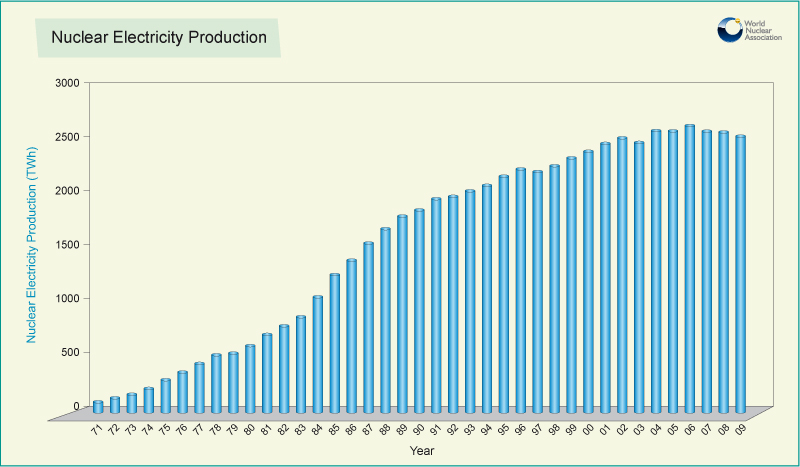
Statistically, coal plants cause about 161 deaths per TWh of power generated. Worldwide, nuclear power generates about 2500 TWh per year. Its average fatality rate has bee 0.04 deaths per TWh. So if all our nuclear plants had never been built, and were coal plants instead, we'd be looking at (161-0.04)*2500 = 402,400 more deaths per year from the additional coal mining and pollution.
In other words, if we analyze safety the way you're proposing, nuclear power saves 400,000 lives each year. -
Re:I'd be open to it, but good luck with everyoneSolandri wrote:
Supposedly some of these spent fuel rods in building #4 caught fire
First off, the fuel pellets in these boiling water reactors are made of uranium dioxide -- a ceramic which has a melting point of 2,865 degrees Celsius and the zircaloy cladding melts somewhere in the range of 1,850 to 1,975 degrees Celsius (depends on which alloy they are using). I could not even find a combustion temperature for either material. That doesn't matter, though, because the temperature of the spent fuel in the pool would be somewhere around 200 degrees Celsius, depending on how long it had been taken out of the reactor.
So it is unreasonable to speculate that the fuel rods have `caught fire`.
Secondly, Tokyo Electric Power Co. said that an oil leak in a cooling water pump at Unit 4 was the cause of the fire the media keeps talking about.
I would strongly suggest anybody interested in following this event watch that web page and/or this one for accurate, knowledgeable, non-scaremongering reporting. I've heard too many news reports totally screw the facts up. (Like when they reported there was a 3rd explosion when really it was the 2nd explosion that happened in the #3 reactor building.)
-
Re:Just terrible news coverageThe following are my news sites of reference:
World Nuclear News This site is fantastic.
Nuclear Energy Institute's site
But I'm a little biased for the last one
-
Re:Considering .....
The most useful reporting I've found so far has been from World Nuclear News' regularly update article, along with the and the NISA press releases/
-
The tsunami, not the quake
The media in Germany give the impression, that the quake provoked the problems. But actually the cooling diesels worked fine until the tsunami hit the plant. That caused the diesels to stop working and hence the failure of the cooling system. But as everybody understands that there can be no tsunamis in Germany the quake must be the culprit, so the public can be scared with the idea of a quake in Germany, too. http://www.world-nuclear-news.org/RS_Venting_at_Fukushima_Daiichi_3_1303111.html
-
Better news source
I found this to be a good source for uncommented information: http://www.world-nuclear-news.org/. I cannot vouch for the veracity of the source, but it does not seem to be very biased.
Unfortunately the nuclear accident seems to have overshadowed reports on the real human tragedy - the tsunami and the earth quake. Especially in Germany, media are instrumentalizing the incident and are plotting doomsday scenarios. The worst of all seems to be "Der Spiegel", which I held in much higher regard until yesterday.
-
Good article at World Nuclear News
For those who want an article with things like numbers and cutaway diagrams of the reactor, please see this article, from World Nuclear News.
-
Re:What's the difference?
-
pharmaceutical schadenfreude
environmental puritans are often opposed to safe and effective means of disposal of nuclear waste
I would tend to parse those comments as demonstrating poor listening skills.
There's a certain kind of person who divides a debate into factions and then argues in terms of the silliest things said on either side. It's usually easy to spot the polarizers in any debate, they tend to lead with labels (e.g. "puritan").
I've discussed environmental issues with a hundred different people, all of whom had different opinions on the subject, and none as silly as the one you quote. I've overheard the kind of silliness you quote in a public hot tub on the other side of town. Disturbed me enough that I no longer visit that pool. I was waiting for their discussion of the environment to segue into Uri Geller, but I lacked the stomach to stick it out to collect on bet with self.
I don't know anyone on the green side of the debate who would concede that "safe and effective storage of nuclear waste" has yet been achieved. Nor do I know anyone on the hard science side of the debate who thinks that "safe storage" of nuclear waste is a slam dunk.
The latest estimate puts the cost of research, construction and operation of the geologic repository over a 150 year period - from when work started in 1983 through to the facility's expected closure and decommissioning in 2133 - at $96.2 billion (in 2007 dollars).
Surprisingly similar time line to Duke Nukem Forever, but with public expense dialed up to 11.
The draft budget removes funding for the planned nuclear-waste storage facility in Nevada, which has been 20 years and more than $9 billion in the making. A Department of Energy spokeswoman told Bloomberg that President Obama and Energy Secretary Steven Chu "have been emphatic that nuclear waste storage at Yucca Mountain is not an option, period."
It's just the crazy puritans who are unconvinced by a $9 billion dollar dry hole? If you kick a straw man in the testicles, does he go "oooff"?
What's pretty clear about safe storage is that we don't yet have an option where the party who advocates the solution is still around to clean up the mess if the whole thing goes south after billions of dollars of mostly public money is spent. That should give any pragmatic person cause to pause and think.
In any debate there will be factions (on both sides) who make a point of pride of their ignorance and who become more invested in the drama of the debate than the merits of the final outcome. It's absolutely true that I wish upon these people that their obstreperousness boomerangs and smacks them in the face. There's nothing profound about it, it's just a way to deal with a disheartening reality while plugging away for something better.
Ebert said much the same thing, if you read between the lines.
http://rogerebert.suntimes.com/apps/pbcs.dll/article?AID=/20070507/COMMENTARY/70507001
"Ill bet you hated to change your mind," I was told. No, I was happy to. It is a hard and frustrating thing to make a movie, and credit must be given where due.
Your ode to pharmaceutical schadenfreude is way overstated.
-
Fears?Hopefully Chernobyl style meltdowns are a thing of the past.
But accidents happen, as occurred this week in Tricastin, France. Burning coal mightn't be greenhouse friendly but don't kid yourself nuclear power is ecologically safe.
Then there's the sensitive issue of selling uranium to countries like Iran.
For some, the risks are too great and would wish others would just leave the stuff in the ground.
-
Nuclear News Articles
I would like to Submit the latest International News Events for discussion:
Russia and USA sign agreement on nuclear energy
President Bush and President Putin have signed an agreement on the development of nuclear energy. They agreed that they "share a common vision of growth in the use of nuclear energy, including in developing countries, to increase the supply of electricity, promote economic growth and development, and reduce reliance on fossil fuels, resulting in decreased pollution and greenhouse gasses."
source
US nuclear power stations near completion of all the additional measures to deal with terrorists.
The US regulator, the NRC, has said that almost all the additional measures taken in response to the threat of terrorists attacks at US nuclear power stations, including additional measures to mitigate the possible effects of a large fire or explosion, including those caused by the deliberate or accidental impact of a large commercial aircraft. Nuclear power stations are already robustly constructed as part of their safety systems but these additional measures should protect them even more.
article source
German Chancellor Merkel decides against reversing nuclear phase out- for now...
Angela Merkel rejected German industry calls to reverse that country's nuclear phase-out policy. However she only said that she did not see the policy being reversed before 2009, when new elections are due. Many members of Merkel's own party would like to reverse the phase-out, but Merkel's party is in a grand coalition with the anti-nuclear Social Democrats. Merkel commited Germany to a 40% reduction in greenhouse gas emissions by 2020, compared to 1990 levels. German power utilities say they need to keep nuclear power stations operating to meet those goals.
click here for the full story -
Nuclear News Articles
I would like to Submit the latest International News Events for discussion:
Russia and USA sign agreement on nuclear energy
President Bush and President Putin have signed an agreement on the development of nuclear energy. They agreed that they "share a common vision of growth in the use of nuclear energy, including in developing countries, to increase the supply of electricity, promote economic growth and development, and reduce reliance on fossil fuels, resulting in decreased pollution and greenhouse gasses."
source
US nuclear power stations near completion of all the additional measures to deal with terrorists.
The US regulator, the NRC, has said that almost all the additional measures taken in response to the threat of terrorists attacks at US nuclear power stations, including additional measures to mitigate the possible effects of a large fire or explosion, including those caused by the deliberate or accidental impact of a large commercial aircraft. Nuclear power stations are already robustly constructed as part of their safety systems but these additional measures should protect them even more.
article source
German Chancellor Merkel decides against reversing nuclear phase out- for now...
Angela Merkel rejected German industry calls to reverse that country's nuclear phase-out policy. However she only said that she did not see the policy being reversed before 2009, when new elections are due. Many members of Merkel's own party would like to reverse the phase-out, but Merkel's party is in a grand coalition with the anti-nuclear Social Democrats. Merkel commited Germany to a 40% reduction in greenhouse gas emissions by 2020, compared to 1990 levels. German power utilities say they need to keep nuclear power stations operating to meet those goals.
click here for the full story -
Nuclear News Articles
I would like to Submit the latest International News Events for discussion:
Russia and USA sign agreement on nuclear energy
President Bush and President Putin have signed an agreement on the development of nuclear energy. They agreed that they "share a common vision of growth in the use of nuclear energy, including in developing countries, to increase the supply of electricity, promote economic growth and development, and reduce reliance on fossil fuels, resulting in decreased pollution and greenhouse gasses."
source
US nuclear power stations near completion of all the additional measures to deal with terrorists.
The US regulator, the NRC, has said that almost all the additional measures taken in response to the threat of terrorists attacks at US nuclear power stations, including additional measures to mitigate the possible effects of a large fire or explosion, including those caused by the deliberate or accidental impact of a large commercial aircraft. Nuclear power stations are already robustly constructed as part of their safety systems but these additional measures should protect them even more.
article source
German Chancellor Merkel decides against reversing nuclear phase out- for now...
Angela Merkel rejected German industry calls to reverse that country's nuclear phase-out policy. However she only said that she did not see the policy being reversed before 2009, when new elections are due. Many members of Merkel's own party would like to reverse the phase-out, but Merkel's party is in a grand coalition with the anti-nuclear Social Democrats. Merkel commited Germany to a 40% reduction in greenhouse gas emissions by 2020, compared to 1990 levels. German power utilities say they need to keep nuclear power stations operating to meet those goals.
click here for the full story