Slashdot Mirror
Domain: worldwar1.com
Stories and comments across the archive that link to worldwar1.com.
Comments · 11
-
Re:This is good.
How do you "hit arable land"? Fold it up and poke it into a black hole? Don't think that you couldn't grow and eat crops around Chernobyl. We are talking about survival, not healthy eating.
How? Instead of concentrating your nuclear arsenal on military targets and big cities where much of the spherical blast is wasted, you disperse them widely across the farmlands and forests of the world, in patterns and with yields designed to maximise rather than minimise the collateral damage and fallout our modern military normally tries so hard to avoid, so that you raze and contaminate as much of the biosphere as possible. If your projections indicate you can also light up a major volcanic ring by triggering fault lines, or even better a super-volcano (google "yellowstone caldera"), go for it. The goal is that by the time the radiation decays to survivable levels, the ecology will be so shot to hell there won't be a food chain worth speaking of, at least not for us.
I remember reading a comment in memoirs of a British WWI soldier. He said the rats in the trenches survived everything the Germans could throw at them, even poison gas. Come to think of it, most of the soldiers survived too.
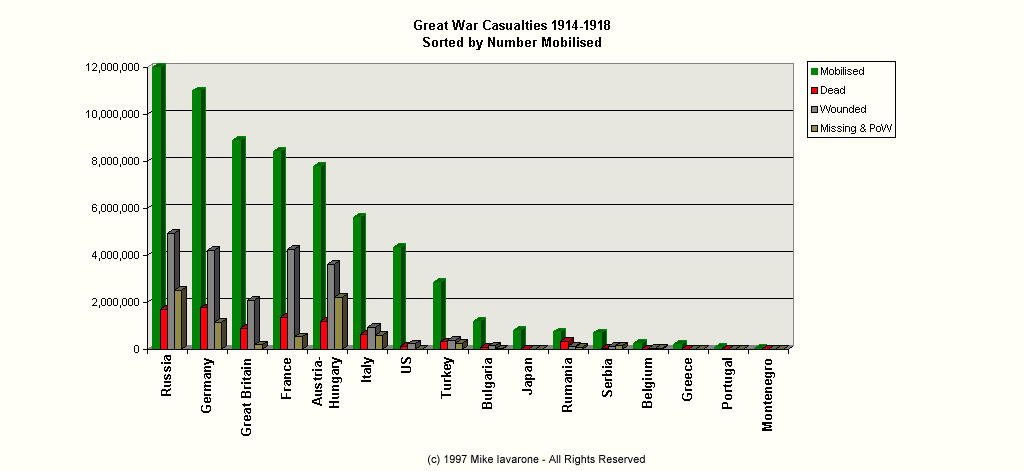
"Most" is... technically true. Rough figures: of the sixty million soldiers mobilised in WW1, eight million were killed and twenty million were wounded (seven million of those maimed for life). So a military casualty rate of almost half. Also eight million civilians died. (source: http://www.worldwar1.com/sfnum.htm). This also isn't counting the twenty to forty million people who died from the 1918 flu pandemic, arguably made far worse by the ravages of the war to economies and infrastructures.
As for the rats - they flourished because they had a lot of food... "Rats were a constant companion in the trenches in their millions they were everywhere, gorging themselves on human remains" -- http://hubpages.com/hub/World_War_1_Trench_Warfare
But if the WWI trench battles had been fought with today's biological, chemical, thermobaric, and nuclear weapons, with nothing held back, I think you'd have a hard time finding anything alive in those trenches bigger than lichen.
Killing people is hard.
Killing people is horribly easy, and getting easier still. Killing everyone is hard only because we're not really trying to do that. Chernobyl was a meltdown, not a premeditated attempt at genocide.
Uh... sorry for the depressing commentary. The good news: we're still alive, and it looks like nuclear power might finally see some decent progress for the benefit of us all.
-
Re:I love this joke
-
Re:I love this joke
-
Re:Uhhh
Legacy formats and protocols die all the time. That's not stupid, that's a fact. Where's the demand for Gopher? Active channels? VRML? The bajillion file formats rendered by plugins during the 90s?
I dunno, but I'd sure love to be able to view the images on this site: http://www.worldwar1.com/fracgal.htm
That developers have to actually spend time on this? Just because you are at the other end of the pipe sending this crap instead of receiving it, it doesn't mean the problem goes away.
Making 10 developers change their browser code is much easier than making 10,000 web developers change theirs.
As a web developer, you have a simpler, more regular markup language to use.
More regular, but not necessarily more usable.
You gain all the advantages of the XML toolchain, so you can use XSLT to transform documents
Why would I want to do that?
embed data from other namespaces
Why would I want to do that?
etc.
Yeah. So I can use XSLT to "transform documents" and I can embed data from other namespaces. And yet you haven't told me one actual benefit to it. You've just spouted buzzwords, can't you see that? Why would I even want to transform a document? Transform it into what, a car?
I don't need new buzzwords, I already have enough of those thank you.
Computers need to have code written for them by people in order to consume it. It takes longer than milliseconds to write that code. Are you deliberately avoiding the point?
No, I just think it's a stupid and invalid argument. I missed the part where I'm supposed to change every web page I've ever maintained to XHTML to make someone else's job easier... why, again, am I doing this?
Right, I get it. The W3C are at fault for not prioritising a need that you admit doesn't exist. Right.
I didn't admit it didn't exist. There's no point to me replying to your untrue statement. -
Hogwash
In 1914 General Joffre, commander of the French forces, refused to use the telephone...
There are numerous references to Joffre using the telephone, such as this one about the Battle of the Marne in 1914:
In contrast to these difficulties, Joffre remained in close contact with his subordinates. An advantage for the French came from their falling back on their lines of communications and their relying on the telephone. While Moltke issued no orders from September 5 to 9 and received no reports from his First and Second Army commanders from September 7 to 9, Joffre maintained contact with his army commanders via telephone (even though he preferred written messages). The French also gained very valuable information from intercepted wireless transmissions.
One can understand that written messages have an advantage over orders issued verbally since they are less likely to be confused when they are relayed or remembered. For a similar reason, email messages today have an advantage over the telephone calls.
-
Misuse of term "Rail Gun"
Real rail guns have names like "Big Bertha", "Julie" or "the Paris Gun".
Physics geeks need to make up a new name for their amped-up jacob's ladders and stop stealing googlespace and wikishare from World War veterans.
Why can't it be a spark gun? A jake gun? A Tesla gun? Oh, that last one's taken. -
Quarter-shrinker, not rail gun!
The famous Sandia Z-machine is more of a quarter shrinker than a rail gun.
Sadly, the evolution of the English language nowadays seems to be directed by bad science fiction and gory video games. Real rail guns were projectile weapons so large they must be transported by rail - they can't be towed or moved with a truck without being disassembled because they are too heavy for roadbeds - and they have names like "Gustav", "Big Bertha" and "Schlanke Emma".
If the Z-machine was a gun (which it's not) it oughta be called a capacitive discharge cannon, not a rail gun. But I guess that's too hard to spell for kids today?
Those who ignore history are apparently in charge of revising the english language. Wikipedia and dictionary.com both use the "new" definition of railgun (although at least wiki has the grace to mention real railguns in passing).
Future historians are going to hate us for this one. -
Re:Too Bad Commercial Airship Development Has Stal
Don't forget about this
-
airships
The goodyear blimp is only a flying billboard, whereas the hindenberg was more like an ocean liner.
They were called airships because they were originally intended to do everything a ship could do, only from the air. The germans used airships to attack britain in the first world war and there were plans for airborne freight for go-anywhere delivery of parcels at a fraction of the cost of other courier systems.
I suppose that if engineers really wanted to work at it and spend a lot of money, we might have nuclear powered, hydrogen lofted aircraft carrier blimps defending america today - stealth airbases that could suddenly appear deep behind enemy lines and move around at will.
alternatively you could have a solar powered blimp-yacht for recreation: solar cells on the top of the air bag generate electricty, a scoop on the front collects h2o. electricity splits the h2o into hydrogen for loft and propulsion and oxygen. Fuel cells turn the hydrogen back into electricity on demand and drive the electric motors connected to the propellers. -
Solstice, Christians, Pagans, and good music
A couple of years ago I ran across this song by Dar Williams called "Christians and Pagans". It's hilarious (+1) and insightful (+1), and it's been my favorite "Christmas" song ever since (except, perhaps, for John McCutcheon's "Christmas in the Trenches").
So back in 1998 my brother and I started to throw "solstice" parties. We looked into various holiday and solstice traditions around the world. No real attempts at sorcery, bachannals, or blood, which I suppose some might expect. We wassail an apple tree, we make radish and butter carvings, we light and extinguish and light candles and talk about what we've done the last year and what we hope to do again. We have the "Urn of Fate" assign friends for the year. We sing "here comes the sun" and "christians and pagans". I'm sure any serious pagan would laugh at us, but it's our little chance to do things a little bit differently, remember there's other cultures and traditions in the world, and perhaps find magic/life/spirit in an unexpected place or two.
I'm still a reasonably solid Christian. OK, I occasionally go for bouts of rational agnosticism, but for the most part, I've found that Christianity as a spiritual practice seems to have something to it. So still I'm a little uncomfortable singing that line from Dar's song "sending hope for peace on earth to all their Gods and Goddesses". But I like this new tradition of looking at other traditions and fashioning new ones from it, and we're going to keep it up, as well as gathering on Christmas day and reading Luke 2 (stopping before we have to explain circumcision to the kids -
Pretty obvious...This is pretty durn obvious. No fighting force has ever been defeated by any "wonder weapon". (Japan in WW2, you ask? Look at the campaigns that led up to the bombing of Hiroshima & Nagasaki.) If a group or nation has the will to fight, nothing except troops on the mud will defeat them.
One historical example come to mind: WW1: In what was probably the greatest demonstration of skill-at-arms ever, Sgt. Alvin York, US Army, captured an entire German machinegun battalion. He did this alone, armed with a five-shot rifle and a seven-shot pistol.
At the time, the machinegun was the "ultimate weapon". It commanded the terrain for 500 yards, killing all in its path. The machinegun was the primary reason that WW1 was reduced to "trench warfare"--everyone was scared of 'em!
Today's "wonder weapons" are no different. A smart bomb still isn't smart enough to kill one rifleman. And it's the still the rifleman that carries the day.