Slashdot Mirror
Search
Search the archive with full-text matching across story titles, bodies,
and comments. Phrases are quoted; or, -word,
and parentheses behave as in a web search. Queries must be at least
3 characters.
Stories · 200
-
Water Basketball Robot
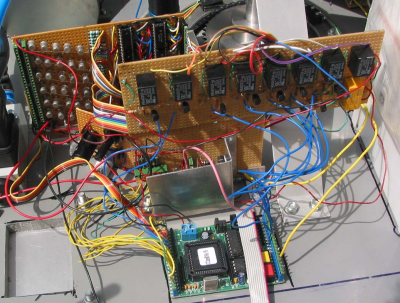
tisaak writes "Second-year Mechanical Engineering students of the ETH Zurich are required to participate in the so-called "Innovation Project". A subject is assigned each year and 12 teams battle it out to develop a complete product. This year's subject was "Sport and rehabilitation" and "Cleaning". One of the teams managed to build a floating, ball-throwing kind of robot. I think the whole idea is funny and the fact that it has a lot of cables and a processor in it should appeal to the Slashdot public :-) The electronics platform used is called C-Control and is used to control the sensors, the motor and the LCD-Display. The implementation of the game program is nice, considering it is written in a subset of BASIC."
-
Open 3D-Graphics Spec For Devices Nears Release
An anonymous reader writes "LinuxDevices.com reports that version 1.0 of the Khronos Group's OpenGL ES (embedded subset) graphics API spec for embedded devices is now ready for final review and ratification by Khronos Group members, a process which should lead to its public release in July 2003. OpenGL ES is described as a light-weight, royalty-free embedded graphics standard that provides 3D-capable graphics API profiles for a broad range of embedded systems and devices, including handheld wireless devices, automotive and avionics displays, and multimedia consumer devices such as advanced digital TVs, set-top boxes, and game consoles."
-
Mirror Listings Though TXT DNS Records?
mackman asks: "I was wondering if anyone has ever though about using their DNS servers to provide mirror information? A specially formated TXT-record could easily provide a DNS-cache-friendly mirror listing. A TXT-record would just need a list of servers and paths, or perhaps a more complicated mapping for servers which only mirror a subset of the original site. This would allow for much more flexibility than a basic round-robin A-record scheme. For example, instead of pounding the Red Hat web server to get a mirror listing (or relying on Slashdot posts for that matter), why not do a 'dig -t txt mirrors.redhat.com'? Of course we could build this into download managers like wget."
-
Scripting Language City
Ursus Maximus writes "Scripting Language City is for folks who want to learn more about the future of this increasingly important subset of the programming universe. Scripting languages are not just for odd jobs anymore ;-))). Special attention is paid to four languages in Python City, Ruby City, Perl City, and JavaScript Expert Systems which includes a Scripting Language Chooser Program as well as a Basketball Expert Ssystem and a Football Expert System that are certainly something different from the usual same old mouse-over scripts usually found on JavaScript sites. There is also a web spider program that scrapes the web daily and provides updated lists of new web articles on scripting languages, with seperates outputs for each of the featured languages. as added bonuses, there is a page of essays and resources on open source and the free software movement called Farnham's Freehold and a page called The Linux Chronicles that follows the experiences of a Linux newbie with wit and humor. Not a slick professional web site, Scripting Language City is a work of love by a paramour of everything connected with scripting languages, open source, and the programming of free software."
-
Web Page Entanglement
jason writes "tangle is a system for what we call "web page entanglement". tangle creates links between pages automatically based on how users move from one page to another. tangle proxies connect together in a peer-to-peer network for scalability: as users surf the entangled web, they are passed from proxy to proxy. Each proxy serves as an expert for a particular subset of web pages. For example, you can take a look at the entangled version of the GNU homepage as seen through a tangle proxy. tangle alpha2, the first public version, has just been released. See http://tangle.sourceforge.net for more information, or read on..."
jason continues:
"By viewing the web through a tangle proxy, you can see the connections and associations left by those who surfed the web before you. By surfing the web using tangle, you also leave behind connections and associations for others who will surf in the future.
When you exit one page and enter another (by clicking a link or performing a search), a two-way link is created between the pages. As users surf through a particular page over time, tangle keeps track of popular ways to get to the page and popular places to go next. These entry and exit links are displayed at the top of each page, sorted by popularity.
Clicking on one of these entry/exit links tells tangle that you think the link is relevant and useful (like a vote for the link) and increases the link's popularity. In other words, if a user thinks of something relevant while reading a page and performs a search for it from that page, tangle gauges how others react to that association over time.
tangle is similar in some ways to the closed-loop hypertext system Everything2, though tangle works for the web at large.
We have several tangle proxies up and running. The tangle proxy software is also available for download.
A note for the paranoid:
Though tangle keeps track of web usage patterns, the focus is not on tracking the habits of individual users, but on tracking the trends of an entire community of users. tangle is GPL'd open source [source here], so you can see for yourself: clicking a link through a tangle proxy simply bumps up the links popularity---user IP addresses are completely ignored." -
Shared Address Books for Mac OS X?
sg3000 writes "A friend asked me a question about setting up shared address books with Mac OS X, but I have no idea how to solve this. He wants to set up an address book that can be accessed by different user accounts on the same Mac or by different Macs in the same household. This would be useful for having a single place to put contact info for family and friends. His first thought was to move the Entourage user folder to the Shared folder in Mac OS X and just move aliases of that folder to each of the users' folders. This way when they open Entourage they would see the same address book and both can make changes to it. The downside? Well, you're stuck with Entourage, it will work only on a single machine, everything is shared between the users (all contacts not just a subset, calendar, email, to-do list, etc) and it won't work with other mail clients. I know with the new Mac OS X 10.2, you can share calendars between people using iCal. Is there some way to do this with the new address book for Jaguar too? Since 10.2 is basically shipping now, you can throw NDAs and caution to the winds!"
"My solution was to set up a FileMaker Pro database and put the file in the Shared folder. The downside is you couldn't do a simple lookup from the email compose window like you can with the integrated address book.
So finally I thought, what if you set up an LDAP server running on one Mac in the house, and then just set up your email clients to access those. Easy, except other than what I just described I know nothing about LDAP.
LDAP looks like it's a lot more than the shared email list that you see in a mail client. And I couldn't find an LDAP server for Mac OS X. It looks like OS X Server has something but that's overkill; we're talking about sharing addresses among five people, tops. Mac OS X has something called Directory Setup that looked kind of right, but Google returned no info on how to do this." -
MS Palladium Patent
Concerned Citizen writes "cryptome has Microsoft's patent for Palladium. Including such gems as: 2. The computerized method of claim 1, wherein protecting the rights-managed data comprises: refusing to load the untrusted program into memory. 14. The computerized method of claim 1, further comprising: restricting a user to a subset of available functions for manipulating the rights-managed data. And I'm sure we'll all be coerced to agree to Palliadium during a future security patch agreement."
-
Visualising Code Structure in Large Projects?
TheMaccLads asks: "I've recently joined a new C++ project, and it's in a terrible state. There are 100-odd source directories, dozens of libraries, and a couple of dozen executables and DLLs. Some executables pull in (i.e. compile themselves) the occasional source file from a library, instead of using the libraries. My job is to port a subset to unix, but I need a tool to visualise all the relationships between directories, projects, libraries, and so on, because my brain will overheat soon otherwise. Preferably a tool that will do it by parsing the MS Dev studio projects and workspaces, but if I have to write it myself in Perl, I will! Anyone know of any tools? Or suggest an approach?"
-
Borking Outlook Express
Johannes writes: "Swedish Gnuheter has a story on Nick Moffitt arranging with his X-headers in way that makes it impossible to read his email with Microsoft WebTV or Outlook Express. Moffitt states: 'The folks using Outlook Express have locked themselves into a limited subset of the information that can flow over the Internet, and are blaming me personally for not limiting my transmissions to that outlook-centric subset.' See also original email (in English). Immoral? Or just right?" Looks like Moffit's "Who, me?" attitude is tongue in cheek, but the creative header changes here are hilarious.
-
Large Scale, Professional, Mail Merge Apps?
xtermz asks: "I recently began working for a mid-large scale print house. We do everything from printing of sales fliers to invoices for some fortune 500 companies. For doing these invoices, we use something called JetLetter which is basically a mail merge program on crack. It lets your create a template, pull from a database and send a PCL stream to your desired printer type. The problem with this program is that it is designed only to pull from flat text files, or antiquated .dbf files. It can't support SQL Server, XML, or anything made after say...1992 (even though they have a 'JetLetter 2000' version, which is basically the same DOS based app with a 'Windows' interface). If you try doing a search for 'mail merge', your likely to get back a couple thousand hits for MS Word. Talking to my co-workers, JetLetter seems to be the only solution which suits our needs." Many people seem to think that to do "mail-merges" you need a word-processor. Not so. A mail-merge is simply applying a subset of data over a text template. Looking at the problem this way, can any of you offer suggestions to a solution that xtermz might be able to use to replace (or supplement) JetLetter?
-
Compatibility Issues Across Linux Distributions?
CarrotLord asks: "Looking at the recent release of IBM's Small Business Suite for Linux got me wondering about distribution compatibility and standards. Personally, I run Debian, and am considering a move to Progeny. However, I am concerned by the fact that many products (particularly commercial ones) are available for only a particular subset of distributions (usually RedHat, Mandrake, SuSE, TurboLinux and Caldera, but rarely Debian-based distributions or the BSDs). What is the current state of play, particularly in regards to tools for developers to enable them to create and test installation packages for various distributions?" Such a tool would go a long way in removing the force behind the "Linux fragmentation" argument that most of Linux's detractors often refer to.
"How are the LSB and the FSSTND affecting consistency between distros? What about RPM and APT? What tools are there available for developers of software to ensure that their software runs on the widest variety of systems? Is there some software development or packaging tool to assist developers in making distribution-independant software, so they can create files in dpkg, RPM and tgz formats for any distribution without much additional effort on their part? What about tools to test their software installation on individual distributions, and assist with the resolution of problems? Should this be up to the individual distributions, or should be have a unified approach?"
-
Germany OK's Human Gene Patents
Masem writes "According to the Oct 26, 2000 issue of Nature, Germany has allowed the patenting of human genes, or parts thereof. There is currently an initiative thoughout the EU to push similar regulation through all other member countries, but many have been slow to adopt it (shades of UCITA). Many are protesting these decisions, which they argue continues to undercut privacy and the value of a human being for commercial purposes. The Netherlands are suing the EU for even having this initiative. Particularly at issue is that subsets of the gene structures can be patented, which could lead to a number of trivial but valid patents. Germany officials say they will try to limit such subset patents to those that perform the useful function they are supposed to."
-
Alternatives To deja.com's Usenet Archives?
wtfcca asks: "deja.com decided to revamp again. What are the chances it will drop its Usenet archive/search section in the future? Are there alternatives to Deja.com for searching/archiving Usenet? What would it take to set up a Usenet archive/searching site? Besides the obvious hardware requirements, anybody know if deja.com's Usenet searching software is available? I'd consider donating time/equipment to archive a subset of Usenet if so (since I happen to like Deja's power user interface). Some time ago Deja News said it would acquire old article archives, dating back to the mid-80s or some such. Did that ever happen? Every once in a while I see an old articles, but not consistently to lead me to believe that it did."
-
Overclocking is a Counterculture
dayeight sent us an article at ZD Australia which talks about overclocking as a counter-culture. There are of course so many subsets of the generic (and overused) 'Geek' term, but this is definitely one of the cool ones. It's also an easy one for the mainstream world to understand since they are already quite familiar with the automotive gearhead culture that has existed for decades.
-
AM Frequency Hinders ADSL Capacity
hajmola writes "a recent study has shown that AM radio may be causing problems for ADSL. According to this story at Network World, interference from AM stations can slash high-speed bandwidth by 40% on approximately 15% of ADSL connections. While AM interferes with download speeds, it does not affect upload speeds. AM frequency only affects ADSL and its subsets (not SDSL), including rate adaptive DSL and G.lite. "
-
The Do-It-All Remote?
MisterFig asks: "I, like many of you, have too many remote controls to know what to do with. One for the TV, the VCR, the Receiver, the CD player, the Cable box... you get the drift. I don't mind using them all, but is there an easier way? Sure, there are so called "Universal" remotes. But I find these often provide a very limited set of functionality for usually only a subset of my devices. Each remote has it's own special buttons and features that a Universal remote doesn't know about. So I am stuck keeping all the remotes out. Can one remote do it all? I recently came across an add for the Harman Kardon "Take Control". This is a cool remote control that is software programmable, looks really easy to use and supposedly can be programmed to do everything each of your current remotes do. Could it be? A single remote control that can control everything? It's laid out in such a way that you have activities, like "watch tv", "play a cd" or "watch a video". Clicking on the activity will setup the entertainment center to a predefined state of your choosing. This sounds too good to be true! However, it's about $300. Is it worth it? Has anyone used one of these? Are there any other remotes out there that can control everything? Including all the special buttons/features that each of the individual remotes have? " Can it be? An All-In-One remote that claims it actually WORKS?
-
QuakeII Coming to BeOS
Adrian Ziemkowski from Benews.com wrote in to plug a story that the Be/Quaker subset of you will enjoy: QuakeII on BeOS. Screen shots and other comments. Glide accelerated on Voodoo2 cards. Free upgrade for current Q2 owners.
-
Linus reshapes Transmeta
More Transmeta information has allegedly been leaked. Linus is said to have changed Transmeta from a x86 company to a NT 5.0 compatible company -- which could mean anything from pure RISC to a subset of the x86 instruction set. Ed: Given that this report is the only one I've seen to this effect, I'd assign it a rather low certainty.
-
HP To Make Custom Java
Chris Short writes "In a move that creates a rift among a industry coalition against MS, HP has announced that it is releasing it own JAVA Virtual Machine. This VM will be a subset of JAVA and will, along with MS, break JAVA's "write once, run anywhere" promise. HP insists that it still supports Sun's JAVA, but has created this subset for commercial appliances. Among the companies that have already licensed the HP VM is Microsoft for Windows CE. For articles on this look at news.com or the Wall Street Journal."
-
PostgreSQL 6.3 Released
Eugenio Sanchez wrote in to say "PostgreSQL 6.3 has been released. It includes lots of enhancements and fixes, included the much sought capability of performing subselects, and a greater subset of SQL '92. The PostgreSQL homepage is at The PostgreSQL Home Page." I know the SQL database war is a hot one with everyone, but a new version ups the stakes for everyone. I need to build an SQL server that can house millions of records and get them fast. Each SQL Server that releases a new version makes that more of an inexpensive reality.